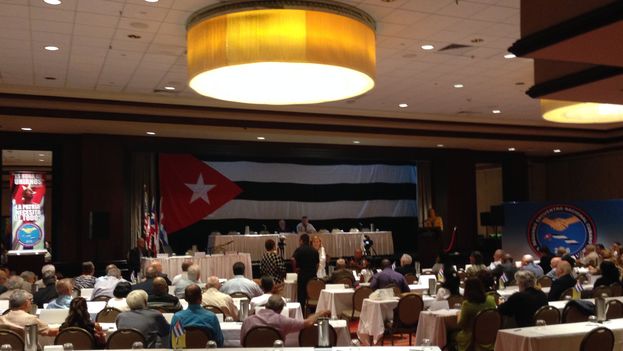
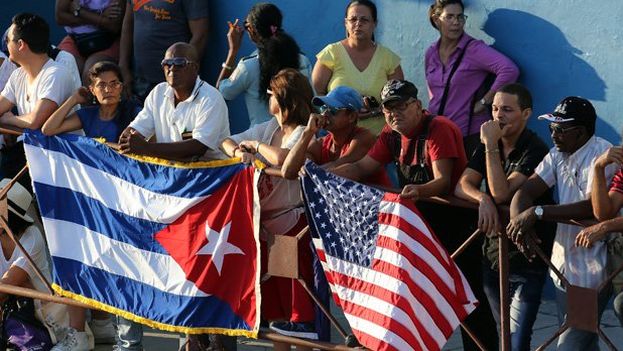
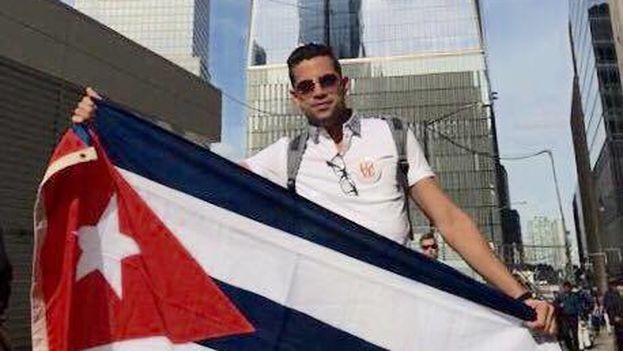
#YoNoSoyExCubano: Milkos Danilo Sosa Molina, a young Cuban resident in Miami responds to Randy Alonso. (Courtesy)
14ymedio, Mario Penton, Miami, 19 August 2016 — A recent comment by official journalist Randy Alonso has generated a number of protests on social networks.
The well-known Cuban TV host questioned the nationality of the Cuban athlete Orlando Ortega, who won silver medal competing for Spain at the Olympic Games in Rio de Janeiro.
On the Roundtable program, which he moderates on Cuban State TV, Alonso dedicated a segment to Cuba’s performance in the Olympic Games in Rio de Janeiro and spoke about the “controversial elements” in that sporting event, mentioning the case of “the ex-Cuban Orlando Ortega who is going to compete for Spain, and other cases of athletes who have jumped from one country to another.” The journalist placed his speech in the context of a supposed controversy “that today animates the international sports scene, tempered by the growing influence of money.” continue reading
In conversation with14ymedio, Milkos Danilo Sosa Molina, a young Cuban who lives in Miami, said he was “outraged” by the moderator’s words. “Nobody has the right to deny the nationality of a single person because they do not want to live in their own country,” he said.
Molina calls on young Cubans abroad to use the hashtag #YoNoSoyExcubano (I Am Not Ex-Cuban) in response to what her considers Randy Alonso’s “unacceptable attitude.”
“They consider us to be Cubans for some things and not for others. They want Cubans to be only those who think like them and live in Cuba, but the odd thing is that to enter your country they consider you a Cuban and demand that you use a national passport. In this way they get hundreds of dollars out of you,” he comments.
Other social network users on Facebook, such as Norges Rodriguez, following the logic of Randy Alonso, have questioned the nationality of Henry Reeve and Maximo Gomez for having left their country and fought with foreign armies for the freedom of other countries. Fernando Alvarez wrote #YoNoSoyExCubano, I was born in Cuba, I am and will be 100% Cuban wherever I am!”
The Roundtable is a television program that began in December 1999 amid the Cuban government’s campaign for the repatriation of Elian Gonzalez. It airs Monday through Friday and was a favorite of Cuban president Fidel Castro, who regularly spoke for hours on the program.
This newspaper tried to access the program mentioned in the official website of the Roundtable, but it has been removed from the YouTube platform in the United States at the request of the International Olympic Committee for violating copyright. Cuban television commonly uses audiovisual content belonging to third parties without paying for the services.
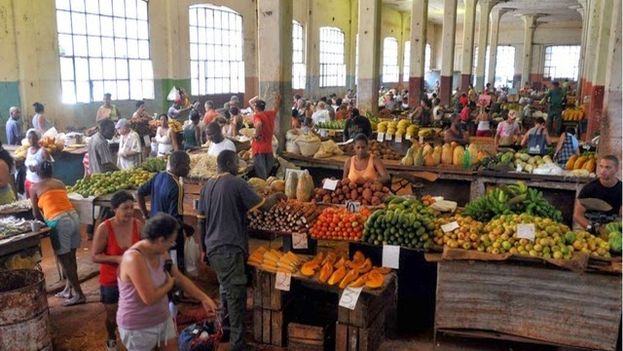
About 10 million people eat the same thing at the same time in Cuba, the few products available in the market. (EFE)
14ymedio, Dominique Deloy, Havana, 18 August 2016 – My situation is like that of the majority of mixed couples where one of the two had the good fortune to be born in a democratic country – indeed, a country with a free press and a multi-party political system, where a person can express an opinion without fear of being denounced by their neighbors or reprimanded by the police. It is useful to remember this in these difficult times, with a certain tendency, on the other side of the Atlantic, to forget or deny the achievements and advantages of democracy even though, of course, it is far from perfect and is always an ideal to that is being striven for.
In these cases, sometimes, the Cuban man or woman, who remains deeply attached to their island, convinced their partner to initiate the “repatriation,” full of hopes for change after the famous handshake with the former enemy and potential invader. continue reading
Then comes the tricky part of the papers to formalize the return. “Give me your PRE (Foreign Residence Permit) and I will give you back your permanent residence,” says the official to the Cuban citizen. As for the one with foreign nationality, they can “arrange” their stay in Cuba but only after a great deal of paperwork and a good-sized handful of bills.
As the saying goes, “Who has a husband has a country.” So, here we are, although not without a certain trepidation. How can we adapt, find professional work, rebuild ties with friends lost after two decades of living in France? Also, you have to resume old habits: standing in line for hours under the burning sun (“Who’s last?” we ask, on joining the line, to mark our place in it), eating the same thing and at the same time as 10 million other people (right now in the markets there are: cabbages, beans and avocados) and, for me, being addressed on every corner in English (“mafrende” as a Cuban version of “my friend”) because of my skin, too pale, and my clothes, undoubtedly too Parisian.
In addition, you have to climb eight flights of stairs to get home most days because the elevator isn’t working and, worst of all, swallow your words, think less and keep your mouth shut. How to take pleasure in this island when it has already passed, too long ago, that state of rapture caused by fine sand beaches, salsa and old American cars? When did Cuba stop being a postcard? Suddenly, when my friends ask me why I made such an absurd choice, I can only tell them, “Love, of course, love!” But I feel, without admitting it, that a certain consternation is growing in me and I ask myself: Why did I have to get myself into such a mess?
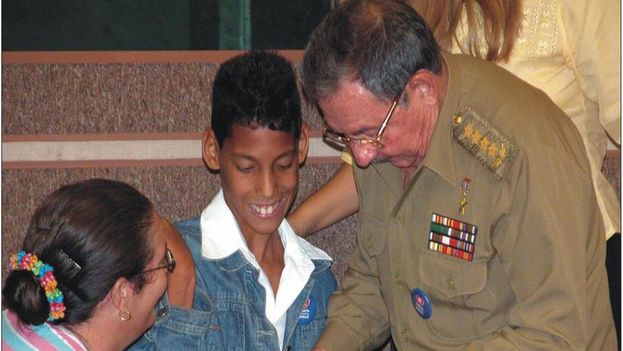
Jorgito debuted in his public life on the occasion of the Fourth Pioneers Congress, when he caught the attention of Raul Castro
14ymedio, Ignacio de la Paz, Camagüey, 19 August 2016 — The Revolution needs to constantly reinvent new ideological struggles, constructing new heroes that meet the demands of the so-called ideological work with the masses. Thus, after the stage of the founding epic there was the release in 1988 of Orlando Cardoso Villavicencio, who had been held for nearly 12 years by Eritrean rebels, later there was the ideological battle for the return of Elian Gonzalez and finally, the struggle began for the return of the Five Heroes imprisoned by the “empire.” The saga of revolutionary heroes could not be finalized once and for all, and now a new one is being constructed, Jorge Enrique Jerez Belisario, otherwise known as Jorgito the Disabled.
At his birth in the Provincial Maternity Hospital of Camagüey on March 8, 1993, in the toughest year of the Special Period, Jorgito suffered physiological jaundice complicated by symptoms of a generalized infection by the bacterium Klebsiella and was finally diagnosed with Infantile Cerebral Palsy. This information is public, taken from Ecured, Cuba’s official on-line encyclopedia. However, we Camagüeyanos who knew the Ana Betancourt Maternal Hospital in those years knew that it was a time of every man for himself, and suspect there could have been poor medical practices caused by the lack of hospital resources. continue reading
Jorgito’s parents, professor of Marxism Maria Julia Belisario and then prosecutor Jorge Jerez, moved heaven and earth to raise their son, receiving every possible support. The mother stopped working, receiving full pay, to care for the child at home, and Julio Diaz Hospital in Havana took care of his rehabilitation for four years. When Jorgito needed a computer to write because of fine motor skills problems, he was assigned one. He was prescribed botulinum toxin, dispensed free of charge although the cost for the medication according to Jorgito himself is $400. In addition he received specialized classes targeted to his disability with teachers to see to his needs.
Jorgito displayed a strong will and perseverance, partially rehabilitating himself, and soon expressed his revolutionary political vocation. In 2006, Jorgito debuted in his public life on the occasion of the Fourth Pioneers Congress, where he attended as a delegate and made an emotional speech of thanks, drawing the attention of Raul Castro who presided over the event due to Fidel’s illness. Thereafter, began the ascendance of the rising star of the new Cuban ideological hero. Later on he joined the campaign for the return of the five “prisoners of the empire,” developing personal friendships with them and their families. This produced an umbrella effect, with Jorgito being associated from that moment with “The Five.”
The young man studied journalist and discussed his thesis on the case of the Five Heroes in the presence of Gerardo Hernandez, one of the released prisoners, and his wife. His blog, JorgitoXCuba, achieved national popularity with the premiere of a documentary based on his life on the Roundtable TV program, entitled The Power of the Weak, by German director Tobias Kriele. Thus, Jorgito became a roving ambassador of the Cuban Revolution, traveling through many countries in the Americas and Europe.
He was at the 18th World Festival of Youth and Students in Ecuador, at the Summit of the Americas in Panama, at the 2nd Day Against the Blockade in the United States, and toured 13 German cities and now Switzerland and other European countries on the old continent.
Jorgito is enjoying his honeymoon with the Cuban government. He has free Internet in his lovely apartment, receives special work permits and constantly travels abroad with his family, receiving gifts. He does not suffer the miseries of ordinary Cubans, much less those of many disabled who do not have the same luck and do not receive any attention or help.
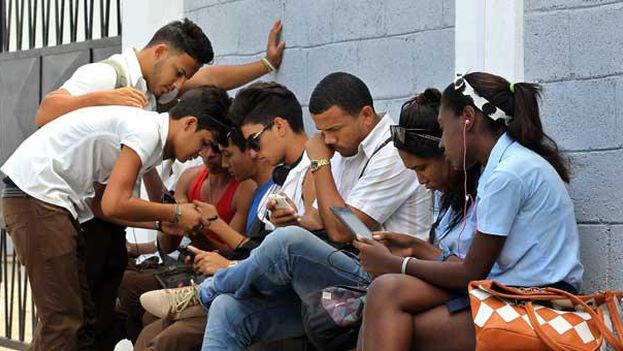
A group of young people connect to the internet in a wifi hotspot in Havana. (EFE)
14ymedio, Havana, 18 August 2016 — The Cuban Telecommunications Company SA (ETECSA) said Thursday that “internet access from navigation rooms and wifi hotspots was restored in 17 August, along with access to ENET.” The disruption led to a flood of complaints from customers of the telephone monopoly.
Etecsa apologized for the inconvenience caused by service failures, problems that have become common in recent months. In mid-July, the company announced problems with Nauta e-mail access from cellphones due to maintenance work.
In November 2015 users were unable to send or receive e-mails for six days, a problem that was repeated a month later and resolved after a delay of more than 24 hours.
The wireless network known as WIFI_ETECSA began operations on 1 July 2015, and now counts more than 80 navigation hotspots in the country. Each day about 200,000 people use this infrastructure to access the vast World Wide Web.
Guidelines of the Sixth Congress of the Communist Party. (14ymedio)
14ymedio, Reinaldo Escobar, Havana, 18 August 2016 — The tabloid with the updates of the Sixth Congress of the Cuban Communist Party Guidelines, is distributed lately without fanfare. The few copies on sale in the newsstands and the majority of people’s lack of interest in official documents, suggest that very soon they will be forgotten. However, to not analyze or question them would be another form of meekly accepting their principles.
From the opposition sector voices are heard describing these new party directives as “tricks and traps from a caste that maintains itself in power.” The foreign press, for its part, has been quick to draw conclusions after a sidelong glance at them, but few have plunged into othe274 points plagued with grandiloquent propositions, commitments that seem to be dreams, and a syntax that is difficult to understand. continue reading
A question as basic as whether the stage between 2016 and 2021 will be characterized by an economy that leans toward the market or toward centralized planning can only be answered after determining what is missing and what is included, and weighing the nuances of the new wording that has been introduced in each concept.
After reconstructing the loose pieces, it is clear that the State will maintain majority control over production and services. The only positive innovation introduced in this edition is the appearance of “second degree cooperatives,” the characteristics of which are not explained, but which seem like the boldest step the Party is willing to take.
Some presences are easier to detect looking at the 16 pages of the brochure, such as the inclusion of the word “wealth” in the third point in the chapter on the economy. Not content with having determined at the 6th Congress to prohibit “the concentration of ownership” for non-state forms of production, the new version from the 7th Congress adds that neither will the concentration of wealth be accepted.
In a country where no one has ever made a formal declaration of their possessions there is no way to calculate what each person has, either in goods or in cash. The absence of regulatory mechanisms with regards to the possession of wealth, especially among natural persons, makes the control of assets a real mission impossible.
Such an alarming addition is nothing more than a potential threat, and even a formula of commitment to satisfy those most concerned about the growing inequality which has worsened in the country over the last two decades. Perhaps it is a crumb to please the hardliners within the Party, a wink and a nod to the old guard.
The disappearance of some guidelines, the rewording of others and the inclusion of new ones, makes it difficult to research which of the guidelines are in the 21% the authorities claim to have met, and which are in the 79% that are “in the implementation phase.” As if reshuffling the dominoes makes the readers unable to detect which tiles are missing.
As the artist Arturo Cuenca said one say, “the takes can be more important than the puts,” especially when the points that are missing or reduced in some of their essential aspects, don’t appear on the list of things accomplished, but in the sub-paragraphs of the problems, of those objectives that have been set aside.”
The first guideline to disappear is number 4 which mentions the idea that structural, functional, organizational and economic changes will be made “informing workers and listening to their opinions.”
Another striking and highly provocative example is the evaporation of an objective reflected in Guideline 57 of the chapter on fiscal policy, which in 2011 proposed to establish “higher taxes for higher incomes, to contribute, also in this way, to mitigating inequalities among citizens.”
Has the Cuban Communist Party (PCC) met this objective with the taxes imposed by the Office of Tax Administration (ONAT) or has it just abandoned tempering inequalities through the treasury?
The text is not without its absurdities, like the commitment outline in the change on economic integration of “giving priority to the participation of the Bolivarian Alliance for the People’s of Our America (ALBA),” a regional organization that has lost prominence since the death of Hugo Chavez and seems doomed to an early demise.
A new chapter entitled Demographic Dynamics is reduced to the issue of the aging of the population and efforts to stimulate fertility, but omits the most serious problem facing the country today: the uncontrolled emigration that robs it of its human capital.
In other parts of the document, the inclusion of a concept reveals the pressures of certain sectors, such as the demand to “comply with medical ethics” in the chapter regarding healthcare, or the unexpected appearance in the section on culture of a point for the implementation of “the policy regarding the transformation of Cuban cinema.” A clear response to the demands of the numerous artists who joined together in the so-called G-20 group that is demanding a new Film Law.
When we contrast the wording of the 6th Congress guidelines with those now updated, details such as “attention to cruise ships” jump out. Along with more subtle references like changing the proposal to delete the ration book by “the orderly and gradual elimination of products in the ration book,” a way of making the subsidized market languish, instead of eradicating it all of a sudden.
The warning regarding “progressively decreasing the levels of subsidies” runs through a good part of the document like a thin strand of steel, like that emphasized in point 58 focused on achieving the principle of “subsiding people and not products.”
The update of the Party Guidelines is far from meeting the expectations of those who want to see in its pages a clear path to the dismantling of the centralized economy and the freeing up of the productive forces in Cuba. But also to distance itself from the paternalistic tone that once characterized the five-year plans on the island.
One step forward and two steps back? Or simply a Party that seems to be running in place
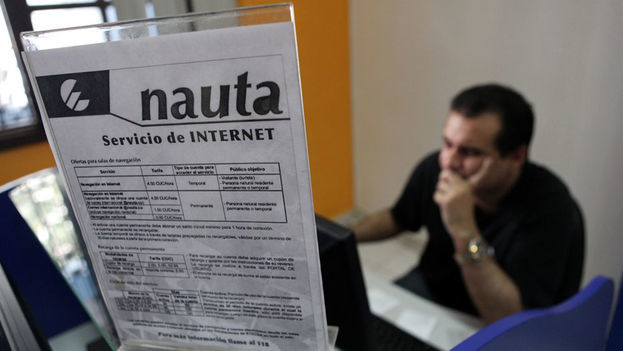
Nauta internet service continues among the worst in the state communications monopoly. (EFE)
14ymedio, Havana, 17 August 2016 – Connecting to the internet from state WiFi rooms and hotspots, became more complicated this morning after the interruption suffered by the web browsing service provided by the Telecommunications Company of Cuba (ETECSA). The interruption has left a trail of frustrated users and thousands of calls of complaints against state monopoly.
The service outage is also being felt in navigation rooms with the company’s own terminals, as confirmed by this newspaper through a phone call to the 118 repair number and a tour of several of the internet rooms in the Cuban capital. According to an employee, the company is undertaking “upgrading work on the network to improve service,” but she was unable to say when the service would be restored. continue reading
In a note posted by ETECSA on its Facebook page, the company reported that is “had been necessary to stop the service” because “since the early morning hours” there had been “failures in the equipment that supports internet access.”
The company explained that “specialists are working on solving the problem,” and that users “will be informed in a timely manner about the reestablishment of service.”
The note, signed by ETECSA’s Communications Board, offered apologies to the company’s clients “for the inconvenience this disruption may cause.”
Problems access the internet from WiFi hotspots and navigation rooms add to those of a difficult week in the functioning of email service on mobile phones. As of last Monday, users of this service complained about congestion blocking access to their mailboxes, which increases the difficulties of downloading and sending messages.
Previously, ETECSA has announced failures in the Nauta service for cellphones cell in the early hours of July 14 because of maintenance work.
The cut in the e-mail service is one more event added to what happened in of last year, when customers were unable to send or receive e-mails for six days. In January of this year the problem was repeated for more than 24 hours.
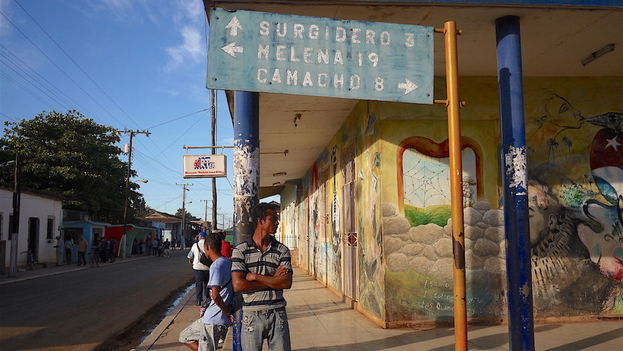
Surgidero de Batabanó is a fishing port with a little more than 5,000 inhabitants. (14ymedio)
14ymedio, Havana, 18 August 2016 – The Surgidero de Batabanó, a fishing port with a little over 5,000 inhabitants, seems a place forgotten by modernity and development. However, among its humble homes and deteriorating streets lies one of the main centers of the illegal lobster trade that supplies Havana.
With an abundance of shellfish on the seabed, the economy of this coastal area, belonging to the province of Mayabeque, centers around the Industrial Fish Company and the Seafood Factory, but also the illegal capture of the queen of Cuban tables, the demand for which has grown with the increase in tourism and the expansion of private restaurants. continue reading
While glamorous dining locales have given rise in recent years to a lobster dish that never costs less than 15 Cuban convertible pesos, in Surgidero de Batabanó it is a common food on the tables of the poorest inhabitants. Most of their streets may be unpaved and at night the town is boring and dark, but the sea guards the greatest wealth all the residents there possess.
From their humble houses, hidden in suitcases under clothing, camouflaged with ingenious covers and pursued by the police who control the roads, travel the lobster tails that end up on the menu of the finest Havana paladares, the capital city’s private restaurants.
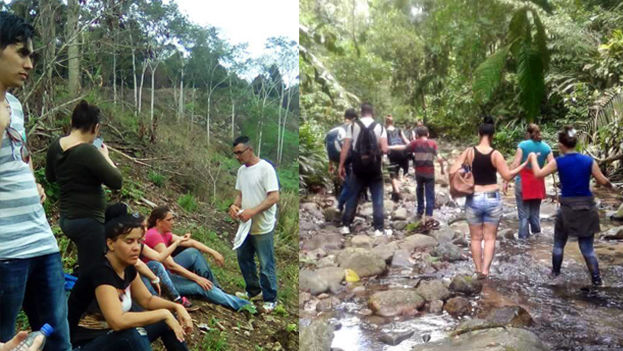
Cubans crossing the Darien jungle to get to Panama. (Courtesy to ’14ymedio’)
14ymedio, Mario Penton, Miami, 18 August 2016 — After escaping deportation in Colombia, some 650 Cubans managed to cross the border through the Darien jungle area and are now in the Panamanian town of La Miel. They have been assisted by the Panamanian government’s “Controlled Flow” operation, and may continue their journey but face an uncertain route affected by the decision of the countries of the region to deny them passage.
“Costa Rica is a supportive country, but it has no ability to receive more migrants,” Maurice Hererra Ulloa, the nation’s Minister of Communications told 14ymedio. “Some 66 Cubans have been returned to Panama. Our message is clear: Costa Rica is not going to receive them. The border with Nicaragua remains absolutely closed and there will be no way to get to the United States.” continue reading
Herrera made it clear that his country would not provide transportation of any kind for these Cubans and would not make efforts to get them to the United States. The same applies for transcontinental and Haitian migrants. “If they reach the border of Costa Rica they will be turned back immediately,” he says.
Panama’s Minister of Security Alexis Betancourt told this newspaper that his country’s border with Colombia remains closed, but it is permitted to shelter those who have penetrated the jungle because “we will not let anyone die.”
“They are illegal in Panama, in Colombia and throughout the Central American corridor. Those who come to our borders by normal means are not allowed to pass. In our country migration is not a crime, but they should not be here. For those who come through the jungle and run that risk, we will offer humanitarian aid,” he explains.
The minister also reported that the flow of Cubans right now is relatively low compared to the number seen during the first months of the year. So far this year, Panama has undertaken two humanitarian operations to transfer more than 5,000 Cubans who were stranded in their territory.
“We want to make it clear that we recommend that they do not go through the Darien jungle where there are dangerous animals, violence and disease,” says Betancourt.
“We are investigating the matter of the bodies that have been found. It could be that there are some in the lowlands of the mountain range, but those that have been documented are on the rise, which is an area belonging to Colombia,” he adds.
With regards to the 72 hours granted to Cubans to leave Panamanian territory, the minister said that “it would be advisable not to come” and that his government is not responsible for people who decide to go into the jungle.
“Those Cubans we find are taken to one of three camps that we have set up,” where they are provided with medical care, food and water. “We then explain to them the conditions of the camp, where they can bathe and rest. We take their fingerprints, and interview them and they pay their own passage to the border.”
Ubernel Cruz, one of the Cubans in the village of La Miel, said that the situation there “is getting ugly.”
“Most of these people do not have money and those who do have are afraid of getting into contact with the coyotes. Nobody knows exactly what will happen to us, although 75 a day are leaving.”
On the opposite border, the Costa Rican side, is Cuban Yunior Peñate. He is in the village of Peñas Altas, hidden along with six other migrants.
According to Peñate’s account, he sent friends in the United States more than $2,000, the result of seven years of work in Ecuador, with the aim that they would help him during the trip, sending money for each segment of the journey. But once the money was in the hands of his “friends” they never wrote him again.
He has suffered two assaults while trying to cross Nicaragua.
“I had to return here (Costa Rica). A family took us in and thanks to them we have food and shelter. In gratitude we work on everything they need done here. We do not know how long this situation is going to last,” he explains.
“If Costa Rica finds you in their territory they deport you to Panama, where you can’t be either. Nicaragua doesn’t let us pass. The only option is cross in hiding, but there is a lot of fear,” explains the young migrant whose destination is the United States.
The blockade on the borders of Central America to prevent the passage of Cuban, Haitian and transcontinental immigrants is feeding the underground networks of human trafficking. Several countries have asked the United States to eliminate the privileges enjoyed by migrants from Cuba, who are immediately welcomed when they step onto American soil.
The Foundation for Human Rights in Cuba and other exile groups have said that such statements “reflect a significant ignorance” of the true causes of Cuban emigration. “They focus their attention on the differential treatment of these migrants in the destination country, ignoring the incredible and exceptional disadvantages of these citizens in the country of departure,” the foundation explains.
Rafters missing along the Mexican coast. (14ymedio)
14ymedio, Mario Penton, Miami, 17 August 2016 — Thirteen men were determined to leave the misery, despair and weariness of lives filled with official propaganda. For months they crafted a boat on the cost of the Isle of Youth, off Cuba’s southern coast. In absolute secrecy to avoid being betrayed, they prepared a catamaran and stocked it with food and water. They wanted to get to Central America or Mexico, to continue their journey overland to the United States, an ever more frequented route, but a month and a half later they are still missing at sea.
Noyri Muñoz, a Cuban, 47, who is the sister of one of the rafters, explains that, of the 13, only seven have returned to Cuba, deported from Mexico a month ago. On returning to their own country, they do not want to talk to the press nor with the families of the missing. Their silence is more eloquent. Of then other six, there is no news. “The sea is so vast, perhaps it swallowed them,” she commented from Spain, where she lives. continue reading
The weeks pass and the fear grows that the worst has happened. “They left at dawn. They were from different towns on the Isle of Youth. They bought a good quality engine and set sail for Mexico,” explained Muñoz, so said that for 15 days they “didn’t see land anywhere” and decided to separate into two groups to increase their chances of being found.
When the engine gave out they continued to paddle and use the sail they carried, but they didn’t seem to make much headway, so they decided to separate, according to the version of one of the young boys who was on the boat,” added the sister.
“Three days after we separated a boat found us,” explained one of the rafters in Mexico to a family member of the missing. According to this testimony, half of the group left with eight inner tubes, in search of better luck. They divided the biscuits and the water. Since then, they don’t know anything more about them.
The same rafter explained in Mexico that at least four boats passed them and didn’t help them. The drifting boaters were finally rescued by the supply vessel MV Fugro Vasilis, 130 miles from Arrecife Alacranes, north of the Yucatan Peninsula.
“My brother was an economist for a state enterprise. He was a fighter, intelligent, a man always looking for solutions to problems. He was very creative. We are desperate, because we don’t have any information. We have tried to communicate with the Navy and the Mexican Army and US but without success,” says Muñoz.
The lives of the rafters could have been seriously threatened by Hurricane Earl in early August in the Western Caribbean. The number of rafters has significantly increased this year. According to the United States Coast Guard, from 1 October 2015 to 15 July 2014, 5,241 Cuban rafters have tried to reach the coast of the United States.
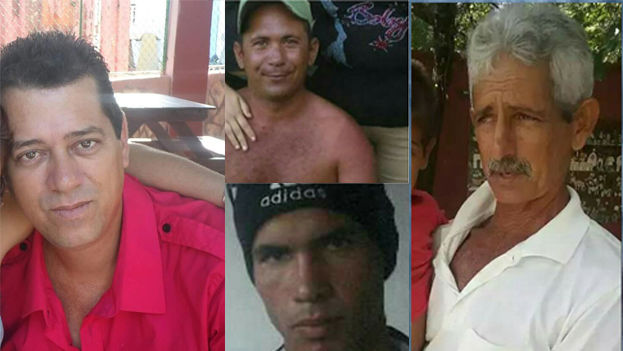
The names of the missing are José Armando Muñoz López, Luis Velásquez Osorio, Rafael Rives Rives, Yoendry Rives del Campo, Amauri Pupo Pupo and Juan Antonio Pupo Pupo.
Guillermo Farinas on hunger and thirst strike. (Courtesy / File)
14ymedio, Havana, 17 August 2016 — In a letter to Pope Francis, eight activists from the Anti-Totalitarian Forum (FANTU) have asked “his Holiness to take an interest” in the condition of regime opponent Guillermo Fariñas after 27 days on hunger strike.
The signatories are appealing to the Bishop of Rome to “keep Fariñas in your prayers” and said that the 2010 recipient of the European Parliament’s Sakharov Prize for Freedom of Thought is risking his life to demand “compliance with Cuba’s existing laws to stop the violence of some Cubans against others.” continue reading
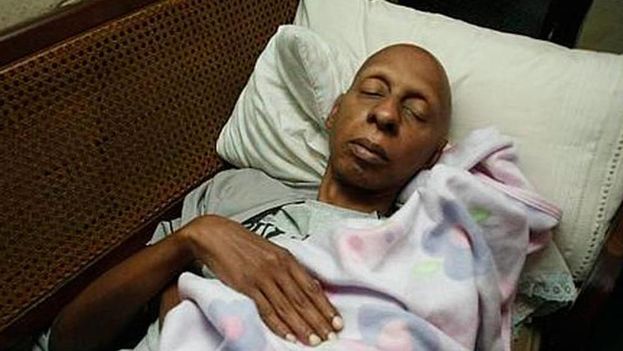
Guillermo Fariñas is in “critical condition” according to several reports issued on Monday afternoon by Jorge Luis Artiles Montiel, known as “Bebo,” a spokesperson for the well-known dissident during his hunger strike.
Artiles Montiel told 14ymedio via telephone that Fariñas had slept “from the time the doctor left in the morning” until the afternoon visit of independent unionist Ivan Hernandez Carrillo, with whom he spoke for a few minutes.
The spokesperson for the FANTU leader said the opponent is now in a very delicate state in which “he sleeps for long hours, passes little urine and reports a lot of pain in his lower back and joints.”
In the early days of this month, Farinas was visited by a representative of the Holy See in Havana, José Manuel Alcaide, and the bishop of the diocese of Santa Clara-Sancti Spiritus, Monsignor Arturo Gonzalez Amador, who came to his house to show their concern for the health of the dissident.
During Fariñas’ hunger strike he has also been visited by Dana Brown, head of the Economic Policy Section of the United States Embassy in Havana and Raquel Gómez, minister counselor in the Spanish embassy.
Fariñas is demanding through his hunger strike that Raul Castro publicly commit to not repressing the Cuban opposition and to ending state abuses that affect the self-employed. He is also demanding a dialogue between the authorities and the Cuban opposition.
Since Farinas began his protest on July 20, he has been taken to the hospital twice, both times after becoming unconscious. In both cases he received intravenous hydration in the Arnaldo Milian Castro Hospital in the city of Santa Clara, and then returned to his home, where he is being looked after by his mother, who is a nurse.
Guillermo Fariñas has said previously he is willing to continue his strike “until the final consequences” if all of his demands are not met.
In its 23 years of work the City of Havana Office of the Historian has created more than 13,000 jobs directly and thousands indirectly. (14ymedio)
14ymedio, Luz Escobar (Havana), Mario Penton (Miami), 16 August 2016 — “Do you see that building? Ten years ago it was full of stinking water, rats and trash. When people passed through the doorway a balcony could fall on their head. Today it is housing, thanks to the work of Eusebio,” Mirna says excitedly.
After expressing her gratitude to the Office of the Historian of the City of Havana (OHCH) for having provided her a home, this 68-year-old woman confesses her concern for the future of this institution, which has passed gradually into the hands of the military. continue reading
It is an open secret that the majority of the Historian’s companies have been transferred to an entity of the Armed Forces. It has not yet been published in any official decree nor has the national press spread the news, but the Historian of Havana, Eusebio Leal Spengler, has confirmed to 14ymedio that assets have been transferred to the Business Administration Group (GAE), a consortium managed by the Army. “It has not been transferred to the Armed Forces, but rather to GAE, a development company with investment capacity and prestige, which the Historian’s Office maintains the power to advise on the conservation of the work and also on new projects,” he explained via email.
Leal assures that the institution is calm because “the work of conservation now extends to the heritage cities of Cuba.” However, the historian expresses his sorrow at what this means for his efforts to protect the national patrimony. “It hurts us, that at the time when perhaps the greatest respect for the circumstances of life is required, the mediocre who lack any work are taking advantage, the poor in spirit, to hurt and damage many who have worked over the years to save the patrimony of a nation, whether in Cuba or anywhere else on earth.”
The Office of the Historian of Havana emerged in the ‘30s, in Republican Cuba. In 1967, after the death of the first title holder, Emilio Roig de Leuchsenring, Eusebio Leal took the helm of an entity that gradually grew not only in size and income, but also autonomy.
Its uniqueness comes from the ‘90s, when the OHCH received by Decree-Law Number 143, the freedom of economic initiative. The Government, in an unusual gesture of decentralization, entrusted Leal with creating a corporate structure that would allow social reinvestment and restoration of buildings. The institution responsible for the conservation and rehabilitation of the historic center of Havana, declared a World Heritage Site by UNESCO, would be answer directly to the Council of State, and would have a special legal jurisdiction, personality and permissions to import and export, among other prerogatives.
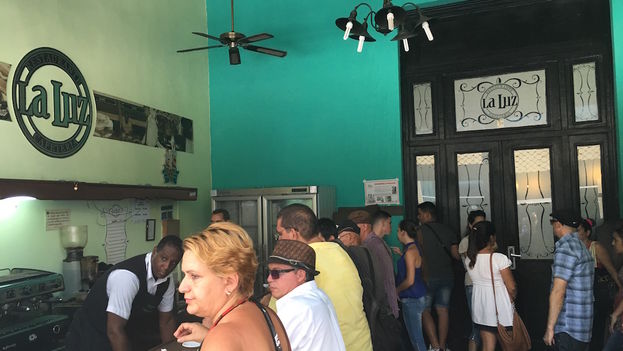
The bar of La Luz Restaurant. (14ymedio)
In addition, it gave the Office the ability to have entities not subordinate to it and encompassed within in the prioritized are contribute to the conservation of buildings with payment of 1% of their income from operations in national currency (Cuban pesos, of CUPs) and 5% from operations in hard currency (Cuban convertible pesos, or CUCs).
Within the broad and complex business fabric that OHCH has woven for more than two decades are the Habaguanex hotel chain; the San Cristobal travel agency; the Opus Habana cultural magazine; the Habana Radio station; the Bologna publishing house; and several websites for marketing its products. The company also controlled two real estate agencies, Aurea and Phoenix; more than fifty cafes and twenty restaurants; museums, concert halls and shops; an import company, a workshop school and three construction companies (later merged into one), among other assets.
In its 23 years of work, the Office has created more than 13,000 jobs directly and thousands indirectly. According to research published by the University of Havana, of the 500 million dollars generated during this time, 60% has been earmarked for social works. In addition, the company has received more than 30 million dollars in funding from international cooperation.
About 55% of tourists coming to Cuba visit Havana, and 90% of them tour the Historic Center. Tourism revenues are soaring, therefore, in this area, reaching 2,185 CUC per resident compared with 245 CUC for the whole city.
“The best part of the cake is Old Havana, everyone knows that, so they are taking all of Leal’s businesses,” said a worker in an old-age home funded by the Historian.
Leal confirmed that the Office retains some financial instruments, including the 5% tax on any public or private activity in the historical district and the shops considered heritage, linked to the system of museums. In addition, other State institutions continue to contribute to the operation of the entity.
The Historian’s Office was getting fat in the first decade of the century when it added to his portfolio the Traditional Malecon, in 2003, and Chinatown in 2005. Following the publication in the independent press of several corruption scandals related to its administration, some of the OHCH companies were taken over by other state agencies.
“The process of disengagement has been slow. They have been removing one company after another to save Leal. The comptroller has uncovered a very large embezzlement and the only way not to charge the Historian, who actually had nothing to do with these thefts, is to exempt him of responsibility for these companies,” said a Cuban economist who prefers to remain anonymous.
Leal flatly denies these allegations and explains that “wherever someone is willing to sell his soul to the devil there will be administrative or corruption scandals.” The historian also says that “it is simply about consolidating efforts for development that we can not handle within our own means.”
But there are other theories. Eugenio Yanez, a Cuban academic who belongs to the study center Cubanálisis, believes there are three problems the transfer is designed to solve: “First, Raul Castro has a more pragmatic view, so he may want there to be a specialized management company that is responsible for business in Havana. Then there is the issue of the Leal’s deteriorating health, and thirdly there is the problem of serious corruption in the Office of the Historian companies. The Comptroller has discovered shady businesses. The solution has been to the transfer them to the Army, which is trusted by Castro.”
Self-employed individuals in Old Havana say they feel protected by the OHCH. Some expressed to 14ymedio their misgivings about the transfer of the Office of the Historian’s business to GAE. “The state always promotes its own restaurants, hotels and businesses instead of private businesses, so we don’t know what will happen now,” said Reinaldo, who operates a fashion business.
Camilo Condis, self-employed, who works with Gilberto Valladares (Papito), the hairdresser who spoke with President Barack Obama during his visit to Cuba, says that small and medium sized businesses have worked in Havana as managers of local development. “Without the Historian’s Office the work we do would not have been possible,” he said at a meeting of the Association for the Study of the Cuban Economy (ASCE).
As of August 1, the institution that has saved at least one third of the historic center of Havana has seen its activities reduced to “museum management, promoting cultural activities and conservation of the heritage,” says a source at the Vitrina de Valonia cultural center.
No one knows how the restoration processes in the capital will proceed from now on, but many fear that the military will not know how to manage the legacy of the Historian and will seek a more immediate profitability, without taking residents into account.
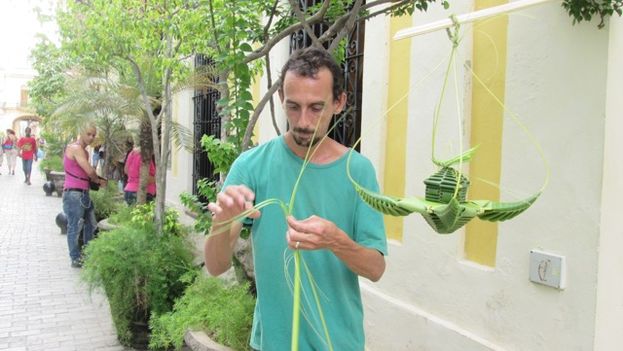
Misael Gonzalez, weaver in the streets of Havana. (14ymedio)
14ymedio, Yosmany Mayeta Labrada, Havana, 11 August 2016 – For Misael Gonzales, Old Havana is the gallery that for years has refused to display his figures made from natural materials. All the passersby on Teniente Rey Street between Oficios and Mercaderes, will see there his grasshoppers made from coconut leaves and some Japanese-inspired constructions of braided green fibers.
The artist tells 14ymedio that initially he made clay and ceramic structures but with that raw material it became very complicated to get permission to market his work. Nature saved him from those difficulties and, although his business of figures made from natural leaves has not been without setbacks, little by little he has made his business thrive. continue reading
“I was fined several times,” says the artist, “but now I have authorization from the Office of the City Historian to develop my craft works here,” he said, while his fingers agilely braided the wings of an inspiring insect.
At 44, this Artemisa artist based in San Miguel del Padron has turned to crafts looking to support himself. When he lived in his native province he came to the capital every week with the pieces he had made “selling them for prices between 1 and 5 CUCs,” which still hold.
“I have been experimenting for seven years,” explains Misael, and describes some of the “spectacular” works that have never sold that he treasures at home. “I feel comfortable making these pieces out of natural materials and, in addition, I don’t get into trouble with the law,” he stresses.
Every afternoon the artist positions himself near Los Frailes Inn in the old city center to sell his sympathetic figures, most of which he creates before the eyes of the buyers. Other pieces are on display for “when someone is interested” and he then makes them on request in front of his customers.
Onlookers surround him and Misael displays his skills with leaves between his fingers. Sometimes a child approaches and is ecstatic with the animals that emerge with each fold. Misael gives him a grasshopper that seems about to take flight. He knows that many of these little ones’ families don’t have the money to pay him.
“Being an artist is being born again,” he says with the same wisdom that, one day, led him to create wonders with materials that others discard.
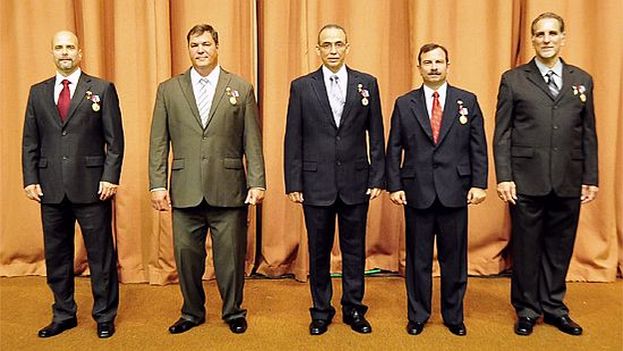
Raul Castro in February 2015 honored as heroes the five Cuban agents convicted in the US for espionage. (Revolution Studios)
14ymedio, Boris Gonzalez Arenas, Havana, 11 August 2016 — My friend Adriana Gutierrez suggested I write this, only asking that, out of respect for her father, I change the names. She has lived in Spain since 2007, when she went to do a degree that also offered the occasion to stay and live outside of Cuba. Her father and mother remained in Cuba. Let’s call her dad Anibal Ochoa to use the last name of his great friend Arnaldo Ochoa Sanchez, the general executed or murdered, or both as it appears, in 1989. Adriana and her father don’t have the same last name because he wasn’t her biological father, but the man who took on caring for her and did it in the best way he knew how, considering that she was also his only daughter.
Anibal spent his whole life as an official in the Ministry of Foreign Affairs, and his specialty was to plant spies in Spain to travel around the rest of Europe or, to continue with the language of farming, to harvest them when they were totally worn out and return them to Cuba with false identities and all kinds o technical intricacies. continue reading
He was also a racist who despised his daughter’s black lovers, when she had them, and was macho enough not to rest until his wife, Adriana’s mom – let’s call her Leonor – left her job as a nurse to devote herself to being a housewife. She was a woman who spoke in a measured way and smiled more with her eyes than with her mouth. A beautiful smile that she passed down to Adriana.
Even after retirement, Anibal went to the Foreign Ministry to advise new diplomats in the art of shaking hands without giving away the knives up their sleeves and smiling discretely so as not to show their fangs. But, as his era coincided with the aggressive years of the Cold War, a time when a Cuba financed by the Soviets lacked the intelligence to profitably manufacture a pencil, although it played at being a military power, Anibal’s advice seemed more like funny anecdotes than plausible directions. Anibal, who was no fool, quickly understood and, as he had his pride, he ended up distancing himself from Cuba’s Foreign Ministry.
Almost simultaneously his wife died and his two grandchildren were born in Seville. Retirement did not suit him and slowly he slipped into the old age of an ordinary Cuban, making him a man dependent on help from his daughter.
Shortly after being widowed he returned to Spain for the first time after two decades. He feared being denied a visa, something that his former enemies were in charge of and that emphasized his current impotence. But none of this happened and he got the visa. He was there three months and when he returned we talked a lot. He was happy, and in addition, as expected, he had slimmed down and his skin cleared up. Then there was a second visit and he stayed a year, and eventually he stayed for good.
Two months ago Anibal died of a heart attack at 79 and took his secrets to his grave, some of which he regretted and so decided not to share with anyone, even after so much time and distance from his career as an official, a diplomat and a spy.
Adriana said that Anibal once commented he had been used. Perhaps he also thought about Arnaldo Ochoa and concluded that he had had better luck than his deceased friend. At the death of the Cuban general, Anibal was out of work for some time, understanding nothing and unable to pretend that he did. They say that something happened to Raul Castro at this time that only aggravated his alcoholism. Later, Anibal recovered and took up his previous duties, which would never be the same, because the death of the Cuban general coincided with the end of Soviet socialism and, still unable to produce a pencil, the Cuban state sank too deeply into misery to support any James Bonds.
In Spain, Hannibal used to be welcome to sit in outdoor cages, which he also did in the 70s and 80s, but he was too self-absorbed and distrustful to enjoy anything.
Hannibal had a peaceful death, surrounded by his daughter and grandchildren as he always wanted, in the country he treated throughout his working life as an enemy and where he settled, in retirement, as a home.
Cuban National Conference in Puerto Rico (14ymedio)
14ymedio, Reinaldo Escobar, San Juan, 15 August 2016 — The emergence of a new opposition partnership called the Conference of the Cuban National Congress is the most notable result of the event that has gathered in Puerto Rico 65 organizations from the island and in exile.
After lengthy and complex discussions in which there was laughter and tears, reasoned arguments and passionate declarations, lights and shadows… in short, Cubans. An agreement has been reached to forge an integrated structure with a Coordination Committee composed of 22 elected representatives. continue reading
Work has been assigned on different fronts distributed among 11 working committees, including ones assigned IT and communications, the press, popular consultation, Human Rights and one to address political prisoners and their families. Like any other organization, some working committees will deal with international relations, finance and legal affairs. Leading each committee is one representative from the island and one from exile. These coordinators will appoint a minimum of three and a maximum of five members to their respective committees, and will provide a report on their work every three months.
The principal declaration from the event that expresses the consensus on the new Cuba proposed at the Second Cuban National Conference, ratified the Democracy Agreement of 1988 as containing the elements needed to reconstruct the new Republic of Cuba, which had been ratified in the previous conference held in August of 2015.
The Declaration supports “the establishment of a commission against impunity” and, in response to the demands of several organizations, it proposes to “retroactively audit the management of existing companies in Cuba with the intention of respecting the conventions of the International Labor Organization.” Similarly, with clear perspective on the future, it proposes the need to implement “measures that guarantee transparency and integrity and fight corruption in public management and the electoral process of the new Republic of Cuba.”
Telecommunications was a topic at the meeting. In the accords, the US government was asked to seek an accord with the Cuban government to connect an internet cable between the two countries and to ask the American company Google to establish an appropriate policy to provide uncensored internet via wifi. In addition, it denounced the violation of the internet giant’s code of conduct for its indifference to the Cuban people in this regard.
Telecommunications were present at the meeting. In the agreements, the US government to seek an agreement with Cuba to connect an Internet cable between the two countries and the US company Google to establish a correct policy to provide uncensored internet via wifi was claimed was requested. In addition, the violation of the code of conduct Internet giant was denounced for its indifference to the Cuban people in this regard.
As is usual in this type of meeting opposition activists and civil society residents on the island manage to get together with Cuban exiles there were immeasurable parallel results that over the long term will open new contacts and support the emergence of diverse indicatives.
The results of the agreements reached will not have an immediate effect, but progress has been made, despite the inevitable differences among personalities, given those who only understand unity when it goes their way, along with all the pessimism and the overcoming of exhaustion and induced suspicions.
The composition of the Coordinating Council of the Congress of the Cuban National Conference is (in alphabetical order by last name).
Composition of the Coordinating Board of the Cuban National Congress (In alphabetical order by last name).
Chosen by the Island
Eliecer Ávila: Somos+
Henry Constantín: Proyecto La Hora de Cuba
Guillermo Fariñas: Foro Anti Totalitario Unido (Fantu)
Jorge Luis García Pérez (Antúnez): Frente de Resistencia Orlando Zapata
René Gómez Manzano: Corriente Agramontista de Abogados Independientes
Juan Carlos González Leyva: Consejo de Relatores de Derechos Humanos
Iván Hernández Carrillo: Confederación de Trabajadores Independientes de Cuba
Mario Félix Lleonart: Instituto Patmos
Damaris Moya Portieles: Coalición Central Opositora
Félix Navarro: Partido por la Democracia Pedro Luis Boitel
Rolando Rodríguez Lobaina: Alianza Democrática Oriental
Chosen by the Exile
Ana Carbonell:Instituto de la Rosa Blanca
Pedro Fuentes: Consejo Presidio Político Cubano
René Hernández: Partido Demócrata Cristiano de Cuba
Faisel Iglesias: Fundación Nuevo Pensamiento Cubano
Augusto Monge: Free Cuba Foundation
Rosa María Payá: Fundación para la Democracia Panamericana
Pedro M. Peñaranda: Círculo Democrático Municipalista
Mario Rivadulla: Unión de trabajadores cubanos de la comunicación social y la cultura.
Ramón Saúl Sánchez: Movimiento Democracia
Julio M. Schiling: Patria de Martí
Guillermo Toledo: Cubanos Unidos de Puerto Rico
United States and Cuban flags in the streets of Havana
14ymedio, Yoani Sanchez, Havana, 15 August 2016 – The baby cries in her cradle while her mother sings to console her. Barely three months old, her name is Michelle, like Barack Obama’s wife. This little Havanan who still nurses and sleeps most of the day, came into the world after the armistice: she is a daughter of the truce between the governments of Cuba and the United States. A creature without ideological phobias or hatred on her horizon.
In the history books that Michelle and her contemporaries will read, these months after 17 December 2014 – “17-D” as Cubans have dubbed it – will remain in a few lines. In these retrospective summaries there will be optimistic tones, as if the whole island, stranded for decades on the side of the road, had set out anew from this moment, putting pedal to the metal and making up for lost time. But, for many, living through the reconciliation is less historic and grandiloquent than was playing a starring role in a battle. continue reading
A process that, one day, analysts will compare with the fall of the Berlin Wall and perhaps define with high-sounding names like the end of the sugar curtain, the death of the Revolution or the moment when peace broke out, is losing brightness now, faced with the daily exhaustion. Indeed, the truce quieted the noise of the slogans and has allowed us to hear the persistent hum of the shortages and the lack of freedom.
The day when the presidents of Cuba and the United States announced the beginning of the normalization of relations has been left somewhere in the past. It will be a reference for historians and analysts, but it means little to those who are facing a whether decision to spend the rest of their lives waiting for “this to be fixed” or to choose to escape to any other corner of the world.
17-D has increased apprehensions about the end of the Cuban Adjustment Act. The number of Cubans who, since then, have crossed the United States border has shot up, with 84,468 arriving by land or air while another 10,248 have tried to cross the sea. The popular ironic phrase of the latter for leaving the island –“turning off El Morro,” a reference to Havana’s iconic lighthouse at the entrance to the bay – dramatically foreshadows those numbers.
Why not stay in the country if the thaw promises a better life or at least a more fluid and profitable relationship with the United States? Because 17-D arrived too late for many, including several generations of who had to face off against our neighbor to the north, shouting anti-imperialist slogans for most of their lives and abetting the commander-in-chief in his personal battle against the White House. They don’t trust promises, because they have seen many positive prognostications that survived only on paper and in the mystique of a speech, lacking any impact on their dinner tables or their wallets.
After a prolonged skirmish lasting over half a century and eleven US administrations and two Cuban presidents with the same surname, the nation is exhausted. The adrenaline of the battle has given way to dreariness and a question that finds it way into the minds of millions of Cubans: Was it all for this?
It is difficult to convince people that the confiscations of US companies, the diplomatic insults, becoming the Soviet Union’s concubine, and the many caricatures ridiculing Nixon, Carter, Reagan and Bush were all worth it, even with all the official propaganda that controls every one of the county’s newspapers, radio stations and TV channels.
The American flag raised at the US Embassy in Havana just one year ago, on 14 August 2015, put a final end to an era of trenches and to the eternal soldier: the Cuban government with its still hot Kalashnikov and a marked inability to live in peace. It is prepared for confrontation but its ineffectiveness is clearly evident in times of armistice. In his convalescent retirement, Fidel Castro noted how the country he molded in his image and likeness was out of his hands. The man who controlled every detail of Cubans’ lives cannot influence how he will be remembered. Some rush to deify him; others sharpen their arguments to dismantle his myth; while the great majority simply forget he’s alive: he is buried while still breathing.
Children born since 31 July 2006, when the illness of the “Maximum Leader” was announced, have only seen the president in photos and archival materials. They are the ones who don’t have to declaim incendiary versus before him in some patriotic act, nor be a part of the social experiments that emerged from the gray matter under his olive-green cap. They live in the post-Fidel era, which does not mean they are entirely freed from his influence.
For decades to come, the schism created by the authoritarian leadership of this son of Galicia, born in the eastern town of Birán, will divide Cubans and even families. The aftermath of this tension that has infiltrated the national identity, otherwise lighthearted, will last for a long time. There will be a before-and-after Castro for the followers of the creed of political obstinacy he cultivated, but also for those who will breathe a sigh of relief when he is no longer.
The Maximum Leader’s 90th birthday, celebrated this August 13 with cheers and a good dose of personality cult, has all the earmarks of being his farewell. Now his closest family members should be exploring the calendar to select a date to announce his funeral, because such a huge death won’t fit just any date. They will have to pick a day that is not associated with the memory of some offensive in which he participated, a project that he opened, or some lengthy speech that hypnotized his audience.
There will be no need, in any case, to disconnect the machines or to stop administering medications. To say the final goodbye, it will be enough to give him his measure as a human being. Forget all those epithets that extolled him as “father of all Cubans,” “visionary,” or “promoter of medicine” on the island, along with “model journalist,” initiator of the “water-saving policy”, “eternal guerrilla,” “master builder,” and a long list of other grandiloquent titles that have been repeated in the days before his birthday.
Fidel Castro and Michelle, the little baby born after the visit of Barack Obama to the island, will be together in the history books. He will remain trapped in the volume dedicated to the twentieth century, although he has made every effort to put his name on each page dedicated to this nation. She will star, along with millions of other Cubans, in a chapter without bloody diplomatic battles or sterile confrontations.
****
Editor ‘s Note: This text was published on Monday 15 August 2016 in the Spanish newspaper El País .
 14ymedio, Mario Penton, Miami, 19 August 2016 — A recent comment by official journalist Randy Alonso has generated a number of protests on social networks.