Police Arrest Several Activists From Candidates For Change / 14ymedio

The only party allowed to exist under the Cuban Constitution is the Communist Party. (EFE)

14ymedio bigger14ymedio, Havana, 27 August 2016 – Regime opponent Julio Aleago reported to this newspaper that the police detained several activists on Saturday morning to keep them from attending a meeting of volunteer observers associated with the Candidates for Change platform. The meeting was to be held at the home of Juan Moreno in Havana’s Vedado district, but the host was taken to the Aguilera police station in the 10 de Octubre municipality.

The activist Ricardo Marlene was prevented from leaving his home in San Miguel del Padron, where he now remains under house arrest. The whereabouts of the other participants are unknown.

Julio Aleaga, executive secretary of the electoral platform Candidates for Change, told this newspaper that the arrest of Moreno was made by a State Security officer identified by the alias Diego. “We will not allow” the meeting to take place, “Diego” had warned last Tuesday.

Among the tasks of the volunteer observers are to gather the concerns of the population and present them in the district accountability assemblies – meetings where elected officials report back to citizens on the achievements of government programs and promises – and to make these concerns available to the elected delegates through the offices instituted for that purpose.

The initiative is an effort by Candidates for Change with the aim of overseeing the government on behalf of the citizens and questioning public policy at the district, people’s council and municipality levels.

At present Candidates for Change is discussing the appointment of Party Central Committee member and National Assembly Deputy Reinaldo Garcia Zapata to the position of governor of Havana. He has been brought in from the province of Santiago de Cuba to replace the recently removed Marta Romero.

The appointment was a proposal presented last Saturday by Agustin de la Pena, from the Candidacy Commission, with the concurrence of the Vice President of the National Assembly, Ana Maria Mari Machado, and of General Ulises Rosales del Toro.

Aleaga notes that there is no protocol in the law for citizens to reject these appointments, which are not the result of an electoral process. The objection lodged by Candidates for Change has received no institutional response.

The volunteer observers have representatives in the provinces of Santiago de Cuba, Sancti Spiritus, Granma, Cienfuegos and Havana. Its members plan to work intensively on the electoral process that will begin in late 2017. They will focus on the electoral registers, the area assemblies where direct proposals from the population are put forward, and on verifying election results at polling stations.

Aleaga believes that the intent to repress this meeting is “an attempt to prevent the strengthening of the internal structures of this movement whose objective is to use the government’s electoral system to promote the transition to democracy.”

Doctors Give Medical Clearance To Guillermo Fariñas / 14ymedio

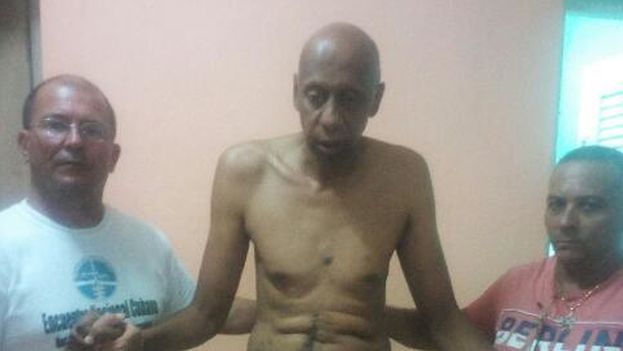
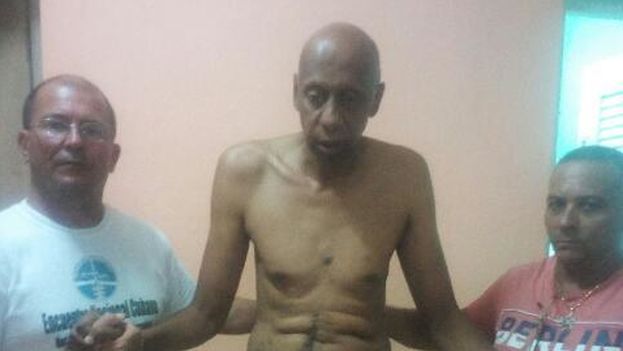
Guillermo Fariñas on hunger strike. (Courtesy)

14ymedio bigger14ymedio, Havana, 28 August 2016 — Regime opponent Guillermo Fariñas received medical clearance on Saturday, after staying for several hours at the Arnaldo Milian Castro Hospital where he was taken because of his delicate state of health after 39 days on a hunger and thirst strike. The 2010 winner of the European Parliament’s Sakharov Prize for Freedom of Thought fainted at his home in the Chirusa neighborhood in the city of Santa Clara, as was confirmed to this newspaper by his mother, Alicia Hernandez.

On a phone call from 14ymedio’s newsroom to the observation room in the hospital, an employee confirmed that Fariñas “arrived unconscious at about three in the afternoon,” but an hour and a half later was “better as he opened his eyes.”

Alicia Hernandez said her son “recovered consciousness” and the decision about whether he should remain in the hospital or be discharged would depend on “how he reacts to treatment,” a reference to the rehydration sera administered during his stay in the observation room.

The dissident suffers severe dehydration and severe joint pain. This is the fourth time he was transferred to the hospital after fainting.

Along with his mother, several activists from the Anti-totalitarian Forum (FANTU) were also with Fariñas in the hospital.

Paternalism Kills Creativity / 14ymedio, Eliecer Avila

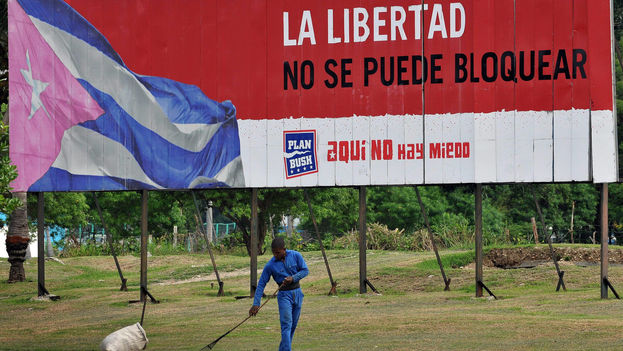
A worker sweeps in front of a propagandistic ad in Havana (EFE). The ad reads: Liberty Cannot Be Blockaded/Here There Is No Fear

14ymedio bigger14ymedio, Eliecer Avila, Havana, 27 August 2016 – When I was small, I suffered from asthma for several years. I remember that my grandmother would not let me leave the house if it was slightly cloudy; I also had to wear shoes and thick socks although all the other children of the neighborhood ran barefoot through the gutters filled with puddles where one could experience the pleasure of feeling the mud between one’s toes.

Overcoats, blankets and mosquito nets did not manage to improve my health. However, a sports instructor did manage the miracle of not only an improvement but the definitive cure of this illness that tormented almost my entire childhood. continue reading

Contrary to the opinion of my relatives, the then-student of Physical Culture who for us would always be Loriet, taught a group of us adolescents in the seventh grade that “the body and spirit can be shaped by a force that is greater than all illnesses or limitations, a transformative and colossal force call willpower.” At first these words sounded strange and distant to us. Only years later did we understand their significance.

I began training in taekwondo, drowning every time I ran 20 meters or did 10 pushups. Unable to breathe, I looked towards everyone around me to approach the nearest person, I suppose in search of some support in order to feel more secure. On one occasion, someone protested to the teacher, saying: “Don’t you see that this boy is purple?” However, Loriet displayed not the least pity or concern, at least not visibly. He just told me instead: “None of them can help you, only you can manage it yourself, the problem is yours and you have the option of overcoming it, but you have to work hard, learn to breathe and recover without yielding and continue advancing. I promise you that this will not last forever.” And so it was!

After two years, my health took a radical turn. I could endure whole afternoons of practice and fighting, I added weight training with the teacher Mario (the strong) and even participated in some city competitions in both disciplines. For the coming “green” medical checkup, as they call it in the Compulsory Military Service, no one remembered any longer my nights of intensive therapy, eating a breakfast, lunch and dinner of aerosol hydrocortisone. I passed each test, and they gave my condition “Fit 1,” thus totally ready for the rigors of military training, which by luck was commuted for me mostly because of the “mission” of teaching physics and mathematics in senior high school, given the province’s lack of teachers and my notable educational results.

Later I continued occasionally practicing taekwondo, even in university. I did not win many fights in competition, but I always felt proud of having overcome my own natural vulnerability.

I give you a little of my own history in order to talk about something much more important that concerns not only me but all Cubans born on the Island after ’59. I am referring to the false paternalism that the government still continues assuming with the pretext of protecting us when in reality it deprives us of the possibility of exploiting our strengths as individuals and, as a whole, as a nation.

For four generations, we have carried an umbrella against foreign propaganda, an overcoat to avoid ideological deviations, anti-communism socks, safety goggles for different information, and a powerful aerosol that kills any germ of personal creativity or inspiration for entrepreneurism.

Even today, when the times have changed, the world has changed, people have changed, still there appears on television a young journalist warning us of the “grave dangers” that “so-called inter-connected societies” bring, like the “loss of privacy” or “the alienation caused by the game Pokemon Go,” when the vast majority of Cubans cannot even access a landline.

Nothing is more advisable for managing any tool than to use it in a natural and everyday manner. The lack of practice by our citizens with respect to basic elements that characterize modern societies is visible in the behavior that we adopt on finding ourselves exposed to an environment where the minimum personal effort is required to find solutions or answers for ourselves. Simply, we are not accustomed to solving our problems without depending on someone or something.

During my last airplane boarding at the Jose Marti Airport in Havana, I carefully observed the conduct of several people, especially those who had to be between 50 and 60 years of age. Cubans that I bet had some university degree were incapable of interpreting posters, signs or signals of any type in the airport, or on or inside the airplane. Facing the simple issue of finding a departure gate or a seat identified by a number, the first reaction was not to try to understand the symbols or signs, but they opted to ask constantly about the slightest detail, brandishing the easiest argument for their insecurity: “It is that I am not accustomed to these things.”

Something very different drew my attention when I left Cuba the first time and lived for four months among Europeans. There people spent several minutes before a map at a train station or configured a mobile app that offered the needed information, but rarely did they yield to the temptation of asking or complaining without first making an effort. That attitude of absent-minded ease is very widespread and, unlike Cubans, there exists a respect or almost a cult of self-management, the capability, initiative and talent of getting along with ease in any circumstance. Because there and in other parts of the world (coincidentally the most developed) it is autonomy and not dependence that has been instituted as a value in society.

It is not unusual to see three French teens comfortably disembark in Latin America with a map and backpacks, in stark contrast with a Cuban engineer who lands in Paris who, if someone doesn’t pick him up he might die of cold without daring to tackle the subway system by himself.

I could cite thousands of daily examples of how our dependent personality manifests itself, but the essential reflection that I want to share is that it is not a change of system that is going to bring a change of attitude in Cuba’s citizens and, therefore, a better and more prosperous society, but the reverse: without a change in the people, in their expectations, values, behaviors, they will never be able to overcome the system and its effects. Because the system does not consist only of a government and a system of laws, but it consists of the whole of the beliefs, myths, schemes and behaviors that we daily assume, accepting and resigning ourselves to suffer as from a chronic illness, one that can be overcome with a minimum of risk and individual effort from each of us.

A totalitarian and repressive political system can suffocate a society like asthma can suffocate our lungs. If we shed the overcoats, thick socks and mosquito nets on which we depend and go out to run, to discover and confront our obstacles, surely we will discover how incredible and marvelous it is to be able to breathe deeply all that oxygen that was always there, waiting for us.

Translated by Mary Lou Keel


Moscow Does Not Fit In A Suitcase / 14ymedio, Luz Escobar

The Sadovod Moscow market. (Ancon)

14ymedio bigger14ymedio, Luz Escobar, Havana, 25 August 2016 – For decades visiting Moscow was the golden dream, but only the most trusted could enjoy a stay in the Soviet Union. From these trips to the “godmother nation” they returned with suitcases filled with products unavailable in Cuba. Today, some take the same route, but this time they shop in a Russia with a market economy and well-stocked stores.

Most of them are “mules” who make the long journey to Pushkin’s native land to bring back shoes, clothing and Lada or Moskvitch car parts, which they sell in the informal market. Those with more resources pay for their own airline tickets, knowing that they can make back the money; but others offer the room in their suitcases in search of an investor to pay for the trip.
continue reading

With the restrictions imposed late last year on the entry of Cubans to Ecuador, one of the most important routes of imports for the black market was closed. Russia, however, has continued its policy of not requiring visas from residents of the island, so the “mules” have reoriented their travel to Moscow, a route also widely used to emigrate.

The travel agency Ancon, located in a spacious property on Linea Street in Havana’s Vedado district, is taking advantage of the growth in interest in Russia to offer “shopping trip” packages to Moscow. There is no shortage of customers and the tour operator focuses on organizing visits to markets, filling travelers’ suitcases and facilitating getting the merchandise back to the island.

Vladimir Putin’s Russia has a commercial network unthinkable in Raul Castro’s Cuba. While the shelves of Havana stores display the same products over and over again, or are empty, Moscow’s markets are a permanent temptation to the wallet.

“The travel agency is part of the Russian company Kompozit 21 and has been operating in Cuba for three years,” says Ada Soto, an employee of Ancon. The CEO is Nikolay Popov, but in a spacious 16th floor apartment, two Cubans manage reservations and sales.

Soto explained to 14ymedio that since early this year business has significantly increased. Cubans who contract their services are received by one of their compatriots based in Moscow who greets them at the airport and will answer any questions in Spanish, while leading them to their hotel arranged from the island.

The seven-day packages that costs not more than $500 for accommodation, transfers and a guide, are the most sought after and the highlight is the tour of the a visit to the Sadovod marlet, a shopping mall with wholesale deals and more than 4,500 stores.

Most customers prefer to focus on shops and ignore Ancon’s cultural program with visits to museum. Cuban travelers seem more interested in the goods on offer and the sales rather than taking a look at the Red Square.

Vivian, 32, made the trip earlier this year. She says she spent it “eating hamburgers and pizza,” while acknowledging that “the Russian language is a bit of a problem, but if you speak some English and with a calculator in hand, no problem.” Together with her husband they bouhgt two passages and hired the services of Ancon. “It was a business trip,” she says.

The couple spent a day in Moscow in the Saviolovskiyo electronics market to stock up on photography and video equipment, mobile phones, tablets and other electronic devices, merchandise that can be sold at three times its value in the Cuban black market.

Vivian fed her nostalgia for the times when the Kremlin and Revolution Square were close with some Russian souvenirs, like matryoshka nesting dolls and decorated wooden crafts. She also fulfilled the request of her father in the Puerto Sur car market, buying some spare parts for his Volga.

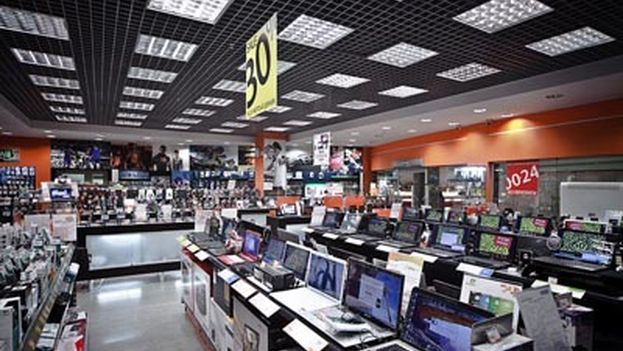
The Saviolovskiyp electronics market. (Ancon)

The young woman’s husband was delighted with the Sokolniki shopping center with accessories for Jawa, Voskhod, Minsk, Karpati and Riga motorcycles, models that circulate widely on Cuba’s streets. With a couple of purchases made at the request of some friends he said he would “recover nearly half the money spent on tickets.”

The agency handled the transfer of goods to the hotel, gave them the use of a cellphone, and helped them manage the payment for an extra suitcase, in addition to the 33 kilograms they could bring home free, between a large bag and a piece of hand luggage.

On Revolico, the classified site similar to a Cuban Craigslist, they rented coats and boots because it was still “quite cold” when they landed in Moscow. The couple hopes to repeat the trip in late September and has already bought the tickets on Aeroflot for 630 convertible pesos each.

“I’ve realized a dream of my lifetime because when I was a chiquita my father went to Moscow on a trip he earned as a bonus for being a vanguard worker, but my trip was for shopping,” enthused Vivian while showing off some of her purchases. Unlike her father, she didn’t have to work overtime or demonstrate ideological fidelity to realize her dream.

Costa Rica Returns 56 Cuban Migrants To Panama / 14ymedio

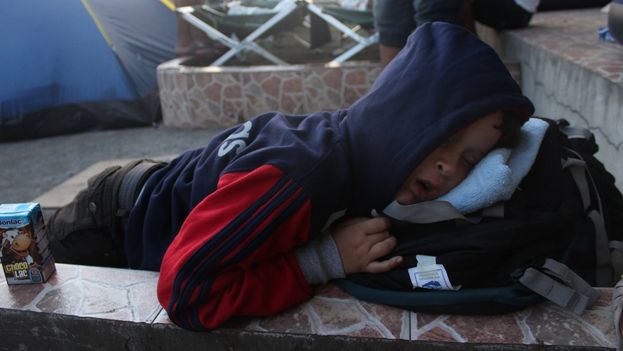
A Cuban child sleeps near the border between Panama and Costa Rica waiting to continue with his family travel to the US. (Silvio Enrique Campos)

14ymedio bigger14ymedio, Havana, 24 August 2016 — The Government of Costa Rica returned a group of 56 Cuban migrants to Panama, according to a report in the local press on Tuesday. The Cubans, including an eight-year-old boy and a woman eight months pregnant were taken to the capital where the Catholic charity Caritas will care for them until the government decides their future.

Sietnel Candañedo, a member of Pastoral Caritas of Chiriqui, explained to the newspaper La Prensa that the migrants have no money, nor any place to stay and that they need “urgent” help with personal hygiene items, canned food, water, drinks, disposable cutlery and milk for children.

The Cubans allegedly entered Panama through Colombian’s Darien jungle. In the the last three weeks several migrants have traveled from Panama City to Chiriqui hoping to cross the border to continue their journey to the United States.

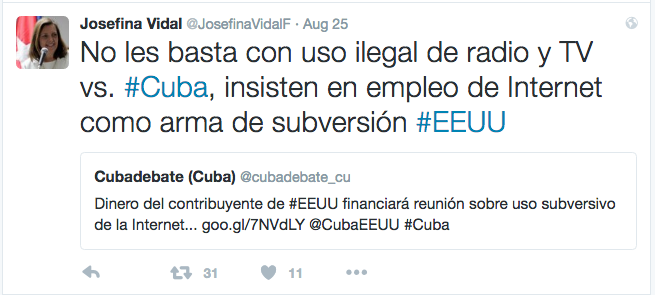
Cuban Official Josefina Vidal Accuses US of Using the Internet “To Promote Subversion” / 14ymedio

holding text
“The illegal use of radio and TV against Cuba isn’t enough, they insist on using the internet as a weapon of subversion”

14ymedio bigger14ymedio, Havana, 26 August 2016 – Josefina Vidal, Director of the United States Division for Cuba’s Ministry of Foreign Affairs, said Tuesday that the internet is being used from the United States as a way to promote internal subversion on the island.

“The illegal use of radio and TV against Cuba isn’t enough, they insist on using the internet as a weapon of subversion,” the diplomat complained through her Twitter account.

Vidal criticized the first conference on the free use of the internet on the island, organized by the Office of Cuban Broadcasting, which operates Radio and TV Martí. The event, which will be held in Miami on 12-13 September, will bring independent Cuban journalists together with digital innovators and individuals who are fighting for the island to open up to the World Wide Web.

In an article published by Cubadebate and shared on social networks by the diplomat, she says that the government of the United States, over the last two decades, has spent 284 million dollars to promote programs of regime change in Cuba.

First Conference On Internet Freedom In Cuba To Be Held In Miami / 14ymedio, Mario Penton

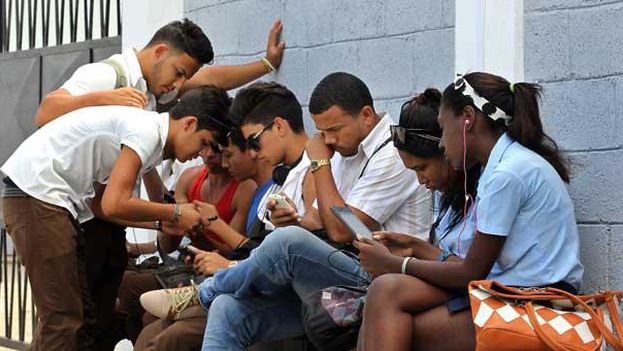
A group of young people connect to the internet in a wifi zone in Havana. (EFE)

14ymedio bigger14ymedio, Mario Penton, Miami, 24 August 2016 – This coming 12-13 September, independent Cuban journalists will meet with digital innovators and individuals who are fighting to open the island to the World Wide Web. This first conference on the use of the internet in Cuba is being organized by the Office of Cuban Broadcasting (OCB), which operates Radio and TV Martí. The event will be free and open to the public.

One of the pillars of “The Martís” (as OCB’s media are known on the island), is free access to the internet in countries where the right is censored, as is the case in Cuba,” explained Maria (Malule) Gonzales, OCB’s director. continue reading

According to Gonzalez, the event will be something new because it will not be Miami Cubans teaching islanders about the internet, but more than 20 experts in different areas who will come exclusively to share their knowledge and experience with the use of the network in Cuba.

“We are looking, first of all, to provide the ABCs of internet use in Cuba, and also to present the ‘offline’ internet that people on the island have developed: applications, informal information networks, among other things,” she explains.

The Office of Cuban Broadcasting is an institution funded by the US government in order to break the government monopoly on information in Cuba. For more than 30 years it has managed Radio Martí, later adding a television signal, both of which are bones of contention between the Cuban government, which wants their elimination, and the US government which funds them.

“Our first means of distribution is Radio Martí, but shortwave use is declining in Cuba. The digital world is gaining tremendous momentum,” said Gonzalez, hence the interest of the enterprise to enhance its digital portal.

The conference will include different sessions, among them universal access to the internet as a human right, the work of social networks and dissidence and activism in the digital era, as well as covering different Cuban media from outside the island.

Among the speakers from Cuba will be Eliecer Avila, president of the Somos+ Movement (We Are More), and Miriam Celaya, freelance journalist. In addition, professors Ted Henken and Larry Press will attend, along with Ernesto Hernández Busto, manager of the blog Penúltimos Días, and Karl Kathuria.

For Celaya, the meeting in Miami will be an occasion to show that journalism on the island has its own voice. “We are in a process of maturation. Independent journalism in Cuba was not born yesterday, but is the result of an evolutionary process. Right now, the conditions are ripe to accelerate it,” she said.

Cuba ranks among the countries with the poorest internet access in the world. According to official sources, about 30% of the Cuban population has been on the wireless networks that the government has installed in parks and downtown streets of some cities. Only two provinces have wifi in all municipalities, and prices remain very high for the average Cuban, at two CUC per hour, in a country with an average wage equivalent to about 20 CUC a month.

An Enslaved People / 14ymedio, Pedro Armando Junco

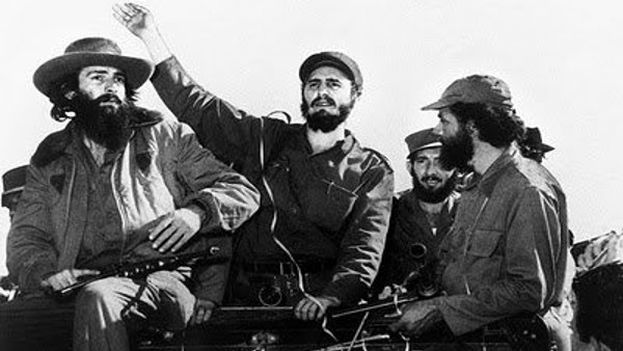
Fidel Castro’s entry into Havana in 1959. (File)

14ymedio bigger14ymedio, Pedro Armando Junco, Camagüey, 24 August 2016 – The level of enslavement of a people is determined by the sum of freedoms that are restricted. Slavery and freedom are two ends of a scale that, as one side slants downward from the weight of the load on its side, its counterpart rises.

I explained this to a high school student some days ago when he asked me if I agreed with the opinion of his grandfather, who told him that the Cuban people are suffering a modern form of slavery. continue reading

It took me a few minutes to answer his question. With teenagers and children one has to be extremely cautious when offering insights, and even more so when they ask questions based on the admiration and respect they have for us. What we express to them can become a dogmatic axiom for their lives. Children are intelligent and think for themselves and then seek out an adult who, for them, has their own opinion.

To dodge his query I answered with another questions;

“What is the basis for your opinion of the condition of a modern slave.”

“Many characteristics, prof (high school students call everyone who teaches them ‘prof’).

“For example?”

“The slaves of previous centuries suffered punishments that today wouldn’t work: shackles, whips, mutilation… But my grandfather says that we Cubans have lost rights that we enjoyed before the triumph of the Revolution and this is called modern slavery.”

The young man’s grandfather had informed him that in January of 1959 more than 90% of Cubans were fidelistas – Fidel loyalists – and that people put signs on their doors saying, “Fidel, this is your home,” and that apparently the Maximum Leader took the offer seriously: he banned the sale of homes and confiscated more from everyone who kept things in their own names than from the rest. This he called “Urban Reform.”

Then he did the same thing with the haciendas and he called that Agrarian Reform. He confiscated the businesses, from the huge corporation to the last little mom-and-pop stands that supported thousands of proletarian families, stretching out their meager earnings. His grandfather had told him all this with a wry smile, saying that even the combs and scissors of the barbers did not escape confiscation. He didn’t know what to call this.

Possession of firearms was prohibited. Anyone who rebelled was shot or imprisoned. The labor unions were nationalized and the right to strike eliminated. The intellectuals were told “within the Revolution everyone and against the Revolution nothing,” leaving the concept ambiguous, but in a clear warning to those who tried to present personal arguments in publications and artistic works of any kind. The Cuban people, as a whole, were left stripped of their basic rights: without possessions, without arms and without the ability to show their discontent. The great ideologues of tyranny, especially Stalin, were always convinced that miserable people were not capable of rebellion.

This happened in the first decade of the Revolution. The results didn’t have to be waited for. The population, all of it, became the proletariat. The ration card arrived, a macabre Leninist idea from when people in Russia were starving to death in huge numbers. The coffee and meat quotas were reduced, along with those of other most needed items. Smallholdings were forbidden from selling their products to anyone but the State; the rancher who slaughtered a cow for family consumption could be punished with a long prison sentence; and so it was with most individual producers, creating the largest monopoly in memory in all of Cuba’s history, including during the centuries of colonial rule.

An official document was created for those who wanted to leave the country: the “white card,” controlled by the Ministry of the Interior and virtually unattainable by the common citizen except in exceptional cases. Cubans became inmates within the limited territory of the island, and all those who emigrated illegally, became a foreigner, stripped of their Cuban citizenship. An even greater limitation, was restricting the right of residents of other provinces to live in Havana.

In 1973, the right of the people to appear directly in court as an accuser was eliminated, regardless of their having proof of being the main injured party, regardless of the damage suffered, thus violating Article Six in the Universal Declaration of Human Rights. “Everyone has the right to recognition everywhere as a person before the law.”

In 1975, tens of thousands of Cuban were sent to fight in Angola. Refusing to serve as soldiers in this war was severely punished, especially among young people doing their compulsory military service. Members of the Communist Party and the Young Communist Union were stripped of their membership, and non-members were fired from their jobs. Thousands of Cubans lost their lives for a cause interfering in the affairs of another country that had nothing to do with them. The Cuban people still do not know the number of their compatriots who died in this adventure.

In 1980, homophobia reached its peak when a group of desperate people invaded the Peruvian Embassy; the Port of Mariel was opened for their deportation, and from there homosexuals, the disaffected and prison inmates were expelled to the United States. President Jimmy Carter’s humanist approach cost the Democratic Party the presidency of the United States.

At the end of the decade European Communism collapsed and Cuba faced a misery unprecedented in its history. The country coped by enforcing major restrictions on citizens, and there was even talk of communal kitchens and creating an indigenous style habitat. Luckily Hugo Chavez showed up with his oil in exchange for highly qualified Cuban personnel, rented out by the State, these “internationalist” collaborators – mostly doctors and other health care workers – received barely a miserable stipend from what Venezuela paid the Cuban government for their work.

Possession of an American dollar was punished by several years in prison. The consumption of fish was restricted to a greater extent and the ordinary citizen never had the right to try seafood, beef or other products from livestock farming.

Then came the new millennium, the high school student’s grandfather explained to him. Time did its work and the leadership of the country passed – apparently, the grandfather stressed slyly – to the hands of Raul Castro, the general president.

The general president opened some opportunities to the beleaguered citizens with his reiterative motto, “without haste, but without pause.” He removed the restrictions on travel, without completely letting go of the rope through a section of a decree. He allowed individual work, despite impeding the economic growth of businesses, and much less authorizing national citizens to make major investments, a privilege reserved only for foreigners. Holding of dollars was allowed, but every remittance received by an individual – from family or friends abroad – had to be immediately exchanged for a currency that has no value outside the country.

The Cuban people continue to drink at dawn a concoction that is not pure coffee. They put “chopped meat” on their tables with such a high proportion of soy it’s an effort to believe they are eating meat. They buy used clothes in the trapishoppings – a name derived from the word for ‘rag’ – donated by charities in other countries. They continue to be paid in Cuban pesos worth four cents each, versus the convertible pesos worth a dollar. They go on vacation to popular campsites along the riverbanks like aborigines, because places like Varadero are reserved for foreigners and senior leaders.

Their proletarian earnings don’t allow them to buy plane tickets to travel abroad and they lack the wherewithal to buy a car. The state monopoly swallows, as if into a funnel, the country’s scanty agricultural production at bargain prices. Popular dissent is not allowed or recognized, and when women go out into the streets carrying flowers in peaceful protest they are beaten, while the voices of dissenters, opponents and freethinkers are hermetically silenced in the mass media, and in the blocking of internet sites and radio broadcasts, which are considered enemies

After listening to all the conjectures of the young high school student, I had no choice but to respond: “You belong to the new generation of Cubans that represent the future of the nation. You are young, talented and a friend of truth and wisdom. You have the right to determine through your own reasoning if the Cuban people are slaves or not; and, of course, the duty to work so that these injustices are eliminated.”

Viñales Pool Owners Rebel Against the Bureaucracy / 14ymedio, Zunilda Mata

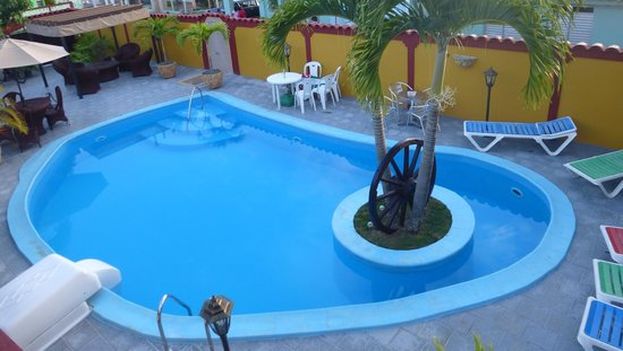
Casa Nenita pool (14ymedio)

14ymedio bigger14ymedio, Zunilda Mata, Vinales, 23 August 2016 – The tables are ready, the glasses shine on the tablecloths and the bar displays a wide variety of beverages. Nevertheless, the restaurant is closed. Some months ago, the ample dining room of Casa Nenita, in Viñales, was full of tourists, but the construction of a pool resulted in the cancellation of the owner’s license for renting rooms and selling food.

The drama that Emilia Diaz Serrat (Nenita) is living through is repeated all over the beautiful valley of Viñales among those dwelling owners who decided to build a pool. The local authorities have required that these entrepreneurs demolish what was built or convert into enormous flower beds the works intended for a refreshing dip.

A muffled fight, which newcomers barely notice, strains the paradisiacal valley crossed by wooded hills, caves and fields of tobacco. More than five years ago and before the touristic flowering of the region, self-employed workers devoted to renting rooms took a further step to diversify their services and began building their own pools. continue reading

However, at the beginning of this year and by surprise, the Municipal Administration Council decreed the closure of all of them and cancelled the rental licenses of those who resisted obeying. The local authorities even used satellite images to detect those striking blue circles or rectangles in the backyards of houses.

Roque, 38, is a private taxi driver who makes the trip between Havana and Viñales every day. Born in the beautiful Pinareño town, he knows each story of the place like the back of his hand. “What they have done here has no name,” he comments while driving his car through the unpaved streets on the periphery of the tourist epicenter.

“They say that the problem is the water, but in recent months it has rained a lot here, and the Jazmines Hotel pool (state-owned) is always full,” complains the man. So are those of La Ermita lodging and the popular campground Dos Hermanas, which belong to the state. Like a good many local residents, Roque believes that the measure is “an extremism” by the authorities against “those who produce more money in the area.”

The Viñales hosts pay the Tax Administration Office (ONAT) about 35 CUC every month as a license fee for each room that they rent. To that is added 10% of their income and payments for social security.

At first there were plastic pools bought in stores like those of Plaza Carlos III in Havana for a price of between 600 and 1,800 CUC. Hardly a water reservoir where customers could cool off from the torrid summer and fulfill their dreams of an idyllic vacation on a Caribbean Island.

The accommodations with a pool had an advantage in a town with 911 dwellings that are licensed for renting and in which more than 80% of tourists who arrive in the Pinar del Rio province spend the night. Offering a swim in the garden was a plus for attracting clients.

Little by little, the temporary became permanent. Glamorous designs replaced the plastic of the first, almost infantile pools. Beautiful ones, with islands of coconut palms set up in the center, an irresistible blue depth and sophisticated pumping system, began to appear everywhere. The investments in some cases exceeded 8,000 CUC.

In Cuban stores they barely sell the bleach compounds, disinfectants or products necessary for cleaning pools, but a thriving informal framework provides everything needed for their maintenance. In most cases the products are imported personally and receive authorization for entry in Customs, or they are diverted from the state sector.

The Viñales self-employed had to overcome all those obstacles, and at no meeting of the group of Dwelling Landlords or in the Delegate “Accountability Assemblies” were they warned to discontinue their renovations, a detail that they now reveal in order to try to stop the official assault.

Some sought solutions in order not to depend on water supplied through the pipes that arrive from the street. “When they told us that the problem could be the water, I hired a state brigade to dig a well, but not even that way could we stop this curse from above,” says M., owner of one of the houses whose license was withdrawn and who preferred to remain anonymous for fear of reprisals.

The onslaught came from all sides. Thirty-two rental licenses were withdrawn and only the homeowners who obeyed the sudden order to demolish or fill in their pools with dirt kept their permits. Those who raised their voices to complain about what is happening have received the treatment for “counter-revolutionaries” and a greater surveillance of their movements, they protest.

“We have hired a lawyer, the head of a provincial firm, in order to advise us, but so far it has not helped at all,” complains M. “We have gone many times to the People’s Municipal Power and the Municipal Party, but we have not gotten coherent answers.” He clarifies, however, that they do not want to turn this “into a political issue, because otherwise they will never arrive at a solution.”

Dozens of these owners even spent a night in a park in order to have a meeting with the president of the Provincial Assembly of the People’s Power, but the meeting never took place. They were surrounded throughout the wee hours by agents of the Special Brigade, two police patrols and a bus from the Technical Department of Investigations (DTI) as if they were a gang of dangerous criminals.

“Here the state invests little and demands a lot,” explains an employee of the Olive Tree restaurant, located on the main street of Viñales. “We have raised this place up, the entrepreneurs, because twenty years ago this place was half dead and today it is one of the country’s most important tourist destinations.”

In September 2014, Resolution 54 from the Institute of Physical Planning made clear that it would not award new licenses for the construction of pools, but the majority of the 28 that are in dispute today in Viñales were built before that date. In January of this year, the Official Gazette introduced new fees for the use of pools in the private rental sector.

A letter sent to Raul Castro in June by a group from the area of rental property owners affected by the prohibition is still unanswered. “We decided to make this report to you so that you may know that the doors to development in this country are closing,” say the claimants in the missive. Some of them talked hopefully this weekend of a prompt correction of the measure, but their predictions are more like hopes than certainties.

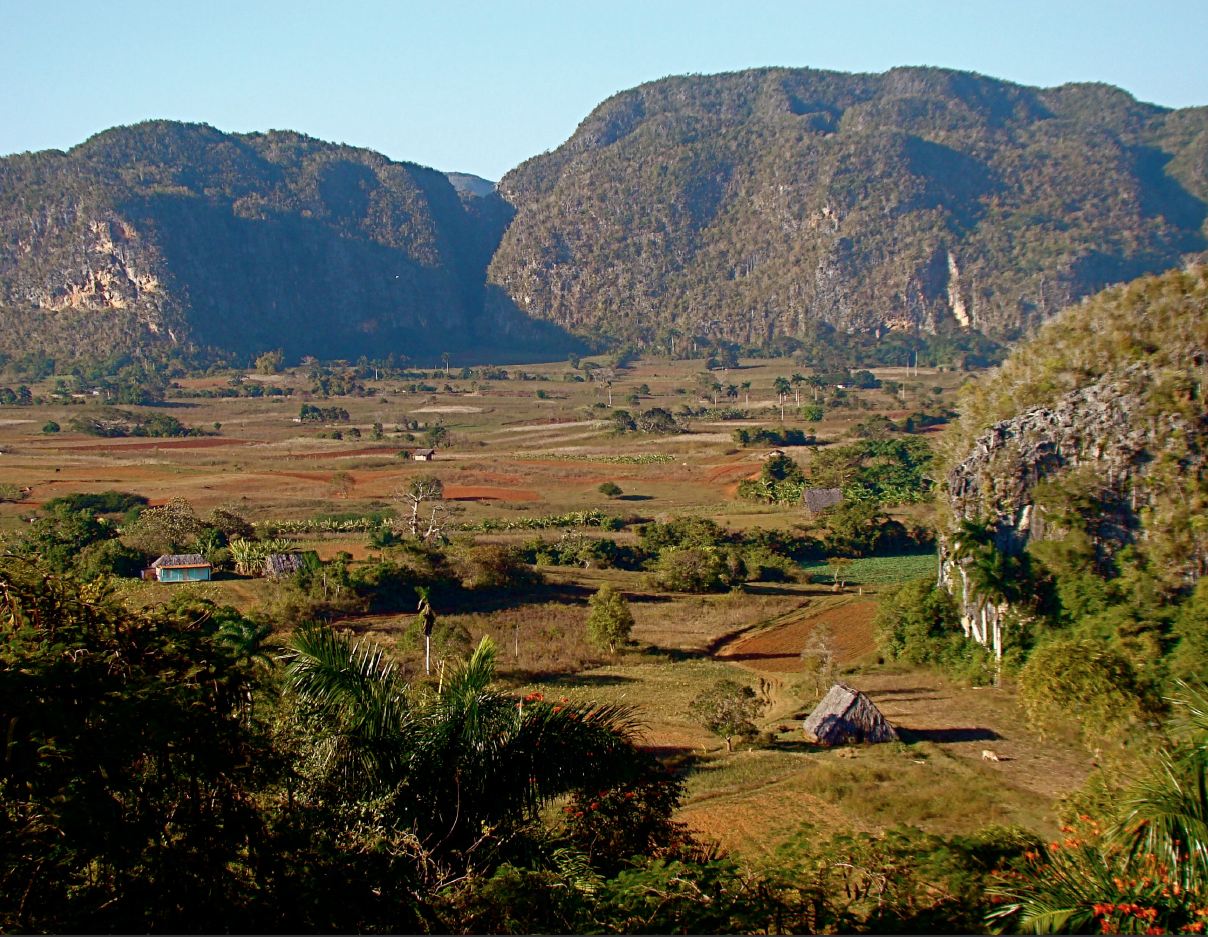
Viñales Vally landscape (MJ Porter)
Viñales Vally landscape: tobacco growing in the foreground, “mogotes” in the background. (MJ Porter)

They do not understand a decision that they think was made in a “precipitous manner” and “without taking into account the consequences that this would bring for tourist development” in the area. In the text that they delivered to the Council of State’s Office for Attention to the People, they characterize the measure as “unjust, disproportionate and out of step with the times in which we live.”

“I’m not going to empty the pool,” Nenita emphatically says under the inclement August sun, and meanwhile on her whole property not even the buzz of a fly was heard. The residence has been empty for weeks although in the streets of the tourist center visitors are stacked up in search of a room and on the TripAdvisor booking site her house is the best rated in the area.

Six other hosts also are prepared to “continue fighting” to keep their pools, in which, right now, no tourist bathes and which are only beautiful mirrors of water reflecting the mogotes, Viñales’ striking landforms that played an important part in its designation as a UNESCO World Heritage Site.

Translated by Mary Lou Keel

‘Coffee, Three Cents’ / 14ymedio, Pedro Campos

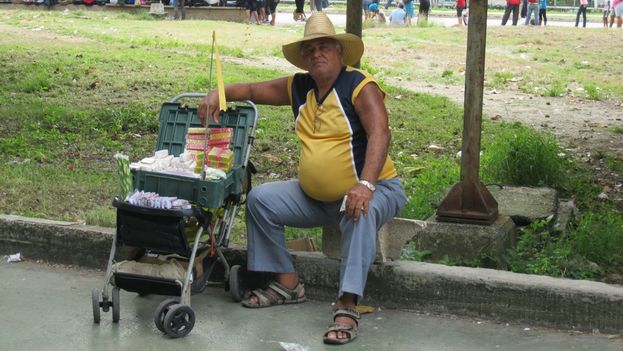
An independent seller of peanuts and sweets on the streets of Havana. (Luz Escobar)

14ymedio bigger14ymedio, Pedro Campos, Havana, 23 August 2016 – Self-employed Cubans are tossed out of places where they’ve contracted with the State to work, without consideration of the consequences for them and violating what is established in their “contracts.” Recently this happened in Pinar del Rio, according to various reports, thanks to the redevelopment of the city boulevard. But this happens commonly all over Cuba.

An emblematic case happened in a Havana park when it was closed to the public for repairs and two dozen self-employed individuals, among them food vendors, sellers of toys, balloons and baby things, photographers, parking attendants and others, were left without work and without any ability to demand redress, although they had one year contracts and their licenses, payments and other documents were in order. continue reading

Months later, having finished some light painting and other things that could have been done between Monday and Friday without closing the park, which was mainly used on Saturdays and Sundays, this important recreation area was reopened, but under another administration.

The protests of the self-employed were ignored. The new administration had no “responsibility to the old contracts,” they told those who tried to reestablish themselves there. They needed new contracts for which they had to present all new documentation, photographs, self-employment licenses, tax payments, letters of good conduct from their local Committees for the Defense of the Revolution, and other things.

About twenty self-employed people were out of work for months, and had no recourse. The new administration set up new contracts with other self-employed people and some of the previous ones who had learned about it in time when they reopened the park. Others weren’t able to get new contracts. The opportunities were limited. And the previous contracts? Fine, and you?

In Cuba it is very normal that when the management of a company, a factory, a municipality or a province change, many other things also change.

It comes from the genesis of the top-down statist system introduced in Cuba by Fidel Castro, in the name of a socialism that has never existed other than in the dreams of many Cubans.

With the new administrations there are always changes among the most important positions, in the relationships between bosses and subordinates, in the old and new privileges granted by the boss, and in the way a business works in general.

And for this model – top-down, directed, bureaucratic, paternalist and populist – “the cadre is the backbone of the Revolution,” as Che Guevara said in one of his programmatic writings, not institutions nor their arrangements. According to this philosophy, present in Cuba at every step, when the cadre, that is the backbone, doesn’t exist, the whole body collapses.

This philosophy on leadership and management is very typical of Stalinist regimes, where the central figure, the leader, and his decisions are everything for his political subordinates. It happened in the USSR and other “socialist” countries: the bureaucracy, the so-called “unforeseen class,” according to some scholars, quickly adapted to the changes and went from socialist bureaucracy to capitalist bureaucracy, or from virtual owners in “socialism” to real owners in the new private capitalist model.

It is like one of those historical regularities of state-socialism, which invariably is found in the system at all levels and everywhere.

So it was not surprising that the fall of a leader changes many things, because these personality-focused governments are not capable of generating structures or institutions that serve the interests of the majority and the communist parties themselves, in reality, have been nothing more than political armies loyal to their founding bosses.

Today we see the Cuban Communist Party is incapable to presenting a program of consistent, comprehensive development for the Cuban nation and where, backwards and forwards, exclusions, designations, impositions, contradictions and failures are our daily bread.

Thus, those who think that the general rules that govern the country won’t change until there is a change in our administrator in chief are not mistaken, the same as always, and then, when other winds blow through Cuba, the loyal bureaucracy will act like the coffee seller who was walking along the wall of the Malecon in Havana in 1961, when the Bay of Pigs invasion happened. As he hawked his little cups of coffee he called out, “Cafeeé, … Cafeeé tres centavos, tres centavos” and when he heard that the American boats could already be seen approaching the coast, he quickly revised his come on: “Coffeee, three cents … Coffeee, three cents.”

Camagüey Has No Water Despite a 40 Million Dollar Loan from Saudi Arabia / 14ymedio, Ignacio de La Paz

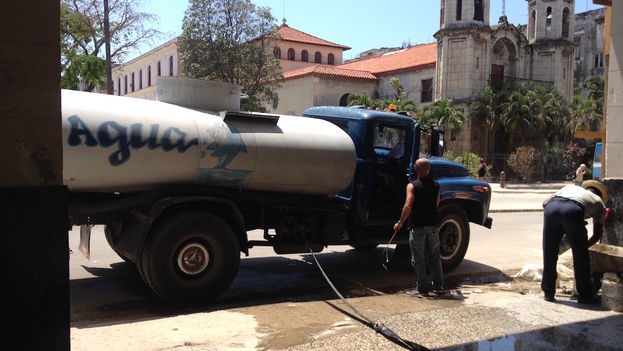
Water supply truck, last April, in Havana. (14ymedio)

14ymedio bigger14ymedio, Ignacio de la Paz, Camagüey, 23 August 2016 — The water supply crisis suffered by Camaguey, the third largest city in Cuba, worsened this August despite the spring and summer rains. Although the supply in some areas of the city presents no difficulties, in the historical district the situation is truly critical and citizens must resolve it as they can.

“I get water every day, clean and with good pressure,” said Luis, a resident of the Avenue of the Martyrs, in the neighborhood of La Vigia, in the north of the city. “I boil the water, treat it with sodium hypochlorite and we drink it.” Quite another thing happens to Roberto, who lives on Calle San Pablo, in the city center. continue reading

“I haven’t had water for three days. The water here comes very irregularly. Sometimes there’s no water for a week, and I’ve spent a whole month without water. I don’t have the strength to carry water. I was operated on for a hernia, but I still have to carry buckets of water from the tanks at workplaces. I live on a corner, I can’t dig a well, or install a tank, because the sewer pipe runs under the house. Nor can I install a “water thief” (a makeshift pump that “steals” water) because there is almost never water in the tap.

“Here in the higher area almost no one has water, and it’s the same in Hermanos Agüero and Principe Streets,” complains Heriberto, a resident of Cisneros Street. “The little that comes is taken by the Marquis and La Sevillana tourist hotels, which have huge tanks.” A resident of Havana Plaza, Hilda says that the water supply in the area is irregular and the greatest problem “is that it is very dirty.” She adds, “You have to let it sit for several days before you can use it. I don’t know why the water problem hasn’t been solved, when there was a big hullabaloo in the press about Saudi Arabia providing a loan to solve Camagüey’s water problem and now we don’t hear anything more about it.”

The official newspaper Adelante, in its issue of 20 August 2016, addressed the problem of water with a series of justifications based on lack of resources and investments. However, it omits mention of the soft loan of 40 million dollars from Saudi Arabia, granted in December 2014, to improve Camagüey’s water and sewer systems.

In an interview with Radio Camagüey on 13 April 2016, Luis Palacios Hidalgo, director of the Aqueduct Rehabilitation Project, and an official of the National Institute of Hydraulic Resources Delegation, promised that starting in June of this year the province would have – thanks to the credits granted – the “technological equipment and devices necessary for the aqueduct, guaranteeing the quantity and stability of water for the people.” To do this, he detailed, 1.8 million pesos will be dedicated to a water treatment plant.

These promises have not only not been fulfilled, but the situation has gotten worse. As for the Saudi credit, there has been no information about where the 40 million dollars is, how much of it has been used and how and why the project has been so delayed. Meanwhile, Roberto, Heriberto and so many other Camagüeyans continue to carry buckets of water in the afternoon for bathing and cooking.

Raul Castro Tells Intellectuals That Cuban Culture is Threatened / EFE, 14ymedio

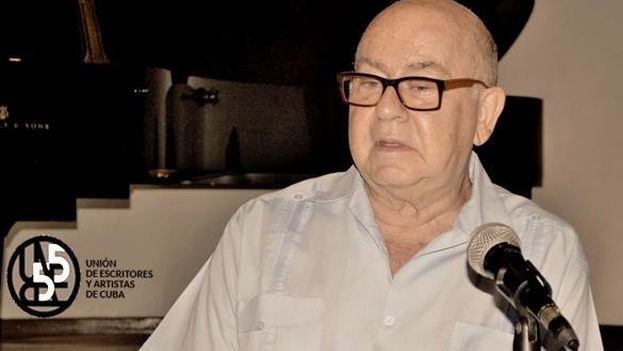
Cuban Writers and Artists Union President Miguel Barnet. (UNEAC)

14ymedio biggerEFE (via 14ymedio), Havana, 23 August 2016 – Cuban President Raul Castro warned in a message to the island’s intellectuals and artists that the country’s culture is threatened by “subversive projects” and a “global wave of colonization,” although he is confident that they can confront the challenge, according to an article in the official media published this Tuesday.

The letter, read last night during the celebration of 55 years of the official Cuban Writers and Artists Union (UNEAC), congratulates an institution “that was born in a decisive stage of the Cuban Revolution” and has been “at the service of culture, considered by Fidel as ‘the nation’s shield and sword’.” continue reading

“Today we are doubly threatened in the field of culture: by subversive projects that aim to divide us and by the global wave of colonization. UNEAC will continue to face these complex challenges with with courage, revolutionary commitment and intelligence,” says the statement, read by the president of the organization, Miguel Barnet.

Castro’s statement made reference to the 1961 Words To The Intellectuals of his brother, Cuban leader Fidel Castro, among other events that preceded the creation of UNEAC, and mentioned its first president, the “great” Nicolas Guillen, Cuba’s national poet.

“On getting to this day my congratulations go to the founders and the generations that have given continuity to the work begun in August 1961,” concludes the message, which appears in newspapers above the signature of Raul Castro.

In recent months, after the formal restoration of relations with the United States with the reopening of the embassies in both countries in July 2015, Cuba has become a fashionable destination among artists and intellectuals of all kinds, who have seen something of a thaw in the culture.

Havana has served as the backdrop for the filming of TV shows and movies such as House of Lies and the most recent episodes of the cinematic sagas Fast and Furious and Transformers, while celebrities such as Katy Perry, Rihanna and Madonna have walked its streets.

In a display never before seen in the country, The Rolling Stones gave a free concert in March in Havana, an unthinkable event in previous decades.

A month later, important figures from the United States in all fields of art and intellectuality formed a delegation of over 50 members and guests of the President’s Committee on the Arts and Humanities, which arrived in Havana with the support of the US President to strengthen cultural ties.

In May, couturier Karl Lagerfeld and Chanel staged a milestone in the history of the island by bringing together celebrities and supermodels in an unprecedented parade of the prestigious French fashion house’s haute couture, which disembarked for the first time in Latin America with its Cruise Collection.

However, last July Cuba’s Council of State, at the proposal of President Raul Castro, ousted Minister of Culture Julian Gonzalez, who was provisionally replaced by Abel Prieto, who had previously held that responsibility for 15 years until 2012.

The dismissal was announced in a terse official note published in the official media, in which, as is common in Cuba, the reasons for the ouster were not mentioned.

See Also:
A Pawn to Distract You
The Persistence of Fear
Cremata Expresses an Artist’s Bellyful Against Cultural Repression

Foreigner For One Day, Foreigner Forever: Diary of a Returnee, Part 2 / 14ymedio, Dominique Deloy

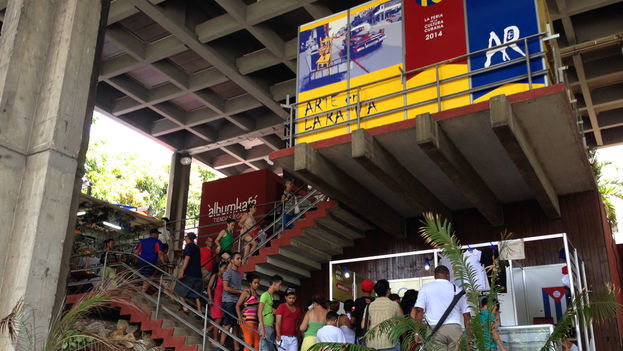
A foreigner can pay up to 12 times more than a Cuban to enter cultural events such as the La Rampa Art Fair. (14ymedio)

14ymedio bigger14ymedio, Dominique Deloy, Havana, 22 August 2016 — How do Cubans to know I’m not from here? I wear the same clothes as Cubans (shorts, shirt and sandals) and my skin is not that white in this scorching summer. Also, I flatter myself I speak pretty good “Cuban”… So why do I still feel like a perpetual stigma like I’m being “délit de faciès” (racially profiled) as we would say in France to refer to those who control the streets and target immigrants with no other motive than their physical appearance. Why am I forced to hear continued calls in the street of “Hello my friend?” in English. Followed in Spanish by “Do you want a taxi, a good private restaurant, where are you from? What language do you speak? Do you want to go to the beach?”

Why can’t I just seem normal, like the rest of the citizens, and not an almost extraterrestrial being? Why is the label of tourist stuck to my forehead, as if I was suffering from an obsession that consists of touring the island over and over? Ten years from now will they still be offering me wooden statues of Che berets? Why doesn’t anyone think I live here, and even work here, in exchange for a Cuban salary? continue reading

But that is not all. A few days ago, at the La Rampa Art Fair, I had to pay 2 CUC to get in (just to have the right to buy things inside!). My partner, nowever, was only charged 4 Cuban pesos, that is twelve times less than me.

What bothers me most is that everything is implicit, natural, wordless, without explanations, just from looking at my face. And so it is at any cultural event, except the movies, thank God: 2 Cuban pesos for everyone, the only time I become a normal person.

I think that over a long time, despite globalization, an invisible barrier has been raised between Cuba and normal people, between normal Cubans, and the “strange” foreigners. I hardly know if my status as a foreigner is more a positive or a negative from the perspective of Cubans, who generally seem to be well disposed toward me. There is an invisible but unalterable barrier, and I can’t figure out if it’s because Cubans appreciate foreigners. Happily, I left behind the era when my future husband had no right to sleep with me in a hotel or a private B&B, much less swim with me in the crystalline waters that bathe this island, when – at that time, yes – I really was a tourist.

Preparing For The New School Year Amid Economic Constraints And Teacher Shortages/ 14ymedio, Luz Escobar

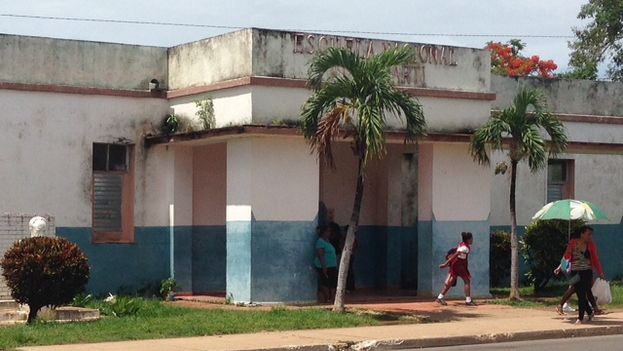
A primary school in Candelaria, Pinar del Río. (14ymedio)

14ymedio bigger14ymedio, Luz Escobar, Havana, 20 August 2016 – The 2016-2017 school year starts in just two weeks and the authorities of the Ministry of Education are calling on people to take good care of school supplies given “the economic limitations of the country.” Department head Ena Elsa Velaquez Cobiella, also acknowledged the lack of teachers in several territories, a problem that last year amounted to a deficit of 10,300 teachers island-wide.

For the upcoming school year, among the provinces with the most significant lack of teachers are Ciego de Avila, where an exodus to other lines of work has caused a shortage of 663 education professionals. These positions will be covered, according to Barbara Rodriguez Milian, Provincial Director of Education, with “personnel contracted for on a hourly basis, a university contingent, and methodologists and the boards of directors of the schools,” as the official told the local press. continue reading

In Villa Clara, meanwhile, Director of Education Esperanza González Barceló recently acknowledged that there is “a deficit of over 1,000 teachers” in that territory. The official said that it was necessary to “seek alternatives” to cover the deficit, and said she will appeal to “professionals and college students, whether or not that have teaching degrees,” so work under contract.

The limited number of staff is a problem compounded by the physical state of the schools because, according to Gonzalez Barcelo, more than 60% of the schools in the province are in critical condition.

Santiago de Cuba province is one of the few that is in good shape, and according to local media has “filled all the positions” and created “a reserve of 620 teachers” for primary education. The department head said that the territory has “met the needs for pencils, notebooks and crayons” despite “the economic limitations of the country.

Education authorities have tried to play down serious deficit of teachers in the media as September approaches, and during an appearance in Camagüey, Velázquez Cobiella said that “more than 5,000 new teachers” just graduated from the School of Education and will take their places in front of classrooms nationwide in a few days, but that number fails to cover the accumulated shortages.

In a measure to accelerate the training of teachers, for the next school year, a teaching degree program will last only four years, not five as it had been up until the last school year.

New scenarios, such as the restoration of relations between Cuba and the United States have introduced some issues in the training of teachers, a detail that was not absent from the preparatory workshops for the new school year. Now teachers should emphasize during their classes on topics related “to the teaching of history, the prospects of relations between Cuba and the United States, the ideological and political subversion,” among others.

Since the fall of the socialist camp in Eastern Europe Cuban education has been undergoing an accelerated process deterioration, affecting materials and educators. The complaints of the population over the poor quality of teacher preparation, the reduction in the number of classes and the excesses of ideology when teaching certain subjects, have grown in proportion to the collapse of the sector.

The exodus of teachers into other employment sectors and emigration led the authorities to implement a teacher training program at the beginning of this century called “emerging teachers” – that is starting students not yet out of high school in teacher training programs and placing them in front of classrooms with as little as two years of preparation – as well as the introduction of classes taught by TV and videotape. These measures failed and are currently being reversed.

See also:

The Instant Creation of Emerging Teachers

Cuban Teachers Desert an Increasingly Despised Profession

The Challenges of Young People

From the Denial of the Denial to the Denial of the Obvious

They Taught Us to Lie, Steal and Pretend

Reaping the Whirlwind


FANTU Activists Ask Obama to “Save the Life” of Guillermo Farinas / 14ymedio

Guillermo Farinas on hunger and thirst strike. (Courtesy)

14ymedio bigger14ymedio, Havana, 21 August 2016 — A group of activists from the Anti-Totalitarian Forum (FANTU) have sent an open letter to President Barack Obama, asking him to “save the life of Guillermo Fariñas Hernández” who, as of Sunday, has been on a hunger strike for 32 days. The missive is addressed to the leader as “president of the country which is a beacon of human rights in the world.”

Seven members of the opposition organization which is led by Fariñas, winner of the European Parliament’s Sakharov Prize for Freedom of Thought, are asking Obama to “use his political wisdom to take any action” that would avoid the death of the dissident. However, they clarify that the letter is not asking the US president to do “something tied to politics.” continue reading

The opponents explain that “Fariñas Hernández’s strike is against violence, he has not called for the overthrow of the government.” Instead of them, with his prolonged fasting the activist from Santa Clara is demanding “the end to the oppression by some against others because of the way they think or how they choose to honestly obtain their income.”

Which, according to the signers, “is not to risk a life on a hunger strike, because it is the very essence of the democratic governments of all countries in the world.”

Guillermo Fariñas has been very critical of the process of normalization of relations between the governments of Cuba and the United States that began during the administration of Barack Obama.

Since December 17, 2014, when the diplomatic thaw was publicly announced, Fariñas has labeled the actions of the US president as a betrayal of Cuban dissidents.