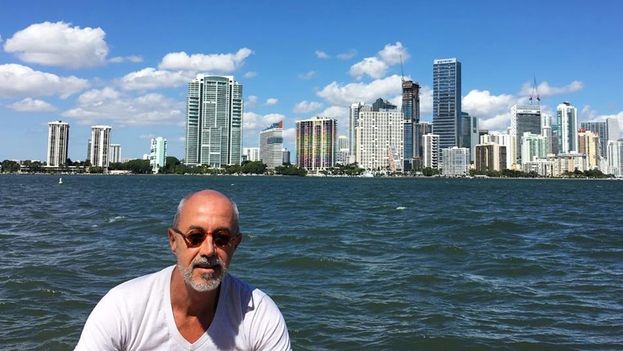
Cuban Film Director Juan Carlos Cremata Relocates to Miami / 14ymedio

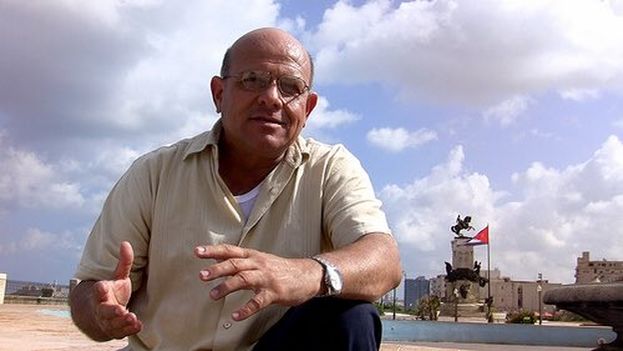
Juan Carlos Cremata in Miami. (Courtesy)

14ymedio bigger14ymedio, 5 November 2016 — The Cuban filmmaker and theater director Juan Carlos Cremata decided to stay in Miami and become “one more exile,” according to the newspaper El Nuevo Herald.

Cremata had been censured for his production of El Rey Se Muere (in English known as “Exit the King” or “The King is Dying”), a work by Eugene Ionesco, staged in Cuba by the El Ingenio theater group in July of 2015, which officials of the Cuban Ministry of Culture took as an allusion to the former president Fidel Castro, and the play was shut down after two performances. continue reading

After the dissolution of the company and the ban on Cremata’s working in film or theater in Cuba, the artist wrote letters of protest that were widely reported in the international media.

Invited by the PEN Club of New York to participate in the World Voices Festival, Cremata, age 54, decided to remain in the United States.

“When I sensed that in Cuba I would not be permitted to even ‘shoot a pea,’” I decided not to return to the island,” the filmmaker told the Miami newspaper.

“Some officials pressured a few friends who were helping me not to do so. Without saying a word it was clear that that they would not let me do anything more,” said Cremata, who said it was clear that he would be confined to “a low profile, which is like a living death.”

“They condemned me to ‘not be’,” he explained.

“And if the Revolutionary slogan is simply ‘homeland or death,’ the most logical and reasonable is to seek a life elsewhere, even it starting from scratch.”

Cremata is planning to initiate an ambitious project called “Memories of Exile,” to be published on social networks. He also plans to bring to life the work El Encarne (The Incarnate), “the only musical written by Virgilio Piñera, which has never been produced.”

“Come what may, I intend to continue making Cuban culture. To reflect truthfully and to speak with propriety about the millions of stories generated in exile,’ said the artist.

A Carte Blanche to the Market of Tourists’ Dreams / 14ymedio, Marcelo Hernandez

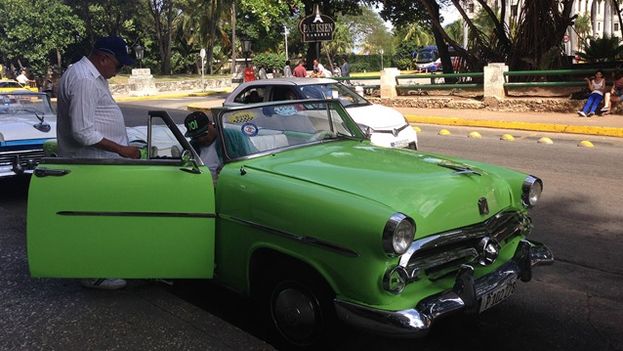
Since early this year in the streets of Havana the best-preserved vintage cars can be seen with their yellow stickers allowing them to operate at hotels and airports. (14ymedio)

14ymedio, Marcelo Hernandez, Havana, 4 November 2016 — For tourists coming to Cuba, one of the most cherished fantasies it is to get into a car of the last century and cruise the streets of cities and towns. A new type of permit for private carriers is bringing that dream even closer to reality, as it authorizes the drivers to operate at airports and in the vicinity of hotels.

Since early this year in the streets of Havana you can see that the best-preserved models of Chevrolet, Oldsmobile, Cadillac and Ford displaying a yellow sticker on their windshield. It is the carte blanche to park outside hotels and legally offer their services to foreigners. continue reading

Previously, the areas of the Cuban capital most frequented by tourists were a feudal estate, where the only legal operators were the so-called Panataxis and the vintage cars owned by the government. The self-employed had to settle for picking up tourists on the periphery or managing the business through intermediaries.

The mouth-watering market for tours in convertible cars for recently arrived visitors, costing between 40 and 50 Cuban convertible pesos (CUC) per hour (about $40-50 US), is attractive to drivers everywhere. Antonio Martinez, 52, is one of those who long to get the “yellow sticker” that would “turn a pumpkin into a carriage,” as he says sarcastically about his old Toyota jeep.

“I’m getting less and less business on the route between Santiago de las Vegas and Fraternity Park,” the driver explained to this newspaper. The entrepreneur spent more than five years working as a collective taxi driver focused primarily on domestic customers.

However, since the middle of this year local authorities have imposed price caps and “business is getting worse,” said the driver. “Many are switching to this type of work with tourists, because it always pays better and there’s the tip on the side,” he adds.

Following a decision by Havana’s Provincial Administration Council, it was established that the carriers cannot decide to raise fares on their own, and only the prices charged before July 1 are acceptable. The majority of drivers have shortened their routes and others make deals with the riders not to reveal to the inspectors the actual fares paid.

But Martinez is tired of this “cat and mouse game.” After an investment of more than 2,000 convertible pesos to make his car “as smooth as silk,” the driver has begun the process to obtain the longed-for sticker that would allow him to “carry Pepes without having to be hiding around corners,” he says.

Competition is strong, because of the more than 496,400 people throughout the island who were engaged in self-employment at the beginning of this year, at least 50,482 carry cargo and passengers. But there is a very small number who have cars “in the impeccable condition that is lovely in the eyes of the tourists,” says Martinez.

Asking around among other drivers who already have the sticker to operate in tourist areas and make “airport pickups,” led the self-employed driver to the No. 9 taxi base on Ayestaran street.

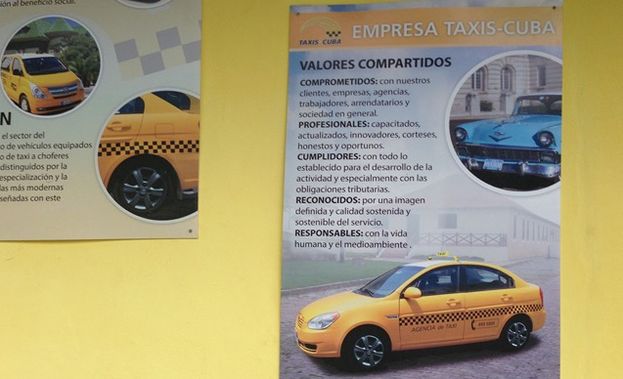
Characteristics of Cuban taxis promoted by the authorities of the sector. (14ymedio)

It was not as easy as he thought. The director of the state agency, Ernesto Reyes, first described to him the simplest requirements to achieve his goal, including “opening two bank accounts, one in national currency and another in convertible pesos, and taking out the operating license needed by all taxi drivers.”

To not lose the sticker, drivers must pay about 25 CUC and the same amount in national currency, the Cuban peso. “With that you will be allowed to park outside Havana hotels and may take or collect clients at the airport, but it is not valid to go to Varadero beach,” said Reyes.

The most insurmountable barrier is that with the new permit the driver is required to “consume 90 gallons of fuel monthly” that must be purchased at the taxi base on Ayestarán Street at a total cost of 360 CUC. The measure seeks to prevent the self-employed from turning to the informal market to buy their fuel*.

Antonio Martinez has decided to “leave the yellow sticker for another time” because, he said, “rather than a permission, it seems like a shackle.”

*Translator’s note: The “informal market,” in this and other cases, is essentially state resources that have been “diverted” (stolen) for sale on the black market. Much of the Cuban economy – at all levels, from households to businesses – is supported by “under the table” purchases of diverted state resources.

14ymedio Reporter Sol Basulto García Arrested In Camagüey / 14ymedio

Sol García Basulto
Reporter Sol García Basulto was arrested Thursday night when she was preparing to travel to Havana. (14ymedio)

14ymedio bigger14ymedio, Havana, 4 November 2016 – The reporter Sol García Basulto was arrested by Cuban State Security Thursday night when she was traveling to Havana. The correspondent for 14ymedio in Camagüey was intercepted on the way to the capital by officers who handcuffed her and confiscated her belongings. About two in the morning she was released, with a warning that she cannot leave the province for 60 days.

The arrest occurred on the outskirts of the city, when the bus was stopped at a checkpoint. Several police officers entered the bus, handcuffed her and put her in a patrol car, taking her to a State Security unit in the Montecarlo neighborhood. continue reading

“They never gave me an explanation of why I was being arrested,” she said, in a telephone call to the 14ymedio newsroom in Havana. “At the unit I resisted giving them my belongings because they wanted to take my cellphone and my documents.”

“Six people seized me violently, five men and a woman, and took away everything I had, except for my passport.”

“I have to go every Wednesday to the State Security unit because I am charged with disobedience,” she detailed. If she does not appear, “a retentive measure will be applied,” she reported.

Basulto Garcia was heading to Havana to visit the newsroom of this newspaper and to begin the paperwork to travel abroad. The reporter would have gone to the Panama consulate on Friday to request a visa to participate in a course on investigative journalism, at the invitation of the Latin American Press Association.

A contributor to the magazine Hora de Cuba (Cuba’s Hour), and a reporter focused on cultural issues, García Basulto has been harassed in recent months for her work as a freelance journalist. In February of this year she was interrogated and threatened by the political police and told not to continue her work.

“They don’t like my work,” the reporter wrote in an email previously after suffering various pressures. “They warn me that I am constantly watched and that I am in their hands,” she said at that time.

Former Cuban Political Prisoner Arnaldo Ramos Lauzurique Dies / 14ymedio

The former political prisoner Arnaldo Ramos Lauzurique died in Havana at age 74. (14ymedio)

14ymedio bigger14ymedio, Havana, 3 November 2016 — On Thursday morning former political prisoner Arnaldo Ramos Lauzurique died in Havana at age 74 after a long battle with cancer. The funeral of the regime opponent, sentenced to 18 years in prison during the Black Spring of 2003, will take place at 7:50 pm on Friday after a wake at the National Funeral Home on Infanta Street.

Ramos Lauzurique was released from prison on parole in November 2010, as a result of the negotiation process involving the Catholic Church, the Cuban government and Spanish diplomacy. The activist rejected going into exile despite receiving in call in prison from Cardinal Jaime Ortega y Alamino to seeking to arrange his departure. continue reading

On the decision to stay on the island, the opponent told 14ymedio in March of last year that “a lot has happened since that time, but there’s no going back.” He kept a critical eye on the Cuban Government and considered that the authorities of the island “have no willingness to change.”

“He was an excellent economist, a beautiful person, he never had any problems problem within the opposition in which he was involved for over 25 years,” recalls the dissident Martha Beatriz Roque Cabello. “A person dedicated to study, a born analyst and he also liked to write about economic problems,” she added.

“It’s a shame we have lost him,” said Roque Cabello, who was involved with him on multiple opposition projects.

Earlier this year, before US President Barack Obama’s arrival on the island, the government granted permission to travel outside the country only once, to former prisoners of the Black Spring still residing in Cuba.

Lauzurique Ramos did not make use of that special permission to leave because he was in very poor health after surgery last December.

One Family Loses All Its Belongings In A Fire In Old Havana / 14ymedio, Yosmany Mayeta Labrada

The family is temporarily housed in the nearby Casa del Pedagogo. (14ymedio)

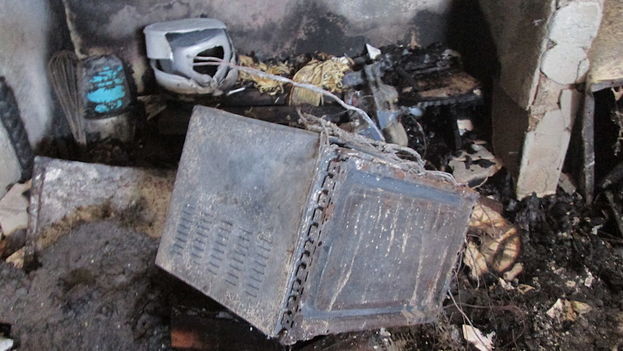
14ymedio bigger14ymedio, Yosmany Mayeta Labrada, Havana, 3 November 2016 — A raging fire reduced to ashes this Wednesday all of the belongings of a family at 263 Mercaderes Street, in Old Havana. The incident caused no fatalities. The family is temporarily housed in nearby Casa del Pedagogo, while insisting it will not accept living in a shelter.

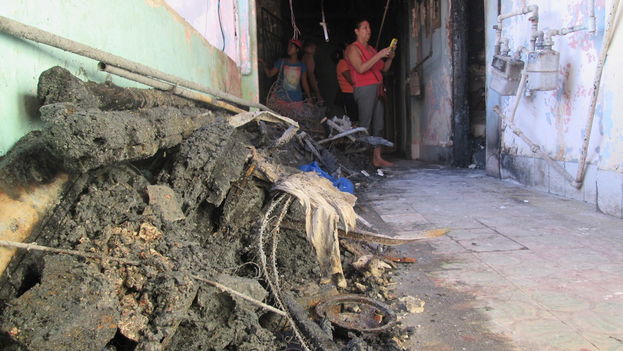
The fire broke out around noon, when the house where two women and a 4-year-old girl lived was empty. One of its residents, Francis Marais Acosta Ramirez, 21, had gone to the market at the time the fire started. “I have no strength to speak,” she tearfully told 14ymedio on Thursday. “So many years of effort and sacrifice turned into ashes, I still can not believe it,” she exclaimed as she pointed out all her belongings transformed in a gray pile outside the building. continue reading

“We have lost all our appliances and even the money we saved to buy an air conditioner that was stored next to the clothing,” complained Acosta Ramirez, who has received the condolences and solidarity of her closest neighbors.

“The firefighters soon arrived,” says a neighbor while cleaning out the water that had entered her home during the efforts to extinguish the fire.

The images of the flames coming from the windows of the third floor of La Cruz Verde building quickly spread through social networks. The location of the property on one of the busiest streets in Havana’s historic center facilitated the recording and subsequent dissemination of the incident.

The eight apartments on the third floor were also affected, along with those on the floor below.

On Thursday morning several social workers from the Municipal Labor and Social Security Department came to the building to quantify the damage. Odalis Martinez, a social worker, explained that her task was to assess the situation and provide a summary to the directors of the Council of the Municipal Administration (CAM) of the People’s Power. “They will be the ones who respond,” said the young woman, who explained that social workers are only “mediators between the government and the people, nothing more.”

Jose Luis Garcia, a resident affected by the incident, said the damage caused by heat, fumes and smoke spread across all the housing units. “I was not here when it happened, but a wave of heat came through the bathroom window that melted my blender and affected other appliances in the house”.

The fire broke out around noon, when the house in which live two women and a four-year-old girl, was empty. (14ymedio)

“The door fell out and since yesterday we are without electricity, water and gas, because all these facilities were destroyed,” insists a neighbor. If the damage is not dealt with promptly, the neighbors plan to address the government agencies to demand a response.

Another neighbor who requested anonymity said that the power grid of the building was in poor condition. “For years we have been suffering from the poor condition of the cables, but we had to fix the breakdowns ourselves and problems still persist.”

Requiem for the G Café / 14ymedio

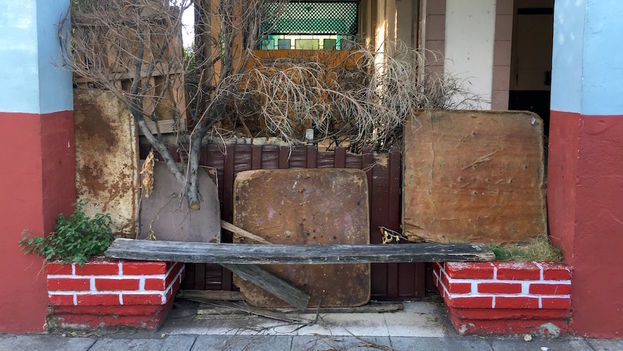
Some tree branches have been placed to block the entrance. (14ymedio)

14ymedio bigger14ymedio, Havana, 1 November 2016 — With the same impulse with which many vegetarian restaurants were opened across the country at the beginning of this century, there also arose the concept of a literary cafe, a place to mix culinary consumption and good reading. With reasonable prices and with a clientele of regulars, those places have disappeared without any official announcement to explain their downfall.

The most emblematic of these sites opened its doors in 2005 at the intersection of 23rd Street and Avenue of the Presidents in Vedado and was known as the G Café. It barely differed in design from the previous Tea House that had been very popular in the late nineties. Today, the building shows signs of abandonment, with no commercial activity on one of the most important corners in Havana.

When it opened, the place offered both mojitos and daiquiris, although with the passing of the years it was common to hear the employees say “there isn’t any,” and “we’re all out.” The lack of menu items was sapping the popular site, condemning to closure this joint initiative of the Young Communists Union and the Cuban Book Institute.

If, in the early years, the walls of the G Café displayed drawings and photos by Cuban artists, today they display only dampness and a bad smell. Some tree branches have been placed to block the entrance and the neighbors dream that the site will be turned over to a self-employed entrepreneur or a non-agricultural cooperative to rescue it from the morass it has become and return it to the crowded and appreciated place that it was.

Samsung Disembarks In Cuba / 14ymedio

Samsung’s booth in the FIHAV 2015. (14ymedio)

14ymedio bigger14ymedio, Havana, 3 November 2016 — The industry giant Samsung Electronic will open a store in Havana before the end of the year. The products of the South Korean firm will be available in the market at 3rd Avenue and 70th Street in Miramar, west of the city, as confirmed by a press release issued Wednesday by Gilberto Ramirez, Latin America marketing manager for the company.

The Asian firm took advantage of its participation in the 34th edition of the International Fair of Havana (FIHAV) to make the announcement. The exhibition area of Samsung at the Expocuba fairgrounds is one of the most visited for its attractive technology, among which are telephones, televisions and accessories for telecommunications. continue reading

The firm works closely with the Hard Currency Collection Stores (TRD), a state monopoly with a presence in all provinces of the country.

Samsung is participating in FIHAV for the fifth year and this year has a 281 square meter exhibition space. Ramirez says that the large variety of equipment exhibited at the place lets visitors ” interact” with the terminals and test their operation.

The chance to test the 360° high resolution virtual reality goggles designed and manufactured by Samsung has set off a lot of excitement.

The company’s products have been coming to the island for years, mainly sold in the informal market. The phones and tablets of the Asian brand are highly valued by Cuban users who choose terminals operating with Android, more flexible than others in responding to the country’s poor internet connectivity conditions.

Samsun’s flat-panel televisions also enjoy the preference of domestic customers, because they offer multiple ports to connect everything from USB drives to hard drives, a technical characteristic that supports the consumption of audiovisual materials other than those presented by official state TV.

However, Samsung will open its first store on the island at a time when the company is facing a crisis of credibility and the falling share prices, after the problems caused by the company’s Note 7 devices, which it no longer sells after several caught fire.

The decision of Samsung to stop selling Note 7 affected the share price of the conglomerate on the Seoul Stock Exchange, where shares fell around 8% after the report of the withdrawal of the model, a loss of 18 billion in capitalization.

We Don’t Buy Anything Here / 14ymedio, Zunilda Mata

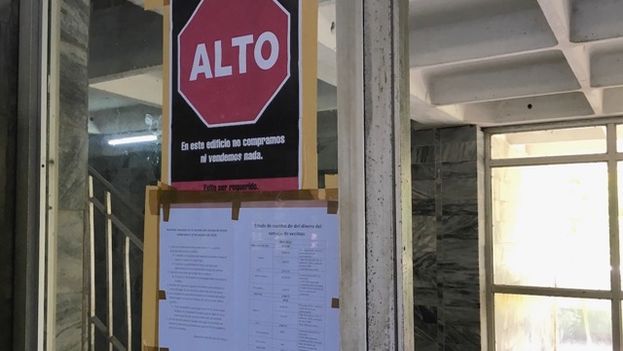
”Stop. In this building we buy and sell nothing”: The warning fails to stop the sellers who knock on the door of families offering everything from eggs to appliances. (14ymedio)

14ymedio bigger14ymedio, Zunilda Mata, Havana, 2 November 2016 — In a speech in front of foreign businessmen at the International Fair of Havana (FIHAV), the Foreign Trade Minister Rodrigo Malmierca, emphasized the country’s urgency to receive “high rates of investment.” However, outside the Expocuba fairgrounds, the speech’s echoes are barely heard and the informal market continues to set the pace of life.

While the national press talks about a portfolio of opportunities, the Cuban people immerse themselves in illegality to survive.

“In this building we buy and sell nothing,” reads a sign at the entrance to a concrete block with more than 100 apartments located in Havana’s Plaza district. The warning, placed by the neighbor’s council in collaboration with the Communist Party militants, fails to stop the sellers who knock on families’ doors offering everything from eggs to small appliances. Now, they just have to do it with more discretion.

The official rhetoric is having a love affair with foreign investors, whom it wants to convince that the island is a good place to build an industry, run a hotel or produce cigarettes, but within the country, the local entrepreneur is viewed with suspicion by the authorities. With the outlawing of selling imported clothing and footwear, the capping of prices in agricultural markets or the recent end to the issuance of licenses for private restaurants, many small businesses have turned to the illegal networks to offer their products. All that’s left for them is to go door to door, knock quietly and offer their merchandise.

Marx, Human Rights And Freedom / 14ymedio, Mauricio Rojas

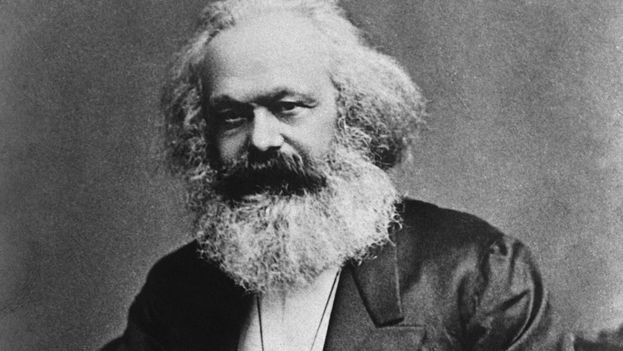
The issue of human rights is comprehensive and explicitly developed by Marx in his essay 'On the Jewish Question'. (CC)
The issue of human rights is comprehensive and explicitly developed by Marx in his essay ‘On the Jewish Question’. (CC)

14ymedio bigger14ymedio, Mauricio Rojas, Santiago de Chile, 2 November 2016 — Recently I sent a tweet that surprised some people. In it I said: “G[uillermo] Teillier, president of the PC [Communist Party], criticizes defense of human rights in Venezuela. Nothing unusual. Marx wanted to abolish them for their selfishness and opposition to the collective.” The surprising thing was not, by the way, the part about Guillermo Teillier, acknowledged admirer of dictatorships such as North Korea and Cuba, but about Marx. Thus, I would like to expand on this issue, a key to understanding Marxism, in a way that the brevity of Twitter did not allow me to do.

The issue of human rights is broadly and explicitly developed by Marx in his essay On the Jewish Question (Zur Judenfrage), published in early 1844 in the Franco-German Annals. In this text, Marx directed harsh criticism at the beginning of the significance of human rights such as those embodied in the celebrated American and French declarations of the same. These rights are criticized for being, in his judgment, the expression of man as a selfish being, the quintessential superior right of the individual versus the collective or society. continue reading

Marx’s words, in this regard, deserve to be quoted at some length because we are in the presence, here, of the anti-liberal essence of the paradigm that will form the nucleus itself of the future Marxist ideology:

“Above all, we note the fact that the so-called rights of man, the droits de l’homme as distinct from the droits du citoyen, are nothing but the rights of a member of civil society – i.e., the rights of egoistic man, of man separated from other men and from the community. […]None of the so-called rights of man, therefore, go beyond egoistic man, beyond man as a member of civil society – that is, an individual withdrawn into himself, into the confines of his private interests and private caprice, and separated from the community. In the rights of man, he is far from being conceived as a species-being; on the contrary, species-life itself, society, appears as a framework external to the individuals, as a restriction of their original independence.”

For Marx the only important rights are political rights, that is, those of the citizens in their capacity as such. In this way, and like Hegel, man ceases to exist in himself, to be reduced to a member of the State (or the politically organized community) and the rights that are recognized are as a citizen. That is why Marx can not understand how the French could create a kind of rights that are only obstacles to collective political will, rights that create a sphere that is beyond politics or the collective:

“It is puzzling enough that a people which is just beginning to liberate itself, to tear down all the barriers between its various sections, and to establish a political community, that such a people solemnly proclaims (Declaration of 1791) the rights of egoistic man separated from his fellow men and from the community.”

What Marx wants is the total society, encompassing everything without barriers – that is without individual rights that impose limits – between man and the social collective represented by the state. That is, exactly, the essence of the original definition of the concepts of the totalitarian state and totalitarianism, as Mussolini had already used it in the 1920s: “Everything within the state, nothing outside the State, nothing against the State.”

It is precisely this totalitarian way of seeing things that makes Marx manifest a particular distaste for the idea of freedom, as individual freedom, as expressed in the French Constitution of 1793 where it says (Article 6, which is just a repetition of the famous declaration of 1791, that “freedom is the power of man to do anything that does not prejudice the rights of another.” In the face of this, Marx says:

” Liberty, therefore, is the right to do everything that harms no one else. The limits within which anyone can act without harming someone else are defined by law, just as the boundary between two fields is determined by a boundary post. It is a question of the liberty of man as an isolated monad, withdrawn into himself.”

For this very classic freedom, which is the essence of liberalism, neither Marx nor the Marxists have the slightest sympathy. Nor will other totalitarians such as the Italian fascists, the German Nazis or the Islamic fundamentalists.

The obvious continuity between Hegel and Marx in this area should not, however, hide the important difference between the conservative realism of totalitarian thinking of Hegel and revolutionary utopian totalitarianism of Marx.

The totality of Hegel is a heterogeneous, differentiated and hierarchically organized society, i.e. social diversity organized as an organic whole within the “rational State.” Individuals continue to be different and therefore unequal, according to the social role and their place in this totality.

Marx cannot accept this solution, which for him does nothing but keep the divisions of the past. His totalitarianism is radically leveling and is expressed by him and the idea of a future society in which the abolition of all difference and heterogeneity is achieved. It is about, in other words, the dream of a “homogenous society,” to use the expression that the Italian philosopher Lucio Colletti used to describe Marx’s Utopia, that is a society without classes, hierarchies or interest groups, in which State and civil society are reunified like the collective and individuals. This totalitarian and egalitarian Utopia is, apparently, the framework of the communist dream of Marx and his followers.

Marx, however, goes beyond the pure idea of the emergence of a homogeneous mass society. He also raises the idea of renewal of the human being and the birth of a new man, to use the expression popularized Che Guevara. In a manner reminiscent of medieval messianic mysticism he raises the emergence of what we might call the “man-kind”, that is, a man amalgamated with the human species, with the collective of men. This is the radical disappearance of the individual as a unique and irreducible reality. Thus, disappearing the individual will disappear individualism and with it, all social division. His words deserve, for all they say about the mystical-religious essence of Marxism, to be carefully meditated on:

“Only when the real, individual man re-absorbs in himself the abstract citizen, and as an individual human being has become a species-being in his everyday life, in his particular work, and in his particular situation, only when man has recognized and organized his “own powers” as social powers, and, consequently, no longer separates social power from himself in the shape of political power, only then will human emancipation have been accomplished.”

To achieve the goal of definitively emancipating man from all alienation and creating this new man who is the “man-species” for Marx there is not other option but to eliminate the true essence of modern society that is none other than private interest and profit motive, and its base is the power of private property and money. This is what Marx at this point in his evolution designated with the expression Judenthum (Judaism), since according to him the very essence of Judaism is none other than this capitalist attitude taken to its extreme. His words, which seem straight out of a Nazi anti-Semitic pamphlet, are strong (the emphases are Marx):

“Let us not look for the secret of the Jew in his religion, but let us look for the secret of his religion in the real Jew. What is the secular basis of Judaism? Practical need, self-interest. What is the worldly religion of the Jew? Huckstering. What is his worldly God? Money.”

That is why, in his view, the suppression of all this will involve the final elimination of Judaism:

” Very well then! Emancipation from huckstering and money, consequently from practical, real Judaism, would be the self-emancipation of our time. An organization of society which would abolish the preconditions for huckstering, and therefore the possibility of huckstering, would make the Jew impossible.”

With this, according to Marx, the Jewish religion itself would end with this change as “[The Jew’s] religious consciousness would be dissipated like a thin haze in the real, vital air of society.”

In the final paragraphs of On the Jewish Question all the ends are tied up. The idea of the end of the Jew as such merges with the idea of the end of the individual in what would be the grand finale of the divided and troubled life of the human species and the emergence of the man-species (emphasis Marx):

“Once society has succeeded in abolishing the empirical essence of Judaism – huckstering and its preconditions – the Jew will have become impossible, because his consciousness no longer has an object, because the subjective basis of Judaism, practical need, has been humanized, and because the conflict between man’s individual-sensuous existence and his species-existence has been abolished.”

These are the ideas that will be reflected in the proposal communist of Marx and his followers, and this is why they despise democracy. In his view, this political system, with its diversity of parties and its competitive elections, is nothing but an expression of “bourgeois society” in which individualist selfishness reigns and opposes various classes and interests. They speak, therefore, disparagingly of “bourgeois democracy” and confronting it will rise the Utopia of the society-community, society of comradeship, altruism, the new man and the only party, as in Cuba or North Korea.

___________________________

Editor ‘s note: this analysis has previously been published in the online journal El Líbero. It is reproduced with the permission of the author. Mauricio Rojas is director of the Adam Smith Chair of the University of Development (Chile).

Translator’s note: Translations of Marx are taken from this site.
A Lot of Noise and Few Investments / 14ymedio, Reinaldo Escobar

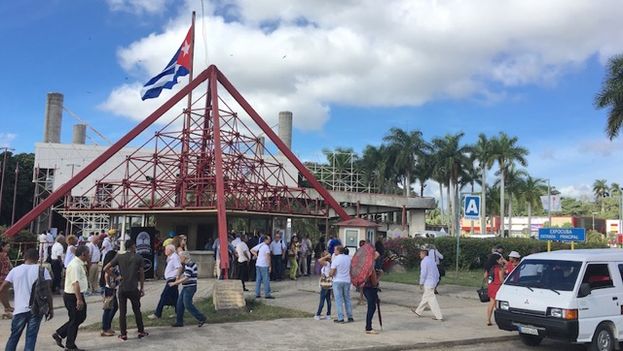
Entrance to the International Fair of Havana (FIHAV 2016). (14ymedio)

14ymedio bigger14ymedio, Reinaldo Escobar, Havana, 3 November 2016 — Oggún is one of the orisha warriors of the Yoruba pantheon, but a tractor that bears his name is losing the battle for the Cuban market. The Cleber firm has failed to establish itself in Cuba, although a year ago it was heralded as the vanguard of US investments in the island.

The tractors designed by Saul Berenthal and Horace Clemmons jumped to the front pages of the newspapers as a symbol of the economic rapprochement between Cuba and the United States. However, at the International Fair of Havana (FIHAV) it has been announced that the project was terminated for not having met “the requirements of technological innovation” required for the Mariel Special Development Zone (ZEDM). continue reading

In the halls of the fair contrasts abound. Officials dressed in impeccable guayaberas smile and encourage the exhibitors to showcase their products. The number of delegations has grown this year and Japan has come with its sophisticated equipment from Panasonic. But one also gets the feeling that the trade event is a useless showcase without concrete results.

What happened with the Oggún tractors recalls other cases in which expectations of doing business on the island have remained intentions or headlines. A situation that contradicts the economic emergency in the country, where the economic growth forecast for this year has fallen below 1% and there is a need to attract foreign capital at a rate of two billion dollars a year.

The process of investment is marked by slowness and timidity. So far, the ZEDM has only laid the first stone of the joint venture to produce Brascuba cigarettes, formed by Brazil’s Souza Cruz company and Cuba’s Tabacuba. If they meet their objectives, it will be the end of 2018 before the industry produces 15 billion cigarettes a year.

Among business groups, frustration and impatience is growing. “They don’t know how to do business, everything goes very slowly and many have become tired of waiting,” a businessman of Cuban origin based in the United States commented outside the ExpoCuba fairgrounds, on one of his occasional visit to Cuba. “I’m about to throw in the towel,” he added.

“They promise a lot, but little has materialized after two years,” he explained, under conditions of anonymity. He notes that he came looking for “something more than words.” After several months of exploring the opportunity to position his firm in the domestic market, the entrepreneur believes that “it is still cheaper and faster to install a factory in Mexico or in Jamaica. What would be the advantage of doing it here?”

In his speech to present the new version of the Business Portfolio, Foreign Trade Minister Rodrigo Malmierca Diaz, was forced to chase away the fears: “Foreign investment is not a necessary evil, we want it for the country’s development. It is a sovereign decision of Cuba that no one is imposing on us, we are doing it because we are committed.”

However, the ideological discourse of recent weeks has risen in tone and become more belligerent against the US administration. Television alternates reports in which there is talk about investment, businesses and joint ventures, with other material in which capitalism is demonized and the neighbor to the north is accused of “overthrowing” the Cuban system.

“Companies complain, with reason, that the negotiations need to be sped up,” Malmierca admitted to the investors. However, the slowness is also established in Guideline 64 approved by the 8th Communist Party Congress, where it establishes that “who decides is not negotiable” in international economic relations.

The Cuban officials attending FIHAV can appear to be in the best mood, with the widest smiles and business cards filled with responsibilities, but the foreign entrepreneurs know they are powerless intermediaries without the ability to make any decisions. Their task is simply to explore the proposals and generate illusions among the people they speak with.

It is not only bureaucratic sluggishness that makes investors lose momentum. “The dual currency system and the state monopoly over payrolls* are discouraging many people,” a Guatemalan businessman attending FIHAV explained to 14ymedio. “We are not used to not being able to contract directly* with our own personnel,” added the visitor.

The restoration of relations between Cuba and the United States has been one of the main causes of the flood of entrepreneurs who have visited the island in the last two years, but that undeniable push does not constitute a source of permanent energy. Every day that the Cuban government fails to take advantage of the momentum from the rapprochement between the two neighbors, it drags the country towards economic inertia and sinks it in failure.

*Translator’s note: The Cuban government acts as the employer in this situation, hiring the workforce, assigning individuals to jobs, and collecting the wages for their work. In exchange for this ‘service’ the government retains a large share of the wage income, passing on only relatively small portion to the workers. International firms are not accustomed to working in an environment where they have no ability to choose their own workers or to motivate them through the incentive of salaries.

Repatriating, Yes. Settling In Is Another Thing / 14ymedio, Luz Escobar

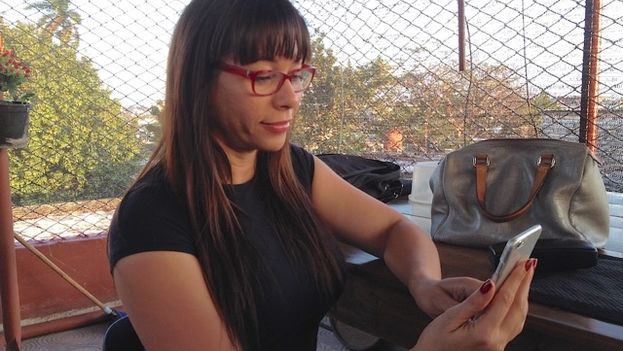
Iliana Hernandez says she feels no regret for having returned to Cuba. (14ymedio)

14ymedio bigger14ymedio, Luz Escobar, Havana, 2 November 2016 — “I swore I would never set foot in this country,” recalls Lazaro, age 48 and from Camaguey, who emigrated in the late nineties to Miami. However, a few months ago he changed his mind and began the legal process to return to Cuba. “The land pulls me,” he says with a smile while showing off his brand new identity card.

At the end of 2012, the average number of emigrants who chose repatriation that year barely reached 1,000. However, after the immigration and travel reforms put in place by Raul Castro’s government in January of 2013 – including the elimination of the often-denied permit needed to travel outside the country –the number has skyrocketed. continue reading

During a radio interview, the Cuban ambassador in Washington, Jose Ramon Cabañas, said that as of the beginning of 2015 until today, some 13,000 Cubans resident in the United States have returned to the island. This phenomenon is repeated among émigrés in Europe and Latin America.

The reasons for return range from buying a home, to coming and spending one’s old age with one’s family. Returnees also recover their right to an allocation of goods on the rationed market, and the right to vote, which Cubans living abroad cannot do.

The common denominator among the returnees is that most opt for repatriation only after acquiring a foreign nationality. “It’s not the same to return as a sato Cuban,” a phrase that roughly translates as a ‘garden variety’ Cuban, “as to return with a yuma passport,” i.e. a foreign one, “in your pocket,” explains Lazaro, who has had US citizenship for a decade.

Although Cuban authorities do not recognize dual nationality, having a foreign passport streamlines paperwork, facilitates traveling from the island, and can open many doors in the convoluted management of daily life.

In the case of Lazarus, the motivation to return goes beyond nostalgia. “I want to buy an apartment and if I’m not a resident of Cuba I can’t do that,” he says. The law governing the sale of property only recognizes this right for citizens who are permanent residents of the country.

Since getting his identity documents, Lazaro has spent a few weeks in his native land. “Right now I don’t want to live in Cuba,” he explains, and adds, “What I’m doing is an investment for the future, for when ‘the thing’ changes and it really makes sense to return.

“I have a retired friend who has done all the paperwork to repatriate because he has a pension that is very low for Miami, but here he can live like a king,” he adds. Among the reasons that motivated the pensioner, says Lazaro, is to find “a younger woman, because he feels very lonely over there.”

The ability to inherit property, open a private business or to get free medical care are also among the incentives for return.

Returnees also enjoy the prerogative of one-time opportunity to import a large volume of belongings. For the General Customs of the Republic, Yipsi Hernandez says, moving a “household has no weight limit” and is “tax-free.” The official confirms that you can import “two of every kind” of appliance.

Iliana Hernandez just repatriated from Spain. Her process lasted five months and to start it was only necessary to go to a notary with the person she planned to live with, her mother, who took responsibility for her return to the country.

“With this letter from the notary and a stamp costing 100 convertible pesos you have to go immigration,” she explains. “After filling out some forms, the authorities send you a notice to collect your ID card, which takes an average of six months.”

The reason for Hernandez’s return focuses more on social activism. “I want to fight to bring a quality of life here that is the same as abroad,” she says. Recently, the athlete, who left Cuba legally after a failed attempt to swim to the US military base at Guantanamo, has created Lente Cubano, an audiovisual project that brings together news and views on various topics.

She says she does not feel regret for having returned. “Sometimes when I am riding on a bus, I miss my little car. It is hard here,” she says, because “your quality of life is completely lost.”

Cuban Human Rights Group Denounces “Unstoppable Deterioration Of Civil And Political Rights” / 14ymedio

From today your life will be "very difficult", Dagoberto Valdes was warned by Cuban State Security (@mariojose_cuba)
From today your life will be “very difficult”, Dagoberto Valdes was warned by Cuban State Security (@mariojose_cuba)

14ymedio bigger14ymedio, Havana, 2 November 2016 — The arbitrary arrests of peaceful dissidents in Cuba marked the highest figure in the last three months in October, with 620 cases, according to the Cuban Commission for Human Rights and National Reconciliation’s (CCDHRN) monthly report, released Wednesday. The report also cites 17 physical assaults, 39 acts of police harassment and three instances of “repudiation” by the secret political police and vigilante groups.

“The repressive actions in recent months are indicative of a visible and unstoppable deterioration of the situation of civil and political rights and other fundamental rights in Cuba, despite the countless gestures of goodwill towards the regime that has ruled the island for nearly 60 years,” laments the document. “Meanwhile, the vast majority of the Cuban people continue to survive amid a lack of freedom, poverty and despair,” it.

In the first 10 months of 2016, 9,125 arrests were registered, a figure that exceeds the totals for each of the last six years. The CCDHRN is led by Elizardo Sanchez, who predicts that this year’s final count of arbitrary arrests will exceed 10,000 cases.

The CCDHRN mentioned the secret political police raid of October 21 on the home and office of a legal aid center in Pinar del Rio, also the site of the newsletter Panorama Pinareño, sponsored by the Cuban Institute for Freedom of Expression and the Press (ICLEP).

The report also addresses the threats against the Catholic layman Dagoberto Valdes, director of the Center for Coexistence Studies (CEC) of Pinar del Rio, which publishes a magazine with the same name.

A Cuban Doctor Fights To Stay In Brazil Free Of Cuban Government Contract / 14ymedio

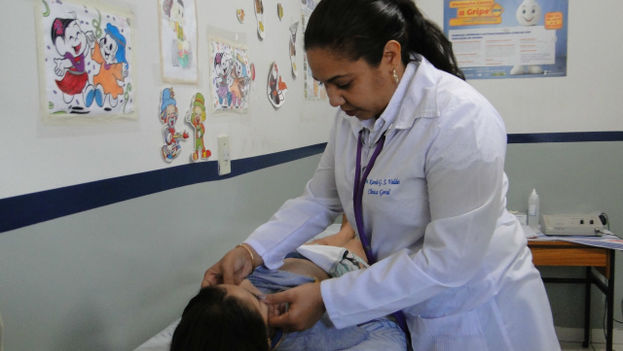
Dr. Karem Guadalupe Saboit Valdes is fighting to stay in Brazil beyond the three years allowed on her contract with the Cuban government. (Courtesy)

14ymedio bigger14ymedio, Miami, 31 October 2016 – She worked for three years at health centers in Dourados, a region of the Brazilian state of Mato Grosso do Sul, as part of the government program Mais Medicos (More Doctors). Karem Guadalupe Saboit Valdes is fighting to stay beyond the three years allowed under the contract between the Cuban government and the Pan American Health Organization PAHO), according to reports in the Brazilian newspaper O Progresso.

Saboit Valdes was the first doctor to reach the city, but her contract expires on November 9 and she must return to Cuba. The doctor, in love with the local people, is looking for ways to stay in Brazil without the mediation of the Cuban government. continue reading

The Mais Medicos program was announced three years ago as a “bonus mission” for Cuban doctors. Many were sent to third world countries where they completed their service to fill the quotas offered by Dilma Rousseff’s government to Havana.

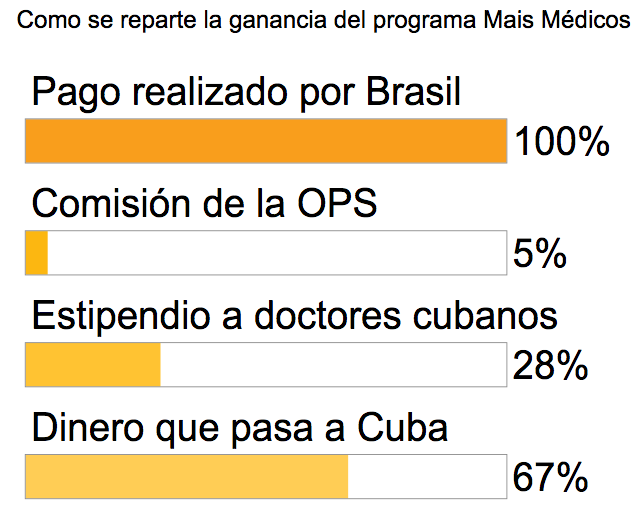
A week has passed since a court in Brasilia, in Saboit Valdes’ case, made the unprecedented decision that the Ministry of Health could renew a contract directly with a Cuban doctor, without the mediation of PAHO or the Cuban government. This decision means that, from now on, the doctor will receive the total value of the agreement that the Ministry of Health offers to foreign doctors who work in remote areas of Brazil, some 11,500 reales (3,587 dollars). Until now, their salary has been 2,976 reales (928 dollars), with the difference pocketed by the Cuban government.

In Dourados, the decision was seen as a victory for the doctors against the authorities of the Cuban Medical Mission. Saboit Valdes, one of the 12 Cuban doctors serving in the city, believes that ruling will become a source of inspiration for other doctors who want to stay in Brazil.

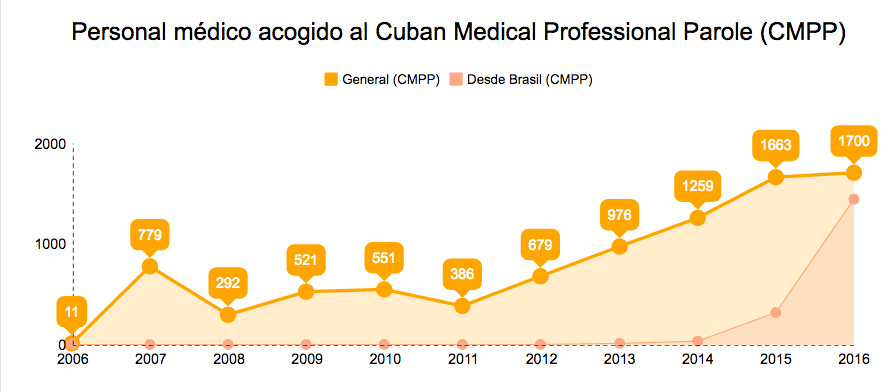
According to figures obtained by 14ymedio, so far this year 1,439 health professionals have escaped from Brazil to the United States through the Cuban Medical Professional Parole program, established by the US specifically for Cuban doctors. Others have chosen to stay in Brazil and revalidate their credentials. During the first ten months of this year more than 1,600 Cuban doctors took the Brazilian medical licensing exams.

According to the Saboit Valdes, a native of Camagüey, the Cuban professionals who establish families in Brazil should have the option of staying in the country. “I’m married to a Brazilian and I have strong emotional ties here. I am in love with this country. Despite not having anything against Cuba, I would like to stay in Brazil. It is a matter of choice,” she says.

But marriages with foreigners are a taboo subject for the Cuban government. The disciplinary regulations that all Cuban civilian workers abroad must accept state that “if there is any loving relationship with natives, [the Cuban government] must be informed immediately and it must be in accord with the revolutionary thought of our stay and no action can be excessive” (sic).

Saboit Valdes told the Brazilian newspaper that adapting herself to the Brazilian reality is very easy, because there are few differences between Cuba and the South American country. She has overcome the language barrier and her intention is to continue growing professionally.

“There is a completely free and very organized structure, both in health and education,” she says.

The doctor, who as part of the Cuban contingent completed the preparation course to work in the Brazilian Health System, plans to revalidate her credentials to work for herself and even, in the future, to open her own practice.

caption caption
Medical personnel taking advantage of the United States’ Cuban Medical Professional Parole program since 2006
caption caption
Where the money from the Mais Medicos (More Doctors) program goes. Paid by Brazil to Cuba: 100%. Commission to PAHO: 5%. Stipend to Cuban doctors: 28%. Money that goes to the Cuban government: 67%

cation caption
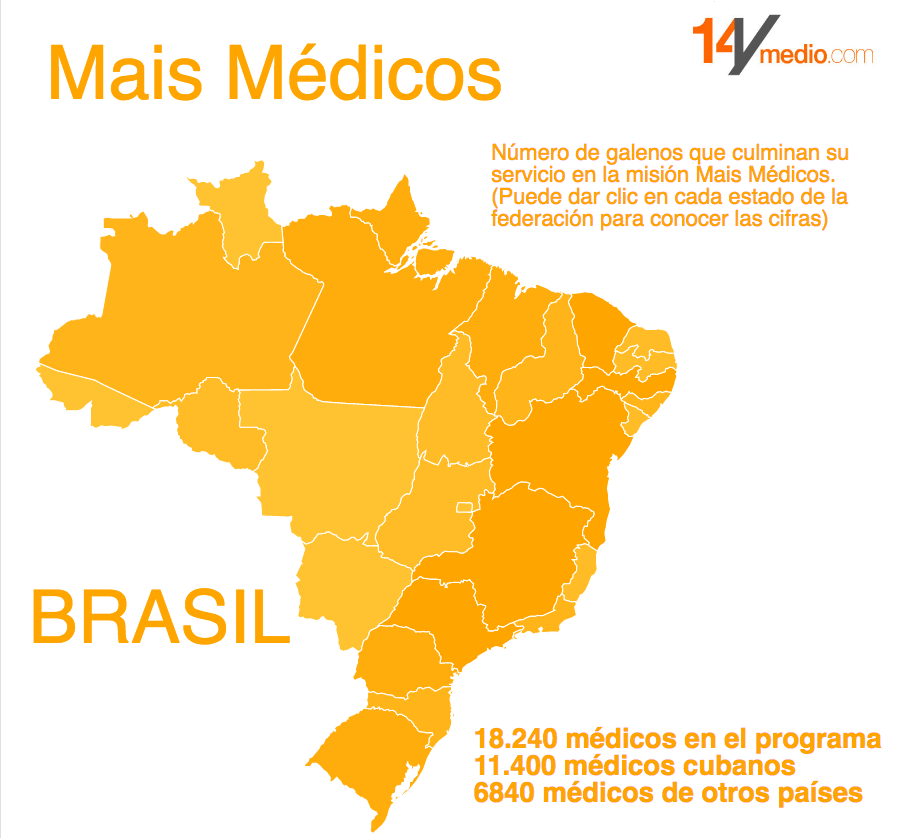
Concentrations of foreign doctors in Brazil. 11,240 doctors in the program. 11,400 Cuban doctors. 6,840 doctors from other other countries.

Chocolate Store or Museum? / 14ymedio, Yosmany Mayeta Labrada

A box of 80 chocolates costs 68.25 CUC, three months salary of a professional. (14ymedio)

14ymedio bigger14ymedio, Yosmany Mayeta Labrada, Havana, 31 October 2016 – For weeks, astonished and laughing faces have surrounded the display windows of a candy shop in the Plaza Carlos III shopping center in Havana. The excitement has come with the sale, for the first time at that center, of the Italian-made Ferrero Rocher chocolates. However, a box with 80 wrapped pieces costs 68.25 Cuban convertible pesos (CUC), the equivalent of three months’ salary for a professional.

For those who just want a quick taste of the treat, there is an option to buy a box of three for 2 CUC, still high for a country where the average wage doesn’t exceed 25 CUC a month.

The arrival of the exclusive delicacies generates curiosity and cries of alarm among customers, but also a certain doubt among employees about the possibility of marketing merchandise at such high prices. Three months after they went on sale, the only ones buying them have been “foreigners, but we’ve only sold six or seven boxes,” according to a clerk at the establishment.

“I couldn’t even dream of buying them,” says a lady who has joined the group raising their eyebrows at seeing the figure affixed to each box of Ferrero Rocher. Rather than a store, the place looks like a museum these days, with an exposition that combines sugar with the absurd.

Cuba’s Cienfuegos Refinery Reduced Production By Half Due to Cuts In Venezuelan Oil / 14ymedio, Mario Penton and Nora Gamez Torres

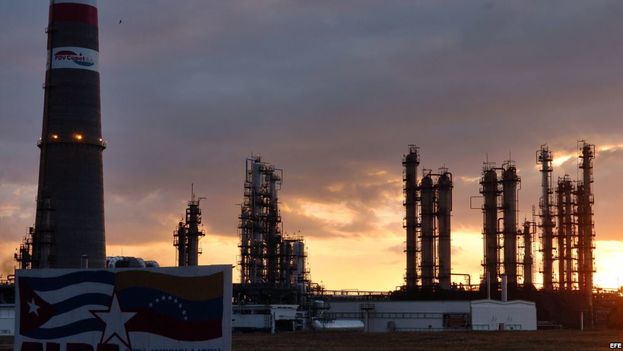
The Camilo Cienfuegos refinery in Cuba. (EFE)

14ymedio bigger14ymedio, Mario Penton and Nora Gamez Torres, Miami, 31 October 2016 – Cuba’s Cienfuegos refinery, operated by Cuvenpetrol SA, a Cuban/Venezuelan joint venture, has been forced to cut production by half due to cuts in shipments of crude oil from Venezuela, according to comments made on Monday by an official of the Cuban Communist Party (PCC).

Plans to build a neighboring petrochemical complex with Venezuela’s participation are also on hold, said Lidia Esther Brunet, first secretary of the Cienfuegos Provincial PCC.

The official admitted that the Camilo Cienfuegos refinery, a plant from the Soviet era, will not meet its targets this year “as it had done since its reactivation in 2007” and will process about 9.43 million barrels of oil, just 53% of the plant’s planned production. Brunet attributed the causes to “contract issues, Venezuela and other questions,” as she explained to the Chinese news agency Xinhua. continue reading

“Right now it is not processing Venezuelan crude. Shipments decreased substantially since last year,” said a specialist at the refinery who requested anonymity.

This month marks 16 years since the signing of the cooperation agreement between Venezuela and Cuba under which oil is exchanged for Cuban doctors and other services.

A worker at the refinery said the plant is refining crude oil from Algeria. “The situation is unstable, we start again Sunday, but sometimes it stops and restarts. We are all very afraid that in the end we will be lout of work. It would be a tremendous blow,” he said. The plant has a payroll of 780 workers, according to official data from 2010.

“The managers are saying that the joint venture could be closed due to the economic situation of Venezuela, and Cuba would wait for another country to assume their 49% of the shares. The big problem is that the refinery has never been profitable, because there were a number of needed investments that were never made,” said the refinery specialist, adding that “there has not been a reduction in the workforce yet, but it has already been announced. ”

In July of this year,Luis Morillo,general manager in Cuba for the Venezuelan state oil company PDVSZ, announced that the refinery would partially shut down for 120 days in various periods of the year “for maintenance.”

“The statements confirm what was already announced. Cienfuegos is not operating, but not because of technical problems, but because Venezuela does not have enough crude oil to send to refineries in Cuba. It is not about Cienfuegos, but about Venezuela,” said Jorge Piñón, acting director of the Center for International Energy and Environmental Policy at the University of Texas at Austin.

The expert, who monitors the movement of tankers in the Caribbean, said that in the last three or four months “there has been almost no traffic to Cienfuegos.”

The refinery’s expansion plans included increasing oil processing capacity to 150,000 barrels per day, the construction of a plant for olefin and aromatics, expanded storage capacity, and reactivating the pipeline between Matanzas and Cienfuegos.

According to Piñón the impact of the decrease in oil supply from Venezuela has not been even greater because the country continues to import oil from other sources, which comes in primarily to the port of Matanzas.

On Monday, Foreign Trade Minister Rodrigo Malmierca, admitted that the Cuban economy, severely hit by the crisis in Venezuela, would not grow even the 1% expected.

Starting in the second half of this year, the government announced cuts in fuel and electricity consumption, mainly in state enterprises. Under this plan, the central government assigns each company a monthly allocation of kilowatts of electricity. If the company exhausts its quota before the end of the month, their supply is cut off and workers go home “on vacation.”

The authorities have also cut public lighting and the distribution of fuel to companies, a part of which was diverted to the black market for private transport, the prices of which have risen as a result of this decision.

During a televised speech in July, President Raul Castro confirmed the decline in oil shipments from Venezuela. According to Reuters, citing internal PDVSA data, Venezuela supplies fell 40% in the first half of 2016. Jorge Piñón, the expert from the University of Texas, estimated that the reduction is 25% since the beginning of this year. The government has no recent statistics on the total refinement and extraction of domestic oil.