Cuba Will Close 2016 With A Record Number Of Self-Employed / EFE, 14ymedio

Paladares – private restaurants – have been the Cuban self-employment sector hardest hit by recent arrests and closures. (EFE)

14ymedio biggerEFE/via 14ymedio, Havana, 11 November 2016 — The number of self-employed in Cuba totaled 522,855 at the end of September, representing the addition of 15,513 people to the sector in the last six months and an increase of nearly 24,000 compared to the total of 2015, according to data broadcast on state media on Friday.

Self-employment has maintained sustained growth since Raul Castro’s government expanded opportunities for the private sector in 2011, in order to boost the economy of the island and compensate for the phasing out of 500,000 state jobs between that year and 2015. continue reading

In 2012 the self-employed totaled 404,600, a figure which increased the next year to 424,300 and rose at the end of 2014 to 483,400, according to the state-owned newspaper Granma reporting on data from the National Bureau of Statistics and Information (ONEI) and the Ministry of Labor and Social Security.

In mid-2015, Cuba exceeded the milestone of half a million self-employed, and although the figure was reduced to 496,000 months later, the sector grew again in 2016 to the 507,342 workers recorded in May, and increased to 522,855 six months later.

Some 65% of self-employed workers are concentrated in the provinces of Havana, Matanzas, Villa Clara, Camaguey, Holguin and Santiago de Cuba, and 11% of them are dedicated to the restaurant industry, which employs 58,993 people.

In this sector, which includes the most famous paladares – as private restaurants are called – 1,870 were granted licenses this year compared to the 1,650 authorized in 2015 and 1,570 in 2014.

A series of inspections to uncover alleged irregularities in the establishments and the suspension of the issuing of new licenses to paladares in Havana between September and October sparked concern in this sector, one of the most dynamic in the economy of the island, but as of 24 October licenses are again being issued.

Cuban authorities deny that these measures are due to a backtracking in the state policies to open private sector opportunities, and say that their intention is to guarantee that the restaurants comply with the law.

The expansion of private labor is one of the major reforms of the government of Raul Castro to “update” the socialist economic model in Cuba which, as of today, authorizes 200 different work activities in which the self-employed may engage.

Coppelia Ice Cream Celebrates Half a Century / 14ymedio

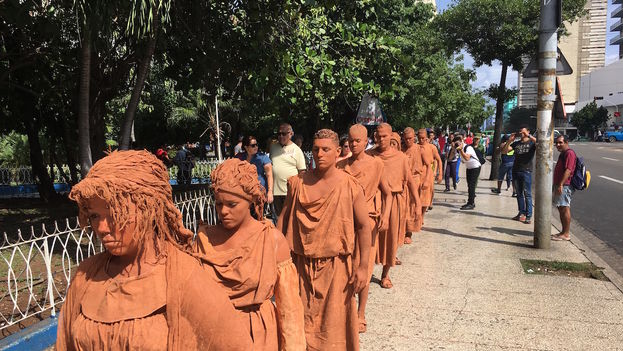
Members of the street art group D' Morón Teatro, Thursday in Havana. (14ymedio)
Members of the street art group D’ Morón Teatro, Thursday in Havana. (14ymedio)

14ymedio bigger14ymedio, Havana, 10 November 2016 – The Havana corner of 23rd and L in Vedado displayed an unusual panorama on Thursday. Along with the passersby were mixed characters dressed in period clothing with a patina of mud. The street art group D’ Morón Teatro came from Ciego de Avila to celebrate five decades of the ice cream parlor with their work Anaphylaxis.

The presentations of this group are based on the technique of living statues using clay as makeup. The group was created in 1987 and its performance pieces have become very popular thanks to titles like Muddy Medea or one inspired by the epic of Troy. More recently, a bold version of the novel by Cirilo Villaverde, Cecilia Valdes, took to the streets.

Although the work of D’ Morón Teatro has been widely featured by the national media, there was no shortage of smiles when its muddy characters appeared on one of the busiest corners of the capital. Photos, jokes and applause followed the singular staging, to the point of distraction for the customers in line at Coppelia, waiting for those icy treats so different from half a century ago.

Looking at Society Through the ‘Cuban Lens’ / 14ymedio, Pedro Acosta


14ymedio bigger14ymedio, Pedro Acosta, Havana, 12 November 2016 — Iliana Hernandez and Yusmila Reyna circulated among sculptures and art installations at the Cuban Art Factory this week. The two women recorded some scenes for the program Lente Cubano (Cuban Lens), a program that approaches the reality of the island through culture, complaints, and the stories of success or hopelessness that populate the streets.

Camera in hand, Hernández and Reyna organized on this occasion an interview with the model Katy Gil. To reach Vedado in time, the two artists had to cross much of the city: from Cojimar and Bauta, respectively. They did it without hesitation, because the project arouses a passion in them along with a good dose of enthusiasm. continue reading

“Transportation is a serious difficulty, because we do not have our own,” Hernandez told this newspaper, saying that she sustains the program economically with her personal resources. Renting a car is a luxury they cannot afford during these first steps of their audiovisual creation.

The aim is ambitious: a weekly, half-hour show, with five sections in which they talk about fashion, report on complaints, promote private businesses and disseminate the work of artists. It is “totally free,” the creators clarify when asked about the distribution of the material.

The difficulties that need to be overcome include not only the illegalities the alternative media in Cuba are subjected to. In recent years several independent spaces have emerged and competition becomes fiercer every day. Users are very demanding and it’s not enough to reflect on the issues the government ignores, professionalism matters.

“I know it seems difficult,” explains Reyna, who has also had extensive experience as an activist. “We have edited five programs and aired four,” she says. Uploading each chapter to the great World Wide Web takes a lot of time and money. Sometimes it has taken up to nine hours to send one of their programs through the collapsed Cuban networks.

“The interest in getting ahead and making a quality product is our main motivation,” she says. Even the microphone used during filming is an innovation from other team members: Gabriel Gonzalez in film-editing and presenters Jose R. Galan and Andy Marrero.

However, the major obstacles that must be overcome are not exactly material ones. During their work they often come up against the fear that runs through Cuban society. Getting statements in the street is complicated by respondents’ fear, but they always end up finding someone who decides to speak.

Some figures of Cuban culture have refused to appear in Cuban Lens because it is an alternative program. Others have been given long proposals, but never responded. On one occasion, after doing an interview and editing it, the guest asked them not to publish his speech because the show has a “political bent” and he isn’t looking for problems.

In part, to exorcise those demons, in the project’s early episodes they have made it clear that they are “looking at society in all its aspects” and at people “with their successes and their problems.” Cuban Lens “is not political, but with a varied approach and uncensored,” so that it “never misrepresents reality, nor the opinions of its guests.”

Those facing the lens of the two restless creators have ranged from the president of the Yoruba Society of Cuba, José Manuel Pérez, to musicians in the style of Yomil, El Danny, El Noro, Dayana and Adriano Disjay. Activists Eliecer Avila, Manuel Cuesta Morua, Wilfredo Vallin and Martha Adela Tamayo have also been invited to share their views.

Hernandez says that they are in negotiations with an American producer for the program to be broadcast in that country. To the extent that they earn the resources, they will cover other areas of the island outside the capital. In the future, this Cuban who lived for many years in Spain and decided to repatriate, dreams of owning an advertising agency.

While waiting for the much-needed resources, those who are a part of the project do not receive a salary. “You have to juggle until finances appear”, says its director. Instead, warnings from the State Security have not been lacking, and an official has been charged with letting the activist know that she must “be careful” with what she does with her program, especially with the section dedicated to citizen complaints.

Private Restaurants Closed, Owners in Jail / 14ymedio, Ignacio de la Paz

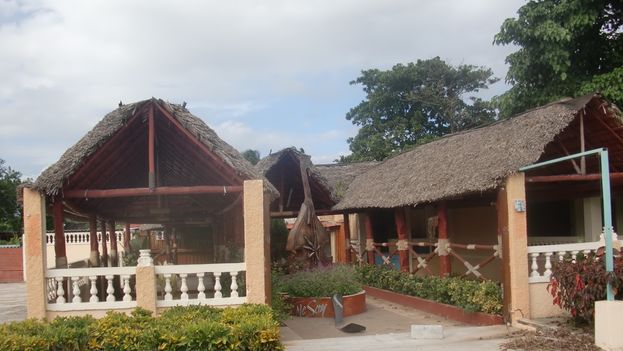
 Me Son paladar in La Ceiba. (Ignacio de la Paz / 14ymedio)
Me Son paladar in La Ceiba. (Ignacio de la Paz / 14ymedio)

14ymedio bigger14ymedio, Ignacio de la Paz, Camaguey, 11 November 2016 — Closed and silent. Thus are several of the most successful private restaurants – known as paladares – in Las Tunas and Camaguey these days. Their proprietors are accused of several economic crimes and are in jail awaiting prosecution, despite requests from their lawyers to release them on bail.

Last month, after a thorough search of the Me Son paladar, ten miles from the Las Tunas capital, the authorities took Valentin, its owner, to El Tipico prison. It didn’t help Valentin that he has in his own house the presidency of the Committee for the Defense of the Revolution, according to the residents of the town of La Ceiba, in the municipality of Majobacoa.

“The police took everything, they only left what they couldn’t take, we don’t know if we’ll go back to work,” lamented an employee of the paladar. “Customers come from Holguin and even farther. We also function as a site for parties.” continue reading

Juan Carlos, a young farmer in the area who supplied the paladar with “food and vegetables every week,” confirmed that “the place had become very famous” and that “it was a question of time before the police came down on it.”

According to the source from the provincial prosecutor’s office, Valentin is accused of “having committed serious illegalities, like having products without proper receipts*, workers without contracts, and arrears in tax payments to the National Office of Tax Administration (ONAT).”

In recent months the authorities have warned that licenses for private restaurants don’t include authorization for cultural activities, hiring artists, or bars. In Havana, several paladares have been closed for violating these rules.

Valentin’s legal problems are accompanied by the arrest, last summer, of Roberto, the owner of La Moncloa, the most successful paladar in Las Tunas. The arrests and severity of legal actions against the accused set off alarms in the private sector. “Everyone is keeping their heads down,” said a relative of the owner.

In neighboring Camaguey, at least three owners of paladares have also been arrested and prosecuted in recent months.

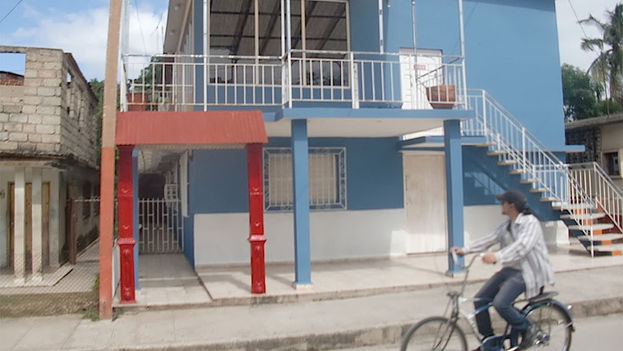
 Mi Hacienda paladar. (Ignacio de la Paz / 14ymedio)
Mi Hacienda paladar. (Ignacio de la Paz / 14ymedio)

About 500 people work in the 74 legally registered private restaurants in the province. In the face of the fears running through the self-employment sector, an official of the Council of Provincial Administration, Jesus Polo Vazquez, clarified that the searches and arrests are simply actions to “maintain legality in the exercise of non-state management,” and that “in compliance with the law, no installation will be closed without justification.”

Polo Vazquez described those arrested as “the unscrupulous who are enriching themselves,” with tax evasion. “Cuba has a right to defend its taxes, because that it what pays for education, health, culture and other social services.”

The family of Alberto Raiko disagrees with the official and insinuates that the month’s detention of the owner of the Mi Hacienda paladar in the Alturas del Casino neighborhood, is “an extreme measure to frighten successful self-employed entrepreneurs.”

Employees of Rafael Papito Rizo’s La Herradura, one of the most famous paladares in Camagüey, share that perception. The name of the small businessman went on to become synonymous with quality and fine dining thanks to a history of more than two decades. Today, the restaurant located in the Villa Mariana neighborhood is closed.

The most famous case, however, has been the centrally located restaurant 1800 Plaza de San Juan de Dios, winner for two consecutive years of TripAdvisor’s excellence award. The place was closed a few weeks ago after a search of several hours. The police “loaded up even the air conditioner,” says a relative of the owner, Edel Fernandez Izquierdo.

“They seized 150 boxes of beer and 200 bottles of wine Edel had bought over the counter without being given a receipt at the Tourism Fair in Havana,” says the relative. “They also took bottles of liquor that were gifts from Edel’s customers and friends.”

Fernandez Izquierdo is accused of having containers of liquefied gas without a receipt* for their purchase and valuable works of art that were not listed in the Heritage Register. In his neighborhood many suggest that the trigger was the Peugeot the successful businessman managed to buy and other property he owns in Camagüey. “That’s when everything exploded,” says a neighbor, Ramon Buenaventura.

The owner of 1800 is in the Ceramica jail and his father, retired from the Interior Ministry with the rank of colonel, still hasn’t gotten over his surprise at what happened. “The uniform hasn’t done him much good, because it’s not about something his son did, but about setting an example so others don’t cross the line,” said Buenaventura.

*Translator’s note: Private businesses are required to present receipts to prove that they bought their supplies in state stores, not in the underground market.

Harassment of Pinar del Río Journalists Continues / 14ymedio, Ricardo Fernandez

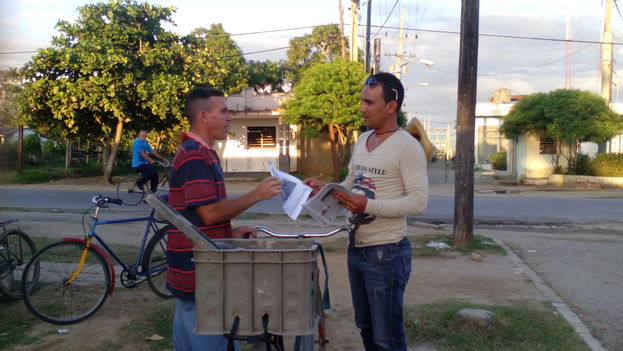
Lazaro Luis Ruiz Echevarria distributing the publication 'Panorama Pinareño' on Calzada de la Coloma. (Ricardo Fernandez / 14ymedio)
Lazaro Luis Ruiz Echevarria distributing the publication ‘Panorama Pinareño’ on Calzada de la Coloma. (Ricardo Fernandez / 14ymedio)

14ymedio bigger14ymedio, Ricardo Fernandez, Pinar del Rio, 11 November 2016 — A new wave of repression erupted on 9 November against journalists and contributors to the fortnightly newsletter Pinareño Panorama. This media, belonging to the Cuban Institute for Freedom of Expression and the Press (ICLEP) has been heavily repressed in the last six months even though its content is purely social and does not explicitly address political issues. In addition to publication on the webpage www.iclep.org, the newsletter has a monthly circulation of more than 500 copies distributed among the population.

The trigger for the actions undertaken by Cuban State Security forces was the distribution of the newsletter that took place outside the interprovincial bus terminal. The new director of Pinareño Panorama, Lazaro Luis Ruiz Echevarria, and the contributor Esteban Ajete Bascal, were violently arrested on Delicias Street, between Colon and Recreo Streets, at 2:40 pm, by Captain Juan Perez Puentes, Major Orestes Ayala, Lieutenant Colonel Vuenes, Major Ivan Blanco, and the lieutenant known as Jorgito. continue reading

In the operation, State Security forces confiscated 47 printed copies of Pinareño Panorama, along with the personal phone of its director. The activist from Independent and Democratic Cuba (CID) Yaimel Rodriguez recorded what happened on his cellphone to denounce the violence that Ruiz Echevarria was subjected to; he was put in a stranglehold and dragged to a red Lada car where Majory Ayala beat him in the face.

The two detainees were taken along with the CID activist to the Provincial Unit of the National Revolutionary Police, where, they say, they were subjected to interrogation and threats. Rodriguez was released after being forced to delete all the files on his phone while the director of the publication was imprisoned for 24 hours after being brought to emergency room at the Abel Santamaria Cuadrado Provincial Hospital.

The State Security operation also held, for several hours, the former director of Pinareño Panorama, Dianelis Rodriguez and her husband, attorney Raul Risco. Two other journalists for the newsletter were summoned on Thursday and were subjected to interrogations and threats.

Havana Wakes up ‘Olive-Green’ for a Military Parade Rehearsal /14ymedio

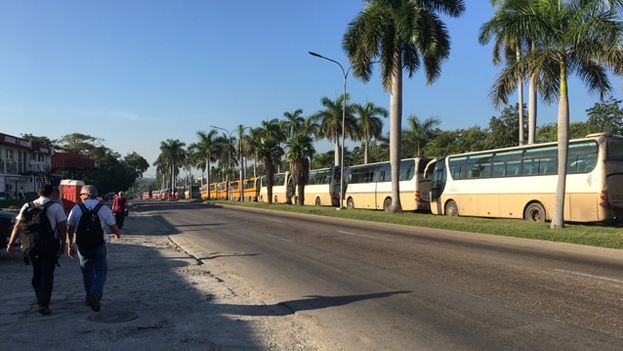
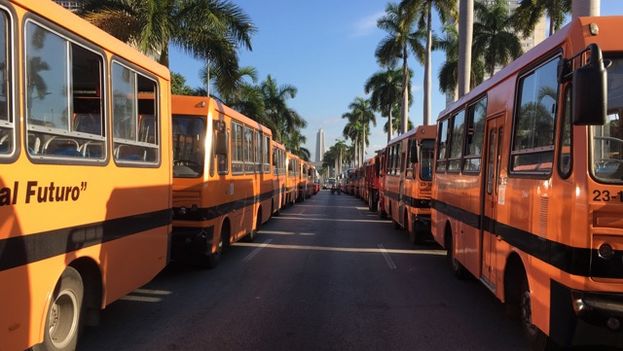
 Rancho Boyeros Avenue in Havana was filled with buses that transported the soldiers. (14ymedio)
Rancho Boyeros Avenue in Havana was filled with buses that transported the soldiers. (14ymedio)

14ymedio bigger14ymedio, Havana, 12 November 2016 — From the early hours of the morning this Saturday frenetic activity it has taken possession of Rancho Boyeros Avenue, near the Plaza of the Revolution in Havana. Hundreds of buses, with thousands of soldiers, arrived for the rehearsal of the military parade which, this coming 2 December, will mark the 60th anniversary of the landing of the yacht Granma – the vessel that brought Fidel Castro and his revolutionaries from Mexico.

The Provincial Traffic Safety Commission announced earlier the closure of several of the capital’s major arteries, including the Paseo Avenue, from Zapata to Ayestarán; Carlos M. de Cespedes, from Zapata to Calzada del Cerro; and Avenida Salvador Allende, from Boyeros to Calzada de Infanta. Measures that, since early in the morning, have complicated traffic in the city.

However, comments heard on the surrounding streets corners focused more on criticizing the economic cost of military deployment than on traffic jams. “there are almost no medicines in the pharmacies, but are spending a lot of money in this parade,” a newspaper vendor, who was trying to cross a street closed to cars and filled with packed buses carrying troops, told this newspaper.

The National Road Safety Commission announced interruptions in traffic. (14ymedio)

Cuba’s Hard Currency Stores Prohibit Hiring of Education and Healthcare Professionals / 14ymedio, Jorge Luis Navarro Ruiz

The hard currency stores will not hire workers coming from Education and Healthcare, a reader tells 14ymedio. (EFE)

14ymedio bigger14ymedio, Jorge Luis Navarro Ruiz, Havana, 7 November 2014 — A relatively new phenomenon is now affecting a small sector of the population, including me. The state-owned hard currency stores (TRD – the Spanish initials for “Hard-Currency Collection Store”) are a chain spread throughout the country, which, as every Cuban knows, sell products in Cuban Convertible Pesos, one of Cuba’s two currencies which is valued at 25 times the Cuban peso – the other currency and the one in which Cubans are paid their wages. But this discrepancy is not the subject of my complaint, rather it is that these stores are prohibited from hiring – as employees – professionals from the Health and Education sectors and from the “scientific pole” sector, according to the precise words of the human resource manager who spoke to me on 19 October.

The issue concerns me greatly because I am an “emerging teacher” graduate, “stepping up” to fill the needs of my province (Ciego de Avila). However, I didn’t know that heading in this direction would turn out to be a hornet’s nest from which it would be very difficult to extract myself and, given today’s experience, I believe it’s going to be harder for me to find employment without being rejected by my former profession. continue reading

Words fail to express what I feel. I feel like I’m being rejected by society as if I were a criminal or an ex-convict trying to reestablish myself. As a teacher, I should be proud of my profession. Although I only have three years experience, I know that it is thanks to me and my teaching colleagues that this society can educate its children. From our hands come engineers, doctors, farmers and so on.

However I feel very sorry and ashamed, because despite my deep love of teaching, I can’t do it because the working conditions are not the best and, most importantly, the financial reward is very unfavorable (430 Cuban pesos, or 17.20 Convertible pesos – about $17.20 US – a month). In addition, we don’t receive any other perks; we don’t get uniforms, we don’t get bags of toiletries, we don’t get household items and we don’t get special points to buy things in the TRD stores, as do those in other state companies and agencies.

Fidel Castro, in History Will Absolve Me*, devotes a relatively short passage to the situation of teachers working for meager wages. However, today, half a century later, the situation has not changed much. In order to earn more than 1,000 Cuban pesos, it is necessary to obtain a doctorate and have at least 25 years of experience.

That is why the critical situation in Cuban schools should not be a surprise, caused by the great exodus of teachers looking for another source of income to supply their needs, like employment in a TRD, where the conditions are more favorable and the salaries higher (275 CUP basic salary, and pay for results of an extra 10 CUC, as well as tips from customers).

More and more young teachers are forced to abandon their blackboards and chalk and operate a pedicab, work in a restaurant, in hotels, construction, etc. The government is already taking action to prevent this situation, but the methods used, far from raising teachers’ salaries (as has happened in the healthcare sector, where a cleaning assistant earns around 600 Cuban pesos a month), what they are actually doing is closing the doors to other opportunities to leave teachers no choice but to return to the classroom.

The joke is that our beloved Foreign Minister Bruno Rodriguez is at the United Nations demanding an end to the United States “blockade” of Cuba. And I ask myself: Where can I go to demand the end to the internal blockade by Cuba against its own citizens?

*Translator’s note: Fidel Castro’s 4-hour speech in his defense at his trial for the attack on the Moncada Barracks, in which he declared: Condemn me, it does not matter, history will absolve me.

The Informal Market Compensates for the Lack of Medicines / 14ymedio, Zunilda Mata

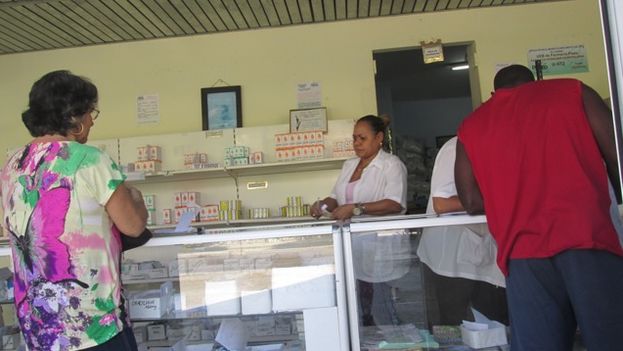
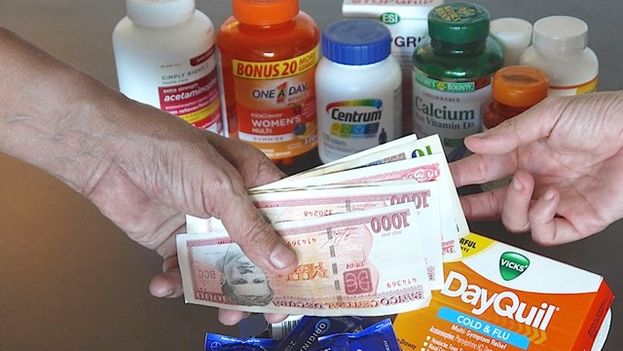
Shortages in state pharmacies fuels illegal trade in medicines in Cuba (14ymedio)

14ymedio bigger14ymedio, Zunilda Mata, Havana, 7 November 2016 – “There is no headache that can resist this Bayer aspirin,” says Vicky, a seller of imported medicines who offers vitamins, sedatives, flu remedies and ointments. The shortages in state pharmacies fuel illegal trade in medicines in Cuba, many of them brought from abroad.

Vicky has been “in this arena” for three years, according to what she tells 14ymedio at her house in Old Havana, which she has repaired and furnished thanks to the medicine business. She says she has regular customers whom she keeps supplied with “antacid pills, multi-vitamins and flu remedies.”

Customs regulations in force since 2014 permit the import of up to ten kilos of medications duty-free into the country. It is only required that they come in “luggage separate and independent from other articles” and that they keep “their original packaging.” continue reading

“Do you know how much Alka-Seltzer fits in ten kilos?” Vicky jokes about the commercial brand of effervescent antacid that is recovering its popularity among Cubans after decades of absence. “There are many needs, and this is a business that never loses,” she explains.

“I have several contacts who travel to Miami and Panama to supply me,” says Carlos Manuel, another medication seller, more focused on the Island’s central market. “Many are accustomed to US brands, so I try not to change my suppliers,” he adds.

“In the countryside people have a tough time getting many of these things,” says the seller, who explains that some customers do not pay him with money but with agricultural products. Carlos Manuel, in fact, already has “agreed to a pig at the end of the year” in exchange for “a nebulizer and a digital blood pressure monitor” ordered by a sixtyish farmer.

Cuba produces some 531 medications, of which 322 go to the pharmaceutical network and the rest to hospital centers, according to data from the Ministry of Public Health. The state subsidizes the sale in dispensaries and regulates the quantities that each consumer can buy, even for non-prescription medicines.

The pharmaceutical industry is going through a difficult period with the lack of liquidity that the country is experiencing. Managers of the state company BioCubafarma explained to the official media last October that the medication deficit is due to decreased availability of raw materials, a result of defaults by foreign suppliers.

“Those that sell fastest are acetaminophen and ibuprofen plus vitamin E, triple antibiotic creams and Scott’s Emulsion,” says Carlos Manuel about his alternative offerings. “There is much demand for medications by older people,” he says.

With a very low birth rate, high life expectancy and increasing emigration by the young, Cuba is on track to become the ninth oldest nation in the world in 2050 and the oldest in Latin America. Currently the elderly exceed 20% of the country’s 11.1 million residents.

“There are more requests for circulation problems, knees guards, canes, bedsore creams and disposable adult diapers.” However, the seller says that still “the medications for chronic illnesses have to be gotten here through the black market, because out there it is very difficult to buy without a medical prescription.”

In that latter category are third generation antibiotics and many of the drugs for heart disease. But also the aerosol Salbutamol for asthmatics and doses of Enalapril for arterial hypertension are scarce in the state networks and are more complicated to acquire abroad.

The imports are products with flashy labels, bottles that often promise a number of pills “free” and with variations for all tastes. “I have the same medicine in pill form but also in gum and syrup,” adds Vicky.

A bottle of 30 children’s animal-shaped, soft vitamins costs in his “private dispensary” some five convertible pesos, a fourth of the average monthly salary. A nasal decongestion spray costs twice as much, the same as a cream for combating nail fungus.

Vicky sells vitamins, sedatives, flu remedies and ointments in her “private pharmacy” (14ymedio).

“Among my clients some spend up to 30 CUC per month on medicines, above all those who have young children or the physically impaired in their care,” the woman says.

The medicines distributed in the pharmacy network throughout the country mostly come in unattractive boxes, in the traditional blister packs or white plastic packages; there is no variety even if by chance there is a medicine for each illness. “It is not the same; although they may be good medicines they look outdated, old,” reflects Vicky.

“Everything that I have is quality, without adulteration,” the saleswoman promises a customer who has come to her house in search of a bottle of Omega 3 and other products. “It does not matter if you don’t have pain or corns, it is always better to invest in health,” she takes the opportunity do some advertising.

Translated by Mary Lou Keel

Berlin Remembers The Fall Of The Wall In The Shadow Of Trump’s Win / EFE, via 14ymedio

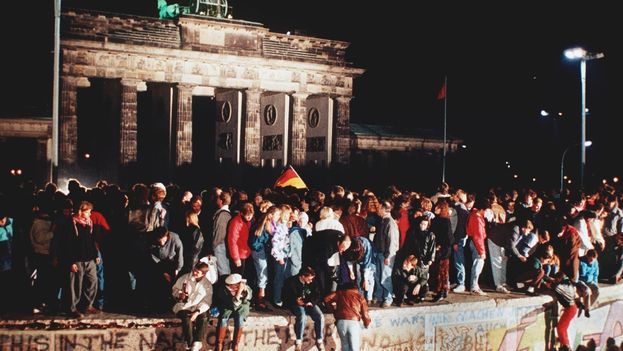
The fall of the Berlin Wall. (Stock Photo)

EFE / via 14ymedio – Berlin, 9 November 2016 – Today the German Capital celebrated 27 years since the fall of the Berlin Wall, under the shadow of the rise of populism in many parts of Europe and the victory of Donald Trump in the presidential elections in the United States.

The two issues were present during the key ceremony at the monument to the victims of that division, attended by the mayor-governor of Berlin, Michael Müller, and with the participation of students from Norwegian, French and German high schools. continue reading

The fall of the Berlin Wall, on 9 November 1989, was remembered as the beginning of open borders in Europe, just at a time when in many European countries new fences are being built.

“Open borders were the result of the awareness that we must never again make war but we have learned nothing, in Europe they are again building walls, the populists have created a crisis and last night’s election results in the United States make me fear for world peace,” said Hildigund Neubert, president of the citizens’ initiative which is charged with keeping alive the memory of those who died along that line of separation.

“Populism is increasing everywhere and there are people who are thus encouraged to resort to violence,” he added.

However, he then recalled that the fall of the Berlin Wall had shown that peaceful resistance is possible.

“The fall of the wall was not a violent act, the wall was a work of violence. To remember that, people are invited to put flowers on what remains of it,” he said.

The flowers were placed in the cracks of one of the sections of the wall that still stands on Bernauerstrasse, around which the memorial center has been created.

After that first part of the event, attendees went to the Chapel of Reconciliation, which is also part of the memorial, where candles were lit in memory of those who died at the wall.

The first candle was lit by Mayor Michael Müller. Students of the invited schools participated in an separate event where they spoke with eyewitnesses of the division of the city and with the Syrian refugee Jihad Tello.

The Portfolio Of The Arrogant Beggar / 14ymedio, Reinaldo Escobar

Cuba’s current portfolio looking for foreign investors offers 395 projects distributed in 14 areas of the economy. Compared to the previous year it has two more sectors.(14ymedio / Luz Escobar)

14ymedio bigger14ymedio, Reinaldo Escobar, Havana, 7 November 2016 – The appearance of unusual proposals such as ostrich farming, the production of quail eggs, or the tanning of exotic hides, along with the timid introduction of a banking sector, are some of the most significant novelties in the Portfolio of Opportunities for Foreign Investment launched during the recently concluded International Fair of Havana.

The illusions generated in 2014, with Cuba’s new openness to foreign capital, have lost strength along the way. The third edition of the portfolio targeted to international business is evidence of this disengagement. The document repeats proposals that didn’t find any takers and adds timid offerings that have yet to overcome mistrust. continue reading

Investors have not “fallen all over themselves” before the pieces of Cuban cake. In part, because there is no easing of the concerns about the dual monetary system, but, fundamentally, because there is no easing in the short term to make the country an attractive and secure place to set up a business.

The current Portfolio offers 395 projects distributed in 14 areas of the economy. Compared with the previous year, it presents two more sectors: sugar and hydraulics. In all, there are 69 additional options from 2015, and some 149 more than in the document published two years ago.

However, as often happens, the numbers don’t tell us everything in this case. Only three sectors, sugar, food production and tourism, are responsible for the “new opportunities,” while construction, industry and mining show a decline.

In the area of health, the three projects from the previous year remain almost unchanged, with the difference that the investment for the International Sports Medicine Clinic is no longer estimated at 11 million dollars but at 18.3 million. The reason for the cost increase is not clear.

Something similar happens with the creation of audiovisuals, which appeared in the portfolio for the first time in 2015. Among the offerings still included, which no one seemed to take up, are projects for a national cable television system, an initiative to improve teaching in computer science and audiovisual media, along with the creation of a forum for the production of high definition materials.

The portfolio is not, as many believe, an inventory of what is up for auction on the island, but a list of what has fallen to pieces or that will fail to exist if it doesn’t receive, quickly, the fresh air of foreign capital. Its pages describe the nation’s economic holes and the amounts fixed, along with the conditions imposed, which resound as the request of an arrogant and disturbed beggar.

The Mariel Special Development Zone (ZEDM), where only last week the “first stones” of two industries were laid, maintained its privileged position at the beginning of the document. Some of the projects of that economic enclave are repeats of the offerings from two years ago, without the wave of enthusiasm initially predicted for the desolate site.

The longed-for “plant with clean technology for the assembly and production of a minimum level of light vehicles,” is back on stage, although this time the offer differs from the two previous editions, when it was offered as a joint-venture project. Now the government has chosen to give way and accept that it would be established as an enterprise with wholly foreign capital.

The same change has happened to the project for a plant “with clean and leading edge” technology for producing dinnerware, glasses and cups for the hotel industry. Currently these products are almost entirely imported and supply instabilities plague the tourist sector.

The stagnation in the ZEDM has also affected the mythical plant for glass containers for beverages, medicines and preserved food, with a cost of 70 million dollars. The operation of this industry depends on everything from the production of pharmaceuticals to the manufacture of soft drinks, beer and compotes for children.

In the rest of the country other projects are repeated year after year, among them a proposal for the technological modernization of a slaughter line for 3,000 chickens per hour, as a joint venture; one for rice production in the province of Artemisa; and others for peanut and coffee processing.

Sugar, which broke into the pages of the portfolio in 2014 with the proposal to improve corporate governance in four sugar mills, just reappeared a year later through an overview from the state sugar company Azcuba. After the successive failures of past harvests, it is now proposing the added processing of cane derivatives.

The telecommunications, information technology and communications sector hovers in the portfolio, but without detailing specific projects. The only information that is presented is that “it excludes the form of wholly foreign-owned enterprises in this sector,” a way of maintaining state control over the transfer of information.

In the last pages of the punctilious document the banking and financial sector is mentioned for the first time, but only to present the facilities investors can count on. The text warns, however, that “investment in the capital of 100 percent Cuban financial institutions is excluded, along with the establishment of branches of foreign banks.”

The new portfolio opens an era of expectations. Optimists are confident that the tinkered-with projects will generate some enthusiasm among investors, but they forget that no gesture is made more cautiously than putting one’s hand in one’s pocket. There is no one more difficult to trust with one’s capital than those who have disdained wealth and systematically assaulted the patrimony of foreign owners.

Of Foreign Investment and Half-Closed Banks / 14ymedio

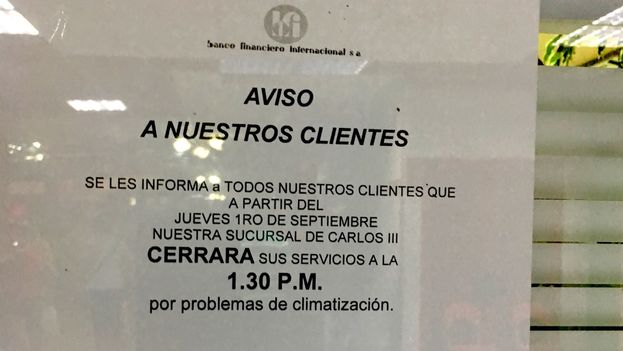
The International Finance Bank announces it will close at 1:30 PM because of "air conditioning problems". (14ymedio)
The International Finance Bank announces it will close at 1:30 PM because of “air conditioning problems”. (14ymedio)

14ymedio bigger14ymedio, Havana, 5 November 2106 – Cuts in energy consumption are affecting the entire country. In schools, hospitals, industries and ministerial offices the monthly quota of kilowatts has been reduced. To accommodate the narrow plans, many of these entities must reduce electric lighting, turn off air conditioning systems and reduce working hours. Banks do not escape this situation.

In the midst of the International Fair of Havana (FIHAV), and as the authorities are promoting to foreign investors that the banking system is prepared to efficiently manage their funds, not even in the International Financial Bank has been able to avoid the restrictions imposed by the fall in crude oil imports from Venezuela.

Now, along with delays in processing of paperwork and chronic problems with the connections between branches, there is the additional problem of reducing the opening hours of these offices. The situation further complicated any operation that involves changing, saving or withdrawing money from the island’s banks.

Trump in Miami, Clinton in Havana / 14ymedio, Luz Escobar and Mario Penton

14ymedio bigger14ymedio, Luz Escobar, Mario Penton, Havana/Miami, 8 November 2016 – With the presidential election this Tuesday, not only is the fate of the United States in play. Its results will also affect the future of the island. In Miami, the South Florida city that Cuban exiles have turned into their capital since the sixties, the Cuban-American community will go to the polls very early to exercise their right to vote. Jorge Guillarte, a 30-year-old Cuban-American, doesn’t care for Donald Trump or Hillary Clinton. He explains that, although he is going to vote, he prefers to do it for local candidates and to use his vote for things that change his own community. “If we had a candidate like Michelle Obama, I would vote for her,” he adds.

“I am a Republican, I am Cuban, we defend the rights and freedom. We want Clinton to leave and Trump to get in to live a little better, with peace and security, with more jobs and more prosperity for the American people,” Enrique de la Cruz, a former Cuban political prisoner, told 14ymedio. continue reading

The New York magnate promised to be tough on the government of Raul Castro if he comes to power. In an attempt to win the Cuban vote, traditionally Republican, but shifting among younger voters, Trump promised to reverse the opening to Havana maintained by President Barack Obama.

“The United States should not protect the Cuban regime economically or politically as Obama has done, and as Hillary Clinton plans to do. They do not know how to make a good deal. She is as bad as him, if not worse,” Trump told the veterans of the Bay of Pigs at a campaign event at the headquarters of Brigade 2506.

Others, however, choose the Democratic option. Such is the case with Ventura Soto, a retired Cuban who was born in the territory that today corresponds to the province of Granma.

Soto explains that he is going to the polls to support everyone who is a Democrat. “Starting with Patrick (Murphy) and doing away with his opponent (Sen. Marco) Rubio who is swarthy,” he says.

In the face of a “racist” speech by the Republican candidate, he is choosing continuity. “He doesn’t want us,” Ventura Soto affirms.

Ileana Cabrera, another Cuban who has spent 22 years in exile, is worried. “We Cubans have experienced monstrosities in our country, it costs a lot of work to believe that in this beautiful country that has accepted as that there are political problems as serious as those facing us,” she adds. “We have to unite, because Cubans divided us.”

In Cuba, the opinions seem to be marked by the influence left by the visit of President Obama in March. Vicenta, a woman selling crafts in Old Havana, believes that the best option for the US is Hillary Clinton, because she seems “fair” and “better person.” Antonio, a retiree, shares this view and, although he was not able to remember the name of the Democratic candidate, he predicts her victory.

Despite the limited access to the internet on the island, Antonio says that judging “online, she” will be the winner.

A young sophomore in the Faculty of Mathematics at the University of Havana also expressed an opinion in favor of Clinton and evaluated her victory as a “preferred” way out, adding it would be “among the negative [choices], the better one.”

Only one of those interviewed predicted Trump would be the winner, “with the money he has, he’s going to win.”

On Tuesday morning, Cristina Escobar, the commentator on international issues on Cuban National Television, without venturing a prediction about the possible winner, concentrated on detailing the scenarios for Cuba in either case.

The journalist explained the real estate moguls unstable position with regards to Cuba, saying he has shown a proclivity to open businesses on the island, and also met with the veterans of the Bay of Pigs Brigade 2506. The Republican candidate also promised to reverse the diplomatic normalization promoted by Obama, she said.

On the former First Lady, Escobar predicted that she would maintain the steps toward a thaw taken by the current administration. However, she clarified that Obama considered the issue of Cuba an important part of his “legacy” but Clinton did not seem to give it much importance.

End of the Obama Era: Valuable Time Lost / 14ymedio, Yoani Sanchez

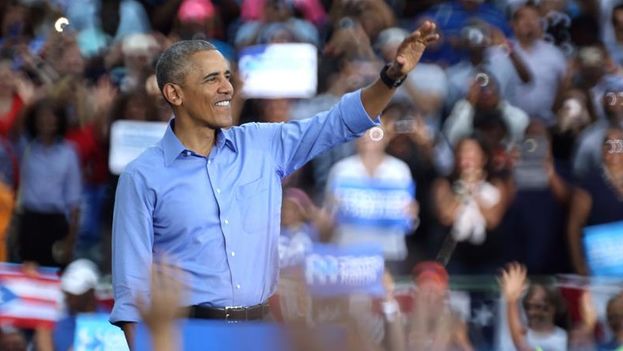
Barack Obama in one of the last rallies of support for Hillary Clinton. (EFE / EPA / CRISTOBAL HERRERA)

14ymedio bigger14ymedio, Yoani Sanchez, Havana, 8 November 2016 – On Tuesday a new era opens for the United States and for the rest of the nations on the planet, while for Cuba a period of great opportunities will end, one that the Plaza of the Revolution’s stubbornness did not use to its advantage.

The normalization of relations between Washington and Havana, announced on 17 December 2014, began a time of possibilities to improve the lives of the Cuban people, a time that the Cuban government received with excessive caution. Every step taken by Barack Obama was responded to with suspicion by Raul Castro, without any lessening of political repression and, in recent months, with a escalation in the tone of ideological rhetoric. continue reading

The general-president has wasted the enthusiasm of the thaw, squandering chances and delaying – with his stubbornness – the inevitable opening that the island will experience. He has chosen entrenchment rather than ease the iron controls that strangle the country’s economic, civic and cultural life.

When the opportunity opened for Cuban coffee growers to sell their product in the United States, our side responded with a tirade from the National Association of Small Farmers. Before proposals to strengthen ties between the young people of both nations, olive-green officialdom barricaded itself in a bitter campaign against scholarships offered by the World Learning organization.

Google’s offers to help connect the island to the internet ran up against the monopoly of the Cuban Telecommunications Company, which only at the end of this year will begin a “pilot project” to bring the great World Wide Web to 2,000 homes in Old Havana. Meanwhile, censorship is still in force against digital sites, and wifi zones maintain their high prices and poor service.

The Plaza of the Revolution has focused its discourse on the glass half empty. For long months it has blamed Obama for not managing to lift the embargo or to return the Guantanamo Naval Base, a propaganda strategy of strident demands to cover up the evidence that our neighbor to the north has shown itself in a better mood for reconciliation.

The photos of Castro and Obama shaking hands and smiling for the cameras matter little. The reality is far from deserving the headlines in the foreign press, which tell us that Cuba has changed because Madonna walked the streets of its capital, a United States soccer team shook the stands of a stadium on the island, or that both countries are collaborating on protecting the region’s sharks.

In recent weeks, the slowdown has been felt more strongly. Cuban authorities know that the new occupant of the White House will face many challenges ahead. Her or his first months’ agenda will focus on emergencies such as the war in Syria, the conflict with ISIS, and the country’s own internal problems, which are neither few nor small. Cuba will not be a priority on the agenda of the next president of the United States.

Whether Hillary Clinton or Donald Trump wins today, it will be some time before the new president addresses the issue of the island and makes it their own, with an imprint that could mean “freezing the thaw,” or deepening the path initiated by Obama. But the reins that keep Cuba locked in the 20th century do not issue from the Oval Office, they are held in the hands of an octogenarian who fears this future that awaits us, one where he will not be.

Biologist Ruiz Urquiola Arrested for Demanding Medicine for His Sister / 14ymedio

Biologist Ariel Ruiz Urquiola on hunger strike to demand medical treatment for his sister. (CubaNet)

14ymedio bigger14ymedio, Havana, 6 November 2016 – On Sunday morning, the police arrested for the third time this week the researcher and marine biologist Ariel Urquiola, who has been holding a peaceful protest in front the National Oncology and Radiology Institute (INOR) since Thursday. He is demanding medical treatment for his sister, Omara Isabel Ruiz Urquiola, who is suffering from cancer.

According to what this newspaper was able to confirm, the specialist remained under arrest until five in the afternoon.

Shortly before his arrest he was received at the Oncological Hospital by its director, Dr. Luis Alfonso Curbelo, who notified him that the drug for his sister had arrived and would be administered this coming Tuesday. continue reading

Urquiola was dissatisfied and incredulous with this response and believes that, given that all this time the patient has been injecting herself, the only thing they had to do was to give her the drug this Sunday or Monday, and so he decided to continue his protest until the matter is truly resolved.

As reported to this newspaper by Oscar Casanella, at three in the afternoon on Sunday, after an interrogation at the police station located in Zapata and C, Urquiola was taken to the emergency room at Fajardo Hospital where he was given a physical examination to determine that he had no injuries.

In communication with 14ymedio, Urquiola’s sister explained that so far he has not been allowed to see his family for the duration of the arrest. “The officer in charge of this case is named Raul with a badge number 03734. I have told them I have nothing to talk to them about until they permit me to see him,” she said, shortly before he was released.

Urquiola’s sister suffers from invasive ductal carcinoma which is treated with two monoclonal antibodies every 21 days. For the completion of this immunotherapy she has lacked Trastuzumab (Herceptin).

The drug, which has been supplied for more than 20 years by the Ministry of Public Health (MINSAP), is manufactured by Roche pharmaceuticals. According to the family of the patient the absence of this drug is attributable to the Ministry of Public Health and the representation of the Swiss firm in Cuba.

Since Thursday, Ariel Urquiola has not taken food or drink and has been accompanied days by several civil society activists in solidarity with his demands. Among them are Gorki Águila, Eliecer Avila, Rudy Cabrera, Oscar Casanella, Claudio Fuentes, Antonio González Rodiles, Ailer González, Boris Gonzalez and Yanelis Nunez.

Biologist Ariel Urquiola, D.Sc., was expelled from the University of Havana after being deprived by the administration of his scientific project, arguing that he was not “trustworthy” because of his political leanings.

In the afternoon, the biologist was released, but vowed to continue his hunger strike until the reasons why he initiated it are resolved. However he agreed to withdraw from the site he had occupied in front of the hospital.

Elections and the ‘Blockade’ / 14ymedio, Pedro Armando Junco

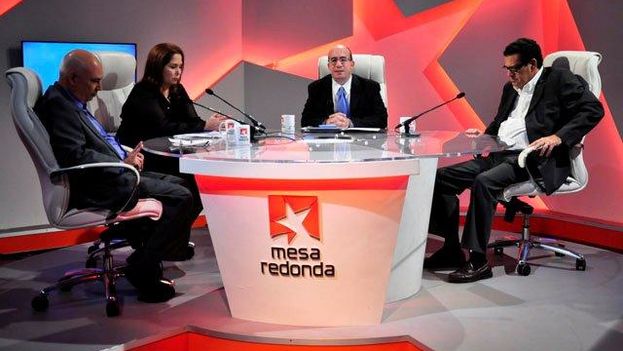
The "Roundtable" program where Cuban journalists lash out against the United States. (Cuban TV)
The “Roundtable” program where Cuban journalists lash out against the United States. (Cuban TV)

14ymedio, Pedro Armando Junco, Camaguey, 6 November 2016 — I met a man who, when his wife left him, carried on endlessly about the contempt he felt for her, constantly berating her, although he couldn’t stop talking about her: she was a prostitute, a liar, a thief and all sorts of other despicable things that came from his mouth. Such was the hatred he felt for this person that, a little while later, he reconciled with her.

Something similar has happened with the official Cuban press in recent weeks. The campaign has developed as never before against the United States “blockade” (as the Cuban government insists on calling the embargo), and the detailed attention to the upcoming US elections takes us back to the sixties with its bitter rancor. Primetime Cuban Television News spends about 25 minutes out of every 30 on these two topics. It is a paroxysm of unnerving propaganda. continue reading

The US government’s abstention on the vote to condemn the embargo in the United Nations General Assembly surprised everyone, at a time when Barack Obama was being presented as no longer a “good president.” The respect and admiration with which he was referred to during his visit to Cuba had collapsed, since some official interpreted his peaceful intentions as a new formula for destroying the Cuban Revolution.

Measure after measure taken by Obama – many of them officially recognized as positive – have been useless in developing a good understanding between the two systems. There is always a “but” to give a discordant note and suggest “the black intentions of imperialism to destroy our fair, equitable and progressive system.”

It is true that the world is against the embargo. What is not explained to the Cuban people is that on questions of international politics, things work this way: there are basic principles of international order that obliges governments, not at all sympathetic to our system, to challenge the financial embargo against Cuba.

Nor is it explained to the ordinary Cuban that the fateful embargo is a law. And in that country not even presidents can abolish laws at the stroke of a pen. In totalitarian regimes, yes they can, because as Machiavelli said, the Prince is above the law. In the United States the legislation that established the embargo was strengthened by the Helms-Burton Act in March of 1996, when President Bill Clinton signed it due to the downing of the two civilian Brothers to the Rescue planes: a crime very similar, although on a smaller scale, to the downing of the Barbados plane, Flight 455.

The embargo and the Cuban Adjustment Act will continue to patiently absorb the Cuban nation toward an annexation as reviled in the same measure as, in the minds of the young people on the island, the dream grows of flying to other lands where they can develop fully and reach a standard of living superior to the one this country offers them. A government that clings to stagnation not only ceases to be revolutionary, but is going backwards in time, because global development of all the nations of the world is a marathon race; and when a nation comes to a halt, for whatever reason, it goes to the back of the line: see North Korea.

Nor do they explain to the Cuban people the causes of the embargo and the requirements that might lead to its abolishment. Perhaps that is why there is such a reluctance to provide unlimited internet in homes and why a decree is being developed to allow the prosecution of independent journalists.

The other issue obsessed about in Cuban TV’s broadcasts on international news, is the election in the United States. The Roundtable show is exclusively devoted to this subject. Reinaldo Taladrid and Randy Alonso paint with a broad brush, discrediting both the main candidates. Clinton has a private server and Trump fondled a girl in an elevator in one of his multimillion dollar buildings and has mocked the female gender like one of the most depraved chauvinists. Yes, politics is dirty. But that is the result of freedom of the press! It is better to know even the wart on the left foot of the person who leads us, than to believe in a crystal urn like the most illustrious of the saints.

Randy and Taladrid even presented a red and blue map on the Roundtable program. The central states in red tend toward Trump; those on the east and west coasts are certain for Clinton. There is no lack of criticism for the system of electoral votes. What is not said is that the system has been respected in the United State Constitution because it was created by the founding fathers, and on only three occasions – two of them in the 19th century – has it not coincided with the popular vote. Nor is it said that a president, no matter how good and effective he or she is, only has the right to be reelected one time, for a maximum of eight years at the head of the government.

But the question that arises is this: Why such a close following of US politics when in Cuba there aren’t even presidential candidates, there are no direct elections, there are no journalists digging into the private lives of the leaders – a very important question when evaluating their moral and human values?

Why waste hours of radio and TV time if we are convinced that, whether Trump wins or Clinton wins, the neighbor to the north will continue the “blockade,” the Cuban Adjustment Act, the Guantanamo Naval Base, the Radio and TV Marti broadcasts, and many more measures as long as Cuba doesn’t respect the right to dissent, to create opposition parties and free trade unions, to have direct presidential elections and, above all, the individual economic empowerment of its citizenry?

A lot of paper and ink has been spent on this side projecting the caged country of 2030. This Cuban megaproject that predicts so many beautiful dreams, perhaps lacks, among others, two basic aspects impossible to evaluate: what percentage of the population living on the island will be under sixty, and how many young Cubans will have crossed the Florida Straits by 2030?

I am afraid, because I am not an annexationist*, that what could happen to us could be what happened to the man at the beginning of this article. Time will have the last word.

*Translator’s note: An “annexationist” in this context, is someone who wants Cuba to become a part of the United States – a charge frequently lodged by the government against its opponents.