Robbed, Arrested And Beaten By Cuban State Security / 14ymedio, Juannier Matos Rodriguez

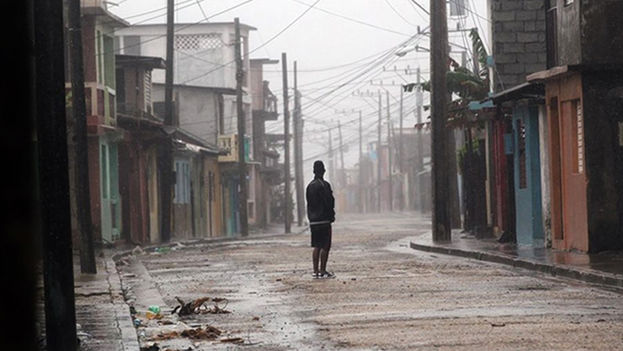
A man stands in the street in the city of Baracoa, in Guantanamo. (EFE)

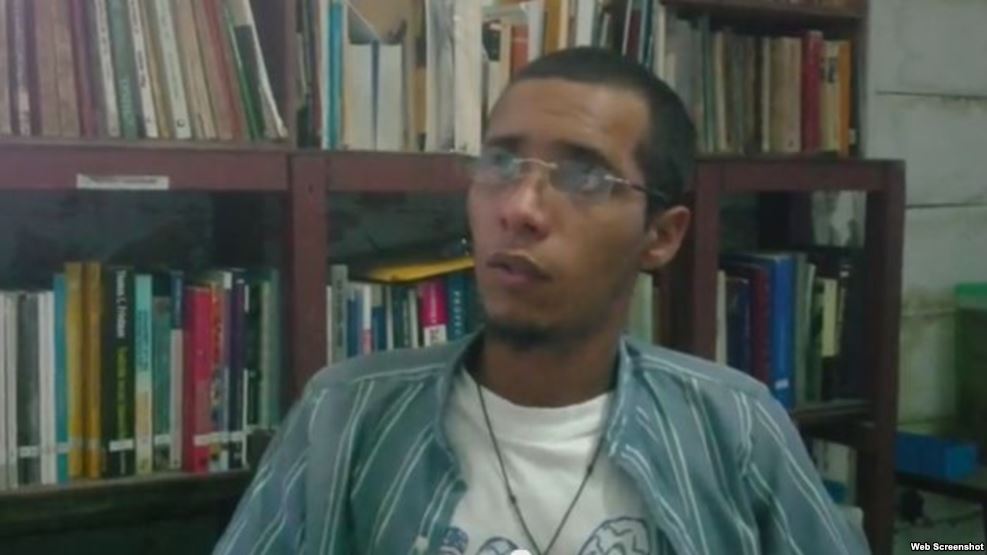
14ymedio bigger14ymedio, Juannier Rodriguez Matos, Baracoa, 30 October 2016 — On Wednesday, October 12 at 5:40 pm, when I was on my way to the phone company in downtown Baracoa, the voice of Capitan Alfredo Oliveros ruined my afternoon, “Juannier, let’s go to your house for a moment, we want to talk with you […], we’re going to do a search,” he told me in an arrogant tone of voice.

A patrol car came up the road and the driver and a soldier from the Special Troops got out, handcuffed my hands behind me, and made me get in the back of the car. He got in with me and looked at me so long and fixedly I had to say to him, “Compadre, don’t look at me any more.” He responded, “You wouldn’t want me to pick you up and beat you.” continue reading

They took me back to my house and waiting there was Dieser Castro Pelegin (formerly a deputy of the Ministry of the Interior, MINIT, in Baracoa, now I don’t know what he does), the State Security agent Eliner Leyva, an official from the Cuban Revolutionary Police with the ID number 25513, the investigator Diorvys Odelin Lamoth, a van with some six or eight soldiers from the Special Troops, the informers from the Vigilance Committee, Diosmarys Infante Palmero (president of the Federation of Cuban Women) and Meydi Duran Navarro (agent from MINIT’s Special Protective Services Company), along with Alfredo Oliveros.

They showed me a search warrant signed by Elier Lopez Carcases, currently a MINIT deputy in Baracoa. They did not tell me the reason for the search.

They took my computer, a phone, a hard drive, two USB memories, several books and magazines, among other things.

Those hands took my books and threw them in a dirty sack, and with some copies they mockingly said: “This is burning my hands.” They took books that did not even mention Cuba, it was enough that the title would include the words freedom, rights, ethics, civic, transition, journalism and democracy, any of those words that are always repeated in international settings by the experiment called Revolution that is Cuba.

The officers claimed they were subversive books, but they were mine and they had no right to steal them from me. I don’t go to some communist’s house and say, “Hey, that book 100 Hours with Fidel is useless. Give it to me, I’m going to toss it out, it’s 100 hours of lies.”

What hurt me most was that the flash drives and the computer had years of research for my degree in Biology, my diploma work, a recent several months long research project collecting information on a population of polymita brocheri (land snails) in Punta Maisi on which I will publish new results, hours of work in the hot sun in Maisí, dozens of gigabytes of literature on the subject and specialty, as well as personal information.

I begged them to let me keep the items about biology, which is professional work, about those beautiful snails that are a threatened species, that was done for Cuba, I didn’t even know what to say, but as if it was nothing, they didn’t understand they were taking a part of my life.

They took two Cuban flags, one of which I flew from my roof as a gesture of solidarity with the neighbors who lost everything and in appreciation for my brothers all over the island who prayed for us during Hurricane Matthew, which I’m convinced made God protect every human life; and one of which was on the wall at the head of my bed, which made me dream every night about a more just and fraternal country with room for everyone.

Then I was again handcuffed with my hands behind my back and without saying anything they took me to a cell in the Baracoa police station. There I refused to eat and continued to do so the next day, when they took me out again, handcuffed, to a jail in La Maya, in Santiago de Cuba, passing through Imías, San Antonio del Sur and Guantanamo.

The next day in the morning, a MINIT major went to the jail, apparently the second in command in the La Maya unit, and I told him, “Officer, you are violating my right to a phone call.” He responded, “Yes, and we will continue to violate it.”

I told the officer who was guarding the cells I was feeling sick and would he please take me to a doctor. I heard a senior officer reply: “The one from Baracoa, he’s a disgrace, he’s a counterrevolutionary, let him die, it’s not your problem, it’s CI’s (Counterintelligence) problem.” I was in that filthy cell without eating until Saturday morning, when a police official came and put me out on the street.

I arrived in Baracoa the next morning. I went to the MINIT delegation and they told me they weren’t going to return anything, that everything had to be reviewed in Guantanamo and then they would give me an answer.

Juannier Rodriguez Matos

In Cuba ‘Raulismo’ Follows The Fine Print Of ‘Fidelismo’ / 14ymedio

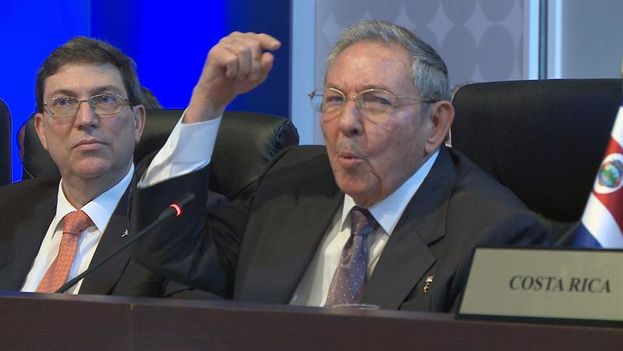
The state model promoted by Raul Castro is incapable of sowing the crops needed to feed the population. (EFE / Señal Instucional)

14ymedio bigger14ymedio, Havana, 27 October 2016 – In recent weeks several alarming news reports about the Cuban economy have filled the front pages of newspapers. The attitude of the government in monopolizing the aid for the victims of Hurricane Matthew and its cutting off of new licenses for private restaurants have raised fears that the country is heading down the path of “counter-reform,” accompanied by an aggressive political rhetoric.

The first signs of this backtracking were felt in the “Guidelines for Economic and Social Policy of the Party and the Revolution,” updated during the 7th Communist Party Congress last April. These guidelines not only refuse to accept “the concentration of property” in non-state forms of productions, but added that the concentration of wealth would also not be tolerated.

For those who were waiting for the Party Congress to lead to greater flexibilities for national entrepreneurs, this strengthening of the most orthodox line increased their frustration.

“Raul Castro’s government seems more willing to lose the income from taxes on entrepreneurs than to allow entrepreneurs to exist with positive results,” laments an economist at the University of Havana who asked to remain anonymous. “Although the foreign media has exaggerated the similarities between the reforms undertaken on the island and the Chinese and Vietnamese style models, in practice, Cuban officialdom strives every day to do the exact opposite.” continue reading

The national press is full of calls to use the maximum “reserves of productive efficiency” that supposedly exist on the island, but this is just an empty phrase if they don’t start opening the Cuban economy instead of closing it.

After officially ascending to power in 2008, Raul Castro initiated a process of changes in the economy that he called “structural” and necessary for the country. Among those that had the greatest impact on daily life was the push for the private sector, which had been corralled with excessive controls, rules and high taxes during the presidency of Fidel Castro.

The leasing of state land under the terms of usufruct generated hope for advances toward greater flexibility in production and trade in agricultural products. The creation of urban cooperatives also helped to fuel the illusions of an economic recovery and an improvement that would be felt on Cuba’s dinner tables and in Cuban pockets.

There were also the relaxations to allow Cubans to buy and sell homes and cars, to travel outside the country and to be able to have cellphones, which achieved greater political impacts, lauded in the headlines of the international press as it highlighted “the Raul reforms.”

Eight years after the beginning of that impulse for renewal, officialdom is determined to divert attention from the main problems facing the country. In the streets there is a palpable sense that the country is returning to the early years of this century, with an imposed economic arbitrariness.

The former Minister of the Armed Forces, now president, has not met his commitment to push transformations “without haste, but without pause,” a much-repeated phrase that has become a touchstone of his supposed intentions. In recent years, instead of advancing, the flexibility measures have stalled and only 21% of the Guidelines have been met, according to the authorities themselves.

Recently, the private sector in the dining industry has begun to suffer new pressures. The announcement of a freeze in the issuance of new licenses to open private restaurants has been read as an unmistakable sign of a slowing, and even a backtracking, in the reforms.

Instead of concentrating its facilities to create a wholesale market, the state has chosen to dedicate all its efforts so that entrepreneurs cannot acquire the products and raw materials needed for their businesses in the informal market. Monitoring and control absorbs more resources and energy, in this case, than enabling and empowering.

Something similar has happened with private transportation, which, since the beginning of the year, has been under intense scrutiny by the authorities, with the government canceling of licenses in an attempt to regulate rates already established by supply and demand. Price caps have affected the population and doubled the time passengers spend in travel.

When logic suggested that the authorities should turn their efforts to providing carriers gasoline and oil at wholesale prices, they inverted the logic with inspectors demanding receipts from the drivers of shared-taxi services to prove they bought their fuel at state outlets. This, at a time when it is an open secret that private transport is only profitable if fuel is supplied through the informal market.

The ever louder beating of the drums by the most recalcitrant targets the accumulation of wealth, but without announcing the definition of what is acceptable and what is not. A practice of confusion and permanent anxiety that was very effective for Fidel Castro in keeping the country on tenterhooks for five decades.

The question many are asking is why doesn’t the government turn its energy to working with private businesses to make the state sector more efficient. Why not decentralize this mammoth network that produces more costs than benefits?

The little progress that has been made in this direction is felt in the country’s development. According to official estimates, in 2016 economic growth will be less than 1%, a figure dominated by the state sector that employs three-quarters of the labor force.

The state model driven by Raul Castro has chosen, in recent months, to spend huge resources on political mobilizations, but is incapable of sowing the crops needed to feed the population.

What country does he intend to bequeath to his successor?

Those who applauded his reforms look out over a Cuba today that is turning to the past, and a government that redoubles its rhetoric against independent journalists, bloggers and academic critics. A nation that continues to put the brake on its productive forces and looks grudgingly on entrepreneurship and prosperity.

Does Economic Development Lead To Democracy? / 14ymedio, Jose Azel

The political sociologist Seymour Martin Lipset. (Wikicommons)

14ymedio bigger14ymedio, Jose Azel, Miami, 27 October 2016 – For decades the statement that “the more wealthy a nation is, the greater the chances that it supports democracy” has been a conventional view and a centerpiece of United States foreign policy. This quote is from a seminal work from 1959, “Some Social Requisites of Democracy: Economic Development and Political Legitimacy” by the political sociologist Seymour Martin Lipset.

Lipset was the first to raise, on empirical grounds, a correlation between development and democracy. His thesis continues to guide US foreign policy and is often cited in discussions of how to promote transitions to democracy. continue reading

In what is known as the Lipset hypothesis, the professor theorized that economic development supports the consolidation of democracy, expanding levels of literacy, information and access to the media, expanding the middle class, activating independent civic organizations, emphasizing legitimacy and other sociopolitical values. Sadly, he is one of the most cited authors read.

Lipset noted that the correlation between politics and democracy is a wide list of factors that change social conditions, enabling the reception of a democratic culture. These elements, among them industrialization, urbanization, wealth and education, are the conditions, not the causes, of democracy. As suggested by the title of the article, the relation between economic development and political democracy is correlative, not causal.

US foreign policy errs when it ignores the contingent nature of history and relegates the complex social and structural conditions that lead to democracy to a simplistic economic variable. The error is multiplied when correlation is confused with causality. As Lipset shows, economic prosperity is often accompanied by personal freedoms, but that does not mean that economic growth causes political reforms.

The fact that the two events are frequently observed together does not meant that one causes the other: that the rooster crows every morning does not mean that the rooster makes the sun rise. In logic, the principle that correlation does not imply causality is known as the cum ergo propter hoc fallacy, which in Latin means “with this, therefore because of this.”

The most important political implications of the Lipset hypothesis have become one of the most researched topics in the social sciences. Recent studies don’t support the affirmation that economic development brings democracy. The most that can be obtained from empirical evidence is that development facilitates the permanence of this form of government, but does not make it more likely.

However, the US foreign policy will continues to depend on the false causality of the “development first, democracy later,” approach.

Atypical cases flow in both directions with wealthy autocracies like Saudi Arabia and poor democracies like Costa Rica. In the case of totalitarian regimes, it is clear that economic development does not lead to political reforms, as is shown in China and Vietnam. In totalitarian societies the elites have a lot to lose and choose oppression.

In the case of authoritarian regimes, the experience is mixed. The divergent cases of South Korea and Singapore illustrate the limitations of the claims that development furthers democracy. South Korea seems to exemplify circumstances where the increase in wealth contributed to the later democratic consolidation. Singapore, for its part, turns the thesis on its head, because the country remains authoritarian and has become more repressive with the increase in prosperity.

Our understanding of the relationship between the type of regime and economic development remains, at best, probabilistic. But we have learned that in previous communist societies it wasn’t the economy that generated the pro-democracy movements. In those countries, the essential struggle between the population and the elites was about human rights and civil liberties.

Therefore, to promote democracy US foreign policy should be updated and better informed, to understand how citizens adopt democratic values and push for democratic reforms.

____________________

Editor’s Note: José Azel is a senior researcher at the Institute for Cuban and Cuban American Studies at the University of Miami and author of Mañana in Cuba.

Camilo Cienfuegos, Nowhere to be Found / 14ymedio

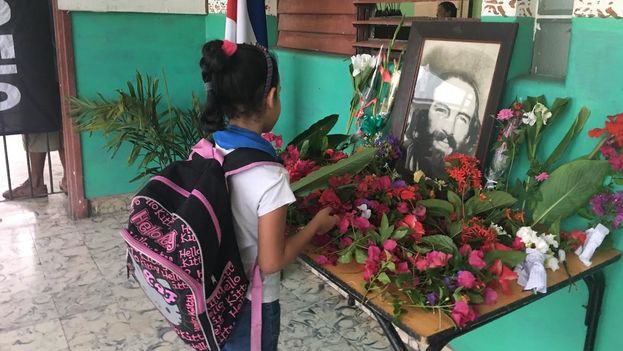
Each October 28 the commemoration of Camilo Cienfuegos has become a tradition in primary schools across Cuba. (14ymedio)

14ymedio bigger14ymedio, Havana, 28 October 2016 – Every October 28 the action is repeated, already converted into a tradition in the elementary schools throughout the country. Children bring flowers to their classrooms and from there leave to through them into the sea as a reminder of Commander Camilo Cienfuegos, who disappeared in 1959 in strange circumstances. Over time, the historical details have become blurred, the official version of events has become highly schematic, while students made comparisons or ask uncomfortable questions.

This morning, at a school in Havana, a preschool teacher tried to explain to her five-year-old students that “the Gentleman of the Vanguard” was lost at sea and they never found “anything at all” of him, not a single trace. The response of one of the little children disconcerted the energetic teacher, “Yes, teacher, I was at the beach once with my cousin and he lost a toy in the water that never came back… we looked everywhere and we never never found it.”

For new generations of Cubans, Camilo is that gentleman of the big hat and diaphanous laughter… of whom there is “nothing, nothing” left.

The Blockade Again… Fidel’s War Against Windmills / 14ymedio, Pedro Campos

Foreign Minister Bruno Rodriguez defends the UN General Assembly resolution against the embargo to which, in 2016, no country voted no. (@Minrex)

14ymedio bigger14ymedio, Pedro Campos, Havana, 28 October 2016 – Launching an advertising campaign, deploying a costly diplomatic action charged to the Cuban people against a “blockade” that doesn’t have a single opponent in the United Nations, because even the United States government abstained, is at the very least to make yourself a laughingstock to the world.

This happens when politics is not structured based on rational thought, nor even on your own interests, but on the remains of pride, madness and fear.

We discover, one more time, that this campaign is directed against the Cuban people whom it tries to continue to disinform and shut up with nonsense seeking justifications for suicidally clinging to obsolete methods and ideas, superseded by history, even at the cost of international credibility. continue reading

The world doesn’t care about fidelismo, about the Castro regime. It is demonstrably tired of it. The regime’s goal is to maintain power within. An absolute power that makes room for any nonsense, so corrupt is it, so addicted and brutish.

The US government’s intelligent abstention in the periodic vote in the UN General Assembly on the American embargo on Cuba, left the Cuban government, as we say colloquially, with the rifle on its shoulder ready to swing at a ball that hasn’t been pitched, or falling under the cannon fire of a ghost ship on the high seas.

Now how are they going to keep blaming Obama and his government for the permanence of some strings of the blockade (as the Cuban government likes to calls it), or the embargo (as it is, in fact).

The overwhelming media and mobilizing campaign against the “blockade” reached its zenith on the eave of the UN vote on the repeated Castro regime proposal stating the “need to put an end to the economic, commercial and financial blockade imposed by the United States of America against Cuba.”

Cuba’s press organs spent several days trying to demonstrate that the blockade-embargo is the cause of all our ills. For weeks, the repudiation rallies have been unending in work and study centers, led by the likes of television talking-head Randy Alonso, against a policy that never diminished one iota the well-being of the political elite and which, instead, has served to justify its disasters, repressions and phobias toward democracy.

People, meanwhile, play at the Soviet era game in Russia: “They pretend to pay us and we pretend to work.” Which translated in this context would mean something like “they try to deceive us and we let them think we believe them so they’ll leave us alone.”

If anything has demonstrated once again how useful fidelismo is in maintaining what is left of the embargo, it is precisely this beardless social mobilization to entertain people and the rigged domestic measures to counter the “imperialist penetration,” which at any particular moment they identify with the policies approved by the last congress of the Cuban Communist Party (PCC) regarding self-employment, cooperatives and foreign investments.

The policy of rapprochement with the United States, developed in the last years of the Obama administration, which has been taking steps since the last Bush administration, has reached the reestablishment of relations, the signing of several presidential orders modifying nearly everything that is not codified by Congress, and even the visit of the US president to Cuba, whose people did not hide their joy at possibly the most momentous visit by a head of state in the last half century.

The US president has been very clear: he wants to live the blockade, but it doesn’t depend on him. He is doing everything he can to dismantle it from the office of the president. It’s clear that he would like a democratic government in Havana with whom the US would have better relations, but he does not intend to meddle in Cuban affairs. He said this in Cuba: this is a matter for Cubans.

But it doesn’t matter, the campaign against the blockade will continue. Fidelismo cannot live without enemies, and even though the adversary vows, promises and acts constructively, he must continue to be blamed for all wrongs and his “fifth column” must be repressed. If not, on whom is going to fall the historic blame for the disaster? Because history “must absolve” it*.

Fidel’s war against the windmills will continue.

*Translator’s note: A phrase taken from Fidel Castro’s defense in court (according to a version later published by he himself) for the 1953 attack on the Moncada Barracks, which is considered the start of the Revolution that ultimately triumphed in 1959: “Condemn me, it does not matter. History will absolve me.”

From Today Your Life Will Be “Very Difficult,” State Security Tells Dagoberto Valdes / 14ymedio

Dagoberto Valdes was summoned on Thursday at one in the afternoon to the headquarters of the State Security Pinar del Rio. (@mariojose_cuba)

14ymedio bigger14ymedio, Havana, 28 October 2016 — The director of the Center for Coexistence Studies (CEC), Dagoberto Valdes, summoned to a meeting with State Security on Thursday, received “an official warning” which anticipates “the possibility of committing crimes against State Security as defined in the Penal Code.”

Valdes, who remained at the police headquarters on the San Juan road for two hours and fifteen minutes, explained to 14ymedio that the officials threatened him that “as of today” his life “would be very difficult” if one day “he was to incur one of these crimes.” The police mentioned as possible violations of the law the receipt of money from the United States for his activities, or the lack of a contribution to the treasury. The director of Coexistence affirmed that he had “received not even one cent from the United States government.” continue reading

Despite these warnings, Valdes affirmed that everything happened “in a serious and respectful climate” and that “there was no physical abuse” at any time.

“I came to this place [the headquarters of the State Security] on time and within minutes of the hour I was received by Lieutenant Colonel Osvaldo Labrador, head of the unit, and Major Joaquin” said Valdes in a statement received by this newspaper.

According to the director of Coexistence, on entering the unit he was led to “an interrogation room where the entire conversation was filmed.” In it, he said Lt. Col. Labrador told him that for “all these years” he had remained “at the razor’s edge between being a layman of the Church and being a counterrevolutionary.”

Accordingly, Valdes added by telephone, they advanced that if he “engages in counterrevolution” he would be “treated” accordingly, but not if he continues with “his profile as a Catholic layman and cares for the social objective of Coexistence” and he mentioned “2003, when the 75.”

At the end of the declaration, Valdes was taken to the “technical” room where they took his “finger and palm prints, an odor print of his pelvis and photos from the front and side,” and later took him to the infirmary. Despite telling Major Joaquin that he felt “in very good health,” they insisted on taking his blood pressure, which was stable.

Dagoberto Valdes is thankful “with all his heart, for the immense solidarity received from friends and brothers of many countries and institutions, as well as for the prayers of pastors and brothers of different faiths.”

The Coexistence Studies Center focuses on training for citizenship and civil society in Cuba. Among its activities is the publication of the magazine Convivencia (Coexistence), the discussion of proposals for the future of the island and the exchange ideas about our current situation.

Last September the members of Coexistence denounced that at least nine of them had been subjected to police interrogation. The activists were forced to suspend the My Neighborhood One Community program due to pressure from State Security, which included operations around several of their homes, arrests and the cutting of the cell phone service of event organizers.

Based in the province of Pinar del Rio, the independent entity is conceived as a think tank to “think about the national home we desire, to contribute to the reconstruction of the human person and the fabric of civil society.”


“It Is Not Because You Write In ‘OnCuba’, It Is What You Write,” University Professor Told / 14ymedio, Mario Penton

Juan Antonio Fernández Estrada, a professor at the Faculty of Law of the University of Havana. (Cubaposible)

14ymedio bigger14ymedio, Mario Penton, Miami, 26 October 2016 — “It’s not because you write in OnCuba, it is what you write,” were the words used by the authorities of the Faculty of Law of the University of Havana to tell Juan Antonio Fernández Estrada that he could not continue to be a university professor. This measure “put the lid on the jar” and provoked a reaction from the teacher, who says he will not stay silent about this new outrage.

“I do not want to make a media show of this. I am submitting demands through the relevant channels and waiting for the responses to a situation that I consider unjust,” Fernandez told 14ymedio by phone, after an email he shared with friends explaining his situation went viral on the national servers. He further clarified that had never asked anyone to share or make public that communication which was meant to be private. continue reading

As of March 2012, the professor has contributed articles to the American magazine OnCuba, a publication with correspondents in Cuba that is widely disseminated through informal networks on the island.

The magazine is permitted by the Government and is a refuge for journalists and academics who see their contributions as a way to increase their meager income working in the state sector. Fernandez has published twenty columns ranging from opinions, history, politics and other topics of interest to Cubans.

“They informed me that my contract as a guest lecturer at the Faculty of Law could not be continued because I had been asked to resign from the Center for the Study of Public Administration (CEAP), and having done so, I had resigned from all of the University of Havana. I told them that other teachers had continued on as guest lecturers after having resigned as professors, but they explained to me that my resignation from CEAP had been for personal problems, the University considered it was because of my writings for OnCuba, and especially for an article about President Obama’s visit to Cuba,” reads an email that Fernandez sent to his friends.

The article referenced said, “I don’t want to know anything about the Industriales (baseball team) or Obama,” published at the beginning of April of this year, after the visit of the US president to Cuba. In this opinion column, Fernandez lambasted “the cries that warn us of Obama’s deception” and, putting his finger on the wound, wrote, “We, the people, we are not the one approaching the United States, nor like sovereigns did we talk in secret for more than a year with that government, nor did we invite President Obama to Cuba, nor did we invite him to speak live on national television.”

Given the impossibility of being hired, the professor told them that teaching was his only work, but the officials, undaunted, spit out that “you should have thought of that before writing those things.”

“I am telling you this because my silence is over this time,” said Fernandez in his email. “The University has not respected my silence all these years. I didn’t complain in 2008, I didn’t complain in 2012, but this time they can’t eliminate me without my speaking and responding.

The pressures of the Cuban authorities so that journalists and academics don’t collaborate with the private press and the emerging digital platforms has intensified over the last year. Presenters on radio and television were told in a circular transmitted verbally that they were prohibited from cooperating with these other media. According to a witness to some of the meetings, they were reminded “within the Revolution, everything, but outside of the Revolution, nothing,” which motivated everything from letters of protests to continued desertions to the independent press.

“The confusion of some has been to think that all my problems at the University of Havana have been because of errors,” concluded Fernandez, “because of naiveté, but it’s not like that, my problems have been for telling the truth, for being dignified and honest, for defending socialism and criticizing the opportunists and the shameless. These are my crimes and I will continue committing them.”

Kidnapped by Human Traffickers / 14ymedio, Georlys Olazabal Drake

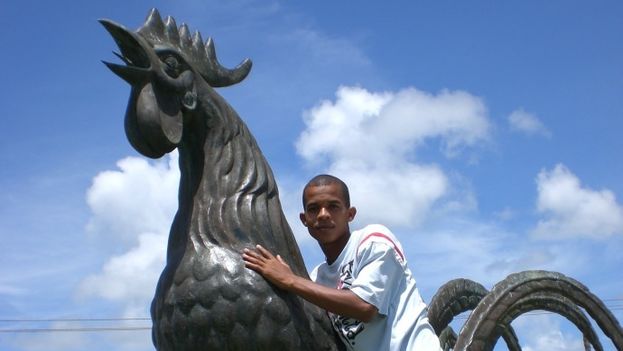
Georlys at the emblematic Rooster of Morón in Ciego de Ávila. (14ymedio)

14ymedio bigger14ymedio, Georlys Olazabal Drake, Florida, Camagüey Province, 19 October 2016 — At 29, like many of the young people here, Georlys Olazabal Drake fled the lack of opportunities in Cuba for undertake the risky journey to the United States. A member of the opposition movement Somos+ (We Are More), Olazabal Drake, who studied computer science, signed up for an illegal exit that would end up with his being kidnapped in Mexico by human traffickers.

Now he shares his story with the 14ymedio’s readers, with a notable number of details that reveal the framework of extortion, complicity and violence that surrounds many of these journeys to follow a dream.

This story started last July 23, when my cousin’s wife told me there was a boat leaving to take people to Mexico, some of them from Florida, the name of our town in Camaguey. She said the trip would cost between 2,000 and 3,000 dollars a person, but along the way – when I could no longer turn back – I discovered the real cost was 10,000 dollars.

The journey came like a hope, because everything was going badly for me at that time. I had had problems with the inspectors and the police had taken away my business license. I also had problems in my personal life.

Previously I wanted to leave the country and several of my family members had abandoned the island. Although I’m not in agreement with the system of government, the reasons that led me to leave had nothing to do with my political ideas, but with personal circumstances. I was a way to escape: I was presented with an opportunity and without thinking about it I undertook the journey. continue reading

I left in a rented car from Fontanar headed to the bridge of the PRIMER ANILLO of Havana, where a group of people had already gathered to be picked up. From there we were taken to the city of Pinar del Rio in a private truck being used to transport passengers.

During this leg of the journey I still felt sure about what I was doing. I believed it was the solution. On arriving in Pinar del Rio a gentleman picked us up outside the bus station and took us to his house. Then, in another truck, we took the highway to a town called Las Marinas. They collected us in these carts that they call spiders and took us to a farm.

We were 32 people, 20 from Pinar del Rio, 6 from Santiago de Cuba, and the other 6 from my town of Florida. There were no children, just 29 men and 3 women. Among them were 2 young men who had deserted from the border guards, taking their uniforms, their guns and leaving their jeep abandoned.

Once there, there was already no way to turn back. The only chance to abort the trip was if the border guard troops found out about it and interfered, or if the boat was intercepted at sea. They made it very clear that if we tried to leave or if we didn’t want to go, they would put an end to our lives.

There was no way to communicate with anyone, because we had to give up our cellphones. We could only go with a change of clothes, a package of cookies, a bottle of water and the money we had. We weren’t even allowed matches.

I wanted to call my wife but I knew they wouldn’t forgive me if I did so. However, I consoled myself thinking that I was making the journey for the two of us and if it worked out, I would find a way to get her out, to leave all the problems we were going through and to start again.

At the farm they didn’t give us any food. Many things were going through my head. I felt insecure, but the only thing left to me was to go forward and ask God for things to turn out well. The people got that far, although we didn’t know each other, were pretty communicative. We tried to help each other.

We slept one night at that farm, where there were several animals like cows and horses, but fortunately no mosquitoes, only some MORO crabs who were all around us because we were near the beach. Some farmers watched us at night with their faces covered, so they couldn’t be identified in case the border guards raided the placed.

During the night the time the boat would leave was changed several times, until some demanded to know the truth. After some pressure they told us it would leave at 7:30 in the morning. Then they gave us more warnings and brought us a jug of water

Around seven in the morning the farmers returned to tell us to get ready, the boat was about to some. When we approached the rock along the shore we could see in the distance what looked like a dove in the water. At that point I don’t know what I felt, I just remember telling myself, “Yes, this is what I should do.”

We were content. However, until that moment I also hoped that the boat wouldn’t arrive. I felt a desire not to make that journey, to put it all behind me and to return to the people I loved. At the moment you leave Cuba, that is when you value it.

Around 7:20 in the morning on July 24 the boat arrives. When we were far from shore I put my hands to my head and said, “My God, what have I done?” But I could no longer throw myself in the sea. The boatman pulled out a pistol and let off two shots in to the air to let us know we were under his control.

The crew was made up of two people: a boatman and his helper, both Cubans. The helper was called “El Menor” and was originally from a town in Pinar del Rio called El Cayuco, while the boatman was called “El Yuma” and was from Güines. Both of them live in Mexico and can’t enter Cuba legally, because they are wanted to drug trafficking, human trafficking and murder.

The boatman bragged about having killed his previous helper, a Honduran who was a boat mechanic.

The two men took security measures, like making us throw away our shoes so no one could escape when we landed. One of them told us that from the same place we had left from, they had made more than 30 trips last summer.

They bragged about coming and going from the island as if it was their house. According to them, in Cuba there are no teams to pursue fast boats. They leave Mexico like a fishing charter, and at night stay 60 miles out and advance slowly as if it was a fishing boat. When the sun rises, they rush in at full speed, pick up, and leave in the same way.

At around 30 miles they made a call to Mexico, to the boss of the business, and told him only: “We’re coming.” The boatman boasted that five boats belonging to the same business owner to look for people in Cuba, but only he had been able to pick up.

The trip was long because they were forced to enter Mexico at night. We arrived at Cancun, near the hotel area, after nine at night. We landed on a dock where we had to pay 100 dollars each to enter.

We were waiting for two small buses and boarded them, 16 people each. They took us to an abandoned warehouse, a sort of old rented building with all the security for this type of business. There two groups of us joined up with more than 50 people who had arrived on previous trips.

On arriving in Mexico we had to get the money to pay them. They took care of the paperwork for each migrant to fly north and present themselves at the US border. The entire trip cost 10,000 dollars, but I had no money to pay. At that point I began my odyssey.

The abandoned warehouse had two floors. Upstairs there were four bedrooms and a large living room where the TV was. One of the rooms was for the guides, who are responsible for finding people in Cuba who want to leave the country. The guides are more comfortable, with mattresses and food, and the trip is free. They are also used to control discipline. The other rooms are like cells.

The bosses were Cuban. They call the main one El Millo and he never shows his face in the business. Later it was Julian, El Negro, who is from Matanza and “attends to” the migrants and helps them do things like call their families. He functions as an intermediary. In addition, there are people everywhere who collect money.

A man named Rey, from Vertientes in Camaguey, is known as El Pinto and looks after the house. He is also responsible for the tortures.

They collected all our clothes from us, our identity cards, passports, and money to prevent any change of escape. They left us with shorts and a t-shirt, which is the “uniform” of the people help in that place.

The next day, at seven in the morning, we had a piece of bread and a glass of water for breakfast. Then they started the calls with our families, most of whom were unaware of our exit plans. They only allowed us to speak for a few seconds to they would know it was true that they had us.

If the family said they didn’t have any money, they warned them they would put their relative in a tank of acid and nothing would ever be heard of them or they would put them back in a boat and take them 30 miles out and throw them to the crocodiles.

I wasn’t tortured but others didn’t enjoy the same luck. They just punished me for not having any money and took me to a room where they only took me out for a bath once a week. We couldn’t watch TV or talk to anyone, and we had to be quiet and sleep on the floor.

I saw how they beat up several people, among them a young man that almost killed. Another who didn’t have any money, they broke two of his fingers with an ax.

If someone fell ill and they didn’t see any chance to get any money from them, they’d take them away and they never came back. We didn’t know what happened with them, if they kept them prisoner or killed them. Sometimes they would split someone’s nose and send photos to the family to scare them and threaten them.

Those who didn’t have any money didn’t receive any food. I spent 38 days with just water but no food. Sixty-nine of us lived like this, because in my group there were only 14 with money who were able to go to the United States.

It was better not to be very communicative, because they could think you were up to something, or going to flee or something else. Some, to get in good with the bosses, brought them information, so I preferred not to speak.

I stayed in a corner, quiet, sitting there, and when I was tired I slept to avoid reprisals of they became violent.

I wasn’t afraid but I worried about what my mom was able to do and thought a lot about my grandfather. On the other hand, they were convinced I was going to get out of there but couldn’t imagine how or when.

On the 35th and 36th day they started saying they were going to toss people 30 miles out or take us to the migrant centers of Chetunal and Tabasco. They took a photo of me and said to be ready at seven at night.

They put me in the taxi and called the federal police, with whom they do business. They sent the photo and the taxi information and later I just had to get in the police car. I was with the federal police for 48 hours, with the right to an attorney and they gave me a book that explained my rights and duties.

They gave us food and treated us well. The police were corrupt and also offered us the chance to continue the journey in exchange for money.

From there, they took us to the migrant center in Chetumal, where I was for 17 days, waiting for everyone. When I got there, there were 29 Cubans and on the day I left 17 more came. It was amazing to see how Cubans who don’t demand their rights on the island, do so there. They were protests about the cleanliness, water, food.

I knew they were going to deport me, but I still had the chance of refuge or political asylum. I thought about this last option, but gave up because I missed everything in Cuba. Despite all the problems I’d left behind, my country was better.

On 22 September they took me in a can to the Cancun airport and the next day, around seven in the morning, I left to fly to Havana.

They took all of us to the migrant center at Valle Grande prison, where they analyzed us, took statements and checked for criminal histories. The treatment was good, respectful and they didn’t ask us about anything. After a period of quarantine they sent me to the police station in my town and from there, home.

I’m happy to be in Cuba, with my family, my friends, and to have the chance to continue my political activism. Although sometimes I thought the solution was to emigrate to the United States, I don’t think I will try to leave again. I just want to establish myself here and have a family.

Although it’s hard to live with the problems we have in Cuba, the situations that face us when we try to exit illegally are harder. I urge everyone to fight for change in Cuba, since leaving the country is also leaving everything you love.

Cuba’s Pro-Government Intellectuals Denounce US “Cultural War” / EFE, 14ymedio

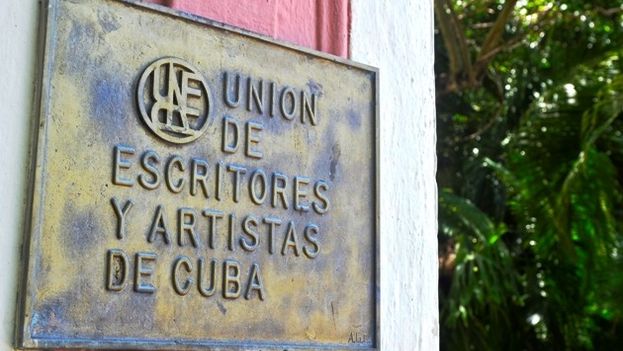
UNEAC says the US is trying to "undermine" unity, "cast doubt" and demobilize. (UNEAC)
UNEAC says the US is trying to “undermine” unity, “cast doubt” and demobilize. (UNEAC)

14ymedio biggerEFE/via 14ymedio, Havana, 20 October 2016 — The National Union of Writers and Artists of Cuba (UNEAC) and the Hermanos Saiz Association on Thursday blamed the United States for being behind a “war of culture and symbols” against Cuba and warned that “any naiveté in this sense could be very expensive for the sovereignty and independence” of the country.

“It is obvious that the war of culture and symbols that we confront is based on an explicit laid out in the statements of the leaders of the US themselves and in documents of that country’s armed forced,” says a message from these groups collected in the official press to mark the Day of Cuban Culture. continue reading

The two associations, that include the intellectuals of the island’s officialdom, say that they are trying to “undermine” unite, and “sow doubts” and demobilize.

“Although those who attack us have failed to break the commitment of the vanguard of Cuba’s artists and intellectuals with the Revolution, they do not pause in their attempts,” affirms the letter, published by the newspaper Juventud Rebelde .

The letter stresses that “history itself has been charged with demonstrating that it is not possible to imagine the survival of a socialist revolution if it is not accompanied by a profound cultural transformation that reaches the level of common sense.”

It also quotes former President Fidel Castro, who defined culture as the “shield and sword of the nation” and the current ruler, his brother Raul Castro, who recently warned that the field of Cuban culture is “doubly” threatened by ” subversive projects” and” the global wave of colonization.”

Intellectuals also refer to the economic embargo the United Stats has maintained for five decades against the island and whose “attacks” has been “suffered directly” by Cuban culture.

On October 20 Cuba celebrates National Culture Day in commemoration of the first singing of the country’s anthem, in the city of Bayamo.

The Old Age of Elpidio Valdés / 14ymedio, Yoani Sanchez

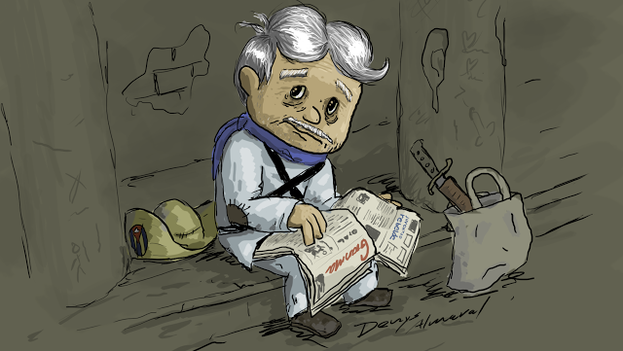
The image of the artist Denys Almaral gives an unexpected turn to the iconography created by Juan Padrón.

14ymedio bigger14ymedio, Yoani Sanchez, Havana, 24 October 2016 — Several generations of Cubans have grown up watching cartoons based on the adventures of Elpidio Valdés. A Mambí – Cuban freedom fighter – friendly and popular, the character has starred in many popular sayings and some jokes repeated ad nauseam. Willing to annihilate the Spaniards with a slash of his machete, nationalist to the core and vindicator of the version of history clung to by the official discourse, this insurrectionist tried to represent Cuban identity in his picaresque rebelliousness.

The image created by the artist Denys Almaral gives an unexpected twist to the iconography created by Juan Padron. Aged, forced to sell newspapers to survive and marked by economic hardship, this Elpido Valdes of this little vignette belies the heroic tints in which he appeared in numerous shorts and feature films dedicated to the witty independence fighter. continue reading

Instead of the country for which he fought, the rogue spends his last years in a Cuba where those who live better are those who have hard currency, where the dreams of equity are a thing of the past, and where the generation that helped to build the system is a “hindrance” to the government’s desire for a monopoly.

The island is full of Elpidio Valdéses asking for alms, standing in long lines to buy the only bread they have the right to each day and dreaming of the project of this nation that led them to the countryside to shake off the yoke of a foreign power. Now, they are not subjects of the metropolis, but of the Castro regime.

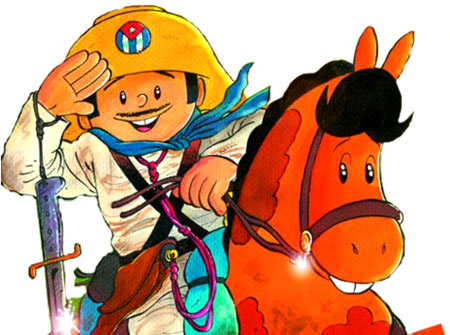
Elpidio Valdes -- the Jaun Padron version "in his youth"
Elpidio Valdes — the Juan Padron version “in his youth” Source: kreweofmambi.com

Cuban Institute For Freedom Of Expression And The Press Denounces Harassment Of Its Members / 14ymedio

logo51

14ymedio bigger14ymedio, Havana, 24 October 2016 – A Cuban State Security operation has been directed, so far in October, against different independent journalists who cooperate with the Cuban Institute for Freedom of Expression and the Press (ICLEP), according to Monday’s press release from that organization.

These operations have resulted in the arrests of nine journalists, raids of their homes, and confiscation of the tools of their trade. Victims say they have used physical violence and verbal threats. continue reading

The journalist Dianelys Rodriguez, director of the media Panorama Pinareño, denounced that last Friday, 21 October, his house was searched without a warrant. The official in charge, identified as Lt. Col. Jesús Ramón Morel, head of the Department of Confrontation of Pinar del Rio Counter-Intelligence, with the help of two other officers, forcefully dragged Rodriguez and covered her mouth so she could not protest, according to the journalist. Finally, she was taken to the police station where she was held for five hours. They prepared a warning letter and threatened her with incarceration if she continued her work.

Four other journalists’ were also victims of raids on their homes and confiscation of the tools of their trade. The preliminary balance sheet, according to the ICLEP members affected, was the confiscation of five printers, two laptops, a video-camera with a tripod, six cameras, three cellphones and other auxiliary devices.

Last Friday, Ricardo Fernandez, Panorama Pinareño’s editor, was summoned to the Pinar del Rio Technical Office, where he was threatened with going to prison and “assured that ICLEP would disappear.” Previously, the political police had raided his home, confiscating a laptop and cellphone.

Raul Velaquez, ICLEP executive director, was arrested while investigating what happened to these journalists. On this occasion, they took Raul Velaquez’s cellphone, gave him an official warning and threatened that he would be prosecuted if he returned to visit the province.

ICLEP’s legal director, Raul L. Risco Perez and journalist Claudia Cristina Ortega were summoned and threatened with jail. In the east of the country, Leovanis Correa Moroso, director of Santiaguera Voz, was “arrested, handcuffed and beaten in the face” and then remained “under arrest for three days” and also was threatened with prison if he “continued working as a citizen journalist.”

In the municipality of Jatibonico in the province of Sancti Spiritus, Osmany Borroto Rodriguez, director of the Espirituano, was accused of distributing the newsletter in the streets. Shortly before, Ada Maria Lopez had been arrested in the capital’s Fellowship Park and taken to a police station because he was distributing the Habanero Amanecer (Havana Dawn) newsletter.

Another case of arbitrary detention against ICLEP journalists occurred on 14 October against a Majadero de Artemis worker, Yosdanys Blanco Hernandez. The journalist was detained in a market by agents of the National Revolutionary Police and taken to the Artemis National Police station, where he was held under arrest for 24 hours. The agents explained to him that he was arrested because there was a complaint against him.

ICLEP’s denunciation is part of the growing wave of repression by the authorities towards independent media, which in recent months has led to the arrest of many journalists.

A Vaccine Against Populism 14ymedio, Reinaldo Escobar

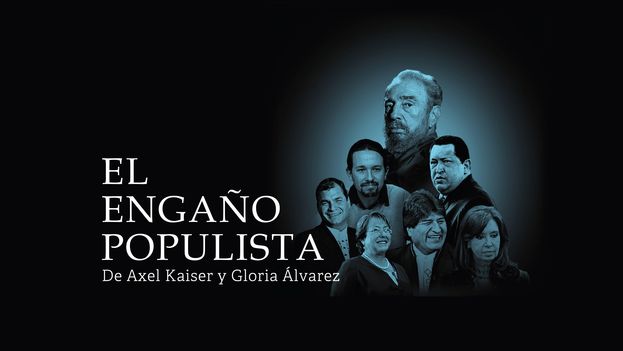
The book 'The Populist Deception' was published this spring by Ediciones Planeta Colombia
The book ‘The Populist Deception’ was published this spring by Ediciones Planeta Colombia

14ymedio bigger14ymedio, Reinaldo Escobar, Havana, 24 October 2016 — While it may be considered tacky to reveal the trick with which a circus magician entertains his audience, it is very useful to expose the tricks used by a fraudster to deceive his fellow man. This seems to be the public utility of El engaño populista (The Populist Deception), a book by Axel Kaiser and Gloria Alvarez published this year by Ariel publishers in collaboration with Planeta Colombiana Publishing.

In 15 sections grouped into three chapters, these essays present factual information and philosophical and political arguments in a balanced and convincing way.

The book exposes the populist as a political figure who promises a host of social benefits that can only be provided by an omnipotent state. This will be the paternal state that defends the helpless citizen from the shellfish appetites of capital, and from some external enemy that threatens the sovereignty of the nation. continue reading

In just two hundred pages, the authors describe the state designed from the populist perspective. Like any authoritarian father, it nullifies the individual who tries to differentiate himself. To do this it spreads the obsession for egalitarianism and the idea that all accumulated wealth is the fruit of plundering others. This phenomenon is identified with concrete and contemporary examples. Chile, Argentina, Cuba, Venezuela, and even the Spain proposed by the Podemos Party, find amazing coincidences and common points of departure.

One of the most striking aspects of this book is the definition of the role played by “organic intellectuals” in the process of building and financing populism. The project, developed by Antonio Gramsci (1891-1927), is based on the assumption that intellectuals can construct a cultural hegemony to sensitize the masses and lead them to socialism.

“Twenty-first century socialism” as an antidote to neoliberalism and the strategy developed by the Sao Paulo Forum are identified in this study as populist developments to which we must pay more attention. The roadmap of Latin America’s leftist movements was drawn in the 1990 Forum led by Luiz Inácio Lula da Silva and his Workers’ Party of Brazil — he was then president of the Party and later president of the Brazil. Just when socialism seemed definitively buried, the Forum achieved a renewal of thought among the Latin American left.

If The Populist Deception weren’t so obviously apologetic of liberalism as a political doctrine, it could find a wider audience precisely among those deceived by populism. This, at least methodologically, seems to be its weak point. Demonstrating the dichotomy between freedom and security is, in reality, a false dilemma; the real contradiction is between the proposal of a system that promotes happiness and one that ensures the right to achieve it.

The most valuable thesis of this book may be that populists governments concentrate power in the hands of the state, supposedly so it will have the resources to allow it to deliver happiness to its people; meanwhile “the others” create a state of law in which it is assumed that each person may have at therr disposal the resources to build their own personal happiness.

History has shown that populism does not achieve its goals and ultimately poverty and corruption prevail. But contemporary liberalism also has unfinished tasks. The book that would explain this in detail, free of ideological propaganda, remains to be written.

Panama’s Darien Gap, a Mediterranean Without Boats or Headlines / 14ymedio, Yoani Sanchez

Cubans crossing the Darien jungle to get to Panama. (Courtesy to '14ymedio')
Cubans crossing the Darien jungle to get to Panama. (Courtesy to ’14ymedio’)

14ymedio bigger14ymedio, Yoani Sanchez, Panama, 23 October 2016 — If anything deserves to be called “tropical” it is the Darien jungle in the south of Panama. Humidity, mosquitoes and heat makes moving within the dense vegetation of the area a superhuman task. Through the dense jungle extends one of the most dangerous migratory routes of the world. A Mediterranean without boats or headlines, but one where opportunity and death also converge.

Where Central America joins in a narrow embrace with South America, is is the deadliest and most feared stretch along the route to the United States. Crossing from Colombia to this area in Panama are migrants arriving from nearby or distant countries, such as Cuba, Haiti, Ivory Coast, Ghana, Somalia, Bangladesh, Nepal, Pakistan and Sri Lanka.

This piece of land has lodged in many migrants’ memories as the most difficult in the long march toward a dream. However, for migrants from other continents, coming from Asia and Africa, overcoming it is a major effort. There are those who cross the Atlantic at the mercy of the human traffickers, hidden in the cargo holds of ships that often depart a Europe incapable of confronting its own immigration crisis. continue reading

Without speaking a word of Spanish, nor knowing the least cultural details of this area of the world, the recently arrived collide with a region where reality oscillates between the marvelous and the sinister. In most cases, they carry no identity documents and only a few know words such as “water” and “food.”

Those who manage to cross the thicket of vegetation and danger, celebrate on the other side, now in Panamanian territory, with the joy of reaching a final destination, but with the crossing of the rest of Central America and Mexico still ahead of them, some of it semi-desert. But conquering the Darien comes to be seen as winning a medal in the most difficult Olympic disciplines… one in which the athletes play at life.

There are no half measures in this strip of rough terrain. A coyote might be an experienced guide who leads a group of travelers toward the next frontier, or a criminal who delivers the group into the hands of extortionists, rapists and thieves.

Through the jungle, the migrants appear in groups, some with children riding on their shoulders, stumbling through the mud and branches along makeshift routes. Their stories are barely told in the foreign media, and international organizations have been parsimonious in highlighting the humanitarian crisis that is taking place in this narrow waist of land that enhances the curves of America.

It is also a path marked by simulation. Many Haitians cross the jungle passing themselves off as Africans. The citizens of the country in this part of the world hardest hit by natural disasters and poverty are considered as pariahs, with little appeal even to the human traffickers.

In no other place on the continent, as in the Darien, are the deficiencies of Latin American diplomacy in coordinating common policy more apparent. Meanwhile, Nicaragua continues to keep its borders closed to migrants, Costa Rica seeks to stem the flow of foreigners flooding it, and the president of Panama warns that those who enter the jungle area separating his country from Colombia “are going to be given humanitarian assistance to continue their journey.”

The Darian Gap incarnates the fiasco of regional integration, delayed by the short-sightedness of the politicians and the successive attempts to create select clubs of countries, united more by ideological conveniences than by the urgent needs of their citizens. The greatest failure is the fault of the Central American Social Integration Secretariat (SISCA), incompetent to implement an effective contingency plan for the situation.

It has been of little use that James Cavallaro, President of the Inter-American Commission on Human Rights (CIDH), made a call to the United States of America to act “immediately to open channels that allows these people to migrate legally and safely.” In the government palaces, everyone seems more focused on lighting their own fires than in supporting joint efforts.

This diplomatic selfishness didn’t escape Cavallaro, who also said that “the fact that the migrants resort to irregular channels and human traffickers is explained by the lack of legal and safe channels to migrate,” a situation that increases their vulnerabilities to the abuses and extortion of criminal organizations, human traffickers and corrupt police.

The landscape worsens every day with a Europe overwhelmed by the massive arrival of migrants and a “destination America” appearing as an option for those fleeing armed conflicts: the poor and the desperate. Like a river that starts with a thin trickle of water, the flow of those crossing the Central American isthmus grew and grew, swelled by thousands of Cubans who fear the repeal of the Cuban Adjustment Act and the benefits it offers them in the United States.

The drama takes place beyond the photographers’ lenses. The images of the boats filled with refugees coming from Myanmar and Bangladesh trying to get to Indonesia, Malaysia and Thailand filled the newspaper headlines in the middle of last year, while the Darien hid its most terrible scenes. It barely appeared in the international press.

To those who boast of living in a hyper-connected world, with every inch already explored and with the eyes of satellites crossing it foot-by-foot, they would do well to visit this jungle. One of the last natural redoubts that terrorizes men, stops the most daring expeditions and seems to laugh at adventurers in the style of Indiana Jones.

A descent into the abyss of humidity and insect bites could shade the reading of news about space probes that reach distant planets and collect images of other galaxies. The region remains as stark as in the days of the Spanish Conquest.

The Pan American Highway, which runs from Alaska to Argentina, is interrupted here. A situation that has helped to preserve the natural diversity of the area but that certainly increases the deadliness of this stretch for migrants.

In September of this year, a family of three drowned in the Turquesa River. Fishermen in the area reported the body of a child not yet four years old floating in the water. Then they also found his parents. All had “foreign-features,” according to the Panamanian border service.

They are just a few of the many victims claimed by the Darien Gap. This jungle is so thick that not even screams escape it.

__________________

Editor’s note: This text was published on Sunday 23 October in the newspaper El País.

“It’s Hard for the Government to Tolerate the Professionalism of Independent Journalists”

Ignacio Gonzalez, journalist and editor of Free Hot Press agency (screenshot)

14ymedio bigger14ymedio, Joanna Columbie, Havana, 21 October 2016 – Ignacio Gonzalez is frequently seen in the streets of Havana with microphone in hand recording citizens’ reactions to a flood, a historic baseball game or the re-establishment of diplomatic relations between the governments of Cuba and the United States. Independent journalist and editor of the Hot Free Press (ECPL) agency, the young man aspires to continue excelling professionally and thinks that non-government media are experiencing a time of growth.

Recently Gonzalez spent 48 hours under arrest at a police station as a consequence of his work as a reporter, an arrest that is among the repressive acts carried out against independent journalism in recent months.

Columbie: How was Hot Free Press born?

Gonzalez: It comes from the idea that people are again gaining confidence in the independent press, which had lost a little due to government propaganda that says that it involves unqualified and mercenary journalists. We interview not only the regime’s opponents but also doctors, engineers, can collectors, mechanics, carpenters… people like that. continue reading

Columbie: You suffered an arrest recently. What happened?

Gonzalez: I was doing a report together with another colleague on a study of central Havana, and an operation began with a patrol car, five police officers and two agents from State Security. They took us to the fourth police unit and interrogated me in one of the offices. They made me undress and squat forwards and backwards in order to see if I had hidden any USB drives. I felt denigrated.

Then I was transferred to a police station on Zanja Street and later to the 10th of October, located on Acosta Avenue. I was detained for 48 hours, which had never happened to me, because they had always detained me between three and four hours.

Columbie. Were you accused of some crime or are you now subject to some investigative process?

Gonzalez. They told me that they had a file on me and that I am a counter-revolutionary. Although they assured me that my detention was not because of political problems, but because I was committing an illicit economic activity, since I had an agency where it was known that I paid workers and that I had no license to practice this activity nor was I accredited in the country. They also threatened me that my equipment could be seized. I did not sign nor will I sign any paper. There is no accusation as such, what I have is threats.

Columbie: Do you feel you are a “counter-revolutionary?”

Gonzalez: I told them that they were the counter-revolutionaries because they refuse progress and all kinds of democracy to our country. If they are going to put me in prison, they are going to have to do so also with thousands of Cubans who bravely and spontaneously make statements for our reports. Nor am I a mercenary. I work and get a salary for my work with my press outlet.

What they want with their threats is that I stop being an independent journalist and dedicate myself to taking photos for birthdays and quinceañeras [girls’ 15th birthday celebrations – a major coming-of-age milestone].

Columbie: How do you define yourself?

Gonzalez: I am neither an opponent nor a dissident; I am a person who practices journalism in favor of the truth. If the government does something positive, I do an interview or a report about that topic, but if it does something negative, I also bring it to light. If an opponent commits an act of corruption, I bring it to light, and if he is making a move in favor of the people, I do as well. That’s how journalism should be: impartial.

Columbie: Why do you believe that the repression against you has become more intense now?

Gonzalez: The increasing growth of independent journalism is upsetting them. We unofficial reporters have had the opportunity to attend courses, improve ourselves, and the government doesn’t tolerate it. This improvement, this professionalism that journalists are acquiring, even the audio-visual media which shows the whole world the news as it is, it is hard for them to tolerate. They are trying to accuse us of illegalities. It is a zero-tolerance policy towards the independent press.

In the case of Hot Free Press we are making reports almost of the same quality as Cuban television, but with the difference that we are not censored. We are reaching people; we have managed to make people feel a little more confident with the independent press, to give their statements. We have even found among members of the public that they say that if it’s not for national television, they say whatever they want. They are more disposed to make statements to independent outlets because they know that the national press belongs to the government and simply does not work.

Columbie: Are other non-governmental press agencies going through the same situation?

Gonzalez: I have not seen the same attitude with the rest of the new supposedly independent programs, like Bola 8 or Mi Havana TV. These just have a lot of nonsense. Supposedly they are being financed by the self-employed, but I work in this industry, and I know that the self-employed cannot pay for a production like these programs are showing. There are diverse locations and entry to places to which the independent press does not have access.

Columbie: How would you define the practice of the press in Cuba outside of the official sphere?

Gonzalez: Being an independent journalist here is like being a war correspondent.

Translated by Mary Lou Keel

Cuba’s Private Restaurant Owners are Worried / 14ymedio, Luz Escobar

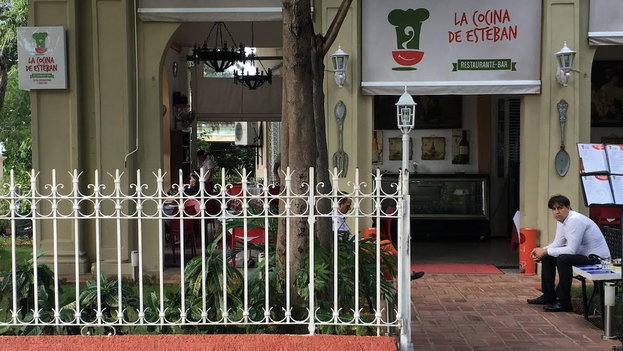
The Esteban Kitchen paladar (private restaurant) in Havana’s in Vedado district. (14ymedio)

14ymedio bigger14ymedio, Luz Escobar, Havana 20 October 2016 — Chinese, Italian or international food fill the menus of Cuban paladares, but lately fear has starred as the main dish on the menu of these private restaurants. The jewel in the crown of entrepreneurship on the island is experiencing moments of uncertainty after the government froze the issuing of licenses for these businesses run by the self-employed.

In recent months food and beverage outlets have watched a parade of pop stars, Hollywood actors, emblematic rock-and-rollers and even US President Barack Obama through their establishments, but it is a complicated time.

Even Camaguey province has been shocked, after the closure, at the beginning of this month, of three of the most important paladares operating in the city. Restaurant 1800 was searched by the police, who confiscated some of the furniture and arrested the owner, Edel Izquierdo. Two other paladares, Mi Hacienda and Papito Rizo’s Horseshoee, were also forced to close. continue reading

The suspension in the granting of new licenses for these premises has stoked fears about a possible backward step in the reforms undertaken by Raul Castro starting in 2008. Although officialdom has rushed to clarify that this is a temporary measure, a sense of a country going backwards to times of greater controls is felt on all sides.

The Acting Vice-President of the Provincial Administation in the capital, Isabel Hamze, declared on national television this Wednesday that “of the 135 license holders [of private restaurants] we met with 129 to alert them to a group of problems that cloud the services that they offer and we explained them that, with these exchanges ended, it was time to undertake an inspection.”

The official noted that during several meetings with owners of the private locales they discussed among other issues the consumption and sale of drugs inside restaurants, along with evidence of prostitution and pimping.

Hamze emphasized that those who acquired “money in Cuba or abroad illegally” in order to “bring it to the island and launder it,” need to be on guard. “Nowhere in the world is it legal to launder money and it is not permitted. We are not accusing anyone of doing it, we talked about where their capital comes from,” she said.


“The state can not compete with the privates, which in a short time have managed to run more efficient and attractive places for foreign and domestic customers,” a waiter of the centrally located Doña Eutimia Restaurant, nestled against the Havana Cathedral. The man believes that the current “storm will pass, because otherwise it would go against the times.”

Most owners of these private premises prefer to keep silent. “He who moved doesn’t end up in the photo,” joked a private restaurant owner on 23rd Street. “Everything is on hold, because no one dares to stand out now,” he added. “The repression of the paladares has come because some have become nightclubs with musical programs that attract a lot of people.”

According to updated data, more than 150,000 self-employed work in 201 occupations in Havana. There are more than 500 private restaurants throughout the capital.

In some locations it has become common to alternate good food with shows ranging from comedy, to magic, to fashion. Lately, the celebrated King Bar has sent out invitations to spend October 30, Halloween night, with costumes and frights.

The government undertakes inspections to guarantee strict compliance with the rules that govern the operations of these establishments: no more than 50 seats, limited hours, and the purchase of supplies exclusively in state stores with receipts to prove it.

However, several entrepreneurs consulted by this newspaper agree that it is difficult to manage a private restaurant following the letter of the law. The shortages often experienced in the markets that sell in Cuban convertible pesos, the lack of a wholesale market, and the prohibition against commercial imports, hobble the sector and push owners to the informal market.

In the Labor and Social Security Office on B Street between 21st and 23rd in Havana, this Tuesday, it was not possible to get a license to open a paladar. “The licenses of those who already have them are not suspended,” but “the issuing of new licenses has been halted,” declared an official to the nervous entrepreneurs who came to the site for more information.

The measure was preceded by meetings with the owners of paladares where they were warned to comply with the law; officials from the National Tax Administration Office (ONAT) and the police were at the meetings. The answer has been felt immediately on the menus of the most emblematic places, which have reduced their offerings to what can be purchased in the state retail network.

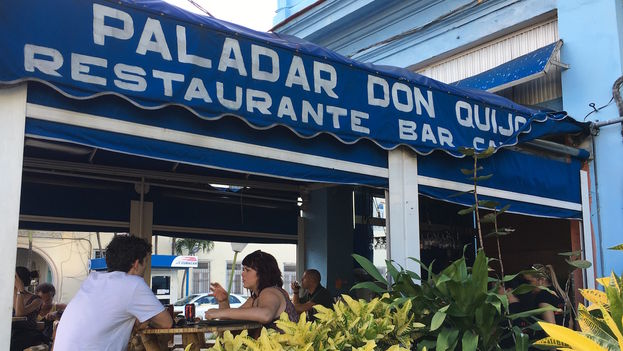
The Don Quijote paladar (private restaurant) on 23rd Street in Havana’s Vedado district. (14ymedio)

Lobster and beef have been among the first items to disappear from the menus, as most of these products are purchased on the black market from suppliers who circumvent police roadblocks to bring them to the city.

The law criminalizes very severely the theft and illegal slaughter of cattle – which is nearly all slaughter of cattle outside the state system – in addition to the “illegal abetting” of such goods. Due to the decrease in the number of cattle, to a little more than 4 million today, the Government considers any irregularities in the slaughter and marketing of these animals to be a serious violation of Penal Code.

However, of the 1,700 private restaurants that offer the country has many typical dishes known as ropa vieja and vaca frita, among other dishes made from beef. Given the current onslaught of the authorities, a stealthy slogan is in play: survive and wait out the storm.