Patria y Libertad: Homeland and Freedom / 14ymedio, Tania Bruguera

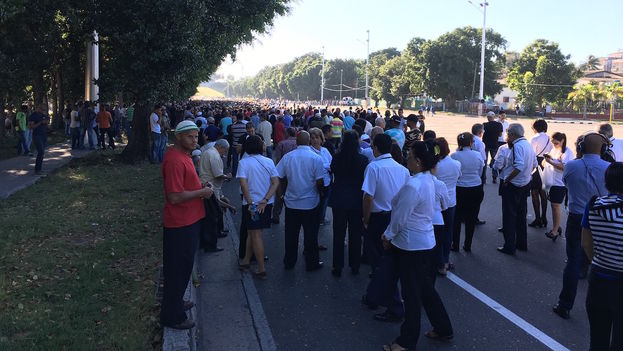
One of the events in Havana in the 9-day mourning period for Fidel Castro (EFE)

14ymedio, Tania Bruguera, Havana, 1 December 2016 — Today in Cuba, we start a new phase, a phase that requires us to transition (shift) from an anecdote to historic data, from rumor to research, from passion to facts from what was symbolically assumed to what was actually done.

Time has come for us to ask for that archives be opened, to know how many truths  were manufactured and  to what extent victories  were achieved, to know with certainty how many  Cubans have  died around the world, to understand what social progress we have made and  to learn which agreements the government has  made on our behalf.

The Cuban people have the right to know its history, all of it, and be able to draw their own conclusions. continue reading

Today Cubans have stopped being children waiting for orders.

However, refusing to be underestimated requires understanding  other people’s feelings, those that think and  feel differently. It means understanding that we are not always right and  that the goal of discussion  is not to win arguments but to clarify our ideas and send them out for consideration..

We need to stop  thinking that only our feelings  are valid because the project of The Revolution  has  been a different  experience for each and  every one of us, and  since they were experiences, all of them  are valid. There are things  to rescue and  things  to remove. It would be more interesting to see  how people have  dealt  with their experiences, what they have done with them, instead of denying   someone to feel in their own terms.

We need to start  saying  “no” to the things  we don’t like, to the things  that keeps us from feeling clean  and  honest, even  if this means losing a privileged position, because there’s no money,  no professional opportunity, no material comfort  that can  be compared to feeling free, to being  able to speak one´s  mind.

But the life project that we can create from now on is only possible if we allow ourselves to stop  having  double standard ethics, if we stop telling something to some people and then something different to others.

We have  an exceptional moment before us, not to defend a government or a position, but to create all together a vision for Cuba; one that  is not biased to either extreme,  a vision that can be a compilation of all our points  of view.

It is the time to create a new legal infrastructure that includes  respect for different  opinions and  stops political hate forever, that ensures that citizens’ preferences cannot be controlled by the government; that can be a space for fair and inclusive decisions.

It is the time to create a political infrastructure that guarantees that never again  a president can hold all powers. This has happened 3 times  in Cuba  since  1902.  There should never be another president who thinks he knows  better than  anyone, and what is better for us all.

This is the time to create a civic and social  infrastructure that includes everyone, that includes rights for everyone, that includes political dissent as a civic right,  that includes civic literacy.

It is the time to create an emotional infrastructure that nurtures room for mutual understanding, a structure that does not allow anything to horrify or minimize us.

A structure that allows solidarity  and  privacy,  individual rights and  social  rights where  the life we want to have is respected but also represents a common effort; a structure that allows truths  and  claims  from everyone, the majority but also the minority. A place  where  a humanist utopia  exists  but never  again  paranoia among its citizens, where emotions don’t compromise what is fair.

Today, there is a real task for Cubans to complete: to balance what we want to rescue and what we want to change. It is the time to stop whispering our hopes, it is time to stop being  afraid.

The best way to honor  our homeland and ourselves is not being submissive, not being a cynical nation,  never  again  being a nation  with different classes of Cubans, nor a place  from where  to leave,  but a place  where  life is a dignifying act  we are proud of.

Placing love, family and friendship above ideologies is the only way Cuba will be a nation again.

(English version from Tania Bruguera’s own site)

Opposition Alliance Calls To Open An Inclusive National Dialog / 14ymedio

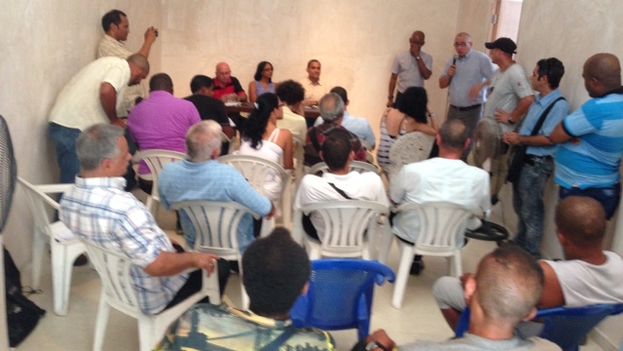
Cuban activists founding the MUAD. (14ymedio)

14ymedio bigger14ymedio, Havana, 1 December 2016 – The Democratic Action Unity Roundtable (MUAD) has made a call to open a national dialog a few days after the death of former Cuban president Fidel Castro. The opposition alliance believes that the country is entering a new stage in its history, according to a declaration signed by its spokesperson, Boris Gonzalez Arenas.

MUAD said that for many Cubans the memory of the political leader is marked by “injustices and inhumane detentions” and the “unjustifiable loss of human lives.” The statement also references the “uprooting suffered” by thousands of islanders “on seeing themselves forced to abandon (…) the land in which they were born.” For these people, Fidel Castro will remain “a totalitarian dictator” the document emphasized.

However, for other Cubans he will always be considered as the ruler “who opened the doors and gave them opportunities for themselves and their families that they did not have before the revolutionary process initiated in 1959.” In the memories of this part of the population Castro will remain “the hero, the father, the ‘at your orders’ Commander in Chief,” the statement says.

The declaration focuses on “a new generation of Cubans” who have “their own interpretation of our history and our reality.” They are individuals with “desires for a respect for diversity of thinking and for freedom,” and who dream of “a truly plural Cuba with respect for human rights and oriented to the benefit of all.”

The challenge for the current government is to put into practice “a set of measures that really impact the economic and social environment” and that allow “wide participation of all Cubans, wherever they are,” MUAD emphasizes.

The renewal of the national legislative political order also is called out as an urgent matter, in the document made public by the opposition coalition.

“The only path we have to achieve all the economic, social and political transformations that we want for Cuba is an inclusive dialog,” says the final paragraph of the statement.

MUAD brings together more than thirty independent civil society organizations. In the middle of this year the alliance suffered a serious reversal with the Patriotic Union of Cuba (UNPACU), the largest opposition organization in the country, left its ranks. The same thing occurred with the United Anti-Totalitarian Front (FANTU), led by Guillermo Fariñas.

Lights After The Ashes / 14ymedio, Yoani Sanchez

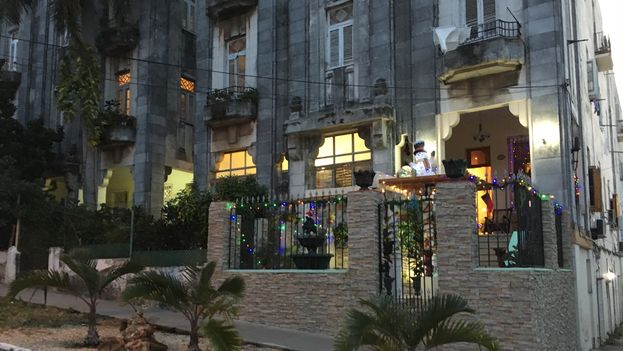
Despite the mourning, some have dared to put up Christmas decorations. (14ymedio)

14ymedio bigger14ymedio, Yoani Sanchez, Havana, 1 December 2016 – Timidly, without much noise or fuss, Havanans are shaking off the national mourning decreed for Cuba, as of last Saturday, for the death of Fidel Castro. Despite cultural activities having been cancelled, the closed theaters and the bars without alcohol, the first Christmas decorations are beginning to be seen in some homes.

The owners of these houses adorned with lights and garlands risk being reprimanded by those closest to officialdom or by the police.

In a city where the authorities have severely reprimanded those who play loud music in their homes, or who plan any kind of festivities, to install Christmas decorations is true defiance, a gesture of irreverence more daring and forceful than an opposition slogan shouted in the Plaza of the Revolution.

Thousands of families across the capital city are waiting for the end of this period of seclusion imposed by the powers-that-be to prominently display their tree with a star and snow made out of cotton. These are the symbols of the new times, of the holidays that will inevitably come after the great funeral.

Fidel Castro’s 13 Most Notorious Failures / 14ymedio, Zunilda Mata

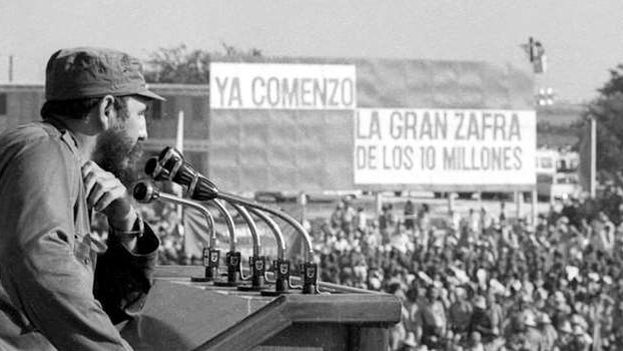
Fidel Castro promoting the 10 million ton of sugar harvest from 1969 to 1970. (Archive)
“Now it begins, The Great 10 Million [ton] Harvest.” Fidel Castro promoting the 10 million ton of sugar harvest from 1969 to 1970. (Archive)
14ymedio bigger14ymedio, Zunilda Mata, Havana, 30 November 2016 – Cuba’s official press and, oddly, a good part of the international media, never stop repeating that Fidel Castro brought Cubans free education and healthcare for all. Cuba was already, however, one of the most developed countries on the continent before the Revolution, much more so even than some European countries such as Spain. Currently, the healthcare system is in a calamitous state since the USSR and Venezuela suspended their enormous subsidies for Havana, and education, despite being universal and free, is totally at the service of an ideology.

These are the 13 most notorious failures of the last 57 years, all attributable to the Maximum Leader.

    1. One of Fidel Castro’s first promises in 1959 was to drain the Zapata Swamp, the largest wetland in the Caribbean islands, and to use it for planting rice. After investing substantial resources and mobilizing a large labor force, the project was abandoned. The failure of this idea of Castro’s was fortunate for the ecosystem, and today the area is included in the National System of Protected Areas and is a breeding ground with more than 10,000 rhombifer crocodiles, a species native to Cuba. A natural resource that would have been lost with the expansion of agricultural crops.
    2. In a public speech in the sixties, Castro said that in a short time there would not be a single marabou bush to be found anywhere on the island. Five decades later, the advance of this invasive plant has hampered agriculture to the point that his brother Raul re-issued the promise in a speech in July of 2007, during the annual commemoration ceremony for the assault on the Moncada Baracks, but the problem remains unresolved.
    3. In the early sixties Fidel Castro promised that milk production in Cuba would be so great that although the population was expected to triple, Cubans would not be able to consume all the milk that was going to be produced. Currently, milk is a rationed product distributed only to children under seven (and those with special medical needs), who receive a kilogram of powdered milk every ten days. In 2007, Raul Castro expressed a desire that all Cubans would be able to “drink a glass of milk” every morning.
    4. The October Crisis, also known as the Missile Crisis, represented a major defeat for the Maximum Leader, when the Soviets ignored him and made an agreement with the United States to withdraw their nuclear arms without considering his opinion. The Cuban people were barely aware of how close they came to perishing in a global cataclysm. In the streets of the island people chanted, “If they come, they stay,” and “Nikita, pansy, what is given isn’t taken back,” (in a rhyming version in the original Spanish), an allusion to the withdrawal of the warheads.
    5. Starting in late 1968 the island began preparing for a 10 million ton sugar harvest in 1970, but managed to produce only 8.5 million tons. The country turned its entire attention to the cane cutting, with the end of year holidays suspended to concentrate on harvesting and sugar production. The economy was left in ruins, fields dedicated to other crops were turned over to sugar, and the damages to the environment were never revealed.
    6. The Alamar neighborhood to the east of the capital, built through a system of microbrigades – people diverted from their normal workplaces to construction brigades – was exposed as the Cuban model of socialist architecture. In Alamar’s concrete blocks would live the “New Man,” an individual without ambitions who would know nothing of markets or exploitation. Today the Alamar apartments represent the lowest price point in the capital’s housing market. Not only for their architectural ugliness, but because this bedroom community lacks an adequate cultural, economic and commercial infrastructure.
    7. In 1967 it was proposed to create what would be called “the Havana cordon” around the capital, with the planting of coffee interspersed with pigeon peas, a miraculous bean to feed cattle. Thousands of Cubans were mobilized for the cultivation and the official press predicted a notable improvement in food supplies. The project was abandoned and its final fate never explained. [Ed. note: Among other problems, Havana does not have a climate conducive to coffee growing.]
    8. In the late seventies it was planned that the Isle of Youth would be Cuba’s first communist territory. Experiments were established to eliminate money and extend free goods and services. Numerous schools were built to welcome students on fellowships from 37 countries. Today most of these schools are abandoned, their hallways and classrooms overrun by vegetation.
    9. The genetically superior cow was one of the most persistent obsessions of the Comandante en Jefe. Crossing Holsteins with native cattle would create the F-1 and later F-2 animals that would guarantee the national cattle herd. The emblematic animal of this project was a single cow named White Udder, which set several records, producing more than 100 liters of milk a day. The year 2015 closed with slightly more than 4 million cows on the island, almost two million fewer than in 1958, while the population had doubled.

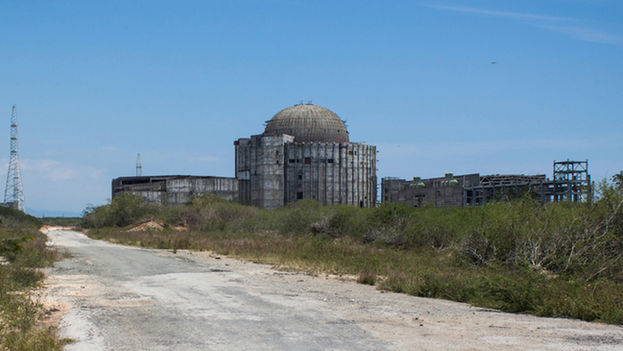
The Juraguá nuclear power plant in the province of Cienfuegos, is visible from the "nuclear city" where plant workers were to reside, and where now people are sunk in economic problems and labor inertia. (14ymedio)

    1. In 1983, Cuban troops surrendered to United States troops in Granada. Cuban official television said that the Cubans had been slain wrapped in the national flag before falling into the hands of the “enemy.” Shortly afterwards they returned to the island, safe and sound, along with the officer in charge of the mission, Colonel Pedro Tortolo. Popular humor named a kind of tennis shoe sold in the rationed market after him, because they were able to “run well.”
    2. The Juragua nuclear power plant, in Cienfuegos province, was proclaimed the “work of the century” in Cuba, but never completed. The project started in 1982 with technical and financial support from the Soviet Union, and was to have four Russian VVER reactors, with a capacity of 440 megawatts each, which should have become operational between 1995 and 1996. After the disappearance if the USSR, the project was paralyzed for lack of financial resources. The works were 50% complete at that time, with an investment of some 1.1 billion dollars.
    3. As a solution to the food shortages of the Special Period, the so-called Food Plan was launched. Thousands of Cubans were mobilized to agricultural camps to produce, in particular, the so-called “microjet” banana. With a system of intensive irrigation they were planted as a solution to increase the food supply, but the costs of production and the low quality of the bananas ruined the plan.
    4. In the environment of the Battle of Ideas,” the idea was generated to create a social worker initiative, a kind of “Red Guards” of the Revolution who were assigned multiple tasks. They distributed energy-saving light bulbs during the so-called Energy Revolution, controlled the sale of gasoline at gas stations, but also served as the shock troops in acts of repudiation against dissidents or ideological reaffirmation. With the coming to power of Raul Castro, they were demobilized and many of them ended up joining the ranks of the Ministry of the Interior.

Fired “Like A Dog” For Satirizing Fidel Castro / 14ymedio, Mario Penton


Apologies: The video is in Spanish without subtitles

14ymedio bigger14ymedio, Mario Penton, Miami, 30 November 2016 — Leamsy Requejo Lorite, who worked as a curator at the Museo Nacional de Bellas Artes in Havana, was expelled from his workplace on Tuesday, after publishing on the social network Facebook an ironic text about the death of Fidel Castro, accusing him of owing him thousands of pesos that he was never paid for the work of his whole life.

“Good morning to those who know the true reality of Cuba,” Requejo said in a video posted on his Facebook profile in which he denounces his dismissal. “It saddens me greatly to use my Facebook profile to give this news. The abuse here in Cuba is becoming more evident,” he adds. continue reading

On November 26, a day after the death of Fidel Castro, this 31-year-old Cuban wrote a post for which he was fired. According to what he explained to 14ymedio by telephone, his co-workers reported him to the museum administration.

“I feel so sad, but so sad, that a person died who was paying my monthly salary,” his Facebook page said.

“He left and didn’t pay me what he owed. He left owing me thousands of pesos.”

“On Monday I approached Oscar Antuñu, deputy technical director of the museum, and he berated me for having posted these words on Facebook. He had not yet made the decision to fire me, but it was already rumored. A day later, he told me to get out because I’m not trustworthy,” says Requejo.

“They have not given me the pink slip, but at least verbally they kicked me out. They have told me I can not even enter the museum,” he adds.

The reason offered by the administration for his firing was the negative comment against “an idol of the Cuban Revolution.” Requejo asked what kind of idol is someone he never voted for to represent him.

“In one of the discussions they threatened not only to kick me out of the museum, but that I would never work in a state institution again,” he says.

Faced with the possibility of not being able to support himself and marked as a “counter-revolutionary,” Requejo threatened to call the international media to report his case, which finally precipitated the decision to dismiss him.

“They categorized me as untrustworthy and verbally abused me,” he explains, but says he didn’t fall short of words to defend himself against the attacks.

Requejo worked as a conservation specialist with six other colleagues, earning 365 pesos (14.60 dollars) per month, which was supplemented by 12 CUC (roughly 12 dollars) a month given to him to pay for his lunches.

“It was a shitty salary, but as bad as it was, it was what supported me,” he says. “In the two years I had been in that department I was always the best, but now they fire me like a dog.”

“I can not understand what my personal Facebook has to do with my workplace. I was fired from the museum simply for stating a political opinion, that goes against every right.”

Requejo says he is afraid of the pressure of State Security on him and it grieves him that this event destroyed his working life.

His immediate boss, Anniubys Garcia Blanco, refused to answer multiple calls from 14ymedio for comment, as did the deputy technical director of the museum, Oscar Antuña.

“I do not know what will happen to me, because I also work at the museum,” said Requejo’s mother, Barbara Lorite. “The only thing clear is that they threw him out, he’s out. Probably, they will fire me too when I return from my vacation,” she added.

The Only And Final Beer / 14ymedio

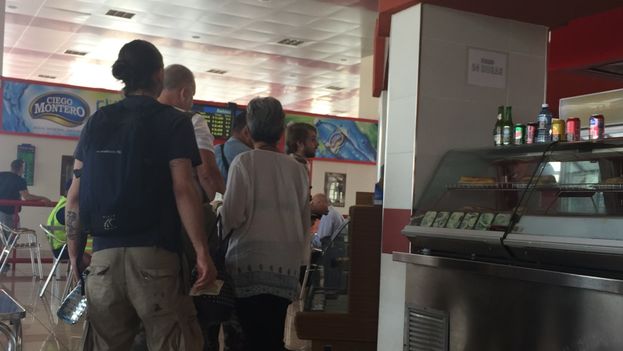
At Jose Marti International Airport in Havana rum and beer are still for sale despite the countrywide ban due to Fidel Castro’s death. (14ymedio)

14ymedio bigger14ymedio, Havana, 30 November 2016 — For many tourists who have experienced recent days in Cuba it has been especially difficult to enjoy a mojito, relax with a daiquiri, or sip a beer to deal with the heat. With the declaration of national mourning, the government has prohibited the sale of alcoholic beverages for nine days, and also cancelled all cultural activities and placed tight controls over music in public and private places.

However, at Havana’s Jose Marti International Airport, rum and beer are still for sale, but only in the area beyond the security controls and emigration booths. This Wednesday, the line at the café in Terminal 3 was longer than usual. Many wanted to once again feel “something cold that soothes the soul” on their tongues, said a Spanish traveler.

Only inside hotels and in the restricted areas of the airport terminals has the sale of these products been allowed. The restrictions include the emblematic Floridita Bar, which will be closed until after the mourning period, and the Bodeguita del Medio, which right now is empty and sad; both are famed for the “regulars” who drank there, including Gabriel Garcia Marquez and Ernest Hemingway, among others. “This is the only and last beer I’ve been able to drink in Cuba,” joked the Spaniard from Madrid, while enjoying a cold Cristal, tempting and unattainable for those on the outside.

The Political Testament Of Fidel Castro / 14ymedio, Reinaldo Escobar

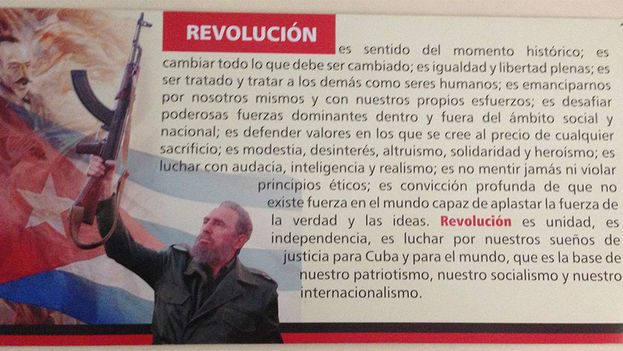
Revolution is ... (14ymedio)
Revolution is … (14ymedio)

14ymedio bigger14ymedio, Reinaldo Escobar, Havana, 29 November 2016 – Under the shadow of national mourning after the death of Fidel Castro, Cubans have been called to sign, as an oath, some words spoken by the former president in May of 2000, in which he left for posterity his concept of Revolution.

“Revolution is a sense of the historic moment; it is changing everything that must be changed; it is full equality and freedom; it is being treated and treating others as human beings; it is emancipating ourselves by our own efforts; it is challenging powerful dominant forces within and outside the social and national sphere; it is defending the values we believe in at the price of any sacrifice; it is modesty, selflessness, altruism, solidarity and heroism; it is fighting with audacity, intelligence and realism; it is never lying nor violating ethical principles; it is a profound conviction that there is no force in the world capable of crushing the force of truth and ideas. Revolution is unity, it is independence, it is fighting for our dreams of justice for Cuba and the world, which is the foundation of our patriotism, our socialism and our internationalism.” continue reading

More than a definition, the text should be understood as a personal assessment of the political process in which Fidel Castro played the starring role. In the absence of a solid theoretical thought, the exegetes of the Commander in Chief have made use of the poetics of his rhetoric to extract, something like that, as a political testament.

The phrase chosen has the turns of an oratory delivered to captivate those congregated in a plaza, where almost all license is permitted, while sounding good and conquering the ears. But read at a distance and analyzed as a thesis, it lacks programmatic solidity.

In the phrase, the term Revolution is ambivalent and is presented both as a result obtained and reached for. At other moments the statement seems a method to achieve certain goals, the final fruit of a process, or a tie to moral values close to the Decalogue of good behavior.

The contradictions of the concept stated by Castro for more than fifteen years ago have discouraged academics of the official environment and organic intellectuals from analyzing it. Instead, they have chosen to sanctify the verse so as not to be seen to be committed to rigorously dissect it.

When Castro mentions that Revolution is the sense of the historic moment, it only confirms that he lacks the political instinct to perceive the wealth of opportunities that such processes trigger, something that rests exclusively in the capacity of certain individuals to take advantage of the situation.

On the other hand, the substantial difference between Revolution and reform resides in the way transformations are realized, but these words avoid pointing out the violent and radical character of the process they promote. The absence of this precision constitutes the most important conceptual deficit of the text.

In the horizon of almost all social revolutions is equality, but a process of such a nature is not needed to try to achieve it. Freedom has historically been most affected by revolutions. In particular, the freedoms of expression and association, and, in the case of socialist revolutions, economic freedoms.

The inaccuracies in the text does not end there.

In the words extolled today, Castro defines his creature as the capacity to treat others and to be treated as human beings. It is the promise of the lowest profile that a politician could project and, most obvious, that includes a concept for posterity that is, at least, a disturbing gesture.

The confusion rises in tone when the leader invites us to “emancipate ourselves by our own efforts,” without specifying if he speaks from the working class that must shake off the “chains” of exploitation, or if it is a nationalist-style demand to eliminate dependency on some foreign power.

In the first case, it would be renouncing alliances with other sectors such as the peasantry, while following the second to the letter leads to renouncing proletarian internationalism.

The act of “challenging dominant forces” differs if you are in an insurrectional period, or it is several years after the beginning of the Revolution. When Castro stated this concept, power in Cuba lay in the Communist Party and especially in his own will, which did not accept the slightest challenge.

The voluntarism of the orator stands out when he calls for “paying whatever price necessary,” while he appropriates Christian values by promoting modesty, selflessness, altruism, solidarity and heroism. The call to never lie or violate ethical principles reinforces the character of the commandments of a religion.

The text also extols audacity, intelligence and realism, guidelines that are more appropriate to succeed in business than to drive social transformation. Emphasizing these assertions with the conviction that “there is no force in the world capable of crushing the strength of truth and ideas”: pure idealism, alien to the dialectical materialism of Marxist inspiration.

Unity does not make the Revolution, nor is independence a conquest in the midst of a globalized world that has put an end to borders, so all that is left to the orator to base his concept on is “our patriotism, our socialism and our internationalism “and to fight for “our dreams of justice,” without substantiating any.

The conceptual gap of the definition of Revolution that, as of this Monday, millions of Cubans have signed, leaves their hands free for whatever future decision is taken by whoever relieves the current historic generation. On this foundation stone, one can erect anything.

Fidel Castro Was Anything But Courageous / 14ymedio, Andres Oppenheimer

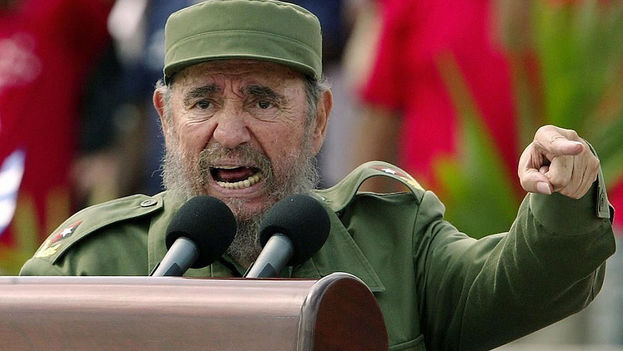
Fidel Castro harangues the crowd. (Archive)

14ymedio bigger14ymedio, Andres Oppenheimer, 28 November 2016 – It is not elegant to criticize someone who has just died, but seeing the messages from the heads of state around the world exalting the supposed courage of the recently deceased Cuban leader Fidel Castro, the truth must be told: Castro was anything but courageous. On the contrary, he was a coward.

In the first place, he was a coward for not allowing a free election in 57 years, from the time he took power in 1959. Only someone who is afraid of losing doesn’t desire to measure himself against others in a free election.

In the second place, Castro was a coward because he never allowed a single independent newspaper or non-government radio station or television channel. His critics didn’t even have access to the official channels. It was as if they did not exist. continue reading

Castro gave the vast majority of his interviews to journalists, models or sports figures who revered and honored him. And the few interviews he gave to serious journalists were monologues, in which he did all the talking.

I remember in the late 1980s, when I asked the Colombian Nobel Prize winner Gabriel García Márquez to intercede for me to ask for an interview with Castro. He laughed and said: “Why do you want an interview with Fidel? He never says anything in an interview that he hasn’t said in one of his five hour speeches.”

Castro’s fear of losing his omnipresent image as Maximum Leader was such that he forbade the media to talk about his private life. He had to be portrayed as a demigod who had sacrificed his life for the public good. For decades, the names of his wife and children were a state secret.

When I traveled to Cuba in the early 1990s, a journalist from the newspaper Juventud Rebelde (Rebel Youth) the communist youth paper, told me he had been reprimanded by his boss for trying to publish a photo of Castro eating dinner. The commander could never be shown eating, said the journalist.

Even the circumstances of the death of Castro may have been a government montage: Cuban official media say he died on November 25, which is the same day that Castro and his guerrillas left the Mexican port of Veracruz on the yacht Granma in 1955 to start their armed insurrection in Cuba.

Did they tamper with the date of his death to show it as a heroic journey to the afterlife, which coincides with the date of the beginning of his revolutionary epic six decades ago?

Third, Castro was a coward because he did not allow any independent political party. According to the Cuban Constitution drafted by Castro, only the Communist Party, which he presided over for decades, is allowed on the island.

Castro used the United States trade embargo as an excuse to prohibit independent political parties and freedom of assembly. Even after he handed the presidency to his brother Raul, although he remained a powerful figure behind the scenes, the Cuban regime intensified repression of the peaceful opposition despite the normalization of relations between the United States and Cuba that began under President Obama in 2014.

According to the Cuban Commission on Human Rights and National Reconciliation, an unofficial group, documented political arrests have soared from 6,424 in 2013 to 9,125 so far this year.

Fourth, Castro was a coward because he never allowed international financial institutions to monitor or verify the positive economic statistics of his government.

Castro boasted that Cuba reduced poverty and improved health and education, and much of the international press believed it, unquestioningly. But unlike most countries, Castro never allowed the World Bank or other credible international institutions to undertake independent studies on the island.

He boasted of the educational progress of Cuba, but never allowed Cuba to participate in the International Student Assessment (PISA) testing program. In fact, many studies show that other countries such as Costa Rica made more social progress than Cuba, without paying the price of mass executions, imprisonments and exiles.

Fifth, Castro never allowed international human rights organizations to conduct on-site investigations into human rights abuses. According to the research group Cuba Archive  Castro was responsible for 3,117 documented cases of executions and 1,162 cases of extrajudicial executions. In any other country, he would have been declared a war criminal.

I am sorry, but the conventional narrative that Castro was a courageous revolutionary who defied ten US presidents and survived numerous assassination attempts does not impress me at all.

Courageous leaders are those who have the courage to compete with others in free elections. Castro was a coward who never dared to allow the Cuban people to exercise their basic rights, and who condemned his island to misery.

His death should be a reminder that there is no such thing as a good dictator. Whether a right-wing autocrat as Augusto Pinochet or a leftist like Castro, all dictators are bad and, deep down, cowards.

______________________________________

Editor’s Note: This article was previously published in Spanish in the newspaper El Nuevo Herald. It is reproduced with the permission of the author.

Cuban Government Imposes Mourning By Force / 14ymedio, Marcelo Hernandez

The government has set out to present an image of massive remembrance, sobriety and pain (14ymedio)

14ymedio bigger14ymedio, Marcelo Hernandez, Havana, 29 November 2016 — Eulalia has two obsessions in her life: listening to music and sitting in her easy chair in the doorway of her home in the city of Alquízar, Artemis. There, she watches the evening fall and keeps an eye on her chickens so they won’t end up “in other people’s pots.” As of Saturday she has not listened to her boleros because the police are patrolling the streets to prevent people from drinking alcohol, listening to music, or holding any celebrations that contrast with the national mourning decreed for the death of Fidel Castro.

“I was here in the doorway when they picked up the pedicab driver,” said Eulalia, a retired 80-year-old with two children in the United States. The woman watched a scene this Sunday she will never forget: a uniformed officer stopped the driver because “he had some speakers with music and they told him to turn them off.” continue reading

The entrepreneur refused to comply and the scene ended with a violent arrest. “In this town not even a fly moves,” said the elderly woman, who believes that everyone should honor their dead however they please. “But to force a whole nation… that seems like extremism to me,” she added.

The scene is repeated everywhere. “My daughter turned 15 on Sunday” — a milestone birthday in a girl’s life often celebrated with as big a party as the parents can afford — “and we had to cancel the planned party because the police came by a few hours ahead of time and told us not to do it,” explained Ramon Carvajal, a resident of Havana’s La Vibora neighborhood. “We had planned to play the music softly behind closed doors, but we couldn’t do even that.”

On the other hand, in the emergency room of Calixto Garcia Hospital one of the guards welcomes the measure because, “since they suspended the sale of alcohol it’s quiet here, peaceful.”

There are also those who want to sincerely express their sadness at the death of the man who dominated the life of this island for more than half a century. That is the case for a cameraman with the Cuban Institute of Radio and Television (ICRT) for whom the president “was like one of the family, like a father who has always been close and now is gone.”

This pain is shared by Humberto, who drives for the Panataxi company, and fears that Raul Castro will not follow the path of his brother, “because he is not the same and there is a great difference in terms of charisma.” He also fears that after the funeral “everything will be forgotten and the government itself with throw aside what has been achieved here.”

“We lost the Great One,” said a newspaper seller this Sunday outside the Payret movie theater in Old Havana. “That man had a power, aché, and he was protected by a powerful dead,” explained the man, referencing the Afro-Cuban religions and the energy of the universe. “But I hope that now he will look after us from the other side.”

Nights in Havana are unrecognizable. “Nobody wants to risk their neck and people are waiting for all this to be over,” says Mizzy, a transvestite who frequents Las Vegas caberet on Infanta Avenue. “What’s going to happen when they open up the sales of rum and beer again… there are going to be deaths and injuries in the lines,” he jokes. “Even inside our homes we have to be careful, because the chivatón, the snitch, is making waves,” he explains, speaking of the whistleblowers who alert the police if there are celebrations in any home.

However, it is not only amusements and drinks that are regulated. “I’m building a house and I have to haul out some debris but no trucks want to move in these conditions,” says a resident of La Timba neighborhood. “I had arranged with some friends to take the left over wood and bricks, but they say there is a lot of control on the streets.”

The government intends to present a picture of massive acknowledgement and pain. It seems to have achieved it because the foreign press doesn’t look any deeper. The scenes on national television are of mourning and homage to the deceased, the announcers are wearing barely any make-up and two well-known presenters were captured on an open camera discussing whether to open the program with the usual “Good morning.”

“I’m looking for a DVD with movies because no one can stand this,” a retired ex-official from the Ministry of Foreign Trade told one of his daughters, looking at the repetitive programming flooding the national TV channels. “This is counterproductive, television is going to lose the little audience that remains and then they won’t be able to complain that people prefer the Weekly Packet,” he added.

In Sancti Spiritus, the residents are complaining that the Rapid Response Brigades are roaming the streets and the city appears to be under a state of siege. “People stay inside, there are a lot of uniformed police and black berets,” source who prefers to remain anonymous told 14ymedio.

At dawn on 26 November, a few hours after the announcement of Castro’s death, two evangelical pastors were arrested in Manatí, in Las Tunas province. The police forcefully entered the home of Rafael Rios Martinez and his wife, Maria Secades, and arrested them for the mere fact spreading their religious message through the speakers used during their worship service.

No one wants to cross the line to disturb officialdom. “You have to sit out the weather and wait,” says Eulalia from her doorway in Alquízar. The woman says that all these controls are designed to “prevent scenes like in Miami, people are toasting and celebrating.” However, despite her age, she is determined to celebrate the event: “On New Year’s no one will forbid me from singing and getting drunk; it will be late but it will be.”

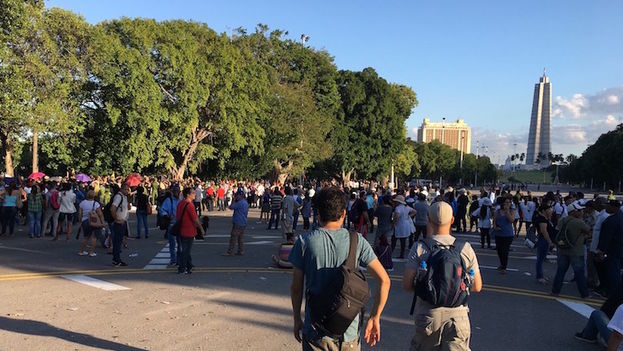
Hundreds of citizens in Havana came on Monday to say goodbye to Fidel Castro. (14ymedio)

Long Lines In the Plaza Of The Revolution To Say Goodbye To Fidel Castro / 14ymedio

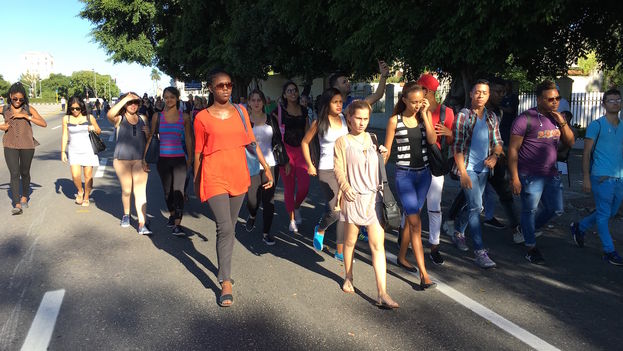
People walking to the Plaza of the Revolution to view the quasi-altars set up for Fidel Castro.
Cubans walking to the Plaza of the Revolution to view the quasi-altars set up for Fidel Castro.

14ymedio bigger14ymedio/EFE, Havana, 28 November 2016 — The memorial to José Martí in the Plaza of the Revolution opened its doors on Monday so that Cubans could say goodbye to former president Fidel Castro, who died on the 25th, and whose ashes have been installed in this emblematic place in Havana where they will remain for two days. People arriving in groups from their workplaces, and schools are assigned gathering points near to the Plaza.

Hundreds of people lined up from the early hours waiting for 9:00 in the morning (14:00 GMT) to render tribute to the Cuban leader in the same iconic scene where he delivered the greater part of his long harangues. The authorities asked people to come dressed in red, blue or white, without caps or hats. Some brought gladioli, others roses. continue reading

At the same hour that the tribute commenced there were, simultaneously in Havana and Santiago de Cuba, 21 gun salutes in homage to the Commander in Chief of the Revolution, who died at 90 years of age, after a decade removed from power because of health problems.

In the Plaza of the Revolution three different entry points have been set up to expedite people’s access, to three tributes, exactly alike, in none of which the presence of the ashes can be observed with the naked eye. All these points are presided over by a large photograph of Fidel Castro, in which he is seen in full body view looking at the horizon and wearing his iconic olive green uniform.

There are also two wreaths, one from the Communist Party of Cuba and one on behalf of the Cuban people, as well as an exhibit with the major awards Fidel Castro received in life.

Flanking these quasi-altars is a bodyguard of members of the Ceremonies Battalion of the Revolutionary Armed Forces and representatives from the Council of State, among whom are the Comptroller General of the Republic, Gladys Bejerana, the Minister of Transport, Adel Yzquierdo, and the Secretary of the Ministry of Transport, Homero Acosta.

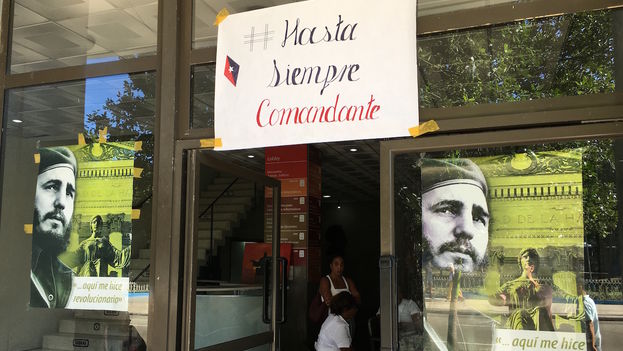
Windows everywhere displayed posters of Fidel Castro

Currently Cuban President Raul Castro is not present at the memorial, nor are other family members of the deceased leader such as his wife, Dalie Soto de Valle, or his sons.

People file past smoothly: there are women throwing kisses, many drying their tears with handkerchiefs, and some who cannot help sobbing, which resonates above the whispers and the sounds of cameras, in the solemn atmosphere that prevails.desesperaba-escuchaban-protestas-laborales-intentaban_cymima20161128_0085_17

“I have come to due to patriotic and revolutionary duty, in hone or our commander in chief, who died as an undefeated comandante,” said Jesus, an 85-year-old man who engaged in the clandestine struggle before the Revolution in Ciego de Avila.

Also reluctant to say goodbye to the comandante were high school students such as Idolaris, 16, who while waiting in the long ling to enter the memorial felt “tremendous pain” for having lost a leader of his magnitude, although “his memory is always present.”

“There is a lot of sadness here. We are all very upset by the death of our comandante because we all love him from the bottom of our hearts, without hypocrisy,” Felix Jardines, a 58-year-old lawyer told EFE, while waiting in line to enter the tribute.

Although Cuba has experienced two days of mourning of the nine decreed by the government, this event marks the beginning of a week of funeral rites that will culminate this coming Sunday with the interment of Fidel Castro’s mortal remains in Santa Ifigenia cemetery in Santiago de Cuba. The residents of Havana will have until tomorrow to pay tribute to Castro in this plaza where, at 7:00 PM, there will a massive act of farewell, attended by leaders and personalities.

Fear, Dry Law and Funerals / 14ymedio, Zunilda Mata

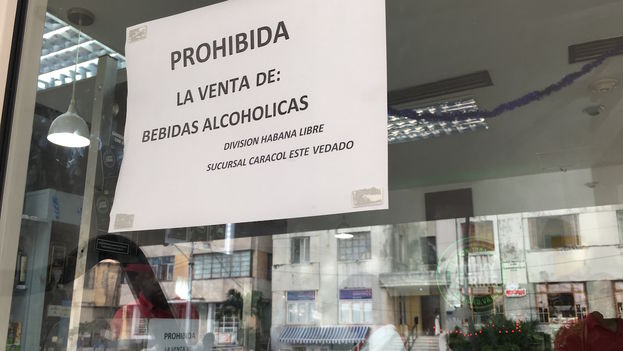
Cubans still manage to get some alcohol in the middle of the 'dry law' imposed by the official mourning. (14ymedio)
“Prohibited, the sale of alcoholic beverages.” Cubans still manage to get some alcohol in the middle of the ‘dry law’ imposed by the official mourning. (14ymedio)

14ymedio bigger14ymedio/EFE, Havana, 28 November 2016 — The always busy corner of Infanta and Carlos III was a desolate wasteland Sunday. Since the death of Fidel Castro was announced, Havanans have gathered at home. The official media say that it is from pain, but fear is the protagonist of days in which the sale of alcoholic beverages has been prohibited and the biggest funerals in contemporary Cuba are arranged.

Foreign journalists are arriving in the country by the hundreds and are seen in the streets trying to interview every passerby. Many pedestrians look down and refuse to give interviews. When the reporters finally manage to get some statements, they are only from those who agree with the official discourse. Inside people’s homes everything is different. continue reading

“Luckily we had a bottle of rum left over from a party,” says Chicho, a retired teacher who has waited decades for this moment. “It is not that we’re celebrating the death of a human being, because this man made us all believe that he was not one… that he was above life and death,” he tells 14ymedio.

Chicho has a nine-year-old granddaughter who will go to school early this Monday, although there are doubts about how the week will go in schools and workplaces, in the midst of the national mourning that has been decreed for nine days. “I’m sure that they aren’t going to teach classes, there is going to be one event and another until the day the ashes reach the Santa Ifigenia Cemetery,” says the grandfather.

For Mileidis, a resident of Havana’s Regla neighborhood, there is another concern. “My brother is a son of Changó,” (an orisha of the Afro-Cuban religion who is the equivalent of Saint Barbara). The celebration of the saint is held every December 4, the same day the national mourning concludes. “I don’t know how we are going to get the brandy and rum,” the young woman worries.

The festivities on the eve of Saint Barbara are very popular on the island, fueled by drumbeats, Yoruba songs and a great deal of alcohol. With the sale of alcohol prohibited, many Santería rights are in danger of collapse. Distilled alcohol has doubled in price in barely three days of the “dry law.”

A well-known bar on Reina Street is deserted and the drinks list has been put away. Nearby, in El Curita park, three regulars of the place get together on a corner and pass a plastic container that looks like it contains cola. In reality it is distilled alcohol, better known as “train sparks” for the effects it occasions in the stomach when ingested.

Police patrol cars and uniformed officers approach, and the three men hide the bottle. “This is my thing, I can’t live without it,” says one of the men, justifying his transgression. “What fault is it of mine that He can no longer take a drink?” he reflects, slurring his words.

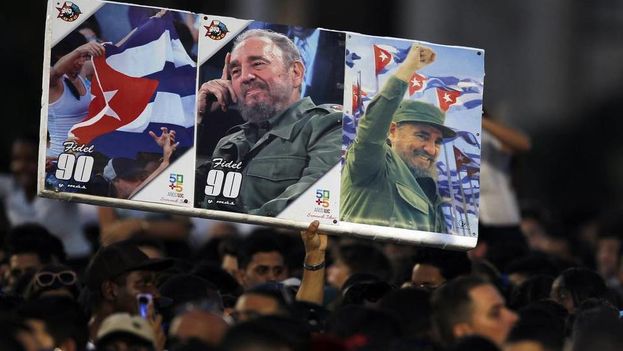
Posters with the face of Fidel Castro are everywhere. Since the celebration of his 90th birthday in August, the tone of the personality cult has noticeably risen, such that Cubans seem to be used to Fidelmania.

“Will they change the bust of José Martí in the schools for one of Fidel?” a seven-year-old girl asks her mother. In the street, Havana residents speculate about the anticipated tributes to Castro and expect the establishment of an official order in his honor, his face on a banknote, a multi-story iron relief with his silhouette in the Plaza of the Revolution — like the ones for Che Guevara and Camilo Cienfuegos – some street with his name, and a museum in his memory in the heart of the city.

The most daring even predict a change in the only political organization allowed in the country. “It’s a good moment to shake off the communist label,” an official academic who asked for anonymity told this newspaper. “It’s possible that at the next plenary session of the Cuban Communist Party or at an extraordinary congress they will re-baptize it the Fidelista Party.

In tune with popular predictions, the illegal lottery, known as la bolita, has seen an increase in bets on the numbers that mean ‘police,’ ‘great death,’ and ‘horse,’ the later for Fidel Castro’s nickname, “El Caballo.”

The Myth Died, Cuba Must Change / 14ymedio, Pedro Campos

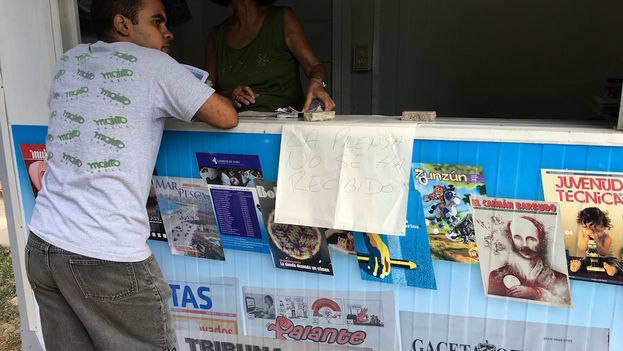
There are no copies of the official daily Granma at the newsstands. (14ymedio)

14ymedio bigger14ymedio, Pedro Campos, Havana, 27 November 2016 — Fidel Castro has died. The mythic figure has died. The event will be discussed for a long time and from many points of view. Nine days of mourning has been decreed in Havana, the flag is at half mast; in Miami they are partying, the same Cuban flag held high.

The Fidelistas mourn, the anti-Fidelistas party. The vast majority of the island’s population, eager for changes, are waiting. It could not be any other way. Since the attack on the Moncada Barracks in 1953, Fidel Castro’s imprint on Cuba shapes our days. The government is ready to maintain total control over the streets. Its mass organizations are mobilized to prevent and counteract any demonstrations against him.

But like the myth, his charisma and his influence are not inherited. We can affirm that a political cycle in Cuba has ended: the eclectic sum of conceptions that make up Fidelism, populism, authoritarianism, neo-Stalinism, statism and bureaucratism, just received a mortal blow. A stage of inevitable changes opens. continue reading

Raul Castro, since he assumed power in 2006, promised to undertake important reforms, replaced many officials, and began dictatorially implementing a set of measures that he consolidated and expanded in both Cuban Communist Party Congresses held since then, but without establishing a legal framework that guarantees them.

During these years, the bureaucracy, laws, regulations and customs of Fidelism, established over almost 60 years, have prevented such reforms from being fully deployed.

Raul Castro now has the opportunity to demonstrate whether his reformist proposals are real or were just a deliberate attempt to counter the resistance within the system and seek international recognition and funding.

Cuba’s economic situation requires that the changes set forth by Raul be deepened and expanded, that all state monopolistic barriers to domestic and foreign markets for capital investment, enterprise development and productive initiatives of all kinds be broken.

However, it does imply that the Fidelistas abandon their positions in the government and the Party and that many regulations and customs of traditional statism be removed. This will be very difficult if, in parallel, there is no democratization process that permits deep criticism of the Fidel regime, the adoption of new forms of organization in the economy and politics, and the emergence and development of new entrepreneurs and unprejudiced leaders at all levels the society.

Cuba is facing inevitable changes. The death of the mythic figure favors them. The Cuban people also demand them. Everyone, those inside and those outside, regardless of their political ideas, must have the right to participate in the reconstruction of the nation. Achieving it more or less peacefully will depend on those who still hold power in Cuba.

It is time to assume, with decency, José Martí’s homeland: With all and for the good of all.

Graffiti Artist ‘El Sexto’ Still Under Arrest, Mother Says / 14ymedio

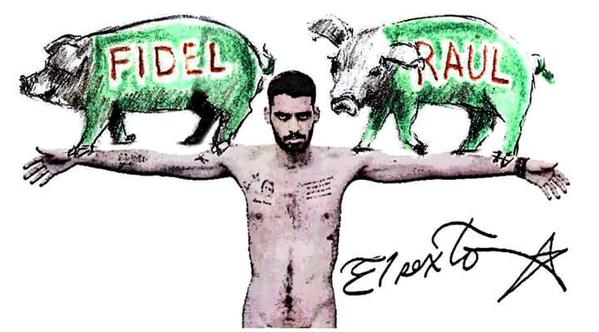
CRxiUMZVEAMwkmT
14ymedio bigger14ymedio, 27 November 2016 — The Cuban graffiti artist Danilo Maldonado, known as “El Sexto” (The Sixth), remains under arrest, according to a report from his mother, Maria Victoria Machado, to14ymedio.

Maldonado was arrested on Saturday and taken to the police unit at 51st and 240th Streets after painting graffiti on a wall of the Habana Libre hotel. He wrote the words “he left” to refer to the death of Fidel Castro, which occurred a few hours earlier.

When relatives tried to contact the artist they were notified by the officials in command that he was not at the police unit, which was immediately disproved by El Sexto who shouted from inside the station, “Down with Fidel Castro, down with Raul.” continue reading

Maldonado’s mother, Maria Victoria Machado, said Sunday afternoon, “They closed 51st Street to take him out of the station and now we know nothing about his whereabouts,” but several hours later she learned that he was at “[Station] 14 of Guanabacoa.”

The officials informed his relatives that, although they will not be allowed to see him, they would be able to send him medications and toiletries.

El Sexto was arrested on Christmas Eve of 2014, when he planned to stage a performance art piece with two pigs that were painted with the names of Fidel and Raul.

He was arrested when he took the two pigs in a vehicle and spent ten months in Valle Grand Prison without trial.

The officers informed their relatives, but will not let you see it, yes they will send medicines and grooming.

The Sixth had been arrested Christmas Eve 2014, when he intended to make a performance with two pigs bearing the names of Fidel and Raul painted in the body.

He was arrested when carrying pigs in a vehicle and spent ten months in Valle Grande prison without trial.

The Ancient Dictator Died Long Ago / 14ymedio, Miriam Celaya

Fidel Castro celebrates his 90th birthday in the Karl Marx Theatre.

14ymedio bigger14ymedio, Miriam Celaya, Havana, 26 November 2016 — The official media have just announced the last and definitive death of Fidel Castro, and I think I have perceived more relief than bereavement in the mournful message. If I were a religious person, I would feel at least a tiny bit of grief, but that is not the case. Definitely, pity toward despots is not among my few virtues. And, as I have always preferred cynicism over hypocrisy, I am convinced that the world will be a better place without him.

At any rate, to me, the old dictator had died a long time ago, at an unspecified date, buried under some dusty headstone, without epitaph in the deepest recesses of my memory, so I can only be curious about what this expected (exasperated) outcome might mean for those who have kept their destinies tied to every spasm of his many deaths.

Nevertheless, just because I had given him an early funeral doesn’t mean that his irreversible departure from this world is not a momentous event. The image of the defeated specter he had become will now disappear, and his passing will also cease to gravitate over the superstitious temperament of the nation as an unavoidable doom. We will finally find out whether the prophecy Cuba will really change after Fidel dies is true or false, because it seems that, for almost all Cubans, waiting for changes that result from nature’s course is easier than taking the risk to do it themselves. Peoples who feel ashamed of their fates often blame their rulers for their own collective irresponsibility. continue reading

There are also the superstitions, a nice wild card for the national lethargy. There are too many people that believe in some god, in a sense of fatality, in the tarot, in the zodiac signs, in the I Ching, in the Tablet of Ifá or other prophecies of the most varied kind. I have never believed in any of them, perhaps because accepting the mysteries of these predestinations as true would have made me feel I was cursed just for having been born in Cuba in 1959. Far from it, such an adverse coincidence became the challenge that I accepted gladly, so I never experienced the deep feelings of frustration that oppress several generations of Cubans, choked under the effects of the power of a sort of superhuman entity that seemed to sum up all creeds in it and that intervened in every destiny. An impostor, in short, pretending to be god, oracle and mantra all at once.

For almost all Cubans, waiting for changes that result from nature’s course is easier than taking the risk to do it themselves

Nevertheless, all my memories are intact. They have survived every cataclysm in good health. How could I go back on them if our spirit is pure memory? I reminisce without love, without resentment, without bitterness and without regrets, as if I were observing, in an old movie, my own story which is the same for millions of Cubans like me. There are even some chapters I find amusing. How could we have once been so naïve? How did our parents and grandparents allow us to be manipulated in such an atrocious way? It was because of fear. Fidel Castro’s true power was never the love of Cubans, but the unspeakable fear they felt toward him, an irrational and irate leader, and an individual whose limitless egomania could only be matched by his inability to feel empathy. Sometimes fidelity is only a resource for survival.

Looking back on the first 20 years of my life, I remember Fidel Castro as a sort of omnipresent magma that invaded every space of public and private life. He seemed to have the gift of ubiquity and to appear everywhere at once. My earliest memories of childhood are invariably associated with that image of the bearded man who never smiled, dressed in a military uniform, whose portrait could be found anywhere, whether on the wall of a building, on a fence, on the covers of magazines, newspapers, or in a carefully framed picture in the halls of revolutionary Cubans, who were a majority back then.

That same man very often appeared on the screen of my grandmother’s television (in my mind, I thought he lived inside that device), or he invaded every home from the radio stations, thundering and fierce, making long threatening and scolding speeches, loaded with harangues. He was always irritated, so I was a little afraid of him and tried – with little or no success – to stay away from his vibrations. My elders swelled with ecstasy and even cried out, excited about the false prophet’s this or that bravado. “It’s El Caballo!* that’s how it’s done!” The admirers of the new hard man would bellow, drunk with a fervor that I did not understand but which, over time, succeeded in infecting me.

In any case, “Fidel” was one of the first words uttered by the children of thousands of families which, like mine, had discovered that on the dawn of January 1, 1959 they were suddenly revolutionaries. And thus, also suddenly, in a nation traditionally Catholic, quite a few proclaimed themselves as atheists and renounced God only to accept a new faith, Fidel Castro as savior, and communist dogma as catechism.

Fidel Castro’s true power was never the love of Cubans, but the unspeakable fear they felt toward him

Meanwhile, countless families were fractured by political polarization and emigration. Parents and children, siblings, uncles, cousins who had always lived in harmony, clashed, became filled with grudges and distanced themselves from one another. There were those who never spoke to each other again, and died without the embrace of reconciliation. Many survivors of this telluric rupture are still picking up the pieces and trying to recreate some parts of our battered lineages, at least out of respect and homage to our estranged departed family members, all because of an alien hatred.

Then came the militias, the Bay of Pigs, the Missile Crisis, the compulsory military service, the rationing card, the monumental harvests, the Revolutionary Offensive, Angola, the in-field schools and the schools in the countryside, and the permanent consecration of endless delusions of the Great Egomaniac. And with the passage of time, the signals of the ruin we insisted on ignoring began to arrive.

The increasing shortages were silenced with slogans and with gigantic plans doomed for failure, all freedoms were buried and rights disappeared, sacrificed on the olive green altar under the weight of once sacred words and now debased by speeches (“homeland,” the most tainted; “liberty,” the most fraudulent), while – unnoticed and blind – we Cubans ourselves helped to build the bars of our prison and, docile, left the keys in the hands of the jailer.

The first great schism between the lunatic orator and me were the events at the Peruvian embassy, and especially the Mariel stampede, between April and May, 1980. They were not, however, isolated events.  The first conversations (they are often referred to as approaches) had taken place in 1978 between the dictatorship and a group of emigres living in the United States, which resulted in the opening of family visits in 1979, although only in one direction: from Miami to Cuba.

Cubans themselves helped to build the bars of our prison and, docile, left the keys in the hands of the jailer

Suddenly, the stateless-wormy-counterrevolutionaries were not that, but “our brothers from the Cuban community abroad,” who had been able to preserve their original cultural values and their own language in foreign lands, and who were being offered the right to visit their country of origin and reunite with their families. Now they happily arrived, weighed down with gifts for the beggars who had chosen a revolution that proclaimed poverty as a virtue. Naïve or not, many of us felt the manipulation and discovered that we had been scammed, and although one does not wake up at the first bell after a long and deep lethargy, we began to live on alert and to question the system.

Then, without expecting it, the New Man, forged under the principles of that celebrated whore called Revolution, witnessed in surprise the spectacle of the hordes gathered at the Peruvian diplomatic headquarters and the mass flight through the port of Mariel. And we were perplexed by the thousands of deserters and horrified by the repudiation rallies, the beatings, vexations and insults towards those who were emigrating and the impunity at the barbarism that was only possible because it had been instigated and blessed from the power.

By then I was sporting my new motherhood, and before every fearful scene I would cling to tenderness for my son. I think it was then that I began to definitively tear all the dense veils of the lie I had lived for 20 years and became obsessed with the search for the truth in which I would bring up my children: freedom as a gift that we carry inside, which nobody grants, which is born with the being. So ended Fidel Castro’s leadership of me, dragging in his fall any possibility of future glitches in my spirit.  The dissident, living in silence within me, emerged that year, and the paradigmatic leader of my adolescence began to transmute into an enemy.

The feelings his existence infused in me were fear, admiration, respect, devotion, doubt, disbelief, resentment, contempt, and, finally, the most absolute indifference

That is why the difficult events and the Fidel battles that followed my conversion did not make a mark: the Ochoa case, the associated executions, the Special Period resulting from the collapse of real socialism, the Maleconazo, the Balseros Crisis, the rescued child rafter Elián, the Open Tribunes, the Roundtables, the Five Spies, the Black Spring, the Battle of Ideas, the Energy Revolution and so much nonsense that resulted in swelling the ranks of the discontented and the disenchanted, widening the rift between the power and millions of Cubans.

My feelings for Fidel Castro went through several stages. It could not be any other way, since I was born in 1959, since I grew up in a family of Fidel fans and since I’ve spent my whole life in Cuba. The feelings his existence infused in me were fear, admiration, respect, devotion, doubt, disbelief, resentment, contempt, and, finally, the most absolute indifference.

News of his death, then, does not stir emotions. A friend recently wisely told me that Fidel Castro was not cause, but consequence. It seems to me an accurate sentence to summarize the history and idiosyncrasy of the Cuban nation. Because we Cubans are not (we have never been) the result of Fidel’s existence, but the reverse: the existence of a Fidel was possible only thanks to Cubans, beyond political or ideological tendencies, beyond our sympathy or resentment. Without all of us the power of his long dictatorship would not have been sustained.

That is why I take this, the occasion of his ultimate death, to sincerely make a toast, not to his memory, but to ours. May our memory never falter, so that we do not forget these decades of shame, so that no more Fidels are repeated on this earth! And I also offer, with all my hope, to celebrate the opportunity that this happy death unlocks to the new life that all Cubans will finally build in peace and harmony.

*The Horse: Fidel Castro’s nickname among Cubans

Translated by Ernesto Ariel Suarez and Norma Whiting
“Cuba’s Tyrant Died,” Miami Celebrates / 14ymedio


14ymedio bigger14ymedio, 26 November 2016 – Thousands of Cubans poured into Miami’s streets in the early morning hours to celebrate the death of Fidel Castro, Cuba’s former ruler, who held onto power for almost five long decades. To the rhythm of “Our Day is Coming” by Willy Chirino and “In Case I Don’t Return,” by the late Celia Cruz, the exiles celebrated surviving the man who dominated with an iron fist the destinies of those on the Island of Cuba.

“Here we are celebrating freedom for the Cuban people. Satan has died, a man who plunged the people into misery and hunger,” said Maria Cristina Labrada Varona, member of the Ladies in White on a visit to the city of Miami. continue reading

The leader of the Democracy Movement, Ramon Saul Sanchez, explained to 14ymedio that the exiles do not rejoice at the death of a human being but “at the disappearance of a symbol that is used as a sword of Damocles against civil society activists and all who want to democratize Cuba.”

Sanchez says that “Raul and his brother Fidel Castro were responsible for making the dynastic transfer” and argues that military exercises like the Bastion 2016 were carried out in order to intimidate people and so that people did not pour into the streets.

“The Cuban is changing in his heart, he wants liberty. One day we are going to see that this happiness that is seen in the Cuban exile is going to be apparent to everyone,” said Sanchez.

Ufracio Gonzalez, a boxing trainer attending the demonstration explained that he decided to go out to the streets with his young daughter to celebrate the death of the dictator because “That man has done a lot of damage to Cubans. We have memories of suffering and bitterness.”

Not only Cubans were among the celebrators. Venezuelans and Latin Americans decided to share the joy of the exiles. Lia Fausta, a Brazilian living in Miami, says that she does not celebrate the death of Fidel Castro but a new life for Cuba and for all the countries in the Americas.

“Lula, Dilma Rousseff, Evo Morales, Nicolas Maduro, Ortega and Santos. We must free ourselves from these people who destroy the future of our young people,” she explained.

“I love Cuba. My mother was a woman who loved the Island. All my life the only thing I heard was ‘what a shame that this has happened (the Cuban Revolution) to a country that was the most beautiful in the Caribbean,’” she added.

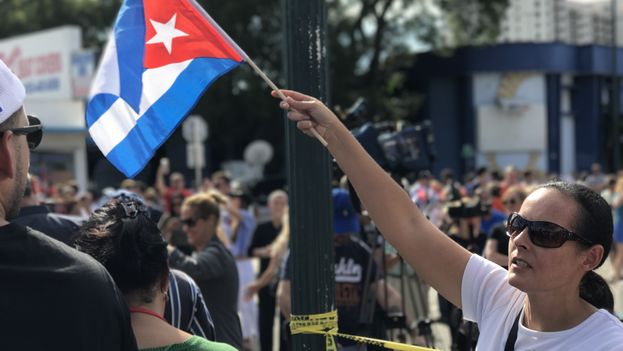
A woman raises a flag to celebrate the end of Fidel Castro (14ymedio).

Since early morning the county police have been present and closed downtown’s Eighth Street in Little Havana, the quintessential meeting place for Cuban immigrants in south Florida, estimated at about two million people.

“It is a family celebration. You find the same thing among the old and the young. No one has wanted to stay home. It is something that we owe to our parents, our grandparents, to all who suffered the worst of the Castro tyranny,” comments Elquiades Suarez, 40 years of age.

In the afternoon Willy Chirino and other famed local artists visited the restaurant Versailles.

Cuban-American members of congress also met to give a joint statement.

“We are not going to expect big changes,” said the recently re-elected Ileana Ros-Lehtinen in a joint press conference with Republicans Mario Lincoln Diaz-Balart and Carlos Curbelo.

Ros-Lehtinen also threw a bucket of cold water on those who expect rapid changes on the Island with the death of Castro: “Do not expect Fidel’s death to open a door to a new chapter of liberty. It is not so easy.”

“What we need is freedom for the Cuban people, freedom of expression and everything that is written in the Helms-Burton law.”

Diaz-Balart for his part said that Fidel Castro’s legacy is “of tragedy, of repression, of corruption, of drug trafficking and terrorism.”

Fidel Castro’s public enemy number one, the militant anti-Castroist Luis Posada Carriles, described the death of the Cuban ex-ruler as “unjust” and lamented that it came “so late.”

Translated by Mary Lou Keel