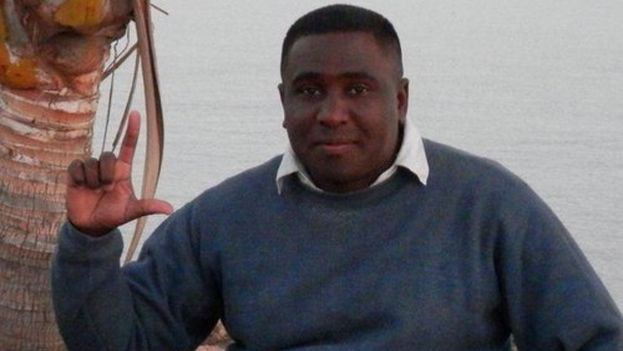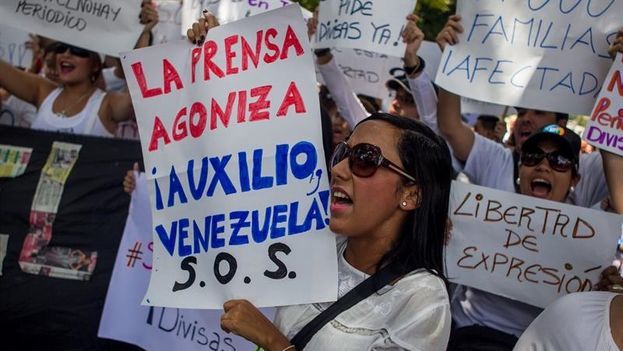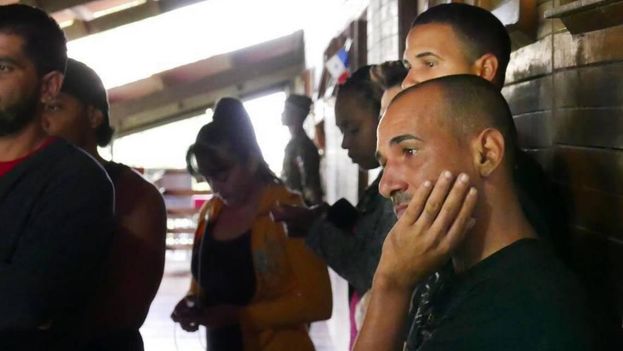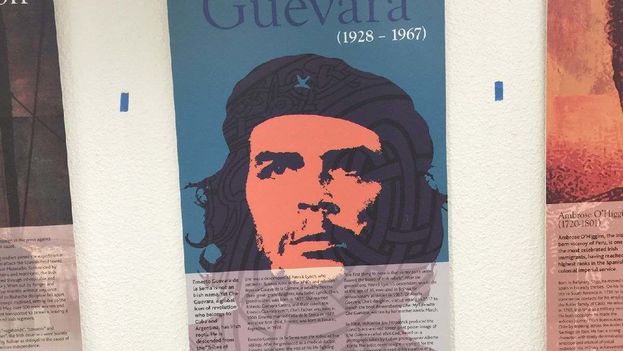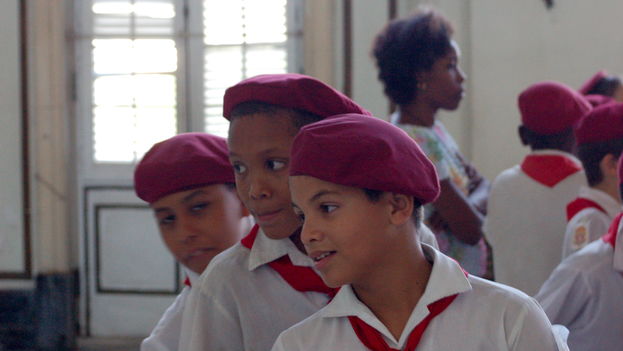

Still from the film ‘Santa and Andrew’ Carlos Lechuga. (Facebook)
14ymedio, Luz Escobar, Havana, 23 November 2016 — The film Santa and Andrés will not be screened at the 38th edition of the Havana Film Festival, to be held between 8 and 18 December. Sources from the industry guild commented to 14ymedio that the exclusion of the independent film, directed by Carlos Lechuga, could be motivated by its theme, focusing on censorship against a gay intellectual in the early eighties.
The 36th International Festival of New Latin American Cinema awarded the film the prize for an unpublished script, but it will not compete in this year’s festival. This decision came from “the highest authority,” several filmmakers told 14ymedio, and contrasts with the decision initially made by the event’s organizing committee, which gave a green light to the showing of the film. continue reading
An article in the official blog El Heraldo Cubano says that the plot of the movie “aims to highlight political persecution and attacks on the island that did not take place.” The article says that the film follows “a course of action that is not consistent with history.”
The article has circulated widely among filmmakers, and Carlos Lechuga, in a passionate response on his Facebook page, says that the author’s words are not only an attack on Santa and Andrés, but also represent “a critique and an attack on all independent cinema.”
The director, Enrique ‘Kiki’ Alvarez, has joined the defense of the film because he feels that the story of the two main characters, “who are opposites, she a revolutionary and he a censored writer, forced to be together,” ends up leading them “to a coming together and a recognition of the other that defines the humanistic will of this film.”
Lechuga continues to hope that the decision to exclude the movie from the most important film event on the island will be reversed. However, the filmmaker Miguel Coyula believes he “is still trying to have a dialogue of the deaf (…). We have to advocate for creating a space, an independent theater, where art films are shown without being dominated by the dictates of an institution.”
The official attack has ignored the vast number of awards received by Lechuga, including the Julio Alejandro Award from Spain’s General Society of Authors and Editors (SGAE). This is the second feature film by this young director, who captivated audiences with his film Molasses (2012).
Santa and Andrés premiered to a full house at the Toronto International Film Festival, and was also screened at San Sebastian, Chicago and Zurich. Its first showings were dedicated to Reinaldo Arenas, René Ariza, Nestor Almendros, Guillermo Cabrera Infante, Virgilio Piñera and José Lezama Lima.
Lechuga says that in the idea and filming of the work he was motivated by “the desire, the attempt, to hear the voice of many who were silenced or who suffered the repression of people who tried to silence them.”
The Havana Film Festival will show 440 films this year, with 36 of them competing for prizes. Among them, two Cuban productions will compete in the category of first works and three will compete for the award for best feature film.
For more than three years several Cuban filmmakers have defended, in open meetings ,the idea of a Film Law that would permit the development and operation of independent production houses.
Eduardo Cardet, national coordinator of Cuba’s Christian Liberation Movement. (Flickr)
Eduardo Cardet, national coordinator of the Christian Liberation Movement (MCL) who has been under arrest since the night of 30 November, as of Thursday has found a lawyer to represent him. His relatives have denounced in several media that no lawyer wanted to take on the activist’s defense. Although the lawyer has not had access to his file, the family is optimistic and affirms that the attorney “fight for his right to bail.”
Yaimaris Vecino, the activist’s wife, told this newspaper in a phone conversation that she was able to see Cardet just after they moved him to the so-called “provisional prison” of Holguin, located on the Bayamo highway very close to the airport. continue reading
Yaimaris said that the regime opponent still has notable injuries on his face that he suffered during his arrest, and she clarified that ultimately the accusations have focused on the crime of attack, for which the prosecution would ask for a sentence of between one and three years, as stipulated in the Criminal Code.
Under the law, it is a crime when the use of “violence or intimidation against a public authority or official or its agents or assistants impede them from realizing an act appropriate to their duties.”
However, according to the testimony of numerous witnesses consulted and the family, it was the agents of authority, represented by two members of the State Security in plainclothes and two in uniform, who pounced on Eduardo Cardet when he arrived on a bicycle at his mother’s house.
“It was they who knocked him off his bike and exercised unnecessary violence to arrest him,” his wife explained. No one has officially explained why they went to arrest him at this time. “The first answer when I asked the reason for his arrest was from a State Security official, who told me everything was for his counterrevolutionary activism and they there were not going to allow any actions of this time,” his wife said.
Yaimaris Vecino explains that the attack occurred at the door of her house in front of their children, one age 11 and another 13 years old. “The only police officer who suffered something like an injury was one who injured his hand when he threw my husband against a fence with spikes to try to injure him,” she adds.
The Christian Liberation (MCL) Movement was founded in 1988 by the dissident Oswaldo Payá (who was killed in 2012); the MCL promotes a peaceful change towards democracy and seeks respect for human dignity.
Problems on the phone company’s Nauta internet service are exacerbated during the weeks a recharge specials are in effect. (14ymedio)
14ymedio, Zunilda Mata, Havana, 9 December 2016 – The Nauta network has failed again. This time users have been unable, for several days, to recharge their accounts on the internet, or to check or make balance transfers. The Cuban Telecommunications Company (ETECSA) suffers constant interruptions, a situation that highlights the deficiencies in its infrastructure, despite the substantial profits it earns as a monopoly.
Since its creation in 1994, ETECSA has been gobbling up all the sectors of the telecommunications market that were once managed by other companies, such as C-COM or Cubacel. Five years ago, Cuban authorities acquired all elements of that company and put an end to any foreign investment in the sector. continue reading
The closing of that stage, which was characterized by foreign investment from countries such as Mexico and Italy, was a symbolic slamming of the door in the same year that the Italian company Telecom sold its shares – 27% of the company – for 207 million dollars. With complete control of the country’s phone service, ETECSA began to dictate its operations.
Currrently, the monopoly manages all fixed and cellular phone service on the island, email communications and internet, and the distribution of recharge cards, the latter of which has improved in recent years with the licensing of private individuals to work as telecommunications agents.
Although in the last five years ETECSA has expanded from 350 to a little more that 600 base stations in the country and brought its signal to all the municipalities in the country, in web services and email ongoing problems generate constant complaints among users.
“I can only send or receive messages late at night, when there’s no one on-line,” protests Yohandri Rojas who lives in Santa Clara. The 29-year-old complains about the poor quality of the Nauta email service, which is managed from mobile phones. “It’s a disaster,” he says.
Rojas works with a friend in a small place that repairs mobile phones, and has extensive knowledge of computing and communications that he taught himself. “This is because of problems with the bandwidth on the data network,” he explained to 14ymedio. “What has happened is that ETECSA has not expanded its servers consistent with the growth in the number of users,” he emphasizes.
ETECSA refused to answer questions from this newspaper to explain the causes of the frequent crashes in service and the poor quality of its operation. “We are working on solving the problem,” an employee at the number to report problems curtly told this newspaper.
Services from email to cellphones have worsened in the past year. “They have sold more accounts than they can effectively manage,” says a telecommunications agent in the Regla district of Havana, who preferred to remain anonymous. “The service is disappointing and if another company emerges offering a different service, ETECSA is going to lose a lot of customers.”
In the middle of this year, Ministry of Communications authorities let it be known that there are 11.2 million temporary or permanent email accounts on mobile phones. Many of them are opened by tourists passing through the country, but at least half are regularly used by domestic customers.
Each megabyte downloaded or uploaded via email on Nauta mobile phone services costs one Cuban convertible peso, the daily wage of a professional. But because of the instability in connections, the same amount can cost three times as much, because interruptions cancel message transmissions over and over again.
The problems are worse during weeks when “bonus recharges” are offered, allowing the user to purchase a recharge amount on the internet with a bonus as a “gift” from the company. “During those days there is no way I can get into my Nauta email inbox,” explains Deyanira, a nurse who lives in Havana’s Cerro neighborhood.
“When they announce ‘double’ or ‘bonus’ recharges, I know I won’t be able to communicate with my family by email that week,” she explains. The young woman’s mother lives in Germany with her younger sister, and email via mobile phones is the quickest way to stay in touch. However, most of the time, “my messages remain in the outbox for hours or days, waiting for ETECSA to wake up,” she jokes.
Bandwidth problems on the cellular network affect more than just email services. Ernesto, a Valencian visiting Cuba for two weeks, complains that “the roaming service is very unstable, and sometimes there’s a signal and sometimes not.” At more than 5 euros for every megabyte sent, the tourist tried to use “Facebook and also Instagram, but with little success.”
In recent months, Cuba has signed agreements for roaming with several telephone companies in the US, most notably Verizon, Sprint and AT&T.
“If they continue to strain the network with users demanding data, but do not expand or update the infrastructure, it will collapse,” predicts Yohandri Rojas. “ETECSA is going to be like the hard currency stores that sell beer: high demand and low supply,” he scoffs.
Frame from the film by Carlos Lechuga ‘Santa and Andrés. (Facebook)
14ymedio, Reinaldo Escobar, Havana, 7 December 2016 — In the 38th edition of Havana’s Festival of New Latin America Cinema, shining by its absence is the Cuban film Santa y Andrés, by the filmmaker Carlos Lechuga. Those responsible for its censorship certainly didn’t cross it off the list without first consulting non-artistic entities such as the organs of State Security and other custodians of the official dogma.
The controversy over the exclusion of the film has been unleashed on social networks and in several digital spaces. Arguing against Lechuga’s feature film are the voices tied to the “establishment,” who claim that it distorts history and that the many errors committed in the cultural field have been rectified. The defenders, for their part, laud the artistic values of the film and assert that it cannot be considered counterrevolutionary. continue reading
The Cuban Institute of Cinematographic Art and Industry (ICAIC) behaves like an entity privately owned by the only political party permitted in the country, and applies the resulting right of admission, an attitude contradictory and unacceptable for an institution that is publicly created as a representative the interests of the whole nation.
Many filmmakers act as if they believe that the ICAIC does not represent the interests of power. This apparent naiveté gives them a right to feel offended and surprised by the censorship imposed by the entity, like the teenager who comes home late with the illusion of not being scolded by her parents, who remind her of their right to search her belongings and to prohibit her next outing.
As long as artists continue to respect and revere institutions without directly questioning them, they will have to bow their heads and obey, or ultimately they will have to leave the country.
Santa and Andrés was conceived and created independently as if censorship did not exist, as if the stern father had softened and tempered over the years. One way of putting strength to the test and pushing the wall of prohibitions.
Regardless of its indisputable artistic values, Carlos Lechuga’s film will be remembered as another occasion when the repressors of thought were forced to take off their masks of good-naturedness. Cultural authorities have again demonstrated the hardened face of an intolerant patriarch showing his children who really holds the key to the house.
The film ‘Hands of Stone’, directed by Venezuelan filmmaker Jonathan Jakubowicz, will be presented this December at the Film Festival in Havana. (Courtesy)
14ymedio, Yoani Sanchez, Havana, 7 December 2016 – He has a Polish last name, a first name of Hebrew origin, and Venezuelan blood running through his veins. Jonathan Jakubowicz is as complex and versatile a filmmaker as the skein of influences that make up his family tree. Born in Caracas in 1978, the director has received both pressure from the government of Hugo Chavez and the most resounding applause from his audience. This December his film Hands of Stone will be shown in Cuba during the Festival of New Latin American Cinema.
The film, based on the story of the Panamanian boxer Roberto Duran, includes in its cast the fellow Venezuelan Edgar Ramirez, in the starring role, and the Oscar winner Robert de Niro in the role of his trainer. Jakubowicz responded to questions from 14ymedio about his expectations on presenting his work to a Cuban audience, and his reaction to the exclusion from the festival of the Cuban film Santa y Andrés, by director Carlos Lechuga. continue reading
Sanchez. During the Havana Film Festival of Havana Cubans will be able to enjoy your film Hands of Stone, one of the most interesting films that will be screened in this year. How can viewers on the island inform themselves before seeing the story of the legendary Roberto ‘Mano de Piedra’ Duran?
Jakubowicz. I think that Cubans feel the story of Duran as their own. Duran is the son of an American Marine who was assigned to the Canal Zone and who had an affair with a Panamanian, and then left. The relationship between the boxer known as Manos de Piedra and the United States is complex starting from his birth. But paradoxically it is only thanks to the help of his gringo coach, the character played by De Niro, that he becomes world champion and beats the United States boxing idols on the biggest stages in the world. It is a Latin American epic, filmed mainly in Panama but with Hollywood legends. I am sure Cubans will enjoy it.
Sanchez. You’re aware of the censorship of the film Santa y Andrés, directed by Cuban filmmaker Carlos Lechuga, and even thought of withdrawing Hands of Stone from the Festival, in solidarity with that filmmaker. Why have you kept your film in the Festival line-up? What do you think about the exclusion of the Lechuga’s film?
Jakubowicz. Cuba and Venezuela are sister nations, not only in our history but in our political present. When my first film came out, Secuestro Express(Kidnapping Express), the Chavez government charged me twice and published in the state media all kinds of information to discredit me. Only someone who knows what it is to be persecuted because of his art can understand the pain that means. That is why it affected me so much to read about censorship being applied to this Cuban film.
I felt that going to the Festival to show my film would be a hypocrisy, like when I saw international filmmakers photographing Chavez while I was being persecuted. I was afraid of becoming that dismal figure of the artist who supports the repressor, a very common figure in our countries, and one that has done great damage to our people.
But Cuban filmmakers themselves asked me not to withdraw my movie from the program, because the festival is one of the few windows left on the island to see the outside world, and so I decided to do it. At the end of the day I don’t live in Cuba and the only thing I can to do is help those who do live there.
Sanchez. You’ve experienced first hand harassment within your own country. How do you experience all those pressures?
Jakubowicz. With much anguish and sadness. My film was not even against the government, but was made by people from all social classes in Venezuela, and the success filled Chavez with insecurity, because his power was always based on dividing the population. On attacking us, he attacked our invitation to overcome the problems we have as a society, but also made it impossible for me to continue making films in my country. So I am filled with admiration for Cubans like you, like Gorki Aguila, El Sexto and others who dare to stay in the cave of repressor to do battle for freedom from within.
I just published a book, Las Aventuras de Juan Planchard (The Adventures of John Planchard), showing the corruption of the Chavista revolution in all its glory. It is my grain of sand in this fight. There are people who ask me if I’m not afraid to publish it, and my answer is that if there are people in Cuba and Venezuela who put their lives on the line daily for freedom, the least I can do is support them with my art.
Sanchez. What do you think of the relationship between cinema and power? Between artists and official institutions?
Jakubowicz. Cinema and power have always been related, the problem is when those in power repress some filmmakers, and welcome and support others. There is nothing worse than an artist who collaborates with a repressive government. To put your sensibility at the service of a power that persecutes human beings who want to express themselves like you do is a contradiction which, in my opinion, annuls you as an artist and makes your work into propaganda.
History is full of talented artists who have done that and ended up persecuted by the very machinery they supported. Generally those who remain cozied up to power forever are mediocre, they would have no capacity for transcendence if not for the help they receive as payment for their complicity.
Sanchez. In Cuba, as of more than three years ago, a group of filmmakers has been promoting a Film Law to gain autonomy and protect their work. What would you recommend to your colleagues on the island in that regard?
Jakubowicz. In my opinion they should focus on creating methods for their films to be viewed online. Just as there are now journalistic spaces coming out in Havana and reaching everyone, create spaces for local filmmakers to put their work on the internet. Almost all filmmakers in the world are doing works that are exhibited on the internet.
Even Woody Allen is making a series for Amazon. No one can underestimate the power of the internet as a tool for the distribution of independent cinema of the future. I find it commendable that they are trying to pass this law, but in my experience art cannot beat authoritarian governments with laws. They can be conquered with art. The laws were not made for artists.
An employee of the Electrical Union of Cuba installing new meters in a building in Havana. (14ymedio)
14ymedio, Havana, 6 December 2016 — The installation of new electrical meters continues to spark controversy in the Cuban capital. It is not necessary to enter individual homes to read the new meters and, reportedly, they are virtually impossible to manipulate in order to fraudulently pay less for electrical service.
“With these, you can’t cheat. Now, if you have two air conditioners running all day, it’s going to know how much current you used,” a technician installing the new devices in a multifamily building on Belascoain Street near Lealtad told 14ymedio. continue reading
Complaints about the cost of electricity have skyrocketed in recent years. Although compared to other countries the costs do not stand out as the most expensive in the region, in relation to the average wages in Cuba the cost of kilowatts is absolutely scandalous.
A family possessing only essential light bulbs, a refrigerator and a television, can pay a bill of around 20 Cuban pesos (CUP) a month (less than one dollar US), less than 5% of the average salary on the island which is around 570 CUP. However, if you cook with electricity and turn on an air conditioner every night to ease the dog days of summer, then the electricity bill can take the entire monthly salary of an engineer.
For years, people have invented all sorts of ways to avoid the high costs, from manipulating the meters to the so-called “clotheslines,” which steal or move electricity from state buildings or nearby homes. With the installation of the new meters to register consumption, many of these tricks appear to be coming to an end.
So the complaints are raining down, lately, on the Electrical Union of Cuba.
14ymedio, Havana, 6 December 2016 — The artist Danilo Maldonado, known as ‘El Sexto’ (The Sixth), was transferred Sunday from the police station at Zapata and C in Vedado to the Bivouac Calabazar criminal prosecution center in Havana. The graffiti artist’s mother, Maria Victoria Machado, visited him on Monday morning and told 14ymedio that the prosecution could keep him there for up to two months.
Machado’s meeting with her son only lasted 10 minutes, in which the artist was able to eat food brought from home, but still refused to eat food provided by the prison.
Machado said that the investigator in the case, Fernando Sanchez, informed her that her son could be held “up to 60 days in preventive detention.” The official explained that the detention would be extended “until the file is investigated.” Machado presented a petition for habeas corpus, with legal advice from the independent legal association Cubalex, and in particular from the attorney Laritza Diversent who leads that association.
El Sexto is accused of causing damage to state property, a crime “that does not exist in the Criminal Code,” Cubalex emphasized in an article published on its digital site. “Painting the walls or facades of a hotel constitutes a violation against public adornment. Inspectors of the communal system are entitled to impose, in these cases, a fine of 100 Cuban pesos (roughly $5 US),” says the article.
Antonio de la Guardia and Arnaldo Ochoa during their trial for drug trafficking in 1988. (CodigoAbierto)
14ymedio, Ileana de la Guardia, Paris, 5 December 2016 – Dawn comes to Paris, this 26 November, the sun barely over the horizon. From the depths of my dreams I hear the phone ring. I don’t want to answer it. It is my husband who does so. His voice tells me:
“He died, he died, wake up! Fidel died!”
I murmur:
“Him again… he comes again to wake me from my dreams.”
Thus it was 27 years ago, when they announced the arrest of my father. And so, this call pursues me like a ghost. No, I don’t want to wake up, he doesn’t have that right. continue reading
Some hours later I get out of bed and from my window I can see the Eiffel Tower on the horizon, my symbol of freedom, of my freedom. Then the horrible memories return: the murder of my father, of course, and of all the others who paid with their lives for the blindness of the tyrant.
Is he really dead this time? There is no doubt. I feel relieved, as if freed from the persecution of a maleficent shadow.
The monster died in his bed, without even being bothered by his crimes. The funeral rites are already prepared. Nothing is left to chance. No one is going to spit on his ashes. And yet…
My father, Tony de la Guardia, departed at dawn on 13 July 1989. He didn’t have the luck to grow old, to know his grandchildren, he was a confidant of the tyrant. He had served in difficult military missions, at times secret ones.
On 12 June 1989 he was arrested by the political police. A month later, after a summary trial, which I will allow myself to call Stalinist, Fidel Castro ordered him shot without mercy. He had not betrayed anyone, nor cheated, nor stolen. He had only carried out the orders of Castro himself: “Find hard currency, by any means, to save Cuba from disaster.”
That day the world collapsed around me. I was young, not political, convinced that Fidel Castro — who at that time, like so many of my generation, I nicknamed El Congrejo, The Crab because with him everything was always backwards — taking into account the missions my father had served on, would pardon his life. It wasn’t like that.
At the same time as my father, Arnaldo Ochoa was shot. The great general of the Cuban Army, The Lion of Ethiopia as the Africans called him when he served on missions over there. Another two officials, Amado Padrón and Jorge Martínez, were also sent to the firing squad. My uncle, General Patricio de la Guardia, my father’s twin brother, was sentenced to 20 years in prison, “for failing to promptly denounce his brother,” as the text of the sentence prepared by the prosecutor states. Today he is in Cuba under house arrest.
All these men fell under suspicion because they felt a certain weakness for Gorbachev’s perestroika. Castro had no real proof, just doubts, from statements of discontent made somewhere, in some meeting of officers, at some family gathering. He had to make an example. Stop this wave from spreading. Be ruthless. Exercise terror to perpetuate his kingdom… Forever.
Despite these terrible memories, I go for a walk in Paris. The city opens its arms to me. I realize what good luck I have. I came to France in 1991, the country of Voltaire, the champion of freedom of expression. Voltaire, the enemy of tyrants, whom I love more every day, because he knew the price of freedom.
Curiously, I am happy, even if in principle we should not rejoice in the death of a human being. I know that I should not jump for joy, but I can’t contain myself. Because beyond all the funeral rites that are intended to be grandiose and docile, as in all communist regimes, what I see is the executioner. The hard man, implacable, willing to sacrifice his closest collaborators to protect his system.
And his power. How can I not seem my father trapped in the lies of the dictator? To get rid of him and others, Castro sold them a perverse and criminal fable: for the good of the country, of the Revolution, he asked them to incriminate themselves for offenses they had not committed. A classic of Stalinist regimes, where children denounced their own parents.
At that time, the agency that fought against drugs in the United States, the Drug Enforcement Administration, suspected that Fidel Castro was lending, charging very dearly, parts of his territory, including his airports, to Colombian drug traffickers as a transit area. How to escape this trap? Turn some high officials into scapegoats, high officials suspected of sympathy for Gorbachev. My father, like the others, persuaded that Fidel demanded of them a new sacrifice, and perhaps to protect their families, accepted this farce without imagining it would cost them their lives.
The process was a sham, a nightmare. At the end of the trial the monster had them shot as traitors. I have been living with this image of horror for 27 years. I see my father’s smile, exhausted by imprisonment and interrogations. His last look full of tenderness. They did not even allow us to put his name on a grave in the cemetery in Havana. He was erased from history. Forgotten, thrown into a common grave, like the heretics of the Middle Ages.
Today I shouted his name so that it will never be forgotten: Tony de la Guardia, my beloved father. May my voice cross the Atlantic to the Malecon in Havana, where dreams are lost on the horizon.
From Paris, I think about all the Cuban families who have experienced tragedies similar to mine. That also mourn their dead in silence and with fear in their bellies, with the hope that perhaps one day they will have the right to return home.
Today, the despot is nothing more than an urn with ashes, but the system didn’t collapse along with him. The propaganda machinery is working at full steam. The political police are not on strike: they spy, monitor, intimidate, beat and isolate all those who disagree, all those who make demands.
Raul Castro has undertaken some insufficient changes, it’s true, why deny it? One more masquerade? A simple trick to escape the judgment of History?
To those who cry for Fidel, with sincere or crocodile tears, I ask you to open your eyes, to listen to the stories of the pain of hundreds of families, victims of the dictatorship. The Castro dynasty wants to perpetuate itself so as to never be called to account for more than 50 years in power.
It is difficult to have illusions; the descendants of the comandante are still pulling the strings of the country. Fidel is dead, but his family is still in charge. Raul Castro’s son directs the repression and intelligence services and his son-in-law manages the country’s economy with an iron hand.
Without hate, without rancor, I demand justice for my father and for others, the political opponents, the cursed poets, the homosexuals, the military dissenters. This dynasty of hoarders must go.
From me, they took everything. I don’t even have the right to step foot on the land of my family, the land where I was born. I have no property, no fortune, but I possess the most beautiful of all diamonds: freedom.
I offer it to my father, Cuban martyr. One day I will put a bouquet of flowers and a marker over his grave. I swear.
Reproduction of a photo taken in Cuba in 1986, of Cuban Colonel of Special Brigades, Antonio de la Guardia posing with this daughter, Ileana de la Guardia. AFP PHOTO / REPRODUCTION
___________________________________
Editor ‘s Note: This text was published in Le Nouvel Observateur. It is reproduced with permission from the author.
After decades without working the fountain at the corners of of Xifré Street and Carlos III Avenue, in the heart of Central Havana is working again. (14ymedio)
14ymedio, Marcelo Hernandez, Havana, 3 December 2016 — For decades this fountain remained dry. It was built in the late ‘80s as an ornament to the entrance to the day-care center located in the corner of the Xifre Street and Carlos III Avenue, in the heart of Central Havana. The children who opened this day-care center never called the place “The Little Martís,” which is its official name, but rather the “the fountain day-care center.”
The employees of the center say that a few days ago some workers came from the Communal Works Company. “It seems the problem was simple because they had it fixed in no time.” Asked about the exact date it began working again, no one could agree. They weren’t sure if it was “after the news that Fidel Castro died…” or “a little before.” continue reading
Now, water flows in the middle of the bustle of the most populated district in all of Cuba, a piece of the city that some consider the “real Havana,” for its tough daily life, its serious housing problems and the power of the informal market over the streets. The nearby neighbors don’t fail to find coincidences between the reestablishment of the fountain and the sprucing up of the city for the for the funeral of the former president.
A septuagenarian who was walking with his dog told this newspaper that he had worked on the fountain when he was in the microbrigades. “In addition to building our houses we built many day care centers in Havana. Every time I passed by here and saw this fountain without water it gave me great sadness. Let’s see how long…”
In a city where most fountains are dry, thanks to negligence and lack of maintenance, it is beautiful news to see this source revive.
Raul Castro placed the urn with the ashes of Fidel Castro in the mausoleum of Santa Ifigenia cemetery. (EFE)
14ymedio, Havana, 4 December 2016 – After nine days of intense media frenzy, the final goodbye to Fidel Castro has taken place far from the national television cameras. The remains of the former president were placed in a mausoleum in Santa Ifigenia cemetery, in the early hours of Sunday in a private and simple ceremony, as stated by his brother Raul Castro.
The third highest official of the French government, Ségolène Royal, explained to AFP that, “There was no speech, it was very sober.” continue reading
The caravan with the ashes of Fidel Castro left Sunday at 6:40 AM local time from Antonio Maceo Plaza, heading to the famous cemetery where the remains of national hero José Martí lie, along with those of famous patriots of Cuban independence.
The ceremony inside the cemetery was attended only by family members of the deceased leader and “specially invited guests,” as confirmed by the national press. The cemetery remained closed throughout the duration of the farewell and guests entered through a private door, which prevented the press and hundreds of people waiting outside Santa Ifigenia from seeing them. Everything indicates that the guests included the presidents of Venezuela, Nicolas Maduro, and Bolivia, Evo Morales, along with former Brazilian presidents Luiz Inacio Lula da Silva and Dilma Rousseff.
Castro’s crypt resembles an immense gray rock, which at its center has a niche covered with a marble plaque with the name “Fidel” inscribed on it in gold letters. Although the first images of the funeral monument, a few steps from that of José Martí, were published as of midmorning, television and the official press did not air the news until several hours later.
During the placement of the urn with the ashes of Castro in Santa Ifigenia, the official television only broadcast scenes of the massive event of the night before, which, according to official figures, involved more than half a million people and where President Raul Castro extolled voluntarism and the tenacity of his brother.
In the streets of Santiago and at the advance of the funeral procession, thousands of people shouted slogans such as “I am Fidel!” and “Long live Fidel!” The procession that moved the remains to the cemetery was presided over by the Minister of the Revolutionary Armed Forces (FAR), General Leopoldo Cintra Frias, and deputy FAR ministers Ramón Espinosa Martin and Joaquin Quinta Solas.
The ashes of Fidel Castro arrived in Santiago de Cuba after a journey of almost 600 miles from Havana, that lasted about four days. The leader of the Revolution died on 25 November, at age 90.
Funeral acts to say goodbye to Fidel Castro’s ashes in Havana (EFE)
14ymedio, Carlos Alberto Montaner, Miami, 3 December 2016 — Almost no one knows how his final hours passed. Did he die suddenly of a cardiac arrest, did he agonize for several days, or did he suffocate because a throat obstruction, as rumors circulate sotto voce in Havana ?
Why the hurry to cremate him? Was it that they didn’t want his final image to be that of a fragile and shrunken old man with a deranged expression? Is that why they made the people file past a photograph of the heroic Comandante on the Sierra Maestra? There is an old tradition of revolutionary primness. One of Stalin’s last requests was that his mustache be well combed. continue reading
Why did they place the urn with the ashes in the Granma Hall of the Ministry of the Revolutionary Armed Forces, far from the presence of the multitudes? Did they fear the improbable scenario that passions might overflow?
Or did they only want for his old comrades-in-arms, like Ramiro Valdés, to bid farewell privately to the caudillo and chief who guided them to victory and turned them into important — though hated and feared — personages?
Is it true that the Comandante’s mortal remains did not travel in the precarious jeep that allegedly carried them to their final destination so as not to endanger them on a pothole-riddled road made hard to navigate by government neglect? Did the idea of giving Cubans a symbolic farewell prevail? What did it matter if the vehicle carried sand or the ashes of another dead man if the act was purely ritual? If Raúl swapped Hugo Chávez’s cadaver, why wouldn’t he do the same with his own brother’s?
Is it true that they planned to switch the ashes at dawn Sunday, shortly before the burial? Using a body double was a trick that Fidel Castro used frequently in life. Was the custom followed after his death? Is that an example of the revolutionary cunning Fidel boasted of so often when he inhabited this vale of tears?
Why did no one interview his official widow and the five sons he had with her? Why didn’t the journalists record the reactions of the other 10 (more or less) unofficial heirs known or presumed to be his? Or the reactions of the 10 other grieving and presumably desperate women who at one time loved the Maximum Leader and dared to give birth to his child?
Is it true that between Raúl’s and Fidel’s families there are barely any channels of communication? Is it true that Raúl’s heirs consider themselves devoted revolutionaries and see their cousins as contemptible bon vivants who mindlessly waste the resources given to them in the sins of the dolce vita, while they themselves aggrandize the legacy of their elders in patriotic endeavors?
Or is it perhaps the domestic and familial variant of the face-off between Fidelistas and Raulistas who, according to the well-informed, has existed deep in the ruling cupola ever since, precipitously in 2006, Raúl came to power hanging from Fidel’s bowels, severely damaged by diverticulitis?
How does Raúl Castro really feels after the disappearance of the older brother who gave him the ideas, the vital drive, the structure of values, who made him Comandante, then Minister, then President and handed him a country he could make or break at will, all the time reminding him that he was an intellectually inferior pygmy without imagination, learning or charisma?
Is Raúl a victim of the love-hate and admiration-rejection provoked by relationships where one party feels he is someone else’s caboose? Does he resent the humiliations received or does he thank Fidel for giving him a remarkable life? Gratitude is the most difficult emotion to handle by most human beings.
Is Raúl aware that the solid juvenile adherence aroused in him by his brother-hero turned to a critical evaluation of the brother-loony with more darkness than glow who lived in a universe of unhinged words or initiatives — dwarf cows, moringa plantations and a thousand other inanities — that gradually destroyed the material foundation of Cubans’ coexistence?
There remains, of course, the most important of all questions. What will happen in the future, now that Fidel Castro lies in Santa Ifigenia Cemetery under a heavy stone, near José Martí’s tomb? That will be the subject of a future article.
The mausoleum that holds the remains of José Martí in Santa Ifigenia cemetery, Santiago de Cuba. (Marie, Flickr)
14ymedio, Pedro Campos, Miami, 3 December 2016 – Genius and figure to the grave, the boy born in Birán, who led an armed Revolution from the Sierra Maestra and governed Cuba for almost 60 years from Havana, wanted his ashes placed for eternity in Santiago de Cuba, near to the tomb of José Martí, in the Santa Ifigenia cemetery.
This could become one of the most controversial of all Fidel Castro’s decisions made throughout his life, for a simple reason: When we need equanimity and closeness between all Cubans, this could stimulate more divisions, given that the figure of Martí is ecumenical, while that of Fidel is divisive and, for many, a figure of conflict. continue reading
The location of the remains of the former president near to those of Martí is already being taken as a provocation by an important share of Cubans, and it is possible that some may not rest until they see them well away from those of Martí.
There are sad precedents in our history. Suffice it to recall the consequences of an alleged desecration of the tomb* of Don Gonzalo de Castañón in colonial times or disturbances during the armed and outrageous attack during the reception of the ashes of Mella in the Republic in 1933. Those events generated great confrontation among Cubans and left enduring marks.
The choice of this place, in addition to being controversial, will demand an enormous security effort and a substantial cost in resources and measures to guarantee the protection of the ashes. Given the foreseeable threats, a broad deployment of surveillance may be necessary, with a great number of professionals and technically sophisticated measures, because the ways in which people will attempt to remove the remains from there could be wide-ranging.
The personal security of Fidel Castro does not rest with his death. To avoid future complications, it might be suggested to the government of his brother that his remains rest only a few days in Santa Ifigena and then be taken to a less controversial place, where they can be honored by his admirers without causing litigation as, for example, the Sierra Maestra, symbol of the struggle, perhaps on Pico Turquino itself, the highest peak in Cuba, where there is a bust of Martí placed by Celia Sanchez, the unforgettable combatant close to Fidel.
Something like the general president thought of for himself, on the 2nd Front.
That might be a wise decision by Raul Castro’s government and an important contribution to the future reunification and peace of the Cuban homeland, for which Martí will always be the Apostle, founder of the nation, and shelter of all its children, while Fidel Castro is considered only by his followers as the most distinguished of his successors.
*Translator’s note: In 1871 eight medical students were executed after having been purposely but falsely accused of desecrating the tomb of this Spanish journalist.
Raul Castro speaks during the ceremony of farewell to Fidel Castro on Saturday in the Antonio Maceo Plaza of the Revolution in Santiago de Cuba. (EFE)
14ymedio, Havana, 3 December 2016 – A somewhat hoarse and visibly tired Raul Castro gave the main speech at the final massive act of homage to Fidel Castro in the Antonio Maceo Plaza in Santiago de Cuba. The general president focused his speech on the voluntarism espoused by his brother and highlighted the phrase “Sí se puede” – Yes we can – as a summary of the actions of the fallen leader.
Those who expected a speech with definitions of the future direction the country will take after the death of the historic leader, had to be satisfied with a speech that the president devoted to reviewing the national history of the last six decades.
Raul Castro recalled the main events in the life of the country while his brother was in command. The Cuban president stressed the difficult years of the Special Period, when the Soviet Union disappeared and the island lost the millions in subsidies that had supported its economy. continue reading
Raul Castro said that Fidel Castro’s name and figure will not be used to name public places, streets or plazas, nor to raise monuments, busts or statues in his memory. A desire expressed by the deceased, who, according to the president, “rejected every kind of manifestation of a cult of personality.”
In the next session of the National Assembly there will be proposals to ensure that Fidel Castro’s desire in this regard is honored, announced his brother
At the event, which attracted thousands of people, representatives of pro-government organizations took the floor, including the Workers’ Central Union of Cuba (CTC), the Union of Young Communists (UJC) and the University Student Federation (FEU).
Miguel Barnet, president of the Writers and Artists Union of Cuba (UNEAC) said that “Fidel broke the traditional political scheme” and added that “Cuba without Fidel will not be the Cuba it is today.”
From the audience congregated in the plaza were heard slogans in the style of “Raul is Fidel” as a form of adherence to the system imposed since 1959, “Raul, amigo, the people are with you,” and the repetition of “Sí se puede,” as an echo of the words of the principal speaker.
In the main grandstand were sitting presidents Evo Morales, Daniel Ortega and Nicolas Maduro, as well as ex-presidents Dilma Rousseff and Luiz Inacio Lula da Silva; and the Argentine soccer player Diego Armando Maradona.
Raul Castro summed up the work of his brother as someone who, “yes, he could” and called to continue building socialism in Cuba “or, and it’s the same thing, to guarantee the independence and sovereignty of the homeland.”
Tonight will be the last vigil over Fidel Castro’s ashes, after four days of crossing Cuban territory from Havana. On Sunday he will be buried in the cemetery of Santa Ifigenia in a ceremony that Raul Castro labeled as “simple.”
Opposition groups in the eastern part of the country, especially the Patriotic Union of Cuba, has denounced the strong surveillance operation around the homes of their activists.
Danilo Maldonado, known as El Sexto (The Sixth). (Artist File)
14ymedio, Havana, 2 December 2016 — Danilo Maldonado, known as ‘El Sexto’ (The Sixth), began to eat the food, his mother, Maria Victoria Machado, told this newspaper. A week after his arrest for painting graffiti on a central Havana street corner and posting a video on his Facebook profile, the artist is still waiting to be released or presented with charges.
Machado explained that she was able to see her son today, and bring him some food at the Zapata and C Police Station in Vedado, where Maldonado is being detained. continue reading
The prosecution has not acted to date, although it is expected that El Sexto will be released on Sunday, according to his mother.
“He has refused to eat the food they give him in the station,” Machado said. On Tuesday, relatives of the artist reported that he had been severely beaten and was holding firm against what he considers an injustice.
“Mamá, I have had a lot of aché (luck/blessing) to be a Cuban artist the day that bloody tyrant died and to be able to express myself. I’ll get out of here,” Machado said her son told her, from the detention center in Guanabacoa, a township east of the Cuban capital.
“When I asked the official what my son’s sentence would be for this crime, he told me just a fine, but then he started to talk about ‘historic conditions’ the country is going through and right there I told him that for me the state property demagoguery wouldn’t work,” she explained.
According to his mother, Maldonado has been beaten on several occasions since his arrest. “He told me himself. In Guanabacoa two officers beat him up,” she explained.
Alexandra Martinez, Maldonado’s girlfriend who lives in Miami, said that El Sexto’s detention “shows the cruelty of the Castro regime that continues to violate its people.
“The regime must release Danilo immediately. His life, his health and his safety are in play and we need him,” she said.
Pit where the remains where, in 1997, the remains of ‘Che’ Guevara and several of his colleagues were found in Vallegrande, Bolivia.(BdG)
14ymedio, Bertrand de la Grange, 1 December 2016 – In the Santa Clara mausoleum everything is genuine. Except, perhaps, Che’s bones. Thousands of people are making pilgrimages lately to this giant stone building to commemorate the 40th anniversary of Ernesto Guevara’s death. Official history says that a team of Cuban forensic scientists found his skeleton in eastern Bolivia and repatriated it in July of 1997. Ten years later, however, there were the first indicators that cast doubt on this version.
Three European experts – Dr Jose Antonio Sanchez, director of the School of Legal Medicine at the Complutense University of Madrid; his colleague José Antonio García-Andrade, from the same university, and a French physician specializing in forensic anthropology and archeology – have analyzed the technical documentation used by the Cubans. continue reading
“Scientific Accomplishment.” Thus, Havana classified the discovery of Che’s bones, made by a team directed by Cuban forensic scientist Jorge Gonzalez. He was buried with six other guerrillas – three Cubans, two Bolivians and a Peruvian – in a pit a few yards from the airstrip of Vallegrande, a town of 6,000 inhabitants near La Higuera, the village when the Argentinean was murdered by the Bolivian Army on 9 October 1967.
The triumphal arrival of the coffin in Havana, on 13 July 1997, gave the communist government a great political victory a time when Cubans were suffering from hunger following the collapse of the USSR, the country’s principal ally and supporter. The guerrilla’s capacity for sacrifice, despite his failure of his stated aim to create “many Vietnams” in Latin America, was an example that every Cuban should follow to endure hardships. The timing of the discovery of the grave could not have been more opportune: a few days from the most emblematic date of the Cuban Revolution, 26 July, and a few weeks from the Fifth Congress of the Cuban Communist Party and the 20th anniversary of the death of the “Heroic Guerilla.”
Operation Che was directed personally by the two Castro brothers through the men in whom they had the most confidence, Ramiro Valdes, Jorge Bolaños and General Fernando Vecino Alegret. Fidel Castro himself asked Bolivian president Gonzales Sanchez de Lozada directly, and he entrusted all responsibility for the operation to a common friend, Franklin Anaya Panka, then Bolivian Ambassador in Cuba. In a meeting we had at his home in La Paz, Panka bragged about the matter while showing me a letter from the Cuban president addressed to Sanchez de Lozada, who had gladly accepted the proposal from his “friend Fidel.”
In their desire to demoralize the guerrillas, the military used to bury the rebels in secret graves. It was known that most of the 36 dead guerrillas, from a troop that never exceeded 50, had been buried on the outskirts of Vallegrande. At the end of 1995 General Mario Vargas Salinas, who had fought the insurgency, broke his silence and said that Che’s body was near the airport runway. He didn’t know the exact place. The person charged with burying the guerrillas, Lieutenant Colonel Andres Selich, had taken the secret to his own grave when he was murdered in 1973. “Che was buried separately from the rest,” said the official’s widow from her house in Asuncion, Paraguay.
According to Vargas, six of the seven guerrillas killed in La Higuera were in a single grave, confirming that the Argentinean had been buried separately. However, when the Cubans, overseen by a “special commission” led by Panka Anaya, finally found the grave on 28 June 1997, they found seven skeletons. There was no time for digressions. Doctor Jorge Gonzales, then the director of the Havana Institute of Legal Medicine, designated one of the seven skeletons as Che’s, before subjecting it to any scientific proof.
“As of 29 June we were convinced that E-2 was the skeleton of Che,” Doctor Gonzalez and his colleague Hector Soto told the official newspaper Granma. “I told Soto to check to see if it had hands [the Army had amputated Che’s hands to check his fingerprints with the Argentine police]. He told me, ‘Negative the interested party,’ which is police language that we use. And indeed, it didn’t have hands.” Something, however, clouded the joy of Doctor Gonzalez. The doctor agreed to an interview with Granma which “worried” him when he saw a jacket and a belt on skeleton E-2. And that was because, according to the historic investigation undertaken by the Cubans and confirmed by other sources, Che had been buried without his clothing, which had been removed before the autopsy.
The last thing Doctor Moises Abraham expected was that the past would pursue him to a refuge in the Mexican city of Puebla. Abraham was the director of Vallegrande Hosptial in 1967 and was in charge of amputating Che’s hands, after completing the autopsy. The visit of the Cuban historian Froilan Gonzalez must not have given him much pleasure. “It was surprising, he never imagined it,” remembers the historian. “However, he tried to be courteous.” It was in the eighties. Froilan Gonzalez was immersed in the mission to find the bones of the guerrillas and rescue the history of the insurgency. His investigations had taken him from Bolivia to Puebla.
What did the Cubans want? Two things: the testimony of the doctor about his experience with the corpse of Che and, most importantly, to convince him to deliver Che’s corpse to Cuba. “On the first point there was no problem, although he didn’t give us authorization to publish his statements about the death.” However, there was no agreement on the other issue: “He set unacceptable conditions,” says Froilan Gonzales. What conditions? Money, a lot of money. On a visit to Puebla, where Abraham had his cancer surgery practice, he was able to confirm it. That time, it wasn’t as friendly. On the defensive, cantankerous, the Bolivian doctor only wanted to talk money: “How much are you going to pay me?”
In any case, Froilan Gonzalez did not reach an agreement with Abraham. Thus, the Cubans were “concerned” when they opened the grave in Vallegrande and saw a jacket on skeleton E-2. The forensic team, with aplomb, decreed that it was Che was because no one, apart from them, knew that Che’s jacket was in the possession of the Bolivian doctor. No one except a German citizen, Erich Blössl, who had arrived in Vallegrande in the sixties, as an agronomist before buying a restaurant. Blössl was a friend of Musa, as Dr. Abraham is called.
“Musa had kept Che’s jacket, all bloody. He showed it to me,” says the German. “It had a broken zipper, and was tied with a rope, exactly like in all the photos taken. There were several bullet holes. He took it to Mexico in the late seventies.”
Witness to the exception, Blössl was there when Cubans opened the pit and saw the jacket, and he sensed something was wrong. “Marcos Tufiño, Deputy Commissioner for Panka Anaya to monitor the excavations, came to my restaurant and asked about the jacket. I said it was not Che’s. He insisted I go to see it again and handed me a safe-conduct for the soldiers to let me pass. I went back. There was Tufiño. I went down to the pit and confirmed that it was not Che’s jacket. It was a waterproof, poncho type, like the Army had.”
After conducting several tests on the seven skeletons in the Japanese Hospital of Santa Cruz de la Sierra, Bolivian authorities authorized the departure of the remains of the guerrillas to Havana.
What does the forensic report about the bones said to be Che’s say? In the Japanese Hospital there is no trace of the document. When the Argentine Forensic Anthropology Team (EAAF) that collaborated on the exhumation in Vallegrande was asked for a copy, its president, Luis Fondebrider, said that only the Cubans could provide it. Jorge Gonzalez didn’t respond to a request. “The Cubans took all the papers. I was left with only this copy of the final report,” says Cueller, who specialized in surgery in Madrid and forensic medicine in Havana. “They have the pre-mortem reports on Che, his dental history, and the 1967 autopsy, and there is no reason not to trust them.”
A comparison between the forensic report edited by the Cubans and Argentineans in 1997 and the autopsy performed on Che at the time of his death is disconcerting for three doctors consulted in Madrid and Paris. Jose Antonio Sanchez, director of the School of Legal Medicine at the Complutense University of Madrid, said some wounds are consistent and others are not, but he believes the documents are insufficient to come to a conclusion. On the other hand, his two colleagues find clarifying elements. “It is two different bodies and they correspond to two different people,” says Jose Antonio Garcia-Andrada, who has had a long career in forensic medicine.
Both he and the French expert, who currently prefers to remain anonymous to not prejudice his own investigation on the matter, highlight the same discrepancies. “The 1997 reports describes fractures on the 2nd and 3rd left ribs. These fractures were not mentioned in the 1967 autopsy, which shows, instead, an injury between the 9th and 10th left rib, which is not in the other report,” they both say.
In addition, the cadaver analyzed in 1967 presents “injuries in both clavicles,” while the skeleton found in 1997 has “an injury only to the right clavicle,” says the French expert. The same is true for the femurs: Che did not show the wound on his right femur “measured at 11 by 13 millimeters” which appears on the 1997 skeleton. Garcia-Andrade added that “the spinal injuries are not consistent.”
The two experts also noted discrepancies in the analysis of the mouth. Che lacked a “lower left bicuspid,” according to the autopsy of 1967. The 1997 report does not indicate this detail, but it does indicate, however, the presence of a “third molar upper left” (wisdom tooth), which Che’s corpse did not have. Both the French physician and Dr. Sanchez were greatly surprised at the absence of references to the surgical removal of Che’s hands by Dr. Abraham. “This operation always leaves visible marks and yet, it is not mentioned,” says the professor from Complutense. One might suspect that the bones of the hands were removed when the skeleton was exhumed, adds the French doctor.
Plaque put in place in 1997 in Vallegrande, Bolivia. (BdG)
In these circumstances, experts agree, only a genetic analysis would allow the “accurate” identification of the remains attributed to Che. Only an independent and reliable analysis, conditions not met by the supposed DNA test that Cuba now claims was done. “I proposed not to do a DNA test and the decision was consensual,” Alejandro Inchaurregui, one of the Argentinean forensic anthropologists who was in Vallegrande, explained in March. “There is overwhelming evidence. There were anthropomorphic and dental records collected before he left Cuba, to be able to identify his remains if he died.”
So, does the documentation submitted by Havana really correspond to Ernesto Guevara, or does it correspond to another of the Cuban guerrillas buried in Bolivia? In a telephone conversation recorded in September, Inchaurregui was furious when asked this question. “You are a miserable person for arguing that the identification of the remains of Che is a falsehood. Sure, I’m that stupid that the Cubans took me by the nose and I ended up signing a document that says they are the remains of Che when in reality they are not.” The forensic anthropologist who no longer works for the EAAF concluded our conversation this way: “Where are you?” In Madrid … “In Madrid, what a pity! Because if you weren’t, I would kill you.”
Obviously, Inchaurregui is not “that stupid” but he seems to favor expeditious methods to solve problems. Che had to be in Havana before July 26, 1997 to celebrate the big homecoming of the prodigal son and give a little morale boost to the Cubans. It was Fidel Castro’s orders. That it wasn’t true would be, after all, a lesser evil.
_____________________________________
Editor ‘s note: This article was published on 7 October 2007 in the newspaper El País.