The document puts the cost to Caracas of trading oil for repression at 63.8 billion dollars
 14ymedio, 19 March 2026, Madrid — The operational withdrawal of Cuban personnel from Venezuela isn’t enough if the country is to be democratized. That is the main conclusion of a report put together by the Miranda Center of Democracy, a US-based organization backed by the Republican Party, published this Wednesday. It recalls how chavismo has been swapping oil for repression—also the title of the report—to such an extent that a full purge of the security apparatus is being demanded if anything is to change in the country.
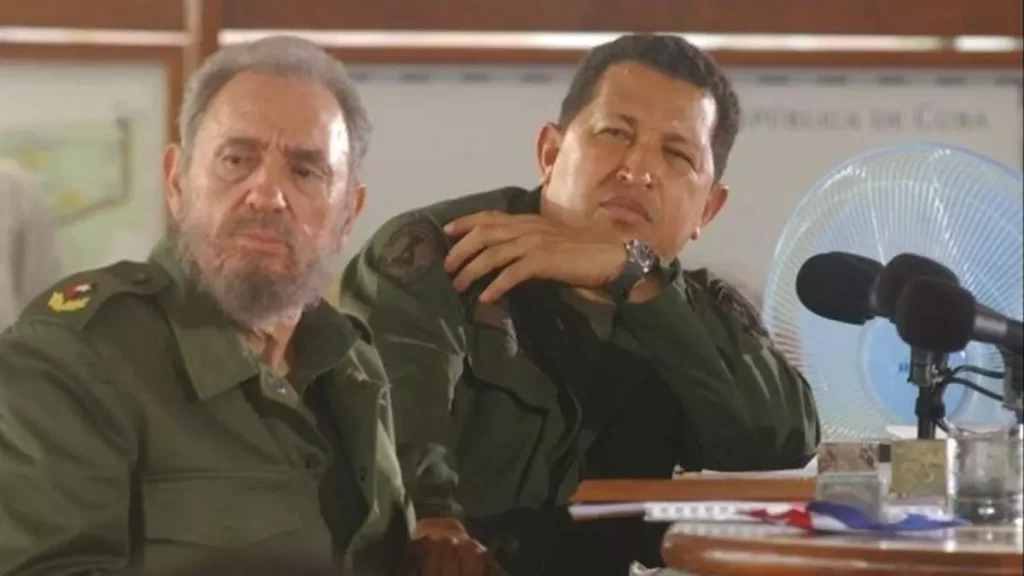
The document highlights the huge amount of money Venezuela has sent to Cuba since the 2000 agreements between Hugo Chávez and Fidel Castro. According to the text, the figure comes to 44.5 billion dollars at current prices, which in real (inflation-adjusted) terms is 63.8 billion dollars. That’s the estimate of what’s been transferred in oil to Havana over all these years in exchange for, among other things, personnel services—although back in 2016 Nicolás Maduro put Venezuela’s “investment” in that exchange at around 250 billion dollars, very likely an exaggeration.
According to the report, the 2000–2004 agreement involved sending 53,000 barrels of oil per day (bpd) on credit at 2% interest over 15 years, including a two-year grace period, with an official exchange of doctors and teachers. When it was renewed, the volumes stayed the same and a fixed price of 27 dollars per barrel was set, shielded from market increases.
The Group for Coordination and Liaison (Gruce) was set up between 2007 and 2008 when, fearing a coup after Chávez lost a referendum, he signed a secret deal with Castro
From 2005 to 2012, when oil production was strong, the amount rose to about 105,000 bpd on average, and the nominal value of the sales hit 3 billion dollars a year (thanks to high global oil prices, which Cuba didn’t have to suffer and even benefited from, since it resold part of that oil to other customers). During this period, according to the report, the Group for Coordination and Liaison (Gruce) was created—a joint intelligence hub—and the “Cubanization” of Venezuelan services such as the Directorate General of Military Counterintelligence (Dgcim) and the Bolivarian National Intelligence Service (Sebin) took place.
In later years, oil shipments started to fall, averaging 69,000 bpd in 2016 and 55,000 bpd in 2017. Between 2020 and 2023, the estimated average was 30,000 to 40,000, years when Cuba’s power crisis went from bad to worse. The report says that in 2024 exports barely reached around 32,000 bpd, while in 2025 they rose to 52,000, to secure Gruce’s backing in case Maduro fell. However, tracking data suggests the real figure that year was much lower, around 27,400 bpd.
The Gruce is, in fact, the central focus of the report. According to available information, it was set up between 2007 and 2008 when, worried about a possible coup after losing a referendum, Chávez signed a secret agreement with Castro to lock in the regime’s survival. Its functions included monitoring both military personnel and civilians, training agents, and filtering out potential plans against the Government. It had a mixed composition of Cubans and Venezuelans.
“White rooms” were set up—interrogation centres where torture was carried out—documented by the UN—designed for the detainee’s “biological exhaustion”
The report mentions a group of about eight Cuban Armed Forces officers specializing in counterintelligence, psychological warfare and crowd control who operated out of Fuerte Tiuna, where 32 FAR soldiers died during the US attack aimed at capturing Maduro on January 3.
On the Venezuelan side, the visible figures were Iván Hernández Dala, described as having turned military intelligence into an internal repression body; Gustavo González López, seen as the main link with Cuba and appointed this week as Defence Minister; Alexander Granko Arteaga, in charge of tactical and shock operations; and Alexis Rodríguez Cabello, currently head of Sebin and, according to the report, a key figure in the Cabello family’s power circle and that of current president Delcy Rodríguez.
The Gruce, the document stresses, introduced three elements which, in the view of the Miranda Center of Democracy, are “irreparable.” First, they replaced Venezuelan military academy manuals with the Cuban doctrine of “War of the Entire People,” under which the opposition is considered an “internal enemy.” On the technological side, they control identity systems, registries and notaries, giving Cuba access to that key database. Lastly, they set up the “white rooms”—interrogation centres where torture was carried out, as documented by the UN, aimed at the detainee’s “biological exhaustion.”
“The deepest legacy of the Oil for Repression model is the total abdication of Venezuelan sovereignty through what is known as an ‘Invasion by invitation’”
Among the consequences of this system, up to 18,000 politically motivated detentions have been recorded since 2014, 2,000 of them during the protests following the 2024 elections, which were widely won by the opposition. There were also documented abuses in detention centres—El Helicoide (Sebin) and Boleíta (Dgcim)—including beatings, blows with blunt objects, suffocation with plastic bags, sexual violence and force-feeding. There are also two recorded deaths in custody: Fernando Albán (in 2018) and Alfredo Díaz at the end of 2025, due to lack of medical care.
“The deepest legacy of the Oil for Repression model is the total abdication of Venezuelan sovereignty through what is known as an ‘Invasion by invitation’,” the document states, accusing chavismo of allowing another State to penetrate the highest levels of national security and sensitive information.
“Any process of redemocratization must involve the expulsion of foreign actors operating under secret arrangements, as has occurred not only with Cuban actors but also with Iranian, Russian, Chinese or Belarusian ones, and the rebuilding of institutions that are beyond repair,” the text calls for. It was released the same day news broke of the replacement of Vladimir Padrino López after more than a decade as Defence Minister. Even so, Venezuela’s Armed Forces remain under the same senior military leadership and are commanded—with Washington’s blessing—by Delcy Rodríguez, identified in the report as a key figure in the civilian intelligence axis.
Translated by GH
______________________
COLLABORATE WITH OUR WORK: The 14ymedio team is committed to practicing serious journalism that reflects Cuba’s reality in all its depth. Thank you for joining us on this long journey. We invite you to continue supporting us by becoming a member of 14ymedio now. Together we can continue transforming journalism in Cuba.