The proposal calls for dismantling the repressive apparatus, distributing humanitarian aid, establishing a provisional government for a maximum of 36 months, and calling free elections.
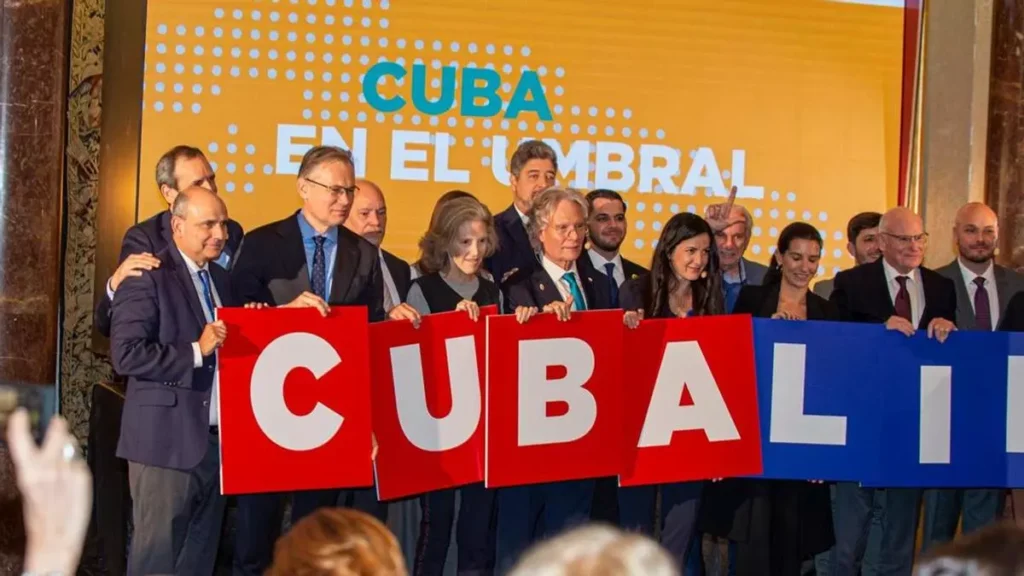
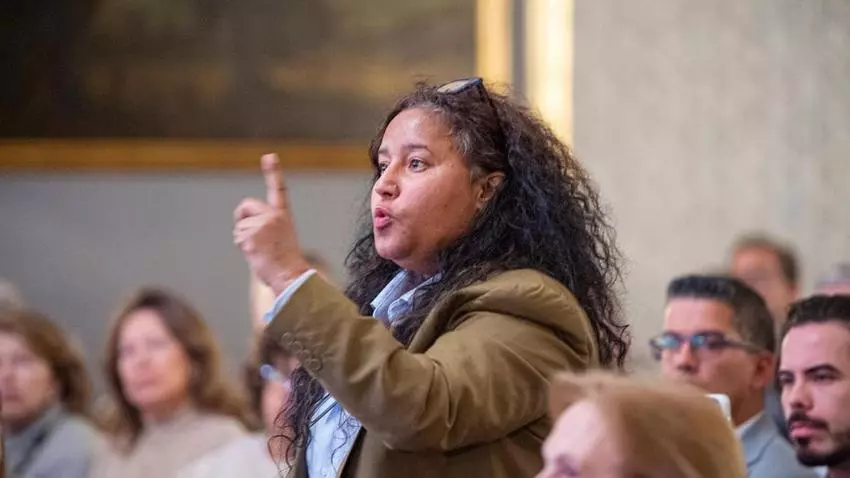
 14ymedio, Madrid, November 4, 2026 – Cuban opposition figure Rosa María Payá presented her plan for a democratic transition in Cuba on Tuesday in Madrid at a meeting that was briefly interrupted when a Cuban doctor approached the stage shouting, “Down with the blockade.”
She was identified as Lucía Céspedes Ocampo, a Cuban doctor with a private clinic in Guadeloupe, a French territory, who appeared on Cuban state television in September thanking Díaz-Canel.
“That young woman, if she is willing to listen, is invited back,” Payá responded. “This proposal is for all Cubans. Even those who are still trapped today in the totalitarian institutions of that dictatorship. Because they, too, need liberation. And because their families are also suffering,” she added.
At that moment, Payá was halfway through her presentation, during which she outlined her three-phase plan. The phases encompass the Castro family’s departure from power, the dissolution of State Security, and a provisional government lasting between 18 and 36 months, with no possibility of an extension. Free elections would mark the culmination of the process.
The first phase of the plan, called “liberation,” requires an end to repression and the restoration of fundamental rights. “There can be no transition with repression,” warned the daughter of the late opposition leader Oswaldo Payá.
Armando Ibarra, coordinator of the security division, detailed plans to dissolve the political police, the rapid-response brigades, and the surveillance mechanisms operated by the Committees for the Defense of the Revolution. “In the new Cuba, weapons will be subject to the law and to the Cuban people, not to the Communist Party,” he stated. The proposal places the Armed Forces under civilian authority, calls for the withdrawal of Russian and Chinese intelligence services, and transfers the military conglomerate Gaesa to civilian administration.
The second phase, focused on “stabilization and reconstruction,” would begin with humanitarian aid. Yaxys Cires, of the Cuban Observatory for Human Rights, explained that during the first 180 days, food, water, and medicine would be distributed, with an initial deployment within 72 hours. A national authority and logistics centers would be established. Assistance would be free and would carry no political conditions.
“The Cuban economy has money. The problem is that it is in the wrong places,” argued economist Elías Amor Bravo, who proposed reducing the role of the state, strengthening private property, controlling inflation, and attracting investment.
Cuban political scientist and writer Julio M. Shiling, an adviser on transitional justice, proposed investigating the regime’s crimes, purging institutions, and restoring or compensating owners for confiscated properties, “with full rights of occupancy for those currently living there.” He also proposed investigating Gaesa and using the 1940 Constitution as a starting point, adapted to present-day circumstances. “We must establish the facts, assign responsibility, provide reparations, disqualify those responsible, and break with the symbolism of that dictatorship,” he maintained.
The third phase, “democratization,” would culminate in a binding constitutional referendum and multiparty elections. Lawyer Mijail Bonito Lovio explained that independent institutions would be established within the first 90 days, including a national electoral service and an auditing office. “The democratic transition law is conceived as a provisional measure with a clear objective,” he said, establishing a legal pathway to return sovereignty to the Cuban people within a maximum period of 36 months.
“The ultimate goal of this plan is not to administer the transition,” Payá stated, emphasizing the need to restore Cubans’ right to decide and reunify the nation both inside and outside the Island.
The event, “Cuba on the Threshold,” was held at the Wellington Hotel ahead of the XXX Ibero-American Summit, which was marked by low attendance among heads of state. Cuba will be represented by Foreign Minister Bruno Rodríguez, without Miguel Díaz-Canel, and only ten of the 22 leaders invited were expected to attend. Hours earlier, Payá had met in Madrid with Chilean President José Antonio Kast and Chilean Senate President Paulina Núñez, publicly thanking them for their solidarity with the Cuban people.
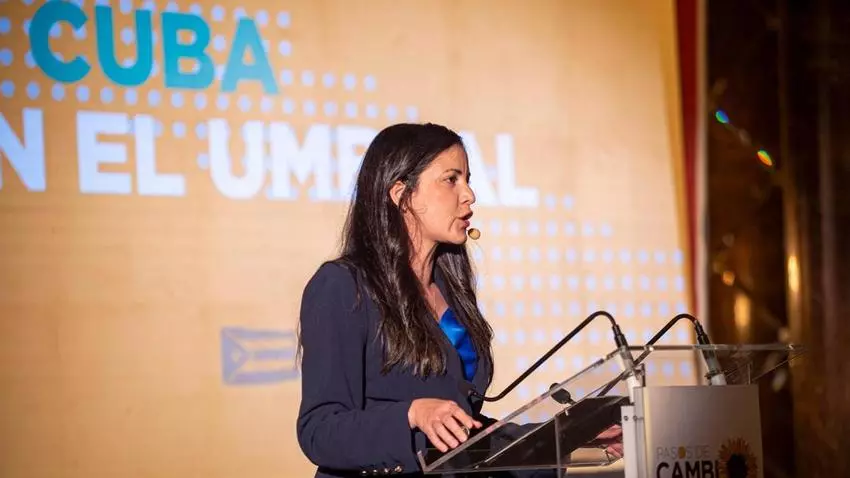
“We are no longer exclusively denouncing the dictatorship; we are preparing the Republic,” said the founder of Cuba Decide and coordinator of Pasos de Cambio, a platform that incorporates the initiative. The project develops the Agreement for Liberation, presented in Miami in March alongside Orlando Gutiérrez Boronat, of the Cuban Resistance Assembly, with the support of opposition organizations both inside and outside the Island.
Those attending included the secretary general of the Organization of American States, Albert Ramdin, several members of the European Parliament, and diplomatic representatives from the United States, Chile, and European countries. Ramdin said that after nearly 70 years without results, it was time to reconsider the Cuban system. He also called for the unconditional release of political prisoners and defended a peaceful transition led by Cubans, although he clarified that his position had not been agreed upon by the organization’s member states.
Polish member of the European Parliament Arkadiusz Mularczyk warned that bringing down communism is not enough to guarantee democracy. He called for preserving the political police archives, prosecuting abuses, and preventing former elites from retaining economic power. Dominican Foreign Minister Víctor Ito Bisonó also addressed the gathering through a recorded message, expressing support for democratic change.
Recorded messages were sent from Cuba by Berta Soler, leader of the Ladies in White, and Iván Hernández Carrillo, coordinator of the independent trade unions. Soler demanded the release of political prisoners, the exclusion of the Communist Party from the transition, and courts that guarantee justice for victims. Hernández Carrillo called for social protection and labor guarantees. “Without freedom of association, there can be no genuine democracy in the world of work,” he stated.
Translated by Regina Anavy
______________________
COLLABORATE WITH OUR WORK: The 14ymedio team is committed to practicing serious journalism that reflects Cuba’s reality in all its depth. Thank you for joining us on this long journey. We invite you to continue supporting us by becoming a member of 14ymedio now. Together we can continue transforming journalism in Cuba.