The return of María Corina Machado has revived the enthusiasm of those who still hope that the changes in Venezuela will also open the doors of Cuba.
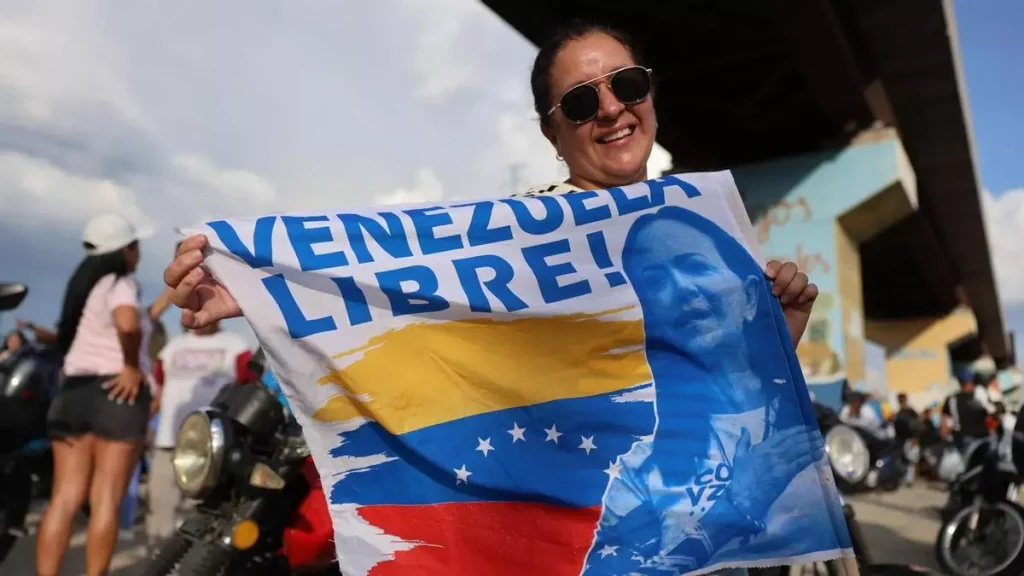
 14ymedio, Yoani Sánchez, Havana, October 26, 2026 / Images of María Corina Machado touring Venezuela, surrounded by thousands of people chanting her name and demanding elections, have reached the phones of many Cubans. They aren’t broadcast on the National Television News nor do they make headlines in the official newspapers. They circulate on WhatsApp, jump from one Facebook profile to another, and are discussed in quiet voices or with enthusiasm. The news that the propaganda apparatus prefers to ignore finds its own way to bridge the distance between the two nations.
The return of the opposition leader and Nobel Peace Prize laureate has a special resonance on this island. Not only because Cuba and Venezuela have been united for decades by a political, economic, and military alliance, but also because events in Caracas have become a kind of mirror in which many Cubans seek to anticipate their own future. Every move on the Venezuelan chessboard is examined here with a mixture of anxiety, expectation, and mistrust.
The capture of Nicolás Maduro by US troops last January unleashed a wave of hope that extended far beyond Venezuela’s borders. In Cuba, where the economic crisis and political stagnation go hand in hand, some imagined that the collapse of Chavismo would also drag down its allies in Havana. Some even began to talk about timelines, calculating weeks and setting dates for a change that seemed imminent.
But the calendar was left uneventful. Maduro ended up out of power, while much of the structure that had sustained him remained in place. Delcy Rodríguez assumed the Venezuelan presidency, and Washington opted to negotiate with Chavismo. Democracy, which many had envisioned entering through the front door, became trapped amidst diplomatic talks, oil interests, and unfulfilled electoral promises.
In Cuba, meanwhile, the long-awaited opening did not materialize. Political prisoners continued to wait, censorship retained its instruments, and institutions remained under the control of the Communist Party. The hope of January began to fade in the face of a stubborn reality. Maduro’s fall was not enough to open the doors of Cuban prisons or for citizens to regain their rights.
Now Machado is introducing a promising variable into that equation. Her presence in the streets of Venezuela serves as a reminder that a transition cannot be reduced to simply replacing a ruler while preserving the mechanisms that impede real alterantions. The crowds that accompanied her were not merely celebrating her return. They were demanding elections, a word that is also absent from the political vocabulary permitted in Cuba.
The silence of the official press is, therefore, so revealing. An event of such magnitude in a country that for years was presented as Havana’s principle ally should merit prominent coverage. However, recognizing the popular support for an opposition leader would require portraying an image that contradicts too many narratives repeated for decades.
Nor is the connection between Caracas and Havana is not a thing of the past. The United Socialist Party of Venezuela, led by Delcy Rodríguez , called the recent arrest warrant issued in Florida against Raúl Castro for the downing of the Brothers to the Rescue planes in 1996 an “intimidation maneuver.” Its support for the Cuban regime suggests that old loyalties still hold sway, even as Chavismo negotiates with the United States.
From this island, Machado’s return is viewed with a hope more cautious than that in January. We Cubans have learned to distrust quick fixes and the freedoms others promise to bring us. But we also know how to recognize the significance of a multitude that loses its fear and once again occupies the streets. Perhaps that is the image that most unsettles those in power: not a woman returning to her country, but thousands of citizens convinced that they can still decide their own destiny.
______________________
COLLABORATE WITH OUR WORK: The 14ymedio team is committed to practicing serious journalism that reflects Cuba’s reality in all its depth. Thank you for joining us on this long journey. We invite you to continue supporting us by becoming a member of 14ymedio now. Together we can continue transforming journalism in Cuba.