An Ecomóvil and a tricycle collided this Saturday in Sancti Spíritus, where these alternatives are gaining ground amid the transportation crisis.
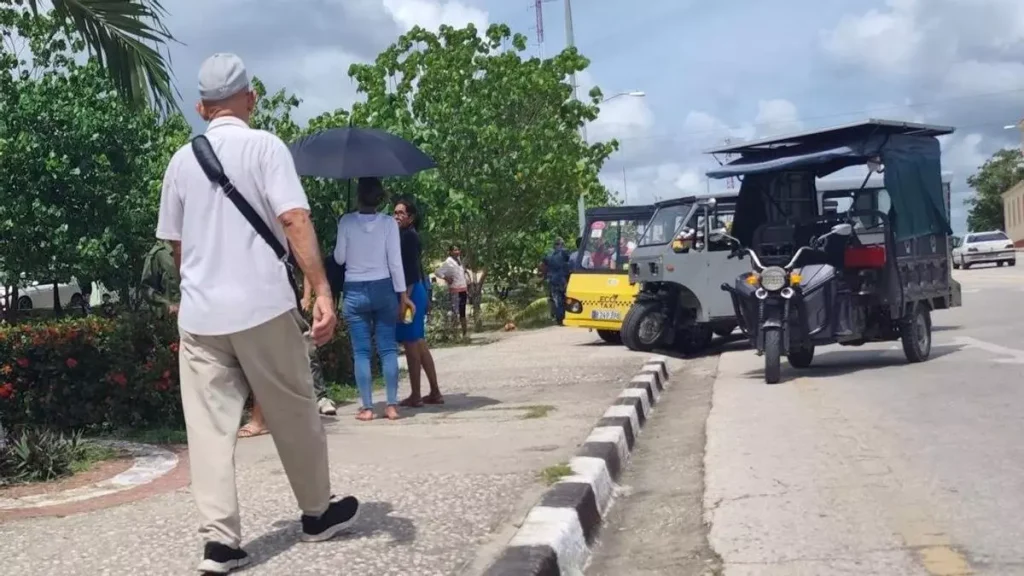
 14ymedio, Mercedes García, Sancti Spíritus, October 3, 2026 – This Saturday, an Ecomóvil and a tricycle ended up next to the curb after colliding at the intersection of Carretera Central and Sobral, in Sancti Spíritus. The accident, apparently without serious consequences, might be dismissed as an insignificant incident if its protagonists were not, precisely, two of the vehicles that best represent the accelerated transformation of transportation on the Island.
According to a witness who spoke to 14ymedio, the motor scooter had activated its turn signal to turn when the Ecomóvil, while attempting to avoid a white Lada, moved toward the same side and the two vehicles collided.
The Ecomóviles, small electric minibuses with little bodywork, have become a common sight in Sancti Spíritus. Conceived as an alternative to the lack of fuel and the deterioration of public transportation, around 30 of these vehicles were supposed to operate in the provincial capital, although passengers complain about increasingly irregular service and waits that can reach two hours.
Fewer cars, however, has not necessarily meant less risk for those who continue to travel
These new forms of transportation are gaining ground just as a large part of the traditional vehicle fleet remains immobilized. In recent months, amid the worsening fuel crisis, the Carretera Central in Sancti Spíritus became practically deserted, while in Havana numerous cars and buses were also disappearing from the streets.
Fewer cars, however, has not necessarily meant less risk for those who continue to travel.
The National Road Safety Commission itself has acknowledged that, despite the “decrease in the mobility of combustion-engine vehicles,” the use of electric motorcycles, mopeds and tricycles as transportation alternatives continues to increase. Between January and March, 1,234 accidents were recorded in Cuba, with 153 deaths and 1,154 people injured. Motorcycles, mopeds and pedestrians were involved in 74% of the crashes.
The phenomenon is even clearer in Holguín. According to data released this Thursday by the official newspaper ¡Ahora!, between January 1 and September 28, there were 344 accidents there, with 47 fatalities and 350 people injured. Mopeds, a category which includes motor scooters, motorcycles, tricycles and motorized bicycles, were involved in 78% of the accidents. Motor scooters alone were involved in 89 incidents.
“They are very fragile when faced with potholes or impacts; there is nowhere to hold on, and the seats are hard, often made only of metal”
Another recent accident, this time on the Maceo-Holguín route, left the driver of a tricycle, a woman and a girl injured. According to an eyewitness who recounted the incident on Facebook two days ago, the tricycle failed to stop at a Stop sign and collided with a bus, whose driver was unharmed. The driver of the light vehicle was knocked unconscious by the impact, although he regained consciousness on the way to the Vladimir Ilich Lenin General Hospital; the other two occupants suffered injuries that were not life-threatening.
Among passengers, the experience does not always inspire enthusiasm either. “It feels like you’re riding a horse. They bounce as if there were no tomorrow and make your stomach come up into your throat,” says a resident of Sancti Spíritus who is accustomed to using them. He also questions the skill of some drivers: “Many are inexperienced; they even drive in the opposite lane.”
“I travel with my heart in my throat,” confesses a Havana woman who regularly uses these vehicles in the capital. “They are very fragile when faced with potholes or impacts; there is nowhere to hold on, and the seats are hard, often made only of metal.” On hills, she adds, patience is also part of the journey: “They are slow, very slow. Sometimes I prefer to pay more for an almendrón that makes the trip in half the time.”
In the absence of fuel, buses and spare parts, the crisis has gradually driven a large part of the traditional vehicles off the streets and put a new assortment of vehicles in their place. Increasingly, they are the ones keeping Cuba moving. And they are also the ones appearing more frequently in its accident statistics.
Translated by Regina Anavy
______________________
COLLABORATE WITH OUR WORK: The 14ymedio team is committed to practicing serious journalism that reflects Cuba’s reality in all its depth. Thank you for joining us on this long journey. We invite you to continue supporting us by becoming a member of 14ymedio now. Together we can continue transforming journalism in Cuba.