The Island has accumulated 217 enforced disappearances since 2012 and 17 in the first eight months of 2026, surpassed only by Mexico.
 14ymedio, Madrid, October 3, 2026 – Cuba has accumulated 217 requests for urgent action before the United Nations Committee on Enforced Disappearances from 2012 through August 31, 2026. This is the fourth-highest figure among the countries included in the body’s report published on September 30. Only Mexico, with 877; Iraq, with 670; and Colombia, with 255, have reported higher numbers.
In the first eight months of this year, the Island recorded 17 requests, the second-highest number after Mexico, which had 73. Ecuador follows, with 11. The document, entitled Informe sobre las solicitudes de acción urgente presentadas en virtud del artículo 30 de la Convención [Report on requests for urgent action submitted under article 30 of the Convention], records a total of actions involving 36 countries, 11 of them in Latin America and the Caribbean.
The International Convention for the Protection of All Persons from Enforced Disappearance allows, under the aforementioned Article 30, a request to the Committee for urgent action to search for and locate a disappeared person.
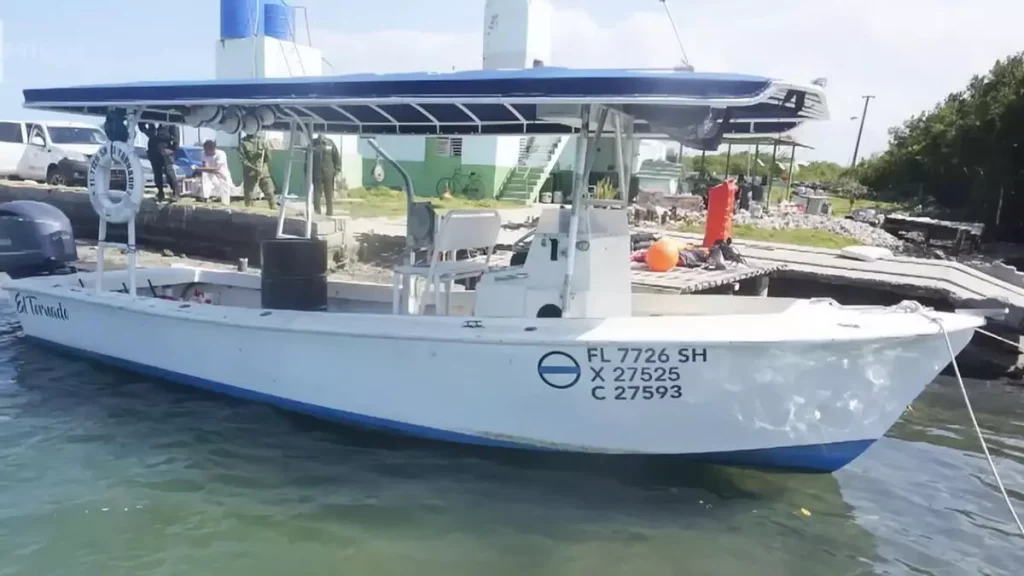
Among the 17 cases from 2026 are the five occupants of the boat from Florida intercepted last February, who were later accused of terrorism
The Committee does not identify the 17 Cubans by name, but describes four groups of cases. Five are the occupants of the boat from Florida intercepted last February, who were later accused of terrorism. “Although the authorities reported that they had survived the interception, they allegedly did not provide their relatives with accurate information about their whereabouts and physical condition after being deprived of their liberty,” the document states.
The case was brought before the Committee by Cubalex, which submitted requests on behalf of Conrado Galindo Sariol, Cristian Ernesto Acosta Guevara, Leordán Enrique Cruz Gómez, Amijail Sánchez González and José Manuel Rodríguez Castelló.
Another 11 cases date back to June. One concerns a man who went to a police station in Havana after receiving a summons and was subsequently taken away in a police vehicle. That description matches the detention of rapper Andrés Matos Alcántara, Mc K-Libre. Cubalex submitted to the Committee both the request concerning his case and the ten urgent actions corresponding to those detained during the operations following the fire at the Orlando Pantoja Tamayo Memorial House, in Maffo, Santiago de Cuba; four of them were minors.
The last Cuban case described by the UN Committee on Enforced Disappearances in its report concerns a person who had been serving a sentence since 2021 and was transferred in July from Guanajay prison to an unknown location shortly before the date scheduled for the completion of the sentence. The person is easily identifiable: Luis Manuel Otero Alcántara, who was taken out of that prison on July 7 and remained at an unknown location before being deported to Miami on July 18. Cubalex had also submitted a request for urgent action before the Committee in his case.
Cuba has still not “provided any information on the measures taken to search for and locate” 11 people on whose behalf urgent actions were registered
According to the report, the Cuban State eventually provided “information clarifying the whereabouts of the persons concerned” in the cases of the five occupants of the boat intercepted in February and the person transferred from Guanajay prison, so the Committee was considering closing those urgent actions. However, the Committee regrets that the Island’s government “has still not provided any information on the measures taken to search for and locate the other 11 persons on whose behalf urgent actions were registered,” the document adds.
The body also notes that “a large majority of the cases in which the disappeared person was located alive refer to disappearances occurring in the context of protests in Colombia and Cuba,” where detainees were deprived of their liberty while their relatives received no information about their fate or whereabouts.
The Committee also devotes a section to so-called short-term enforced disappearances and notes that during the period under review it recorded allegations concerning two cases, one related to Cuba and the other to Mexico. The body recalls that “there is no duration element in the definition of enforced disappearance under international human rights law.”
Translated by Regina Anavy
______________________
COLLABORATE WITH OUR WORK: The 14ymedio team is committed to practicing serious journalism that reflects Cuba’s reality in all its depth. Thank you for joining us on this long journey. We invite you to continue supporting us by becoming a member of 14ymedio now. Together we can continue transforming journalism in Cuba.