In July, more than 3.2 million barrels arrived, the equivalent of three Russian tankers
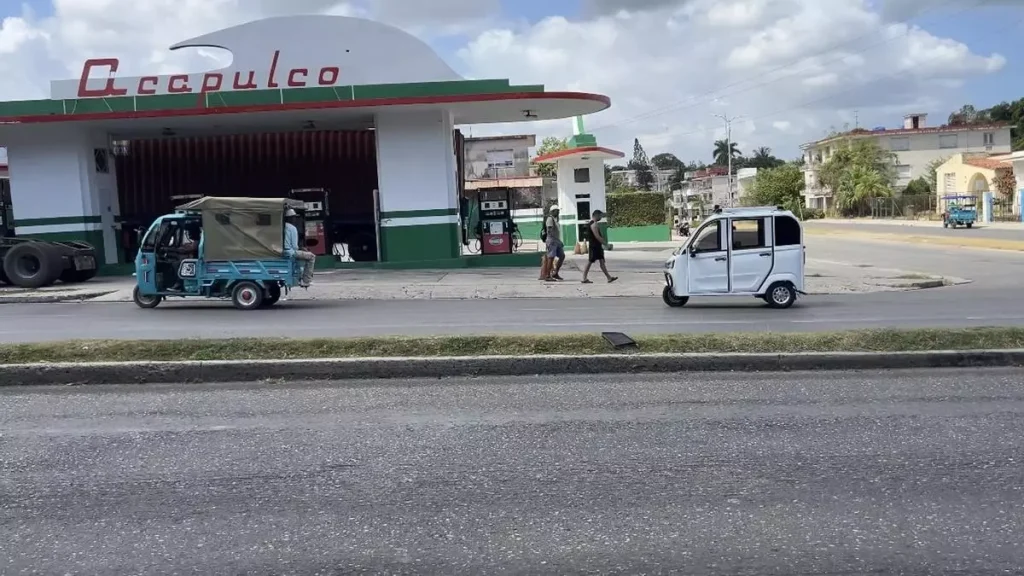
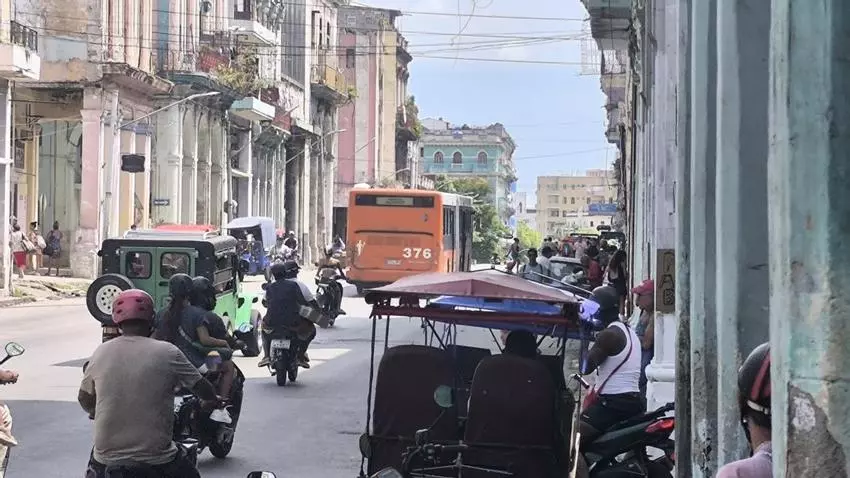
 14ymedio, Havana, September 30, 2026 / “Look, a bus. Make a wish,” a mother told her son a few days ago on Reina Street, in Centro Habana, as if the bus that had just appeared were a shooting star. However, in recent weeks more public transportation has been seen on the streets of Havana, as well as many state vehicles, which has led many people to wonder where they are getting the fuel from, if there is an oil blockade?”.
The data published this Wednesday by the US Energy Information Administration (EIA) show that in July 3,222,000 barrels of petroleum products were exported to Cuba, a record that shatters previous ones. This volume is equivalent to three Russian tankers like the ‘Anatoly Kolodkin,’ which arrived in Cuba at the end of March with 730,000 barrels of crude, barely enough to produce some 360,000 barrels of diesel.
Of the total, 2,654,000 barrels were diesel, 554,000 gasoline, 12,000 lubricants and 2,000 other derivatives. Diesel, used among other things by heavy transport, buses, machinery and generator sets, accounted for more than 82% of the volume.
The jump is extraordinary. In June, the United States had shipped 778,000 barrels, which already constituted a record for 2026. But the July volume was 4.1 times higher. More striking still: during the entire first half of the year, 1.67 million barrels had come in from the US, so that in a single month almost twice as much fuel arrived as in the previous six months combined.
The value of exports had also been growing rapidly. In July, Cuban purchases of US fuels and derivatives amounted to $61.1 million, compared with $47.8 million in June, and totaled $156.8 million since the beginning of the year.
There is, moreover, a key difference from other stages of Cuba’s energy relationship with its allies. Available records do not show a single month in the last decade in which Venezuela, Russia or Mexico alone sent more than 3.22 million barrels to the island. Even Venezuela, when it was still supplying some 90,000 barrels a day in 2016, amounted to around 2.7 million a month.
The comparison, however, favors the July figure even more. Much of the earlier supply arrived in the form of crude, which had to be refined in Cuba to obtain gasoline, diesel and other derivatives. The shipments from the United States, on the other hand, are finished products ready for consumption, mainly diesel.
According to the EIA, producing one barrel of gasoline requires approximately the equivalent of 2.1 barrels of crude, while one barrel of diesel requires between two and three barrels of crude depending on the type of refinery and the process, although the rest of the crude simultaneously yields other derivatives. That is why the 3.22 million barrels of finished products shipped from the US in July represent a much greater effective availability of fuel than a simple comparison with past crude shipments would suggest.
But the numbers also raise another logistical question. Energy expert Jorge Piñón shared one of his concerns with this newspaper: who in Cuba, apart from the state-owned Cupet or Cimex, has enough capacity to store 3.2 million barrels in a single month, in addition to any fuel that might remain from earlier shipments?
The question points to one of the most opaque areas of the new business, because Washington authorizes fuel sales only to the Cuban private sector, and Cupet was added in June to the list of entities sanctioned by the United States.
The fuel boom is part of a much larger commercial transformation
The storage problem had already surfaced a few months earlier. The US company Vanguard Energy planned to send some 250,000 barrels of gasoline and diesel to the island and had negotiated the use of Cupet tanks to store this fuel, intended, according to the company, exclusively for private customers. The project was suspended after the new US sanctions against the state oil company.
The fuel boom is part of a much larger commercial transformation. Between January and July, the United States exported to Cuba goods worth $674 million, 61.8% more than during the same period of 2025. In July alone the figure was $148.9 million, the highest monthly total since the Census Bureau began tracking that trade in 1992.
In just three years, the US went from tenth place to becoming Cuba’s main supplier, ahead of Spain and China, although the trade is practically one-way.
The data on US oil exports seem to prove the minister right when he complains that Washington seeks to create a situation of economic “dependence”
The figures add another contradiction to the Cuban Government’s discourse. At the premiere of his radio program Criterio Compartido on September 23, Miguel Díaz-Canel stated: “It has been nine months since a fuel ship has come in,” and used that situation to explain the difficulties of the economy and public services. The statement ignored, among other episodes, the arrival of the Anatoly Kolodkin.
The situation also appears paradoxical in light of the discourse of the Minister of Foreign Trade, Óscar Pérez-Oliva Fraga, who this Tuesday again denounced the policy that allows fuel to be sold to the Cuban private sector. On the other hand, the data on US oil exports seem to prove the minister right when he complains that Washington seeks to create a situation of economic “dependence” by favoring sales by US companies to the detriment of the regime’s traditional partners.
For Havana residents who once again come across a bus on Reina, Galiano or Infanta, the discussions are different. On one of those buses, which was traveling almost empty this week, a man wondered in surprise at the lack of passengers. “Could it be that people have already gotten used to there being no buses and don’t even wait at the stops anymore?”
Translated by GH.
______________________
COLLABORATE WITH OUR WORK: The 14ymedio team is committed to practicing serious journalism that reflects Cuba’s reality in all its depth. Thank you for joining us on this long journey. We invite you to continue supporting us by becoming a member of 14ymedio now. Together we can continue transforming journalism in Cuba.