Detainees from the Florida boat intercepted in February reveal details of the incursion to media outlets aligned with the regime.
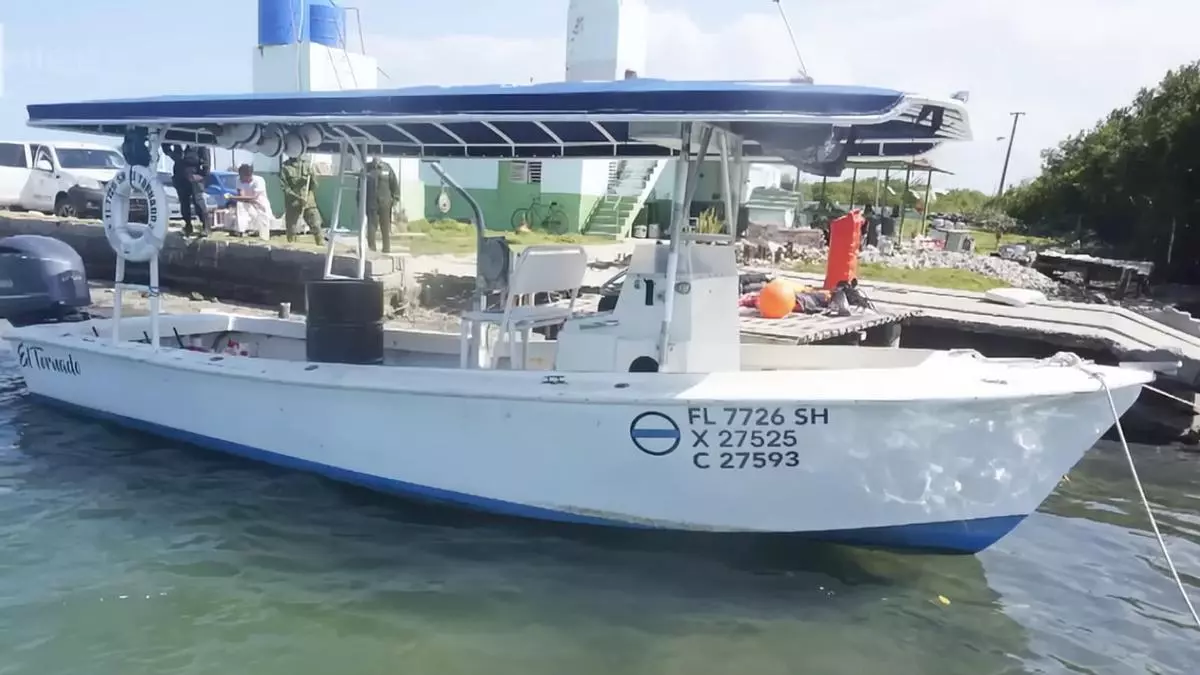
 14ymedio, Madrid, September 23, 2026 – Seven months have passed since Border Guard troops shot several occupants of a boat from Florida in the waters off Villa Clara. The five survivors of the incident remain detained in Cuba on terrorism charges amid an investigation in which the Cuban authorities and the FBI have joined forces to help clarify what happened, but nothing more had been heard about them or their ordeal. Until this Wednesday, when the outlet Drop Site News published an extensive report based on interviews conducted by journalist Ryan Grim with four of the detainees in Cuba.
The lengthy article, prepared together with a team of journalists from Belly of the Beast and Miami New Times –media outlets aligned with the regime– also includes interviews with more than a dozen people in Florida connected to the events or to the detainees themselves, although the heart of the reconstruction of events consists of conversations with José Manuel Rodríguez Castelló, Christian Ernesto Acosta Guevara, Leordán Enrique Cruz Gómez, and Conrado Galindo Sariol. The fifth detainee, Amijail Sánchez González, did not speak, and the outlet says it is not known whether he refused or was not allowed to.
The interviews were conducted separately, in a house in a residential neighborhood of Havana belonging to the Department of International Relations of the Ministry of the Interior. They all arrived one by one, wearing the orange jumpsuits associated with severe sentences, as Cuban legal experts explained to 14ymedio, and handcuffed, although the handcuffs were removed for the conversations, which lasted between 30 and 55 minutes. The journalist, who also identifies the senior officers who witnessed the meetings, warns in the introductory paragraph that all of them said they did not feel pressured, but it is essential to question each of their words because of the situation and the surroundings.
The article emphasizes that there is considerable disparity in their cases. One said he had been forced to take part in the action; another was remorseful; one believed in the cause but admitted that the strategy was a mistake; and the last repeated that he felt pride
The article emphasizes that there is considerable disparity in their cases. One said he had been forced to take part in the action; another was remorseful; one believed in the cause but admitted that the strategy was a mistake; and the last repeated that he felt pride. They all agreed in their accounts regarding the objective of the initiative and what happened when they encountered the Cuban Border Guards, but not so much in their version of the financing and ties to the Miami exile community. They did point to Maritza Lugo Fernández, a former political prisoner and plantada [Cuban prisoner who rejected political reeducation], and a U.S. resident, who provided them with a small farm in Florida as a training camp.
Raúl Quevedo, interviewed in Florida, appears as a key link in recruiting the participants in the events. He is the administrator of the accounts of La Nueva Cuba [The New Cuba], which promotes anti-communist ideas and armed struggle against the Cuban regime on social media. “They were looking for people who had the courage to join a rebellion,” Rodríguez said.
The plan was to “take over a police station, unleash a rebellion and provoke a U.S. intervention,” says the now-detained man. Another report from Cruz says that Cárdenas, in Matanzas, had been selected. In the official account, Interior Ministry agents were more specific: it was Santa Marta, about 12 kilometers from that town.
The group was formed, they all say, through TikTok, a network that served to put these and other people with similar ideological views in contact, and they eventually met at Lugo Fernández’s farm on multiple occasions. There they practiced shooting but were unaware of possible details of a planned operation. “[The leaders] kept the plans secret for security reasons, to prevent leaks,” Rodríguez said. In January, however, things began to take shape, starting with preparations for the boat.
“For something like that, you need a plan, a structure, a Plan B, a Plan C and an escape plan. If you don’t have that, being only 10 people, you’re lost”
Quevedo, contacted by telephone, said he knew everyone involved, but flatly refused to say whether he participated in the planning. “The more you talk, the more your enemy knows about you,” he said. He believes it is easy to bring down the regime but dismisses the February operation. “For something like that, you need a plan, a structure, a Plan B, a Plan C and an escape plan. If you don’t have that, being only 10 people, you’re lost. And it’s a shame because they were good young men,” he maintains.
The interviewees are aware of this. Most agree that it was far from being something solid, but they hoped to trigger something. Some had actively followed similar groups in exile and nothing ever happened, but they saw an opportunity with Maduro’s capture in January, growing pressure from Donald Trump, and the population’s desperation. “It is illogical to think that 10 men can declare war on a country. That would be absurd. But we were aware of the social discontent. We knew people wanted something to happen. Maybe a spark,” Cruz said.
The account of the day of the events, February 24, is very similar to the one offered by the Cuban authorities. One of them said the first shot came from the boat; the other three say they are not sure. They were carrying 14 long guns and 11 handguns; 13,000 rounds of ammunition; more than 100 magazines; homemade pipe bombs packed with fragments of nuts, bolts, and black powder; Molotov cocktails; bulletproof vests; camouflage uniforms; helmets; knives; night-vision equipment; a drone; a Starlink satellite internet terminal; and medical supplies.
Around 7 in the morning – as the participants feared, admitting that they were afraid dawn would expose them – a Border Guard spotted them, and although they tried to flee, the boat ran aground in the middle of a low tide. They got out to free it and then climbed back aboard to start it up at maximum speed, which was insufficient. “That’s when Leordán Cruz Gómez shouted: ‘Get ready. They’re going to shoot. Get the magazines,’” Acosta recalls. None of them expected to shoot their way onto the Island, two of them said, but that is what happened, although all the interviewees deny having fired and blame the others.
Galindo says the wounded Cuban captain was the one who ordered his men to stop. “If he had let them continue, they would have killed us all”
“Amijail grabbed a magazine for the Chinese-made AK-47 he had and opened fire on the Border Guard troops. That’s when the shooting started. I don’t know exactly what happened, because at that moment I got scared and threw myself onto the floor of the boat so the bullets wouldn’t hit me,” Acosta specifies. According to the Cuban authorities, the Cuban coast guards had five small-caliber weapons and none had seen combat.
The exchange lasted minutes, according to both sides, until the survivors surrendered. Galindo says the wounded Cuban captain was the one who ordered his men to stop. “If he had let them continue, they would have killed us all,” he says.
Ledián Padrón Guevara, Héctor Duani Cruz Correa and Pavel Alling Peña died at the scene. Michel Ortega Casanova died during the evacuation, and Roberto Álvarez Ávila died in the hospital a week later.
The investigation contains statements from exiles in Florida who defend the initiative from a certain distance. It also includes explanations from Ministry of the Interior agents who have linked these groups to terrorism on more than one occasion, as well as a review of similar attempts in the past. Beyond the detainees, the team of journalists managed to speak with one of the key figures in the events: Maritza Lugo.
“The Castro regime has constantly accused me of being a terrorist, of paying for things. What could I possibly pay for? I live on Social Security. I receive $700 a month, which is not enough for anything. I try to save. I do odd jobs. My family helps me if I need something extra. But I don’t have money to finance absolutely anything,” she maintains. Lugo did, however, create the Facebook page called 10 Cuban Patriots in support of the group.
“The Castro regime has constantly accused me of being a terrorist, of paying for things. What could I possibly pay for? I live on Social Security. I receive $700 a month, which is not enough for anything”
She is the promoter of the November 30 Party, an ally of Auto Defensa del Pueblo [Self Defense of the People], a group that views violence as a means of ending the Cuban regime, founded by Amijail Sánchez, the fifth detainee, who did not grant an interview. Lugo and Sánchez were romantically involved for more than a year, she says, although she distances herself from any action of this kind. “They went far beyond the limits of what is normal because what they did was truly crazy. Who in their right mind could think that ten men could accomplish anything against a dictatorship like that?” she exclaims. In her view, the military initiative must have come from the United States.
Lugo admits that shooting practice took place at her Florida farm, although for hunting animals. “Anyone who trained at my farm, who said they trained, that’s their problem. Here in the U.S. that is against the law. It is a crime,” she maintains. County officials confirmed to the outlet, however, that this August they inspected the property and noted that there was a design intended to “facilitate training that incorporates multiple shooting angles and directions rather than functioning as a traditional shooting range.”
Regarding financing, Rodríguez says no one paid them for the equipment they used and categorically rules out Lugo. “What she mainly did was handle the political side,” Rodríguez said. In this he differs from the testimony of Conrado Galindo, who says she offered him $500 to film training videos. When he arrived at the meeting, Lugo told him the plan was something else – “You’re going to Cuba” – and threatened him when he expressed reluctance, he says. Two other detainees confirm that there was pressure, while she says they are being coerced. “What are they supposed to say? They want to save their lives, and they are being forced to say those things.”
The detainees’ relatives corroborate that all of them were actively opposed to the regime and reject the label of terrorists.
Currently, the detainees remain in a maximum-security area inside Combinado del Este, the maximum-security prison in Havana
The investigation highlights cooperation between the Border Guard troops and the U.S. Coast Guard. The liaison officers maintain regular contact, related to all kinds of maritime activity, despite the rhetoric of confrontation between the two governments. The Cuban side, however, questions whether U.S. authorities were unaware that this activity was taking place. “Everything is monitored. And yet, a speedboat of this type, carrying ten people, explosives filled with shrapnel, Molotov cocktails and military supplies, and a boat that was coming to sow pain here in Cuba and kill people, was able to make the trip,” says First Colonel Ybey Carballo Pérez, chief of staff of the Border Guard. They also regret the limited exchanges following the events, including the reports. The FBI and the State Department did not respond to the outlet’s questions.
Currently, the detainees remain in a maximum-security area inside Combinado del Este, the maximum-security prison in Havana. Two of them have reported some kicking or stomping, while the other two deny mistreatment. They can receive family visits every three weeks. Rodríguez’s girlfriend visited him in July and found him well, although pale and thin.
Cruz says he still believes in his cause, but that other resources are needed for armed struggle to succeed. “I am convinced that everyone in Cuba wants change,” he said. Galindo says that if he ever returns to the U.S., he will sue Maritza Lugo for kidnapping and threats. Acosta regrets the “insanity”: “The advice I would give other Cubans is to stop consuming so much garbage [on social media]. Keep your jobs and don’t come to do anything, because it isn’t going to turn out well,” he urges.
Rodríguez is the only one who maintains his belligerence intact. He says he feels that he “failed all those Cubans who want a free Cuba” and adds: “If they told me they would send an oil tanker to Cuba in exchange for releasing me, I would rather rot in prison than allow a single drop of oil to enter this country.”
Translated by Regina Anavy
______________________
COLLABORATE WITH OUR WORK: The 14ymedio team is committed to practicing serious journalism that reflects Cuba’s reality in all its depth. Thank you for joining us on this long journey. We invite you to continue supporting us by becoming a member of 14ymedio now. Together we can continue transforming journalism in Cuba.