Six provinces, in addition to Isla de la Juventud, are registering rising incidence: Pinar del Río, Matanzas, Villa Clara, Ciego de Ávila, Santiago de Cuba, and Guantánamo
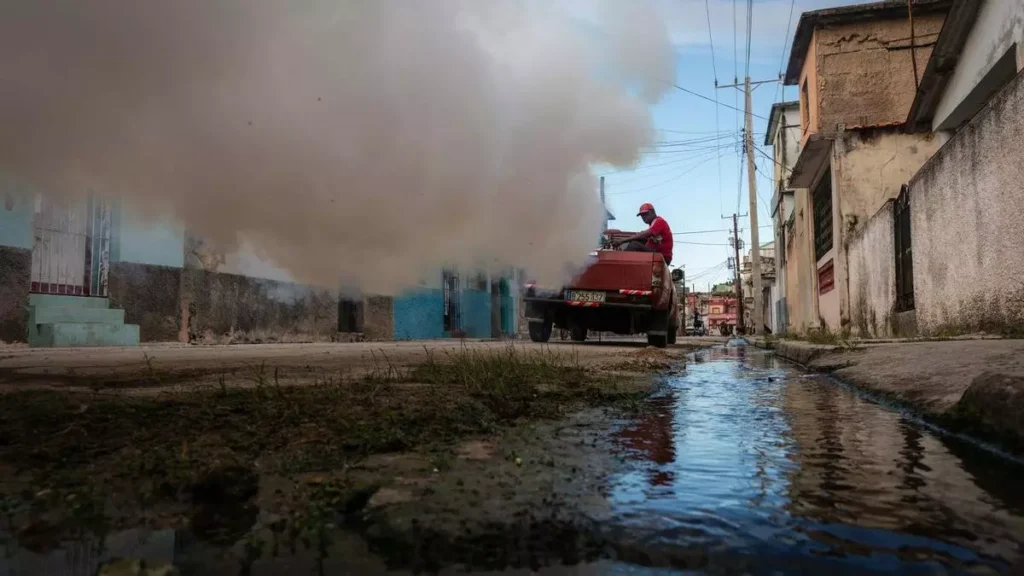
 The cool weather that has reached the island in recent days is not enough to wipe out the mosquito plague. “Last night I was sitting in my living room and I had to put on repellent to be able to watch television because they were biting me all over,” says a resident of the capital. Those who were hoping that the polar cold forecast for Cuba as a result of the El Niño phenomenon battering the planet would reduce the threat of arboviruses will have to wait until at least December, according to meteorologists.
“I think it needs to get a bit colder for them to decrease,” the Havana resident admits. Constant leaks, water tanks, and the omnipresent piles of garbage on every corner of the island have once again proven to be an excellent breeding ground for the proliferation of arboviruses in an atypical season. The months from May to October, with a sharp peak in September, are considered the worst for the increase in numbers of the Aedes aegypti mosquito, the main transmitter of dengue, and of the biting midge, responsible for Oropouche. But by late November, the situation tends to improve. Except this year.
Madelaine Rivera Sánchez, national director of Vector Surveillance and Control at the Ministry of Public Health, stated this weekend that there is transmission of dengue and chikungunya in all provinces. The good news is that there are no cases – at least no confirmed ones – of Zika or Oropouche, but infections from the other two diseases continue to rise.
Madelaine Rivera Sánchez, national director of Vector Surveillance and Control at the Ministry of Public Health, stated this weekend that there is transmission of dengue and chikungunya in all provinces
“At the close of statistical week 44, seven territories exceeded the previous week’s incidence rate: Pinar del Río, which ranks first in complexity for dengue and chikungunya, followed by Matanzas, Villa Clara, Ciego de Ávila, the special municipality of Isla de la Juventud, Santiago de Cuba, and Guantánamo,” said the official, who is also a physician.
The specialist reiterated that it is crucial to keep all water containers covered, “clear the weeds in yards and vacant lots, and take part in sanitation efforts through the CDR [Committees for the Defense of the Revolution] and the community.” “The fewer breeding sites the mosquito has, the less chance we will have of getting sick,” she stated, also stressing the importance of going to health facilities as soon as possible. That recommendation continues to be rejected by most patients, who believe they can manage the illness at home more safely and comfortably. The dismal state of health centers and the shortage of medicines have contributed to the perception that being in them is even riskier than staying away, as long as the condition does not get worse.
But the most surprising thing Rivera Sánchez said concerned fumigation measures. Although all provinces have insecticides and Abate [a temephos-based larvicide], she said, the lack of fuel for the machines has hampered the work. To alleviate the situation, “work has been done to modify a group of the machines to replace diesel with water, which has made it possible to carry out actions in October and so far in November, especially in areas of high transmission.”
The specialist gave no further explanation, although it could be the ULV [ultra-low volume] or cold fogging system, in which, unlike the diesel-based thermal foggers traditionally used on the island, an electric motor is used and a solution of the product in water is dispersed.
Just a month ago, the Pan American Health Organization donated some 50 fumigation units to Cuba, most of which went to Holguín, the province with the most cases. At the time, the director of the province’s Center for Hygiene, Epidemiology, and Microbiology, Geanela Cruz, already pointed out that their use would be limited by the “fuel crisis affecting the country.”
According to official data, the 2025 chikungunya and dengue epidemic, which reached enormous proportions, left at least 65 dead and nearly a third of the population infected. The Cuban Citizen Audit Observatory and Cuba Siglo 21, for their part, stated that there were 8,700 deaths from arboviruses.
So far this year, PAHO has counted 1,746 cases of dengue and 2,716 of chikungunya reported by the island’s authorities, but, once again, the thousands of cases that escape the official count multiply the figures exponentially.
Translated by GH.
______________________
COLLABORATE WITH OUR WORK: The 14ymedio team is committed to practicing serious journalism that reflects Cuba’s reality in all its depth. Thank you for joining us on this long journey. We invite you to continue supporting us by becoming a member of 14ymedio now. Together we can continue transforming journalism in Cuba.