While finding any transportation in pesos has become an ordeal, the private company offers routes across the Island to those who can pay in foreign currency.
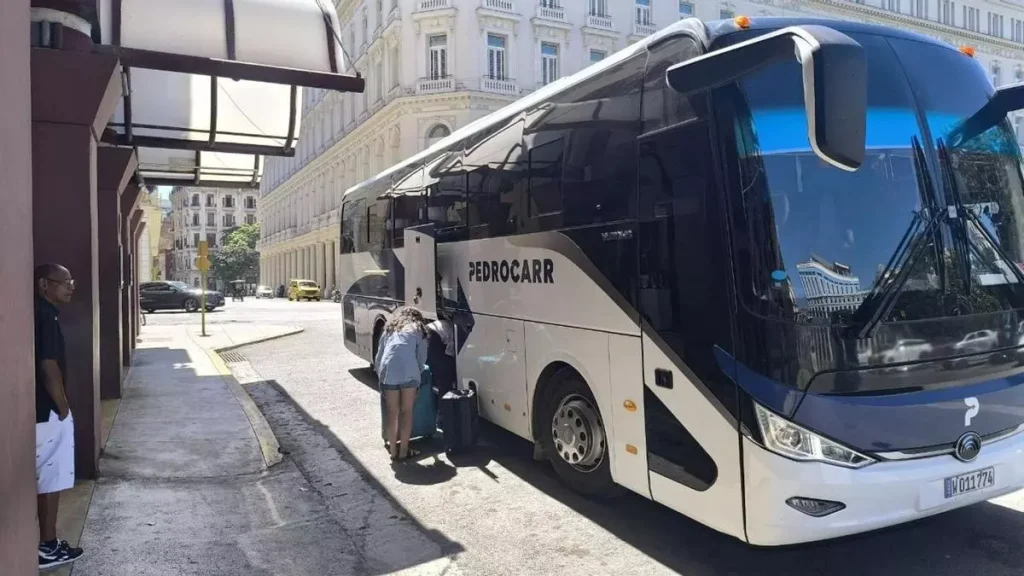
 14ymedio, Havana, Juan Diego Rodríguez / Alejandro de Cañas, July 2, 2026 – A large PedroCarr bus, with the company’s logo prominently displayed on its side, left passersby in Central Havana astonished this Thursday. In the midst of Cuba’s transportation crisis, seeing luggage being loaded and passengers about to board is nothing short of a miracle.
PedroCarr, a private small and medium-sized enterprise (SME), has just opened a much easier option for those who can pay from abroad. On Wednesday, the company launched a digital platform to book interprovincial trips, hotel transfers, and transportation from Cuban airports, with fares listed in euros.
“Travel through Cuba with us,” the private company announces in a social media campaign. Through its new website, PedroCarr promises “fast and secure” reservations, bus rentals for excursions and events, as well as connections between the Island’s main cities and tourist destinations.
The company says its regular services in Cuban pesos will continue operating “under the same conditions and accessibility as always.” However, the launch is clearly aimed at Cubans living abroad who pay for their relatives’ travel and foreign tourists—two groups with access to hard currency in a country where the average state salary barely covers a fraction of the cost of any trip sold in euros.
PedroCarr also offers a downloadable 28-page fare schedule explicitly labeled “Viazul Service Fares”
The most striking aspect is not only the announcement itself but also the documents available on the website. PedroCarr allows users to download a 28-page fare schedule explicitly titled “Viazul Service Fares,” listing routes from airports, provincial capitals, hotels, and tourist destinations across the country.
From Terminal 3 of José Martí International Airport, for example, a transfer to Old Havana costs 10 euros. A trip to Las Tunas is listed at 44 euros, Holguín at 50 euros, Santiago de Cuba at 60 euros, and Baracoa at 74 euros. The fares include two suitcases and vary for children, round trips, and multi-destination itineraries.
The document is virtually identical to the one used by Viazul, the service operated by the state-owned National Bus Company, traditionally aimed at tourists and passengers paying in foreign currency. PedroCarr does not explain in its announcement whether it acts as an intermediary, a ticketing agency, or a transportation contractor for Viazul, nor does it specify what portion of the fare remains with the private company.
The platform presents itself as a bus transportation management and reservation system, but the network of routes it offers covers virtually the entire country, from Viñales to Baracoa, as well as airports, island resorts, and hotel complexes.
PedroCarr is not a newly created company. Cuba’s Ministry of Economy and Planning included it in its official registry of new economic actors as a private SME based in the municipality of Las Tunas, dedicated to ground passenger transportation. It was authorized in 2022 during the first major wave of small and medium-sized enterprises approved by the Government.
In February of this year, the company’s own fleet consisted of ten Yutong buses and seven Foton minibuses, in addition to another 17 leased vehicles.
Behind the business is Pedro Yosvany Carbonell Fernández, known as El Chino. The official Las Tunas newspaper 26 identified him in 2022 as the manager of what was then called Pedrocar y Socio, noting that the project began on May 8 of that year. Its original goal was to transport passengers between Las Tunas and Havana.
A Prensa Latina report published in February of this year refers to him as president of PedroCarr and states that the company operated the Havana–Puerto Padre and Havana–Las Tunas routes with fares in Cuban pesos. To acquire its buses, the private company obtained financing through an unidentified Spanish institution, arranged via Consultoría Internacional. PedroCarr also worked with foreign suppliers, including China’s Yutong Bus and Mexico’s Sunshine Best.
At that time, the company’s own fleet consisted of ten Yutong buses and seven Foton minibuses. Those 17 vehicles were supplemented by another 17 leased from the state-owned National Bus Company, giving PedroCarr a total of 34 vehicles under its management. The launch of a platform offering connections throughout the Island now points to a further expansion of its operations.
The service exists, the bus and fuel appear without problems, and reservations can be made without long lines… but in euros.
The private company’s growth has therefore taken place hand in hand with public institutions. PedroCarr has marketed transportation capacity through state bus terminals and has operated in a sector where fuel shortages, lack of spare parts, and vehicle scarcity have left numerous state-run routes paralyzed.
For a Cuban living on the Island, paying 44 euros for a trip from Havana Airport to Las Tunas amounts to tens of thousands of pesos on the informal market. For a relative paying from Miami or Madrid, however, it may be a quick solution when state-run tickets are impossible to obtain.
That contrast summarizes the direction much of the Cuban economy has taken. The service exists, the buses and fuel are readily available, and reservations can be made without long lines, but only if someone, usually from abroad, has euros.
Translated by Regina Anavy
______________________
COLLABORATE WITH OUR WORK: The 14ymedio team is committed to practicing serious journalism that reflects Cuba’s reality in all its depth. Thank you for joining us on this long journey. We invite you to continue supporting us by becoming a member of 14ymedio now. Together we can continue transforming journalism in Cuba.