A central figure of Castroism for more than six decades, he survived every purge.
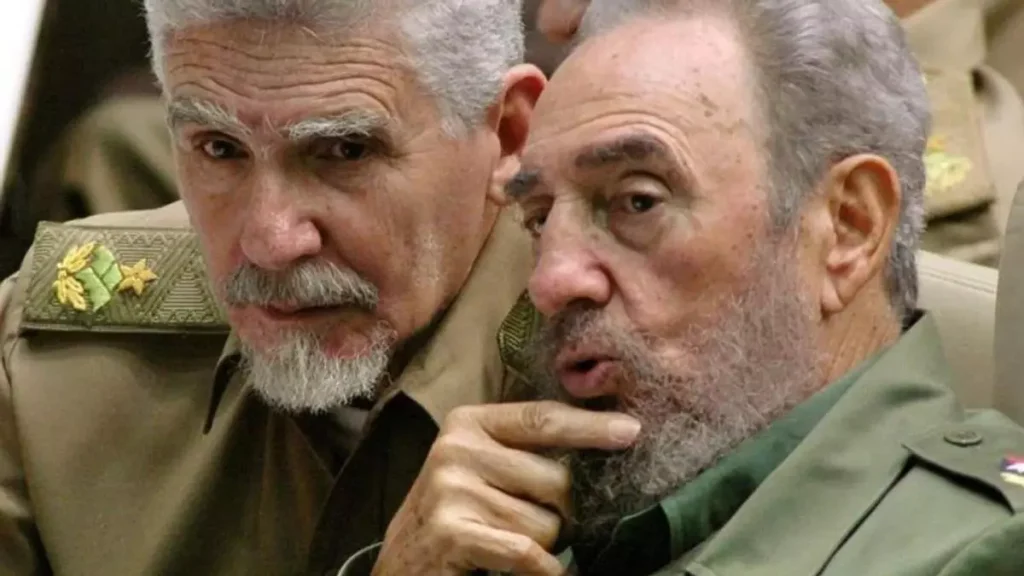
 14ymedio, Havana, June 21, 2026 – Cuban leader Miguel Díaz-Canel announced this Sunday the death, at age 94, of Ramiro Valdés Menéndez, Commander of the Revolution and one of the main architects of the Cuban regime’s repressive apparatus. “The physical departure of Commander of the Revolution Ramiro Valdés Menéndez hurts deeply, like that of a father. That is how I always loved and respected him,” he wrote on social media. Díaz-Canel also recalled “his support and advice, his discreet collaboration, and his exemplary dedication in service to the Homeland.”
Díaz-Canel highlighted Valdés’s “absolute loyalty” to Fidel Castro and Raúl Castro and linked his death to the celebration of Father’s Day in Cuba this Sunday. “Every act in the life of Commander Ramiro was marked by his absolute loyalty to the leadership of Fidel and Raúl, to his comrades in struggle, and to the Moncada Program, whose quest for justice he defended from the assault on the dictatorship’s fortress in 1953 until the last breath of his exemplary life,” he stated.
No details have been provided regarding the cause, time, or place of death. His passing closes the biography of one of the most feared men of Castroism, known inside and outside the Island by the nicknames “Pool of Blood” and “The Butcher of Artemisa,” a reputation forged through his role in repression and the memory of thousands of victims.
With his death, the small group of historic leaders who still maintain a public or institutional presence is reduced even further
Valdés was one of the central figures of the so-called Historic Generation, made up of the leaders who accompanied Fidel Castro before the revolutionary victory of 1959 and who occupied the highest positions of power for decades.
He participated in the assault on the Moncada Barracks in 1953, traveled aboard the Granma in 1956, and was part of the column led by Ernesto Che Guevara during the invasion toward the center and west of the Island. He was the only member of the Castroist leadership who took part in all three episodes and lived into this century.
With his death, the small group of historic leaders who still retain a public or institutional presence is reduced even further, including Raúl Castro, José Ramón Machado Ventura, Guillermo García Frías, and Ramón Pardo Guerra. The rest of that first leadership circle has either died or disappeared from political life.
His supporters affectionately called him Ramirito, just as some referred to Machado Ventura as Machadito. When he headed the Ministry of Information Technology and Communications, he was credited with the phrase, “We must tame the wild colt of the internet.” He also described himself as a “Cerberus of the Revolution,” an expression that summarized the role of ideological watchdog that he played for decades.
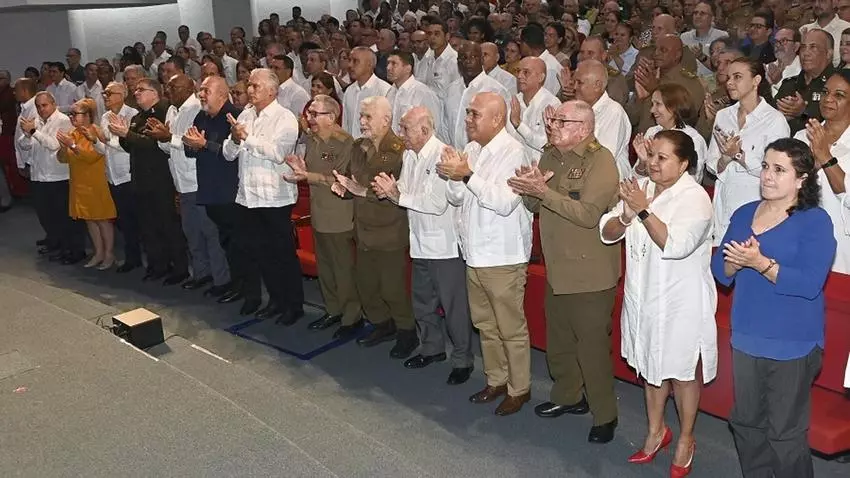
In recent months, Valdés had disappeared from public view. His absence was especially noticeable during the funeral ceremonies for the 32 Cuban military personnel who died in Venezuela on January 3. At those ceremonies, the regime deliberately displayed almost all of its historic leadership. Valdés, however, was absent from the reception of the remains at José Martí International Airport, did not appear in the honor guard at the Ministry of the Revolutionary Armed Forces, and also failed to attend the burial ceremonies and events related to the national tribute.
Nor did he participate in the Council of Ministers meetings held between October and December 2025, according to official broadcasts, in which his seat remained empty. One of his last verifiable public appearances took place on October 3, 2025, during the ceremony commemorating the 60th anniversary of the first Central Committee of the Communist Party of Cuba. A month earlier, he had been seen at the inauguration of a solar park in Sancti Spíritus.
From then on, the silence was almost total. He also missed the December session of the National Assembly, a forum traditionally attended by the historic figures of Castroism. His absence was equally striking on June 5 during the ceremony marking the 65th anniversary of the Ministry of the Interior, the institution he founded and first led.
That void fueled persistent rumors about his health. Some versions spoke of a prolonged hospitalization and severe physical deterioration. As is customary in Cuba, official secrecy replaced public information. Valdés’s death confirms that those absences were not accidental but rather the prelude to an ending managed in silence.
Valdés was born on April 28, 1932, in the Artemisa neighborhood of La Matilde, from which a significant number of the young people who participated in the assault on the Moncada Barracks emerged, despite it being located on the opposite end of the country. His mother had sworn that none of her five children would become a stepping stone for any politician, but she could not prevent the second-youngest son from serving as a rung in elevating Fidel Castro’s figure.
Valdés was, according to multiple consistent testimonies, an enforcer convinced that terror was an effective instrument for maintaining power
Coming from a very poor family, with little education and no established trade, he decided to follow Castro to Moncada, prison, exile, and later the Granma yacht. In the Sierra Maestra he became one of Guevara’s trusted men and ended the war as second-in-command of the invading column led by the Argentine revolutionary.
After 1959, he occupied decisive positions in the architecture of control of the new State. He served twice as Minister of the Interior and, from those posts, directed the apparatus responsible for State Security, intelligence, the police, and the prison system.
Under his authority, practices documented for decades by human rights organizations, former political prisoners, and former regime officials became entrenched: arbitrary detentions, violent interrogations, summary trials, prolonged imprisonment for ideological reasons, and a prison system designed as a tool of intimidation.
Valdés was, according to multiple consistent testimonies, an enforcer convinced that terror was an effective instrument for maintaining power. During his first period at the head of the Ministry of the Interior, the State Security organs that would pursue opponents, dissidents, religious believers, intellectuals, and former revolutionaries opposed to Fidel Castro were organized and structured.
In interviews and public statements given at different points in his life, Valdés defended methods of violent struggle. In testimony collected by pro-government journalists, he boasted of having participated in the placement of explosive devices in public spaces during the insurgent period and presented those actions as heroic and necessary. He never expressed regret. On the contrary, he defended violence as a political and moral principle.
His career was marked by at least two moments when he was removed from power. The first occurred in July 1968, when he was removed from the Ministry of the Interior amid internal adjustments within the security apparatus. After several years away from the political forefront, he returned to important positions during the following decade.
The second documented removal occurred in December 1985, when he was again dismissed as Minister of the Interior without any public explanation. Although he lost positions and was assigned other responsibilities, he never suffered a definitive downfall like other historic leaders subjected to purges.
That ability to survive politically was one of the most notable traits of his career. Valdés was displaced, rehabilitated, and reassigned on several occasions, but he always retained the fundamental trust of the Castro brothers.
In 2009, he returned to the visible core of power as vice president of the Council of State and the Council of Ministers. Later, he remained linked to the telecommunications, energy, and strategic investment sectors. Since the entry into force of the 2019 Constitution, he had served as Deputy Prime Minister.
The legacy of Ramiro Valdés Menéndez is another: that of a leader who decisively contributed to turning repression into State policy and fear into a form of government
On a personal level, Valdés leaves behind descendants whose circumstances illustrate one of the regime’s most persistent contradictions. Several of his children live outside the Island, established in countries where they enjoy civil liberties, mobility, and material conditions denied to most Cubans.
That reality, known and discussed for years in opposition and exile circles, contrasted sharply with the official discourse that Valdés defended until the end. While he was one of the principal architects of migration control, ideological surveillance, and punishment of dissent, part of his family chose to live outside the model he helped impose.
During the Island-wide protests of 11 July 2021 [’11J’], Valdés was involved in one of the most uncomfortable episodes of his long political career when he was booed in Palma Soriano. Amid social tensions and the deployment of repressive forces, his presence in the streets, intended by the government to project control and authority, provoked hostile reactions from citizens.
Far from being welcomed as a historic figure, some demonstrators responded with shouts, insults, and open rejection. The episode, quickly silenced by the official press, was significant not only because it reflected the loss of fear in public spaces, but also because it showed one of the regime’s most feared men confronting, face to face and without intermediaries, the popular discontent that he himself had helped suppress for decades.
Official propaganda will now seek to cement the image of an “exemplary fighter,” a man of “absolute loyalty,” and a “defender of sovereignty.” Outside that epic narrative, the legacy of Ramiro Valdés Menéndez is another: that of a leader who decisively contributed to turning repression into State policy and fear into a form of government.
Translated by Regina Anavy
______________________
COLLABORATE WITH OUR WORK: The 14ymedio team is committed to practicing serious journalism that reflects Cuba’s reality in all its depth. Thank you for joining us on this long journey. We invite you to continue supporting us by becoming a member of 14ymedio now. Together we can continue transforming journalism in Cuba.