Bruno Rodriguez denounces “a total blockade, akin to a military one” while the US “openly calls for the subversion of the constitutional order”
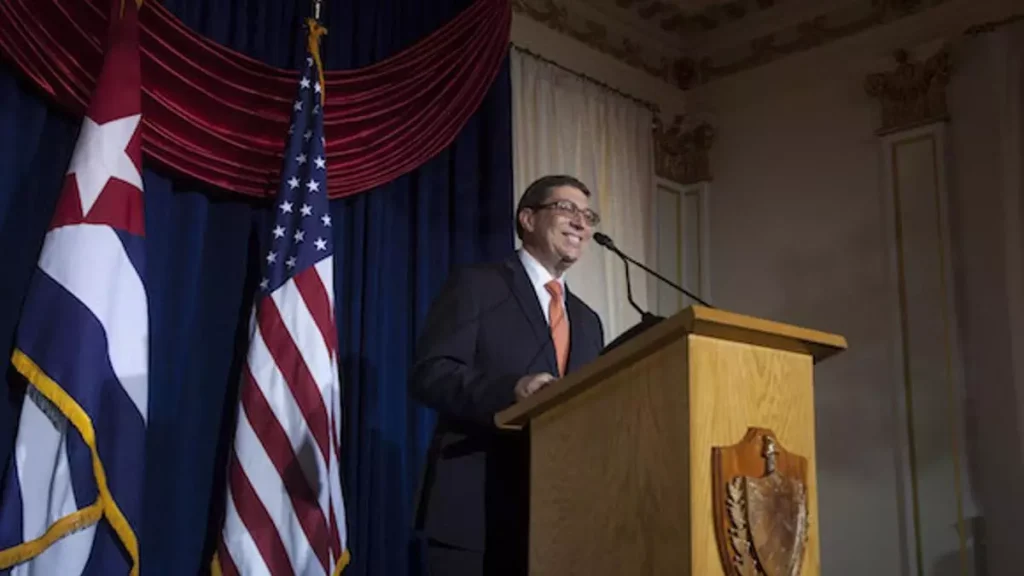
 14ymedio, Havana, June 21, 2026 / The Cuban Government has made Marco Rubio the primary target of its propaganda offensive against Washington. This Saturday, Foreign Minister Bruno Rodriguez again accused the US Secretary of State of lying, concealing the consequences of the sanctions and, above all, of contradicting President Donald Trump.
“When the US Secretary of State speaks of incompetence in Cuba, one would have to ask him why he lies chronically and contradicts the President of the United States and his spokesperson,” Rodriguez wrote on X.
For months, Havana’s propaganda apparatus has been attempting to portray Trump as a leader manipulated by Rubio and by Cuban-American politicians from Florida. According to this narrative, the president would not be the main party responsible for the measures against the Island, but rather the victim of the deceits of a subordinate obsessed with bringing down the Cuban regime.
The official State newspaper Granma went as far as stating, last November, that Trump was “being used, led and steered by his close associate Marco Rubio.” In other articles, the Communist Party newspaper has portrayed the Secretary of State as the operator who “tightens the screws” of US policy and drags the president towards a confrontation that he supposedly does not fully understand.
Even more uncomfortable for the regime is that this external pressure has forced it to dismantle some of the bureaucratic obstacles which Cubans themselves have for decades identified as the “internal blockade.”
Rodriguez himself has now revived that formula by accusing Rubio of denying the existence of “a total fuel blockade” which, according to the foreign minister, the White House does acknowledge. The post casts the Secretary as the architect of a meticulous plan to prevent the arrival of oil, spare parts for thermoelectric plants, tourism investment and technology for mining.
However, the argument contains a contradiction that is difficult to conceal. The main measures that Rodriguez attributes to Rubio’s manoeuvres were not adopted behind Trump’s back, but were signed, endorsed or publicly deployed by the president himself as instruments of pressure against Havana. Even more uncomfortable for the regime is that this external pressure has forced it to dismantle some of the bureaucratic obstacles, prohibitions and restrictions which Cubans themselves have for decades identified as the “internal blockade.”
Havana’s insistence on separating the two officials serves another purpose. It allows the conflict to be presented as the result of the personal obsession of a Cuban-American politician, thus sidestepping any debate about the regime’s own responsibility for the economic deterioration.
Rodriguez lists the hardships caused by the sanctions, but says nothing about the decisions taken over decades by the Cuban authorities. He makes no mention, for example, of the billions spent on building hotels while the thermoelectric plants aged without adequate maintenance, the water system collapsed and the housing stock continued to deteriorate.
The foreign minister also makes no reference to the workings of Gaesa, which controls hotels, banks, ports, hard-currency stores, petrol stations, remittances and a large share of foreign trade.
The emblem of that policy is Havana’s Torre K, the tallest hotel in Cuba, linked to the military conglomerate Gaesa. The 42-storey building with some 600 rooms was erected in the midst of one of the worst economic crises in the Island’s recent history and remains practically empty.
Hotel occupancy had already fallen to 21.5% during the first half of 2025, long before Trump signed, in January 2026, the executive order to intensify pressure on Havana following the capture of Nicolas Maduro in Caracas – the Cuban regime’s principal benefactor. Cuba closed that year with a mere 1.8 million visitors, compared with the 4.7 million recorded in 2018. Despite the collapse in tourism, the State continued to prioritise property and hotel investment over essential sectors such as agriculture, industry, housing and electricity generation.
The foreign minister also makes no reference to the workings of Gaesa, the conglomerate controlled by the Armed Forces that dominates hotels, banks, ports, hard-currency stores, petrol stations, remittances and a large share of foreign trade. Its accounts are not public, it is not subject to citizen oversight, and its real weight in the economy remains hidden even from many state institutions.
Rodriguez also presents Cupet as a company with the infrastructure and capabilities needed to manage fuel supplies. But he offers no explanation of how a supposedly efficient state company allowed the country to reach a state of chronic shortage, with deteriorated refineries and near-total dependence on political benefactors such as Venezuela, Mexico and Russia.
Havana appears to trust that it can pit Trump against his own Secretary of State, convincing the president that Rubio exploits Cuba policy for his own ends.
US sanctions undoubtedly aggravate the crisis and reduce the possibilities of importing oil, obtaining credit or carrying out international transactions. However, that pressure alone does not explain the empty hotels, the lack of transparency at Gaesa, agricultural unproductivity or the decades of neglect of the electricity infrastructure.
By attributing the entire disaster to Rubio, the regime avoids answering the accusation that most unsettles it. The incompetence denounced by Washington does not consist merely in the inability to obtain fuel, but in having built a centralised, monopolistic economy that privileges the business interests of the ruling elite over the needs of citizens.
Havana appears to trust that it can pit Trump against his own Secretary of State, convincing the president that Rubio exploits Cuba policy for his own ends. So far, however, there is no sign whatsoever of a rift between the two. What does exist is a country where food, transport and electricity are in short supply, while the Government keeps its monopolies intact and points towards Washington every time anyone asks where Cuba’s resources have gone.
Translated by GH.
______________________
COLLABORATE WITH OUR WORK: The 14ymedio team is committed to practicing serious journalism that reflects Cuba’s reality in all its depth. Thank you for joining us on this long journey. We invite you to continue supporting us by becoming a member of 14ymedio now. Together we can continue transforming journalism in Cuba.