Laura Tedesco and Rut Diamint warn that democratisation will require dismantling Gaesa’s economic power
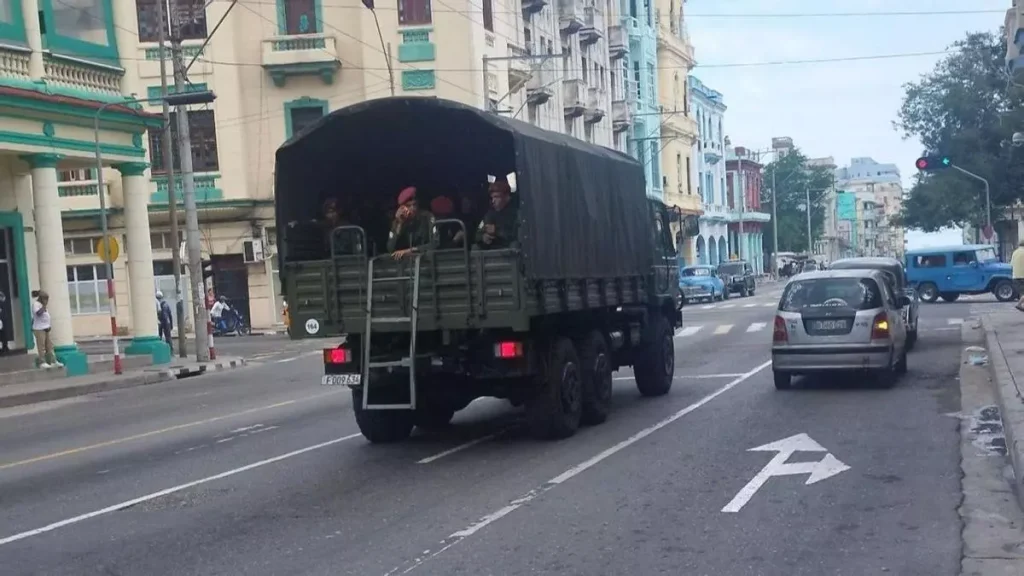
 14ymedio, Yunior García Aguilera, Madrid, 14 June 2026 / Laura Tedesco and Rut Diamint have spent years studying one of the most sensitive issues in any democratic transition: the role of the Armed Forces when an authoritarian regime falls, exhausts itself or transforms. Both Argentine academics – Tedesco is a professor at Saint Louis University in Madrid, and Diamint is a member of the National Council of Scientific and Technical Research in Argentina (Conicet) and a professor at the Torcuato Di Tella University – have researched civil-military relations in Latin America, the limits of military power, the democratic management of defence, and the risks that arise when uniformed personnel retain political, economic or corporate privileges after a change of regime.
Together they have analysed the Cuban case from a perspective rarely seen in public debate: not just what would happen to the Communist Party or to the opposition in a transition, but what role the Revolutionary Armed Forces (FAR), the Ministry of the Interior and the business network formed by the powerful military conglomerate Gaesa – which controls the majority of the national economy – would play.
14ymedio submitted the questionnaire to both experts in writing; they agreed on their answers and replied jointly, except on one question, where they offered their opinions separately.
“Resistance to change does not come so much from the FAR as from other political and economic structures”
García Aguilera. Can there be a real democratic transition in Cuba without explicit negotiation with the military?
Tedesco and Diamint. There can be, although it is very difficult, and the military who enjoy privileges and benefits do not want to lose them. A transition without negotiation will weaken the new government. The first government must be clear that it will have to make concessions in order to achieve governability.
García Aguilera. After studying Latin American transitions and the Cuban case, do you believe the FAR can be part of the democratic solution, or are they, given their current structure, the main obstacle to any real change?
Laura Tedesco and Rut Diamint. They are not the main obstacle, but there is no visible leadership at this moment pointing towards a democratisation of the FAR. It is possible that the FAR will initially defend the new regime and, when existing conditions are no longer favourable, will find ways to adapt, just as happened in other countries in Latin America.
García Aguilera. In a transition, how can one avoid the risks of a military coup, clandestine resistance from the repressive apparatus, a split between factions, or pockets of internal rebellion?
Laura Tedesco and Rut Diamint. Resistance to change does not come so much from the FAR as from other political and economic structures. Just as happened in the countries of the former Soviet Union, they adapted to change, and Cuba has forces accustomed to the party’s command – they have no tradition of staging coups.
In the Cuban case, what is uncertain is how those military personnel connected to the economy through Gaesa will react. Members of the FAR do not enjoy as many privileges as those who are connected to FAR companies.
“Truth, justice and reparation are necessary processes for a democratic transition”
García Aguilera. How can one prevent military commanders from converting their economic power into political impunity during a transition?
Diamint. The military are soldiers of the economic owners. They are not the ones who give the orders, but the economic reforms will be the easiest to implement and the ones that will face the least resistance.
Tedesco. I do not agree with this one hundred per cent. I believe that military hierarchs will negotiate their economic and political role. The military hierarchs connected to companies have a great deal to lose.
García Aguilera. What combination of truth, justice and reparation would be viable to address the victims without falling into the extremes of amnesia or vengeance?
Laura Tedesco and Rut Diamint. Without transitional justice there will be no change, but today there are no leaders visible with sufficient legitimacy to convince society of the futility of revenge.
Truth, justice and reparation are necessary processes for a democratic transition. It must be borne in mind that the dictatorship has been in government for decades. Will it be possible to return the properties confiscated in the 1960s? Probably not. Perhaps only those that have been converted into schools or other public institutions. Those properties that are in private hands should not be expropriated.
García Aguilera. Do you believe that a Ministry of Defence led by civilians should be created from the outset?
Laura Tedesco and Rut Diamint. Yes, with clear mandates defining what will and will not be accepted. And what role the FAR will have in a democracy. With a new name that separates them from the failure of the Revolution.
“We believe that leaders and society do not understand the military problem and the power they represent”
García Aguilera. Costa Rica abolished its army and Panama eliminated its military forces after the fall of Noriega. Are these useful models for Cuba, or historical exceptions that are difficult to replicate? Could part of the FAR structures be transformed into civil protection corps, coastguards, firefighters, forest rangers, natural disaster response units or infrastructure reconstruction teams? Once Castroism is over, would Cuba need an army?
Laura Tedesco and Rut Diamint. In a country so militarised it is difficult to contemplate eliminating them. All armed forces have secondary or subsidiary missions, but these cannot be their primary purpose. Furthermore, Costa Rica had an elite agreement to eliminate the military, and Noriega held a genuine military rank, unlike Raul Castro. Those experiences cannot be transplanted to Cuba – the times, the conditions and the hegemony of the United States are all different.
García Aguilera. What should the democratic opposition, civil society and the exile community be doing right now to prepare for the military problem?
Laura Tedesco and Rut Diamint. We believe that leaders and society do not understand the military problem and the power they represent. The wave of remilitarisation sweeping our region is closely linked to that ignorance among politicians of what the military is and how to use it.
The FAR will not vacate their privileged position of their own accord. A leader with broad legitimacy and well-advised must, in his or her first days in government, send a clear message and execute the necessary measures to begin the path towards civilian control of the Armed Forces.
In the case of the FAR, there must be civilian control of the military and the elimination of the economic role they exercise through Gaesa. The negotiation will be complicated and the FAR will put up every obstacle necessary to maintain their privileged position.
________
This text was produced in collaboration with Cuba Siglo 21 as part of the project “Cuba: stabilise and develop”.
Translated by GH.
______________________
COLLABORATE WITH OUR WORK: The 14ymedio team is committed to practicing serious journalism that reflects Cuba’s reality in all its depth. Thank you for joining us on this long journey. We invite you to continue supporting us by becoming a member of 14ymedio now. Together we can continue transforming journalism in Cuba.