Island Residents Report Sackings, Obstacles to Renting Housing and Social Rejection Following an Altercation in Supermanzana 23
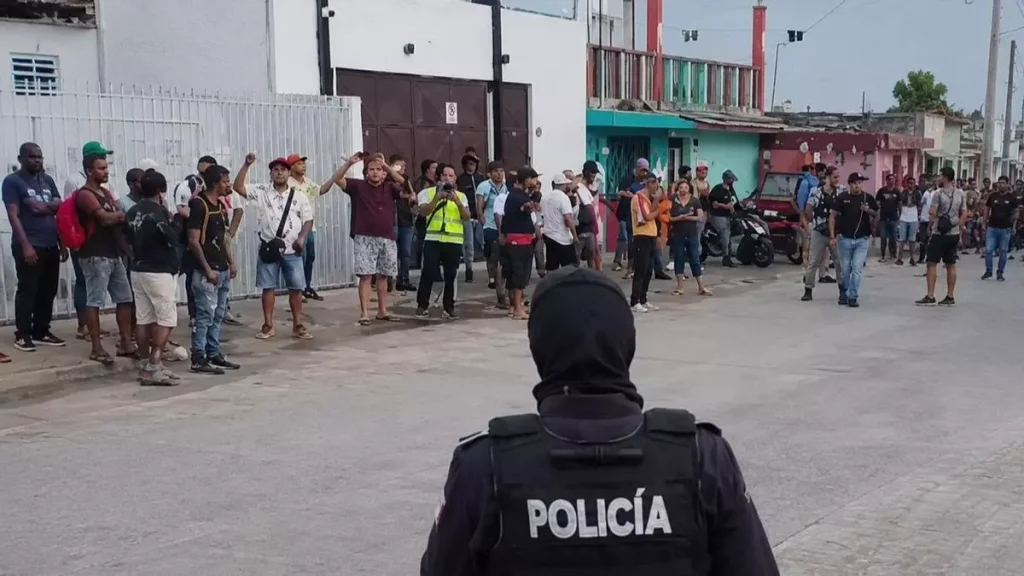
 14ymedio, Havana, 31 May 2026 / Cuban residents in Mexico have called on the Island’s Foreign Ministry and its Consulate in Cancún to issue a public response to the hostile climate that, they claim, has been unleashed against the Cuban community in Quintana Roo following a recent incident in Supermanzana 23 of that tourist city. In a statement circulated on social media, the signatories denounce the fact that the diplomatic mission has remained silent in the face of episodes of discrimination that are no longer confined to the digital sphere but have begun to affect the daily lives of Cuban families who had no involvement in the events.
The text, titled The Need for Active and Impartial Consular Representation, expresses the “profound concern” of Cuban residents at “the lack of an official statement from the Cuban Foreign Ministry” after the case sparked a strong reaction on social media and, according to those making the complaint, gave rise to “real episodes of exclusion and discrimination” in the state of Quintana Roo.
The source of the tension was an altercation in Supermanzana 23 in Cancún, where Cubans Rigoberto “N” and Yudelmis “N” were detained by Mexican authorities and placed at the disposal of the National Migration Institute. The local press reported that the case began with a neighbourhood dispute related to a dog bite and ended with the intervention of security officers, damage to a property and a strong public backlash against those involved. From that point on, outrage directed at two individuals escalated, according to migrant support organisations, into a broader reaction against Cubans living in the area.
The demand is directed squarely at the Cuban General Consulate in Cancún, located in Supermanzana 20, just a few blocks from where the crisis unfolded
“Sadly, we watched with alarm as this online climate spilled over into daily life, affecting our hard-working families who had absolutely no part in these events,” the statement reads. The document cites reports from the civil organisation Cisvac – International Council Uniting Venezuela – which works with migrants and claims to have documented “multiple daily cases” of Cubans who have lost jobs, faced tenancy disputes or suffered direct workplace exclusion following the incident.
The demand is directed squarely at the Cuban General Consulate in Cancún, located in Supermanzana 20, just a few blocks from where the crisis unfolded. For the signatories, that proximity makes the absence of a public position all the more inexplicable. “We find it paradoxical and incomprehensible that our Consulate in Cancún has maintained absolute public silence,” the text states.
The absence of any response, they add, left the community “in a position of clear social and media vulnerability.” The reproach is not confined to the Cancún case. The document links that silence to a broader critique of Cuban consular work in Mexico – a country that has become a transit territory for those heading towards the northern border, or a place of waiting or forced return for thousands of Island migrants deported from the United States.
The residents’ perception is of a diplomacy that is absent when it comes to defending nationals who are not part of associations aligned with the Cuban Government
In recent years, Mexico has been one of the main routes for Cubans attempting to reach the United States, but also a chokepoint for those who fail to cross, are detained or are sent back from American territory. Added to this are those left stranded in southern Mexico, at immigration offices or on the northern border, without documents, without steady work and with no clear way out.
“A considerable number of our compatriots are stranded at various borders within Mexico, facing a severe migration limbo,” the statement warns. The text also refers to Cubans “deported or returned from the United States to Mexican territory,” who are left “in conditions of extreme vulnerability.”
The signatories argue that, given this situation, there should be “vigorous, high-level” consular management with Mexican immigration authorities to guarantee dignified treatment for Cubans in transit or forced return. However, the residents’ perception is the opposite: a diplomacy that is absent when it comes to defending nationals who are not part of associations aligned with the Cuban Government.
“Meetings are frequently organised at the Cuban Embassy in Mexico itself, directed exclusively at resident groups that maintain a direct affinity with the official discourse”
The statement touches on one of the most sensitive points in the relationship between the regime and its diaspora: selective representation. The signatories recall that consular protection consists of “inalienable rights, not political concessions,” enshrined in International Law and the Vienna Convention on Consular Relations. In that regard, they question the fact that the Cuban Embassy in Mexico frequently organises meetings with resident groups aligned with the official line, while ignoring a broader majority that is plural, critical, or simply outside those circles.
“Meetings are frequently organised at the Cuban Embassy in Mexico itself, directed exclusively at resident groups that maintain a direct affinity with the official discourse,” they denounce. That practice, they add, “reinforces an unrealistic rhetoric that attempts to project the idea that all of us abroad support the Government, deliberately rendering invisible the vast majority of our community.”
The text insists that the most vulnerable Cubans are typically not members of those privileged associations. They are, precisely, those facing “migration limbo, border returns or workplace discrimination.” For these people, the signatories say, consular assistance should be exercised “in a strict, impartial manner, free from ideological bias of any kind.”
The statement concludes with three concrete demands: that the Cuban Foreign Ministry issue a public declaration on the situation of vulnerability facing the community in Cancún; that it establish transparent communication channels with civil organisations working with migrants on the ground; and that it assume “an active, inclusive and equitable role of diplomatic management in defence of all its nationals, without political conditions.”
Translated by GH
______________________
COLLABORATE WITH OUR WORK: The 14ymedio team is committed to practicing serious journalism that reflects Cuba’s reality in all its depth. Thank you for joining us on this long journey. We invite you to continue supporting us by becoming a member of 14ymedio now. Together we can continue transforming journalism in Cuba.