During an event organised by Unesco, former Republican-era palaces converted into state offices revealed stained glass, marble, staircases – and sealed-off areas
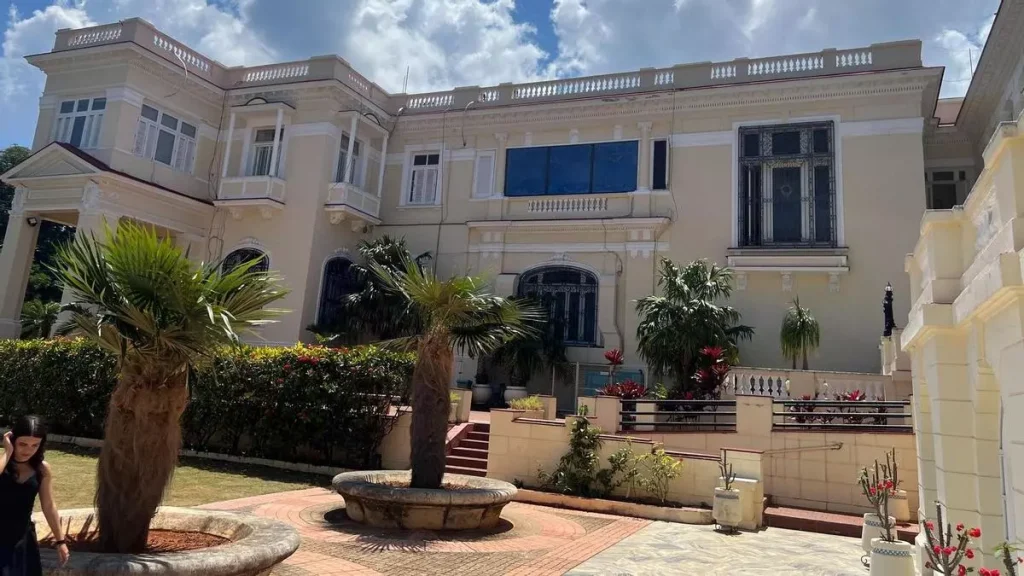
 14ymedio, Havana, Darío Hernández, 31 May 2026 — The first thing they ask of you before entering is not silence, nor respect for the heritage, nor care for the old floors. It is your identity card. At the entrance to each building, an official photographs visitors’ documents, as if a visit to a heritage property were also a bureaucratic formality – or entry to the Embassy of the Past. Only after that gesture, so routine in a Cuba under surveillance and so ill-suited to a cultural outing, does the tour of several Vedado mansions begin, opened to the public for the Open Doors Day organised by Unesco.
There were quite a few people. Families, curious passers-by, students, neighbours who had spent years walking past those facades without ever being able to cross the threshold. Some stared upwards, as if trying to take in all at once the cornices, balconies, columns and black ironwork. Others walked with the discretion of someone entering a stranger’s home – even though that home no longer has a visible owner, only acronyms, custodians, offices and official portraits of Raúl Castro and Miguel Díaz-Canel.
The Mansions of Vedado Open Their Doors, But Not All Their Secrets
In each building, students and professors of Art History were on hand to explain mouldings, stained glass, styles, dates and materials. At times the tour felt like a living lesson in Republican-era architecture; at times, like an excursion through the inventory of a private wealth converted into state heritage. The guides’ voices tried to impose order upon the beauty, but visitors could not help looking also at what was not being explained.
“The hardest thing is the contrast with the rest of Havana, which is falling apart,” murmured a man as he crossed one of the reception rooms. Outside, the city peels, is propped up, collapses, or survives patched together with breeze blocks, corrugated zinc and miracles. Inside, by contrast, there remain chandeliers, sweeping staircases, interior courtyards, gardens and high ceilings – that sense of spaciousness which today seems almost obscene in a capital where so many families live crammed together amid leaking roofs and power cuts.
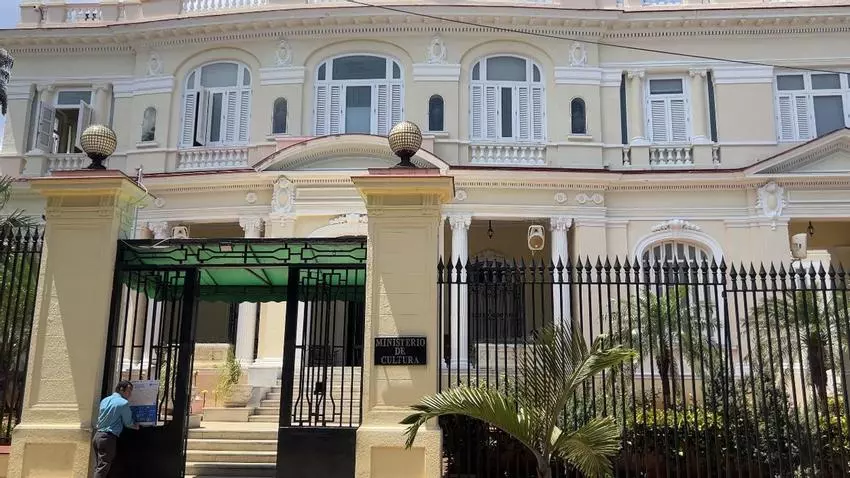
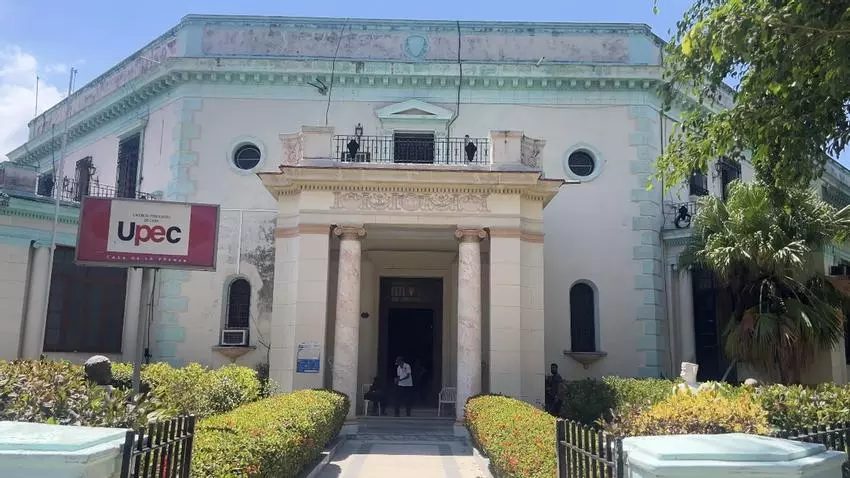
The route included some of the most imposing mansions in Vedado: the headquarters of the Ministry of Culture; the Federation of Cuban Women (FMC), on Paseo and 13th Street; the Casa de la Prensa, headquarters of the Union of Cuban Journalists (Upec), on 23rd and I; and the Fidel Castro Ruz Centre. All share the fact that they were built or inhabited by wealthy families during the Republic – many of Spanish origin or descent from Spaniards – and after 1959 passed into the hands of the new power. Some were expropriated; of others it is said, with the convenient formula of the official narrative, that their owners left the country and “left no heirs.”
At the headquarters of the Ministry of Culture, the former home of Ernesto Sarrá and Loló Larrea commands attention even before one enters. It occupies almost an entire block and still retains the air of a family palace it must have had when the owner of one of Cuba’s largest pharmaceutical fortunes lived there with his wife. From the street, the building promises a novel of money, parties, alliances, servants, china and automobiles pulling through the gateway. Inside, however, the mansion no longer functions as a home. It is a collection of offices from which the culture of the island is administered – and kept under watch.
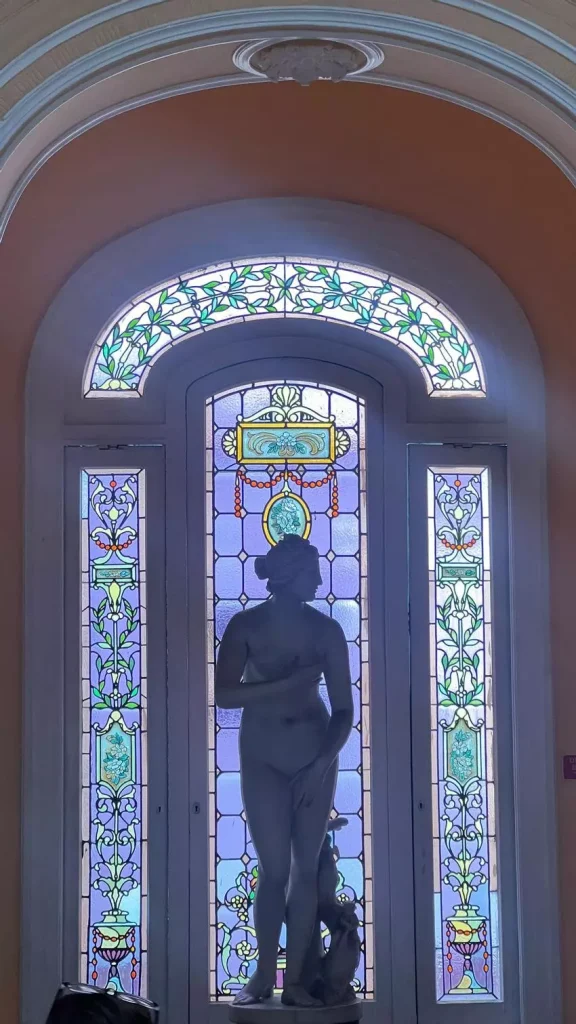
Many areas were closed to the public. Some because they are offices; others because they are “not in a fit state.” This was a constant throughout the tour: half-open doors that could not be passed through, staircases leading nowhere, sealed-off corridors, or areas that the guide mentioned without showing them. Visitors could barely reconstruct, from fragments, the scale of what once was.
At the FMC headquarters, amid stained glass windows, a female sculpture and rooms altered by bureaucratic use, the guide explained ornamental details while visitors raised their eyes to the ceilings, the doors and the columns. “What beauty, and what a waste not to be able to see it in its entirety,” commented a woman as she left one of the rooms. The remark hung in the air with an unintentional precision. The heritage is shown, but with caution; conservation is spoken of, but the history of ownership is barely touched upon.
The Casa de la Prensa, headquarters of Upec, preserves an uncomfortable memory for official journalism. The building on 23rd and I is associated with the García Osuna family, connected to Republican-era politics. From 1963, the organisation that brings together pro-government journalists was installed there. In its salons, where private life, receptions and family conversations once took place, propaganda subordinated to the single Party is now produced. The architecture, with its ornate iron grilles and its old-world elegance, seems to retain more freedom than the institution that occupies it.
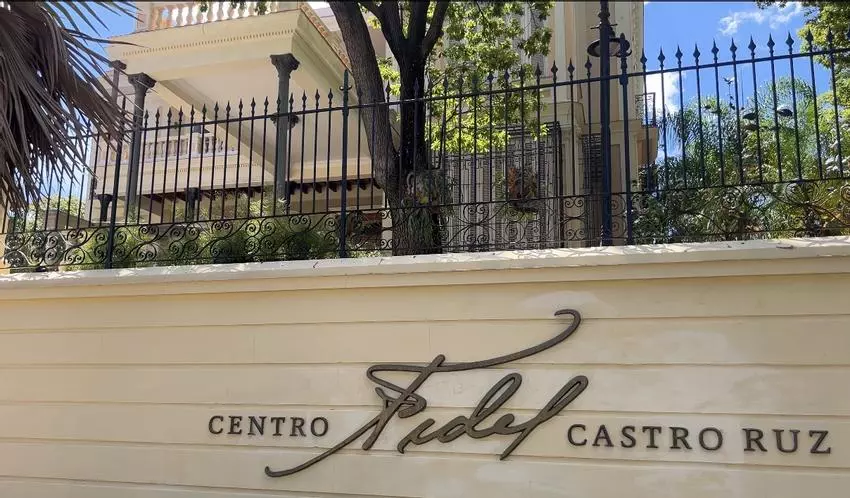
The starkest contrast appears at the Fidel Castro Ruz Centre. The former mansion of the Conill family, with its restored grandeur, its well-kept gardens and its museum-style displays, has become a civic temple to the leader who governed the country in which properties such as this one were confiscated, seized or absorbed by the State. Official sources acknowledge that the house belonged to the Hidalgo de Conill family and that Enrique Conill Rafecas was a captain in the Liberation Army. They also admit that, after 1959, the family left the country and the property was put to uses connected with the Ministry of the Interior.
Here the paradox achieves an almost theatrical clarity. A Republican-era palace, born of private wealth, converted into a shrine of the Revolution. A building that must once have held family albums, china, bedrooms, parties and inheritances, now transformed into the stage set of a single, carefully illuminated memory. “You spend your whole life walking past this place and you have no idea what’s inside,” said a visitor standing before the mansion in which Fidel Castro’s Mercedes-Benz is displayed as if it were a relic.
That detail alone would be enough for a different tour – less ornamental and more honest: one that passes not only through the columns, the stained glass and the ironwork, but through property records, nationalisations, exiles, emptied houses and the official versions that explain too much with too little. Who exactly were the owners? What became of them? What documents prove the transfer of ownership? Was there confiscation, abandonment, donation, seizure, litigation? Where are those archives? On the visit, that part appeared only as a footnote, as if the social history of the mansions were less important than the marble.
The public, however, did not seem indifferent. Many entered in amazement; others, with a mixture of curiosity and suspicion. They walked slowly, photographed stained glass, discreetly touched a banister, lingered before a staircase, looked up at the ceilings as if discovering a hidden city above the visible one. For decades, a large part of the Republican residential heritage has remained behind railings, custodians, ministries, mass organisations, embassies and state offices.
The Unesco open day has value because it allows one to look. And in Cuba, looking inward is already something. But looking is not enough. A country that prides itself on its heritage should also account for how that heritage came into state hands, who built it, who lived in it, who lost it and through what mechanisms. Without that information, the tour remains an incomplete postcard of a Havana that is beautiful, deteriorating and under surveillance – where the visitor hands over their identity card before entering and leaves with more questions than answers.
Translated by GH.
______________________
COLLABORATE WITH OUR WORK: The 14ymedio team is committed to practicing serious journalism that reflects Cuba’s reality in all its depth. Thank you for joining us on this long journey. We invite you to continue supporting us by becoming a member of 14ymedio now. Together we can continue transforming journalism in Cuba.