What remains for the regime is to renounce the hegemonic role of the only permitted party and attempt a real opening, even if it appears to be a fraudulent change
 14ymedio, Havana, Reinaldo Escobar, May 28, 2026 — Three actors are currently leading the Cuban drama: the dictatorship in power, the population, and external factors.
Although the regime wants to give the impression that it is a monolithic structure, it is enough to cite its different names, or perhaps masks, to perceive the subtle differences: the Party, the military, the family clan, the State, Parliament, the State Security organs. Suspicion falls on each of them as to who is truly governing the country.
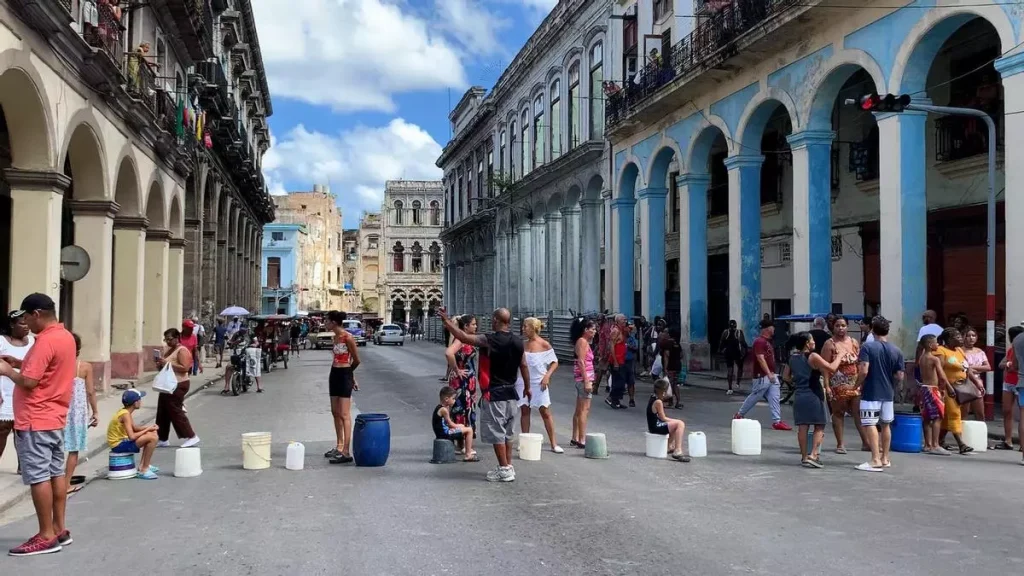
Where it says “the population,” one could say “the citizens,” but that designation should be reserved for those human groups whose members are empowered to challenge authority, organize according to their preferences, and periodically go to the polls to reward or punish politicians. One could also say “the people,” but that is the subject that storms government palaces. For now, we are reduced to being merely the inhabitants of this Island. Here, no one asks how the unions will react or what the students will do.
Where it says “the population,” one could say “the citizens,” but that designation should be reserved for those human groups whose members are empowered to challenge authority
Only intuitively, and with an enormous effort to strip away one’s beliefs, can one define the sectors of the population to place supporters of the process on one side and the dissatisfied on the other.
A more detailed study would divide the supporters into different strata: the Marxist-Leninists convinced that socialism is the correct path; those who for some reason feel benefited; the perennial opportunists; and those who, out of inertia, obey and march wherever they are ordered.
The dissatisfied camp is equally varied: the anti-communists convinced that socialism as a doctrine ruins nations; those harmed by some law or measure taken over the last 67 years; and those suffering the immediate consequences (scarcity, blackouts, disconnection) but who still do not have the “political consciousness” to participate in a clearly opposition-oriented initiative, where an undeniable minority is active.
External factors are also divided into two camps: on one side, the Government of the United States exercising its enormous economic, diplomatic, and military power to demand the dictatorship’s capitulation. It is timidly accompanied by some democratic countries in Latin America and by the indecisiveness of the European Union, where the belief still prevails that signed agreements and accords can open a path toward democratization.
On the other side, with a less explicit commitment, are Russia, China, and Iran, with their declarations of unrestricted support for the Havana regime, and among neighboring countries, the supportive hand of Mexico, Colombia, and Brazil, joined by a breeding ground of organizations dressed in progressive rhetoric mainly dedicated to confronting, often violently, demonstrations by Cuban exiles abroad. From this chapter of external factors come shipments of food and medicine, cash donations, solar energy installations, and above all applause. They are the deniers of the need for political change. Some for strategic needs, others because they do not want to realize how illusory their illusion about Cuba is.
From the northern neighbor, which struggles with the limits of how far its interference should go, political common sense and trust in the population are expected — a population tired of its condition as mere inhabitants and eager to become citizens peacefully
From this parallelogram of forces, where each side pulls and pushes in different directions, a result must eventually emerge.
The most dynamic parts of the contradiction are, in my view, the governments of Cuba and the United States, despite the fact that the fundamental contradiction lies between the population and the dictatorship.
What remains for the regime is to renounce the hegemonic role of the only permitted party and attempt a real opening, even if it appears to be a fraudulent change.
From the northern neighbor, which struggles with the limits of how far its interference should go, political common sense and trust in the population are expected — a population tired of its condition as mere inhabitants and eager to become citizens peacefully, but on the verge of reacting angrily as a people.
Translated by Regina Anavy
______________________
COLLABORATE WITH OUR WORK: The 14ymedio team is committed to practicing serious journalism that reflects Cuba’s reality in all its depth. Thank you for joining us on this long journey. We invite you to continue supporting us by becoming a member of 14ymedio now. Together we can continue transforming journalism in Cuba.