A childhood friend assures me that this is like when the eye of the cyclone passes over us and it seems that calm has finally arrived.
 14ymedio, Yoani Sánchez, Havana, April22, 2026 — I haven’t heard Caruso in days. The neighborhood rooster has stopped singing in the middle of the night, its discordant crowing starting long before sunrise. Did it finally end up in a cooking pot? I peer over the edge of the rooftop and see little lights here and there. Not a single blackout in all of Havana that I can see. That worries me more than the fate of the cheeky rooster on the block. What will come after so much electricity? I wonder.
They say that those who have lived through a war can suffer from what is known as “combat fatigue.” the physical and mental exhaustion, the disorientation, and the anxiety make up the trauma of a soldier who has experienced battle. But here nothing has ended; this is merely a brief respite. A childhood friend assures me that this is like when the eye of a hurricane passes us overhead and it seems that calm has arrived. People become complacent and leave their homes, but soon after the eye of the hurricane the worst winds and the most extreme tornadoes arrive.
It’s not like we’ve had time to let our guard down, because now we have electricity, but we still lack water. In Cuba, you always have to keep one foot in the trenches of precariousness. Last night I had to stay awake listening for the sound of the pipes. “Can you hear anything?” my husband asked me at three in the morning. I got up, checked, and pressed my ear to the thick pipe that runs from the enormous water tank above our heads. “Nothing yet.” I tried to sleep, but every time I closed my eyes, I heard a gurgling stream that woke me up.
I tried to sleep, but every time I closed my eyes I heard a gurgling stream that woke me up
My friend Abel, who works for a state agency, has assured me that this time he won’t be attending yet another petition drive to “defend the homeland.” He was just a teenager during that “constitutional mummification” of 2002 that made socialism an irrevocable option in this country. Forever and ever, Cubans are supposed to bear the burden of those pressures and those masks. Every dictatorship yearns for perpetuity, and Castroism believes that by scribbling on paper it will buy itself a “until forever.”
In my friend’s building, many of those who signed in favor of the regime that day have already left the country. One neighbor, particularly furious, who criticized others for not arriving early to sign the makeshift book—which lacked both the status of a ballot and the official letterhead required for a referendum—is now a businessman in Florida and complains that we on the island aren’t brave enough to shake off a dictatorship.
But courage, like the opportunistic stampede, also begins one day. Last week, my friend’s daughter broke her leg. The ordeal the family went through, the number of “millas” (thousand-Cuban-peso bills) they had to spend along the way so the girl could receive decent care and the necessary painkillers, made Abel say, “That’s it.” Now he’s “staring with a dead man in his eyes,” as the old folks begging in the streets say, recalling proverbs we’ve already forgotten. In other words, my friend doesn’t care about anything; a tribute or a rally of repudiation.
Nobody asks me if I’m going to go sign. Nobody asks the lunatics, babies, and worms to stamp our names on anything
At his workplace, they’ve called for people to sign a petition at a solemn event supposedly meant to defend the nation, but it’s really just validating the single-party system, the family clan that controls us with an outdated ideology that stifles the potential of millions of Cubans. Abel insists he won’t go. But I fear that the pressure and his plan to emigrate will make him give in. The thought of being “regulated,” like so many activists and independent journalists prevented from leaving the country, could break him.
No one asks me if I’m going to go sign. Nobody asks the lunatics, babies, and worms to stamp their names on anything. My absence probably won’t even be counted, because on this island, voter and signatory lists tend to be adjusted to reflect attendance while abstentions are concealed. In my building, too, many who signed that constitutional mummification have left the country . Many of those who voted for the current Constitution no longer live in Cuba either.
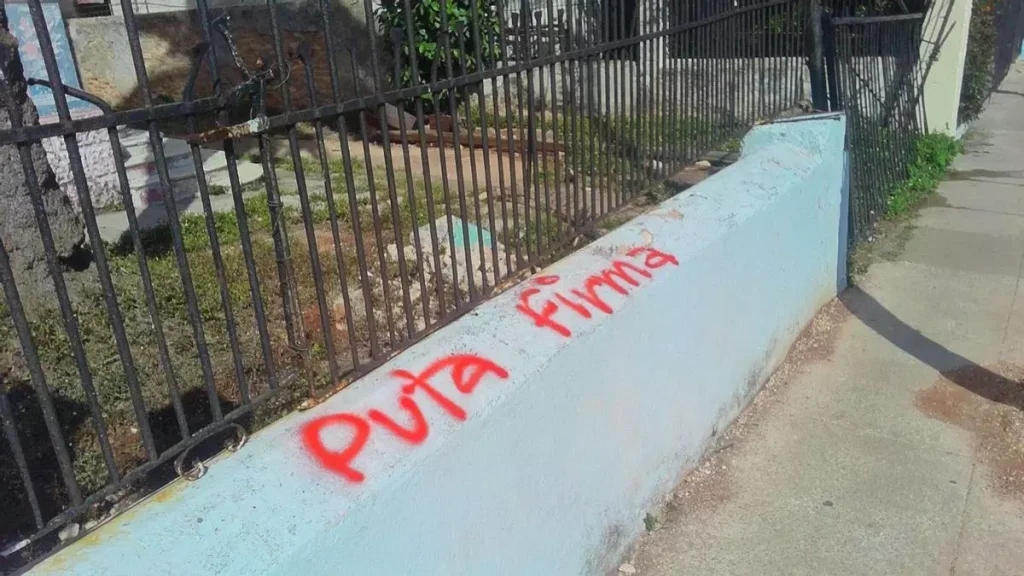
We gusanos, the worms, are sometimes stubborn and stay put. A graffiti on a wall in El Vedado sums up this whole story. On G Street, between 13th and Línea, someone has scrawled two words these days that say it all: “Puta firma.” What does it matter who goes and who doesn’t to leave their mark on those lists? What relevance does it have that there’s electricity now if in a few days the darkness will swallow us again? Is there anything more important than the sound of water when all the pipes are dry?
========
Previous Havana Chronicles:
Dollars, the Classic Card, and a Havana Without Tourists
A Journey Through the Lost Names of Havana
The Shipwreck of a Ship Called “Cuba”
Havana Seen From ‘The Control Tower’
In Havana, the Only Ones Who Move Are the Mosquitoes
Reina, the Stately Street Where Garbage is Sold
Searching for Light Through the Deserted Streets of Havana
The Death Throes of ‘Granma’, the Mouthpiece of a Regime Cornered by Crisis
The Anxiety of the Disconnected Cuban
One Mella, Three Mellas, Life in Cuba Is Measured in Thousands of Pesos
It Is Forbidden To Leave Home in Cuba Today Because It Is a “Counter-Revolutionary Day”
Vedado, the Heart of Havana’s Nightlife, Is Now Converted Into a Desert
COLLABORATE WITH OUR WORK: The 14ymedio team is committed to practicing serious journalism that reflects Cuba’s reality in all its depth. Thank you for joining us on this long journey. We invite you to continue supporting us by becoming a member of 14ymedio now. Together we can continue transforming journalism in Cuba.