The blackouts have wiped out the cinemas and the Coppelia ice cream parlor in El Vedado; life is now in the kiosks where it is advertised: “Here we have everything”
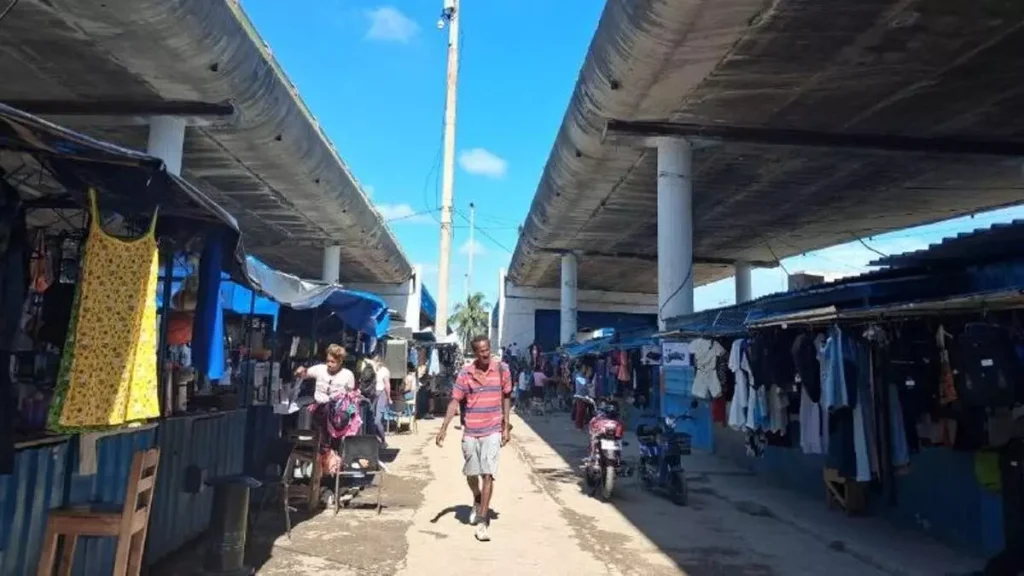
 14ymedio, Yoani Sánchez, Havana, 12 April 2026 — This time the route heads south. I need to get to the market that sprawls under the overpasses at 100th and Boyeros in Havana. My eternal quest for a part to fix leaky faucets leads me to one of the city’s main open-air markets. “We have everything here,” reads a sign I find at a kiosk at the entrance to the candonga [black market], where you can buy anything from antibiotics to soldering iron.
There is no internet connection anywhere along the route to the fair, and in some sections, you can’t even get a cell phone signal to make calls. We Cubans have come to accept that chatting with friends, watching reels, or posting on Facebook is becoming a thing of the past. It’s a shame that X no longer has the option to post via text messages (SMS) like was possible on the old Twitter. We have lost even our smoke signals.

Disconnected but walking briskly, I approach the overpasses. While along the entire route I had barely encountered half a dozen people, the scene changes as I near the market. At 100th and Boyeros, there are more people than at 23rd and L, the iconic corner of La Rampa in Vedado. The crowds that no longer surround the cinemas, clubs, or the Coppelia ice cream parlor seem to have concentrated around the stalls selling instant glue, clothing, and tools.
Even companionship is for sale. Stationed at certain points in the market are women and men in tight clothing with flirtatious glances. Here, rice cookers and caresses are traded; dishwashing liquids and sex. None of those prostituting themselves are over 30. This generation wasn’t even given an attempt to mold them into the “new man”, rather, they were left adrift in classrooms where television replaced teachers. They were the ones who fueled the majority of the Island-wide protests on 11 July 2021, and also the ones who were most frequently imprisoned after those demonstrations.
I slip between the kiosks. Above me, the bridges that once roared with the passing trucks and buses are now almost silent. Life is happening below. Tamales, soft drinks, motorcycle helmets, trash cans, plastic trinkets, and the cries of “we buy gold” or “we buy dollars” echo everywhere. There are narrow passageways, lined with stalls made of zinc sheets and others, more sophisticated, built of brick. In a moment, I’m lost in this labyrinth.

I finally find the sink drain piping I need and decide to look for other parts. To avoid confusion, in a market where there are people from all over Cuba, I approach a vendor and ask him point-blank, “Do you have a sink-faucet-with-handles-for-hand-washing?” The mix of regional names and the many ways of referring to the same object across the island make me want to emphasize what I mean. The man bursts out laughing at my excessive specificity. “I’m all out, but I’ll get more tomorrow,” he replies.
I start heading back. On the way, I pass the Boyeros and Camagüey market, where food and basic goods are sold in dollars. Inside, the air smells of spoiled meat, probably thawed by the long power outages. The refrigerators are practically empty, and an employee asks me to run a calculation on my phone’s calculator because they’re not allowed to bring cell phones into the store where they work.
The cell phone we carry in our pockets is becoming increasingly useless. Workers at the hard-currency stores aren’t allowed to bring them inside, and when I continue on my way home, mine barely works. Near the Sports City, nostalgia hits me. On the same grounds where The Rolling Stones played live ten years ago, grass now grows, and a couple of stray dogs stare at me with eyes pleading for food. Only a few electric tricycles pass by on the avenue, and very occasionally, an almendrón — a classic American car.
I’m already crossing Cerro Avenue. From a nearby doorway, a man offers me “all kinds of medications.” While state-run pharmacies are practically empty, Havana’s streets have become a very well-stocked pharmacy. What customers are offering and seeking most are antidepressants, anti-anxiety medications, and mood stabilizers. It seems that three out of every five people walking the streets are under the influence of some drug.

It’s hard to believe that a regime that tries to control every aspect of life doesn’t know that in Havana it’s easier to get sertraline* [Zoloft] than pork, diazepam* than coffee, amitriptyline* than eggs. A friend says it’s “state policy” to keep people drowsy and sedated. Some people spend part of their salary on a good supply of pills that will transport them to another place where the garbage on the corner doesn’t pile up so much, prices don’t rise every day, and their children aren’t packing their bags to emigrate.
I turn left at Tulipán. I spot my building with its enormous water tank. I reach for my cell phone to call home. Three tries and nothing. Each time, the voice says, “The number you are calling is switched off or out of coverage,” but I have to keep trying. “We are having a blackout,” the voice on the other end finally tells me when I get through. Isn’t there some kind of pill that makes me grow wings so I can get to the 14th floor without climbing the stairs? I fantasize and start humming that song that goes, “cause I try, and I try, and I try, and I try.”
*Translator’s ntoe: All these drugs are anti-depressants
______________________
COLLABORATE WITH OUR WORK: The 14ymedio team is committed to practicing serious journalism that reflects Cuba’s reality in all its depth. Thank you for joining us on this long journey. We invite you to continue supporting us by becoming a member of 14ymedio now. Together we can continue transforming journalism in Cuba.