The ruling brings to an end two appeals in a case that combined economic crimes, leaks involving Venezuela, and espionage.
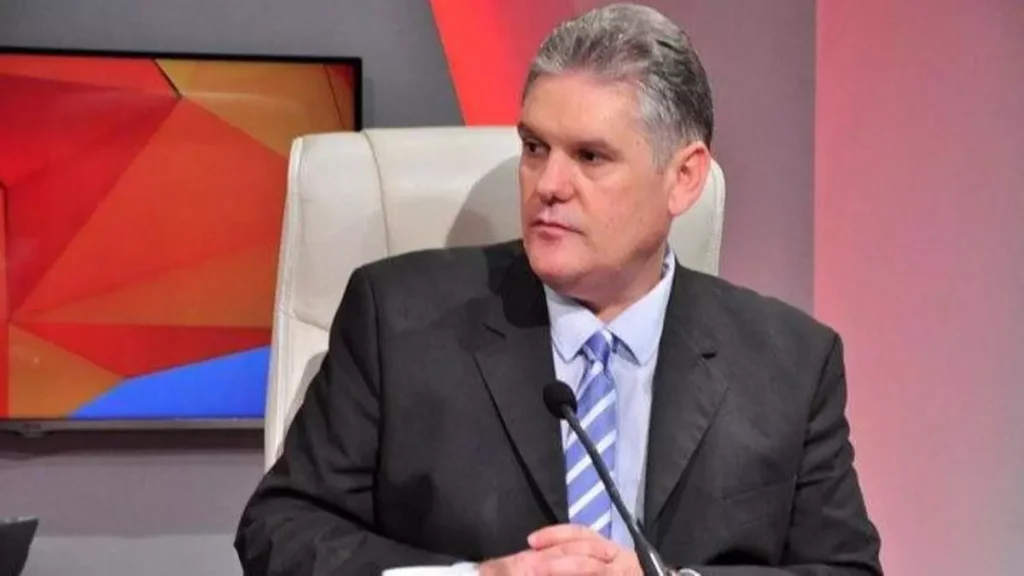
 14ymedio, Havana January 24, 2026 – The Supreme People’s Court (TSP) ruled this Friday to uphold the two guilty verdicts against Alejandro Gil Fernández, former vice prime minister and former Minister of the Economy of Cuba, including life imprisonment for espionage. The decision, confirmed to 14ymedio by sources close to the case, definitively closed the avenue of appeal filed by the defense in both the espionage case and the case file grouping a dozen crimes linked to corruption.
According to the court’s notification to the parties, the appeals lodged against the sentences handed down after the trial held last November, in a double hearing, were not admitted. On December 8, the TSP itself had announced the verdicts: life imprisonment for espionage and 20 years in prison for crimes such as embezzlement, bribery, tax evasion, and money laundering.
Gil was removed from his posts in February 2024 and, barely a month later, authorities announced his arrest and the opening of a judicial investigation for “serious errors.” In November, the Office of the Attorney General of the Republic formally charged him with eleven crimes, although it was the charge of espionage that marked a qualitative turning point in the case and elevated it to the level of “treason to the homeland.”
In an official statement, the TSP said that the former minister “deceived the leadership of the country and the people he represented, thereby causing damage to the economy,” and that he violated protocols for handling classified information, removed it, and made it “available to the enemy’s services.” For the judges, these acts justified a “severe criminal response,” as they constituted “the most serious of crimes.”
The case takes on a greater political dimension because of the mention of Venezuela in the indictment
Gil’s downfall has no recent precedent. A close figure to President Miguel Díaz-Canel and a member of the Political Bureau of the Communist Party of Cuba, until recently he was one of the most visible faces of the cabinet. His tenure was associated with the implementation of the Tarea Ordenamiento [Ordering Task], the 2021 monetary reform that eliminated the dual currency and ended up causing a sharp devaluation of the peso, runaway inflation, and the current de facto dollarization of the economy. He was also responsible for opening—within limits—space for small private businesses and for applying unpopular adjustment measures, such as raising fuel prices by up to 400%.
However, beyond the official narrative, the case takes on a greater political dimension because of the mention of Venezuela in the indictment. Information leaked to which this outlet had access reveals that the prosecution argued Gil had spied for U.S. intelligence services, delivering sensitive information that directly affected the strategic relationship between Havana and Caracas.
The report, signed by Edward Roberts Campbell, chief prosecutor of the Directorate for Combating Corruption and Illegalities, states that the former minister allegedly provided classified data to “an unidentified agent, but presumably belonging to the CIA,” thereby compromising “Venezuelan national security.” The leaked information reportedly included bilateral economic transactions, oil agreements, financial triangulation schemes, the deployment of Cuban medical brigades, and even details of Cuban support in cybersecurity and counterintelligence to Nicolás Maduro’s regime.
The indictment goes even further, including alleged personal data on Maduro himself, his family, his residence, assets inside and outside Venezuela including in Cuba, and details of the security ring made up of Cuban military personnel from the Ministry of the Interior and the Revolutionary Armed Forces. All of this was presented as an operation intended to “undermine Venezuelan sovereignty and overthrow its legitimate president.”
The emphasis on Venezuela and on an alleged “internal traitor” aligns with the narrative of confrontation with Washington
Nevertheless, the very development of the case leaves gaps that are difficult to ignore. According to testimony consulted by 14ymedio, in August 2022 it was planned that Díaz-Canel himself would meet with Maduro, but State Security recommended that Gil go instead, due to the “high level of trust” placed in him. The meeting took place at the Miraflores Palace and was widely publicized by the official press of both countries.
The subsequent chronology is even more contradictory. If, as official programs maintain, Gil had been under investigation since at least 2020, it is hard to explain why in 2022 and 2023 he was authorized to travel at the highest level, accompanying Díaz-Canel on a tour of China, Algeria, Russia, and Turkey, and being designated Cuba’s sole representative to the United Nations General Assembly in New York.
A source with access to the prosecution’s case admits that they do not know whether the allegations related to Venezuela were proven with conclusive evidence during the trial. “I cannot say that it was demonstrated that Gil delivered sensitive information to the CIA, nor that those facts supported the life sentence,” the source notes.
The international context adds another layer of interpretation. The emphasis on Venezuela and on an alleged “internal traitor” coincides with the narrative of confrontation with Washington under the administration of Donald Trump, which has opted to tighten pressure on the allies of Caracas and Havana.
Thus, the trial of Alejandro Gil not only seals the downfall of the most powerful official purged in at least 15 years, but also exposes the internal tensions of a system that, in the face of economic collapse and international isolation, appears to need visible culprits. If Gil was a spy, he was one with inexplicable freedom; and if he was not, his sentence illustrates how far power can go when it decides to protect those who operate at the highest levels.
Translated by Regina Anavy
____________
COLLABORATE WITH OUR WORK: The 14ymedio team is committed to practicing serious journalism that reflects Cuba’s reality in all its depth. Thank you for joining us on this long journey. We invite you to continue supporting us by becoming a member of 14ymedio now. Together we can continue transforming journalism in Cuba.