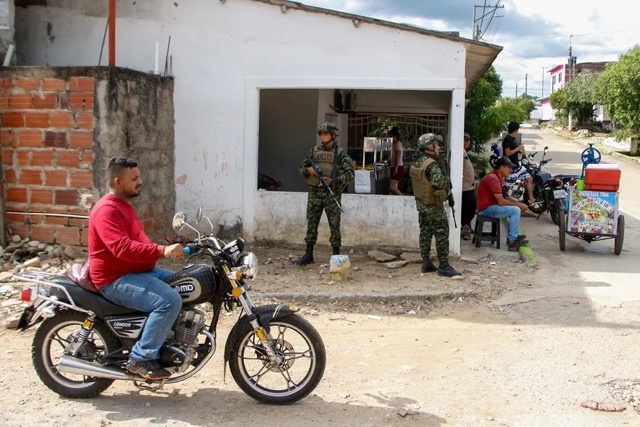
 14ymedio, Madrid, 27 January 2025 — There are 60 to 80 dead and about 50,000 displaced in 11 days, after clashes in the Catatumbo between the National Liberation Army (ELN) and the 33rd Front of the dissidents of the Revolutionary Forces of Colombia (FARC), according to estimates of the Ombudsman’s Office and the Government of Norte de Santander. However, the situation in that territory is such that the authorities have only been able to collect the bodies of 41 victims, since they cannot access certain areas.
As a report published a few days ago by Bloomberg explains, the Catatumbo mountains “are so dangerous that the police and the army do not usually go far away from their barracks for fear of snipers.” The reason for this peak of violence, the most intense of the last decade, lies in the offensive launched by the ELN against its rival group to take control of the cocaine business, from which both are financed. In the border area, not only does smuggling to Venezuela take place, but there are also laboratories and clandestine airstrips.
The ELN are proponents of Marxist ideology who emerged in the 1960s with open sponsorship by the Cuban regime, which provided them with training and weapons for decades, before recently becoming a “guarantor” of the peace negotiations, currently suspended. In recent days, the ELN has been spreading terror by going door to door “with death lists of local peasants suspected of supporting their enemies,” according to Bloomberg.
Among the fatalities are six former FARC guerrillas who signed the peace agreement with the Government
Among the fatalities are six former FARC guerrillas who signed the peace agreement with the Government. In addition, 12 other former FARC members are missing, accused by the ELN of belonging to the 33rd Front, a dissident FARC faction that has not laid down its arms and is fighting for control of the coca crops and drug trafficking routes.
In a statement issued on Monday, the ELN assures that it has not carried out actions against the civilian population or people just for “being signatories of peace,” but that it has attacked those who are armed and are “active under a military command in plans against the ELN and the communities of Catatumbo.”
It also said that “we will never accept either submission or surrender as a policy of peace.” Colombian President Gustavo Petro suspended peace talks due to the violence unleashed by the ELN after January 16 and decreed, on Friday, a state of internal disturbance. This will last 90 days and will extend to 16 municipalities in the department of Norte de Santander, including the 11 of Catatumbo affected by the violence. The decree includes Cúcuta, the departmental capital, and two municipalities in the department of Cesar, which is receiving displaced people.
The Government considers that “there is an extraordinary disturbance of public order in the Catatumbo region, resulting from armed confrontations, threats, massive forced displacements, effects on the exercise of the fundamental rights of the civilian population, alteration of security and damage to protected property and the environment.”
Petro’s claim to achieve “total peace” through dialogue seems to be an illusion
In this context, Petro’s claim to achieve “total peace” through dialogue seems to be an illusion Moreover, it could favor the conservative candidates for the Presidency and Congress in 2026, according to what analyst Sergio Guzmán told Bloomberg. “The worsening of security throughout the country and the extension of criminal gangs to areas that were previously peaceful have made many Colombians impatient with attempts to negotiate with groups that extort, kidnap and traffic cocaine,” the agency said.
According to UN data, the potential production of pure cocaine in Colombia rose by 53% between 2022 and 2023, and the hectares of coca leaf planted in its territory reached the historic record of 253,000. Ceasing to fumigate crops – the Colombian government considered drug trafficking a source of financing for guerrilla groups – was, in 2016, one of the conditions of the FARC to sit down to negotiate with the Government, under the argument – supported by the World Health Organization – that fumigation harmed legal farmers and caused serious health problems to the poorest population.
One of the consequences of the peace agreement was the overproduction of cocaine that has flooded the market ever since, and control of the trade is still disputed by guerrilla groups that have not laid down their arms.
The Colombian Prosecutor’s Office reactivated, last week, the arrest warrants for 31 members of the ELN, including the members of its leadership, alias Antonio García, Pablo Beltrán and Aureliano Carbonell, who had been peace negotiators. Guerrilla leaders have been traveling for years between Venezuela and Cuba, the country that hosted those dialogues between 2018 and 2019, the year in which they were frozen.
The potential production of pure cocaine in Colombia rose by 53% between 2022 and 2023
The relationship between Havana and the leadership of the ELN is, in fact, at the origin of the inclusion of Cuba on the US list of countries sponsoring terrorism in 2021, during the first Trump Administration. It was at the request of Colombia, because Cuba refused to extradite members of the group who were on the Island. The talks had stalled after a guerrilla attack against the Police School in Bogotá in January 2019, where 23 people died and 100 were injured.
None of this – neither the causes of the bloodbath in the Catatumbo nor the role of the regime in the negotiations with the guerrillas – has been echoed by the official Cuban press, which has limited itself to giving news of the displaced people and extolling the “solidarity of Venezuela with Colombia.”
For his part, Petro was confident on Monday that his government can consolidate control on the border with Venezuela. “Today there will be a meeting of the entire cabinet in the area to issue the decrees of internal disturbance that will give life to the social pact in the Catatumbo and the financing of the military operation to consolidate State control at the border,” he said on X.
The Colombian president will hold his usual weekly council of ministers meeting in the municipality of Ocaña, which, like the Catatumbo, is located in the department of Norte de Santander and is one of the main recipients of the more than 48,000 displaced people left by guerrilla violence. Specifically, 9,272, according to figures from the Ministry of Defense. The rest of the displaced went to Cúcuta (21,300) and Tibú (13,313).
Translated by Regina Anavy
____________
COLLABORATE WITH OUR WORK: The 14ymedio team is committed to practicing serious journalism that reflects Cuba’s reality in all its depth. Thank you for joining us on this long journey. We invite you to continue supporting us by becoming a member of 14ymedio now. Together we can continue transforming journalism in Cuba.