Havana’s Airport Dogs, A Sad Sequel to a Nation That Flees and Leaves Them Behind

“She was dumped here, some people who came to pick up their family left her,” recall the workers at the airport. 

A dog at a gate at Havana’s José Martí International Airport / 14ymedio

14ymedio bigger14ymedio, Natalia López Moya, Havana, 1 August 2024 — Lying next to the entrance to Havana’s José Martí International Airport, a dog waits for the owners who left with the mass exodus. “He’s been here for a while, ever since he arrived in a car with his family, they went in, traveled and left him,” says a cleaning employee at Terminal 3, from where most of the flights depart to Nicaragua, the gateway to Central America for many Cuban migrants.

Some workers bring him food and have given the dog a name. “Come here, Canelo,” says one who brings him leftovers from her lunch. “Pinto, have some water,” a taxi driver from the nearby taxi stand hands him a disposable cup. They all know something that the animal doesn’t: that his owners won’t return and if they do, it’s unlikely that they’ll go looking for him at that door where he waits day and night. Some protectors have tried to get him out of the place and find him a home, but the mixed breed, perhaps four or five years old, doesn’t intend to move from that entrance. Time is starting to take its toll on him and his skin is already deteriorating on various parts of his body. continue reading

Everyone knows something that the animal doesn’t: that his owners won’t come back and if they do, it’s unlikely that they’ll go looking for him at that door where he waits day and night.

A few yards away, on the dysfunctional boulevard that was built as an outdoor service and food sales area, a pack of four other dogs prowl around in search of food. The area, where travelers, taxi drivers looking for customers, and some relatives waiting for a relative arriving from abroad gather, is anything but comfortable. Without air conditioning, the outdoor
cafés are unbearable in these summer months and the prices of the products add degrees to the annoyance. A 500 ml can of Spanish Mahou beer costs 1,200 pesos and a half-litre bottle of water reaches 1,000.

Attentive to every person who comes and goes, four dogs, apparently a family: mother, father and two younger ones less than a year old, roam around the place.

Some workers give the dogs food and even give them names / 14ymedio

Speaking of the dog huddled by the door, an employee says, “That one was dumped here, some people who came to pick up their family left her and later said that the dog no longer fit in the car because the girl had brought too many suitcases.” Since then, the animal has had to adapt to the harsh conditions of the environment: vehicles that come and go all the time picking up or unloading passengers, little food available, hardly any water other than what some generous souls give them and the intense heat.

In a country where so many are packing their bags, the dogs at the airport are just one more example of a nation fleeing, leaving behind its homes, family photos and even its pets. “The last one to leave turn off El Morro” as the saying goes, referring to Havana’s famous historic lighthouse. It may end up not being done with the fingers of a human hand but with the strength of a canine paw.
____________

COLLABORATE WITH OUR WORKThe 14ymedio team is committed to practicing serious journalism that reflects Cuba’s reality in all its depth. Thank you for joining us on this long journey. We invite you to continue supporting us by becoming a member of 14ymedio now. Together we can continue transforming journalism in Cuba.

Concerned About the Risk of a New Exodus of Venezuelans, Colombia Asks for ‘Transparency’

The crisis for several countries of the continent has been exacerbated. Mexican President López Obrador sees no “evidence of fraud” and criticizes the “interventionism of the OAS.”

Gustavo Petro accused the United States of maintaining an “inhuman blockade” against Venezuela /EFE

14ymedio bigger14ymedio, Havana, July 31, 2024 — The president of Colombia, Gustavo Petro, who had taken care to make statements about last weekend’s Venezuelan elections, finally expressed his official position on Wednesday. Although he calls for “transparent scrutiny,” the president is ambivalent on other key issues, but he did make it clear that “anything that happens in Venezuela will affect Colombia.”

So far, Petro’s government, through its Foreign Minister Luis Gilberto Murillo, has refused to recognize any victory, either of the opponent Edmundo González Urrutia or of the current president, his political ally, Nicolás Maduro. Likewise, Murillo requested a review of the ballots and an audit of the results declared by the National Electoral Committee of Venezuela (CNE). However, the voice of the Colombian president, who during his term has guided a rapprochement with Caracas, was missed.

“The serious doubts that are established around the Venezuelan electoral process can lead the people to a deep violent polarization with serious consequences of division,” were the first words that Petro wrote on his X account, while calling on the neighboring Government to respect, with transparency, the result of the elections “whatever it is.” continue reading

“We respectfully propose to reach an agreement between the Government and the opposition that allows maximum respect for the party that has lost the elections. Such an agreement can be delivered as a Unilateral Declaration of State to the United Nations Security Council,” he added.

“We respectfully propose to reach an agreement between the Government and the opposition that allows maximum respect”

“I invite the Venezuelan Government to allow the elections to end in peace by allowing a transparent counting of ballots and a scrutiny of all the political forces of the country, with professional international oversight,” said the president, who did not miss an opportunity, however, to point out the “blockade” of the United States as “an anti-human measure that only brings more hunger and more violence than already exists and promotes the mass exodus of peoples.”

The concern about the mass migration of Venezuelans is a subtle constant in the president’s statement. Colombia has been affected in recent years by the stampede of those fleeing Chavismo.

“Free people know how to make their decisions,” is the point of Petro’s statement, and what shows the measure of their loyalty, even if they fall back on neutrality, is the hope that Chavismo will accept its “great responsibility” to remember the spirit of Chávez and allow the Venezuelan people to return to tranquility so that the elections end calmly and a transparent result is accepted.”

The statement – extremely careful – of the Colombian president, however, contrasts with that of other countries allied with Caracas, such as Cuba and Nicaragua, which did not hesitate to congratulate Nicolás Maduro for a re-election that many States of the continent and international organizations consider “fraudulent,” or that have remained on the sidelines, such as Mexico, which does not “see signs of fraud” but is waiting for definitive results.

Colombia awaits a response from Venezuela, which has asked for the withdrawal of diplomatic personnel from several countries that have doubted Maduro’s true victory, including Argentina and the Dominican Republic.

Much more critical positions have been taken by other governments in the region, such as Peru, which reiterated on Wednesday that the multiple irregularities committed in the Venezuelan elections constitute “an authentic electoral fraud.” Peru has now received a diplomatic note from Venezuela that finalizes the official decision to break diplomatic relations.

One day earlier, Dina Boluarte, President of Peru, recognized González Urrutia as the president-elect of Venezuela

One day earlier, Dina Boluarte, President of Peru, recognized González Urrutia as the president-elect of Venezuela, which the Peruvian Foreign Ministry defended again today, explaining that its commitment to protect democracy is “inescapable.”

In a statement released by the Ministry of Foreign Affairs on X, the President indicated that Peru is coordinating with like-minded countries for the protection of its interests and Peruvians in Venezuela, in accordance with the provisions of the Vienna Convention on Diplomatic Relations. Likewise, she said that she will continue to make efforts to serve the Venezuelan community that resides in Peru, estimated at 1.5 million people.

For his part, the acting president of Mexico, Andrés Manuel López Obrador, is still waiting for the results, although on Wednesday he stated that “there is no evidence” that electoral fraud has been committed in Venezuela. He also questioned the Organization of American States (OAS) for its “interventionism.”

“We’re going to wait. I think that evidence has to be presented, the ballots, and I think they must have a record, even if it’s been carried out electronically. I believe that in the procedure there are ballots, there are data to know what happened,” the president said during his morning conference.

He also said that the Mexican Foreign Minister, Alicia Bárcena, will not participate in the meeting convened by the OAS because she does not agree with the organization’s attitude toward the Venezuelan elections. “Why are we going to a meeting like this? That is not serious, it is not responsible,” he emphasized. López Obrador also demanded the end of “interventionism,” the cause – according to him – of the “stagnation” of Venezuela and its problems.

Even the Carter Center, which participated as an observer in the Venezuelan elections after being selected by the ruling party itself, said on Tuesday that the process “did not fit” the international parameters and standards of electoral integrity. The organization, whose delegation left the country before issuing its statement and will present its detailed report in the coming days, was categorical in the advance of its conclusion: the election “cannot be considered democratic.”

“The Carter Center cannot verify or corroborate the authenticity of the results of the presidential election declared by the CNE of Venezuela,” it added. The organization stressed that the entity has not announced the results disaggregated by table, which “constitutes a serious violation of electoral principles. The process has not reached the international standards of integrity in any of its relevant stages and has violated numerous precepts of the national legislation itself.”

Venezuela also has strained relations with Argentina, whose embassy in Caracas is harboring six opponents as refugees since March 26. As those received at the headquarters denounced on Wednesday, Maduro’s “regime security officials” continue being on the outskirts with troops and “seek to take this diplomatic headquarters.”

“We alert the diplomatic corps accredited in the country about this serious violation of international law,” Pedro Urruchurtu, international coordinator of the opposition party Vente Venezuela (VV), said on X.

This is the second time that Venezuelan officials have surrounded the diplomatic headquarters

This is the second time that Venezuelan officials have surrounded the diplomatic headquarters, since, according to Urruchurtu, this Monday a group of police officers also intended to “take” the residence but then left, faced with the arrival of hundreds of supporters of the opposition leader María Corina Machado, in support of the asylum seekers.

Urruchurtu denounced that, since this morning, the presence of “patrols and regime officials in the surroundings” of the headquarters is being repeated, while the residence has had a “power cut” since Tuesday, something that the Government of Argentina described as “harassment.”

Meanwhile, the mood in the streets remains heated. As reported on Wednesday by Attorney General Tarek William Saab, at least 1,062 people have been arrested in the protests carried out by Venezuelans for several days after the CNE granted the victory to Maduro.

Translated by Regina Anavy

____________

COLLABORATE WITH OUR WORKThe 14ymedio team is committed to practicing serious journalism that reflects Cuba’s reality in all its depth. Thank you for joining us on this long journey. We invite you to continue supporting us by becoming a member of 14ymedio now. Together we can continue transforming journalism in Cuba.

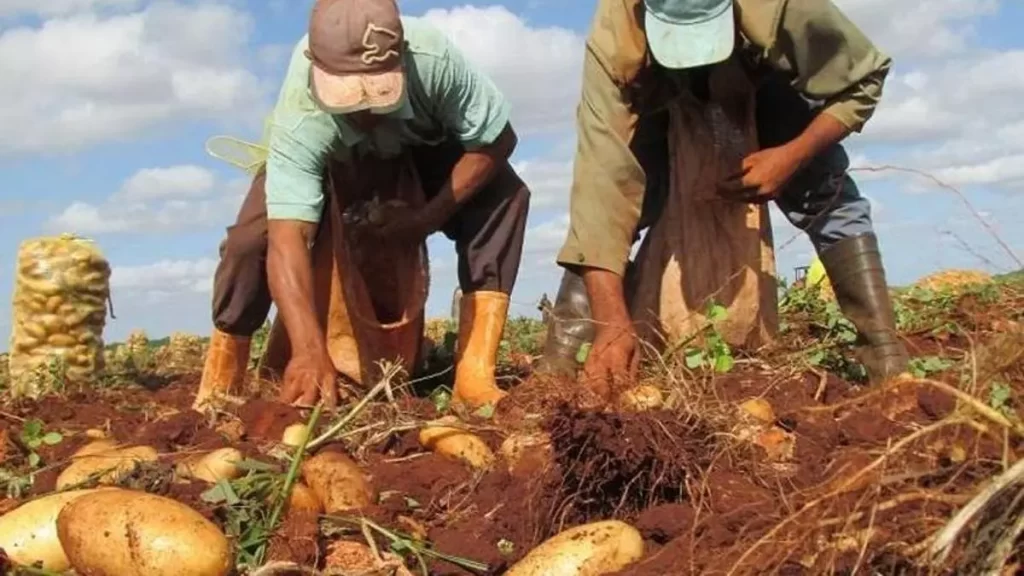
Fined 20,000 Pesos for Filming and Disseminating on Social Networks the Theft of Potatoes in a Field

Norberto Muñoz was fired from his job as an agricultural worker in Artemisa and had to hand over his cell phone to the Police.

The crops that characterize that area of Artemis are potatoes, bananas and legumes / Invasor

14ymedio bigger14ymedio, Havana, July 31, 2024 — Filming a video and uploading it to social networks has cost Norberto Muñoz Palomino a fine of 20,000 pesos, his job and the loss of his cell phone, which has been held for weeks by the Alquízar Police, in the province of Artemisa. The images transmitted by this resident of the community of Pulido, last February, showed a group of people looting a potato field.

In the video, published on Facebook, one can see the long furrows of potatoes belonging to a state company and dozens of area residents filling sacks with potatoes and taking them away. “Man, look at that, people ran into the field, and there is no one to stop them,” says the man posting the video.

Muñoz Palomino also adds that “they are so hungry, not even the special brigade is stopping them,” alluding to the troops of the National Special Brigade of the Ministry of the Interior, also known as “black berets.” The short film was quickly disseminated on social networks, independent news media and channels in South Florida. In a few hours, thousands of Internet users had seen the images.

“Shortly after that I was summoned by the police,” Muñoz Palomino tells 14ymedio. After an interrogation in the Alquízar Police Unit, he was fined 20,000 pesos under Decree Law 370 that allows the authorities to sanction social media users for the opinions they express or the content they disseminate. The agents also kept his cell phone and so far have not returned it. continue reading

“It’s been a hard blow because now I have been left incommunicado and without a job,” says Muñoz Palomino, who adds that after the incident he lost his contract in the state company and nobody in the area wants to hire him as an agricultural worker, a job he performed when he filmed the scenes of the potato theft. In the town of Pulido, on the outskirts of the city of Alquízar, the chances of earning a living, beyond the countryside, are scarce.

With a long and narrow street, Pulido has traditionally been a village of farmers, and after the nationalization of most of the land around it, its inhabitants work mainly in the Basic Cooperative Production Units of the area. The crops that characterize that part of Artemisa are potatoes, bananas, legumes and also garlic and onions.

The inhabitants of the town have been forced to seek their livelihoods in other municipalities

The nearby Pre-University Institute in the Socialist Republic of Romania Field, which in the 80s and 90s was also a source of employment for the residents of Pulido, ceased to function almost 20 years ago as a teaching center. The inhabitants of the town have since been forced to seek their livelihoods in other nearby municipalities such as Güira de Melena or in the municipal capital, Alquízar.

“Not being able to have a job here is a condemnation,” Muñoz Palomino tells this newspaper. In addition, he has already had to pay the 20,000 pesos of the fine to avoid the amount “accumulating and being greater.” That amount of money approaches half a year of the salary he earned as an agricultural worker. He sums up his annoyance: “Just for showing the truth; I didn’t deceive anyone.”

Now, his hope is that they will return his cell phone as soon as possible, but the police have told him that the device is being analyzed to “review its content and the contacts” that Muñoz Palomino has stored on his cell phone. Meanwhile, to communicate, he appeals to family and friends, but he is still unemployed.

Translated by Regina Anavy

____________

COLLABORATE WITH OUR WORKThe 14ymedio team is committed to practicing serious journalism that reflects Cuba’s reality in all its depth. Thank you for joining us on this long journey. We invite you to continue supporting us by becoming a member of 14ymedio now. Together we can continue transforming journalism in Cuba.

The Tobacco Growers of Sancti Spíritus Violate the Golden Rule of the Cigar

Three companies want to accelerate the curing of the leaf with solar heaters to increase production

The province wants to speed up the curing of the leaf to increase cigar production / Escambray

14ymedio bigger14ymedio, Juan Izquierdo, Havana, 31 July 2024 — Sancti Spíritus has initiated a series of tobacco “experiments” that violate the golden rule of the cigar: never produce it in mass. The idea – supported by an “unpublished investment” of the monopoly Habanos S.A. – is to enhance the controlled curing of the leaf, a euphemism that hides accelerated production by artificial means.

The curing process, which normally requires between 45 and 55 days, will now take only one month. Three producers from the municipality of Cabaiguán – the tobacco-growing territory par excellence in the center of the country – are the “pioneers” of the new process, which aims, even if the official press does not mention it, to remedy the terrible results obtained by the province last year, the worst in its productive history. Only one-sixth of the tobacco that was harvested was good enough for export.

Now, and against the basic rules of a crop where there are no short cuts to achieve excellence, the province wants a quick curing of the leaf for more cigars and better quality. The “new project” has solar heaters to accelerate the drying, which Escambray celebrates because Habanos S.A. also paid for them as a strategy to “reduce the consumption of electricity and fossil fuel.” continue reading

The province’s Communist Party newspaper admits that the investment still has no “use value”

The first signs of failure are already there: the province’s Communist Party newspaper admits that – although they have been experimenting with this method for two years – the investment still does not have “use value” and that not a single cigar has been exported with the new method, although the producers say that there is “a high degree of progress” in the project’s infrastructure.

To recover the status of “leading territory” of the cigar, along with Pinar del Río, is the aspiration of the three state producers who have benefited from the investment. Yoandi Rodríguez, Aniskyn de la Cruz and Nelson González intend, in their words, to “bring technology closer to the field.”

“The cigar is less damaged” than when it dries naturally – a process with several centuries of implementation – argue the producers, who promise to increase the amount of exportable leaf. However, the result has to go through the review of the experts and Cuba’s very demanding international customers, who quickly detect any drop in the quality of a product that is very expensive.

The producers centralized the whole process in their cooperatives, from planting to curing

The producers centralized the whole process in their cooperatives, from the planting to the curing, drying and picking of the leaf that is then sent to province’s factories. Sancti Spíritus has tried to improve the fast-track production numbers at any cost, given that the regime chose the province as the venue of the July 26 events and the harvesters were required to be “up to the task” of the “honor.”

This was the case of the Roberto Rodríguez Cigar Factory for Export, which produced 4,000 cigars a day – 96,000 units a month – during the first quarter of 2024. The Roberto Rodríguez takes care of the premium cigars that Sancti Spíritus delivers to Habanos S.A., which end up in the luxury humidors of Spain, China, the United Arab Emirates and the United Kingdom.

Its principal brands are Cohiba, Montecristo, Romeo and Juliet, Partagás, Rey del Mundo, Bolívar, San Luis and Trinidad, the cigar “invented by Fidel Castro” that the regime has vigorously promoted this year.

Roberto Rodríguez’s tobacco growers are paid 27,000 pesos per month – in April there were 40,000 – thanks to the fact that international sales skyrocketed by “180%,” its director alleged. The money has contained the “fluctuation of the workforce,” as the official called the stampede of state workers that characterized 2023. Now the factory staff is “almost covered.”

Translated by Regina Anavy

____________

COLLABORATE WITH OUR WORKThe 14ymedio team is committed to practicing serious journalism that reflects Cuba’s reality in all its depth. Thank you for joining us on this long journey. We invite you to continue supporting us by becoming a member of 14ymedio now. Together we can continue transforming journalism in Cuba.