Fernando Damaso, 25 May 2020 — When Cuba’s President asks for “a mental shift, a return to values, and initiative implementation,” he is “plowing the sea.”* These changes do not come from individuals, like how one changes a shirt, a tie, or a pair of shoes, but from basic objectives. Here one would need to speak, in reality, about a changes of individuals with a retrograde mentality, for others with new mentalities, aligned with the actual necessities. In socialism, this is not easy, because within it positions tend to be long-term or lifelong.
The same President demonstrates a contradiction between his speech and his actions: asks for change and at the same time describes himself as “continuity.” What “continuity?” Maybe from all the mistakes and misdoings during the last six decades. “Continuity” of the same stagnant and immobile mentality, responsible for the misfortunes and misery of Cuba? He needs to speak clearly and without so many idiomatic subterfuges.
For there to be real and sustained economic changes, there must also be political changes. Without these, the former are practically impossible to bring to fruition. continue reading
Some believe that I waste my time raising these things, because the State is a monolithic wall, which does not accept suggestions, unless they arise from itself.
In part, I share this opinion, and in part I do not. I think that, even within the Government, mostly made up of people conforming to its ideology, that is people of proven fidelity, fossilized mentality and a lot of political fanaticism, there are intelligent people, who are capable of seeing existing problems and questioning current ways of solving them, although they cannot express it publicly and, even less, decisively influence its correction. To consider all leaders and officials as incapable would be absurd.
I think that also other people (economists, sociologists, historians, analysts, etc.), for these same reasons, do what I do. And it is good that this is the case! It represents an advance in relation to previous times, where all the means of expression were monopolized by the State and it only published what suited its convenience.
Today the social networks allow us to express our opinions and say what we consider should or should not be done, as well as criticize and question what is wrong and applaud what is correct. All this, regardless of the repressive risk that this represents in Cuba.
If “we are all Cuba,” we must all participate in issues that affect, negatively or positively, the destiny of our country, with equal rights and duties, without exclusions of any kind.
*Translator’s note: A phrase attributed to Simon Bolivar, meaning engaging in useless action.
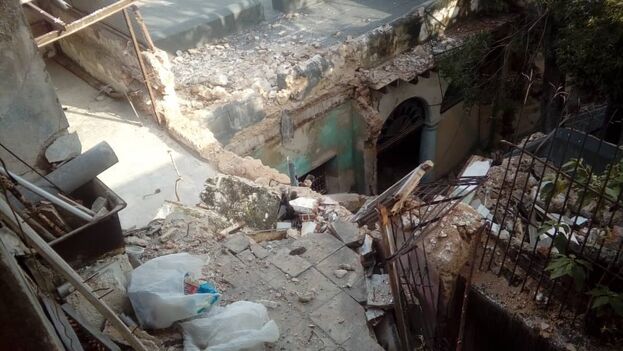
The residents of 355 Teniente Rey Street, between Aguacate and Villegas, Old Havana, still do not believe that part of the building collapsed. (14ymedio)
14ymedio, Serafín Martínez, Havana, 17 November 2020 — A week after having lived their worst nightmare, the residents of 355 Teniente Rey Street, between Aguacate and Villegas, in Old Havana, still do not believe that part of the three-story building where they have lived crowded together for years collapsed, an incident that it has left them living amid dangerous ruins and without institutional aid.
The victims remember the noise they sensed at two in the morning on Monday, November 9, when an area of the third floor roof where the water tanks were placed collapsed and fell on the building’s shared collective bathrooms. The partial collapse did not result in human casualties, but did cause significant material damage.
The hydro-sanitary facilities of the building were completely destroyed and the turbine and the cistern were also buried under the rubble. This system had supplied water to each of the small units inside a building that had been suffering from serious structural problems and advanced deterioration for years. continue reading
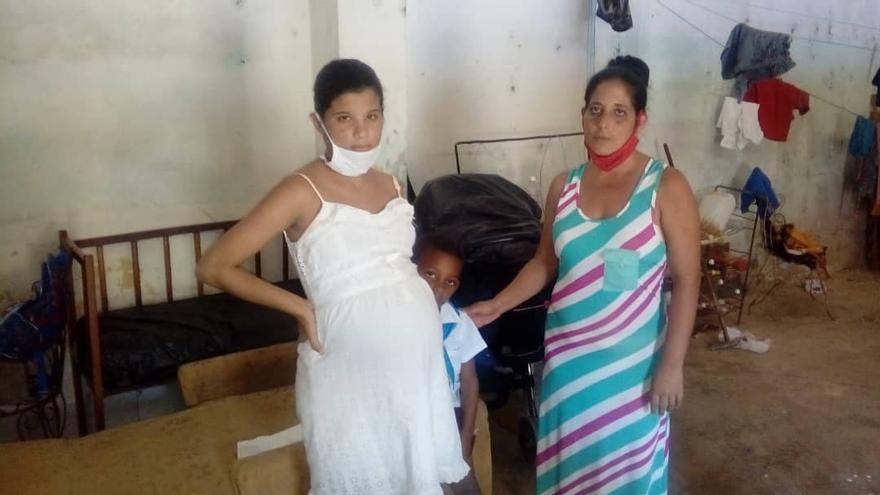
Neglys López Guerrero, age 29, who is 28 weeks pregnant and has two children ages 11 and 4, details to 14ymedio that on the day of the accident they immediately called the police and firefighters who “came without delay, but since no one was hurt they left without doing anything.”
“The officials of the Housing Institute told us that the building will be propped up and the third floor will be demolished, if the architects approves it; so that later we residents of the other floors can fix our apartments with our own means,” adds López Guerrero, who it does not have the financial resources to undertake the repairs.
However, she is relieved to have been able to stay building despite the danger. “We cannot go to shelters because our belongings, which we obtained with so much sacrifice, would stay here and be lost,” she says, a common position among the victims of building collapses who reject collective shelters.
“They took us out for two nights to sleep in the kindergarten and in the House of Combatants, but then they informed us that no one else would be coming and that we stayed here at our own risk. When they told me that what mattered was to preserve lives, I asked them that if lives only mattered at night.”
“What we aspire to is a place to save our lives that are in imminent danger, as well as to protect our property. If the building is not whole, as everything seems to indicate, then let them assign us housing to pay for and live with dignity,” says the young woman.
Another neighbor, Mercedes Castillo, 58, shares López Guerrero’s demands. “We were a total of 14 people, including four minors.” The two families living on the third floor were transferred to a shelter and the authorities “promised to prop up the building so that we could start fixing the apartments on our own, but the promise has not yet begun to be fulfilled.”
“The collapse even affected the school next door and the next door neighbors, but no one has come here, not even to collect the rubble. We have not had water since then and last night they sent us a water-truck. We are desperate. We cannot live like this in fear of our lives,” explains Castillo.
For her part, Mireya Guerrero, 50, noted that the “building has never been repaired. For many years it has been declared threatened with collapse and the Historian’s Office did not make any arrangements, not even propping it up. Despite the fact that it was reported as a critical housing situation at all levels including proposals in the meetings of the electoral district of the People’s Power.”
“On the ground floor there was a state carpentry workshop, which they closed due to complaints from neighbors, because the vibrations made the walls move. This misfortune happened with these blocks in [Covid-19] quarantine. We are like prisoners inside the building and with the jail about to collapse,” she says. “The food they brought us has been very bad, we can’t take it anymore.”
As of December 2018, Cuba had a housing deficit of almost one million residential units, which was also the last time the official press published numbers about the problem; the data have not been updated since. The experts believe that these numbers have been surpassed by the reality of a housing stock that is deteriorating day after day.
____________
COLLABORATE WITH OUR WORK: The 14ymedio team is committed to practicing serious journalism that reflects Cuba’s reality in all its depth. Thank you for joining us on this long journey. We invite you to continue supporting us by becoming a member of 14ymedio now. Together we can continue transforming journalism in Cuba.
Of the 10 women who broke into the workshop, two were relocated by the authorities to state premises set up as halfway houses. (14ymedio)
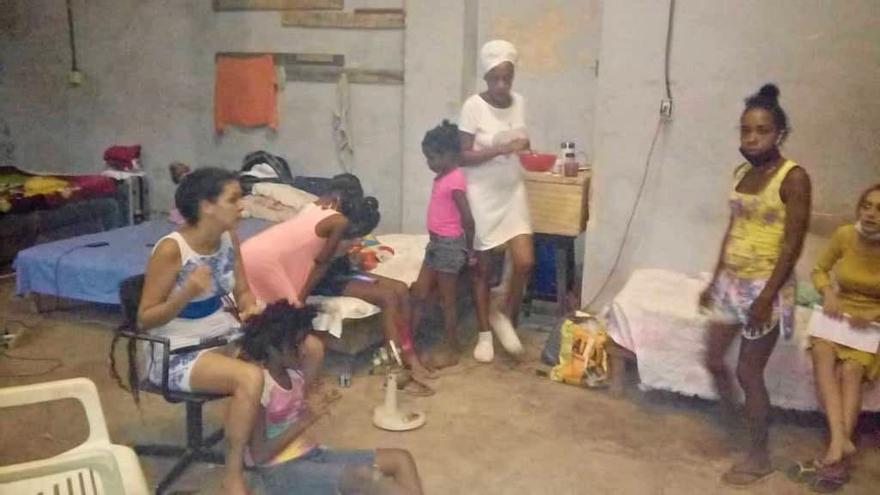
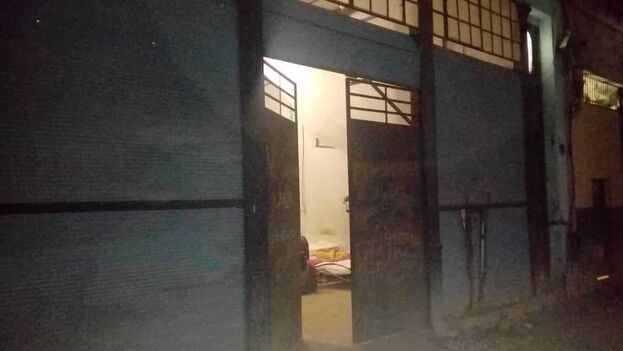
14ymedio, Serafín Martínez, Havana, 21 November 2020 — “The nights are cold and damp, there are mosquitos, rats and cockroaches.” It would seem that this mother who did not want to give her name was talking about a jail cell, but no: she was referring to an abandoned workshop belonging to the Office of the Havana Historian that she and nine other single mothers occupied last Friday, November 13, because they have no place to live.
“We have only one bathroom and there is so much dust that even the mobile phones are failing,” complains the lady, who, nevertheless, adds: “We are going to stay here until we all solve our housing problems.”
Of the 10 women who broke into the place, two were relocated by the authorities to state premises set up as halfway houses, one in an unoccupied school in Centro Habana and the other in an old warehouse in the Luyanó neighborhood, but eight remain, one of them four months pregnant, along with 11 minor children. continue reading
The humidity and poor condition of the property, located at 417 Villegas street, are taking their toll. Just a few days ago, for example, one of the babies, Aniel Pérez Fraga, five months old, had to be admitted to the hospital with breathing problems, says his grandmother, Iris Pinto, age 50.
The women regret that they have only one bathroom and that there is so much dust “that even the mobile phones are failing.” (14ymedio)
She ended up here, like most of these women, fleeing the danger of a collapse, something that occurs increasingly frequently in the Cuban capital. “How long am I going to have my grandchildren in neighbors’ houses?” she laments.
From the same building at risk of collapse, at 426 Villegas Street, Yandira Rodríguez, 33, also left. With two children, a five-month-old and a four-year-old, and raising a 12-year-old niece, she argues: “I don’t want to die by being crushed like has already happened here. The Housing Department officials always say they are going to respond and they do nothing. What we need are solutions, not millstones.”
Igraine Pérez, 30, the mother of an 11-year-old girl, was also in a falling-down house: “I came here because my tenement is collapsing and my family is very big. We were seven people in a twelve-foot-by-twelve-foot room.”
“My daughter is asthmatic and we are both have allergies. There was a lot of humidity there,” she tells 14ymedio. “We are desperate mothers who are not here because we want to be, but because we need houses and we demand the rights that the president declared for single mothers with children.”
All these women carry a heavy story on their shoulders. “I lived in the house with my my mother-in-law, but when I separated from her son, I had no option to live there and my mother would not let me enter the house where I was born,” says 22-year-old Melani Balmaseda.
Despite the fact that the workshop does not have the conditions of a home, Balmaseda feels relieved. “In this place we get along well, we are like a big family, but there are two with nervous disorders and they get upset at night, so it is difficult to sleep.”
In some remote way, she feels that an old dream can be fulfilled: “The only thing I want in this life is to have a house, since I was 13 years old it has been my only purpose.”.
____________
COLLABORATE WITH OUR WORK: The 14ymedio team is committed to practicing serious journalism that reflects Cuba’s reality in all its depth. Thank you for joining us on this long journey. We invite you to continue supporting us by becoming a member of 14ymedio now. Together we can continue transforming journalism in Cuba.
Liliana Torres Ramos with her children in the building they have occupied since June. (14ymedio)
14ymedio, Serafín Martínez, Havana, 27 November 2020 — Almost five months ago, Liliana Torres Ramos, occupied an empty bodega (ration store) in the Havana neighborhood of Santos Suárez with her children, a seven-year-old boy and a 16-year-old daughter, nine months pregnant. The family is now at risk of living on the street due to their imminent eviction from the property, as notified by the Mayor of the municipality of Diez de Octubre, who summoned Torres this week.
Torres, 34, tells 14ymedio that she lived in an apartment located at 162 San Julio, between Enamorados and Santos Suárez, along with six other people. The room had been declared uninhabitable and irreparable and her mother had had an eviction order to go to a shelter since 1992.
“We left desperate,” she says. In the building where she now lives, owned by the Havana Commerce Company, a family with four children had previously resided and had also been evicted by the authorities. “On 20 June of this year, I broke the bodega door, which had been closed for a year and a half, and I got in with my two children.” At night a beggar, whom Torres threw out, slept in the place. continue reading
“Shortly after occupying the bodega, Miguel Ángel, the director of the Diez de Octubre Commerce Company, arrived in a very bad humor and threatened to call the police to evict me and put me in jail. He told me that he didn’t care what [President] Díaz-Canel might have said about providing the population with closed state premises.”
The pressure continued up to this week when she received the summons from the Mayor. “He told me that he would give me 24 hours to leave the premises, that there were thousands of cases worse than mine and that he was speaking to me for my own good, to see if I understood.”
“I live with great fear that they will come to evict me, to throw me into the street with the few things that I have in life. I need help, my daughter is going to give birth and we have nowhere to live. The roof is collapsing in this place and there is a lot of humidity. Look, come in and see the pieces of the roof that have fallen in. You can’t live like that,” she says.
A Santos Suárez neighbor who preferred to remain anonymous insists that Torres is a good person who is suffering many difficulties. “We, the neighbors, help her as much as we can. She already got a contract with the OBE (Electric Company Office) to have electricity, we put the water in and we got her a water tank,” she says.
Although not all residents in the surrounding area have the same opinion. “Some have complained because now they have to run their errands at another ration store further away and they say what needs to be done is to repair this one, that this is not a place to live,” she adds.
The Diez de Octubre Commerce Company refused to make statements about this matter to 14ymedio, although a worker, anonymously, said that there is a list of the company’s own employees waiting for empty premises owned by the company to be offered to them as homes.
The housing situation is critical throughout Cuba and particularly in Havana where there are serious infrastructure problems and overcrowding. Many of the properties in various municipalities in the capital date from the early 1900s and have not received repairs for more than fifty years, not even paint on their facades.
Reinaldo García Zapata, Havana’s governor, announced to the local press on 22 November that the capital city has completed a housing construction plan for the present year, to build more than 7,000 units.
____________
COLLABORATE WITH OUR WORK: The 14ymedio team is committed to practicing serious journalism that reflects Cuba’s reality in all its depth. Thank you for joining us on this long journey. We invite you to continue supporting us by becoming a member of 14ymedio now. Together we can continue transforming journalism in Cuba.
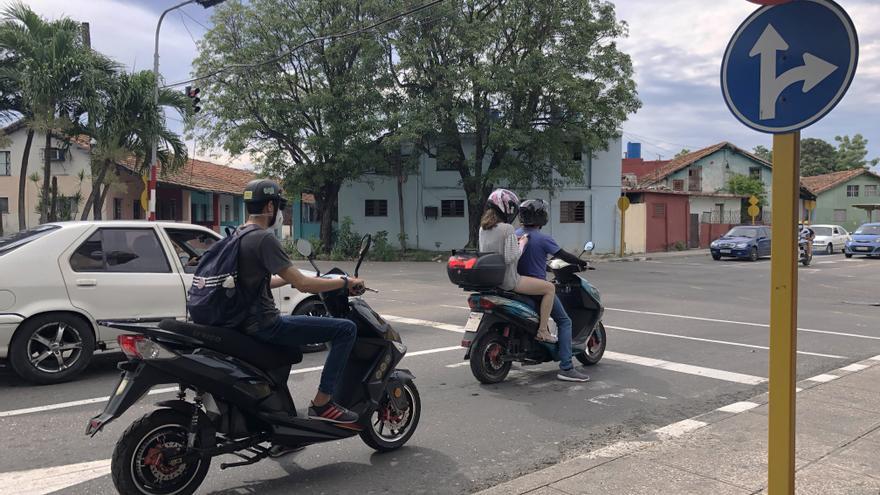
Of the stolen ‘motorinas’, five complete and four disassembled have been recovered so far. (14ymedio)
14ymedio, Havana, 27 November 2020 — At least nine electric motorcycles were stolen in several municipalities of Havana by three citizens, according to a report by Cuban Television. The individuals carried out their misdeeds mainly in the early hours of the morning and entered the houses even with the owners inside.
State television reports that the thieves broke the locks of the homes’ garages to take the machines popularly known as motorinas, which were later marketed through social networks.
With the transportation crisis, electric motorcycles have become increasingly popular in Cuba, constantly making headlines due to the multiple fires that plague them throughout the country. continue reading
Given the increase in this means of transport, the authorities also informed state television that their robberies have increased. One of the elements that is repeated in crimes is the participation of two or more people.
Reportedly, the theft of electric motorcycles on the streets happen when their owners leave them unlocked. The vehicles are taken to other provinces and sold with photocopies of the ownership documents.
Dayron Toledo Lores, one of the victims, who lives in Havana’s El Cerro neighborhood, said that his motorcycle was inside a gated garage, protected with a chain, and one of the tires secured with a padlock, and all that security was overcome by the burglars.
The police were able to fully recover five of the vehicles, but four were found in pieces during an operation that was carried out at the home of the main defendant, who continues to be detained along with the other defendants.
An agent from the Investigative Technical Department of the Interior Ministry said in the press report that the three implicated confessed to the facts and are being processed for the “alleged crime of ongoing robbery with force.” He also said that the investigation is continuing because the criminal chain could expand and they might find similar occurrences.
In October of last year the Facebook group Electric Moto Cuba reported that one of its members was assaulted by two youths who sprayed something in her eyes and took her motorina. “She stopped because supposedly other people needed help and it was all a sham to assault her with blows,” the report detailed.
As of June 2019, it was reported in the official press that there were an estimated 210,000 mopeds in Cuba. Between the time that the stores that accept only convertible currency opened in 2019 and this October, the State sold 10,000 electric units, of different 21 models, including motorcycles, bicycles, motorbikes and motorized tricycles.
The report of fires affecting this means of transport has skyrocketed. According to a report by the Ministry of the Interior, in 2019 there were 208 fires involving electric motorcycles with lithium batteries, 164 of them serious and 44 minor. Most of these accidents occurred in homes or garages and also caused serious damage to nearby vehicles or buildings.
This year, at least 186 fires have occurred in homes, causing the death of one person and injuring more than ten.
____________
COLLABORATE WITH OUR WORK: The 14ymedio team is committed to practicing serious journalism that reflects Cuba’s reality in all its depth. Thank you for joining us on this long journey. We invite you to continue supporting us by becoming a member of 14ymedio now. Together we can continue transforming journalism in Cuba.
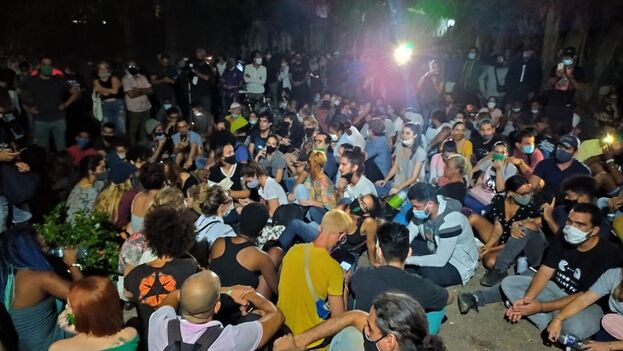
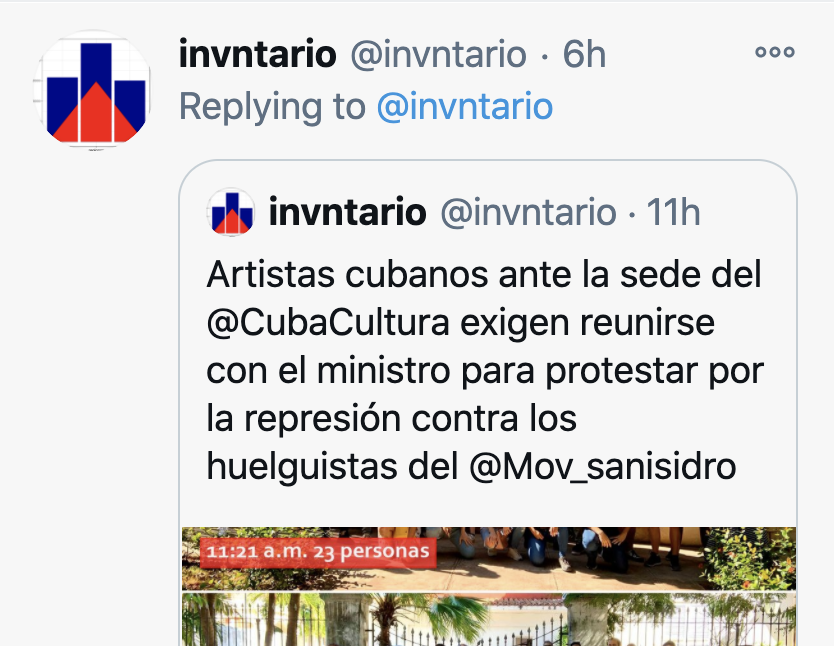
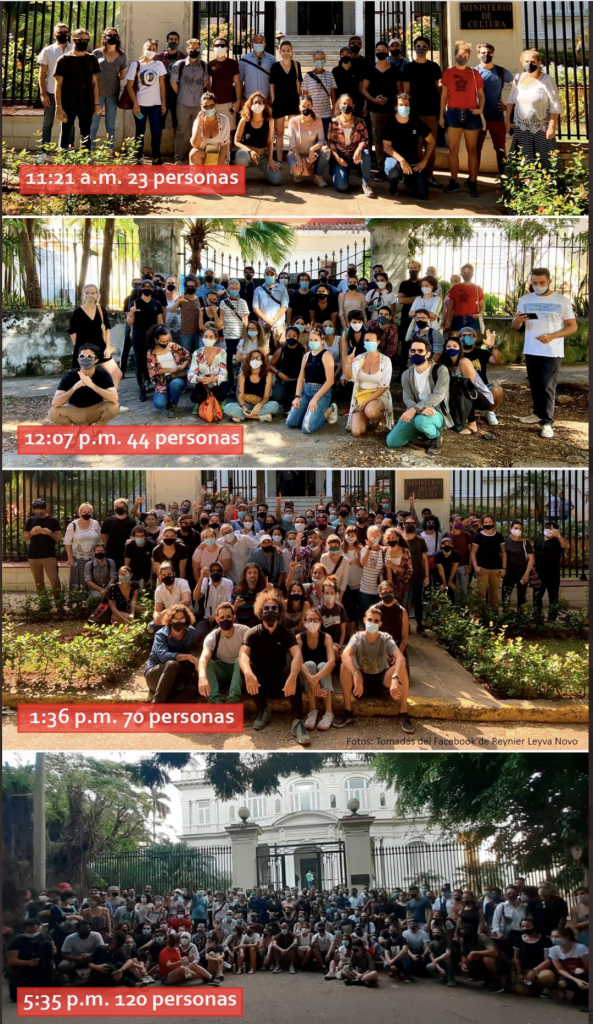
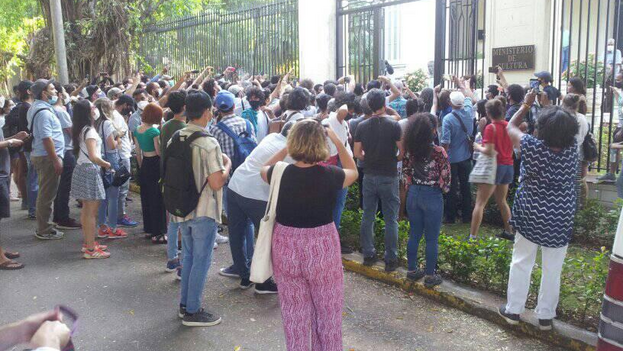
Artists gathered in front of the Ministry of Culture in Havana demanding that the Cuban government open a dialog. (14ymedio)
14ymedio, Yoani Sánchez, Havana, 28 November 2020 – Sometimes in the dark, or with only the beams of mobile phones lighting their faces, hundreds of artists have planted themselves in front of the Ministry of Culture in Havana, until the early morning hours this Saturday. The peaceful protest marks a necessary precedent with unpredictable consequences in a Cuba where many are used to the fact that “nothing happens” and “everything is controlled from above,” or “a leaf does not move without the Government ordering it.”
The arrest of the rebellious rapper Denís Solís, the hunger strike of several activists of the San Isidro Movement and the violent entry into the headquarters of this independent group, last Thursday night, were the triggers for this concentration of filmmakers, visual artists, musicians and all kinds of creators in front of the mansion on Calle 2 in El Vedado, but the ferment of that demonstration had been accumulating for decades.
What happened is the result of more than half a century of trying to subordinate art to ideology without accepting nuances; years of parametración (parameterization), censorship, purges, the Five Grey Years, perks in exchange for silence, forced exile of so many creators, scissors pruning names in publishing houses, stages and galleries. This 27th of November 2020, all that accumulated magma — which at various times has caused the occasional small eruption or spark — overflowed in a public act, with a large presence and in front of one of the most feared of Cuban institutions. continue reading
Unlike 2007, when the cultural authorities and the guardians of the intelligentsia managed to channel the “Little War of emails” to a meeting — with a limited number of participants — at the Casa de las Américas, this Friday the protesting artists had the good sense not to be divided and not to accept the official proposal that only 40 of them might enter the Llauradó room, clearly a classic in the KGB and Stasi manuals.
Instead, in front of the high gate of the ministry, a democratic, plural and diverse government was created in a moment that allowed each union to elect its representatives, thirty people in whom to entrust their demands to be expressed in front of Vice Minister Fernando Rojas, because – of course – the minister himself never appeared, something inexplicable on an island where from any point of the geography you can reach Havana in less than 12 hours if you travel by car and in less than three if you go by plane.
The sequence of what happened on Friday was almost cinematic: it began with the arrival of the first people in front of the ministry around eleven o’clock in the morning, almost “four cats*” – as the official propaganda likes to repeat so often to insult their critics. Then came the hackneyed justification from an employee that the head of the sector, Alpidio Alonso, was not available to see them and that functioned like fuel thrown onto the fire. And then it continued with more and more artists coming to the site to demand a dialogue with the cultural authorities.
The scene was completed with an extensive police operation in the vicinity, the prohibition of passage face by several artists and activists who tried to approach, as well as an unjustified violent incident against a group that was on their way over and was tear gassed by a body of uniformed men who, surely, were not acting on their own but were responding to orders issued from some air-conditioned office.
By the early morning and after the meeting with Rojas, the representatives came out to recount the agreements reached. Results that raised applause but have also generated criticism, a necessary and expected diatribe if it is about planting the seed of a plural and democratic country. While some believe that they grabbed from the powers-that-be the conquest of reviewing their repressive procedures and allowing great freedoms in the art scene, others warmed that if could be a maneuver of distraction.
Everything is possible, because something like this has never happened in this way, in these dimensions and much less in a context similar to this. With a country plunged into the deepest economic crisis ever experienced by many of the young people who met yesterday before the Ministry of Culture; with the historic generation – which has had the island in its fist for more than 60 years – dying without glory nor legacy; and with a society tired of the shortages and dreaming of suitcases, flights and emigration… no one can predict if yesterday’s agreements are “a lot” or “a little.”
What will happen going forward? Some who have experienced previous disappointments predict that the Ministry of Culture will not comply with the agreement, the official propaganda will intensify its attacks against the San Isidro Movement and will raise a wave of supposed demonstrations in favor of the regime throughout the island. Those who previously experienced the seesaw of illusion and frustration with events of this type, predict calls from State Security to each of the most visible heads of the protest.
Separately, in an interrogation office in Villa Marista – the grim prison in Havana where State Security confines its political prisoners – with a mixture of threats and promises, they will most likely be able to make someone retract or at least walk away from any similar action that occurs in the future. The media controlled by the Communist Party will publish statements by artists faithful to the Party who tell of the “enormous support and freedom” that the Ministry of Culture offers them for their creation and some part of those who expressed the demands will go to another country to do a doctorate, create a family and forget the island they left behind.
All this can happen and much more, but it is better to opt for the film in which the events on Second Street give way to new situations, regenerating hope and constituting the embryo of the change that so many of us wish for our country. A change that is promoted not from violence but from the peaceful demands of people who create, love and dialogue. I choose that script, because the other I have already seen in an endless movie my whole life.
*Translator’s note: An insult, as in the phrase “four paid cats [implying paid by foreign governments, mafiosos, enemies, etc.] are not going to bring down the government.”
____________
COLLABORATE WITH OUR WORK: The 14ymedio team is committed to practicing serious journalism that reflects Cuba’s reality in all its depth. Thank you for joining us on this long journey. We invite you to continue supporting us by becoming a member of 14ymedio now. Together we can continue transforming journalism in Cuba.
For Varela it is time to sit down and talk, because “the people of San Isidro are also part of this country.” (Facebook / Olivia Prendes D Espaux)
14ymedio, Luz Escobar, Havana, 26 November 2020 — One week after the start of the hunger strike at the headquarters of the San Isidro Movement to demand freedom for Denis Solís, sentenced to eight months in a summary trial for an alleged crime of contempt, signs of solidarity continue to arrive via the activists of many influential voices in the art world.
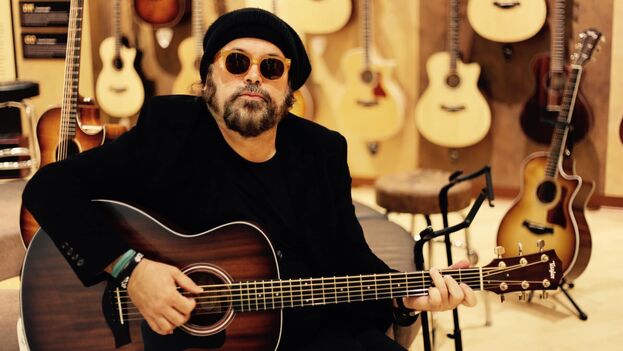
One of the most recent voices to join has been that of singer-songwriter Carlos Varela, who in a post published on his Facebook wall expressed his concern about the hunger strikes that several of the activists are continuing: “If I don’t write these words, I would be denying myself and my story. ”
“I don’t know any of the San Isidro kids personally, but that’s not what matters today. Any human being who is willing to die for a cause, whatever it may be, deserves to be listened to with respect. I am human, so don’t ask me to look the other way. I will not be complicit in the silence of the choir,” he wrote. continue reading
He said that several decades ago, “when those kids from San Isidro were only children or had not been born,” he went through something similar. “They wanted to turn me off too, erase me, marginalize me, censor me and, like a large part of my generation who could not bear the pressure, invite me to leave Cuba.”
For the musician, a member of the so-called Cuban Nueva Trova it is time to sit down and talk, because “people from San Isidro are also part of this country,” while denouncing the acts of repudiation as “infamous gestures” that are “a national shame.”
“When will William Tell’s grandchildren be heard? ” he wondered, paraphrasing his most popular song.
“A good part of my songs were born, surrounded by threats and conjectures, in the warmth of censorship and the silence of others. When will William Tell’s grandchildren be heard?” he asked himself, paraphrasing his most popular song, written at the end of the eighties and dedicated to the generation that fled the island en masse during that decade.
Another of the voices that publicly joined in to support the San Isidro Movement was that of singer Leoni Torres, who published on his social networks the need to express his feelings “about what is happening with the MSI youth group.”
“It pains me to think that after so many years we are still unable to dialogue and that hatred continues to prevail. Cuba belongs to everyone. Ideas do not have to be identical; we do not have to think the same. It is everyone’s right to be able to express themselves freely without being punished,” he said.
Meanwhile, at the headquarters of the group, located on Damas Street in Old Havana, there is no news at this time on the health of the strikers.
Carlos Manuel Álvarez, director of the magazine El Estornudo, (The Sneeze) who, after returning to Cuba from New York this Wednesday joined the 13 activists who have remained inside the building since last November 16th, denounced Thursday a possible Government maneuver to get him out of San Isidro.
Carlos Manuel Álvarez, director of the magazine El Estornudo denounced Thursday a possible Government maneuver to get him out of San Isidro.
According to a live broadcast, on Wednesday night, Health authorities called his friend Mónica Baró, whose address he had given to authorities at José Martí Airport upon arrival in Cuba, to tell her that the PCR COVID-19 rapid test they performed when he entered the country, compulsory for all international travelers, “had showed altered results.”
Perhaps they could not communicate directly with him, he recalled, because his telephone number, which he provided to officials on the immigration health form, was being blocked.
Baró was warned that Álvarez should go to a health center in Miramar before midnight this Wednesday to repeat the exam because, otherwise, they would go look for him at San Isidro. “I did not do what was requested, so it is likely that this second option will happen at some point,” said the journalist.
“It seems to me that behind a medical excuse there is political manipulation to get me out of here,” he argued, in addition to insisting that before traveling to Cuba his PCR test was negative, so “there is less risk of me spreading the virus than the tourists who traveled on the flight.”
“I’m not going to get out of here or give in to such crudely orchestrated pressures,” he said. “I am willing to do a PCR again but under certain conditions because the bond of trust with the Cuban state has been completely broken.” And he explained that he cannot trust a political power whose propaganda apparatus tells “lies and defamations,” such as he has had “contact with international terrorists from Miami,” that “he is a “CIA agent” or that he is “violating the isolation that is imposed on residents or tourists who arrive in Cuba from abroad.”
Thus, the conditions that Álvarez is demanding to take another PCR test is that health personnel go directly to Damas Street #955, specifically accompanied “by my mother or my father because they are both doctors and they know exactly what the procedure is.”
Translated by Norma Whiting
____________
COLLABORATE WITH OUR WORK: The 14ymedio team is committed to practicing serious journalism that reflects Cuba’s reality in all its depth. Thank you for joining us on this long journey. We invite you to continue supporting us by becoming a member of 14ymedio now. Together we can continue transforming journalism in Cuba.
Cuban artists in front of the Ministry of Culture demanding a meeting with the minister to protest the repression against the San Isidro Movement hunger strikers…. and… as the day wore on…
The artists arrived to express their solidarity with the members of the San Isidro Movement and to demand a meeting with the Minister of Culture. (Facebook / Ahmel Echevarría)
In the absence of the minister, Alpidio Alonso Grau, a delegation of 30 creators is expected to meet with the vice minister Fernando Rojas on behalf of all those present.
At 6:00 in the evening, more than 150 artists had arrived, including Tania Bruguera, winner of the 2014 Lázaro Saavedra National Prize for Plastic Arts, Reynier Leyva, Henry Eric, Julio Llopiz-Casal, Claudia Genlui, Solveig Font, Sindy Rivery, José Luis Aparicio, Nelson Jalil, Fernando Fraguela, Edel Figueredo, Sandra Ceballos, Juliana Rabelo, Mijail Rodríguez, Yunior García and Camila Lobón are some of those present. continue reading
Filmmaker Fernando Pérez and actor Jorge Perugorría also joined in the evening. “El Pichi and I are here to tell the Ministry of Culture to receive them,” said the renowned director. “This is going to be the beginning of a new language that Cuban culture lacks… it would not have to come to this if they had listened long before,” he added.
The artists have signed a declaration in which they condemn “the inability of government institutions in Cuba to dialogue and recognize dissent.”
The renowned artist Tania Bruguera, in statements to 14ymedio, explained that the group that arrived at the ministry this Friday “is intergenerational,” and is nurtured by people from all artistic branches who have come together to express that this institution does not represent them, nor has it been able to “find ways to negotiate when the life of an artist is at risk and it has neglected its duty, which is to protect artists.”
Visual artist Julio Llopiz-Casal declared: “I am here because I consider that what happened with the San Isidro Movement is a serious symptom of the systematic cultural policy that the Cuban State has had over 60 years, which consists of criminalizing and defaming the people who want dialogue and have no subversive intention.”
The images are being shared on the artists’ social networks and show that minute by minute more people are joining the call. Reynier Leyva Novo wrote on his Facebook wall: “We are already demanding that the Minister of Culture attend to us! San Isidro Movement. MSI. We are not moving from here…”
Another of the artists who came to the call, Henry Eric, declared to this newspaper that what moved him to join was “the lack of civil liberties,” something that in his opinion “results in the lack of freedom in creative and intellectual processes.”
“What happened in San Isidro seems to me to be a process of serious political repression, of the many that occur cyclically in this country,” and he mentioned as an example the Letter of the Ten in 1991, the Black Spring of 2003 and “the end of the 80s, when many artists in the world of visual arts were practically pushed to leave the country.”
For Henry Eric it is also important to “denounce the right that the Ministry of Culture assumes to say who can and who cannot be an artist,” because “no public official has the right to denigrate a person who decides to make art in the manner they want.”
The playwright and theater director Yunior García specified that the majority of those present are “young artists.”
He sees in what has happened in San Isidro “a threat to all our creative freedoms as artists and our freedoms as citizens,” an environment, he says, “very rarefied when it comes to making our art without having to leave the country where we were born.”
Although up until two in the afternoon the day passed peacefully, as 3:00 PM approached several sources in the place have denounced the arrival in the area where the artists are of “some buses” and of State Security agents along with the police.
____________
COLLABORATE WITH OUR WORK: The 14ymedio team is committed to practicing serious journalism that reflects Cuba’s reality in all its depth. Thank you for joining us on this long journey. We invite you to continue supporting us by becoming a member of 14ymedio now. Together we can continue transforming journalism in Cuba.
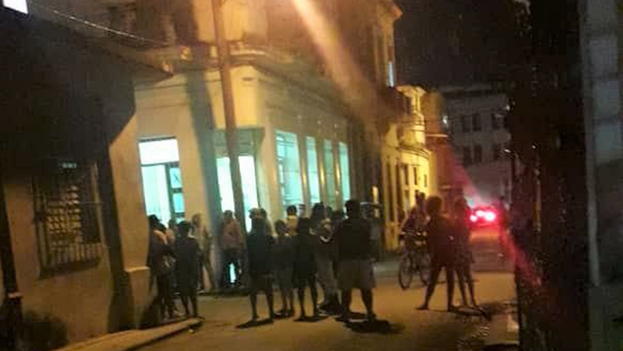
The police broke into the headquarters of the San Isidro Movement (MSI) in Old Havana on Thursday night and arrested the 14 activists.
14ymedio, Havana, 26 November 2020 – The police broke into the headquarters of the San Isidro Movement (MSI) in Old Havana on Thursday night and arrested the 14 activists who were inside the building, as confirmed to 14ymedio by neighbors and relatives of the detainees. Several police patrols and ambulances participated in the operation.
“I passed near the place a little before everything happened and I saw several police patrols, ambulances and a large group of people who seemed to be from State Security a few blocks from there,” a taxi driver who was transporting passengers through the area commented to this newspaper.
“When I returned down the same street, the neighbors were saying that they had taken all the strikers who were in the house,” but they still did not allow them near the place. continue reading
The agents’ raid on the house coincided with a cutting off of the services of Facebook and Instagram on the island, an internet outage that users associated with an attempt to prevent the images and reports of the arrest from being disseminated on social networks.
A tweet from MSI confirmed the information. “Agents of the dictatorship broke into our headquarters, savagely beat our compañeros, took them away and we do not know their whereabouts. We fear for their physical integrity,” the brief message reported.
The independent journalist Maykel González Vivero, director of the Tremenda Nota site, reported from near the house. “I arrived at the scene a few minutes after the forced eviction of the activists.” The reporter said that “the door was violently broken” and the whole area was under a heavy police operation.
“They were dragged away and outside the house an act of repudiation was already prepared with people shouting official slogans,” a neighbor explained to González Vivero.
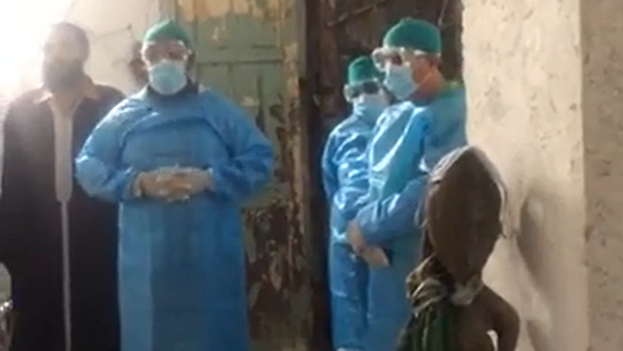
The moment when two men and a woman dressed in protective suits entered the headquarters of the San Isidro Movement looking for Carlos Manuel Álvarez. (Capture)
A few hours before the agents carried their forced entry, two men and a woman dressed in protective suits, gloves and glasses had arrived at the headquarters of the Movement, saying they were part of the health personnel linked to the supervision of suspected cases of Covid-19
They insisted that Carlos Manuel Álvarez accompany them with the justification that his PCR test should be repeated, but he refused, saying that he did not trust them and that he knows that they are receiving orders from State Security.
Zuleidis Cepero, the wife of Esteban Rodríguez, communicated live with ADN Cuba[starts at 3:20 on the linked video] and said that she did not get there in time but when she did, “I couldn’t see anyone, they took everyone away, the San Isidro headquarters was left empty… They did not respect that there were women inside, I am concerned about everyone’s health,” she added.
____________
COLLABORATE WITH OUR WORK: The 14ymedio team is committed to practicing serious journalism that reflects Cuba’s reality in all its depth. Thank you for joining us on this long journey. We invite you to continue supporting us by becoming a member of 14ymedio now. Together we can continue transforming journalism in Cuba.
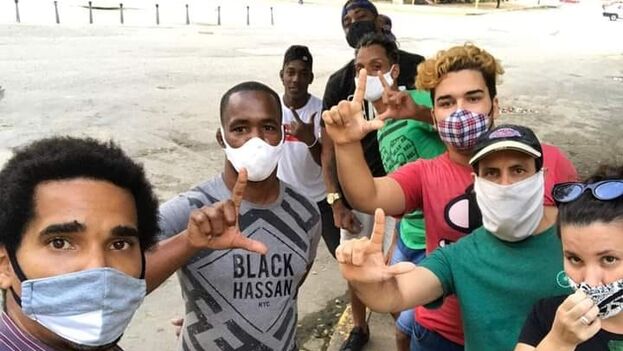
Members of the San Isidro Movement protesting after the arrest of Denis Solís. (Facebook/Anamely Ramos)
14ymedio, Yoani Sanchez, Generation Y, Havana, 26 November 2020 — The arrest of a rapper has led to a hunger strike being waged by several activists, members of a group known as the San Isidro Movement. What began as a meeting of friends showing solidarity and demanding the release of Denis Solís has led to an explosive situation.
What makes the hunger strike of these opponents and independent artists unique? The answer to that question points to the context and not to the use of fasting as a tool for advocacy. In the recent history of Cuba, the body has been frequently used as a civic plaza of demand, in the absence of legal and democratic ways through which citizens can demand rights and denounce injustices. The most dramatic case in recent years is, undoubtedly, that of Orlando Zapata Tamayo, who died in February 2010 after 86 days without eating.
But a decade after that preventable death, the political and social context is very different. The country is going through its deepest economic crisis of this century, the authoritarian figure of Fidel Castro is past history, and the officials who have risen to the highest positions in the nation are seen – by most of the population – as a band of useless opportunists. Added to this is the recent opening of stores that sell food and cleaning products but only accept foreign currencies, which has caused a wave of popular outrage at what is seen as “monetary apartheid,” dividing society between those who have dollars and those who do not have dollars. continue reading
In this scenario, further aggravated by the coronavirus pandemic, a group of young people has decided not to eat to demand that the eight-month prison sentence against a rapper be reversed. In a hasty trial Denis Solís was convicted of the alleged offense of contempt against a police officer. The gesture of solidarity by these activists has stirred consciences and, in recent days, there have been signs of support from various sectors, including those who until very recently did not speak out against the repression against dissidents.
International organizations have asked the island’s authorities to release Solís, one hundred filmmakers have joined in an open letter of support for the San Isidro Movement’s strikers, and social networks are seething with calls to preserve the lives of young people through a dialogue that allows their voices to be heard. But the Plaza of the Revolution seems to have chosen, so far, the path of trying to execute their reputations by calling them “marginals” and creators “without known work,” in addition to surrounding the house that serves as the group’s headquarters with a strict police cordon that prevents access to the strikers by friends or relatives.
Several empty stomachs and a dilapidated house in a poor Havana neighborhood are now the main battle front against a desperate and dangerous system.
COLLABORATE WITH OUR WORK: The 14ymedio team is committed to practicing serious journalism that reflects Cuba’s reality in all its depth. Thank you for joining us on this long journey. We invite you to continue supporting us by becoming a member of 14ymedio now. Together we can continue transforming journalism in Cuba.
Caption: Of all the studies that have been carried out, only one meets all the requirements: that of the national vaccine candidate, Soberana. (Prensa Latina)
Javier Roque Martínez, Isabel M. Echemendía Pérez and 14ymedio, Havana, 24 November 2020 — In mid-March, just two days after the first case of coronavirus was detected in Cuba, state-owned Biocubafarma announced that it had the necessary products to fight the disease, some of them “already proven with high efficacy.”
From then until the end of September, the Registro Público Cubano de Ensayos Clínicos (Cuban Public Register of Clinical Trials) has mentioned 22 trials of pandemic-related products, of which nine would have produced some kind of scientific article by that date. However, so far there have been found academic articles related to only four Cuban coronavirus treatments.
Cuba has presented itself during the pandemic as a pharmaceutical power, but the truth is that, if you look closely at the trials of its medicines and other biotech products, the errors and inconsistencies are numerous. The ideal standard of science are tests that are randomized, controlled, and with some sort of masking technique. But of all those that have been made, only one meets all the requirements: that of the national vaccine candidate, Soberana. continue reading
The four products about which there are publications, were either tested on a very small number of people, or they were tested on groups of patients from which were excluded those most likely to be made worse by their age or by having other diseases, according to the scientific articles.
Cuba has tested four types of products: antivirals to reduce the chance of patients getting worse (such as the interferons); specific drugs to prevent the more severe cases from dying (such as Jusvinza and Itolizumab); products that improve immunity for risk groups (such as Biomodulin T); and vaccines (Soberana).
The interferons were presented as one of Cuba’s great contributions to the world since the beginning of the pandemic, and were tested in many countries. Itoluzimab and Jusvinza, for their part, were promoted by the president himself, Miguel Díaz-Canel, but the studies for most drugs of these groups have not produced publications, which in practice leads to the assumption that the studies do not exist. This is the case, for example, of Biomodulin T, whose results have not yet been disseminated.
Jusvinza and Itolizumab, on the other hand, did produce scientific articles, but to date neither has been subjected to peer review, a process that consists in other experts thoroughly examining the article for errors or biases, in order to ensure that the authors of the research have followed a strictly scientific method.
But the most serious problems do not occur in this regard, but in the data produced by the tests that were carried out.
In the case of Itolizumab, it was tested on a group of 19 patients from the Santa Clara nursing home. Although this drug was advertised as a treatment for severe patients, the recipients only had moderate symptoms, such as fever or lack of oxygen, but without a need for intensive care or intubation. In this outbreak there were 47 positive cases and between three and six deaths, so it does not explain the specific selection of those who participated in the trial, or whether the others did so and their reaction was not included.
Jusvinza, the other product for seriously-ill patients, was tested on the right people, but there were only 16 people, of which two died from an unidentified infection which they acquired in the hospital, which led to the conclusion that “all critical patients (11) recovered from respiratory distress.”
In other cases where the drugs were tested on more people, the findings cannot be clearly determined because the control groups were not comparable. This invalidates the study or makes it meaningless.
“It is important to note that such studies (the uncontrolled ones) cannot be taken as evidence that the treatment works,” said Javier González Argote, a Cuban physician taking doctoral studies in Biological Chemistry at the University of Buenos Aires.
Problems related to the selection of patients in the control group were evident in the study carried out with Heberon (trade name of Interferon alfa-2b), the largest in Cuba.
This antiviral was tested until July in 2,165 patients, a large majority of those infected on the island. The researchers concluded that an individual who tested positive for COVID-19 and treated with Heberon was 57 times more likely to recover than one who did not receive it.
In the control group there were 130 patients, those who did not agree to receive Heberon, those who could have contraindications, and those who were most vulnerable to serious sickness. This made the group completely different from the one who did receive it: younger patients (44 years on average), with fewer previous diseases, and even asymptomatic people (up to 56% of the group). The average age of the control group was 68 years; 80% had possible complications and only 18% were asymptomatic.
In the group that received Heberon, less than 1% died, and in the other group, half did. Researchers recognize the problem of having had two non-parallel groups. “The data analysis in this study was limited, because it includes unbalanced demographic groups,” they add.
In the case of HeberFeron (the combination of Interferon alfa and gamma) a control group similar to the one receiving the treatment was used. But it was decided not to include in the research those patients who were most likely to worsen and those who showed a greater persistence of the virus in their body (several positive PCR tests [polymerase chain reaction] after receiving treatment). In this trial, involving 66 people, all patients with chronic diseases which are associated with increased comorbidity with COVID-19 were excluded.
With these patients eliminated, two groups were formed, one that received HeberFeron and the control group that received another interferon. Although no one died, only one patient worsened in the control group; while in the one which tested the drug there were two. Despite this, it was considered successful because the latter took less time to negativize the virus.
Cuban researcher Susana Delgado Ocaña, a doctoral student in Biological Sciences at the Universidad Nacional de Rosario in Argentina, believes that concessions are acceptable, given the current emergency circumstances, but recognizes that the effectiveness of a drug cannot be validated. “Studies (of this type) may report improvements not necessarily attributed to treatment. In general, such trials tend to show greater efficacy of a treatment, sometimes ‘false positives’,” she pointed out.
U.S.-based Cuban biochemist Jorge Antonio Benítez argued in a recent article that, while the island’s biotechnology has obtained great achievements, its results are affected by politicization, a culture of secrecy, and a lack of regulations against conflicts of interest. For Benitez, one of the main problems of Cuban research is its emphasis on product development that can generate economic benefits in the short term, without conducting research set on solid theoretical foundations.
According to Nature Index, which evaluates countries for the quality of their scientific publications, Cuba is currently behind countries such as Panama or Costa Rica.
Despite all this, the experts agree on the success of the Cuban strategy, the country with the fewest deaths and cases of the continent. However, they do not attribute it so much to their pharmaceuticals, but to the good implementation of “non-pharmaceutical interventions and other epidemiological tools”, as noted in a recent article by the Cuban biologist Amílcar Pérez-Riverol. These virtues would apparently be the rapid implementation of mobility restriction measures, mass investigation in suspected cases, effective contact tracing, and the testing programme, as well as the great strength of its primary care system.
In any case, the rate of lethality, being low, is similar in Cuba to most countries around it and there is no reason for pharmacological triumphalism.
When President Díaz-Canel visited the Instituto Finlay in early October to ask about the progress of the Soberana study, the institution’s director, Vicente Vérez, informed him that his plan was to start immunize “our entire population” in the first half of next year. As always, ideological voluntarism takes precedence over reality.
Translated by: Hombre de Paz
____________
COLLABORATE WITH OUR WORK: The 14ymedio team is committed to practicing serious journalism that reflects Cuba’s reality in all its depth. Thank you for joining us on this long journey. We invite you to continue supporting us by becoming a member of 14ymedio now. Together we can continue transforming journalism in Cuba.
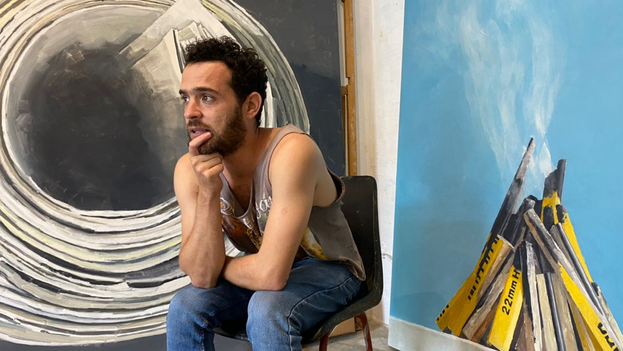
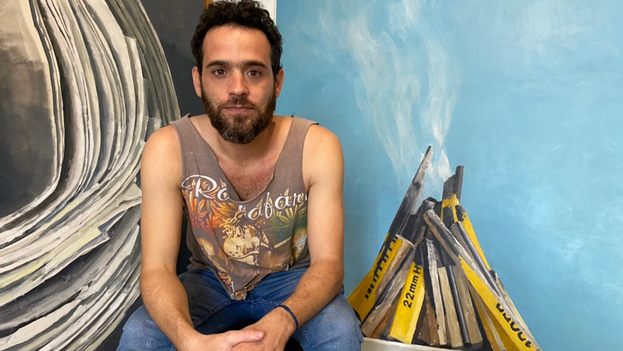
“I was interested in art since I was young, inspired by a super picturesque character who lived in my neighborhood, on the exact same block as me,” confessed Nelson Jalil. (14ymedio)
14ymedio, Luz Escobar, Havana,22 November 2020 — Nelson Jalil was born in Camagüey in 1984 and graduated from the Higher Institute of Art (ISA) in Havana, where he now has his studio in Nuevo Vedado neighborhood which he shared with his fellow countryman Lester Álvarez initially, who later went to live in Madrid. Now he has more space but he misses his friend.
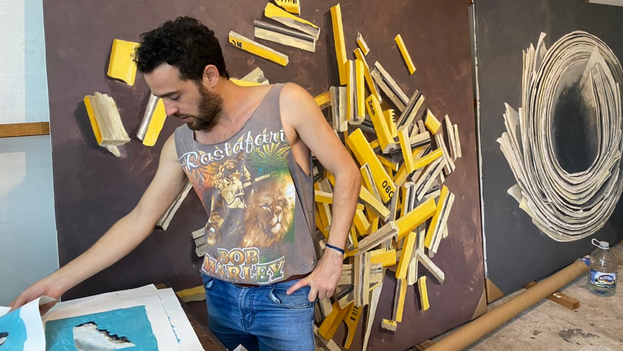
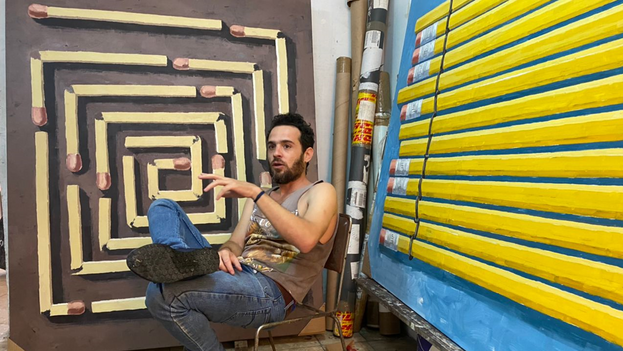
His pieces are woven from their title to their form, they are of such beauty that it makes you want to take them home and hang them on a wall. In the midst of canvases with broken pencils, burned books, a bonfire, a spiral staircase and a tremendous downpour in the background, 14ymedio spoke with Nelson Jalil this week.
Question: Looking at a group of pieces, I realized that your work and the creative process that leads to it have a lot of play, is that right?
Answer: This approach is quite exact. It is one of the ways in which I come close to the creative process in a general sense. I see it closely associated with the idea of leisure and, by extension, the idea of play. I told a friend some time ago that when I had a problem, I would close the studio and would solve it. When I recover that mental space that allows me to focus on the process that is creation, I would return. In the end, taking into account the way in which I operate with these objects that are small and the way in which they are assembled while I observe and deal with them, is very similar to the way in which a child interacts with a toy. continue reading
There is an initial idea that is very generally related to the interest I have in exploring the ability that these everyday, ordinary objects have to embody or express certain situations, spaces, or even human relationships
Q: What comes first, the object or the idea?
A: There is an initial idea that is very generally related to the interest I have in exploring the ability that these everyday, ordinary objects have to embody or express certain situations, spaces, or even human relationships. I gradually land that general idea, and from the way in which the objects are shaped when they begin to go in different directions, then more specific ideas arise and I can talk about a specific experience. This way, I go from a general interest and then I start to manipulate objects, to observe them and to interact with them, as if the same object were expressing that other concrete idea to me.
Q: Is this something that comes from when you were a kid?
No, I was not interested in working with objects until just a few years ago. I did a bit of everything, especially in one’s period of studies, when one experiments almost with all bases, with all media. Periodically, one becomes obsessed with a medium and another and already then when that interest arises, it becomes a discovery. From that point, I became more and more absorbed in the use of objects, until today.
Q: What was your first approach to art and the idea of being an artist?
A: My interest in art started when I was young, influenced by a super picturesque character who lived in my neighborhood, exactly on the same block as me. He was your typical character, half alcoholic, an ex-boxer who lived in very precarious conditions. They called him El Croqueta, he picked up pieces of dolls or Indian heads from a neighborhood handicraft workshop, soaked them and sat with some chopsticks pretending to be molding, thus in a very artistic pose. I would stop on my way to school and I would always sit with him and we would talk, to me. He was a great sculptor, to me, he was Rodin.
“After leaving school, I spent two years working intensively on a series of drawings, which was like the journey of that highly narrative photographic work I had done at ISA,” said Jalil. (14ymedio)
That was my first contact, from there I started to mold a little with clay, to draw. Then I got to know the very good art collection in the Camagüey museum, where my mother worked for a while, and visited the collection frequently. That was the moment when I started to draw formally, with the intention of entering art school.
Q: How do you remember those years at the Camagüey art school?
A: When I studied there it was not called as it is today, Vicentina de la Torre Academy of Art. We studied in what we call the old school, the process of change was quite sad. Previously, it was a spectacular space, a colonial house that shared the building that was the old cavalry barracks of the Spanish Army with the provincial museum. It had very nice wooden stairs, there was a lot of freedom, there were few students. Then came this madness of the renovated art schools and they had put everyone in uniform, they locked all the doors, the students had practically no access to the workshops, it changed a lot.
Q: And then the Higher Institute of Art arrived … what did that change mean?
A: The ISA was a discovery for me, it was not the best moment of the school by far, the whole crisis that the class programs had suffered when nobody wanted to teach had started, but it was a multicultural space. Training in the provinces, in the case of Camagüey, was much more technical and there were also several teachers who were concerned about the creative training part but it was still an even more limited vision, in the sense that we only had a couple of references.
On arrival at ISA, that spectrum opens up, starting with students from all over, with greater or lesser cultural background and different types of information, and I began to discover that what I thought was art was nothing more than a very specific way of understanding art, and teachers thought more or less the same way. Suddenly you learned that so-and-so had used a poem as the text of the discussion of his graduation thesis or that Whatshisface had written a diary… that began to dismantle a series of concepts for me stiffer than one brings from the province.
When you arrive at ISA, that spectrum opens up, starting with students who came from all over with greater or lesser cultural backgrounds and different types of information
Q: You belong to a generation of many artists who have opted for more conceptual art or installation rather than painting. Do you see any specific reason for this? How was it in your case?
A: This is cyclical, as always happens, people get bored. There are different periods, and the teachers are also influential. I remember anecdotes from moments when ISA students who wanted to paint had to practically hide because others made fun of them, I think It was in the 90’s. There have also been periods when they have solidly painted.
I painted very little at the ISA, I especially drew and, for two or three years, was absorbed with photography but lost my interest later on, to such an extent that even I was amazed. It was as if that language was completely exhausted for me and suddenly not had nothing to say about the subject. If at that moment in my life someone had told me that I was going to end up involved in installation projects like the ones I have done or the ones I have in mind, I would not have believed it. The conditions of the ISA were a bit rough for me, so I worked more with projects that I could take with me, more mental processes, those requiring less space.
Physical spaces were there, but it was when the restoration of the school was under way, and there was a certain chaos. This is not a justification, many people took up painting at that time, it was more of a personal process.
After leaving school, I spent two years working intensively on a series of drawings, which was like the transition of that highly narrative photographic work that I had done at ISA. Then I began to explore painting a little from these drawings, so that when I began to work with objects, both installation and assembled objects and painting, the two began to come out simultaneously, probably the result of the maturation of everything this previous search process that has been consolidating.
Q: It is also remarkable that there is a lot of influence of oriental culture in many artists of your generation, why do you think this is?
A: I think there are many things I do not want to question here, but in a general sense, for the younger generations the system that comes from this Judeo-Christian heritage has fallen into crisis for many and if the current access is added to it, we have to something that for other generations was much more unknown…
It is well known that if your curiosity or interest is of a spiritual nature, obviously there are useful tools that have been tested over the centuries. It is like having a box full of tools and you can try to connect with that specific area of knowledge you identify with more, and that does not necessarily have to be what you have received as a family inheritance.
“For me, the fact that the institution becomes a filter that determines who has a career and who doesn’t is fatal,” says Nelson Jal (14ymedio)
Several years ago, through friends who also come from the art world, I began to investigate these processes, where one almost always begins to do a little yoga and some meditation and I finally ended up being interested in a specific method that comes from of the tradition of Tibetan Buddhism. It was quite close to me and I connected with that type of practice.
I see that some artists intermingle very well, but in my case, I do not practice a type of art that is traditionally understood the way it is done in these cultural contexts, quite remote for me. I understand it more as a method of self-recognition and search that eventually expresses itself subtly through some idea that I can outline in my work.
Many of the most interesting ideas that I have had have come to me as distractions, everything is intermingled in an intermediate zone, which has to do with the creative process, but you are not making art in the formal sense, a very oxygenating processes that helps to continually review many processes most people are not aware of, especially on an emotional and spiritual level. A super useful tool.
Q: What are the latest works you have done, and how do you present them?
A: These are two groups of works that I have been developing, I do not even collect them or present them as a series. They are two groups, in two different supports: in paint, oil on canvas and a series of installations, in many cases, objects assembled in small formats. I was mentioning that I have developed them simultaneously, at first it was a bit tentative, it was difficult for me to talk about it because I was imbued in the process of discovering the possibility that all these objects offered me. It was extremely inspiring, but at the same time there were some things that I was not very clear about but, as always happens, the same work process reveals information or a certain type of knowledge that emanates from the same creative exercise.
I have been investigating the possibilities that ordinary objects, seemingly of little value which I stumble upon, offer me, or those that convey situations or behaviors that are intrinsically human.
In some cases, the objects are quite anthropomorphic, and in others, they are the result of some human action or behavior in some way. Obviously, the object is a pretext or an accomplice to express all these kinds of relationships.
Q: Have you been able to obtain the necessary sustenance in Cuba to make a living from art?
A: In my case, I have had the opportunity to sell works periodically without being fully inserted, in the sense that I have worked with the odd gallery dealer or through a dealer who has been in contact with me, or someone who reaches out and contacts me directly, which is a very good possibility. It is super random, it is unpredictable. In my case, it has happened intermittently, few artists aren’t well established enough to foresee when and how a specific work will be managed, although there are artists in that situation, obviously
There are people who can suggest or put you in contact with someone and it has been a bit like that in my case. I am not moving from here, whoever wants to come and see me, let them come. My job is to produce the work, whoever wants to do something with it, will simply pick up a phone and call me, I don’t think it’s more complex than that, I don’t think it’s the artist’s job to go around trying to force himself into the most necessarily appropriate space.
Q: Do you think that the arrival of mobile data and the possibility of having the internet at hand can help with that?
A: A few years ago, most of the artists who lived in Cuba couldn’t even have a website. It was absolutely impossible to upload an image of their work to any space for someone who was not physically in the same site as you to see it. Having access to a platform that allows this is a great advantage. I think it is more at the promotional level. It has been very interesting for me because of the kind of people I have met, artists that I admire who have connected with me, people I never envisioned having contact with.
Q: What impact do you think Cuban art in these times have had in the new independent spaces that have emerged?
“I painted very little at the ISA, I especially drew and spent two or three years absorbed with photography, which later ended up disinteresting me in such a way that even I feel amazed,” Jalil said. (14ymedio)
A: That is good, of course. The fact that the institution becomes a filter that determines who has a career and who does not is fatal for me. If the institution does not feel like recognizing an artist, either because it considers that he or she has no talent or because he is a complicated artist with a type of rebellious discourse or for whatever reason, it is terrible that he does not find another opportunity. I think it’s fantastic that there are other ways, because this filter is very dense in institutional spaces.
Q: How did you experience the phenomenon that the arrival of Decree Law 349 generated in Cuban art?
A: The first thing I did was read the letter that a group of artists had written, it was handed to me by Lester Álvarez. It seemed to me the same as to the rest of the artists who signed it, that it was dangerous to formalize those levels of censorship. I was traveling at that time, and just when I returned, these meetings had already begun. I think everything that happened was terrific because it somehow stopped what could have taken place if this decree was implemented with all the force and impunity with which it was planned.
Translated by Norma Whiting
____________
COLLABORATE WITH OUR WORK: The 14ymedio team is committed to practicing serious journalism that reflects Cuba’s reality in all its depth. Thank you for joining us on this long journey. We invite you to continue supporting us by becoming a member of 14ymedio now. Together we can continue transforming journalism in Cuba.
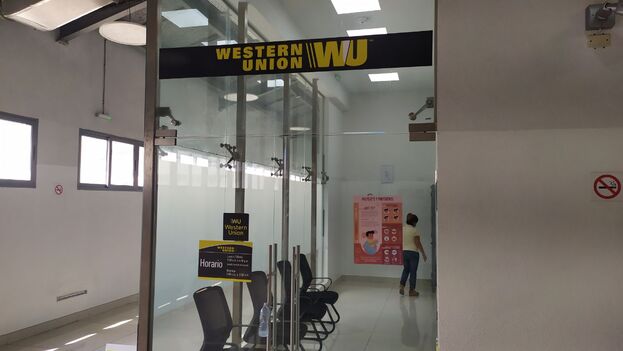
This Monday the majority of Western Union offices in Havana were almost empty. (14ymedio)
14ymedio, Juan Diego Rodríguez, Havana, 24 November 2020 — Four, three, two … A countdown marks the closing time of the Western Union office in Cuba this Monday. When the clock strikes six in the evening, a long era of remittances through the US company will be over, an end resulting from the sanctions imposed by Washington on its Cuban counterpart Fincimex.
If someone expected an avalanche of clients with long faces crowding the company’s offices, this Monday most of its stores in Havana have been practically empty. Only a few last-minute remittance recipients have come to the deserted hallways and been greeted by employees with a gesture of saying goodbye.
The deadline to collect the money sent from the United States expires this afternoon when the 407 branches that the company has on the Island will close after the Donald Trump administration included the Cuban company Fincimex on a blacklist, because it is controlled by the Cuban Armed Forces. Despite the efforts of the remittance giant, the Cuban side did not authorize another, non-military, partner to work with Western Union. continue reading
“Señora, the transfer number is mis-written, so we can’t pay you,” a Western Union worker explained to a woman who arrived at the office located on Belascoaín street in Centro Habana after noon. With last-minute nervousness, the woman mis-wrote the unique 10-digit transaction number her daughter dictated over the phone to receive the money.
“And now what am I going to do?” Asked the anguished woman who calculated she would not have time to call her daughter, who was in the middle of her workday in Miami, receive the correct number and collect the remittance. A problem that until yesterday would not have cost her any sleep, a a regular customer who received “Money in Minutes,” the motto that she learned by heart from reading so much of the company’s advertising.
Others just passed by one of the branches to take a look and see if it was true that the yellow and black colors that represent the company are now just the symbol of something past. “I was born with my grandmother saying that she was going to come down from the house for a moment to collect the money her brother sent her,” recalls Marco Ángel Suárez, a young man of 22
“This was like a member of the family because every now and then it came out in a conversation that I had to go through Western Union or that until the money arrived, I couldn’t buy tennis shoes or a new backpack,” he adds. “In addition, it is very close to our house because we live around the corner from the Plaza de Carlos III where there is an office.”
A few days ago, Suárez received a letter signed by the president of the company through a WhatsApp message chain. “We have been working hard on all possible alternatives to keep our service between the United States and Cuba open while we reorganize this vital channel for our clients. Unfortunately, we have not been able to find a solution in this limited timeframe,” the text added, Khalid Fellahi then explained.
“My soul fell to the ground,” acknowledges the young man. “Although there are other ways and I am sure that my great-uncle will continue to send the money, it is not the same. Western Union gave us security, seriousness and immediacy. With other companies we do not know because many are not even legally recognized here.”
In the midst of fears, there are always those who see the company’s leaving as temporary. “This is pure spectacle, but I don’t think we’ll get to July 2021 without Western Union,” says Dunia, a 47-year-old from Havana who believes that “Joe Biden’s victory will reverse all these measures.”
“It is better that they do not even remove the Western Union sign from these offices because soon we will see them open again,” Dunia insisted this Monday at noon outside the office on Obispo Street in Old Havana. Inside, the empty room was already a preview of a “see you later” that nobody knows how long it will last.
“They will find another way, money is like water, it always finds a way to enter,” predicted a newspaper vendor who makes a profit every day with the lines outside the branch. “I have never received a penny in this way but I know many people who eat thanks to this line,” he detailed to this newspaper. “When they wait to enter they buy peanuts, newspapers and sweets; but when they leave with the money they buy more.”
At a safe distance, a young man hands out a business card from a Miami-based company for sending remittances to Cuba. He offers discretion and brings the money “to the door of the house.” Nobody knows if small companies like these will be able to take on the enormous flow of cash that until today passed through Western Union.
Some 41% of the 3.7 billion dollars of remittances that arrived in Cuba in 2019 did so through companies with contracts with Fincimex, according to Emilio Morales, president of the advisory firm The Havana Consulting Group. According to the economist, the remittances sent to Cuba between 1993 to 2019 totaled 46.8 billion dollars.
At the moment, not a penny more will come through Western Union. Now, its customers do a new countdown: they are calculating the days until the company returns.
____________
COLLABORATE WITH OUR WORK: The 14ymedio team is committed to practicing serious journalism that reflects Cuba’s reality in all its depth. Thank you for joining us on this long journey. We invite you to continue supporting us by becoming a member of 14ymedio now. Together we can continue transforming journalism in Cuba.
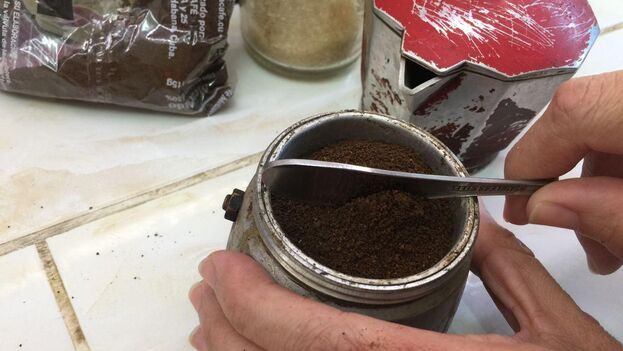
Cubans normally make coffee by pressing the ground coffee firmy into the coffee maker, but if you do that with coffee that is half peas, the coffee maker might explode all over the kitchen. (14ymedio)
14ymedio, Havana, 24 November 2020 – The coffee harvest is an urgent matter in Villa Clara. The rains caused by the effects of Hurricane Eta have spurred on the harvesters paid daily by the Jibacoa Agroforestry Company, as well as volunteers. All for the salvation of a “premium quality” coffee that will be mainly destined for export, as admitted by the State newspaper Granma, this Monday.
A day earlier, the also official site Cubadebate ran a special – titled “The ‘to be or not to be’ of coffee. Hello!” – on the coffee sold in the ration stores, which is mixed 50/50 with peas, a measure that has been practiced for decades despite the fact that the International Coffee Organization says that any product with more than 5% other mixed-in matter cannot be classified as coffee.
The official press reported on the mobilization that took place last Saturday to harvest the beans due to the urgency of completing the work in three or four days, according to Pedro Blanco Méndez, general director of the Jibacoa Agroforestry Company. Of the 8,000 cans (at 20 pounds per can) that were maturing upon Eta’s arrival, 65% had been harvested, but the remainder was lost in the mud. Those beans are what they want to save, with planned collection areas and a redoubling of effort. continue reading
According to Granma, the economic incentives created “an additional motivation to add new forces to the effort to contribute to achieving the 150 tons of coffee destined for internal and external trade, before the end of the year.”
Just enough of the crop will stay on the island so that after mixing it with peas – ‘fifty-fifty’ insists Cubadebate – to supply the rationed market. “We Cubans drink coffee because it ‘lights up’ our souls,” reads the text, in which it is confirmed that the product purchased in the ration stores – called bodegas on the island – is made up of 50% Arabica or Robusta and 50% peas.
To make matters worse, the report acknowledges that the 50% of the ration store ‘coffee’ that is actually coffee comes mostly from Brazil and Mexico, (curiously, Granma does not include Vietnam, which is Cuba’s main supplier) although, “sometimes some quantities from national production are used, especially from Guantánamo, Santiago de Cuba, and Cienfuegos.” Not a trace of the top-quality Villa Clara product promoted the day before in Granma.
The report attempts to respond to the criticism received about the coffee for sale in the ration stores, marketed under the ‘Hola’ (Hello) brand, which arose after the publication of an interview with Antonio Alemán Blanco, general director of the Cuba-Café Company, last October. In the interview the official admitted that the supply will not be able to satisfy the demand until at least the end of the year. Which includes the coffee for sale outside the ration system and even the coffee for sale only in hard currencies.
Alemán Blanco said that 85% of the available coffee is allocated to the “market basket” which each Cuban qualifies for under the ration system, to try to at least guarantee the product to that segment. In response, complaints rained down from readers who questioned the quality of a product that, thanks to the peas, was well known for making their coffee pots explode.
Cubadebate tries to respond to this general feeling among consumers, arguing that the bean is ‘supervised’ and that there are specialized tasters who test the product before it is put on sale.
This is backed up by the testimony of the head of the quality control laboratory at the Cabaiguán Roasting Plant, Suleika González Méndez, who explains that it is verified that the “coffee and pea” mixture that they receive meets the established requirements.
Ricardo René Pérez Pérez, director of Torrefactora, adds that the quality is also tested after roasting and if something goes wrong the process is stopped and they start again. In the roasting plant there are nine tasters and a laboratory that controls the smell, taste and appearance of the product. Finally, another control is carried out on each batch of finished coffee, repeating the process and samples are kept for a time to respond to possible complaints, they add.
With all this, it would be expected that the coffee, or rather that mixture that they consider coffee, is of good quality. But consumers complain that it does not turn out well and their stove-top espresso pots explode. The fault, of course, is theirs, for improperly preparing it.
“People do not believe it or they laugh at science, but one of the causes of poor straining in homes is that the proportion of water corresponding to the ounces or grams of the coffee used is not taken into account,” says González Mendez. In his opinion, it is “a serious mistake” to press down the coffee by pressing it with the spoon on the filter.
However, if the same operation is carried out with real coffee, the expert admits, coincidentally, that does not happen: “The difference is in the peas, which do not allow or assimilate well if you compact it inside the filter holder,” she acknowledges.
The text ends with the personal touch of its author, Yosdany Morejón Ortega, who, although optimistic about a future with real coffee, recognizes that the present is not promising. “It is also true that at the end of the day, there is not enough coffee for everyone’s buchito (‘little sip’) and it is not available in the domestic market. I do not use justifications, nor do I try to cover the sun with a finger, that is not my objective.”
____________
COLLABORATE WITH OUR WORK: The 14ymedio team is committed to practicing serious journalism that reflects Cuba’s reality in all its depth. Thank you for joining us on this long journey. We invite you to continue supporting us by becoming a member of 14ymedio now. Together we can continue transforming journalism in Cuba.