The story of the Spanish professor who went into exile in Santiago de Cuba, fleeing Franco, and who collected nearly 500 pieces of universal art.
 14ymedio, Xavier Carbonell, Salamanca, 2 August 2025 — Doctor Prat was a Catalan, born in 1906, who joined the Republican militia under the name of Francesc, lived in a concentration camp where he was called François, and died in Santiago de Cuba as Francisco (that is, Paco) in 1997. Collector, professor, archaeologist, exile, skeptic, he managed to gather 478 pieces of universal art despite being, for most of his life, a poor man.
It is said that he slept for 35 years on a small bronze Apollo Cithareo—his favorite sculpture—hidden under his mattress for fear of thieves. Is there any more Spanish custom or more Creole cunning? His students remember him carrying Greek amphorae and Egyptian statuettes on the long journey from his home in El Caney to the University of Oriente.
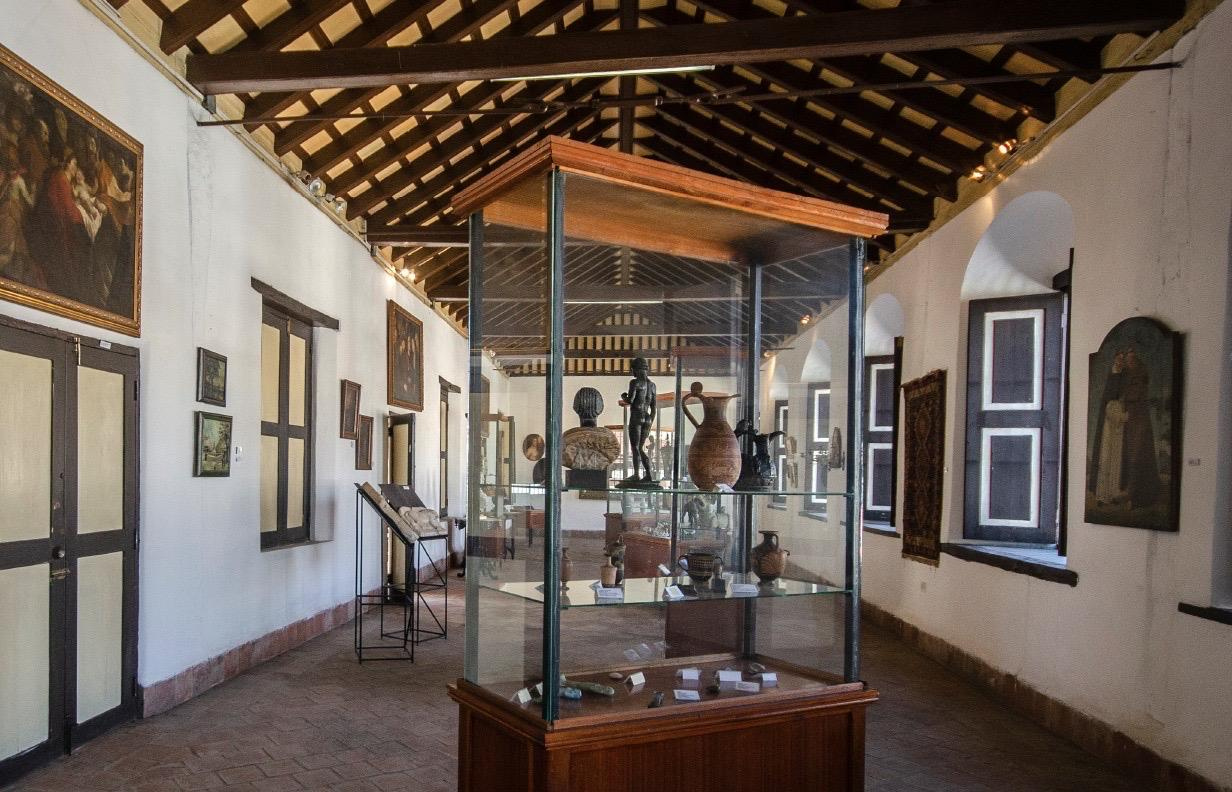
His biography is improbable; his collection, impossible. However, there was a Francisco Prat Puig, and his inventory of wonders exists, which, after many twists and turns, ended up in the former San Basilio Magno Seminary in Santiago. I can’t say much about the state of the pieces. A photo shows the hallway where they are now: a red brick floor, damp and cracked walls, no air conditioning, no protection from light, a couple of display cases.
Many researchers have raised eyebrows upon entering that corridor. They understand that millennia of art are at risk due to a minor historical incident: the Cuban Revolution. In terms of figures, 39 pieces of Sumerian, Egyptian, Greek, and Roman art will be lost; 26 pieces of pre-Columbian art—including objects from Cuba’s indigenous people; 25 pieces of medieval and Byzantine art—the largest collection in the country; 49 paintings, some of them Cuban, from the 15th to the 20th century; 25 manuscripts, from the 15th to the 18th century; and some 300 coins of diverse origins.
What is truly disconcerting is that Prat acquired most of these objects within Cuba.
What is truly disconcerting is that Prat acquired most of these objects inside Cuba. One has to imagine what the country was like in the 1940s and 1950s, the wheeling and dealing of smugglers and millionaires, the era of the Count of Lagunillas—owner of the Greco-Roman art collection at the National Museum—Bacardi, and Julio Lobo. Prat himself had a Jew named Schneider appear at his house during the middle of World War II to sell him a Roman ritual vase.
Prat traded one piece for another, offering his services in exchange for a funerary stele or an imperial coin. He had started as an archaeologist in Barcelona and then in France, when he had to flee Franco and cross the border in 1939, to be interned in the Agde concentration camp. From there, he took some prehistoric figures, first to New York, then to Miami, and finally to Havana.
In the Cuban capital, he encountered an atmosphere of xenophobia and academic exclusion. The university didn’t hire permanent foreign professors. José Gaos and María Zambrano, to name two notables, passed through the island, but eventually left. If the Republican exiles had found a less hostile environment (it was also the era of Franco’s fanatics and the founders of the Cuban Nazi Party), perhaps Cuba could have been Mexico. Perhaps, who knows, learning from them—learning to think—might have freed us from Fidel Castro.
When Santiago founded his university in 1947, he began hiring foreigners in open opposition to the Havana prohibition (“just as the East rose up against political colonialism, it is now doing so against cultural colonialism,” declared the faculty). Prat found a rental in El Caney and never left the neighborhood.
From the beginning, Prat conceived the idea of a Living Museum—what is now known as an immersive museum—an exhibition as representative as possible of all human art, accompanied by contextual explanations and learning exercises. He partially realized his dream while he was a professor, but was never able to find funding for the idea. The collection became “living,” but only because its owner constantly moved it from the classroom to his home, and from his home to temporary exhibitions.
In his possession was a 4,000-year-old Sumerian tablet, bearing a cuneiform inscription: “Six fat-tailed sheep, offerings to the god Enki, from Aba-Enlilgen.”
In his possession was a 4,000-year-old Sumerian tablet bearing a cuneiform inscription: “Six fat-tailed sheep, offerings to the god Enki, from Aba-Enlilgen.” He also possessed several Egyptian figurines known as ushabtis, metaphysical slaves who accompanied the deceased on their journey to the afterlife. One of them was instructed to speak in the name of “Osiris Padineith, righteous of voice, born of the lady of the house of Nekhbet,” and offered to “act” and say “here I am” when invoked.
Prat also had Greek pottery, vessels called olpes, lekythos, and hydrias, with black and red paintings of wild beasts and athletes. As for Roman art, he had found fragments of friezes with lions and a bust of the ill-fated Emperor Commodus.
At the end of his life, Prat had to protect his pieces from the bandits who swarmed Santiago during Cuba’s ‘Special Period’. He decided to donate his collection to the state. No one can explain why it hadn’t been confiscated sooner, as happened to so many collectors in the Soviet world (see Bruce Chatwin’s novel Utz, a small masterpiece about an obsessive collector of Meissen porcelain in Prague).
By then, he had already classified the entire collection—often inaccurately and bizarrely—on meticulous cards that he typed into his Remington typewriter.
Photos from the 1990s no longer show Prat, shovel in hand, a pose he loved, but rather as an old doctor with glasses, a cane, and the appearance of a venerable druid, a true Panoramix*. Spain paid several tributes to the Catalan, but it was too late. Francesc Prat i Puig had become Paco Prat and was Cuban. He died in Santiago on May 28, 1997.
*Getafix, in English. An Asterix character.

____________
COLLABORATE WITH OUR WORK: The 14ymedio team is committed to practicing serious journalism that reflects Cuba’s reality in all its depth. Thank you for joining us on this long journey. We invite you to continue supporting us by becoming a member of 14ymedio now. Together we can continue transforming journalism in Cuba.