Is it appropriate to hide the suffering of a people in the name of culture?
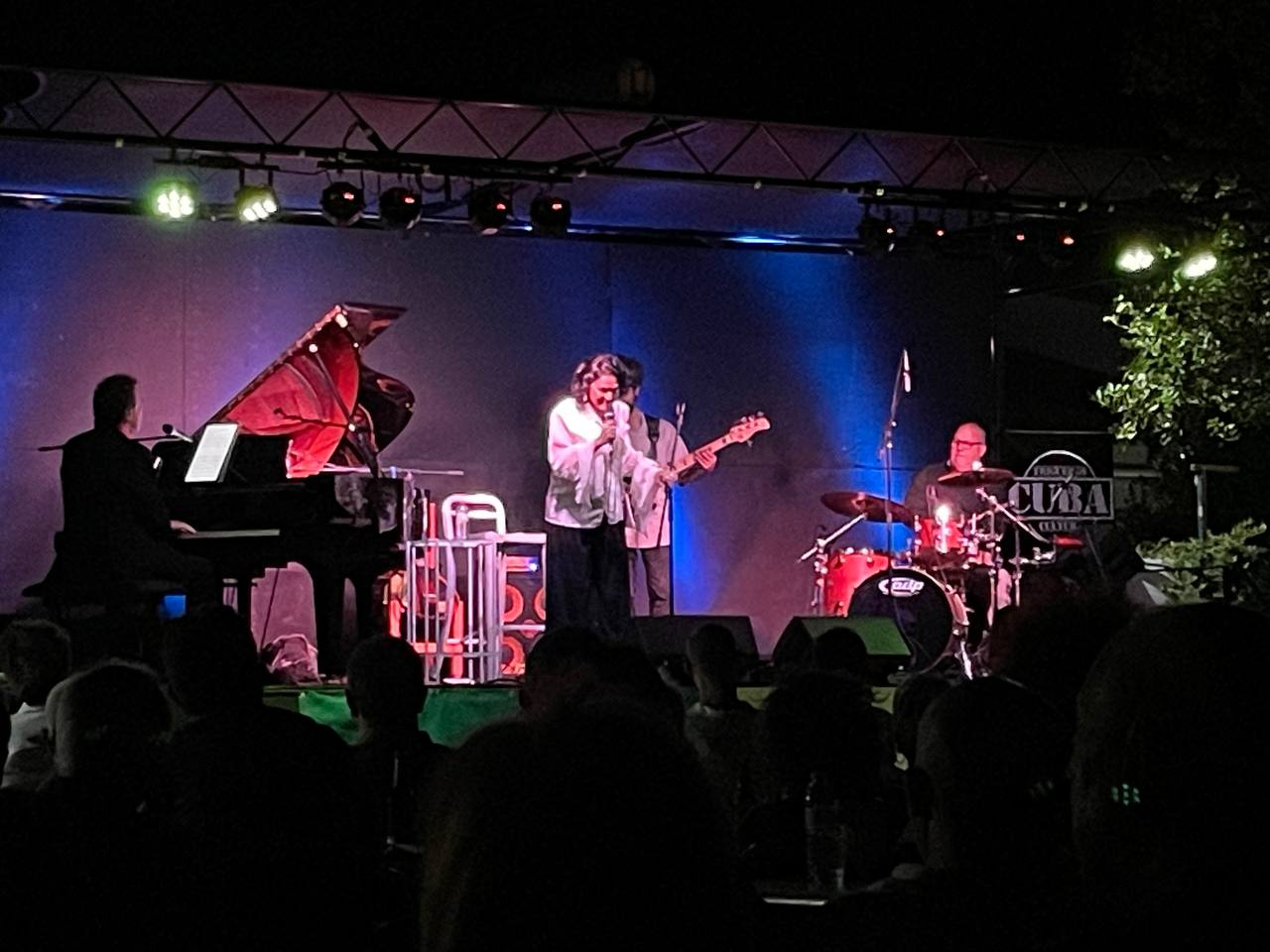
 14ymedio, Yaiza Santos, Huelva (Spain) — The voice of Gema Corredera and the piano of Roberto Carcassés transformed the Spanish village of Trigueros, in Huelva, into a haunted place on Tuesday. In the garden of the Harina de Otro Costal Art Center, sheltered by its giant fig tree, the fresh country breeze—even in August—enveloped the concert that kicked off the CubaCultura 2025 festival, now in its twelfth edition and scheduled to end on the 26th.
The performance featured mainly old songs, those themes of the Vieja Trova buried by the Revolution and rescued by foreign producers at the end of the 20th century, along with lyrics by Marta Valdés, to whose memory, as well as to that of flamenco guitarist José Luis de la Paz, the artist, musicologist and former member of the emblematic duo Gema y Pavel, the recital was dedicated to.
The audience, enthralled, hummed, clapped and danced, not without a certain ‘agallegamiento’ (sway) in the beat.
Earlier, Mirta Ibarra took to the stage, the star of the film series that will be shown during the festival, with the films Hasta cierto punto (1983), Fresa y chocolate (1993) and Guantanamera (1995), all of them directed by her life partner, Tomás Gutiérrez Alea, the last two together with Juan Carlos Tabío.
The actress spoke about the milestone that Fresa y chocolate represented – in a macho society like Cuba’s, “inherited from the Spanish” – and about the Casa de Titón y Mirta, the center dedicated to the filmmaker’s memory, to which the then Havana Historian Eusebio Leal provided a space in Old Havana and which now requests donations of equipment for its film production project.
The cultural authorities from both the Huelva Provincial Council and the Trigueros City Council also spoke
The cultural authorities from both the Huelva Provincial Council and the Trigueros City Council, which fund the event, also spoke, praising the large turnout, which grows every year, and the quality of the guests.
Over the years, musicians such as Haydée Milanés, Kelvis Ochoa, Ernán López-Nussa, and Javier Ruibal have passed through the venue, as well as the writer Leonardo Padura, who stayed in Trigueros for a whole week in 2022, and the actor Vladimir Cruz.
The festival began in 2014 at the instigation of Cuban actress Laura de la Uz, her husband, photographer Héctor Garrido, originally from Huelva, and the couple formed by painter Juan Manuel Seisdedos, born in Trigueros, and Lourdes Santos. This renowned Andalusian artist and his wife had already been catalysts for culture in the municipality since 2011, when they converted an old factory not only into their home but also into the Harina de Otro Costal center.
“It’s 20 euros, 10 for those who live in Trigueros,” Santos herself informed the attendees arriving at the venue. “This is a private event, and we have to give a significant portion to the musicians.”
Indeed, the organizers are the family-run businesses Volumen Huelva (which manages Harina de Otro Costal) and ARTeHOTEL Calle2, the boutique hotel owned by De la Uz and Garrido in Havana, right in the heart of Vedado. It also appears that the ICAIC (Cuban Institute of Cinematographic Art and Industry) is “collaborating,” as in previous years.
That a cultural festival dedicated to Cuba in a remote village in southwestern Spain has not only survived for more than a decade, but has appeared on the summer calendar as a must-see event, is nothing short of a miracle. But the miracle seems to come at a price: not talking about politics.
A single comment from Gema Corredera, when the lights went out momentarily on the stage, alluded to the reality that the Island is experiencing today.
A single comment from Gema Corredera, when the stage lights briefly went out, alluded to the current reality on the island: “We don’t want the power to go out; there are already enough blackouts in Cuba.” And only the most discerning could see the declaration of principles implied by presenting a pre-revolutionary repertoire from a marginalized artist like Valdés. Beyond that, nothing. A spectator might well think, in fact, that this cultural exchange is with a normal country.
A normal country where wonderful artists flourish and prosper. A place with freedom of the market and of thought, of association and political choice. A fertile place, as it once was, full of movie theaters, sugar, and dairy cows. A place where basic services are guaranteed, with education, healthcare, water, and electricity. A place where people aren’t debased by poverty or driven mad by the vigilance of neighbors.
Firmly believing, as I do, that an artist is not an activist, that culture saves and unites, that spaces far removed from the noise of polarization are necessary, and that art is not a bad place for the beginning of a future democratic Cuba, I continue to torment myself. Is it appropriate to hide the suffering of a people in the name of culture?
____________
COLLABORATE WITH OUR WORK: The 14ymedio team is committed to practicing serious journalism that reflects Cuba’s reality in all its depth. Thank you for joining us on this long journey. We invite you to continue supporting us by becoming a member of 14ymedio now. Together we can continue transforming journalism in Cuba.