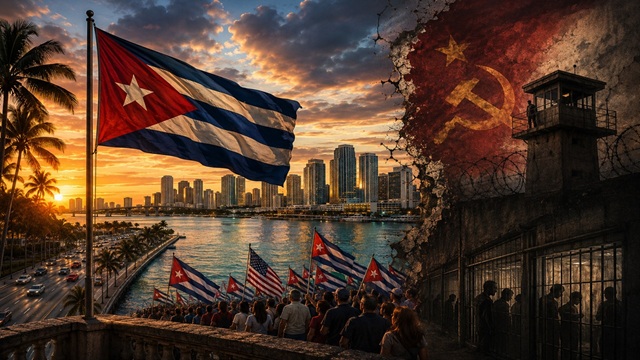
The CubanAmerican Voice, Julio M. Shiling / The Cuban nation has two great cities. One is Havana, the historic capital that today remains captive under the weight of a Marxist-Leninist dictatorship. The other is Miami, a city within the territorial jurisdiction of the United States but one that has, over the decades, become no less Cuban than Havana itself. If Havana embodies the tragedy of an occupied republic, Miami represents the continuity of the Cuban nation in freedom. It is there that a vigorous exile community has preserved the ideals of constitutional government, individual liberty, and democratic restoration. It has become the political, intellectual, cultural, and economic center of a Cuba that refuses to surrender.
For more than six decades, the Cuban nation beyond the island has maintained a remarkably consistent position. The crisis of Cuba cannot be solved through cosmetic reforms, administrative adjustments, or economic openings designed merely to prolong the life of the existing regime. Genuine national reconciliation requires something far more profound: the complete dismantling of the totalitarian system and the restoration of a democratic republic governed by the rule of law. Whether the Castro-Communist state were to imitate the economic models of China, Vietnam, or post-Soviet Russia would not alter the fundamental reality that a Leninist political monopoly remains incompatible with liberty.
It is precisely this unwavering position that has become one of the dictatorship’s greatest strategic obstacles. Since 1959, Castro-Communism has devoted enormous resources to influencing, dividing, infiltrating, and neutralizing the Cuban nation abroad. Opposition organizations, academic circles, cultural institutions, political networks, business communities, and media platforms have all, at various times, become targets of influence operations designed to weaken support for democratic change. The objective has rarely been to persuade the exile community to embrace communism outright. A far more attainable goal has been to cultivate neutrality, resignation, ambiguity, or fatigue regarding regime change itself. That effort has largely failed.
If anything, Miami has become the principal democratic reserve of the Cuban nation. It has generated the political leadership, institutional memory, economic resources, and international advocacy that continue to expose the true nature of Castro-Communism before the world. Recognizing this reality, the dictatorship has steadily refined its methods. Since the 1990s, the campaign to domesticate Miami has accelerated considerably. Each passing decade has witnessed increasingly sophisticated efforts to normalize the dictatorship, blur moral distinctions, and redefine what constitutes acceptable discourse about Cuba. Today, with a U.S. administration placing renewed attention on Cuba and a Cuban-American Secretary of State helping shape Washington’s policy toward the island, the strategic importance of neutralizing the external Cuban nation has become even greater from Havana’s perspective.
It is within this broader strategic context that certain carefully cultivated narratives deserve thoughtful scrutiny. One fact is beyond serious dispute. Cuba’s political prison system has, for decades, been documented by former prisoners, families, international organizations, and countless eyewitnesses as a system characterized by severe deprivation, psychological coercion, physical abuse, arbitrary punishment, prolonged isolation, and systematic violations of human dignity. This is not an isolated allegation but the overwhelming historical record. It constitutes the rule rather than the exception.
History also teaches that exceptions exist. Throughout the history of communist prison systems, some inmates have accepted varying degrees of accommodation with prison authorities and, in return, experienced treatment less severe than that imposed upon the majority. Such cases have appeared in many authoritarian systems. Their existence does not invalidate the brutality of the system itself; rather, they underscore the discretionary power of totalitarian institutions to dispense privilege selectively whenever doing so serves institutional interests.
Against this well-established backdrop, accounts involving the production of thousands of works of art during incarceration, the regular enjoyment of exceptional food, privileged access unavailable to ordinary inmates, or other unusually favorable circumstances naturally invite legitimate public questions. Such anomalies cannot simply be detached from the broader realities of a prison system whose defining characteristic has long been repression. Extraordinary experiences within an extraordinarily cruel prison system demand extraordinary explanation.
One need not allege formal recruitment or conscious collaboration to recognize how authoritarian intelligence services operate. Modern influence operations frequently rely not upon overt agents but upon situations, narratives, personalities, and circumstances that objectively advance strategic objectives. An individual need not intend to serve propaganda for propaganda to derive benefit from the individual’s public image, testimony, or conduct.
The objective is not necessarily to persuade observers that Cuba’s prisons are humane. Such a claim would collapse under the weight of thousands of testimonies accumulated over more than six decades. Rather, the purpose is subtler: to introduce confusion where moral clarity once existed; to normalize exceptional cases until they appear representative; to replace overwhelming historical evidence with carefully amplified anomalies; and, above all, to transform the extraordinary into the ordinary. This is the banality of evil in another form—not the outright denial that oppression exists, but its gradual dilution through selective storytelling until the exceptional overshadows the rule.
The dictatorship has long understood that every successful totalitarian project requires more than police power. It requires the construction of a cultural environment in which citizens begin to question realities that were once self-evident. It seeks not merely obedience but the redefinition of truth itself. What has been accomplished over decades inside Cuba is now pursued, by different methods, beyond its shores. The battlefield is no longer confined to the island; it now extends into the institutions, media, and cultural life of the free Cuban nation.
For that reason, Miami must remain intellectually vigilant. The response cannot mirror the intolerance of the dictatorship. Every individual possesses the right to speak freely, to create art freely, to express unpopular opinions freely, and even to employ language or behavior that others may regard as vulgar or offensive. These freedoms distinguish democracy from totalitarianism and must remain inviolate. Yet freedom of expression has never implied freedom from public examination. Others possess an equal right to question extraordinary claims, analyze improbable circumstances, criticize public conduct, and evaluate narratives against the accumulated evidence of history. Democratic discourse demands precisely that exercise of reasoned judgment.
The battle for Miami is therefore not merely geographical. It is a battle over historical memory, moral clarity, political legitimacy, and the future identity of the Cuban nation itself. Havana understands that as long as Miami remains intellectually unconquered, the democratic aspirations of the Cuban people remain alive. In the end, the most consequential work of art has not been painted on canvas. The real painting, in this recent case, has been painted by Castro- Communism.