Customers complain that they have to give extra money to employees to access more food despite the “all-inclusive” offer
 14ymedio, Julio César Contreras, Matanzas, January 9, 2025 — In Varadero, paying for an “all-inclusive” hotel is no longer a guarantee of a hearty meal. Those who arrive on the Hicacos Peninsula seeking a few days free from domestic worries discover this, sometimes with bewilderment and other times with resignation. At the Barceló Solymar, one of the best-known hotels in the area, the price—$62 per night—doesn’t always translate into full plates
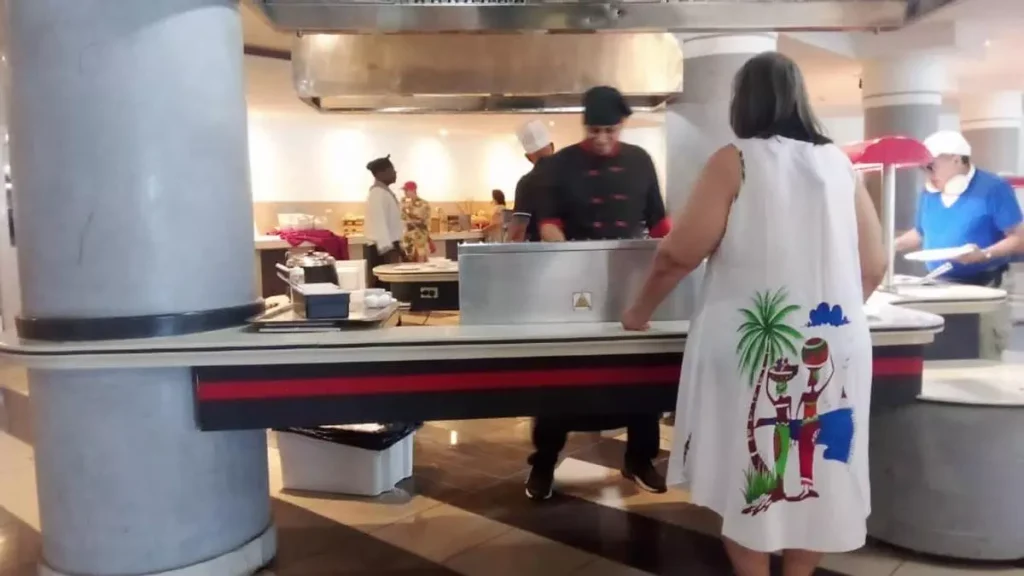
On the buffet trays, side dishes abound; the meats, on the other hand, seem like museum pieces, guarded by employees who react with surgical precision. “When I walked past the roast pork, the employee tossed me such tiny pieces that they were barely visible on the empty plate,” says Iván, a Cuban resident of Miami who returned to the island to give his family a worry-free New Year’s Eve.
The learning curve was quick. “With a 500-peso bill, the waiter will serve you whatever you want. There’s no need to hide giving him the money. It’s like an advance tip so you can eat without going hungry,” explains Iván, who hadn’t been to Cuba in seven years and had never stayed at this hotel. The shock of reality was twofold: even paying for the room in dollars doesn’t protect you from shortages, and the “all-inclusive” concept isn’t immune to the logic of the informal market that permeates daily life in the country today.
Before taking their first course, some diners hold a banknote in their hand to give them the impression of being at a buffet
The scene repeats itself table after table. Before taking their first course, some diners hold up a bill, hoping to give themselves the impression, at least for a little while, of being at a buffet. “The food here cost me more than if I’d gone to a restaurant on the street,” says Eddy, his desire for a variety of desserts unfulfilled. “The only thing you can eat as much as you want of without paying extra is the rice and beans. Everything else is rationed or runs out quickly, like the chocolate ice cream that ran out and they didn’t replenish it. To eat without so much hassle, you have to come when the restaurant opens. Anyone who arrives late, with or without money, doesn’t get much.”
Among the guests, a Cuban accent predominates. Families residing on the island and emigrants who have returned to share vacations occupy most of the tables; a few Canadian tourists complete the scene. Emma, one of them, isn’t willing to pay more. “For a four-star hotel, the buffet is very limited,” she says. “The main courses only have pork, ground beef, and fried chicken. It’s paltry for what you’d expect from a place like this.” She also finds no variety in salads or seasonal dishes, and she’s already considering leaving earlier than planned. “I’ve spent two nights eating boiled tomatoes and plantains. It’s not what I expected.”
Breakfast offers no respite. “In front of me, a Russian tourist was given an omelet with only one egg. I gave the cook 200 pesos and even then I had to demand he make mine with ham,” Eddy recounts. He came hoping for a variety of yogurts; lacking them, he ended up drinking milk. “It’s the same story as lunch and dinner. To get the best, you have to pay for it. If I had known I’d be eating bread and butter here, I would have stayed home.”
During meals, some vacationers also pay to ensure they get cold beer at the table. Tipping ceases to be a voluntary gesture and becomes a requirement to avoid being left watching other dishes go by. “My two children were so excited; I’d never been able to bring them to a hotel like this before,” says Eddy. “Thanks to my father-in-law, who made the reservation from abroad, we were able to come. He paid $496 so the four of us could spend two and a half days eating whatever we wanted, not being restricted like this.”
The contradiction becomes clear when a public relations representative approaches with a survey about the hotel’s operations. While the form asks about customer satisfaction, the table waits for the waiter to return with another round of drinks, previously “arranged.” In Varadero, even under the all-inclusive label, scarcity has found its way onto the table, reminding visitors that, even now, eating well in Cuba remains exorbitantly expensive, even on vacation.
____________
COLLABORATE WITH OUR WORK: The 14ymedio team is committed to practicing serious journalism that reflects Cuba’s reality in all its depth. Thank you for joining us on this long journey. We invite you to continue supporting us by becoming a member of 14ymedio now. Together we can continue transforming journalism in Cuba.