
Cuba and the End of the Historical Generation

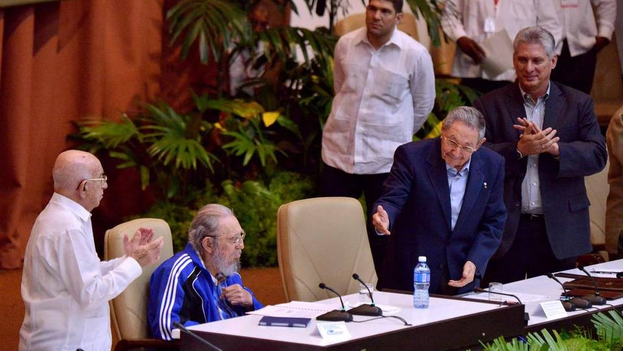
Three Cuban presidents (past, present and future) in a photo taken during the 7th Congress of the Cuban Communist Party (EFE)

14ymedio bigger14ymedio, Yoani Sanchez, Havana, 24 September 2018 — Nearly 60 years after its triumph, the Cuban Revolution today does not resemble what it was or what it pretended to be. In almost six decades, those bearded youth who came down from the mountains went from generating dreams to provoking fear or apathy. Their formula for staying in power has been a mixture of obstinacy and political cynicism.

Of those one hundred founding figures, rebaptized today as the “historical generation,” there are barely a dozen survivors of whom only four occupy key positions. Fidel Castro’s ashes repose in a stone and his brother Raul has passed on the powers of the Government while preparing for his replacement at the head of the Communist Party.

A quarter of a century after the collapse of socialism in the countries of Eastern Europe, and in the midst of a crisis of the left in Latin America, Cuban socialism has had to adapt to new times on a globalized planet where the concept of “capitalist countries” encompasses virtually the entire rest of the world. In order to not perish it has borrowed practices and formulas that it once rejected. continue reading

One of these cyclical make-overs is happening right now with the process of constitutional reform. This process is marked, on one hand, by the stubbornness of official thinking, which maintains that the system is irrevocable, and, on the other, by an excess of hopefulness among the reformist sectors which are betting on the Constitution being a step on the long road toward the transformation of the country.

Outside these two postures is positioned the extensive bloc of pessimists, who think that as long as there is no change in what has to change everything in Cuba will remain the same.

Irrevocability

The Constitution, which is being cooked up under the strict surveillance of the only party allowed in the country, maintains the concept that “socialism and the established political and social revolutionary system are irrevocable.” Thus, when Cubans go to vote on the constitutional referendum, on 24 February 2019, they will be ratifying or rejecting a straitjacket.

Raúl Castro has prepared a meticulous framework of 224 articles to leave the new generation of officials with a cast-iron system, in which it is almost impossible to promote a change of direction from within. The Constitution is the road map that can’t be deviated from by a single inch, or at least that is what the ex-president has planned.

Not even Parliament has the power to reform this principle of irrevocability that functions as a legal constraint for the new generation preparing to take the helm of the national ship, a generation that may be tempted to take the reforms too far, once the group of the historical generation has finally been extinguished.

The extensive text is the last move by the olive-green octogenarians to control the country beyond their deaths, to win the game of biology and continue to determine the fate of Cuba.

Reformist hopes

The most optimistic believe that despite the rigid bars imposed by some articles of the Constitution, other articles open a space for greater economic and social freedoms.

In the new Constitution that is now being promoted, the use of the word communism to define the final goal of the Revolution has been removed, the explicit purpose of eliminating the exploitation of man by man has disappeared, private ownership of the means of production has been accepted and the market’s role in the economy is recognized.

These adjustments open the way for the eventual establishment on the Island of a model in the Chinese or Vietnamese style, where the Party maintains rigid political control while the State renounces its monopoly on property. Economic centralism is undermined by the acceptance of other forms of management, but it is clear to entrepreneurs that they cannot grow or enrich themselves beyond a strict limit.

Other points, such as the acceptance of equal marriage or the regulation of the maximum age of senior officials in the country, are part of an attractively wrapped package within which they want to hide the poisoned candy of the Constitution. With these flexibilities, the ruling party wants to attract the LGBTI community and other reformist groups to endorse the document, despite the fact that the rest of the articles have an immobile and reactionary character.

In the public debates being held on the project, many voices are heard calling for permission for nationals to have the right to invest on equal terms with foreigners and it has been proposed to eliminate the article that inhibits “concentration of ownership in natural or legal non-state persons.” But so far these are only proposals and nobody knows if they will be reflected in the final document.

Optimists also worry about the oscillations or the backward steps that accompany each advance.

While it appears that the long dreamed of aspiration to be able to access the internet will be realized by the end of this year through connections from mobile phones, the ruling party has launched an offensive against the independent dissemination of content and the non-governmental press, which has had its climax in the enactment of Decree Law 349, which tightens the screws on cultural censorship.

Laws have recently been enacted to control entrepreneurs, who are not yet allowed to export or import and who lack a wholesale market to supply them with resources. The new enemy of the Cuban Revolution is – and has been for some time now – the private sector that is outperforming the State in services and quality.

For the Government, self-employed workers are a group that they suck the blood out of with taxes and fines, but also a group that should not be given wings to expand too much or allowed to organize themselves in unions. It is precisely in this area of ​​civil liberties that the system is most reluctant to take steps forward, fearing that a small opening that allows free association will jeopardize the monopoly of the Communist Party.

All or nothing

Despite the surveillance and repression, the sector of discontented Cubans has grown significantly in recent years and numerous nuances have appeared. This critical sector encompasses citizens who suffer, without protesting, the harsh reality where a salary is not enough to feed a family, where market shelves are empty and public transport has collapsed, but also activists who take to the streets to shout slogans demanding democracy and respect for human rights.

Among the latter, especially, the idea prevails that the only solution to the country’s problems necessarily involves “the overthrow of the dictatorship.”

According to this point of view, there is no other way, given the fact that the generational change in power is being cemented by the irreversibility of the system and a single party that presents itself as “the leading force of society and of the State.”

However, outlawed and with few resources, without access to national media and constantly monitored, the likelihood of activists decapitating the system seem nil.

For the opposition, the constitutional referendum could become the only opportunity in a long time to send a message to the regime. For years, disunity, personal conflicts and the constant work of the political police have taken a toll on dissident groups. The diplomatic thaw between Washington and Havana deepened that fracture and divided civil society between those who accepted the rapprochement and those who rejected it.

Now they are at the crossroads of uniting around a No vote in the constitutional referendum or allowing the Government to end up closing the cage with a Constitution that aims to perpetuate the system. In the coming months, the decisions taken by the most important opposition leaders will become clear.

For the moment, there are already many arguments which could convince the ordinary citizen of the need to reject the Constitution. The promise of a bright future that Castroism offered as one of its most important popular pillars has vanished from so much failure to deliver. Nor is there a charismatic leader capable of dragging the masses to new heights of sacrifice.

In the national context the new generations lack enthusiasm, both to surrender their youth to the socialist utopia, and to rebel against the regime. The escape valve of emigration that functioned for decades has been largely closed by the end of the wet-foot/dry-foot policy in United States, the main destination of Cubans.

It is a moment of fragility for that process called the Cuban Revolution. A system that arrives at six decades of existence without having been able to fulfill a good part of its promises, but with the intention of staying in power by force and with a Constitution that consecrates it for eternity.

_____________________

Ed. note: This text has been published by the newspaper La Prensa Gráfica which authorizes this newspaper to reproduce it.

The 14ymedio team is committed to serious journalism that reflects the reality of deep Cuba. Thank you for joining us on this long road. We invite you to continue supporting us, but this time by becoming a member of 14ymedio. Together we can continue to transform journalism in Cuba.
Venezuela: And if Almagro is Right?

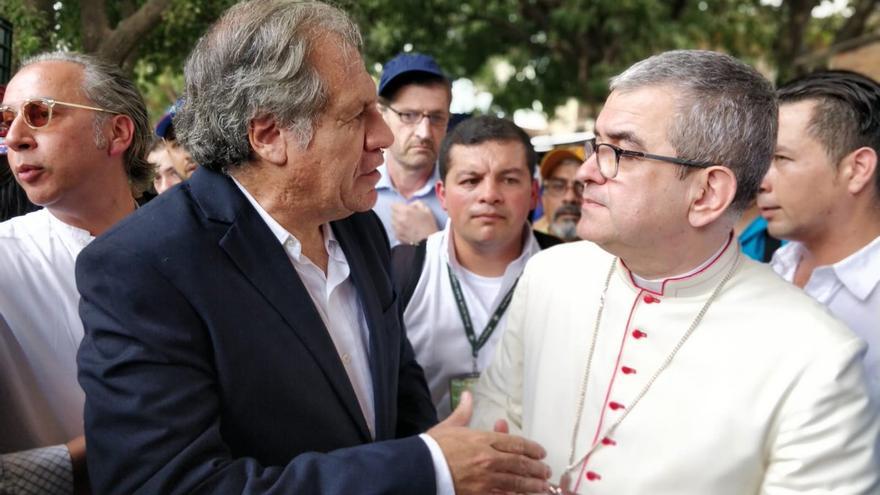
Luis Almagro made some controversial statements during a visit to the Divine Providence canteen and temporary help center for migrants in Cúcuta.

14ymedio bigger14ymedio, Carlos Malamud, Madrid | 17 September 2018 — The statements of the secretary general of the Organization of American States (OEA), Luis Almagro, went around the world and caused a great scandal both internally and externally. On the Colombian-Venezuelan border, ground zero of a migratory catastrophe turned into a regional drama, Almagro was asked about a possible intervention. His response, blunt and without room for subsequent nuances, was the cornerstone of the scandal: “As for a military intervention to overthrow the regime of Nicolás Maduro I believe that we should not discard any option.”

The enemy camp felt his words to be an open provocation and accused him of subordinating himself to the plans of the United States. Venezuelan Vice President Delcy Rodríguez said that he was looking to revive the “worst measures” of “imperialist” military interferences in Latin America and even announced a complaint in the UN for “promoting a military action.” continue reading

The Chavista accusation against US imperialism is paradoxical considering Venezuela has just sold its soul in oil to Xi Jinping. This way, China will intervene to “finance development” and also to influence “the form of governing this country.” Even if, as Maduro reminded us, the biggest difference from Yankee imperialism is that China wants a future “without hegemonic rule that blackmails and dominates.” And if he says it, you have to believe him.

The bewilderment among the sectors most critical of the Venezuelan regime was great. Eleven of the fourteen countries of the Lima Group rejected any military intervention in Venezuelan territory. There were also those who branded Almagro’s words as undiplomatic. It’s true, his statements were not an exercise in subtlety, nor do they allow the possibility of keeping open negotiations, neither regional nor multilateral.

However, the diplomatic option was closed a while ago, and not by the international community, but rather by the constant insults and declarations of a regime that refuses to negotiate both inside and outside of its borders. The imposition of an unconstitutional Constituent Assembly or the aggressive conduct of Delcy Rodríguez when she was the Minister of the Exterior and triedto firce herway into a meeting in Buenos Aires where the suspension of her country from Mercosur was being discussed and to which she had not been invited, are only a few examples.

Almagro could not be diplomatic where there was no space for diplomacy. Nor did he encourage, as his critics claim, a military intervention, but only said that it could not be discarded. Venezuela is at a dead end. No short-, medium-, or long-term solution is in sight. The most complete catastrophe has installed itself in the country and not even Chinese patience can solve it.

In the current conditions it is difficult for anyone to promote or sustain an external intervention. From within is another thing, but here it seems complicated, given the Cuban infiltration in the military and the complicity of its chiefs with the regime. In reality they are the regime. The civic-military alliance is by now more military than civilian and it is the heaviest legacy of Hugo Chávez. This, along with his supposed “Bolivarian Revolution,” was the path chosen to destroy Venezuela.

 Translated by: Sheilagh Carey

____________________________

The 14ymedio team is committed to serious journalism that reflects the reality of deep Cuba. Thank you for joining us on this long road. We invite you to continue supporting us, but this time by becoming a member of 14ymedio. Together we can continue to transform journalism in Cuba.
Latin America and the New Populist Cycle

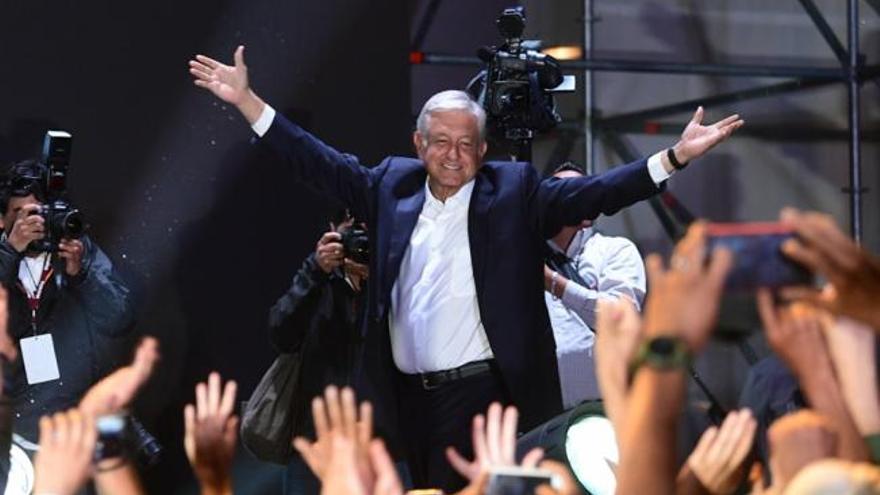
Andrés Manuel López Obrador has legitimately won the Mexican elections and is not expected to govern with prudence. (@PartidoMorenaMx)

14ymedio bigger14ymedio, Carlos Alberto Montaner, Miami, 23 Septmber 2018 — In Mauricio Macri’s Argentina the Peronists do not give a damn that Cristina Kirchner and her husband were two world-class thieves. “Whoremonger or thief, we want Perón” is still the slogan of the tribe. Maybe we are not Republicans. Or sufficiently Republican. To be so, it is essential to voluntarily place oneself under the authority of the law and to respect the dictates of impartial courts, but that is particularly difficult for us. Republics are fragile structures that are only able to breathe in a virtuous atmosphere. Outside of it they die or become something else.

In the Brazil of ‘Lula’ da Silva and his Odebrecht cronies more or less the same thing happens as in Argentina. Cheating, bribes, massive frauds were the order of the day, but to the supporters of the charismatic leader those violations of the law made no difference. Just recently it was learned that Lula himself, against the opinions of his own technicians, gave instructions for the National Bank for Economic and Social Development of Brazil (BNDES) to lend 600 million dollars to Cuba under very favorable conditions. continue reading

The objective was to put the development of Cuba’s Mariel Port in the hands of Odebrecht, knowing that the island could not repay the loan. A substantial part of that credit returned to Brazil in the pockets of corrupt politicians. It was the slice that Odebrecht distributed clandestinely, paid for with the taxes of the mocked Brazilian people. The project, by the way, carried out by a developer that would charge reasonable profits, cost half the amount paid to the Brazilian company.

Despite this filthiness, Lula headed the polls until the courts forbade him to run for president. After this impediment for corruption, imposed by Sergio Moro, an exemplary judge who set up the criminal investigation called the Lava Jato, and who has faced the political mafias of the Workers’ Party with enormous courage, Lula has chosen Professor Fernando Haddad to replace him. Haddad is a radical political professor, former failed mayor of Sao Paulo, also with pending charges of corruption against him. Simultaneously, he has recruited the young journalist Manuela d’Avila, deputy star of the Communist Party of Brazil, as Haddad’s vice president. The selection of the pair shows how things really work. Capital is terrified and is running out of the country through all the available holes. As has been said so many times, “there is no animal more cowardly than a million dollars.”

At the other end of the electoral spectrum, Jair Bolsonaro, the candidate of the right in October’s upcoming elections, a former captain of paratroopers, doesn’t respect the current legality too much either. He speaks with nostalgia of the time of the military dictatorship, justifies the torture, at the time had phrases of praise for Hugo Chávez, and regretted that the army had not shot 30,000 people, including former president Fernando Henrique Cardoso, whom he accused of connivance with the Workers’ Party. Meanwhile, former General Hamilton Mourao, his vice president, mumbles badly about the chances of a coup if they lose the election for alleged fraud. Some in Brazil call Bolsonaro the Brazilian Trump. May God have mercy on our souls.

It is very possible that we are again entering a populist cycle. Macri in Argentina could lose power as a result of the economic crisis. Haddad could defeat Bolsonaro and establish a leftist populist regime. Or Bolsonaro could defeat Haddad — they are tied in the polls — and start a kind of right-wing populist  of a republic. Andrés Manuel López Obrador has legitimately won the Mexican elections and is not expected to govern with prudence.

In Latin America, all the the evil dictators — Nicolas Maduro, Daniel Ortega, Evo Morales, Raul Castro and his handpicked Diaz-Canel — don’t even have to sit patiently at the doors of their houses and wait for the corpses of their enemies to pass by. All they have to do is entrench themselves in power and wait for a new populist cycle. Which we are in.

 _____________________________

The 14ymedio team is committed to serious journalism that reflects the reality of deep Cuba. Thank you for joining us on this long road. We invite you to continue supporting us, but this time by becoming a member of 14ymedio. Together we can continue to transform journalism in Cuba.
The Perseverance of ’Cuba Posible’

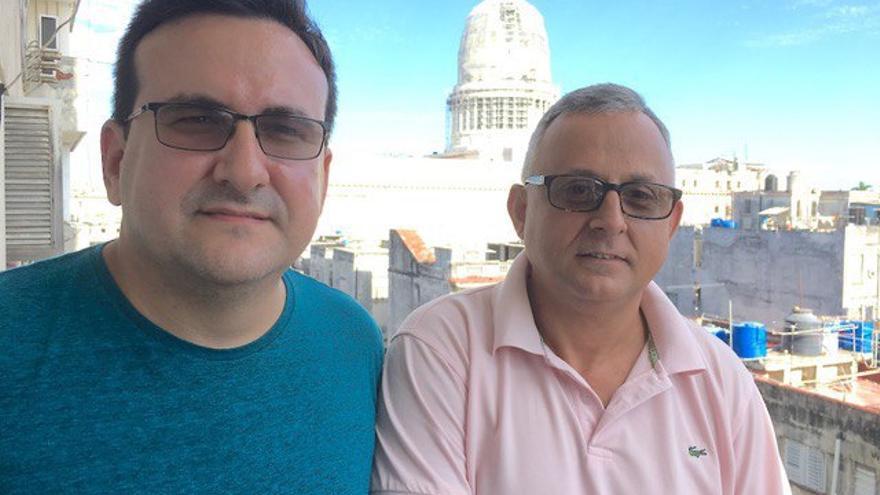
Roberto Veiga and Lenier González started the project with Espacio Laical in 2005. (14ymedio)

14ymedio bigger14ymedio, Reinaldo Escobar, Havana, 21 September 2018 — The civil society project Cuba Posible (Possible Cuba) will continue its work despite the attempts of the Cuban government to strangle it, the misunderstandings with the Catholic Church, and the suspicions of the most radical sectors of the opposition, according to comments its two principle managers made to this newspaper.

Roberto Veiga and Lenier González, director and deputy director of Cuba Posible respectively, started this initiative under the aegis of the Catholic Church in 2005, when both assumed responsibility for the Espacio Laical (Lay Space) magazine, which, more than a religious publication in print and digital form, functioned for a decade as a “zone of tolerance for political debate.”

This was possible, as Veiga explains, because it occurred “in the middle of the process of dialogue between the Church and the Government, which was not only sponsored by the Bishops’ Conference, but also by the Vatican.” continue reading

In a retrospective look at its origins, the director of Cuba Posible recalls that “at that time the process of rapprochement between Cuba and the United States was also taking place (although it was not yet public) and the European Union was already in discussions to withdraw its “Common Position“, which had been in effect since 1996.

One reason that Veiga suggests for the government’s tolerance of this project is that “perhaps it was one of those gestures that are usually made in this type of process, where it is important to build trust between the interlocutors.”

Among these shifting borders, Cuba Posible proposed from the beginning to open its doors to the greatest plurality possible to promote internal political trust and to open the debate about building bridges.

This debate took place on very important issues, including the constitutional reform, the education system, relations with the Cuban diaspora, the role of the Army and other issues that crossed the borders of the digital magazine, or on paper, until they managed to organize events with the presence of a very diverse public, on some occasions, or only with invited guests, on others.

But it was not, as is believed, a bed of roses. “Even in that initial moment the project suffered from the most orthodox sector of the Government ‘disqualifying’ it — that is refusing to recognize it — and, although it hurt us, there were also many misunderstandings within the Church, which took shape in June 2014, when we confirmed our request to resign from the management of Espacio Laical. We offered our resignations as a response to the indications that we should reduce what was identified as our excessive political profile,” Veiga acknowledges.

In the current situation, that dialogue between the Government and the Church, where they talked not only about political prisoners but also about the economy and international relations, is a thing of the past. The little progress made in improving relations between Cuba and the United States has been reversed, but not only because of Trump’s arrival at the White House. The reversal started with the end of Obama’s visit to the island.

Lenier González adds: “There was a decade of relative tolerance that coincides with the ten years of Espacio Laical and the first two of Cuba Posible where the aforementioned circumstances occur, plus the presence of Raúl Castro at the head of the Government.”

González thinks that for Raúl Castro this type of project was perhaps something small, of little importance. “That is why the transfer of power accelerated the conflict towards Cuba Posible,” he says.

The first public attacks on the project occurred even before Obama’s visit. Since then, the arguments with which the government usually attacks appeared, not only against its most bitter opponents, but even against those who depart slightly from the official line. All are accused of: belonging to the CIA, subversion, foreign financing, intentions to destabilize the country and all the charges that contribute to the execution of a reputation.

Lenier González recalls that in these dramatic moments several events happened, including a meeting of the rector of the University of Havana with all the deans and the faculty. He used his authority to report that this was a CIA project. We know that one of those present told him that such a serious accusation required proof and the rector’s response was: “You have to trust in the Revolution,” he says.

Roberto Veiga is not the kind of person who wants to forge a reputation as a hero. “What made it possible for Cuba Posible to continue working was the number and quality of collaborators we had at that time, both inside and outside the country, which allowed us to continue independently with our programs, each one of which had several concentric circles of collaborators and where the closest ones had a higher level of commitment,” he says.

He is referring to the programs for Fraternity (socio-cultural issues), Zero Poverty (socio-economic), Decent Work (socio-labor), Agora (socio-political) and Orb (international) programs.

With the expression of negative opinions, the work of Cuba Posible was criminalized. “In a vast operation of intimidation they visited all the universities, research centers, communication institutions in the country, to explain why no one could collaborate with us. As a result, some of those collaborators that we had were in the situation of having to abandon us, although others refused to comply with those orders,” says Roberto Veiga.

In the last nine months, all those who resisted have been expelled from their workplaces and few remain in the country. “Even though they do not blame us for their situation, we feel we have an enormous responsibility,” says Veiga. “Even worse has been the case of those who work in provincial centers, where everything has been more oppressive.”

“They were people who, for the most part, never intended to break with the system, some of them militants of the Young Communists Union who have been removed from the organization, even against the opinion of their Base Committee. This creates a difficult situation with their family and in their neighborhood, so because they are professionals with good contacts abroad they opted to leave.”

“The first and second circle of collaborators remain intact, they are people who, despite receiving tempting offers abroad, have decided to stay in the country collaborating with Cuba Posible, although now they have to work under new conditions, especially because they are subject to a process of destabilization, of disarticulation, of strangulation.”

The attacks were perceived by the members of the project as isolated actions of the government’s most dogmatic sector, but in February of last year Miguel Díaz-Canel, still a vice president, acknowledged that he had given the order to cut off all avenues of financing to Cuba Posible. “We confirmed then,” says Veiga, “that it was an official position, which, paradoxically, had more immediate impact on institutions abroad than among our collaborators on the island.”

Lenier González points out that in the summer of 2017 the strategy was coordinated and a strong public offensive was made, focused on the debate on “centrism” where “they launched their battleships to give the impression that this would be the end of Cuba Posible.

The decision of González and Veiga to continue working “irritated them a lot” and, also, created a dilemma for those responsible for Cuba Posible.

“All this led us to believe that the most responsible thing we could do was to decree the closure of Cuba Posible because we were harming our collaborators where a majority wanted to maintain a positive position within the system, because they longed for the evolution of the system without reaching a rupture. Some with more moderation and others with less. Their continuing to work on Cuba Posible led to a break with those who did not want to break, people who enjoyed what they did in the institutions where they worked and we had a responsibility to those people.”

“We have a responsibility to the country, to our collaborators and to our families, which is why Cuba Posible is not going to close down, we will not even stop and then restart. Without stopping work we will create the conditions to continue existing in the midst of this lack of clarity.”

 ______________________

The 14ymedio team is committed to serious journalism that reflects the reality of deep Cuba. Thank you for joining us on this long road. We invite you to continue supporting us, but this time by becoming a member of 14ymedio. Together we can continue to transform journalism in Cuba.

Classes Still Suspended at La Lisa School Where Several Students Were Stabbed

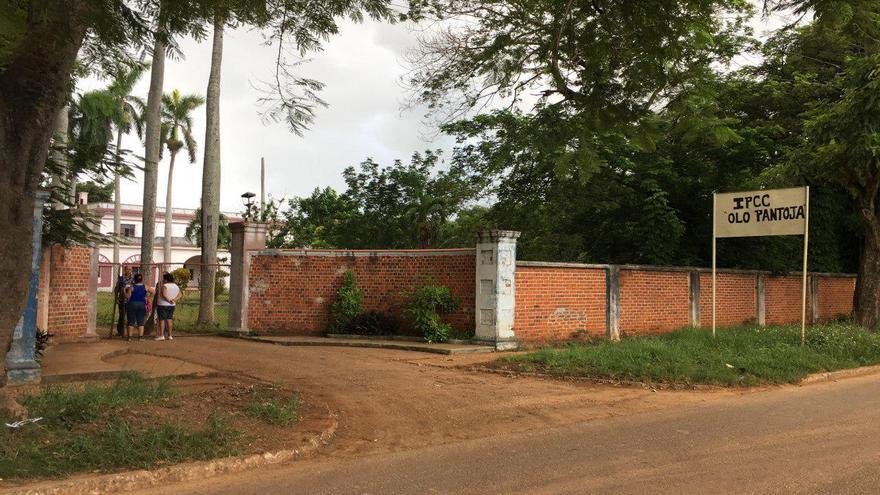
Classes remain suspended at the Olo Pantoja Polytechnic Institute of Civil Construction after several students were stabbed. (14ymedio)

14ymedio bigger14ymedio, Havana, 19 September 2018 — Classes remain suspended at the Olo Pantoja Polytechnic Institute of Civil Constructio  (IPCC), in La Lisa municipality in Havana, after nine students were injured by several people who invaded the school on Monday morning, as confirmed by 14ymedio.

Last Tuesday an employee, who preferred anonymity, confirmed to this newspaper that four adults entered the school, opened the doors of the classrooms and “began to stab people.” At least four students had to be transferred to a nearby hospital and the school canceled classes until further notice.

This Wednesday the entrance gate to the polytechnic remained closed and the parents of students who came to inquire did not receive information about the reopening date. A local employee replied to the constant questions only with the announcement that this afternoon “at three there is a parents’ meeting.” continue reading

According to the testimony of a school employee who spoke with 14ymedio after the incident, at least six students were wounded, five males and one female, with a knife. TheMarianao Pediatric Hospital  confirmed that four adolescents were treated on an emergency basis, among which there was one with cuts on the face.

“Of the four treated only one remains hospitalized for a previous orthopedic injury,” said a hospital spokeswoman.

The wounded were first transferred to the Cristóbal Labra Polyclinic, near the school, to receive first aid. An employee of the school said that once in the polyclinic an individual tried to assault the students again, but was stopped by the police. According to this source, three of the four attackers have been arrested.

14ymedio tried to communicate with La Lisa police station but did not get an answer to multiple calls. The official media have not reported the incident.

“The problem the school has is that there is no security at all. People enter without being asked for identification,” said the employee by phone.

School management informed the parents who came to pick up their children that the school is “under evacuation.” According to one of the employees consulted by this newspaper, several parents have said that they will ask that their children be “unenrolled” from the school for fear that violent acts like this one on Monday will be repeated.

Olo Pantoja School is located on 51st Avenue and 222nd Street and is responsible for training construction technicians in carpentry, masonry and other specialties. Its name pays homage to Orlando Pantoja Tamayo, one of the men who accompanied Ernesto Guevara as a guerrilla in Bolivia, where he died on October 8, 1967, one day before the death of Guevara.

The Government maintains a strict censorship over violent or criminal acts that occur in schools, which the official press rarely reports. The few reports on school violence, prostitution and harassment are made by the independent press of the Island.

At the beginning of the year, it became known that an underground shelter in a junior high school in Camagüey served as a meeting and leisure place for a group of young people between 13 and 23 years old who were involved in a case of corruption of minors and drug use.

Six girls and a boy between 13 and 15 years of age met at the shelter with young people between 16 and 23 years of age, presumably to consume alcohol and controlled medications such as carbamazepine and diphenhydramine.

Cuban education, considered for decades as one of the crowning achievements of the ruling party, has not escaped the crisis that the nation is experiencing since the end of the Soviet subsidies in the early 90s. The exodus of teachers and the low qualifications of the staff has forced the massive hiring of young people from what are called “emerging teacher” training programs.

In 2008 a 12-year-old student died after being hit with a school chair by his teacher, who was 17 years old. The homicide, which occurred at the Domingo Sarmientos Junior High School in Havana’s Lawton neighborhood, did not receive coverage in the official press.

 _________________________________

The 14ymedio team is committed to serious journalism that reflects the reality of deep Cuba. Thank you for joining us on this long road. We invite you to continue supporting us, but this time by becoming a member of 14ymedio. Together we can continue to transform journalism in Cuba.
Cuban Authorities Engage in Search and Seizure of Plastic Bags

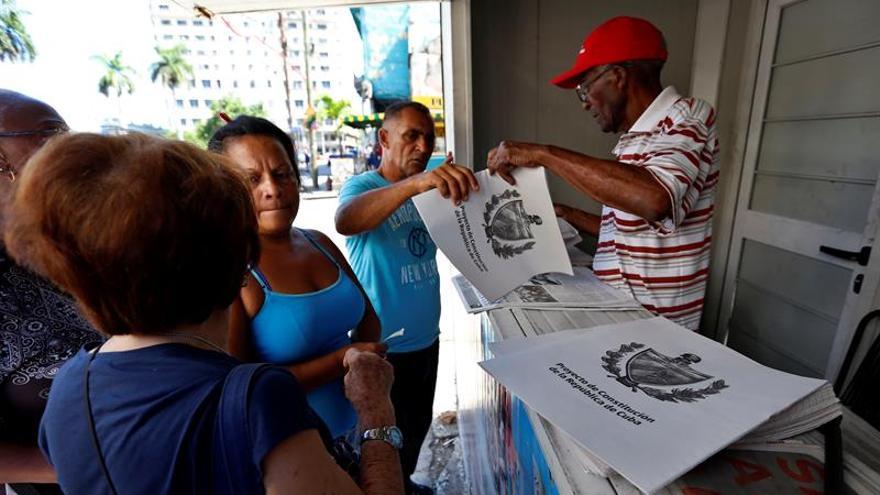
High demand has led Cuban authorities to limit the purchase of ‘jabas’ — plastic bags — to 20 per person. (14ymedio)

14ymedio bigger14ymedio, Marcelo Hernandez, Havana, 20 September 2018 — Until recently, elderly people have commonly been heard outside the agricultural markets calling out “plastic bags,” which they sold to supplement their low pensions.  The resellers buy the products at 50 centavos each (about 2 cents US) and sell them for one Cuban peso, an enterprise that the authorities have proposed to eliminate. Hence the “raids” unleashed in recent weeks.

An avalanche of inspectors, armed with fine booklets and intentions to cleanse Havana’s markets of the plastic bag sellers, have spread out for more than a month across all the neighborhoods where these busy markets are located, such as the one on San Rafael Street administered by the Youth Labor Army (EJT). continue reading

As a result, customers now have fewer options for carrying away the merchandise from the stands, if they forget to bring a bag from home, or they have to stand in long lines to buy the bags from the state stands. However, there is always some “bag seller” who manages to get around the barricades and hawk, in a near whisper, their merchandise, although the risks are high and they could end up at the police station with 1,500 Cuban peso fine (roughly $60 US… the equivalent of more than half a year’s average old age pension).

“This will go on for a few more days and everything will calm down,” says Veronica, a retiree of 78 who sells plastic bags at the 17th and K Street market in Havana’s Vedado neighborhood. “We have experienced this type of offensive at other times and in the end they shut it down,” confides the woman. However, “Every day that I can’t sell plastic bags is a day that things get worse and I’m at risk of not being able to pay my electricity bill and I have to walk everywhere because I can’t pay for a shared taxi.”

The plastic bag — called a jaba or jabita— is an important part of the Cuban universe and has as many uses as circumstance require. They are useful for stopping a leak in a water pipe, storing food, or protecting the head and covering shoes when engaged in some dirty task. It is rare to find someone who walks the streets without carrying a folded one in their wallet or pocket.

The high consumption of the product has created a high demand and it’s common at the state stands where they are sold to limit purchases to 20 bags per person. The authorities argue that the regulation is intended to stop “the hoarders.”

Self-employed workers, who are forbidden to sell the bags to customers but sometimes have to dispense merchandise in them, complain that the official outlets don’t give them a receipt when they buy they bags, but later officials demand proof that they came by them legally.

Jabitas are scarce where they are most needed, such as in the hard currency stores, from which thousands are stolen every day to end up in the black market. A good part of the bags that are sold outside the agricultural markets come from this “diversion of state resources” — that is employee theft.

While the rest of the world is trying to limit or penalize the consumption of plastic bags, in Cuba they are still considered an essential product, with a significant shortage that forces citizens to travel long distances to find food. Cuban comics have even come to describe the Cuban anatomy as head, trunk, extremities… plus a jabita. Lately this structure is incomplete.

__________________________

The 14ymedio team is committed to serious journalism that reflects the reality of deep Cuba. Thank you for joining us on this long road. We invite you to continue supporting us, but this time by becoming a member of 14ymedio. Together we can continue to transform journalism in Cuba.
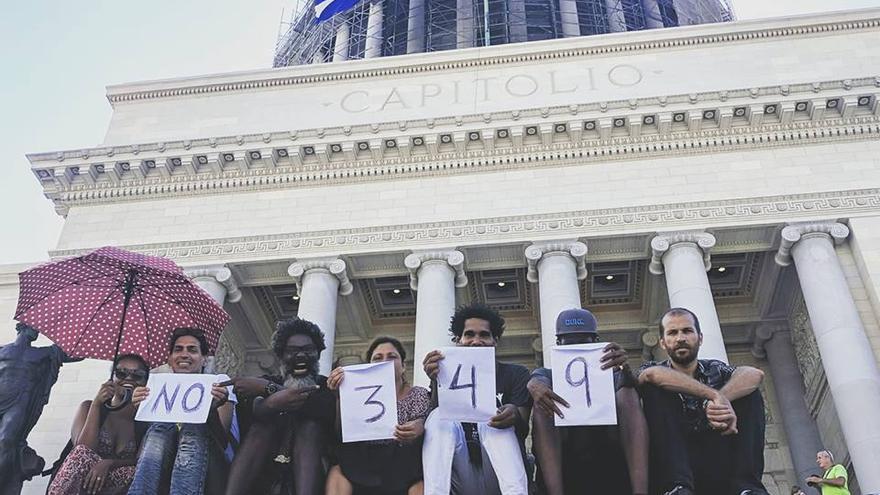
Three Opposition Organizations Describe the Referendum on Constitutional Reform as "Enormous Fraud"

Opposition organizations ask citizens to denounce the “farce” of the Constitutional Referendum. (EFE / Ernesto Mastrascusa)

14ymedio bigger14ymedio, Havana, 21 September 2018 — The United Antitotalitarian Forum (FANTU) together with the National Front of Civic Resistance “Orlando Zapata Tamayo” (FNRC-OZT) and the Patriotic Union of Cuba (UNPACU) describe the referendum on constitutional reform as a “huge electoral and media fraud” in a joint statement that the three opposition organizations have launched to make clear their position in this debate.

The signatories affirm that the intention of “the Neo-Raulista dictatorship” is “to appear to change something that, in reality, does not change anything.”

They explain in their statement that there exists differences in the methodologies of the opposition and civil society contrary to the “totalitarianism of the military junta that misgoverns” the nation. These positions range from “total indifference, to voting No in the plebiscite (…) passing through publicly burning the Constitutional Project (…) or providing civic seminars to citizens” and they assert that all of these “should be respected.” continue reading

The three organizations believe that it is their “patriotic obligation” to find points of agreement to ensure that these differences are not taken advantage of by the “common enemy: Castroism,” that is why they are sending an invitation “to other pro-democratic opposition leaders or intellectual personalities and independent Cuban politicians, residents both in exile and internally” to join this initiative.

Aware of the damage to the movement caused by the lack of unity demonstrated during decades, the creators of the declaration summon all to look with understanding on their differences, but ask the “distinct anti-Castro actors” to defend their points of view focusing their criticisms on the Government and not on those who fight against it.

“As the Cuban patriots that we are and fighters for freedom and democracy, we are obliged not to give weapons to our enemies,” they demand.

In the document a “unifying phrase” is set forth as “the essence of this joint declaration” and says: “Cubans: do not let Castrismo become legitimate, do not act with indifference to the fraud of the new draft of the Constitution of the Republic, and take action to denounce it as the brazen farce that it is.”

They also propose “to the different civic players (inside and outside of Cuba)” that  they maintain “a level of ethics with respect to their pronouncements regarding the different ways to fight against the Constitution project of the Republic of Cuba.”

Guillermo Coco Fariñas, José Daniel Ferrer and Jorge Luis García Antúnez put their signatures on the declaration, each representing their organizations, FANTU, UNPACU and FNRC-OZT, respectively.

Translated by Wilfredo Díaz Echevarria

___________________________

The 14ymedio team is committed to serious journalism that reflects the reality of deep Cuba. Thank you for joining us on this long road. We invite you to continue supporting us, but this time by becoming a member of 14ymedio. Together we can continue to transform journalism in Cuba.

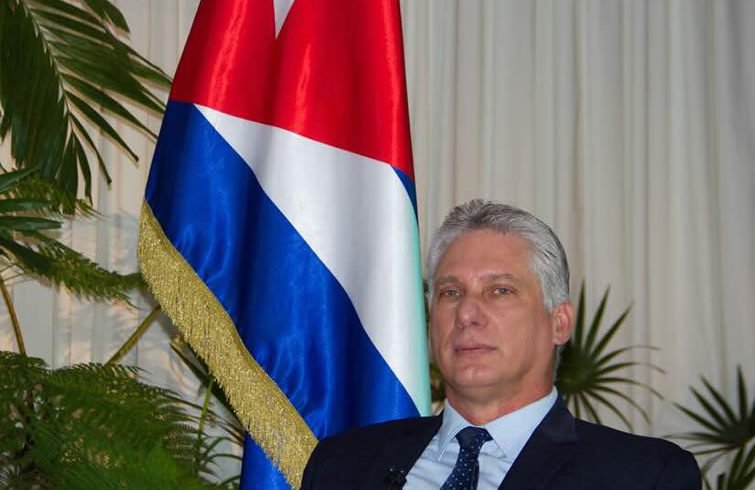
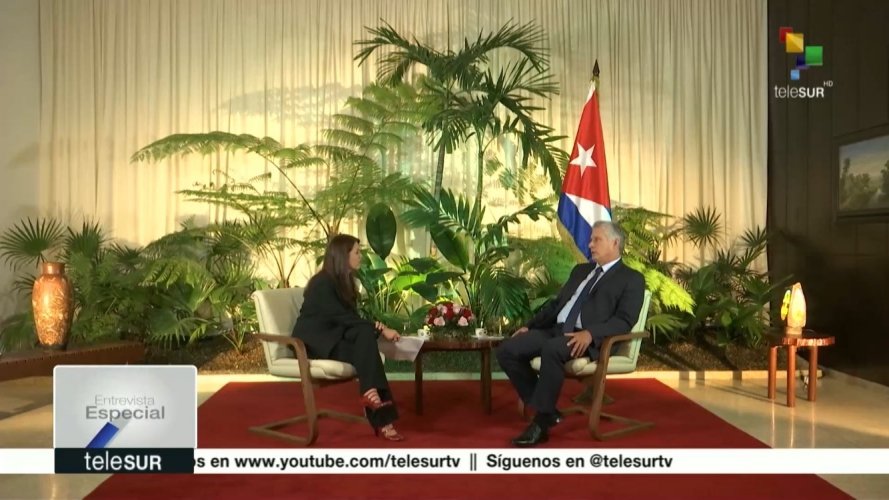
Interview With Díaz-Canel: Neither So Presidential Nor So Much “Media Appeal”

Interview with Miguel Díaz-Canel in Telesur. Photo Telesur / Rolando Segura

Cubanet, Miriam Celaya, Havana, 20 September 2018 — If something stands out in the interview recently granted to the transnational Telesur by the (not elected) president of Cuba, Miguel Díaz-Canel, it is the way in which the poverty of his vocabulary is revealed, the inconsistency of his arguments , the triteness of a discourse as preposterous as the interviewee himself and especially the theoretical fragility of the supposed heir of the Marxist-Leninist-Martiano-Fidelista torch endorsed as the jewel in the crown in the “constitutionalist” project that is currently – ignominiously — circulating throughout the Island.

In fact, the president’s babble overflows with so much mediocrity that trying to dismantle it would be an exercise almost as vain and simplistic as his own arguments. It’s quite enough, as a matter of example, to highlight the worn-out defense of the single party in Cuba under the ridiculous assumption that José Martí – for greater absurdity, an obstinate liberal and antisocialist – founded a single party. Obviously, only if Martí had been bipolar or schizophrenic would he have founded more than one party. But of course, the President did not stop to consider such an insignificant detail. At the end of the day, the masters will say to themselves: the Cuban people have never questioned the political decisions of the Castro regime and its emissaries, why should they do it now? continue reading

Perhaps even more embarrassing was the gibberish he introduced to justify the elimination of the term “communism” as the goal of society in the new constitution. “If one goes to classical Marxism, the mode of production to which we aspire is communism. (…) Communism and socialism are closely related. If you want to build socialism, it is because you want to reach communism, “the President said, undaunted. Perhaps he was convinced that such an inference should settle the matter. So much dialectical genius can only be the result of a very personal and outdated interpretation of the classics of Marxism (God save us from all of them, especially their interpreters!).

In addition, the entire interview overflows with common places such as the “U.S. government Blockade” (“a brutal practice which seeks to condemn our people to die of necessities” and “constitutes the main obstacle to our development”), Imperialist “violence” against Venezuela and its “laborer president”, the defense of the entelechy called “Latin American integration”, and other similar invocations.

Those who expected that in this, his first official interview – given not to a national media but to a foreign one, a disdain to the guild of native scribes – would offer the public some glimpse of a government program, a strategy to promote the battered economy or some kind of master plan to (at least) stop and reduce, in a reasonable timeframe, the pressing and multiple problems of the daily existence suffered by the Cuban population; In short, those who aspired to listen to a president’s proposals were left wanting.

There were no surprises. It is clear that Diaz-Canel was not going to depart from the old script dictated by his tutor and patron from the concealing shadows of the General’s supposed “retirement,” even less so in such uncertain times for both rulers and “governed” and for the region’s allies.  In it are included the responsibility, the ever-conditioned benefits and perhaps something else.

Let’s not forget the sinister Article 3 of the new constitutional script that states that “Treason against the nation is a most serious crime, and he who commits it is subject to the most severe sanctions” (instead of nation, read “the Power”). And it is known that the closer you are to the cupola of an autocratic power, the more serious the “betrayal” considerations become, and punishment results in a greater warning lesson.

Miguel Díaz-Canel interview on Telesur. Photo Telesur/Rolando Segura

By the way, causes number 1 and 2 of 1989 are worth citing. They took place amid the “dismantling” of the USSR and the “socialist camp,” which ended with the execution of several conspicuous servants of the regime and with long prison terms – not exempt of fatal health “accidents” – for others. They are the most convincing demonstration of this statement.

However, and following the basic principle of reading between the lines, he points out that, this time, the president’s words did not show the overflowing triumphalism that usually saturates official discourses. In general, there was emphasis on tone but the message lacked conviction. Diaz-Canel hesitates even when he claims to affirm.

A clear example of this is when it refers to Cuban youth as “active and anti-annexationist” – an attention-grabber use of this second term, which is not part of the common lexicon of Cubans and rather seems to reflect an unspeakable concern for them. The Power Caste that a reality – and later expresses: “This generation is cultured and educated (…), I do not believe that its main desire is to be against the Party and the Revolution”.

The subtlety of this message may be invisible to those who are unaware of the Cuban reality; however, the official discourse has traditionally referred to the country’s youth, not from the point of view of what “it does not want” or what “is not,” but in unequivocal terms of what it is supposed to be: “revolutionary,” “politically committed,” “intransigent” and “combative.”

A detail that apparently does not say much, but constitutes a flagrant slip that would not have been committed with impunity in the days of Castro I … Or perhaps it was an involuntary (and untimely) betrayal of the subconscious.

Because if the President, in his privileged position, is allowed to have the widest and most accurate information about the social temperature of this Island, does not seem very convinced of the revolutionary militancy of the young people and (what seems more serious) considers that the wishes of the current young generations “are concentrated on development, more progress, wishing to be included, aspiring to have more participation and striving for technological development and also social communication” instead of the holy defense of the Socialist Motherland, which was the mission commissioned to the generations that preceded them.

What sense would the authentication in the Law of laws make of an ideology and a sociopolitical system with aspirations of eternity not considered a priority by the current youth, who are heirs by fate and not by choice of a failed legacy?

Without a doubt, the President is confused, and that should not have gone unnoticed by the zealous political commissaries. Pretending to have “media appeal” can be tempting, especially when one does not have enough prestige or an adequate political pedigree, but it also entails many risks. Especially when you are an interpreter of someone else’s libretto, which reduces the probability of interpretation and authenticity to the character.

It may be that at this point the designated successor has received the corresponding phone call from his tutor, whom he considers “a father,” who will have warned him that in successive public presentations he should concentrate only on what the manual dictates and be more revolutionarily convinced of what he says, in order not to hand the enemy excuses to distort things or imagine weaknesses.

In spite of everything, in the coming days the official media will disclose, ad nauseam, the original or edited version of the aforementioned interview. For this, they can count on, to start, the political apathy of a population that, as we know, does not usually consume this type of product.

Not coincidentally, in the television programming this Tuesday, September 18th, the telenovela schedule was shown earlier so then aforementioned interview would be aired… With all certainty, that will be the moment in which, in spontaneous unanimity, the great majority of Cubans, according to their possibilities, will tune in to other channels, they will go into “package mode*” or will dive into “subversive” antenna shows.

*El Paquete Semanal (“The Weekly Packet”) is a one terabyte collection of digital material distributed since around 2008 on the underground market in Cuba as a substitute for broadband Internet. In 2015 it was the primary source of entertainment for millions of Cubans.

Cuba’s Independent Artists Denounce the "State of Exception" They’ve Faced Since 1959

Yanelys Núñez, Nonardo Perea, Amaury Pacheco, Iris Ruiz, Luis Manuel Otero, Soandry del Río, and Michel Matos in a protest action against Decree 349. (Facebook)

14ymedio bigger14ymedio, Luz Escobar, Havana | 17 September 2018 — The group of independent artists who since July have been carrying out a campaign against Decree 349 reports that “since the triumph of the Revolution, in 1959, there has existed a state of exception when it comes to the freedom of artistic creation and expression” in Cuba and that a considerable number of “creators and cultural projects have flourished from their own will and creative capacity, but then been taken down by the powers and the official institutions that rule national life.”

The text is part of the San Isidro Manifesto, presented this past Wednesday by the group as one more of their actions against the rule that regulates artistic presentations in private spaces and against which they have been mobilizing since July. The document, which is circulating on media, is signed by Luis Manuel Otero Alcántara, Yanelys Núñez, Amaury Pacheco, Iris Ruiz, Michel Matos, Hamlet Lavastida, Soandry del Río, Verónica Vega, Lía Villares, Yasser Castellanos, and Tania Brugera, among others. continue reading

Its launch took place at the venue of the Museum of Politically Uncomfortable Art (MAPI), in the San Isidro neighborhood of Old Havana, and musicians, poets, writers, audiovisual directors, producters, and plastics artists joined the act.

Yanelys Núñez read the text, which invites “any individual who feels like part of this phenomenon that today we call ‘the independent'” to participate in the campaign aimed at the repeal of Decree 349, and urges a dialogue that will allow the review of cultural policies that the State institutions are attempting to impose.

Later, the attendees made a pilgrimage to the Malecon to ask the patron of Cuba, the Virgin of Charity of El Cobre, for the annulment of the law.

The manifesto mantains that the law “legitimizes the use of judicial action to punish the free creation and determination” that belongs to them as artists and individuals and says that it “stimulates corruption” through the creation of the figure of the supervisor-inspector “taking into account that inspectors are one of the most corrupt sectors of the regulatory apparatus of the State.”

On July 10 the Council of Ministers approved Decree 349, focused on “the violations regarding cultural policy and over the provision of artistic services” which will enter into full force in December.

The artists who defend the repeal of the law believe that this “is destined not only to control and intimidate artists and creators from various branches of the national culture, but also in the private business sector, to impede a natural and organic relationship inside the different spheres of Cuban society.” In addition, they believe that it “threatens with legal warnings, fines, and seizures of equipment or property used as a platform for the creation and dissemination of independent works.”

The decree grants to the “supervisor-inspector,” they emphasize, the authority to suspend immediately any performance or show that he understands to violate the law, having the ability to go to the extreme of canceling the self-employment license to practice work.

“We understand exactly that any nation in the world must regulate its internal activities, receive taxes if those become lucrative, just as they must safeguard internal order and peace,” point out the artists. However, in their view it is “inadmissable to accept the existence of a confusion of laws” that only aims to control the artistic sector and “punish it for its independent expression and action.”

The group of artists believes that the “only logical aim” this law appears to have is to maintain “the ideological primacy in a highly centralized state.”

Some of the artists complain that the official press has tried to distort the intention and origin of the campaign against Decree 349 and clarify that they are only asking institutions to listen to them and that they are not calling for “either neither anarchy nor confrontation.”

However, they maintain that these laws and rules are impossible to comply with because “they don’t adjust to the national reality at the present time” and because they are “abusive, disproportionate, and they violate international norms and agreements.” For this they direct their proclamation “to all men and women of good will” and invite their support.

“We are determined to come together as a group to begin a collection of sociocultural actions like this as calls for international attention to halt the imposition of a complex of laws that insults all Cubans,” they state.

On more than one occasion this group has suffered political repression for trying to carry out public acts to support and defend their campaign against the decree. On August 11 various artists who wanted to participate in a concert at the MAPI venue suffered the repression of police who showed up at the place along with officials from State Security to stop the action. On that day, which ended with the detention of several of the artists, neighbors from the San Isidro neighborhood went out to the street to condemn the conduct of those in uniform.

Translated by: Sheilagh Carey

___________________________

The 14ymedio team is committed to serious journalism that reflects the reality of deep Cuba. Thank you for joining us on this long road. We invite you to continue supporting us, but this time by becoming a member of 14ymedio. Together we can continue to transform journalism in Cuba.
The Exodus in Cuban Chess

Leinier Domínguez, who currently lives abroad, was expelled from the Cuban national team this spring. (Baku World Cup 2015/Susan Polgar)

14ymedio bigger14ymedio, Ernesto Santana, Havana | 17 September 2018 — The last movements in Cuban chess have been three great escapes—in consecutive years, Yuniesky Quesada, Leinier Domínguez and Lázaro Bruzón—something that could be called the “American exit.” The game is in check, but in reality it is in keeping with the logic of all Cuban sports, where emigration and decline don’t stop.

That the official declaration announcing his expulsion from the national squad contained lies, as Bruzón claimed, is nothing new. “A fabricated note to make them look like heroes and me like a villain,” wrote the chess player from Las Tunas in his response to the National Chess Commission. Rather, it’s normal that the authorities lie about their own responsibility and denigrate the athletes. continue reading

Bruzón wonders where these words full of “negativity and hate” came from. The higher-ups only know how to throw trash onto the lower floors, in INDER (The National Institute of Sports, Physical Education, and Recreation) and in the whole community. It seems that they have no other methods. The athletes who decide to emigrate are, for the bosses, deserting soldiers, not people who want to make a change in their lives.

The expulsions of the three best current Cuban chess players—among the most notable in Latin America—is a devastating blow for national chess. It is even the end of a kind of myth, of a pleasant legend: the rivalry between Leinier Domínguez, from Güines, and Lázaro Bruzón, from Las Tunas, has come to its end, at least inside the country.

Born a year apart—Bruzón in 1982 and Domínguez in 1983—the two were friends since childhood, when they threw themselves into the tough dream of triumphing in the world of chess. Soon they began to receive laurels in Cuba and abroad, and they passed from FIDE Masters and International Masters to become Grand Masters. 2002 was the year of the takeoff of the two friends and rivals. Fifteen years later, the one from Güines settled in the United States. Now the one from Las Tunas is doing it. The dream was lovely while it lasted.

But this “American exit” is not exclusive to the three best. Even as of several years earlier, the United States had become the destination for other good Cuban chess players. In fact, that country is the one that has received the greatest number of these born here in the 21st century so far, and there are already several Cuban Grand Masters in the American ELO ranking.

However, it’s not only there that the exodus of our chess players is aimed. In the field of this sport in the world, more than a few who manage to change their national federation, but it is notable that, for example, in 2014 alone, of the 37 transfers approved by FIDE, five were of Cuban players. Currently, in addition to the United States, dozens of Cubans compete in countries like Ecuador, Paraguay, or Colombia.

The authorities brag that they are continuing to train chess players, but it’s clear that, despite a lot of talent, the new ones don’t end up being included in the elite. This sport is in check, on the verge of checkmate. Unless those above—those always worried more about themselves than about the athletes, and who believe themselves more important than them, although they live off of them—adopt a more realistic attitude.

In chess it is easier—in comparison with other sports—to allow athletes to compete for Cuba even though they live in other countries. They must come up with a solution more or less like this. There is no other path. And they need to do everything possible so that the most promising chess players can raise their ELO. Is it so difficult to offer them internet service, essential for them, which the Government provides to any mediocrity?

The board speaks clearly: there are no more moves and time is up.

Translated by: Sheilagh Carey

____________________________

The 14ymedio team is committed to serious journalism that reflects the reality of deep Cuba. Thank you for joining us on this long road. We invite you to continue supporting us, but this time by becoming a member of 14ymedio. Together we can continue to transform journalism in Cuba.
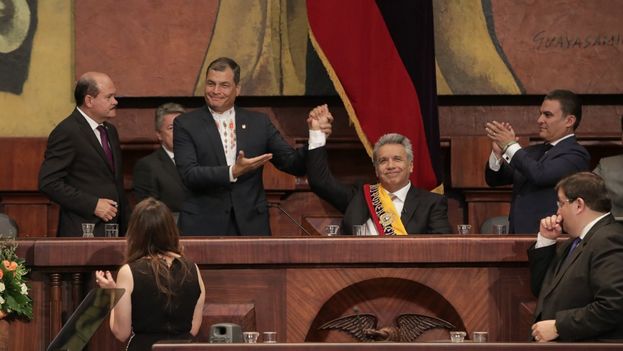
Moreno Versus Correa: Three To Zero

Lenin Moreno after being invested president and receiving the baton from Rafael Correa. (@AsambleaEcuador)

14ymedio bigger14ymedio, Yoani Sanchez, Generation Y, Havana, 20 September 2018 — He seemed the perfect successor: docile, well trained and sticking to the script. However, Ecuadorian President Lenin Moreno has become the worst nightmare of his predecessor, Rafael Correa.

At first it was just a slight fracture that arose between them, marked more by differing points of view or by dissimilar impressions when the time came to take the reins of the county. But as the months pass the current Ecuadorian president has become the main executioner and undertaker of Correaism.

This September, Moreno has thrown another shovelful of earth over the former leader of the Alianza País party. Ecuador lost the legal battle against the American multinational Chevron, after a long confrontation in a historic case of environmental pollution in the Amazon. Before hearing the ruling of the Permanent Court of Arbitration based in The Hague, the president of Ecuador hastened to lay the responsibility on Correa. continue reading

The Secretariat of Communication accused the former president, who governed the country between 2007 and 2017, of using the clash with Chevron “to gain political and media prominence,” in addition to using “public funds for propaganda, manipulating national and international public opinion.” The level of the accusations Moreno’s administration has made against his predecessor marks the final break between the former party comrades and is the most critical point in a series of confrontations.

Recently, Moreno defined Correa as a “thug” who was “obsessed” with re-election and the latter responded by accusing Moreno of being a “traitor.” Ecuador’s departure from the Bolivarian Alliance for the Peoples of Our America (ALBA) also constituted a serious setback for one of the most visible faces of that failed model that was called 21st Century Socialism. To these blunt blows is added an infinity of public skirmishes in which the current office-holder has always come out the winner from the political and diplomatic point of view.

While Moreno has projected an image of an equable man capable of dialogue, Correa’s arrogance has prevented him from controlling himself and in the face of every criticism he has received since leaving office, he has responded with very little statesmanship and obvious irritation on not feeling himself adored by Moreno.

That reaction is due, especially, to the fact that the plans of the former president saw the naming of a substitute as simply a legal move. The new president was supposed to hold on to the presidential sash for a time, just enough years to allow Correa to return to Carondelet Palace.

Instead, the one who had been trained to be a puppet cut the strings and decided to govern on his own. Beyond the lights and shadows of his administration, Moreno is sending a powerful message to other regimes, such as Cuba’s, who see in the handpicked and loyal successions a way to perpetuate themselves. The Ecuadorian president is destroying the illusions of those authoritarians of all political colors who hope to be able to manage, from behind the scenes, a puppet sitting in the presidential chair.

_____________________________

This text was originally published by Deustche Welle’s Latin America page.

The 14ymedio team is committed to serious journalism that reflects the reality of deep Cuba. Thank you for joining us on this long road. We invite you to continue supporting us, but this time by becoming a member of 14ymedio. Together we can continue to transform journalism in Cuba.

The Scandal of the 15,000 Apples

La Puntilla supermarket is one of the best stocked in the capital. (14ymedio)

14ymedio biggerEFE/via 14ymedio, Atahualpa Amerise, Havana | 18 September 2018 — In face of chronic shortages in Cuba, products of the United States embargo and the inefficient policies of state planning, hordes of black marketeers stockpile goods to resell them at a higher price, an open secret that has finally burst with the “scandal of 15,000 apples.”

La Puntilla supermarket, in the exclusive Havana neighborhood of Miramar, received on August 31 an unusual shipment of apples. The prized fruit, rarely seen on the island at this time of year, were set out in boxes of 100 for sale to the public with one restriction: one batch per person.

At the exact moment that they went on sale, dozens of young people, without hiding what they were doing and in a coordinated action, got hold of 150 boxes (15,000 apples in total), paid for them ($6,750), and took them, leaving behind empty shelves to the disgust and indignation of the other customers. continue reading

One of the onlookers was the pro-government journalist Iroel Sánchez, special witness to the fruity “kidnapping,” who denounced it the following week on his blog in an article entitled Robbery in La Puntilla, republished shortly after in Cubadebate, where it generated a big popular stir and ended up provoking the intervention of the authorities.

Sánchez explained that small Cuban mafias get hold of not only apples, but also diapers, chicken, cheese, or any other scarce product to later establish their own distribution networks on the black market at higher prices than those set by the state-controlled socialist monopoly.

For him the fundamental thing is the collusion of supermarket officials and distribution chains, whose meager state salaries of $30 a month invite “incentives” to turning a blind eye, leaking information, or even handing over merchandise to the speculator and helping him to transport it.

Sánchez’s article has raised this problem to the forum of social debate in Cuba, until the point that CIMEX, the State business group that monopolizes distribution, announced the immediate dismissals of eight officials allegedly implicated in the case and — something very unusual — made public their names and surnames for greater public derision.

Efe spoke with two employees of the Havana supermarket who confirmed that it is “strictly forbidden” to make any mention of the scandal of the apples, although one said: “What you have read on the internet is true.”

Meanwhile, an executive from the shopping center told the agency, under condition of anonymity, that the incident “isn’t as bad as they say” and denied any collusion with the black marketeers.

“Each one took the maximum allowed and we couldn’t do anything,” he insisted, after revealing that he and his subordinates are the focus of a rigorous investigation by the authorities and that they fear losing their jobs.

For economist Ricardo Torres, specialist from the CEEC, an adjunct institution to the University of Havana, speculation in Cuba is a difficult problem to eradicate, despite the authorities’ efforts.

“In every society the majority dedicates time and energy to whatever is most lucrative. If the diversion of resources is profitable, it will be more difficult to stop it because people will look for other ways to avoid the controls,” he explains to Efe.

Torres believes that “the fundamental cause is general scarcity, which has shaped certain behaviors in business owners and in the population.”

For him, until the shortages end, the law of supply and demand will control distribution and prices, however much the State tries to maintain control and punish offenders.

The lack of hard currency — aggravated by weak exports, an insufficient distribution system, debt problems, and the US embargo — is at the root of the chronic shortages that Cuba suffers, which end up emptying the shelves of stores, according to the expert.

For his part, Julio, a 55-year-old worker and regular customer at La Puntilla, sums up for Efe his view of the problem: “In every place on earth there are unscrupulous people who take advantage of society’s needs.”

The cause of the shortages “is known by the entire world. We are financially blockaded by the United States,” affirms this confirmed socialist, referring to the embargo that, according to Havana, has caused losses in the amount of almost a billion dollars from 1960 until today.

“We have been blockaded for six decades, but we will continue to resist and we will keep living much more happily than they do in other countries,” he declares in a conversation with Efe, while he waits at the door of the supermarket for his wife to come out with at least half of the products on their shopping list.

____________________

The 14ymedio team is committed to serious journalism that reflects the reality of deep Cuba. Thank you for joining us on this long road. We invite you to continue supporting us, but this time by becoming a member of 14ymedio. Together we can continue to transform journalism in Cuba.
Makeup Doesn’t Cover Jimaguayu’s Problems

Residents in the municipality of Jimaguayú complain about the poor state of the roads. (14y middle)

14ymedio bigger14ymedio, Ignacio de la Paz, Camagüey | 18 September 2018 — The Jimaguayú municipality has been busy for days starting last week, when the authorities announced a visit to Camagüey by President Miguel Díaz-Canel. Between 19 and 21 September the president is expected to arrive, which has unleashed an avalanche of repairs in public areas and state centers.

The provincial authorities of the Cuban Communist Party (PCC) have called several meetings with their members to alert them that Diaz-Canel will be accompanied by a large government contingent and that Camagüey must show “its best face” on these days, especially in the places where the caravan will travel.

In Jimaguayú, one of the municipalities included in the tour, a fever for touch-ups has been unleashed, including a rejuvenation of the road that leads to the Sanguily Genetic Rescue Company, located in the area of Jesús María, one of the sites expecting a visit from the president who, last April, replaced Raul Castro. continue reading

The road to the genetic company right now is the scene of brigades of workers with machetes clearing out the weeds in the surrounding area, a scene that the farmers of the zone look on with surprise. The older ones, such as farmer Omar Vázquez, do not remember “when something like this was done around here.”

Since assuming power, Diaz-Canel, a 58-year-old engineer, has made a frantic tour of several provinces that has been widely followed by the official press, a practice that contrasts with the lack of travel that characterized his predecessor who “did not even come to Camagüey when we were affected by hurricanes,” says Rubén, a resident of the area.

Before the arrival of the president, in the bodegas of San Cayetano and Victorino, two of the poorest communities in the region, the sale of the rationed basic basket corresponding to the month of October has been pushed forward, a usual practice on festive dates. The residents can’t contain their amazement because, for the occasion, products like chocolate, detergent, washing soap and rum are also being sold off the ration book.

The greater police controls that have also been deployed in the area complicate the operation of the black market in a region where most of the cheese that ends up being sold illegally is produced. More surveillance along the roads has producers and retailers of this product holding back on the “under the table” trade, given that the State prohibits any private sales of cheese.

Others prefer to see the arrival of the president as an opportunity to air the daily problems that mark life in Jimaguayú.

“Díaz-Canel has to pass through this area more often, because we are abandoned,” says a farmer who complains that “what is being done is pure makeup in the streets where he is going to pass, but the problems that we, the people who work in the fields, have are not fixed with a little lechada (low quality paint).”

The Camagüey plain, and especially the Jimaguayú area, has a long tradition of raising cattle, but in recent decades the sector has been harmed by the economic crisis and the loss of thousands of cattle as a result of the drought, the lack of fodder and mismanagement in state farms. 70% of the milk produced in the territory comes from non-state farms, according to official data.

Owners of estates, tenants and cooperative members have been pressing for years for the State to allow them access to a better wholesale market, where they can buy things from piping to carry water, to food for animals, something that is now available only sporadically and in small quantities.

“It will take less makeup and more resources because we do not have medicine for the animals, the feed is missing, and even getting a piece of fence to keep the cows in one place is a problem because there is no wood or wire for sale,” says Gumersindo, 66.

The autonomy to sell “milk directly to consumers and develop a cheese industry without going through the State” are also among the demands that Gumersindo and several farmers in the area have been posing for years in meetings of the National Association of Small Farmers (ANAP).

In several meetings at workplaces where the imminent arrival of Díaz-Canel has been mentioned, the workers have called for taking advantage of the visibility that the arrival of the president will give the area to make some social and labor demands.

Several residents hope to be able to raise with Diaz-Canel problems that affect the area, such as the notable reduction in the number of schools and the deficit of teachers. “The schools of La Loma and Piedra Imán where I live closed for lack of students and teachers, and that left only two in San Cayetano and Victorino,” laments Gumersindo.

Before beginning this school year, the Minister of Education, Ena Elsa Velázquez, acknowledged that, despite the “attention” and “stimulation” accorded to the teachers by the Government to “avoid the exodus,” there is a nationwide deficit of about 10,000 teachers. A situation that worsens in rural areas.

“Here we have a double problem, because the low salaries are compounded by the poor conditions of the classrooms and the transportation problems for teachers to get to the schools,” says Carmina, a grandmother of two children of school age, residents of Jimaguayú. “The last teachers my grandchildren had didn’t last three months in front of the classroom.”

Carmina and many of her neighbors complain that the students “have no teachers but rather makeshift teaching assistants who can not teach the kids anything.”

Alberto Murga, a farmer in the area, wants to bend Diaz-Canel’s ear with the difficulties that the residents of Jimaguayú are going through every day as a result of the bad state of the roads and the lack of public transportation, as well as the low electrical voltage of the area that means many families “can only light a couple of bulbs.”

“For more than two years we have not had any buses for these communities and the pharmacy in Victorino does not have the medicines that are sold on the so-called card.” The farmer complains that “the family doctor comes once a week and there is no doctor’s office, so she has to take care of the patients in the social circle without any privacy.”

The chorus of complaints continues to grow as the scheduled date for the visit approaches. The residents know that, in all likelihood, after the photos everything will remain the same. Even the place where the heroic rescue of Brigadier Sanguily took place is lost in the undergrowth and the marabou weed. “Like all of Jimaguayú,” Gumersindo says.

 _______________________________

The 14ymedio team is committed to serious journalism that reflects the reality of deep Cuba. Thank you for joining us on this long road. We invite you to continue supporting us, but this time by becoming a member of 14ymedio. Together we can continue to transform journalism in Cuba.
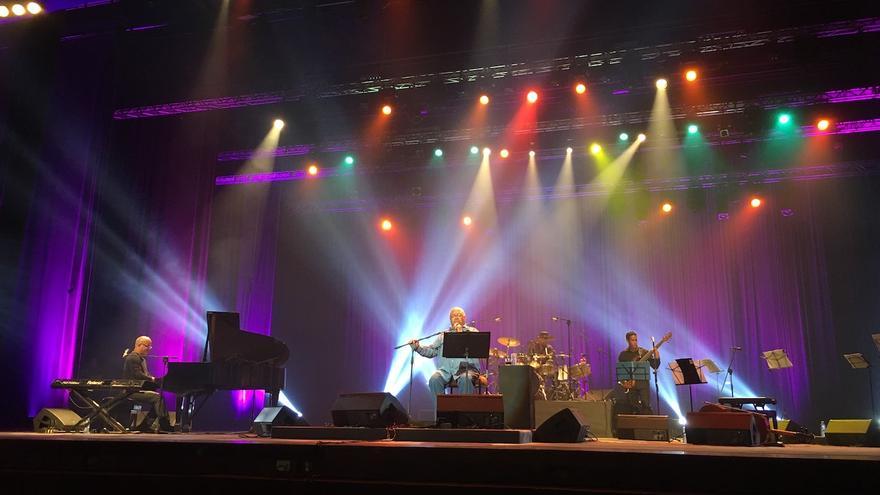
Pablo Milanes Sings to Havana in an Emotional Concert

The audience responds enthusiastically on Friday to Pablo Milanés at the Karl Marx Theater in Havana (14ymedio)

14ymedio bigger14ymedio, Luz Escobar, Havana, 9 September 2018 — Three years since his last concert at the Karl Marx Theater, Pablo Milanés returned to the same venue last Friday. The concert, dubbed “My Havana,” began with the firing of a canon at precisely nine o’clock in the evening, a gesture to mark the five-hundredth anniversary of the founding of the city, to which the singer-songwriter paid tribute.

The audience reaction was enthusiastic. As soon as the curtain rose, there was a standing ovation. The concert began and ended with people rising to their feet in homage to their adopted Havanan hero, who set so many of his songs in the Cuban capital and made numerous appearances here.

After performing a snippet from his song “Marginal” followed by “Cuanto Gané Cuanto Perdí” (So Much I’ve Lost, So Much I’ve Gained”), Milanés commented, with some emotion, that Cubans are his favorite audience, especially those from Havana. Describing the event as “this night among friends,” he told the audience, “there are some new things for you in this recital that I will present for your consideration.” continue reading

The show, which lasted almost two hours, featured Milanés’ classic tunes sung to an audience which responded with tears and applause. The repertoire also included more recent compositions, though the attendees were happy to once again hear him perform old standards such as Para Vivir, Yolanda and De Que Callada Manera.

On stage he was accompanied by musicians who have been part of Milanés’ artistic journey as well as members from his current group, who demonstrated distinctly jazz influences. The almost inseparable trio that has accompanied him for more than a year was made up of Miguel Núñez on piano, Sergio Félix Raveiro “El Indio” on bass and Osmani Sánchez on percussion.

One of the night’s surprises was the appearance of Carlos Varela, who joined Milanés to sing Vestida del Mar and Los Días No Volverán. Both managed to create an intimate atmosphere, transporting the audience to a time when there was more opportunity on the island for writing and performing trova-style songs, a time when their words and melodies impacted the lives of many Cubans.

The second big event of the night happened when Pancho Céspedes left the stage. He thanked Milanés for his trust, a gesture that was reciprocated when the singer-songwriter described him as “a brother and friend of many years.”

For the special numbers, the troubadour invited Maykel González and Robertico García on the trumpet, Emir Santacruz on the tenor saxophone and Aldana on the flute to join him. Accompanied by this metal string, he performed Amor Que Cantas la Noche, a poem by Sandra de Peret that Milanés set to music, followed by Regalo and Amor.

He did not pass up the chance to thank old collaborators such as the pianist Miguelito Nuñez, who accompanied the singer-songwriter for more than three decades. Nuñez came to this concert with his daughter Mariana, who was the cellist that night for Nostalgias, a song that — as Milanés describes it — has turned out to be the most important number from his album Días de Gloria.

Between songs the artist spoke enthusiastically, smiled, shared memories and acted like the host at a get-together in the living room of his own house. Natural and flawless in his interpretations, he displayed a vocal ability that has not been diminished with the passage of time.

Pablo, as his fans affectionately refer to him, paid homage to the Cuban capital with his song Vestida del Mar. He sang, “Havana will come back. It will be what it once was, dressed in the sea, dressed in light, like a rebirth. But it will mourn the loss that it will not be able to revive.” A flood of applause drowned out his voice.

___________________________

The 14ymedio team is committed to serious journalism that reflects the reality of deep Cuba. Thank you for joining us on this long road. We invite you to continue supporting us, but this time by becoming a member of 14ymedio. Together we can continue to transform journalism in Cuba.
Father Jose Conrado Rodriguez Denounces Cuba’s “Totalitarian” System

José Conrado Rodríguez (center) during the presentation of one of his books in Miami. (14ymedio)

14ymedio bigger14ymedio, Mario J. Penton, Miami, 19 September 2018 — The political system in Cuba, an inheritance from the former Soviet Union, is deeply monstrous and inhuman. Caribbean totalitarianism has turned every Cuban into an executioner and at the same time into a victim and the only way to escape from the vicious circle of lies and fear – the basis of the system – is to try to live in the truth. This is one of the conclusions of the new book Resistance and Submission in Cuba , by José Conrado Rodríguez, which will be presented this Wednesday at the Ermita de la Caridad del Cobre in Miami.

With a prologue by Carlos Alberto Montaner, Universal Editions has published this book that complements the recently released Dreams and Nightmares of a Priest in Cuba. It is an analysis of communist totalitarianism from the point of view of four authors from the periphery of the Soviet empire: Czeslaw Milosz from Poland, Constantin Noica from Romania, Vaclav Havel from the Czech Republic, and Cuban Eliseo Alberto de Diego García Marruz.

“The liberating force of truth, understood as a way of life, as a purpose in life, and as a fidelity to what we are, has an intimate dimension and is related to the knowledge of ourselves,” Rodríguez explains. continue reading

The dissidence, for this author and priest, is in intimate connection with the truth, because only from a coherent life that breaks with the social rites of the system, such as repeating slogans nobody believes in, can real change be driven.

The four authors on whom Father José Conrado Rodríguez based his reflection suffered under the communist system. Milosz (1911-2004), winner of the Nobel Prize for Literature in 1980, in his work The Captive Mind analyzes the process of assimilation of totalitarianism on the part of intellectuals. The philologist Constantin Noica (1909-1987) was sentenced to 25 years in prison by the Stalinist regime of Ceaucescu in Romania. In his essay Pray for Brother Alexander, published posthumously in 1991, he makes it clear that only a life in truth and compassion can exorcise totalitarianism.

From Vaclav Havel (1936-2011), activist and, later, president of his country, Rodríguez addresses The Power Of The Powerless, an analysis of what he called post-totalitarian societies, where dictatorship goes hand in hand with ideology, where it becomes a kind of secular religion. Finally, from his compatriot Eliseo Alberto de Diego, he addresses Report Against Myself, a raw account of power in Cuba.

In a society like Cuba manipulation and lies are the basis of the system, says Rodríguez, paraphrasing Vaclav Havel. Already past the caudillo and the first stages of the revolution in which terror filled the prisons with political prisoners and brought down each of the democratic institutions, power does not need society to cohere.

If, earlier, the system tried to create a feeling of “the masses” and intensify the “fighting spirit” against an attacking enemy, the post-totalitarian society seeks to compel the population to accept the status quo.

The system will try to demonstrate “socialist legality” as a way to legitimize itself. “The function of ideology is to fill the gap between the plans of the system and the plans of life, implying that the intentions of the system derive from the needs of life, which is not true, but functions as if it were,” says Rodríguez.

Legality is one of the main weapons that the system has to defend itself. Laritza Diversent, an independent lawyer who went into exile in the United States, has detailed at least 400 laws in the Cuban criminal code that can be used against the opposition movement. In a post-totalitarian society like Cuba’s, everything is limited, controlled, well subjugated to the state apparatus, Rodríguez wrote.

Father Conrado uses Havel’s example of the self-employed person who takes a poster with a political slogan and hangs it in his window. He has not read it, the people who will visit his business will not read it either. The entrepreneur may not even agree with the content of the slogan (the likes of which abound in Cuban stores). But when he puts it in his window he has fulfilled the “social rite,” has been immunized against the suspicion of being disloyal to the system.

Perhaps the most dramatic example of cruelty that the book presents is that of Eliseo Alberto de Diego García Marruz, forced to spy on his own father, the Cuban poet Eliseo Diego. “We are at war against Yankee imperialism, Lieutenant,” he was told while serving in the Cuban army. “The Central Intelligence Agency has an exorbitant costume shop to hide spies, we can not lower our guard,” says the author in his Report Against Myself.

Before the timid objections of Diego García Marruz they gave him a report with the State Security files about his family. Former classmates, residents of the neighborhood, even exiles from Miami who visited his home had delivered reports to the all-powerful Cuban State Security.

“One against others, some over others, many Cubans were trapped in a network of mistrust,” writes Rodriguez and wonders how it is possible that in all the places where the totalitarian system has been established, the same things happened.

“How is it possible that the Russians and the Romanians, the Czechs and the Poles, the Cubans and the Chinese were victims of the same destructive mechanism? Victims and executioners: we ourselves have been transformed into these. We are the victims and the instruments of the system,” he concludes.

______________________

The 14ymedio team is committed to serious journalism that reflects the reality of deep Cuba. Thank you for joining us on this long road. We invite you to continue supporting us, but this time by becoming a member of 14ymedio. Together we can continue to transform journalism in Cuba.