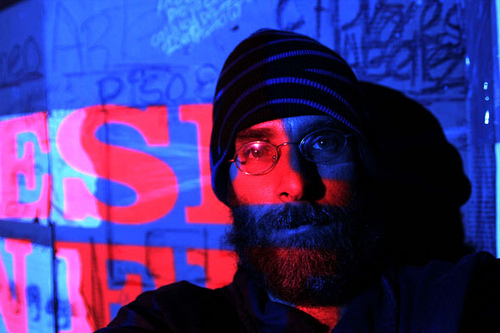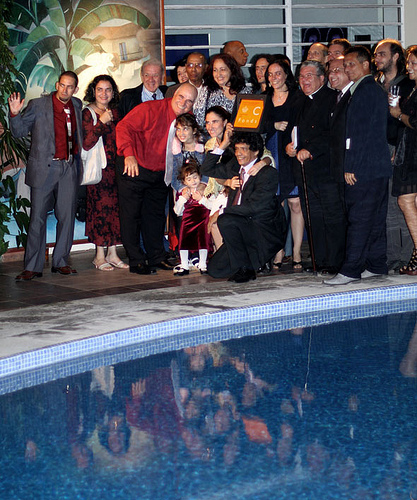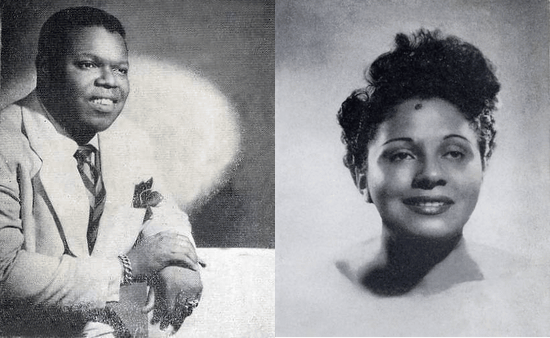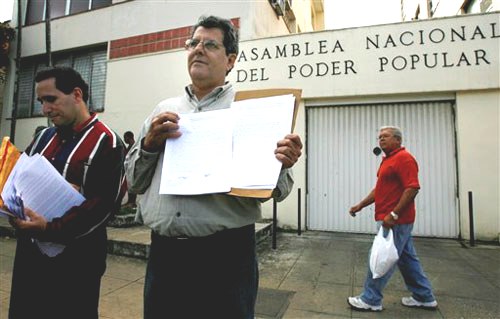
News of Yamil From His Family on Twitter / Yamil Domínguez

Top: The hours are endless for someone waiting behind bars for his FREEDOM.  Yamil and family demand his RELEASE now!!

Middle: There is no reason that justifies keeping Yamil even one more minute in the Security pavilion of the hospital.

Bottom: Today Yamil marks 12 days on hunger and thirst strike. Before he began the strike he weighed 80 kg (176 lbs.), Friday he weighed 66 kg (145 lbs.).

Link to Yamil’s family’s Twitter account.

Translator’s note: “Following” Yamil  on Twitter shows that the world is watching.

How You Can Sign the Civic Manifesto

Since The Civic Manifesto to Cuban Communists was made public in this space, we have received, by different routes, requests to join in on this document. Although the initial intention of the promoters was not to collect signatures of support, the opportunity for people to sign it electronically has been created through the following email: manifiestoaloscomunistas@yahoo.com , or by personally contacting any of the original signers.

January 10 2011

Daddy State and His Frightened Children / Yoani Sánchez

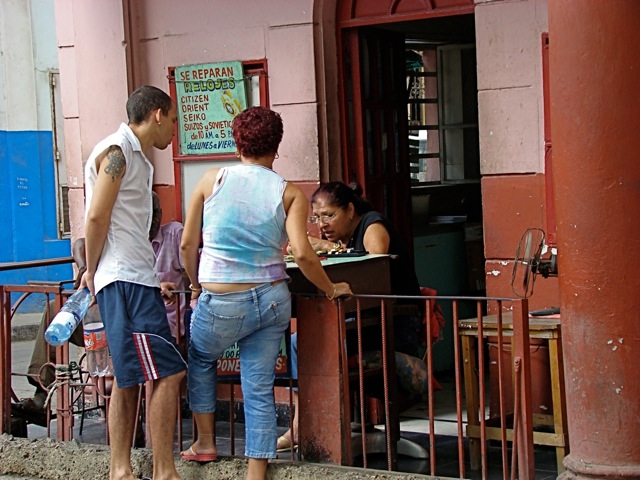
Self-employed Watch Repairwoman in Havana

For weeks they were afraid they would appear on the list of layoffs on the wall, the list of names of those who — at that hospital — would be left without a job in the new reorganization of labor. The doctors, nurses and health care technicians put in more effort and avoided walking the halls during office hours so that their heads would not be included among those who would be laid off. The unusually high attendance and punctuality of those days surprised the manager, but even so they could not avoid the cuts. One afternoon in the dining hall a meeting was held to announce the list of the newly unemployed. Many of those present would not be returning in the morning, they’d been put out in the street as a consequence of the downsizing process that is causing so much anguish on this island.

As odd as it seems, the Cuban Workers Center (CTC), the only legal union in the country, has supported the reduction in payrolls. Instead of calling a general strike and confronting the government and its shock tactics, the CTC announced it would help raise awareness among its members about the need for layoffs. Meanwhile, State television is airing reports of high unemployment in Spain, the United States or Great Britain, while it is silent about the drama that one in four workers in Cuba will soon lose their livelihoods.

Instead of addressing the topic in a serious way, the news throws around triumphalist phrases about the “improvement” taking place in the manufacturing and service sector. Behind every slogan is a family whose meager wages are threatened, hundreds of thousands of people who have no preparation for making a living outside the State, the employer of 90 percent of all workers.

In theory, self-employment is supposed to absorb many of the newly unemployed, but the path to private enterprise is still strewn with obstacles and controls. Just 178 authorized professions are open to independent workers and very few are directly linked to production. Options include bizarre choices such as “button coverers for ready-made clothing,” but exclude more promising professions such as “auto-body repairer” or “ironworker.”

Those brave entrepreneurs who decide to try their hand at small business must pay license fees and taxes starting on day one, and follow strict restrictions on the origin of any resources used. For now they have no access to wholesale markets for raw materials while taking out a bank loan can take months, or years. For those hoping to go into food service, a health inspection is required and can take weeks, waiting for the nearest clinic to get around to sending someone. The entire network of support for private enterprise is fragile and dysfunctional. Thus, the newly self-employed need a strong dose of patience and significant capital to endure the initial stage before they turn a profit.

We should not discount, however, that despite these constraints the cumulative creativity and widespread practice of violating the law might serve these emerging entrepreneurs well in overcoming all obstacles. If this is coupled by growing demand for products and services there could be important dividends. But the lack of business experience and the long years under State paternalism cast doubt on the efficiency of and growth in successful self-employment.

To be pushed into making an independent living is almost like jumping in the void for those who have grown up in a country where, for decades, the State has been the monopoly employer. Fears race through each workplace when the publication of the dreaded list is announced. Not only do fears flourish, but so do opportunism and favoritism. The decision about which workers will stay and which will go is made by the director of each workplace, and we already know of cases where the most capable have not kept their jobs, rather it is those closest to the director. The places they try to conserve tend to be undervalued, and the loss of a quarter of the workers does not mean, for now, any increase in salary for those who remain.

So this afternoon, in a small hospital in a municipality of Havana, the employees know something more than a monthly salary or a place at a Public Clinic was going to be decided. It is also time to open their eyes to a different Cuba, where the promise of full-employment is no longer proclaimed to the four winds, and where working for yourself is a bleak and uncertain option. Some will exchange the white coat for a barber’s scissors, or an oven where they will bake pizza and bread. They will learn that economic independence inevitably brings political independence, they will fail or prosper, lie on their tax declarations or honestly report how much they have earned. In the end, they will embark on a new path, a difficult one, where Daddy State will not sustain them, but neither will he have the power to punish them.

A version of this article originally appeared in Peru’s El Comercio newspaper.

January 10, 2011

A Typical Day in the “Cuban Way” / Laritza Diversent

A typical Cuban day is synonymous with a journey full of dangers. Not because of the gain or loss of a business, nor the ups or downs of market prices. Instead, because one must resort to illegal activities in order to survive.

The Cuban population tends to instantly consume whatever they get their hands on. For those who tend to be thrifty, one month’s salary could last them a week. As for the rest (which is the majority), between contracted debts, electricity, and the purchase of rickety subsidized food quotas, that salary is spent in less than 24 hours.

So then one is forced to live off of “inventions”– a word which in Cuba means “to live from whatever appears”. Or from whatever can be found daily, whether it be legal or illegal.

To live “the Cuban style” means to buy and resell absolutely anything, keeping in mind that such an action could be considered a crime of “reception of stolen goods”, speculation, or monopolization. It also means to turn to the black market, which always has a better stock than the state market and which always has more affordable prices.

It means to keep your eyes wide open because in each block there are eyes which are constantly watching, even though those eyes (which belong to the members of the Committee for the Defense of the Revolution) are very well aware that no one can live off of the earned salaries.

The “watchers” tend to be suspicious of neighbors with higher economic income. They automatically think that such wealth comes from remittances sent by relatives abroad, or because they live off of “inventions”, or in other words, illegalities.

For the authorities, such a presumption is valid. The improvement or increase of quality in a citizen’s life is a sufficient cause to unleash a confiscation process against them under the pretext of “illicit enrichment”. In this case, the charge of the proof is inverted. It is the individual who must prove to the authorities that their assets do not stem from illegality.

Besides, Cubans have the duty of denouncing the events which transgress the law. The failure to fulfill such an obligation is listed in the Penal Code as a crime. It is all designed and arranged very well. In order to facilitate its job against illegalities, the government created a complex network of anonymous denunciations. Such denunciations are usually products of envy, personal grudges, or low levels of ethics.

The prosperity of one neighbor may worry or bother other neighbors who have accumulated years of frustration and find themselves in a stagnant kind of life. And the thing that pushes one to “snitch” could be something like an argument due to music being played very loud, a dispute among children, a disagreement over the limits of an adjacent property, or simply if someone does not like another person because they are rude and does not say hello to anyone.

In other instances, snitching is used to obtain impunity. People who think like that exist in every neighborhood, and their philosophy is something like this: “I engage in illegal business, so that’s why I take part in denunciations and snitching on what others do, so that I am allowed to continue my own illegal activities.”

It’s a very difficult and twisted concept to grasp, especially for foreigners. But it is something that has become normal in Cuba. In a matter of necessity, of survival. It’s one of the main sources which inform the authorities and it is known as “operative secret work”. For revolutionary justice, a denunciation is proof of irrefutable culpability.

There is one reality: daily life not only forces you to violate the law, but it also offers you some “paths” to take to lighten your own load. It doesn’t matter if it’s to achieve impunity, but it is a necessity to give out information about the lives of others.

In sum, “my stuff comes first” is the maximum slogan of national survival. It is essential for living “the Cuban way”.

Translated by Raul G.

January 7 2011

12 FESTIVAL/ALAMAR OF OMNI ZONA FRANCA / Orlando Luis Pardo Lazo


The future is fossil.
The future is foul.
The future is a mist before the cameras.
The future is a noise in the microphones.
Biographies that shrink, not chosen.
Swollen little lives in the rain and pain.
Calcined memory like the columns with osteoporosis and the
facades with vitiligo in this city.
The future is faith. A faith if followers, without Fidel.
The future is fascism or at least an outlaw.
The future is bliss, territory of the impossible imagination.
The future is me.
When the present becomes precarious, when the illusion is invisible,
when the word doesn’t reach nor stop repeating words when
speech is all demagoguery,
when the silence begins to widen, to drown us,
surrounding a posthumous peace, pristine.
Clarion listening to the silence.
The future is a tantrum adrift.
The future is to pedal the defeat: pedicabs, machines to sew or
deconstruct, ball bearing rafts, computer keyboards,
paddling fingers, horns, speakers, walls, pottery of the Revolution
after the Revolution.
The future is gushing reaction.
The future is a Havana beyond too much History.
The future is lack of histology.
Our Havanada in the mire, nationalized
always be your name, avenge us in our ruin, rain thy violence on earth as in his memory, film your future that never was, and deliver us from everything except your sea.
The future is putrid, stone, native humor.
The future is a hole. An echo.
The future is smoke. Humiliation of humility.
The future is ouch. Hologram of today.

December 17 2010

Heredia Project: Choices as a Good Omen / Ernesto Morales Licea


I would dare to suggest that few initiatives in the history of the Cuban opposition have been as inspiring, thoughtful, and complicated for the government of the Island to avoid, as the new project that takes the name of Heredia; an area of civil society has been set in motion.

The Heredia Project — named as a way to honor our great and tortured poet José María Heredia, one of the most famous exiles in national history — arises again with Oswaldo Payá Sardiñas at its head, exploding for the second time, after the beautiful but failed Varela Project, on the most complex and fruitful terrain for peaceful struggle: The law.

Payá Sardiñas — an opponent who with his austerity as proof against blackmail has never been deposed as they would desire — has become a learned scholar of the Constitution of the Republic, and as we say in “good Cuban”: He has chosen to “stew it in his salsa.” And he has done it well.

This time, his Titanic enterprise takes the name “Heredia Project: Law of National Reunification,” and in essence is focused on promulgating a law that guarantees rights recognized in our Constitution, but violated with impunity in practice by those who rule over us. Above all, one in particular: The sacred right of Cubans to enter and leave their country, with complete freedom.

The seven points set out at the beginning of the proposal, and that serve to justify it, are in many ways irrefutable. Among these, I’ll take two: 1. The clear prohibition in Article 42 of the Constitution of the Republic on discrimination based on race, color, sex, national origin, religious belief or any other offense against human dignity, and 2. The resolution proposed by Cuba in 1998, sponsored and signed at the United Nations under the title “Respect for the right of universal freedom to travel and the importance of family reunification.

Henceforth, this legislative initiative fully develops its ideas, which can be summarized in a superficial way in four key areas, a portion of the many articles and paragraphs present:

1. Citizenship: All Cubans, wherever they live, and their natural children, should have the right to choose their citizenship and to enjoy the rights implied by it, without being denied because of the political interests of the country’s government.

Fundamental question: Unlike the rest of the world’s citizens who emigrate to another country, we Cubans are the only ones who suffer the total loss of our property and rights when we decide to reside elsewhere in the world. We are the only ones who must go through the humiliating process of giving the State an accounting of all our possessions, and in most cases, losing them all after choosing the category of “Final Exit,” a term that the Heredia Project specifically classifies as exclusive and ominous.

2. Equality: All Cubans, living in Cuba or abroad, enjoy all the rights of citizens enshrined in the Constitution, so the practices of discriminating based on their condition as political dissidents or emigrants will cease.

Within these discriminatory practices, legislative initiatives have not forgotten the fundamental issue of equality of Cubans and foreigners in terms of Internet access, cable television and similar amenities.

3. Mobility: All Cubans can move freely within their country and have the right to travel abroad. End the requirement to submit a Letter of Invitation to visit another country, require only submission of an updated passport. In addition, eliminate the Exit Permit, and the Letter of Release required by immigration authorities from one’s workplace, and end the requirement for Cubans living abroad to present a visa to enter their own country.

This being the essential chapter of the Act, it is not surprising that it covers a remarkably rich range of violations and practices that Cubans suffer today under the theme of emigration and international visitors, from the need to be able to pay for the cumbersome procedures in Cuban pesos, the currency in which wages are paid on the island, to the habit of punishing certain professionals who apply to leave the country (mostly doctors), by sending them to work in the most complex and difficult locations in the country.

4. Property: All Cubans have a legitimate right to continue to live in their homes without anyone depriving them of their property.

And here the “National Reunification Law” plays one of its most serious cards, astute and, in my estimation, the boldest of the whole proposal: If it were to be approved, Cubans living outside the country would have no right to reclaim their properties that were expropriated before the law went into effect.

Why is this section fundamental, even vital, to achieve mass support in Cuba? Very simple: Because the first thing that would make Cubans on the Island oppose a deal would be allowing the exiles to return to their land, which would mean that displacement of hundreds of thousands of Cubans who today live in homes formerly belonging to other owners.

And not just homes: The Law of National Reconciliation understands the impossibility of returning to those previous owners properties that are today, in Cuba, schools, daycare centers, hospitals, and an endless list of other uses.

The importance of this aspect is absolutely fundamental: One of the fears that the government of the Island has intentionally spread among nationals, regarding the possible return of the exiles, is that they would lose their homes: “If those who left return, the first thing they will do is take your house where you have lived for 30 years, because in the 1960s it was their property.” A brilliant manipulation to short-circuit the momentum of popular justice.

Thus, Project Heredia begins the year going from door to door, circulating from hand to hand, quietly and fearfully, in the hopes of another 10 thousand signatures to enable them to present it to the National Assembly as a popular initiative, which they would then be obligated to pay attention to.

Without any kind of ingenuousness: Whether this bovine Parliament, unanimous to the point of absurdity, will reject the project with the same shameful attitude with which they dismissed the earlier Varela Project, time will tell. In fact, this same Law of National Reconciliation was presented to the National Assembly in 2007 by two citizens, and they are still waiting for a response from the members of parliament.

But I think the context in which this initiative arises, the spread of technology in Cuban society, and the growing popular discontent that will undoubtedly begin to develop as half a million people lose their jobs, will, this time, be the principal partners of a project in which, I confess, I have limited faith, but faith nonetheless.

According to the wise words of a lawyer and friend — who, precisely because he is a friend, I protect with anonymity — “This Law project is impeccably constructed, and begins to resolve one of the outstanding issues of the Cuban legal system: Implementing a Citizenship Law that up until now does not exist.”

One can only endure, and sharpen the perception: The Heredia Project, with tens of thousands of signatures one can almost guarantee they will obtain, will be the perfect gauge to test how much truth and how much magician’s illusion are contained in the official words, when they speak today of redirecting the destiny of a nation.

January 6 2011

A Well-Deserved Award / Rebeca Monzo

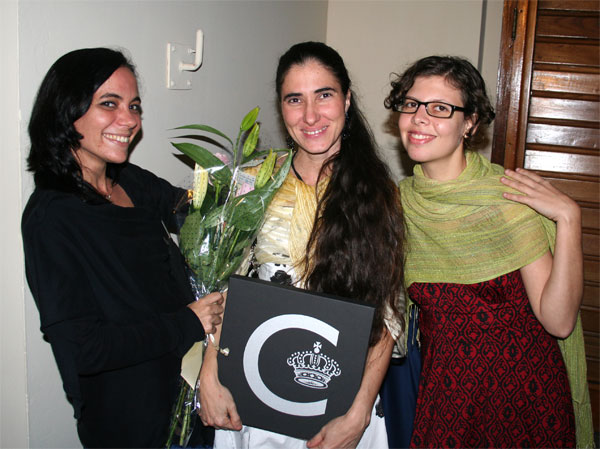
The evening was cool. Since the early hours we were preparing for what would happen that afternoon. We were to pick up the poet and Regina in order to go together to the Dutch ambassador’s residence, where there would be a reception to present the Prince Claus award officially to Yoani Sánchez.

Upon arriving at the appointed place, we were able to observe that there was already a large group of bloggers on the corner of the residence, waiting for the hour stated on the invitation. A mysterious white pickup truck with darkened windows was parked right in front of the place. On the other corner, a cyclist on his motorcycle, with his helmet on and not moving, seemed to have turned into a sculpture. There was also a couple who pretended to be checking an address. None of them were moving.

Among the last to arrive were Coco Fariñas, Father José Conrado and Dagoberto Valdés. After exchanging greetings, the whole group of us headed for the site of the event. Fortunately no one bothered us. But, since we knew what it was all about, before we went in we directed a big smile towards the parked white pickup, as well as the couple that was not moving from its place and the motorcyclist.

The ceremony was truly moving. We were all there to support and accompany Yoani. She, with the wise and simple words that are her hallmark, gave thanks for the well-deserved award. With great applause, the award ceremony was closed. Then a varied and delicious buffet was served. We had a truly charming evening.

Translated by: Espirituana

January 8 2011

SOS from Rita and Bola / Laritza Diversent

How neglected and abandoned! In Guanabacoa, the houses where masters of Cuban art and music, Rita Montaner and Bola de Nieve, were born are about to fall down.

Neighbours from this area in La Habana have told to Rafael Egües Velázquez, from the Web of Community Communicators, who could not take photos because State Security confiscated his camera.

Magalys Loza Rodríguez showed Egües the state in of the house where she lives and in which Rita Montaner came into the world in 1900, on Cruz Verde number 18, between Amargura Street and Duarte Street, Guanabacoa.

“The household is shored up, the roof is in danger of falling in. I wrote to the City Historian Eusebio Leal and he has not had courtesy to send someone to evaluate the damage. Even though this house is our National Heritage.”

“No one at the Ministry of Culture is interested. Nor is anyone at the Assembly of Peoples Power. And I am not going to waste my time proposing it. It seems to be a lie that they will pay attention to the site where one of the glories of the Cuban culture was born. They’re waiting for it to collapse and then they’ll whine about it later.”

For her part, Odalis Fonseca Jiménez, went to the ombudsman to confirm the heavy damage to her abode in which Bola de Nieve was born in 1911, in Máximo Gómez Street number 101 between Enrique Valenzuela Street and Quintín Banderas Street, Guanacabacoa.

“It is in danger of collapse and nobody in the town office has paid it the attention it deserves. Ten months ago I wrote to Eusebio leal and he has not responded to me. The town historian wanted to put a plaque on the house and I refused. The architects from the district have presented themselves, warning me it is not habitable and proposing I go to a shelter, I’ve also refused that.”

“They should give materials to repair the house little by little Office of the City Historian should undertake the restoration, because Bola de Nieve meant a lot to the music and culture of this country.”

Via this blog, we send out SOS to all Cuban artists and musicians, living outside or inside Cuba, to save the two houses and turn them into the museums Rita and Bola deserve.

Iván García, Laritza Diversent and Tania Quintero

Translated by Ivana Recmanova

Originally posted: January 7 2011