Gustavo Fleitas Ramírez belonged to Fidel Castro’s old military guard, and his death continues to reduce the ranks of the “historic generation.”
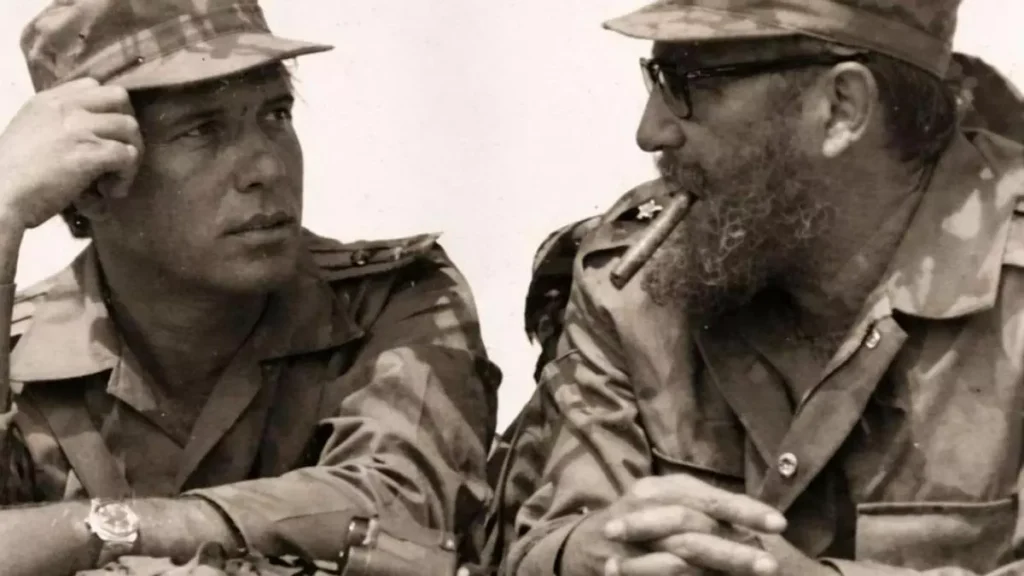
14ymedio, Havana, November 14, 2026 / The death of Brigadier General (Ret.) Gustavo Fleitas Ramírez, known as Mandarria , has left two epitaphs that are difficult to reconcile. The Ministry of the Revolutionary Armed Forces bid farewell to one of its veteran combatants this Friday, while one of his sons recalled that the officer had even asked for his execution by firing squad for “traitoring the homeland.”
Between these two versions emerges the story of a man whose loyalty to the Revolution, according to family testimony, was above even blood ties.
“He dedicated his entire life to that damned Revolution, abandoning his family. When I was imprisoned, he asked that I be shot for treason,” wrote his son, Jorge Fleitas.
“He dedicated his entire life to that damned Revolution, abandoning his family. When I was imprisoned, he asked that I be shot for treason. But he was my father. Rest in peace, General,” wrote his son, Jorge Fleitas, identified on Facebook as Guitera Antonio. This serious accusation is a revealing testament to the family fractures caused by the subordination of private life to ideology in Cuba.
Fleitas Ramírez belonged to the generation of military officers whose careers began fighting against Fulgencio Batista and ended intertwined with the survival of the regime established by Fidel Castro. In February 1958, he joined the Third Front “Doctor Mario Muñoz,” commanded by Juan Almeida Bosque, after participating in clandestine activities of the 26th of July Movement.
After 1959, he received the rank of first lieutenant and began a rise through the ranks that led him to command armored units, infantry divisions, and territorial structures of the Armed Forces. He was head of the Holguín Army Corps, the Central Army, and second-in-command of the Western Army. He also participated in the Bay of Pigs invasion and in the operations against the insurgents in the Escambray Mountains, officially called the “fight against bandits.”
His military record includes four missions in Africa. In Angola, he was head of the Southern Troops Group and deputy head of the Cuban mission. In Ethiopia, he led a tank brigade and later the military mission. All of these were responsibilities reserved for officers who enjoyed the confidence of the political and military command structure headed by Fidel Castro.
That confidence did not necessarily translate into effectiveness. Testimonies from former military personnel , gathered in investigations into the case of General Arnaldo Ochoa, maintain that Mandarria was replaced in Angola by Leopoldo Cintra Frías, known as Polo , due to the deteriorating military situation prior to the Battle of Cuito Cuanavale. Ochoa would later assume command of the mission.
‘Mandarria’ was replaced in Angola by Leopoldo Cintra Frías, known as ‘Polo’, due to the deteriorating military situation prior to the Battle of Cuito Cuanavale
A founder of the Communist Party, Fleitas received numerous decorations, including the Antonio Maceo, Camilo Cienfuegos, and Ernesto Che Guevara Orders. His son had previously denounced that, despite so many years of service, the general ended up living in conditions of neglect.
His death adds to a string of fatalities among former revolutionary leaders. During 2026, Ramiro Valdés, William Gálvez Rodríguez, and Alcibíades Wilmer Pérez Rivero, among other veterans, also passed away. Biology is accomplishing what no political renewal could: definitively removing the initial protagonists of the Revolution from the stage.
In 2019, journalist Reinaldo Escobar warned in an article that belonging to the “historical generation” required more than just having fought against Batista : it required embracing communism and demonstrating loyalty to the ruling elite. Mandarria embodied that condition to its most intimate consequences.
The Ministry of the Revolutionary Armed Forces announced that his ashes will initially remain in the Colón Cemetery before being transferred to the Mausoleum of the Third Front in Santiago de Cuba. There he will receive military honors. His son, meanwhile, offered a much less ceremonial farewell: the acknowledgment of a father whom, despite everything, he could not bring himself to hate.