Rain and electrical storms caused an oscillation that triggered the second collapse of the National Electric System (SEN) in less than 24 hours this Monday
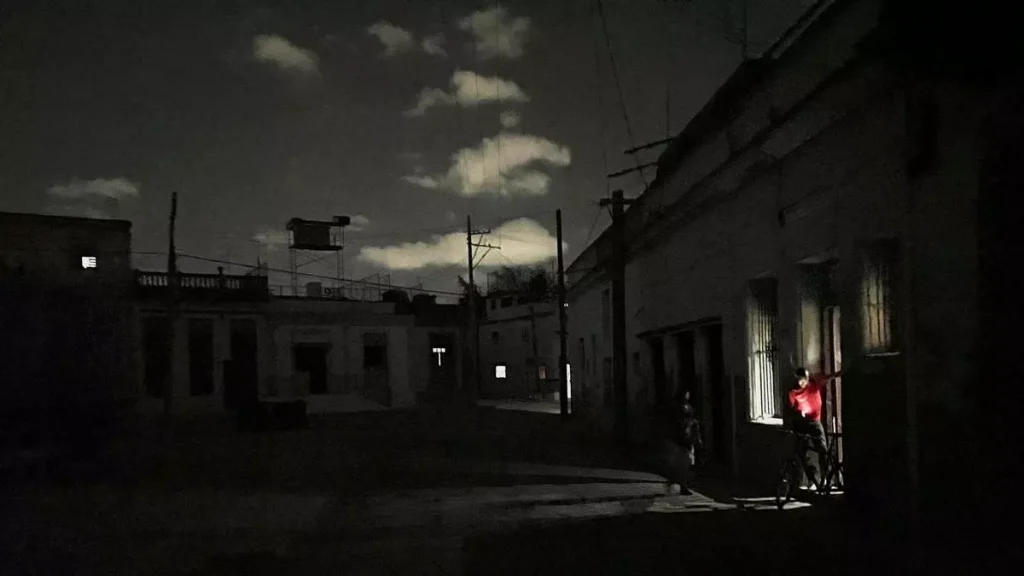
 14ymedio, Madrid, August 4, 2026 / The National Electric System (SEN) has been linked since this morning from Pinar del Río to Holguín, with the three easternmost provinces still to be added. The reconnection, however, has not yet translated into power for the population, which is complaining on social media about blackouts lasting 50 to 72 hours in a row. This was the second total collapse of the SEN in less than 24 hours, and the seventh so far this year.
This morning, Cuba’s Electric Union said that unit 6 of the Diez de Octubre thermoelectric plant came online shortly after 8:20 a.m., contributing “to the recovery process.” The latest information from Havana indicates that 22 of the capital’s 26 substations were providing service. Only 38% of the population – 325,785 of the 862,732 customers – had power through the 108 recovered circuits, out of a total of 286. In addition, 40 of the city’s 45 hospitals have power, as do seven of the 18 pumping stations and main water supply sources.
The provincial Electric Company noted that “some users may continue to be affected even when their circuit has been restored, due to other causes. Of the restored circuits, 18 show effects from a generation deficit and seven from breakdowns.” This is the case at 14ymedio’s editorial office, where the blackout has already reached 40 hours.
The counterpoint is Santiago de Cuba, where four sectionalized circuits remain in service “to guarantee the electricity supply to vital centers by means of microsystems.”
The counterpoint is Santiago de Cuba, where four sectionalized circuits remain in service “to guarantee the electricity supply to vital centers by means of microsystems.”
Yadier Ruiz, director of the load dispatch office in Villa Clara, gave a provincial update at dawn this Tuesday. During the day, the priority would be to link the system through Cienfuegos. “If that is achieved,” he said before the reconnection, “the outlook should improve, increasing the availability of power in the province and the number of circuits in service,” he added, though he admitted that most of the population has remained in the dark since Sunday night, when the first collapse occurred.
“The Palmarito water pumping station in Santa Clara and all hospitals currently have electricity, except those located in Remedios and Caibarién, which are being sustained by their own generators. As of this report, Villa Clara had only 22 MW available and 16 lit circuits,” he said around 6:30 a.m.
The collapse of the SEN occurred Monday at 5:00 p.m., just a few hours after the slow recovery began from the collapse that occurred Sunday night. Official media reported that an “oscillation” caused a new disconnection of the system and wiped out the progress made during the day.
“In the process of restoring the SEN, the existing weather events caused damage to the grid, directly affecting the generating units that were online,” reported on social media the pro-government journalist Lázaro Manuel Alonso.
Around 5:00 p.m., official media reported: “A new disconnection of the national electric system occurred a few minutes ago. Despite the progress made today, an oscillation caused the collapse.” Half an hour later, the Electric Union (UNE) reported that the reconnection protocol had begun. “We continue working intensively to reverse this situation and achieve the restoration of the system as soon as possible.”
Shortly after 5:00 p.m., rain and electrical storms caused an oscillation that knocked the Energás Boca de Jaruco units and one Santa Cruz del Norte unit out of the system
Félix Estrada, director of the load dispatch office of the Electric Union, appeared again on Canal Caribe at 8:00 p.m. to explain what had happened. The official said that shortly after 5:00 p.m., rain and electrical storms caused an oscillation that knocked the Energás Boca de Jaruco units and one Santa Cruz del Norte unit out of the system. At that point, the system had been linked from Pinar del Río to Cienfuegos, but it had to start over.
As the engineer spoke, unit 4 of Energás Boca de Jaruco and the transmission network substations of Diezmero, Naranjito, Melones, Cotorro, Regla and Guanabacoa were already generating power.
“We continue moving forward in restoring our Electric System, overcoming all kinds of difficulties, under a total energy blockade, with a great deal of effort and commitment,” wrote Energy and Mines Minister Vicente de la O Levy on social media. “The speech is very positive, but the reality is very negative. Please, set aside your comfort and react. This country cannot go on like this,” a user replied to him.
The new collapse occurred while the SEN had still not recovered from the total blackout recorded this Sunday at 10:43 p.m. Throughout Monday, UNE worked to restore service through microsystems and the gradual incorporation of some power plants. Monday’s recovery was very limited. The priority remained ensuring service to hospitals, water pumping facilities and other centers considered essential.
Around 5:00 p.m., the electric company in Villa Clara reported that a failure occurred at the Hanabanilla hydroelectric plant and, as a result, “some of the circuits that had been restored, including those serving hospitals, were again left without electric service.”
Posts on social media announced that in Villa Clara, a breakdown had “left the Cardiocentro, the Celestino Hernández Oncology Hospital and the Santa Clara Military Hospital without service.”
In Matanzas there were also problems reaching the Faustino Pérez Hospital, which was resolved through a microsystem using the Guanábana batteries.
A failure occurred at the Hanabanilla hydroelectric plant and, as a result, “some of the circuits that had been restored, including those serving hospitals, were left without electric service”
At the time of the total disconnection, Havana had 23 substations online, benefiting 50% of the population and 38 hospitals.
For its part, the Cuban Telecommunications Company (Etecsa) reported interruptions in cell phone service following the breakdown of the generator that backs up one of the main mobile network centers. According to the company, the problems affect numbers beginning with the prefixes 52, 509, 598 and 599.
Expert Jorge Piñón, a researcher at the University of Texas, had told 14ymedio in advance that weather conditions could also affect the “islands” built with solar power. The weather service had reported cloud cover over much of Cuba, which, in the specialist’s view, highlighted “the structural challenge of solar energy without a storage system or transmission line system to distribute the electricity generated by renewables to consumers.”
With this new collapse of the SEN, the recovery process of the electric system will have to start over from scratch, prolonging the blackout affecting the entire country.
Translated by GH.
______________________
COLLABORATE WITH OUR WORK: The 14ymedio team is committed to practicing serious journalism that reflects Cuba’s reality in all its depth. Thank you for joining us on this long journey. We invite you to continue supporting us by becoming a member of 14ymedio now. Together we can continue transforming journalism in Cuba.