Several units of thermoelectric plants return to service after months of maintenance.
 14ymedio, Havana, September 12, 2026 – Cuba’s “energy independence” appears to be getting closer, at least if the authorities are to be believed. This Friday, a report by Canal Caribe celebrated the recovery of several thermoelectric plants, the installation of more than 1,000 megawatts (MW) of photovoltaic energy, and the use of domestic crude oil and gas as signs that the country is moving toward that goal. However, national television acknowledged that, due to the lack of imported fuel, generating plants have stopped producing more than 1,200 MW.
The recovery of some thermoelectric power plants (CTEs) is real. According to Lázaro Guerra Hernández, general director of Electricity at the Ministry of Energy and Mines, one of the Mariel units is supplying more than 95 MW and is practically at its design capacity after remaining out of service for a long period. There are also two units operating again in Santa Cruz del Norte, others that were reconnected at the Nuevitas and Renté CTEs, and the Antonio Guiteras has resumed supplying the national electricity system (SEN).
The authorities attribute a reduction in blackouts to these additions. The numbers, however, continue to show a system far from any normality. On Thursday, the maximum shortfall reached 2,267 MW at 8:40 p.m., well above what the UNE itself had forecast. The improvement, therefore, depends on the old thermoelectric plants remaining in service, something that in recent years has been impossible for any prolonged period.
Domestic oil is heavy and has a high sulfur content, characteristics that accelerate corrosion and increase maintenance needs
The Government’s other major bet is solar parks. According to the authorities, Cuba has already surpassed 1,000 MW of installed photovoltaic capacity, to which the El Algarrobo park in Guantánamo was recently added, despite the “unexpected departure” of the Chinese. The program will continue this year with new installations that, the Government maintains, will make it possible to reduce blackouts, although only during daylight hours. However, for technical reasons, only half of the installed capacity can be used.
Furthermore, when the sun goes down, that generation also drops, while demand approaches its maximum. It is then that the newly proclaimed “energy independence” depends primarily on Cuban crude oil and gas, and on the thermoelectric plants not suffering another breakdown.
Nor is this an innocuous raw material for already aging plants. Domestic oil is heavy and has a high sulfur content, characteristics that accelerate corrosion and increase maintenance needs. Distributed generation, the Turkish floating power plant in Havana, and other facilities that could provide more than 1,200 MW are paralyzed due to a lack of fuel, after traditional supplies from Venezuela, Mexico, and Russia plummeted under pressure from Washington.
Even when the National Electric System (SEN) manages to produce electricity, the distribution network shows increasing deterioration.
“Currently, there is no imported fuel in the country,” the official admitted, in an interview with journalist Bernardo Espinosa for Canal Caribe. All nighttime production, he added, is currently sustained by domestic sources. The official explanation for the lack of supplies was once again the U.S. embargo, presented in the report as an “asphyxiation” that prevents the country from operating in international hydrocarbon markets.
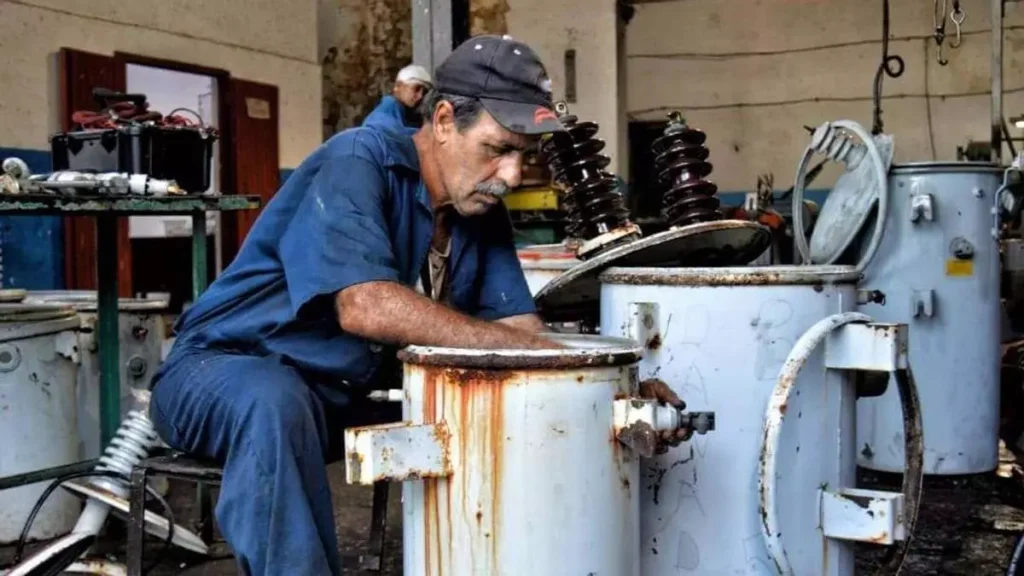
But the problem does not end at the generating plants. Even when the SEN manages to produce electricity, the distribution network is showing increasing deterioration.
By the end of August, the Ministry of Energy and Mines had recorded 479 thefts of dielectric oil from transformers. Matanzas tops the list with 175 cases, followed by Ciego de Ávila, with 67, and Santiago de Cuba, with 60. In Matanzas, 43 of the 98 substations had suffered attacks, and 12 remained out of service because of them.
The crisis thus generates its own vicious cycle. Prolonged blackouts facilitate the theft of oil, and when power returns, an emptied transformer can overheat and become unusable. What began as an outage caused by a generation deficit can end up becoming a prolonged breakdown because replacement equipment is also in short supply.
Translated by Regina Anavy
______________________
COLLABORATE WITH OUR WORK: The 14ymedio team is committed to practicing serious journalism that reflects Cuba’s reality in all its depth. Thank you for joining us on this long journey. We invite you to continue supporting us by becoming a member of 14ymedio now. Together we can continue transforming journalism in Cuba.