Producers will sell 1,404 tons and the Colombian government will subsidize export.
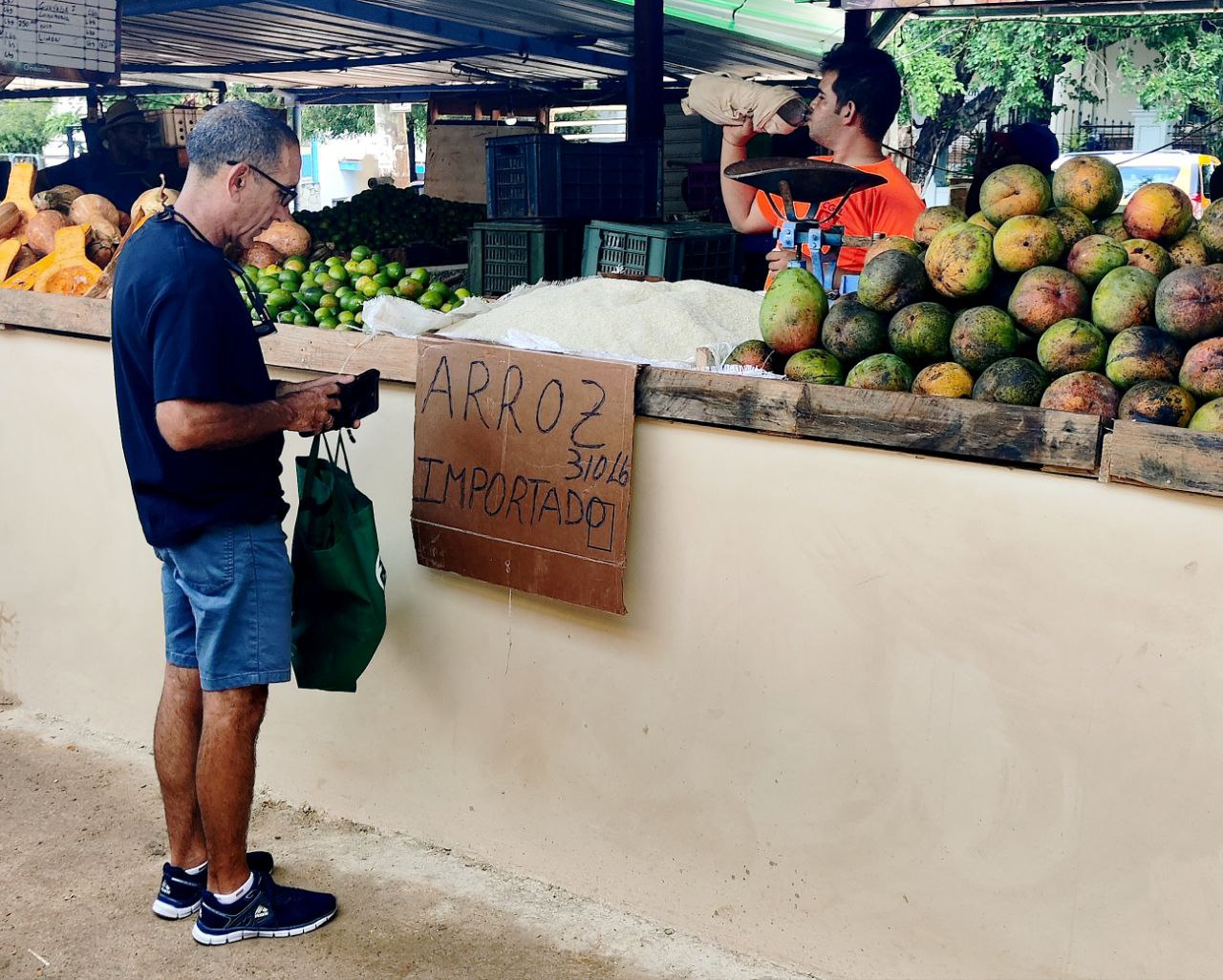
 14ymedio, Madrid, July 10, 2025 — This Wednesday, at the Youth Labor Army (EJT) market on 17th and K, a poster announced the sale of imported rice at 310 pesos a pound. A few hours ago, the May’s allocation arrived at Havana’s ration stores (bodegas). “How can the poorest people eat rice with these prices?” asked a Havana resident on a walk through the countryside. “In my house you have to buy a pound daily, for lunch and dinner for three people. It’s 9,300 pesos per month, and my mother’s check is 1,500 pesos, same as my stepfather’s. They couldn’t eat rice without me,” he says.
In a parallel world, in Tolima, Colombia, so much rice is produced that prices have fallen to the minimum. In 2023, Colombia produced 685,576 tons of the product, more than 21% of national production, so the Colombian government has facilitated an agreement to sell 1,404 tons to be exported to Cuba. Although it is a small thing for the region, and farmers have warned that it does not solve their problems, any help is welcome for the Island, which barely harvested 80,000 tons of rice, a staple for Cuban tables, last year. This covered only 11% of the demand.
Cuba spent more than $300 million last year to import 407,000 tons of rice to make up its deficit, and it is not known how much it will now pay for this direct agreement with the Government of Colombia, which subsidizes the export of the product to the Island in order to minimize the costs of domestic enterprises.
Small-scale Tolima rice producers -4,968 of them- are expected to export their rice to Cuba, “generating business worth more than 5.984 billion pesos over a year,” equivalent to $1,487,817
According to the Agency for Rural Development, trade will be direct between small producers and Cuba, and it is expected that 4,968 small producers of Tolima rice will export their grain to the Island’s market, “which will generate business in excess of 5,984 million pesos during one year,” equivalent to $1,487,817.
There will be 1,644 tons of white rice marketed annually, of which 1,404 will go to Cuba, while 240 tons remain to supply social programs in Colombia, “positioning the country as a reliable food supplier and reaffirming the potential of farmer societies,” states the government agency in a press release.
But this is no solution for Dignidad Agropecuaria Colombiana, an organization that has been demanding for at least a year the intervention of the leftist government of Gustavo Petro in a complex conflict, one for which a strike is called between July 7 and 14.
“The Presidency of the Republic announces that 1,644 tons of rice will be exported, with subsidies, probably to the exporter to sell them, but the country will collect more than 2 million tons in the harvest that has already begun. This export is an effort, but it does not solve even 0.1%”of the problem, regrets this farmers’ movement, which calls for the imposition of remunerative and stable prices, in addition to fulfilling the agreements reached in a previous strike.
Between March and April, during the previous strike, the government promised to provide marketing subsidies, but months passed as farmers saw promises not kept while cereal prices plummeted and inputs became more expensive. This agreement with Cuba is one of the mechanisms to make the plan effective, but the volume of subsidized sales is, the producers claim, much too low.
In Tolima, the region where the rice that goes to Cuba is produced, productivity is very high. Despite being the third in land area dedicated to sowing, it is the largest crop of the country, with a yield above the national average, at 7.3 tons per hectare. The figure contrasts sharply with the 1.6 achieved in Los Palacios, in Pinar del Río, although the Vietnamese company AgriVMA, which cultivates 1,000 hectares under usufruct in that same province, achieves an average yield of 7.2 tons per hectare.
The figure contrasts sharply with the 1.6 achieved at Los Palacios, in Pinar del Río, although the Vietnamese company AgriVMA, which cultivates 1,000 hectares under usufruct in that same province, achieves an average yield of 7.2 tons per hectare
“The climate is very good for agriculture, and the way Cubans work here is good, but there’s a shortage of fertilizers, so we brought everything. The biggest problem here is transportation and fuel, which we’re working on with the Cuban company,” Trán Trony Pai, a Vietnamese specialist in Los Palacios, told the international press this June.
“We want more yield (in our business in Cuba), but it’s the first time we are sowing here. There are many things we are learning as well: for example, to know the land,” he added.
The crisis in rice production in Cuba has forced the government to take measures such as this, to lease land for the first time to a foreign company, but also to depend on donations from some of its partner countries – mainly Vietnam and China themselves – or to import it from Brazil, Uruguay or Canada, usually with difficulties in paying the freight.
On several occasions the inability of the Government to carry out the transaction has caused the ships to remain outside the island or stopped in port without being able to start unloading, while the Cubans are still looking for life every day to be able to fill their plates.
Translated by Regina Anavy
____________
COLLABORATE WITH OUR WORK: The 14ymedio team is committed to practicing serious journalism that reflects Cuba’s reality in all its depth. Thank you for joining us on this long journey. We invite you to continue supporting us by becoming a member of 14ymedio now. Together we can continue transforming journalism in Cuba.