- Foreign Minister Bruno Rodríguez condemns Washington’s intention to “impose a total blockade on fuel supplies” to the Island
- The president of the state news agency Prensa Latina accuses Trump of seeking “a genocide of the Cuban people”
- China condemns U.S. measures against energy supplies
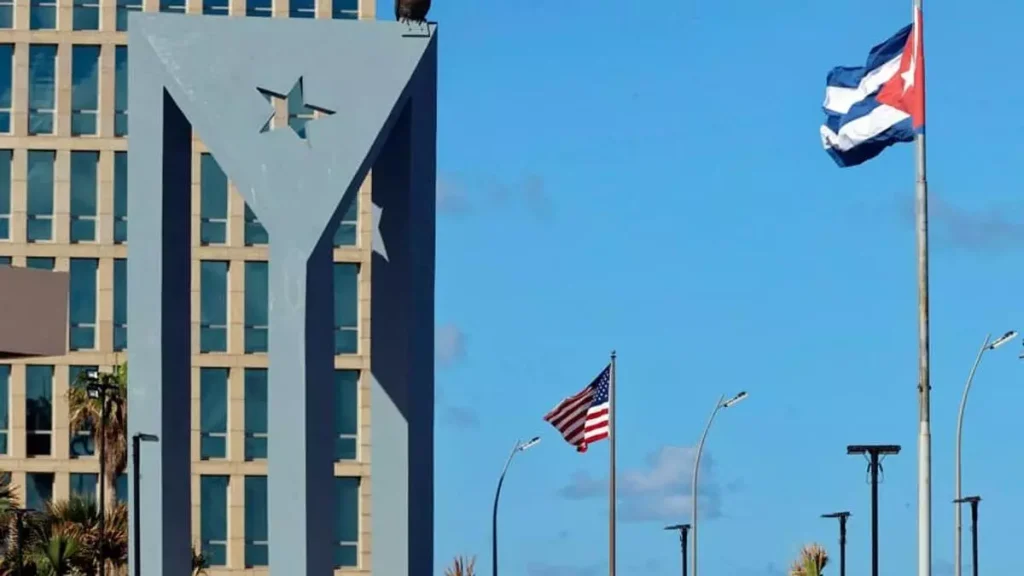
 14ymedio, Madrid, January 30, 2026 – Cubans were heatedly debating whether the new U.S. measure to impose tariffs on countries that deliver oil to the Island is good news that would bring down the regime or a punishment that would be borne by the people. Into that debate stepped Foreign Minister Bruno Rodríguez, with his usual verbosity: “We condemn in the strongest terms the new escalation by the United States against Cuba. It now proposes to impose a total blockade on fuel supplies to our country,” he wrote on his X account.
The minister added: “To justify it, it relies on a long list of lies that attempt to portray Cuba as a threat that it is not. Every day there is new evidence that the only threat to peace, security, and stability in the region, and the only malign influence, is that exerted by the U.S. government against the nations and peoples of Our America, whom it seeks to subject to its dictates, strip of their resources, mutilate their sovereignty, and deprive of their independence.”
Rodríguez denounced that the U.S. is resorting “to blackmail and coercion, trying to get other countries to join its universally condemned policy of blockade against Cuba, and threatening those that refuse with the imposition of arbitrary and abusive tariffs, in violation of all norms of free trade.” This statement has accumulated more than 200 reactions for and against, among which one stands out as particularly interesting: “And besides condemning, what else is your regime going to do? Because you’re going to be left with zero fuel.”
For her part, Mexican President Claudia Sheinbaum appealed this Friday to the principle of national sovereignty to defend crude shipments to Cuba through Petróleos Mexicanos (Pemex). According to the president, the imposition of tariffs announced by the U.S. government “could trigger a far-reaching humanitarian crisis.”
“We have to know the scope, because we also don’t want to put our country at risk in terms of tariffs,” said Mexican President Claudia Sheinbaum
However, Sheinbaum said she wants to know the scope of the announced measure so as not to “put Mexico at risk,” and therefore instructed the foreign minister, Juan Ramón de la Fuente, to establish immediate communication with the U.S. State Department.
The recent threat by U.S. President Donald Trump comes amid negotiations over the United States–Mexico–Canada Agreement (USMCA). Trump has threatened to pull his country out and negotiate bilateral agreements, as he has already done with some nations.
“We have to know the scope, because we also don’t want to put our country at risk in terms of tariffs,” the president said at her usual morning press conference, this time from Tijuana, Baja California.
Sheinbaum insisted that Mexico “will always seek the diplomatic route” and called, “first, for the self-determination of peoples and, second, to avoid a humanitarian crisis for the Cuban people.”
For the moment, there does not appear to be a plan within the Cuban government, whose only available mechanism for now is rhetoric. “Having to resort to so much abuse against Cuba is the greatest recognition by the U.S. executioners of their own defeat. Long live Cuba and down with the criminal siege of the U.S. We will resist, we will defend the peace we conquered through struggle. We will live and we will prevail!” wrote the deputy head of the Cuban mission in Mexico, Johana Tablada, in a tone similar to her minister’s tweets.
Going even further was the president of the state news agency Prensa Latina, Jorge Legañoa, who was the very first voice of officialdom to speak out on Cuban television, in a special news broadcast. “What is being sought? What is being sought is a genocide of the Cuban people, and if it materializes through tariffs, the effect would be to paralyze electricity generation, transportation, industrial production, agricultural production, the availability of health services, the water supply… in short, all spheres of life, asphyxiation by the U.S. government.”
Legañoa denied one by one all the accusations contained in the executive order signed by Donald Trump this Thursday. “Cuba is not a threat to national security and never has been,” he maintained. He then rejected claims that there are Russian or Chinese facilities on the Island, that there is cooperation with terrorism, and that political opponents are persecuted and tortured. He also accused the U.S. of harboring terrorists, citing the late Luis Posada Carriles as an example.
The journalist described the new measure as “an act of aggression” and called on the international community to choose whether or not to join that blockade policy. “We ask ourselves whether the world will be governed by the use of force to impose the will of one state over another and compel a third to join in,” he reflected.
“We ask ourselves whether the world will be governed by the use of force to impose the will of one state over another and compel a third to join in”
Legañoa stressed that no country can survive without fossil energy and accused the U.S., after seven decades of failing to do so, of trying to bring down a “legitimate system of full sovereignty, social justice, and the promotion of peace and solidarity with the rest of the world. Let us not be deceived by another blow from the empire,” he concluded.
Legañoa’s appeal to other countries has found its first response in China, which this Friday condemned the measure, considering that it violates Cuba’s sovereignty and deprives its population of the right to development. Chinese Foreign Ministry spokesperson Guo Jiakun said at a press conference that Beijing “firmly supports Cuba in safeguarding its national sovereignty and security,” and opposes “external interference” and “actions and even inhumane practices that deprive the Cuban people of their right to survival and development.” He also reiterated support for lifting the embargo and any pressure policy.
Nevertheless, the response does not differ from statements made in previous days or from those China once made regarding Maduro’s Venezuela. This Tuesday, Guo used very similar language when the new executive order was not yet known. “We urge the U.S. side to stop depriving the Cuban people of their right to survival and development, to end the blockade and the sanctions against Cuba,” he said, adding that China will continue to support the Island “within its capabilities.”
Attention is now turning to Russia, which in 2026 supplied about 6,000 barrels of fuel per day, according to the University of Texas Energy Institute. For the moment, the Kremlin has not spoken, although Russia’s ambassador to the UN, Vasily Nebenzya, did address a related issue: the chances that the U.S. could achieve political change on the Island similar to what it achieved in Caracas. “In Venezuela, without a doubt, a betrayal took place. It is something spoken about quite openly. A part of the senior officials, in fact, betrayed the president,” Nebenzya said in statements to Russian television. He added: “That little trick won’t work in Cuba.”
“In Venezuela, without a doubt, a betrayal took place. That little trick won’t work in Cuba”
Another focal point is Mexico, Cuba’s main crude supplier after Venezuela. This Thursday, before Trump’s measure was announced, the U.S. president spoke with his Mexican counterpart, Claudia Sheinbaum, in what he described as a “very productive” conversation on border issues and drug trafficking. “Mexico has a wonderful and very intelligent leader. They should be very happy with that!” the president remarked.
Sheinbaum, for her part, has spent several days carefully navigating the issue with the press, which has persistently asked about the cancellation of a Pemex crude shipment that was supposed to arrive in Cuba at the end of January. The Mexican president maintained that it was a “sovereign” decision by the state company and that crude would continue to be sent depending on the company’s decisions or, failing that, on a government decision for “humanitarian reasons.” In 2025, between 6,000 and 12,000 barrels per day arrived on the Island from Mexico, depending on estimates. Although two weeks ago the U.S. Secretary of Energy said he would not pressure Mexico to suspend those exports, Trump’s latest statements point in the opposite direction.
“It seems it won’t be able to survive. Cuba won’t be able to survive,” the U.S. president said last night. When asked whether he is trying to “strangle” Cuba, he replied that the word is “very harsh,” but insisted that the Island is “a failed nation.”
“You have to feel sorry for Cuba because they have treated people very badly. We have many Cuban Americans who were treated very badly and would like to return,” he said to close the matter.
Translated by Regina Anavy
____________
COLLABORATE WITH OUR WORK: The 14ymedio team is committed to practicing serious journalism that reflects Cuba’s reality in all its depth. Thank you for joining us on this long journey. We invite you to continue supporting us by becoming a member of 14ymedio now. Together we can continue transforming journalism in Cuba.