H1N1 Attacks

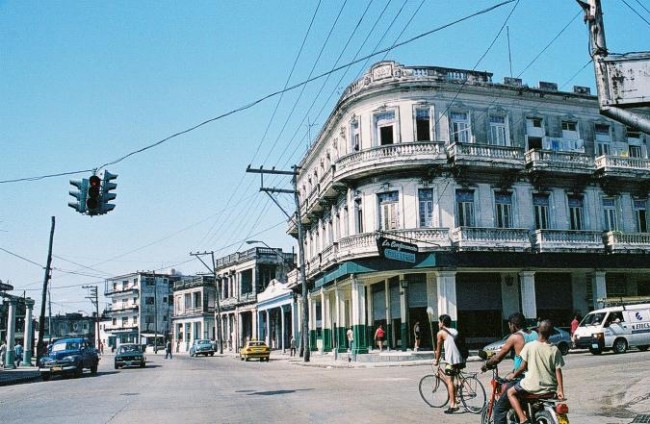
dsc00647dsc00647.jpg

The new influenza is gaining ground in Cuba. With the change in the weather, according to epidemiologists, it’s expected that the H1N1 virus will reap its harvest among the population of the island. As of October 1, the Ministry of Public Health reported the detection of 457 cases.

Now the Hubert de Blanck High School, in the municipal district Plaza of the Revolution, in the capital, has been forced to close. On Wednesday, September 30, the principal of the school reported that a sanitary commission, headed by the provincial director of epidemiology, had carried out a detailed inspection at the school.

A couple of days before, the principal had sent out an SOS because of the high number of students with respiratory problems. Due to bad hygienic and building conditions at the school, an old mansion poorly adapted to serve as a school, at first it was thought that this could be the cause of the high fevers and respiratory problems that many were suffering.

After numerous check-ups the doctors found 121 cases with respiratory problems of various degrees. As a preventive measure, the sanitary authorities decided to close the school. The tests done in the labs of the Institute of Tropical Medicine confirmed that five students were infected with the H1N1 virus.

In another two high schools in the same area, José Larruñada and José Luis Pérez, the alarm has gone out. Ana Rosa, a civil engineer who is 34, admits that because of the parents’ fear that their children might get infected, school absences have been noted. As an example, she says that on Friday, October 2, 70 students at José Luis Pérez High School did not attend classes.

Despite the fact that the virus threatens to become a pandemic, the government has taken it calmly. Maybe to avoid spreading the panic, the press has not mentioned what occurred at Hubert de Blanck and prefers to mention “stimulating” cases, like that of a woman in an advanced state of pregnancy, who, thanks to medical attention, survived the type-A flu at the National Hospital.

On television, a timid propaganda reminds us that hands should be washed frequently and cleanliness should be maintained at home. In taxis paid in foreign currency and in city buses, posters have been placed in favor of better hygiene. But the new flu is not explicitly mentioned.

Low-income families in Nuevo Vedado, where the word on the street is that H1N1 is almost a plague, want to know if it had crossed the minds of the Castro brothers’ government to make an urgent and substantial discount on products like soap and detergent, which can be bought only in Cuban convertible pesos, at prices that are impossible for most ordinary Cubans. It would be the logical thing to do. But so far, the rulers of the destiny of Cuba have shown no concern about this sector of the population.

Alarmed, I phoned the provincial office of the Ministry of Public Health. I asked if sanitary authorities were ready to confront a possible pandemic. The person who answered did not want to identify himself, but he assured me that they had sufficient anti-virals and medicines to treat H1N1.

Many parents interviewed believe that the mega-concert given by Colombian singer Juanes, on Sunday, September 20, was the explosive device for the uncontainable advance of the virus. More than one million people gathered in tight quarters, and this could have been the “soup” that made it easy for the virus to grow.

If that is the case, Juanes’ good intention of singing for peace in Havana could have become the ideal place for H1N1 to form a massive attack on the citizens of Havana. As a coincidence, the most-affected schools are within a few kilometers of the Plaza of the Revolution.

Now the problem is whether the Cuban authorities have resources and effective measures to stop the spreading of the disease. I hope they do.

Iván García

P.S. On Friday, October 9, a television program was announced to report on the situation in Cuba with the H1N1 flu, respiratory illnesses and dengue.

Translated by Anonimatus Generacion Y

The Poet Was Listening to Boleros

I saw him. It was he. He did not recognize me, engrossed as he was, in a bar on Belascoaín Street, listening to one of Orlando Contreras’ boleros, or perhaps it was La Lupe, with “Yours is Pure Theater,” on a decrepit, recycled RCA Victor record player.

It was 4:30 in the afternoon on Wednesday, September 8. An almost desert-like heat seemed to melt the asphalt in Havana. Without a drop of breeze. People were crowing into a dirty little store on Sitios Street, trying to cool off from the heat wave by drinking a tasteless juice, with a slight taste of orange.

It was the day of the Virgin of Charity. Dressed in yellow, many people were walking quickly toward the Church of the Virgin, located on Salud Street, at the corner of Manrique. At 6:00 in the evening, a procession would leave from there with the patron saint of Cuba, to walk through the streets of Central Havana.

To kill time, I sat down in a bar with a blackened mahogany counter. And as if it were a miracle of “Cachita,” when I turned my head, I saw the poet Raúl Rivero playing dice with the bard Rafael Alcides and the journalist Reinaldo Escobar.

A record player salvaged from some warehouse of useless objects offered a recital of boleros. From the two Orlandos, Contreras and Vallejo, continuing with La Lupe and Blanca Rosa Gil, up to Freddy, that voice that puts meat on the chicken.

Reinaldo and Alcides were drinking out of glasses, in no hurry, from a bottle of Caney rum, aged seven years. The plump Rivero, with closed eyes, was enjoying the music, while in his fingers a mentholated cigarette threatened to burn his hand.

I did not want to call him. I did not want to break the spell. But I swear that the man with glasses, seated with his friends among drinks, dice and boleros, was he. The poet who in his last years in Havana lived on Peñalver Street, in the La Victoria neighborhood. He had come back in disguise. To this Havana in 2009, without charms or spells. But with something to put under my pillow at night to fall asleep.

Yes, I saw Raúl Rivero. One of my journalistic icons, who for seven years directed me at the Cuba Press Agency. It was in the middle of the ’90s, until the fateful spring of 2003, when an arrogant and closed government, that did not want – and does not want – to permit ideas and poems to be published on their merits, sentenced the poet of La Victoria to 20 years in jail.

At that time I was a novice wanting to consume the world. His journalistic advice was engraved on me forever. For me, a one-hour chat with Rivero represented years of classes in any school of journalism.

One cold afternoon in the spring of 2004, he left Canaleta prison, in Ciego de Ávila, the land where in 1945 he saw the birth of a world war, recently ended. He marched into a hard exile with his native land and his friends on his back. Also his manias.

In the splendid city of Madrid, a stranger to the city and its people, to boleros and record players. For that day of the Patron Saint, he jumped over to Havana. And I discovered him seated, listening to boleros, in a bar on Belascoaín Street. It must have been a miracle of the Virgin.

Iván García

Translated by Regina

D-Day

diad

At times I have recurring dreams. One of them is a nightmare. There’s a loud knock at the door, and when I open it a couple of huge burly guys lift me up and without even touching down on the stairway, they throw me into the backseat of a Russian-made Lada 2107.

They put a hood over my face and order me by menacing gestures to put my head between my knees. The last thing I remember before I wake with a start, are the hands of my captors, deformed by an excess of martial arts.

Other dreams are more pleasant. Two hands, warm and soft, waken me. It’s my daughter Melany, age 6, who comes to give me good news. “Grandma Tania, Aunt Tamila, and Cousin Yania, are coming this afternoon from Havana,” the girl tells me happily and rapidly.

Margarita, my wife, explains to my amazement, “The radio is breaking the news. Raúl Castro resigned and established a transitional government.  The first measure taken is that Cuba belongs to all Cubans, and the exiles who want to can return,” says my wife.

I have never seen her so happy.

More than a few times, in the solitude of my room, I have wondered which of these dreams will come true first.

Translated by: Tomás A.

My Neighborhood, My Little Country

In the bureaucratic and political jargon of my country it’s called Vibora People’s Council. It’s my neighborhood. A piece of geography, extending from Avenida de Acosta to Santa Catalina, and from the Causeway on 10th of October – once called Jesus del Monte, which the poet Eliseo Diego Rodriguez immortalized – to Mayia Rodriguez.

They form a quadrilateral seven blocks long and ten wide. There are many schools like the Institute of Vibora, now a technical and business school, the “Thomas Alva Edison” primary school and “Enrique José Varona” secondary school, once prestigious colleges. Other schools, such as “Pedro Maria”, are now dirty warehouses, and the ancient college of the “Marist Brothers” is the headquarters of the shadowy political police.

When night falls, the Calzada de 10 de Octubre, becomes a catwalk. Repressed gays hunting for a partner. Lesbians with military haircuts, who after drinks kiss desperately at the door of Pain de Paris, an exclusive cafe that takes only convertible currency. Cordova Park is perhaps the largest open-air “hotel” in Havana. Cheap sex in foreign or domestic currency, whichever. You choose your sexual preference.

Later in the morning, old men with sad faces and worn clothes form a line at the Metropolitan Bank — opposite the former home of the Counts of Parraga, today a cultural center — to collect their meager pensions. Also under the cover of darkness, thieves, robbers and voyeurs practice their misdeeds.

When the sun heats up, the nightcrawlers go to bed. And the street is colored yellow, red and brown, the colors of uniforms for secondary, primary and high school. Rushing people gather at bus stops to board lines P-6, P-8, P-9 and P-10, and to try to get to work on time.

The old men who in were line at the bank at dawn are now the first to buy the solitary 80-gram roll that the ration book allows us.

These seven by ten blocks make up the Vibora neighborhood. My home town.

Iván García

Translated by: Tomás A.

Russia is Coming Back

Breaking: The Russians are coming back to Cuba, this time as tourists and with hard currency. And these last few days there has also been a fleet of enormous Russian ships, bristling with weaponry and radar, at anchor in Havana’s port. The intentions of both governments are clear. Castro II wants to ask for a lot and to pay little. Dimitri Medvedev wants to re-position Russia at the center of world power.

They’re as tall as palm trees. They walk slowly and scrutinise the buildings in the old part of Havana. It’s a group of five Russian tourists. Three men and two fashionably dressed young women. They’re blond and have green or blue eyes. If you didn’t know about the embargo on Americans travelling to Cuba, you could easily mistake them for bored and slightly lost Yankees.

Near the Plaza de Armas, in their faltering English, they ask a balding mulatto guy holding a guitar where they can get something inexpensive to eat. “Fast food”, says the Russian girl. “Oh, there’s no McDonald’s here. The most similar thing you’ll find is the ‘Di Tu,’ which sells chicken, about two blocks from here”, the mulatto guy replies, in Russian, to the amazement of the tourists who want to know where he learned it.

“In the 70s I studied at Oleg Popov’s famous Clown School in Moscow”. “Oh, so you’re a clown?” asks a Russian wearing a Chelsea football shirt. “Yes, a clown who earns his living by singing nowadays,” he replies, while picking out on his guitar the tune to “Midnight in Moscow.”

The ex-clown manages to extract 10 convertible pesos from the Russian’s wallet for the song. His name is Manuel Oritz and he’s 53 years old. For the last 15 years, he’s been on the soup circuit (the term used on the island for serenading tourists while they eat) around Old Havana’s cobbled streets. “I was lucky with them. On the whole, they’re stingy, the Russians, and they don’t like hearing the old Russian songs, nor being called Tavarish.”  [Translator: Tavarish is the Russian word for comrade, and was the only acceptable form of address in the days of the USSR.] Ortiz confirms that he did indeed study as a clown in the former USSR. With this new wave of Russian tourists, the extensive and well supplied informal market place, home to jineteras, personal guides, musicians, rum and tobacco sellers, drivers, and guest house keepers, is dusting off the old basic Russian manuals so as to be able to break the ice with the new visitors.

Joel Romero is 32, slightly overweight, and has the look of an intellectual about him. He works as a private guide for tourists. Keeping an eye out in both directions in case a tourist comes along, and smoking a menthol cigarette, he offers the following profile of the Russian visitors: “They still like rum and Cuban tobacco in excessive quantities, just like the old Soviets did. They go after mixed race girls, and young bisexuals, for their orgies. Unlike Western Europeans, they don’t like the old style Cuban music. They prefer rap groups, like Orisha, or Isaac Delgado’s salsa. They do sometimes leave tips, but they’re not big tippers, not like Cuban-Americans or Canadians.”

Héctor Gómez is 48 and works for the Gran Caribe hotel chain. He estimates that the number of Russians who have visited the island this year is about 10 thousand. And the new Russian invasion extends beyond tourism. Russian-made Maz buses are operating the Metrobus company’s PC, P9, P6 and P10 lines, some of the routes around the city’s main roads where the use of large capacity buses has managed somewhat to alleviate the capital’s difficult transport situation.

Besides buses, the Cuban government is also studying the possibility of establishing joint ventures with Russia in the petro-chemical and biotechnology sectors. Where they’re keeping mum is on the question of the military. We know that the islands’ armed forces are  equipped with out-dated Russian technology: it’s a miracle it keeps going and then only thanks to the numerous adaptations carried out by Cuban military workshops. Nothing was said last November about this during Dmitiri Medvedev’s visit as Russian leader.

One thing which is being updated is civil aviation with new Russian Ilyushin 96 and Tupolev 204 airplanes. Even in religious matters Cuba and Russia are busy. Those who control our destinies have never looked favourably on the Catholic church.

The latter awaits an official response in order to be able to dedicate more space to pastoral work and to the work of the church in educational and social spheres.

Meanwhile, however, a Russian orthodox church has been consecrated in historic Havana; this is a religious doctrine which has few followers in this country. Raúl Castro’s new foreign policy aims to get Russia back as an ally, alongside Venezuela and China, so as to re-float the country’s precarious economy. The Russian answer has been Yes.

It remains to be seen what cards the young Russian president is keeping up his sleeve. Analysts suggest that Cuba has a debt of 20,800 million rubles to the former USSR. Neither Putin, the current Prime Minister, nor Medvedev, is a fool. They know that the island’s ability to pay for their products is non-existent. Cuba isn’t a good place to do business.

So, the reasons for this rapprochement with Cuba must be of a political nature. The joint military exercises with Venezuela, plus the war with Georgia, both point to Russia looking to regain a pole position among those countries which play a decisive role on our planet.

It remains to be seen whether the current government of Castro II is more interested in a dialog with the president of the United States, Barack Obama, or with being a chess piece in Russian’s foreign policy. once before, 46 years ago, marriage with Russia could have meant the end of the world with the missile crisis. And in exchange for an oil pipeline and Russian oats, the Russians got permission to establish on our soil military bases like the Study Center Number 11, and the Lourdes Farm of Electronic Espionage.  Apart from that, Russia made little mark on Cuban society.  Thousands of marriages, and names like Mijaíl, Iván, Tania or Tatiana.

The shape of Cuba’s future foreign policy is in the hands of Raúl Castro and his team, and theirs alone. It’s simple. Do we side with Obama and his view of the world or with Russia’s twisted imperial ambitions.

The visit of the Russian fleet to Havana, and the political flirting with Moscow, create more doubts than hope. Let’s wait and see.

Iván García December 2008

Translated by RSP