Without Freedom… Even to Travel!

One of the various unresolved and failed issues of the Castro brothers’ government is the Cuban citizens’ lack of freedom to travel. If a foreign friend invites you to spend some time in his country, in addition to extensive and tricky bureaucratic red tape, ultimately, with nerves of steel, you have to wait for the exit permit granted by the Department of Immigration, which is part of the Ministry of Interior.

This department determines whether or not you have the right to travel. Also, if a person has been exiled, said military body is the one which determines whether or not such a Cuban can visit his native land. It’s humiliating. It’s like begging to be allowed to leave Cuba, and, what’s worse, to be allowed to enter your own land.

For me this is the most flagrant violation of personal rights committed by the government of the island. It doesn’t matter if an individual who wants to visit a friend or a relative has an immaculate record and doesn’t have any prior convictions. If Immigration considers you unsuitable, you cannot leave the island.

It’s a form of punishment. Something like, you better behave if you want to see the world. To behave badly is, above all, to publicly dissent from the way the State administers the country. Another major arbitrary act is when a person definitively leaves the country. It doesn’t matter that he owns his house. If he lived alone, he doesn’t have the right to leave or give his house to whomever he wants.

No. The government’s laws put an end to your right to dispose of your own home. This is coupled with a number of tricks and lies to circumvent the unjust measures that the State applies. Whenever people think about leaving the country for good, they put the name of a friend or family member on the deed beforehand so they don’t lose the house.

Days before you abandon your country, an inspection from the Institute of Housing inspects your home and verifies the furniture and electrical appliances that you possess. If, at the moment of leaving, it’s proven that you have given someone these things, your permission to leave can be denied.

What people do is to give away or sell the furniture, refrigerator or television, before the housing inspectors visit. It’s arbitrary. I will tell you a personal story.

My mother, Tania Quintero, an independent journalist, together with my sister and my niece, left Cuba to go to Switzerland, on November 25, 2003, at the beginning of the Black Spring. [Translator’s note: The “Black Spring” refers to the 2003 government crackdown, when independent journalists and democracy advocates were arrested and imprisoned.]

When she left, she did not know my daughter, Melany, who was 9 months old. Because she was a political refugee and a persona non grata for those who direct my country, Melany’s maternal grandmother had to content herself with seeing her in photos and chatting by telephone when her rare retirement resources allowed her to telephone.

She will probably die in the staid city of Lucerne without ever knowing her other granddaughter. The government hasn’t given the slightest inkling of doing away with its absurd rules on emigration. It’s true that in the USA, on account of another stupid law, North American citizens aren’t allowed to travel to Cuba. Ninety miles apart, the two countries are still living in the Cold War era.

Both of our communities, so close geographically and, at the same time, on account of the policies of their respective administrations, so distant, must insist on having our rights count.

There’s no reason why my mother should have to die 9000 kilometres away without ever knowing her granddaughter. It’s unreasonable for anyone to stop her. But the Castros keep in their pockets the files for all exits and entries. And Melany’s grandmother is not to their liking.

Iván García

Translated by Regina Anavy & RSP
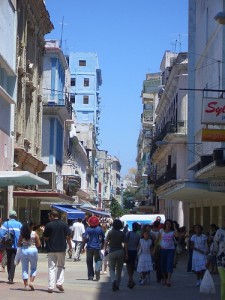
Havana Boulevard

Beginning at Prado street and ending at Galiano, there is a five-block long pedestrian mall in the heart of Havana, replete with stores that take hard-currency or national pesos. Cafes, barber shops, ice cream parlors, markets, a cinema for children and a jewelry store in decline.

Throughout the year the boulevard is very busy. December, the month of summing up and hospitality, causes city dwellers to shop compulsively. It’s possible that in some of its businesses they can get what they want or need.

At the Belinda store, a group of ladies enter, looking for a set of sheets for their home. Their mouths drop open and they remain speechless when they learn the prices in inflated currency.

Nearby, some guys who are drunk, accompanied by cheerful black girls in the same condition, look both ways and surreptitiously enter by a rusty iron gate what were once the Duplex and Rex theaters. They empty their bladders full of beer, consumed in a nightclub called Palermo, where they usually will hook up with the old, cheap whores who don’t have the option of hooking up with a foreigner.

At the National Cabaret, where the boulevard starts at Prado Street, are a line of men in their fifties and a group of young mestizo girls, with the typical body language of females seeking pleasure, trying to find some “Temba” (men in their fifties) to pay the entry fee to the nightclub. The Disco Temba, as it is known, opens at 4 pm.

A stone’s throw away at the gates of the Hotel Inglaterra, Nordic ‘Vikings’ and fat ‘Iberians’ drink daiquiris, accompanied by tapas of ham, cheese, and olives. They listen raptly to a bad version of Chan-Chan by Compay Segundo. Inside the hotel, a Japanese girl with teenage acne complains in English to a clerk about how expensive Internet service is: a card costs 6 CUC per hour. What shall we Cubans say?

Evening falls and the comings and goings of hurrying people increase. To alleviate the thirst caused by the heat from this end-of-year fire, people drink bottled soft drinks, locally produced, at 5 pesos a bottle. In a kiosk they sell unwrapped bread, exposed to the air, with the appropriate dose of microbes; bread with either pork, ham, or a cheese with a terrible smell.

Wherever you sit, to take a drink, or eat a serving of fried rice or a piece of smoked chicken, you are approached by dirty, mangy dogs, which with pitiful faces beg you to give them your leftovers. They are part of the army of hungry dogs that roam around the entire city.

Beggars also do their part in the streets of downtown Havana. Some shamelessly and even aggressively ask you for money.  Others, with the picture of a saint, usually St. Lazarus, ask you for alms, “preferably in hard currency.”

If you look like you have a foolish face, a crook will try to separate you from your money. You can find everything in the Boulevard of San Rafael. Schemes are constantly hatched and if you don’t look like a cop in civilian clothes, you can buy a gram of coke for 35 CUC or a Creole marijuana cigarette for 25 pesos.

The cobblestone streets are painted with large white squares, surrounded by pots with withered plants that the state gardeners do not look after, disgusted by their low pay.

Now at the far end, at the corner of Galiano and San Rafael, a park is a reminder that in this place once stood El Encanto, one of the most chic department stores in Havana. It was devoured by fire on April 13, 1961, as part of the sabotage before the Bay of Pigs invasion. There were 18 injuries and one fatality, Fe del Valle, the head of the El Encanto’s children’s department.

This story is not known to the children, whites, blacks and mestizos who play soccer with a deflated balloon. A black boy pulls off feints incredible for his age, barefoot and with a faded Kaká T-shirt. His fans, sitting on a wall, applaud the small Cuban Pelé.

Maybe the Boulevard San Rafael does not have the charm of Paris or Barcelona. But it is the only one in Havana: meeting point for Havanans, nostalgia for exiles, and headquarters of private guest houses for outsiders. If you pass through Havana, be sure to visit.

Ivan Garcia

Translated by: Tomás A.

The Cuban Facebook


Devoid of Internet and cable TV, people in Cuba get by as best as they can. Newsagents don’t sell foreign newspapers. And if you want to be properly informed, the only way is to listen to the BBC from London, Radio Exterior from Spain, or the Voice of America, from the United States. And that’s it.

Over the last 50 years, the Castro brothers have put a fat lock on information. Zero sports from the Yankees. No news from abroad, if they criticize the Castros, or what is going on the island, even in the slightest. In the dollar stores, short wave radios have “mysteriously” disappeared.

But the regular Cuban in the street wants to learn what he doesn’t know, whatever way he can, even if he has to sacrifice his grub. One of the most lucrative businesses nowadays is to hire out a bunch of foreign TV channels for 10 CUC a month (250 pesos). In Cuba, this is called “renting out your antenna”. Or simply “the antenna”.

If you ask Roberto, he will tell you with a faint smile that “in the five years I have been hiring out the antenna, I have made enough money to buy my motorbike, refurbish my apartment, and eat meat every week.” And this, in a Cuba stuck in an endless Special Period, is plenty.

And, what’s more, he boasts of being well-informed. Usually, the program listings offered by those renting out the Cuban cable, are full of B movies, mediocre Mexican soaps, Spanish humour shows and baseball games from the Major Leagues.

But some offers include news programmes from Univision. “Some people only want to rent CNN in Spanish, ABC, NBC and ESPN. This sort of people pay double, 20 CUC a month”, states Roberto.

The antenna business is a sort of local Facebook, and it sprung up out of the strong desire – and need – for having an alternative to the highly-manipulated news fed on a daily basis by the regime. To avoid state television, which is generally boring and full of tired shows.

“It all begins when some friend or relative from the other side of the Florida Strait pays for a bundle of cable programs, preferably in Spanish. Then, the TV signal receptors are smuggled into Cuba. Once they are here, there are some people who make a living building rustic antenna dishes,” Roberto explains.

“When you have all the gear, that is, the receptor and the dish, then you begin to offer the private cable service to your neighbours. The demand is huge, because even if they are living it rough, many people would make sacrifices to see a different way of life.”

The owner of the antenna connects up all the houses using a coaxial wire. In Havana, you can find people in the business of renting out antenna who have more than 100 homes linked up.

You can do the math! No less than 1,000 CUC (25,000 pesos) a month. That is why, despite the joint efforts by the Cuban intelligence and the police to curb the boom in private antennas, they have achieved little. If they catch you, they can fine you up to 30,000 pesos (1,250 CUC). And if you are a repeat offender, you can even go to jail for up to two years.

But it is a good business, and people like Roberto take the risk. There are hundreds of anecdotes to tell, such as a firefighting station, whose staff enjoy free cable TV in return for their silence.

The regular Cuban on the street wants to be informed and entertained. He doesn’t mind if he doesn’t have pork or vegetables on the table. It is worth it to sacrifice them to watch, with his very own eyes, what is happening on the other side.

And frequently they find out what happens in their own country through the foreign media. When there is no internet and foreign media, the business of hiring out antennas is a sort of social network. The Cuban Facebook.

Iván García

Translated by: trelex

The Letter of the Year


Photo: Reuters. On the right, the Cuban writer and journalist Natalia Bolivar

With the arrival of the first serious cold front, which in these days of January has lowered the thermometer to unusual temperatures in Cuba, the babalaos of the island gave the expected Letter of the Year.

This time it was announced with a drum roll and cymbals. Friday the first of January, Radio Progreso, a broadcaster of national importance, gave the whole reading of the document issued by the Cuban Council of High Priests of Ifá.

According to the Cuban babalaos, this year the sign is Obesa, ruling Yemayá and accompanying Changó. On the island, the devotees of Afro-Cuban religions count in the millions. No one knows the number to a scientific certainty. But religious sincretism is so strong that it is common to see a Catholic who “makes himself a saint” and a Santero being married in the church.

One song from Adalberto Álvarez, who sings Afro-Cuban songs, says in its refrain, “There are people who believe in nothing and they go for consultations at the first light of day.” It’s true. Frowning Marxists from the Communist Party have their bean-tokens and at times “feed them” to the higher power.

It’s speculated that even Fidel Castro, since he was a boy, has a Haitian voodoo doctor. The government never has denied the rumors. But let’s get to the point. In the letter for 2010, the local babalaos offer their recommendations and advice.

In a cryptic reading they offer a series of adages from the signo, which Juan Carlos Ariosa, 25 years old, a young sculptor, believes interprets signs of the political diatribe towards the government. Luis Álvarez, a retired soldier, who, since his participation in the African wars has been a devotee, in capital letters, of Afro-Cuban religions, interprets everything just the opposite.

“It’s a good sign that the government gives the Letter of the Year official publicity. The Council of Priests is a group of patriots who support the Revolution. If you read the document carefully, you will come to that conclusion,” affirms Álvarez, elated, with her necklaces of green and yellow beads and a white hat.

Each to his own. And those who are desperate, because of the extended outcome of the economic and political situation in Cuba, think that the babalaos expressed a weak sign in a veiled way.

If Cubans know anything it’s how to read between the lines. Neither the Catholic church nor the Council of Priests has publicly and openly condemned the politics of the government. At least in the last 10 years.

It’s like a cat and mouse game. If you shut up, we give you space. And at least, in my assessment, a part of the religions on the island have made themselves complicit in this silence.

It’s not possible that the majority of common people think otherwise and the churches and temples don’t speak their minds. As far as the Afro-Cuban religions are concerned, in the last two decades, they have converted themselves into a prosperous business.

It’s become the mode to become a babalao to mount a throne and get hard currency. Hundreds of devotees from Spain, Switzerland, Japan and even Australia come to the country of sun and palms to be blessed. It’s not cheap. For a Cuban it costs a minimum of 10,000 pesos (400 CUCs), a year and a half’s salary for an engineer. For a foreigner it costs double.

Faithful practitioners are many. But some beliefs, like the Afro-Cuban ones, have degenerated and become commercialized. In any event, the announcement of the Letter of the Year always awakens great expectations.

In an ancient mansion dating from the beginning of the 20th century, in the Calzada of 10th of October between Josefina and Gertrudis, where on occasion the babalaos consult the saints, on the afternoon of January 3, a group of 20 to 30 people were trying to read, with anxiety, the Letter of the Year 2010.

Probably they had not heard Radio Progreso. Also, at the same time, some thousands of kilometers away, in Peru, the South American shamans predicted that the Venezuelan president was very sick and that Fidel Castro had a vague death that protected him. According to the Peruvian oracles, Castro could live for the years that he offered.

To confirm the validity of their prognostications, they gave the example that last year they said that Barack Obama would win the US elections. On the island, when people saw on Channel 23 in Miami the news of the religious leaders of Peru, many were astonished.

At least the Peruvians were daring and gave prophecies. The Cuban babalaos were neither one nor the other. You would have to continue reading them between the lines. Something anyone could do by reading the latest edition of Newsweek, where they predict that 2010 might be the last year on earth for Fidel Castro.

Iván Garcia

Translated by Regina

Our Best Wishes for 2010

We wish all readers and their families the realization of all resolutions proposed for this year, and to Cuba, our homeland, we wish for a new beginning with tolerance, respect and a democratic conciliatory spirit, leaving behind the resentment that has blinded us for so long. From Havana, Cuba, a sincere hug from,

Iván García y Laritza Diversent

Translated by Tony de la Fuente

The Joke of the New Man / Ivan Garcia

The formation of the New Man has always been a fruitless task. Comandante Ernesto Che Guevara, its precursor, with his straw full of mate (a kind of tea that Argentinians drink from a bulb-shaped container, through a straw), was delirious in his moments of rest in the guerrilla war, on the road to Santa Clara in the last days of 1958. At that point in the war against the dictator Fulgencio Batista, the Argentinian Guevara was convinced that in the future society that would be built in Cuba, they would have to start by designing a “laboratory” man.

Che, a Maoist and radical communist, was dreaming, and he believed it would be possible, but the fun-loving Cuban people–with a tendency to idleness and informality–would need a firm hand to discipline them. According to Guevara, these Creoles, given to unending parties and festivals, playing around and disrespectful with their neighbors’ women, needed a revolution, with a dose of repression and terror that would permit the construction of a Communist society.

The Argentine tried it. In the short time he was Minister and an important man in Cuban politics, besides festively pulling the trigger in the large, damp patios that served as firing fields in the San Carlos de La Cabaña Fortress, he imposed “voluntary” work, moral stimulation and other formulas that the doctor from Rosario (i.e. Che) had read about in his Marxist studies.

Until he realized that fabricating men in an assembly line from a test tube who were monogamous and would not move their hips to the rhythm of drums was an impossible mission on an island of sun, drink and craziness. Che was a convinced fanatic, argumentative and with faith in proof by bullets. But his friend Fidel Castro was another specimen.

The lawyer from Birán (Fidel), in the best of cases, was a pragmatic opportunist, with an inflated ego, a narcissist who saw in guys like Che and Communist ideology the best way to draw up a plan for permanent and effective power. Guevara then marched to his own drummer, creating centers of guerrilla warfare and the formation of killing machines that would annihilate the gringos without mercy, anywhere in the world.

He died convinced, risking his hide to try to demonstrate his truths. This was around 42 years ago in Quebrada del Yuro, Bolivia. After his fall, he was converted into one of the largest marketing operations in history.

Castro, Cuban after all, knew that to modify the souls of his countrymen, who were given to Santería and not taking things seriously, illusion was necessary. In order to dominate for 50 years, he has used, at his discretion, fear, prisons, and a pinch of cheap idealism. And above all, a false morality, excitedly imparted to him by Ernesto Guevara in the days they were in a jail cell in Mexico City, in between chess games and theoretical discussions of what the future would be for Cuba and Latin America.

Not an atom remains of the New Man that Che Guevara dreamed of. Almost all Cubans steal whatever they can at work, from a straw to a piece of paper. When someone begins a new job, he is not interested in how much his salary will be, only in how much he can steal.

A few followers remain. At appropriate moments – historic dates and anniversaries of his death – they put on their masks and at the daily work meetings or publicly, they raise their voices, put themselves on automatic pilot and even act emotional talking about Che. Excellent actors, unseen and missed by Hollywood.

And the Revolution sails on. Now, functionaries and rulers try to gain time and search for hard currency. No one remembers the New Man, nor the stupidities advocated by social engineers like Che Guevara. The supposed New Men are in the lines outside the Spanish Consulate or the U.S. Special Interests Section, crazy about leaving.

They have forgotten about the world crisis. Since they were born, they have lived in a crisis and in ghost-wars against the Yankees. Many of these “new men” go out at night as transvestites, to engage in sex and drugs until dawn, and with luck, to hook up with a foreigner. Or they are dissidents, independent journalists or bloggers.

For the tired and unbelieving Cubans, the true New Men are guys like Kendry Morales or Isaac Delgado, who seized their chances, who are free to name their own price and who make a lot of money, whether it’s by making home runs or dancing in public with their contagious music. To talk about the New Man is today a joke in very bad taste in Cuba.

Translated by Regina Anavy

Ciro’s Swans

[youtube=http://www.youtube.com/watch?v=cb7n6mpGIb0&feature=player_embedded]

The Cuban musician Ciro Diaz, from the group Porno para Ricardo (Porn for Ricardo) made a rock version of Swan Lake, written by the Russian composer, Tchaikovsky (1840-1893). For the title he put “I Hate Swans.” It was recorded on La Paja Records,* an underground music studio in Havana. The drawings are by Charlie Bravo, who was inspired for the story by the supposed clash between swans and crocodiles for the control of a lagoon on the island.

Translator’s Note:

*”Paja” means masturbation, and “Paja Records” is a play-on-words of pajarraco, an expletive for a bird, as in “damned bird.”

Translated by Regina Anavy

Chronicle with a First Quarter Moon

Perhaps I’m not the right person to write this chronicle. Or perhaps I am. I know of colleagues who personally knew Silvio Rodriguez in that first stage of the revolution, ingenuous and difficult, crude and contradictory, where children, as if by magic, were converted into men.

Again I am going to talk about the spell that Silvio cast on my generation, considered by many to be “lost.” All of us under 50 years of age found a rare similarity in the way we agreed with his lyrics.

Perhaps in school, in the theme song for a child’s television show or in the voice of a friend, I don’t remember exactly now, but when I discovered Silvio he was composing songs for a little while, and he had been one of the founders of the Sound Experimentation Group of ICAIC (the Cuban Institute of Art and Cinematography), together with the indispensable Pablo Milanés, Noel Nicola and Vicente Feliú, among others, all directed by Leo Brouwer, who already was a maestro.

One year later, in 1973, the New Trova Movement, of which Silvio was a major part, had been created. The Beatles, already a myth around the world, had disintegrated in 1970, and it was no secret to anyone that the geniuses of Liverpool, with their rock-ballads, had left an irremediable vacuum after their break-up, in spite of the psychosis that they gave to the Cuban cultural and political authorities.

Then, I think the experts on culture strategy saw a gold mine, and thus they supported that unkempt group that sang about strange things but in the end were “revolutionary.”

A truce was declared. The media spread Trova, little by little. They were at the service of Silvio and the New Trova. With his reserve, of course. At the beginning, to the disgust of the Trova singers, they were heard only during political events, patriotic commemorations or days of national mourning.

The official propaganda up to then emphasized the known themes of Silvio Rodriguez, like The Era is Giving Birth to a Heart, Gun Against Gun, Song for the Elected and the Mambi Chief, songs that with their metaphoric and poetic language demonstrated support for the revolution. Silvio also sang about the every-day and lost love but, for the moment, until his complete loyalty was not shown, those lyrics sailed away into semi-secrecy.

The singer-songwriter from San Antonio de los Baños was a kind of diminishing quarter-moon. We could aprpeciate only one part of his face. Thus, in that way, he came to our generation.

We hummed the lyrics on patriotic anniversaries or when remembering the martyrs. Silvo was growing up with us. When the 80s arrived, the proven Cuban composer was not censored. It had been a sad and traumatic birth, but here was this Rodriguez, in his proper place. One of the best Cuban composers of the 20th century.

The lyrics of The News Summary and I Hope So stopped raising suspicions. On the contrary, he was a prophet in his own land and also in Latin America and Spain. Many, the same as I, pursued and annoyed him, from concert to concert. We knew almost his whole repertoire by heart.

Human beings need myths, leaders, chosen people….and for us, Silvio was it. Or, at least he marked a precious percent of Cuban youth, although some of them later were converted into critics of his work and his ideological position. Others say that he was blocked, he adapted and was intimidated.

My current political position differs a good bit from that of Silvio Rodriguez during these days of November when I turned 63. But I’m not going to stop admiring his songs for that reason. It would mean negating and betraying an important part of my life.

Now, Silvo, we see you clearly, bereft of the halos whose lights deceived us. And we are grateful to you, we have been enriched spiritually and separated from superfluous and useless music. Millions of those from my generation are far away in other lands, under the sea or have split forever. I don’t know about others, but I want to thank you for having proposed something to us, not imposed. For having freely transmitted to us good values. That is more important than any militancy.

Iván García

Photo: Interiano Vinicio, Flickr

Translated by Regina Anavy

Silvito the Free and I

[youtube=http://www.youtube.com/watch?v=VD9BSe7zihU&feature=player_embedded]

Before Sept. 20, when Juanes * at the end of his concert made public thanks to Los Aldeanos (The Villagers) and Silvito El Libre (Silvito the Free), the rapper son of Silvio Rodriguez was already known on the internet. “Who said that the Cuban revolution is in the final stage, that there is no renewal or new blood? Here we have Silvito el Libre … We still do not know if he uses the words sunset, hummingbird and soothsayer in his rhymes, but surely he will be a big summer blockbuster. “Don’t lose sight of him,” they wrote August 25 on the Chilean Web site The Clinic. Among his topics that you can hear on You Tube are the Hero, Now We Will See The Faces, Kill Yourself, Mamá and Rap, I’m Still Here, Nothing and The Etik, among others. More about his life, published in the cyber-magazine on the blog Rapdiacion Local.

* Colombian pop singer.

Translated by Regina Anavy

The Cristal River

Río Cristal, a tourist center inaugurated in 1960, is located on Avenida Rancho Boyeros, close to one of the airports in the capital, after passing the Aqueduct of Wind. It’s on the site where, in the 18th century, a slave barracks existed, and, later, a convent for nuns. Remodeled on different occasions, it still enjoys being the choice for the people of Havana, above all those who can pay with CUCs to stay there.

The entrance is still the same, wide and shady.

The swimming pool is in great demand all year.

…surrounded by a tranquility and a vegetation that is absent in the best hotels of the city.

And, for the kids, the park.

…in particular the little castle, in good-enough shape.

Inside the same installation, not only are there unattended areas, there is also the river. According to data published on Cubanet on September 22, between 2008 and 2009, five young people drowned in the Cristal River, which borders the recreation center of the same name.

Because of the deaths and accidents. the police have put up a sign prohibiting swimming in the river, but the young continue to do it. They say it’s because they don’t have other places where they can go to have fun.

Alexander, a lifeguard at the Rio Cristal swimming pool, said that on many occasions he has had to help kids who were on the point of drowning, but he did not always arrive on time.

Ana Lidia, the mother of a child who lives in the area, asserted that the river water is very contaminated. “The time my son escaped from me and went into that filth, he contracted a staph infection.”

Iván García, with text and photos by Robin Thom, of Flickr.

Translated by Regina Anavy

Good Bye, Happiness

[youtube=http://www.youtube.com/watch?v=7wrjltWcYP8]

It is not a video, it is an audio to which photos have been added, But the news is that, at last,

the song that caused the detention of its authoress, Ela O’Farril and her subsequent exile in the 60’s, can be now found in You Tube. It is part of ‘Gracias’ (Thank you), Omara Portuondo’s last record.

Translated by: Tanya May

An alcoholic with a name

Rufino Delagado, 38 years old, in his occasional lucid moments, admits that his life has already hit rock bottom. And he looks up to the sky, impotent, as if looking for an answer to his problem with alcohol. He has not always been a dirty and rude guy. Six years ago, he used to work in the warehouse of a tobacco business, and with what he used to steal from the State and the salary he received, he could afford to keep his wife and daughters with some ease.

“I used to offer a box of tobacco for 20 CUC. There were days in which seven or eight were sold. As my wife received remittances, the money left over was used to buy me drinks.”

He started as a social drinker. And ended as a common drunk, one who sells the little that is left in order to get a drink. At the beginning he used to drink quality rum and beer. Now, Rufino drinks the alcohol of the miserable, filtered with molasses, in improvised barrels, where a liter costs 10 Cuban pesos. He cannot live without drinking. His family put him under medical treatment. But it didn’t work. Rufino always would come back to the alcohol.

When he was drunk he was a monster. He used to hit his wife and daughters. His wife got rid of him, as you throw away an old sofa, when one night in 2006 she arrived at their poor apartment and found him naked among vomit, food and cockroaches that were enjoying themselves in the mess as if they were at a party.

He never again had news about either his daughters or his wife. He lost his job. Now he roams in the surroundings of La Vibora. He eats, when he eats, from the little that people throw away in the bins. He has no friends. Only sad guys like him, that every day get together on the corner of Calle Carmen and 10th of October, opposite Plaza Roja, to drink the drink of the forgotten.

They always finish in the same way. Fighting among themselves. In the squabble they hit each other and cause a huge disturbance. Even the police are not interested. If by chance they are detained for a couple of days, they bathe and kill the hunger of their days with prison food.

In his occasional periods of lucidity, Rufino remembers that he was a guy who used to love his daughter, and he used to dress tastefully. He took baths with hot water and ate home-made food. After, he used to sit with his wife to watch the soap-opera of the moment on the telly. He never thought that his life would become hell.

When he is not drunk, the memories take him back to alcohol. Among tears and curses, with the 10 Cuban pesos that he gets selling some old item or money given as payment for a favour, he goes to the same place, to buy distilled alcohol. His existence is a vicious circle. And what is left is for going to church and imploring the Virgin to let death take him away, soon. With just one wish to be granted, that, before dying, he will be allowed to see his wife and two daughters.

Iván Garcia

Translated by: Tanya May and Regina Anavy

If the comandante danced to rock…

If the Cuban generals had liked rock, things in Cuba might have been different. Perhaps the soldiers would not have gone out in their vulgar Russian jeeps, scissors in hand, cutting the hair of those devoted to this type of music. And they would not have had to arrest thousands of young people whose only crime was to be a fan of the songs of the Beatles, the mythical quartet from Liverpool, and send them to those concentration camps that were called the Military Units of Support for Production, more commonly known by their acronym, UMAP.

If Fidel Castro and his military court had frequently hummed “Yesterday,” or some other ballad by Led Zeppelin, and at their ranches, between beers and select rums, while they filled their mouths with shrimp and masses of fried pork, the weekends had been spent with the Rolling Stones or some other rock band of the epoch, perhaps Cuba would not have known the Gray Period in the ’70s.

Later, everything was pure cynicism. The Cuban leaders always hated rock, Western influence, books of foreign authors and the consumer market. They thought that the flock of sheep that is the Cuban people ought to be immunized against the “brutal and decadent capitalist society.”

Therefore, zero short-wave broadcasts, music, styles and foreign pleasures. They wanted those long-hair types and druggies who composed strange songs to remain very far away from the proletarian and internationalist archipelago.

When the air from the East began to blow, indicators that the “brothers in the socialist camp” were tired of collective societies, repression and unanimous thought, then the comandante and his generals decided to paint over some things.

They named a minister of culture with long hair, who perhaps in his youth had listened to prohibited music. But as soon as he entered into the martial discipline of the Communist Party, he had to trade his tastes and sing loud and clear the marches and hymns that Fidel Castro liked.

The summit of impudence was to erect a statue to John Lennon in a park in Vedado, in Havana.

lenon.jpg

And very serious and with remorseful faces, celebrate in Havana the 8th of December, the day Lennon was assassinated in New York. One of so many ways to insult peoples’ intelligence. Because when the ex-Beatle was alive, in order to listen to him, you had to be a prisoner in Cuba.

Also, they are now paying homage to the playwright Virgilio Piñera and the writer José Lezama Lima. If the comandantes and generals have demonstrated something on the island, it’s that they know how to take advantage of the figures of culture, above all after they’re dead. Although I do have one doubt.

If in the hypothetical case that the Castro dynasty lasts 100 years. would they raise statues to the poet Raúl Rivero, the blogger Yoani Sánchez or the opposition figure Oscar Elías Biscet? From a regime as surrealistic as this one, anything can be expected.

Perhaps, if the commandante and his generals had danced to rock, none of this would have happened. And our country would be enjoying democracy. It’s symptomatic, in societies that are not closed, that the leaders enjoy rock music. In Cuba it could not be different.

Iván Garcia

Translated by Regina

Carrots and Sticks

I would like to understand certain radical leaders of our America.  I share many of the social political views of the left and I have my doubts about a liberal economy.  Above all, when it is poorly applied by the leaders of the continent.

For almost two centuries there have been enough Latin American presidents who mostly ran their countries like they were their own country estates. Many see the government as a way to write their own ticket and loot the public treasury.

It’s the same from the left and the right.  Look at Carlos Menem or Hugo Chávez.  Without considering their inveterate habit of becoming plotters and dictators. We blame our ills on the United States. It is the easiest. True, the colossus of the north, which emerged as a nation around 1775-76, more than a few times has referred to the region as its natural backyard.

We don’t have U.S. type leaders for the simple reason that Latin American governments tend to nepotism and warlordism. The Yankees, with their gift for business, realized they could impose their views on the continent throughout the centuries with a couple of dollars and a few threats.

In the deal between two people or countries one invariably tries to set itself above the other. It is the animal tendency of the human being. This has happened because the brilliant military leaders such as Bolívar, Sucre, Paez, and San Martín who brought about independence were not succeeded by statesmen of their stature.

In the United States, no.  The leaders of their revolution were equal to or less than their counterparts on the continent. It is at the time of governance that the country of the stars and bars surpasses the countries of the region.  In Latin America there has not been a Washington, Lincoln or a Roosevelt.  The majority of our statesman are more worried about leaving rich from their time in office, and in creating an opaque framework, than in governing well.

Sad to say, but that’s the case.  Now in the 21st century, we look with favorable eyes on presidents like the Chilean Michelle Bachelet, or the Brazilian Luiz Inacio “Lula” da Silva, two who are philosophically socialist but realistic about the world around them.

And in 2009 a guy like Barack Obama came to the United States, a black man who exceeds the leaders of the continent in clear ideas, empathy, and good sense.  I watch with concern as radical statesmen like Evo Morales or Hugo Chávez who, at the first sign of change, add to the hackneyed speeches accusing him of “Yankee Imperialism.”

If they were to govern democratically, respecting differences without polarizing the logical contradictions of opinion that usually exist in any nation and do not always look askance at what the U.S. president does and says, this would be the first big step forward for the region.

In the Summit of UNASUR (Union of South American Nations), held in late August in San Carlos de Bariloche, Argentina, leftist radicals engaged in a bitter debate over the establishment seven U.S. military bases in Colombia.

They may be right. I do not think it’s time for military bases. But I’ve never heard of Morales, Correa and company criticizing the joint military exercises conducted this year by Venezuela and Russia. Nor did they criticize Chavez’s huge purchases of Russian weapons, nor do they criticize their complicity with autocratic governments like Iran.

I believe in social ideas. I consider myself a kind of leftist. I’m tired of seeing populist rulers, made hoarse by protesting U.S. policies and yet being silent when it applies to measures affecting the people or the sovereignty of other nations under a leftist president or a dictator like Fidel Castro.

I’ve never heard Chavez or Morales demand that the Castro brothers allow other political parties, free press or elections. Nor do they recall that in the Fall of 1962, Cuba had nuclear missiles and Russian military bases.

It’s true. It is pragmatic and convenient to portray the USA as allied with the worst guys on our continent. But the blame for most Latino leaders has been scant, we can not always say everything is the fault of the gringos. Yes, it is also true: at times they use the carrot and stick approach.

But we must recognize that during its more than two centuries of existence, the U.S. government has enabled its people to live better. Latin American radicals make splendid speeches, talking about bright futures and social theories. But in practice it has not worked. If you doubt this, look to Cuba.

Iván García

Translated by Karen

Bad Luck

If bad luck had a name it would be Antonio Fonseca.  An enormous black man of almost 400 pounds, with a wide nose, sharp cheekbones and lips two fingers thick, who was born one cold, wet night in January 1981.

His mother, stark raving mad, set her husband and son on fire, when the latter was three years old. The father died. Fonseca still has visible marks on his entire body. And he still wonders what his mother’s motive was for her macabre pyromania.

Not having any family to take care of the little boy, from the age of three he lived in a state orphanage to the south of Havana, very close to the José Martí International Airport.

“In my childhood I had very few happy moments. One of them was when I was 10 and a group of us escaped from school to go watch the big planes take off and land.”

Antonio, wearing dirty, discolored, denim shorts, was seated on a wooden bench, in the shack where he lives, in the heart of Havana. On his nude torso you can see large bruises, produced by the burns of his disturbed mother.

“I don’t know the name of the woman who gave birth to me. I have never wanted to know about her; I only know that she spent many years in prison,” recounted Fonseca, while he took a drag on his cigarette.

He finished the 5th grade with great difficulty. And since he was 12 years old, the only thing he knows how to do is to commit small crimes and smoke marijuana. In spite of looking like a basketball player, he is not a violent guy. No. The three times he went to prison were for possession of drugs for his own consumption, It’s been a year since he was referred to a drug addiction clinic. But nothing helped him get better.

“I feel better when I’m high, only then can I sleep and hope for another day.”

And his eyes shine brightly. He works as a construction worker and does any work in the neighborhood, from finishing a patio and clearing debris, to filling buckets with water. Then, with the money, he buys a couple of joints at 25 pesos each. And on dark nights he feels like he’s in the clouds when he walks through Brotherhood Park, in the direction of Monte and Cienfuegos, in search of a cheap whore to calm his sexual appetites.

His minor crimes, to get some money, usually consist of stealing lightbulbs or chairs from some house. The money, of course, is destined to buy marijuana. This was Antonio Fonseca’s vicious circle. A big baby who could barely read and write. A prisoner of drugs. A sick guy whom luck avoided.

But the culmination, just a few days ago, was that in the tenement where he lives there was an over-the-top police operation. As usual, Antonio was high. And with his red, bleary eyes, he found himself accused of a violent robbery. A witness recognized him as the man who savagely beat a young person in order to steal his gold chain.

He swore to the authorities, on the mother he never new, that he was innocent. But confronted with a guy from a dissipated life with prior crimes, the police had already closed the file on the case. He remained in jail, hoping they would take him to preventive detention, where he would wait for his trial.

The prosecutor is requesting a penalty of 25 years. Without family, children or friends, Antonio Fonseca knows what fate awaits him. “No one can do anything without luck,” he used to say. He was right. Luck was never his ally.

Iván García

Translated by Regina Anavy