Waiting for the Americans

There is still a labyrinth of parliamentary procedures. But the U.S. Congress is considering authorizing the travel of its citizens to Cuba. The measure appears to have great potential for adoption.

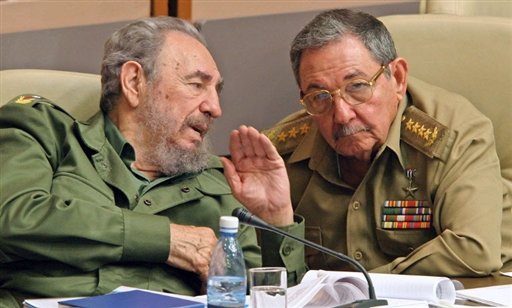
Already the Castro brothers are sharpening their teeth. If the gringo politicians say yes, cash registers will overflow with dollars. Let the ‘bucks’ (dollars) we are waiting for come, it could mean the government of the island!

And how needed they are. We know that the Cuban economy is not even treading water. For 17 years, since they legalized the possession of dollars in 1993, in large part, the emigrants, the despised ‘worms’, as Fidel Castro liked to say with some rage, are those who have kept the impoverished economy from sinking.

Yes. Its more than one billion greenbacks a year are the lifeline of a regime that has always been repulsed by the “American way of life.” The United States is public enemy number one for Fidel Castro. But there’s been a lot of water under the bridge since 1959.

And while you stir the guts of the old guerrilla commander, in this 2010, the land of Stars and Stripes is the leading seller of food to Cuba. Also their NGOs are the ones who provide the most help. And Cuban-Americans, are an important segment of the people who come to go sightseeing and spend hard currency.

The embargo is a fossil of the cold war. A joke. It only served as a pretext for Castro to maintain his authoritarian policies and to deny a handful of essential freedoms to his people.

It always had more holes than Swiss cheese. While Castro, the one with the beard, shouts himself hoarse in any public plaza, talking about what the country suffered because of the”blockade,” while hard currency shops and cafes sell Coca Cola and Dell computers.

For the rest, the world condemned the prohibitory and unilateral policy of Washington to Havana. It is healthy that the administration of Obama reconsiders. And demolishes all the scaffolding mounted on a stage that many years ago said goodbye.

Cuba is no longer a prodigal and conflicting son of the former USSR. Let it be known, Latin American and African guerrillas are not training in military camps on the island, to create pockets of civil war in other nations.

To not allow U.S. citizens to travel to the island was a major folly. It brazenly violated their rights. The champion of democracy and freedoms could not afford such nonsense.

Either way, Americans who wanted to, could come to Cuba through a third country. More than 50 thousand per year, according to reliable figures. Although they feared the Castros.

If the embargo ends and travel is allowed he will continue ruling with an iron fist all who oppose him, and then the eyes of the world will be on an anachronistic and undemocratic regime.

Already the local mandarins have tried out a few variations. If the Yankees take their foot off the accelerator, it could be that the Cuban government, kicking the ball back into Obama’s court, might make some mid-sized changes, maybe even some profound ones.

Those who govern our destinies do not believe in representative democracy. But will do what they have to do to stay in power.

No wonder that during the stay of the Spanish Foreign Minister Miguel Angel Moratinos, in the coming days, they will release 52 political prisoners from the Black Spring of 2003. As a reward for Spain’s Socialist Party, a faithful friend through thick and thin. And as Spain will be able to claim the laurels, it will not appear that such releases have been conditioned by the possible openings from Obama’s government.

With that, the Castros will kill two birds with one stone. They get the international pressure to ease up a bit, and incidentally, unlock the European Union’s common position. That fox Moratinos knows a thing or two.  He already said there could soon be some surprises.

This summer brings a three-way political game. United States, Spain and the Cuban Catholic Church, which is chosen by the government to serve as mediator in the conflict with the Yankees and the release of political prisoners.

The brothers from Birán need peace and some leeway to implement a series of tough and unpopular ecnomic measures to get the country out of the hole created by bad management. If tomorrow the Yankees land in Havana, it won’t only benefit the managers of tourism. It will benefit the Castros, too.

And, of course, the Cubans who live on the informal economy. And there are many. Gringos putting dollars into the hands of private homes for rent and buying illegal tobacco boxes. Whores chasing after the blong guys, tall and unmarried from America, they might even propose marriage.

As I write this note the news still hadn’t run from mouth to mouth, but the neigbors I talk to receive it with great joy. Even the married and ex-military party militant. The happiest, the private taxi driver who brought me to a hotel and the waiter who served me coffee while I connected to the internet.

The two gave me an opinion that I happen to share: “If the Cuban government wants the Americans to come en masse, they’re going to have to eliminate that diabolical 20% tax on the dollar.”

Otherwise the Yankees are going to keep on visiting Punta Cana.

Iván García

Photo: Patricio Bridges, Flickr
Hunger Strikes, Weapon of Cuban Dissidents

A tragic fashion. Objectionable to many. The only option the opponents have. They believe that in this way they can force the regime. It is their war cry. But it is not a new weapon.

Already in 1972 a 53-day hunger strike took the life of opponent Pedro Luis Boitel. It was before the era of the internet and global media. Few learned of it. One of the principal dissident organizations on the island bears his name.

After 1959, it was one of the most-used measures by those imprisoned for opposing Fidel Castro and his revolution. According to Archivo Cuba, of the 59 to date, at least 12 political prisoners have died from hunger strikes. Others gave up or, at the request of family and friends, reconsidered their position.

Oscar Elias Biscet, a gynecologist who began his criticism of Castro condemning abortion and demanding respect for basic human and political rights, used fasting as a tool to draw worldwide attention and to put the stubborn and rigid commander’s back against the wall.

He failed. Nor did the opponent Orlando Zapata Tamayo succeed, he died after 86 days without food in the hellish prisons of the island.

Right now, there are several Cubans who, as a way to protest for their demands, have chosen hunger strikes, more or less strict.

One of them is Egberto Escobedo Morales, who on April 16 declared a hunger strike in prison in Camagüey. Escobedo was arrested in July 1995 and sentenced to 20 years imprisonment, for the alleged crimes of “spying, theft with force, and enemy propaganda.” With his strike, he demanded that the regime dialogue with internal opposition. His situation critical, ten days ago he was taken to hospital Combinado del Este in Havana.

Guillermo Fariñas, a psychologist and freelance journalist, has maintained his strike from the February 24, as reported in this blog. A twitter from the opposition Martha Beatriz Roque, reported that on the night of Sunday 27 June, a group of dissidents was going to spend the night outside the hospital Arnaldo Milian, of Santa Clara.

Since March 11 Fariñas has been in intensive care there, but his health has deteriorated alarmingly. His current physical status is unknown. Although he is permitted visitors, similar to the June 19 case of Ariel Sigler Amaya, recently released from prison, they have not let anyone take photos or videos.

It is not the first time that Fariñas has decided to use hunger strikes as a weapon of pressure. Is the 23rd. A record.

One who uses this method for the first time is Juan Juan Almeida García, son of the legendary Juan Almeida Bosque, one of the stalwarts of the Revolution. He has gone two weeks without food but he is taking liquids. He has decided to undertake a hunger strike because the government will not let him travel abroad, to visit his wife and daughter. It remains to be seen whether the son of the guerilla can move the general.

Unlike Zapata, Escobedo and Fariñas, Almeida junior is someone close to the Castro family. For a while he lived in the home of Raul Castro. And he became a close friend of Alexander, Raul’s only son. He does not make political claims. He just wants to respect for his rights and to be allowed to leave and return to his country.

Others who have decided to use hunger strikes as a weapon of pressure in 2010, are accused of trafficking in persons, fourteen of them in the Ariza prison in the province of Cienfuegos.

In Havana, the Cuban Yamil Dominguez, 37, has gone 75 days without eating, only drinking water, in the maximum security prison, Combinado del Este.

Yamil was arrested in 2007 and sentenced to 10 years for the crime of human trafficking, in an illegal trial according to independent lawyers. After three years in prison, and after exhausting all legal requirements established by the Constitution, Dominguez opted for the hunger strike.

Independent sources report two Cuban political prisoners in their respective prisons who have declared a hunger strike, Diosdado and Abel Linares López Díaz Pérez, as well as the opponent Guillermo del Sol Perez, who recently released a letter stating that he has been proclaimed Fariñas’ successor, if he should die.

The fatal fashion of dissidents and prisoners, political or common, of refusing food and liquids, promises to continue to grow. But no one in the regime has taken them seriously.

There is no history of a hunger strike in Cuba that has softened the hearts of the Castro brothers. Still, the Cuban prisoners and opponents believe that hunger strikes are a weapon to pressure the regime. So far, none have succeeded.

Iván García

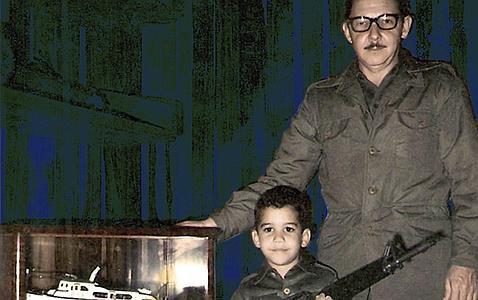
Photo: ABC. Juan Juan Almeida, then 5 years old, standing next to a model of the yacht Granma and Raúl Castro.

The Business of the "Pacotilla" in Havana

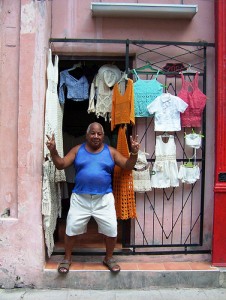
There are particular stores in Havana to chose from.  In some, you will find arts and crafts made by hand.  Others are better sorted than the Cuban outlet of Adidas or Zara.  This is the case with the “shopping” establishment of Rufino, age 45 and retired because of an illness.
In his house he sells everything.  In fact, he even orders things.  His wife receives you in their living room with a Colgate smile.  She’ll lead you to a spacious and well-ventilated room where there is a closet that takes up an entire wall.  In it, hang numerous articles of clothing.

In a mahogany shoe-rack there are over two dozen pairs of shoes.  For all preferences, too.  Nike, Adidas, New Balance.  There are even leather Italian and Brazilian shoes.  There are even Guess and Levi shirts and jeans.  There are Lacoste shirts and Mango dresses.

Without ever letting her smile fade, the lady then shows us another room where there is a wide range of toys and electric appliances.  “Always cheaper than the store,” she tells us.

In the patio of the house they display hardware supplies. In his square shorts and Hawaiian sandals, the owner of the illegal shop, Rufino, asks us if we are satisfied.

This kind of private store, without authorization from the government, has surged throughout the entire capital during the last few years.  They compete in price with the State stores and many times they are better in quality.

Ernesto, 39, also dedicates himself to the pacotilla business.  He is a man who speaks well and is smart.  He graduated in History, but his degree resides in a drawer somewhere in his room.

Pacotilla,” in the singular, is what Cubans call one or more cheap merchandise articles.  Many times they are copies of name brand products, a field where the Chinese are specialists.

“Selling pacotilla makes more money,” assures Ernesto.  “One day I told my family in Miami that, instead of sending me 200 dollars monthly, I would prefer if they lent me 5 thousand dollars to set up a clothing store.”

Two years ago, his family finally lent him that money.  In a year and half, Ernesto paid them back.  “I sell clothes for all sorts of price ranges, and if someone wishes to purchase something exclusive, then I simply order it for them.”

Since 1992, the allocation of industrial products on the ration book disappeared and so too did the practice of Father State yearly granting each Cuban citizen a pair of shoes and two articles of clothing; now Cubans had to find their way however they could.

And if you want to be trendy, you have to have lots of cash.  But they get their hands on it.  Especially in Havana, where the majority of young kids want to go about dressed similar to those in any other Western city.  They want to carry their iPods, iPphones, Motorola cells, etc.

It’s known that the money necessary to purchase pacotilla mostly comes from all the financial assistance sent to Cubans by families in exile, especially those in the US.  Lots of the money also comes from prostitution.  With hard currency, prostitutes spend crazy amounts on clothes, shoes, and perfume.

In 1993 the dollar was legalized.  Since then, variety stores, commonly known as “shoppings”, sprouted up throughout the country selling pacotilla by weight  For an even more select club, boutiques were created with sky-rocketing prices.

Similarly, in the clandestine market a handful of people are dedicated to buying and selling clothes, shoes, perfumes, jewelry, toys, and even computers and plasma TVs, began to appear.

Thanks to massive collaboration of doctors, teachers, and sports trainers in Bolivia, Ecuador, and Venezuela (amongst other countries), a good number of those who are carrying out “solidary missions” from the strict salary that the Cuban government pays them, they save money and acquire pacotilla in significant amounts.  Later, they sell them when they return to the island.

Rene, 32, is a lucky guy.  He is the auditor of a company which does business with Venezuela and he travels to South American countries four times a year.  When he is in Cuba he buys dollars in bulk, at 0.92 cents U.S. for each Cuban Convertible Peso (CUC).  He pays better than the state offices; they give 0.80 cents U.S for one CUC.

He always leaves for Caracas with at least 3 to 4 thousand dollars in his Samsonite suitcase.  He uses nearly all of it to purchase pacotilla in commercial centers in the capital of Venezuela.

Business has not been bad for Rene.  He has been able to repair his house and is even thinking of buying an American car from the 50’s.  Truth be told, his pacotilla share the quality of those sold by Rufino, whose slogan is “good, pretty, and cheap.”  Even though the “cheap” part will be determined as time goes on.

Ivan Garcia

Photo: yanroux, Flickr

Translated by Raul G.

What they Don’t Tell Us about the Matamoros Trio

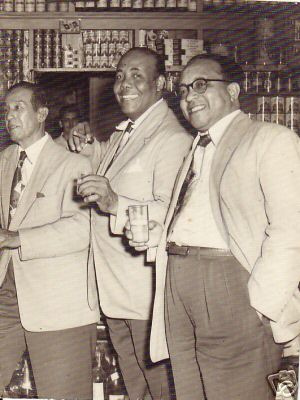
Fifty years ago, on May 10, 1960, the Matamoros Trio, headed by Siro Rodriguez, Rafael Cueto, and Miguel Matamoros, performed in public for the last time.  They bid their farewells on the program called Partagas Thursdays, one of the most popular Cuban TV shows at the time.

According to the Colombian investigator, Walter G. Magaña, “the silence which the Matamoros Trio was subdued in was not accidental.  We must remember that on January 1, 1959, the movement headed by Fidel Castro had displaced the president Fulgencio Batista, and during that time period the leader of the Cuban revolution announced Cuba’s integration into communism (a year later, in 1961, he announced it to the world during the ONU)- a move which Miguel Matamoros was never supportive of.  Therefore, in order to not musically represent a communist country before international eyes, he opted for silence”.

Magaña then continues detailing:  “Everyone was aware of the sympathy that Batista felt for the Trio, thanks to all their compositions previously made against the politics of the dictator Gerardo Machado.  In the 50’s, when Miguel Matamoros returned to the structure of the Trio with very irregular activity, Congress granted them economic help so their members could live decently, according to Jose Pardo Llada, the Cuban journalist who lived in Cali (and passed away in 2009).”

If such statements are accurate, the interpreters of “Son de la loma“, “El que siembra su maiz“, and “La mujer de Antonio“, along with many other famous songs, did not sympathize with the bearded revolution.  In fact, most of them came from Oriente province, just like them.

But that anti-communism, or anti-fidelism, is not exposed to the public today in Cuba.  The songs of the Matamoros Trio, just like those of Ignacio Piñeiro, Benny More, Bola de Nieve, and other great Cuban musicians, are among the most covered songs in the world.  And the cultural authorities prefer to ignore it and just skip the page.

Political disagreements aside, in Cuba the Trio from Santiago is still very much venerated.  Recently, in order to commemorate the 85 years since its beginning on May 8, 1925, in the Trio’s native city, Santiago de Cuba, Cafe Matamoros was reopened.  Every two years that large city is host to the International “Matamoroson” Festival.  The latest edition, in 2009, commemorated the 115th anniversary of the birth of Miguel Matamoros.

The version of “Lagrimas Negras” (‘Black Tears’) which Bebo Valdes and Diego El Cigala interpreted is well known in the five continents.  But perhaps very few know that the woman who inspired this song was not Cuban.

In 1930, during a tour in the Dominican Republic, the Matamoros Trio witnessed an unexpected hurricane.  The devastation was tremendous and the death toll was up in the thousands.  The musicians returned to Santiago de Cuba in a Cuban military plane that had transported doctors and medicines to the Dominican Republic as humanitarian aid.

Impacted by the disaster, Miguel Matamoros first composed “El Trio y el Ciclon” (‘The Trio and the Hurricane’), and a few days after, “Lagrimas Negras”.  The lyrics to this song were inspired by a lady that he saw crying uncontrollably in Santo Domingo.  Her husband had abandoned her and between sobs she would utter that she did not care if she died because that man had been the love of her life.

Miguel Matamoros (1894-1971) was not only a talented composer and innovative musician, but also a chronicler of his era.

It’s noted that in June 1929, the Basque doctor Fernando Asuero (San Sebastian; 1887-1942) arrived in Cuba. He had become a media hit in Spain, Portugal, France, Argentina, and Mexico, among other countries, for having discovered a method to cure certain kinds of paralysis by pinching a nerve known as the “trigeminal.”

That “therapy” did not cure anyone on the island.  But the volume of information about the doctor and his miraculous cures served as inspiration for Matamoros to write “El Paralitico” (‘The Paralytic’).

The Paralytic is an original and catchy son.  But its lyrics aren’t as brutal as the “Cocainomana”, a song which Silvio Rodriguez made an excellent cover of.

Ivan Garcia

Photo: jaramij, Flickr

Translated by Raul G.

Being a Journalist is Almost Impossible in Cuba / Ivan Garcia

Being a journalist in Cuba is like performing black magic.  Investigating a story or getting reliable data is like trying to catch hold of a mirage.  With a faltering voice, people whisper information to you that there is no way of confirming.  I will give examples.

Having some drinks one hot night on the balcony of his house, an employee told me all about a dark, corrupt plot between the government and a foreigner at the firm where he works.

The following morning, now sober, I asked him if he would let me publish his story.  He was frightened.  “Please, remember that this business is my livelihood. If you write about this, I will be the first suspect, so, definitely no,” he told me.

It also happens with people who phone you to supposedly give valuable information. After agreeing to an appointment, in a park or central location in the city, what happens next seems like a mediocre espionage film.

The subject wears dark glasses and makes you walk three blocks. “Now bend, sit on a bench, stand, buy a Granma newspaper and wait in the coffee shop on the corner,” he’ll tell you wearily and automatically to your back.

Then, after he has vomited up his story, it seems so fantastic, it makes you laugh out loud. A pure conspiracy theory. “If you want me to write a line of this, you have to give me something more than just storytelling,” I say incredulously.

He promises to get videos. I haven’t heard from him again. It has a bad smell. Perhaps because of an agent of the political police. Once, a woman who worked as a maid of a famous person told me about the extravagant and wasteful life style of her master.

When I say that I would quote her using another name, she panics. “If the police question me, I’ll say you invented all this,” she says indignantly. Others think that a journalist is a blank check. “If I tell you what I know, how much would you pay me?”, they inquire with a greedy look.

And there are people for whom all legal options have been closed and they resort to dissident or independent journalists, to provide them a greater impact for their cases.

Sometimes they are navel-gazing. The story might be trivial. Such as creole squatters, evicted to live in empty houses. Or someone who wants to accuse the head of the union of their factory, who has been granted, by favoritism, a microbrigade apartment (built by the workers). The man thinks he deserved it instead.

At the other end of the scale of obstacles to working as a reporter in Cuba are the government agencies. Any request for data raises suspicion. I phone an office, to find out what percentage of whites and blacks there are on the island. The questioning begins: Who are you? Why would you want this data? Who authorized it?

In March this year, I went to Cardenas, the home of Elian Gonzalez, the former child rafter, now a military school cadet. I tried to interview him, and then I was hounded with questions. One of his guards said I had to get a paper signed by a member of the Communist Party Central Committee, or by the first party secretary in Matanzas or Havana.

Everything is too difficult in Cuba. Eating breakfast, lunch and dinner. Arranging a house. Transferring by bus around the city. But being a journalist is almost impossible. Still, I try.

Iván García

Translated by: CIMF

“If we have eaten cat stew…”

During the last few years, Cuban places located outside of the island have exposed the production and consumption of catfish- that voracious species- in an unpleasant light, in fact, it has been stated that the environment may be at risk if we do not control the production of such a plate.

The issue already made headlines in 2006 as product of the documentary titled “Blue Revolution” which was made by a Mexican student of the International Cinema and Television School of San Antonio de los Banos, in the outskirts of Havana.

According to Jesus Baisre, the fishing industry adviser, two types of catfish were brought into Cuba between 1998 and 2000.  These were the macrocephalus and the gariepinus, coming from Asia and Africa.  The catfish were introduced in the country in order to increase the consumption of protein of the population.

“But the cure was worse than the disease because the catfish has become a powerful threat to the Cuban ecosystem”, argued Nibaldo Calvo who has a degree in economics and is a resident of Mexico.

Before 1959 the main fish consumed by Cubans was the biajaca.  “In the ’70s they introduced the tilapia, which at first nobody liked thanks to its dirt taste.  But seeing that there was no choice, we had no other option but to invent recipes so our families could eat it,” remembers Lidia, 67-years-old and a retired teacher.

Other exotic fish species that are consumed in the island, besides catfish, are Tench, Sea bass, Red Sea Bass, and the Chinese Grass Carp.  On April 2009, during a workshop in Artechef, a restaurant of the Cuban Culinary Association in Havana, numerous elaborate plates were presented with various different kinds of fresh water fish, among them the catfish.

Someone who does not want to hear talk about “the catfish or any of those strange fish” is Jose Miguel, an 81-year-old grandpa.  “It’s incredible that on an island surrounded by sea they have to spend money raising fish and that they have not been capable of allowing us the fish that we Cubans have eaten all our lives, like snapper, ruffle, swordfish, and the yellowtail snapper.”

The local press publishes information about the production and consumption of the catfish and some journalists acknowledge its dangerousness, especially when there are intense rains or hurricanes and the dams overflow and these fish escape.

But that occurs among the ecologists- nationals or foreigners- directly affect by the controversy.

The economist Calvo points out that the uncontrollable expansion of catfish in Cuba during the last decade “is provoking serious havoc among aquatic fauna and vegetation.  The ecological equilibrium and domestic life is also affected because the catfish preys on tilapia and frogs and could very well introduce itself into subterranean caves, sewers, and household tubes.”

The fact is that the catfish- also known as the devil fish- is capable of traveling across land, thanks to very strong whips of its tail, in search of food outside of the water.  Since it is carnivorous, if it is loose, it can swallow anything in its path:  lizards, snakes, rats, and even birds, turtles, and small crocodiles.

There is not much worry right now for the population.  Neither ecologically or with regards to food.  “It must be known that no one has become sick or has died yet because of eating catfish.  It is a dark and ugly fish, but its meat is white and tasty.  When I have oil, I bread and fry the filets.  Sometimes I also make croquettes which my kids love,”  explains Roxana, 35, who works as an office assistant.

Just one kilogram of catfish filet costs around 39 Cuban pesos (1.50 dollars).  “It’s very popular, it sells quickly.  I get about 200 kilos and in two days it’s gone,” declares Dionis Cruz, a fish vendor in the capital.

Ana Rosa, 70 years of age and a housewife, defends the controversial fish:  “They say that catfish eat rats, but if we have eaten cat stew, and cats also eat rats, eating catfish filet is now a luxury.”

During the difficult years of the Special Period (1990-2000), many Cubans substituted cats for rabbits, for once they are skinned there is no difference. If in home bathrooms they raised pigs, while animals were disappearing from the zoo and vultures had gone to look for food in household cooking pots, then eating catfish today is the most normal thing in the world.  At least for Cubans it is.

Ivan Garcia

Photo:  Breaded catfish filet

Translated by Raul G.

The Capital Dresses Itself for the Fair

It is organized for the weekends in the city of Havana.  It takes place in public spaces, avenues or wide plots of undeveloped land.  Trucks arrive and improvise points of sales- some sell directly from their vehicles, on boxes, on the floor.  The offers vary:  viands (potato, sweet potato, yucca, bananas), fruits, vegetables, meat derivatives, and hardware tools, among other things.

Local restaurants offer fast food under thick colored carps:  fried chicken, smoked pork, and beer.  Lunch-sellers with tall white hats and squared pants prepare pork sandwiches, ham, hot dogs, or breaded fish.

There are sky-rocketing prices.  Just one kilo of papaya costs 20 pesos (one dollar).  Black beans are 10 pesos per pound (half a kilo).  Well, at least what is supposedly a pound.  Manuel Montoya, 65 years of age, is retired.  He always finishes stressed and with high blood pressure due to the displeasure he goes through when he has to purchase some viands and meat.

“Despite the prices, the sellers try to swindle you when they weigh the product.  I always take a small personal weight and whatever I buy usually weighs up to two pounds less than those measures given to me by the sellers,” points out Montoya while he tosses around yuccas and sweet potatoes that are full of reddish dirt.

Hygiene is not the specialty of the viand, vegetable, and fruit sellers.  In Cuba, agricultural products are not taken aside and cleaned.  They are brought in bulk in bags and boxes and they get all mixed in platforms or on the floor, together with dirt, rocks, and bugs.

The Red Plaza of La Vibora, in the municipality of 10th of October, which is actually neither a plaza or painted red, and is nothing but  a 260 foot wide street, is converted into a mixed flea market on Saturdays and Sundays.

Besides vegetables and other foods, they sell recycled clothes, plumbing products, and efficient light bulbs.  The good stuff starts early in the morning.  Refrigerated trucks that offer fresh fish for 15 to 20 pesos per pound arrive to the rhythm of Willy Chirino and Isaac Delgado, exiled Cuban salseros who live in Miami and are censored by state media.

They also sell turkey, chicken, and cured meats.  It usually sells out very quickly.  The lines are long and many people wake up very early to be one of the first ones.

Those people from Havana attend these fairs in mass.  But they are very shocked by the abusive prices, like Josefa Cerdena, 60 years of age, and who is a housewife.  “One mango is sold for 5 or 10 pesos, while a mamey is sold for 15 pesos,” says the lady with her eyes wide open.  Other fruits, like guavas, oranges, and grapefruits are just as expensive.  However, there is an abundance of potato, cabbage, and tomato.

Despite the fact that the aggressive June heat quickly decomposes vegetables and fruits, the prices stay just the same.  They have a news series on TV that has criticized the inefficient form of commercializing these products and the scandalous corruption displayed by many of the vendors.

According to official sources, the decrease and devaluation of fruit and vegetable quality, over 750 thousand pesos (30 thousand dollars) is lost daily, in the capital alone.

We know where that money ends up.  The majority ends up in the pockets of the administrators, while the minimum goes to the sellers.

Whatever the case may be, these weekend street sales are a relief for thousands of families.  With pesos, they can purchase merchandise that they lack.  It’s true that such fairs have a common denominator:  the long lines.

Ivan Garcia

Photo:  Kirsty Stephenson, Flickr

Translated by Raul G.

An Economist Behind Bars

When I first went to his home, what struck me most was an old glass cabinet. Inside, sorted by date, were national newspapers from at least ten years before.
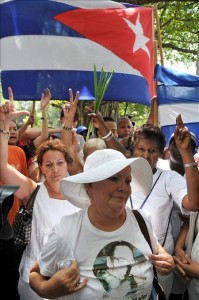
Lacking a computer and Internet, this had been the main source of information for Arnaldo Ramos Lauzurique (b. Havana, 1942), an economist who believed in the revolution while he worked in state institutions. When he became disillusioned, unlike other Cubans, he had the courage to dissent even though he is old enough to be a grandfather.

Sentenced to 18 years imprisonment in April 2003, he is now the oldest political prisoner of conscience. But he is also one who has made the most use of his time behind bars continuing to carry out his profession.

In the lined or blank pages of notebooks, using pencils or pens, Arnaldo Ramos has continued to further analyse the economic and political situation of the island. One afternoon in August 2003, he sent a piece of work he had written to my mother, Tania Quintero. She typed it up and sent it out through a Spanish diplomat. It was entitled “Two lawsuits, the same author,” in which he compares the conditions of opponents jailed in Cuba with the five Cuban spies convicted in the United States.

“Cuba is very good” and “Cuba, between the Orinoco and Titicaca” are two of his texts that can be found on the Internet. The latter, about the libretas (the Cuban ration book), has just been published in  El Mundo/América.

But perhaps one of the most substantial is “The so-called achievements,” written jointly with Manuel Sánchez Herrero, who died in 1999 and who was one of the founders of the Institute of Independent Economists of Cuba, created by Martha Beatriz Roque Cabello in the ’90s.

Like other Cuban political prisoners, Arnaldo has suffered abuse and humiliation by his jailers. In September 2004, his wife, Lidia Lima, denounced him and he then found himself in the prison at Holguín. After a search of his cell, Ramos was beaten with sticks, kicked and slapped by the appointed “re-educators” named Florencio and Batista. After the beating, they took him to the head of the prison, Israel Pérez, who also abused him and sent him to a punishment cell for five days.

The son of a Cuban father and a Spanish mother, Ramos Lauzurique was part of the group that in 1997 wrote “The Fatherland Belongs to All”, one of the most important documents for Cuban dissidents.

In his childhood and adolescence, Arnaldo lived in the room on Eagle Street, in Jesus Maria, one of the poorest and most troubled neighborhoods in the capital. This marginal environment did not stop him from studying and graduating university. This was at a time in our history when families like his raised their children with a premise now lost: that they were poor, but honourable.

Iván García

Translated by: CIMF

Neither Strawberry Nor Chocolate

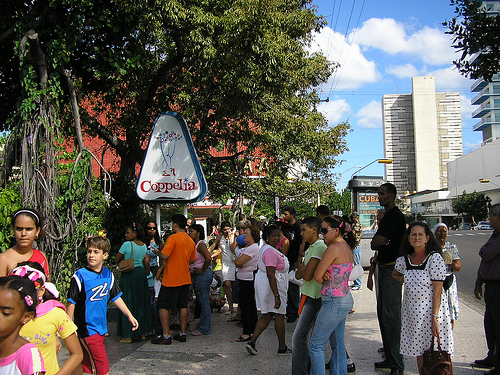
The corner of 23 and L is the center of Havana. It is always lively. At any hour. Together, as if they were shaking hands, we have the Habana Libre hotel, the Coppelia ice cream parlour and the Yara cinema. There are too many blown bulbs amongst the neon lights of the cinema billboard which barely manages to announce a British film, The Imaginarium of Doctor Parnassus.

The cafeteria of the former five-star hotel chain Hilton, today the Habana Libre, full of lights and marble, is a rendezvous for girls on the hunt for a foreign boyfriend and bisexual guys who walk about with the same aim. There are also people with some purchasing power for foreign or domestic beer who watch football on large plasma screens in the bar. The cliques that support Spain, Brazil, Argentina, Germany, Italy, Holland and France are having a great time in the heart of Vedado.

There, in La Rampa, a four-lane street with sidewalks of granite, designed by famous artists, which begins and ends at the Malecon, are concentrated the best nightlife spots in town. In the arcade, right at the entrance of the building, is a television, fans gathered around it to watch the game in which Australia was humbled four nil by Germany.

The noise is tremendous. Although more bearable than the ‘vuvuzela’ on South African stages. The management of the Yara cinema announced that giant screens would be placed outside, so passersby can watch the semifinals and final of the Cup. And that Cuba is not in the World Cup.

Children and adults line up for two hours to get into Coppelia. The ice cream is no longer of the same quality as in years gone by. There is no strawberry nor chocolate ice cream in Cuban pesos. Only for hard currency. Opposite the parlour, a kiosk sells hot dogs 24 hours a day, for 10 pesos (0.50 cents to the dollar), with sufficient demand.

While many see the Adidas Jabulani ball moving around, few have noticed that the Castro brothers’ government is discreetly shuffling the deck. With his best currency exchange and negotiation playing card being the political prisoners. As has always been the case.

Already the opponent Ariel Sigler Amaya has been released from prison. In an ambulance, very ill. To date, twelve have been transferred to prisons closer to their homes. In vans with bars, escorted, they have been put in their new cells.

Foreign Minister Moratinos said in Luxembourg that in the coming days there will be more releases in Cuba. Probably. Maybe not. The list of the Castros is like a lottery. It depends on domestic issues, on the international situation or on the mood of the big bosses.

For Cubans who walk along La Rampa, the political prisoners are a distant issue and the releases are not news.

The government plays its cards close to its chest, skilfully keeping its movements hidden from the people. It does not want to alarm them. It prefers to keep people busy with football and two hours of queuing for an ice cream cone. Although there is neither strawberry nor chocolate.

Iván García

Photograph: veo_veo, Flickr

Transalted by: CIMF

What Will be the Next Move?

Carrying out any sort of political analysis or political prediction in Cuba is almost like an Indiana Jones adventure.  The media does anything it can to misinform.  They barely extract any bit of information from those in power.  There is no way of getting any official statistics or facts.
When one is an independent journalist and the government does not approve of you, everything becomes much more difficult. Instinct and reading between the lines of official reports are common investigation methods.

Another way of trying to understand the reality of this island is if you have friends or sources who work for important organizations and they chose to whisper information into your ear.  It is already known that Cubans are extroverted.

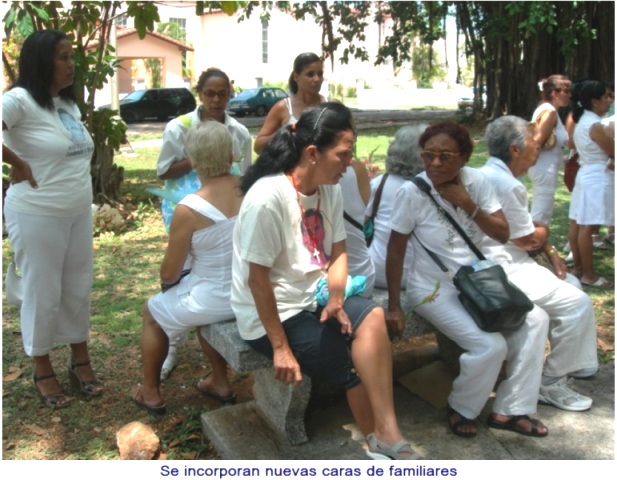
Well, back to the point.  It is true that in Cuba something is moving.  For the first time in 51 years the Castro government has given in to a group like the Ladies in White.

The strategy used by those in power was a very interesting one. They pulled the letter of the Catholic Church out of their sleeve.  Using the church as a mediator and as a valid interlocutor has various interpretations.

They either pretend to win some time and sell the idea that the regime is willing negotiate certain political things, or in reality the economic crisis that has been plaguing us for 21 years, the decrease of foreign investments, and the empty treasury, are forcing the government of Havana to search for a negotiated exit with two heavy-weight actors: The United States and the European Union.

Castro, a charismatic statesman of unpredictable strategies, always confused Western politicians with his tricks.  Just ask Felipe Gonzalez, Carlos Solchaga, or Jimmy Carter.

When you think you have him cornered and without defenses, he pulls a card out of his sleeve as if he were a magician.  It turns out that this situation is different.  Since July 31, 2006, Fidel Castro has lost a large portion of power.

And it has not been the dissidence that has opened the breach.  It is the generals, those businessmen in the island who are ruled by his brother, who have taken over power.

Ever since the 1980’s, a portion of the military and intelligence sectors were allowed to establish certain businesses, and so started the beginning of the end for the monolithic rule of Castro I.

For years the generals have made money.  They have hidden bank accounts and have become corporate men.  They traded in their AK-47s for executive briefcases.  The word comrade was traded for the word sir.  And the rustic Soviet technology was exchanged for sophisticated first world equipment.

Those elite military men who control the few profitable businesses that function in Cuba prefer to drink Jack Daniels over our own rum.  After a while, they traded in their traditional guayaberas for very formal suits with silk ties.

They have converted themselves into cut-throat capitalists.  Their advisers studied marketing and speak about efficiency and profitability, costs and gains.  They also like to keep some dollars or euros under the mattress.

It is precisely those generals who are really in charge during this summer of 2010.  Fidel Castro is only a symbol.  Very heavy.  Perhaps the old guerrilla leader just pulls the strings of exterior politics.

But the economy is in the hands of the military.  And they want certain changes.  Nothing big, really.  Economic freedom for the people.  Firing a million workers in the inflated labor scene.  They want to give autonomy to small and medium companies.  They want to do away with the benefactor State.  They want to lighten the load.

The military favors some liberalizations in Cuba for the simple reason that it would be a much more effective way of staying in power.  They know that with hard-line and radical discourse, and with the huge crisis that faces the planet, business doesn’t work.

Internal peace is needed.  Developed countries do not need to condemn the island.  Then, they had to give in.  And they used the church.

It is also possible that a number of political prisoners may be released.  Not all of them.  The regime needs prisoners like spare change.  But it is the only way of keeping the determined Ladies in White calm.

The internal dissidence is not very worried about the generals who control the power.  For various reasons.  One of these reasons is that the opposition is deeply penetrated by the political police.

The other reason: they do not have a solid base within the population.  They also do not have brilliant or charismatic leaders.  That is why I think that the recent move by the Castros was conditioned by the pressure of a sector of the military.

What will be the next move?  If the money does not continue coming in and the international pressure does not stop, there will be new sacrificial moves. The Castros still hold some winning cards in their hands.

But the deteriorated economic situation, which has not had any possible solutions mapped out, the disgust of a wide portion of the population, the poor rule of the leaders, and the huge monstrous bureaucracy all have the Creole mandarins cornered.

This summer promises some interesting things. Raul Castro has been on the throne for two years and has only implemented cosmetic measures. The situation which the country faces needs an entire package of wide reforms, from top to bottom.

The generals look at Vietnam.  This Asian nation has achieved economic changes while maintaining its hard fist towards internal politics.  Of course, Cuba is not an interesting market like China or Vietnam.

If the European Union or the United States continue with their politics of closed borders and deaf ears and if they don’t ease up in response to the liberation of only a hand full of political prisoners, then the government will have to change its strategy.  This would most likely lead them to negotiate with a sector of the opposition.

The regime wants power and it needs financial oxygen.  It will everything in its power.  In politics, it’s all worth it.

Ivan Garcia

Translated by Raul G.

More Doubts than Optimism


While some prisoners of the Black Spring of 2003, like Pablo Pacheco and Adolfo Fernandez Sainz, have their optimism levels up in the clouds, there is much more caution amongst the feelings of the Ladies in White.  In fact, there is much pessimism.

The doctor Lidia Lima, wife of the prisoner of conscience Arnaldo Ramos (an 68-year-old economist- one of the oldest political prisoners) has her doubts.

For Lidia the transfer of Arnaldo to the 1580 prison in the municipality of San Miguel del Padron in Havana is a relief.  The Ramos family resides in the capital and the trips to Santi Spiritus (about 400 kilometers from Havana) were always difficult and painful journeys for her and her two sons.

According to what Arnaldo told his wife during her latest visit, the food has improved.  However, he now resides in a galley full of very old men who suffer from mental illnesses.  At this very moment Lidia has more desire than faith.  She prefers not to fool herself with the idea that her husband could be one of the prisoners that will be liberated thanks to the visit of Dominique Mamberti, the Vatican’s chancellor.

This sentiment of doubt prevails amongst other Ladies in White.  The government of the Castro brothers has found itself at a crossroads.  If there is something that has defined them during these last 51 years it is that they do not like to give up any of their power.  The difficult political situation, the amount of international pressure, especially that of the US and the EU, has put them in a very uncomfortable spot.

It is very well known that with just a phone call from one of the Castros to the high ranking members of the Ministry of the Interior, the 56 prisoners left from the Black Spring, or the more than 200 political prisoners that still remain behind bars, could immediately be released.

If Fidel Castro took a few weeks to detain and judge 75 people only for opposing or writing without a mandate, freeing them would be a breeze, that is if the regime wanted to do it.  In Cuba, such situations are not solved in parliament.  They are personal decisions.

The ball is already rolling in South Africa.  The World Cup could be a good moment to free some political prisoners.  Some are in very poor states of health, like Ariel Sigley Amaya, who is practically paralyzed.

It was in the beginning of the war in Iraq, on March 18, 2003, that the one and only commander unleashed an oppressive wave against groups of dissidents and independent journalists in order to minimize the impact of such news.

Now, the regime of Havana could opt to try a military strategy.  The planet is focused on soccer.  At least that is what Pablo Pacheco thinks.  If you ask the family members, they’re not that optimistic.

Ivan Garcia

Photo:  Martha Beatriz Roque.  Ladies in White outside the Santa Rita Church on Sunday, June 6th.

Translated by Raul G.

Being Black in Cuba

At the intersection of Acosta Avenue and Calzada 10th of October, around 11 pm, a police van detained a group of people who carried bookbags or handbags. Inside the vehicle there were seven young black men who were detained and handcuffed. With blank stares, they clearly questioned the motives for their detentions.

Lieutenant Delfin Carneado did not know how give them a concrete response. “Shut up”, was what he told them. A frail mulatto with an afro and various green and yellow bracelets on his left wrist, wished to know if the cause of his being suspected of some presumed crime was the color of his skin.

Lieutenant Carneado stared at him coldly and answered: “I am not a scholar, but I do know that the majority of thieves are black”.  The lieutenant said something that was right. According to reliable sources, 88% of prisoners for common crimes in Cuba are either mestizo or black.

The Ministry of the Interior has never published any statistics about the number of common prisoners on in the island and their ethnic classifications. There is a statistic that states that in Cuba there are more than 100,000 behind bars, this is according to estimates made by human rights activists.

If 88% of these are mestizo or black, then the numbers are shocking. This would mean that within the island’s prisons there could be over 88,000 Afro-Cubans. Blacks are involved in 8 out of 10 bloody events that finish in death. They are also more prone to theft, pickpocketing, armed theft, and rapes.

Of course, blacks live in the worst neighborhoods in the most precarious of homes and most come from fractured families.  In a discourse by Fidel Castro on February 7, 2003, he acknowledged that the revolution “had not achieved the same success for eradicating the differences in social and economic status for the black population of the country.”

Seven out of ten managers of important businesses are white. In high political positions not even 10 percent of the positions are filled by blacks. If we consider the census of 2002 to be factual, then 34% of Cubans are either mulattoes or blacks.

Ethnologists and sociologists do not consider these statistics to be accurate, instead they state that the true numbers of black and mestizo citizens in Cuba ranges somewhere around the 60% mark. The numbers and the routines ring true when it comes to the police squad headed by lieutenant Delfin Carneado which operates in the late hours of the night and detains a considerable number of dark-skinned men.

It’s common. Before any operation or round-up blacks are the first suspects. That is why lieutenant Carneado does not have an answer to offer the young man with an afro who wishes to know if his arrest has something to do with prejudices. Perhaps it isn’t a racial problem. Habits, sometimes, are stronger than certain laws.

Ivan Garcia

Translated by Raul G.

For a Messi Shirt

It was at the exit of the nightclub. The night was over. Around 3 o’clock in the morning, in an unlit block, they beat him on the head with a baseball bat. That was the last thing he saw.

Yasser Bedia, 19, woke up in an intermediate care ward. Serious bruises on his head and with 43 stitches. The gang of thieves robbed him of his light blue Levi’s, retro plastic glasses, his Motorola, a wallet with nine Cuban convertible pesos ($8) and 75 Cuban pesos ($4), and a shirt with the red and blue stripes of Barcelona’s Argentine star, Lionel Messi.

“I thank God that they didn’t kill him,” says his mother, who does not understand how a person’s life can be endangered for so little.

Exaggerated acts of violence such as the case of Yasser are not isolated events in Havana. Havana is still not as violent as Rio de Janeiro or Caracas, but it is on the way.

Groups of juvenile delinquents roam the streets late at night. Their mission is simple: to steal or rob people wearing an item of value. Or simply because they like the shirt of a football star or an iPhone.

Let’s analyse these types of thieves. They go in bands of 5-10 youngsters. The average age is less than 18. They are armed with knives, razors, well sharpened scissors or just punches. Sometimes they have guns. The majority are black.

Now I present a young man who served five years in prison for assault with a deadly weapon. Call him Yoandri. In a brawl in prison, he lost an eye. He has a long, ugly knife wound on his rear end. He looks like a mature adult. But he is only 21.

“I’ve always lived by stealing and assault. I have no father and my mother is an alcoholic and a raving lunatic. I was raised by a grandmother in the neighborhood of Belén. There I began snatching gold chains. We rode on a motorcycle and when we saw a person with a good piece, we would grab the chain and, with the motorbike running, we dragged them across the asphalt, until the chain broke,” says Yoandri.

He lost count of the items he took. “There were a lot, particularly at the exit from clubs. Well-dressed girls and young men with good phones – with a gun in our hands, we left them naked. If the female was good, sometimes we all screwed her,” narrates the young man without a fuss.

They caught him one afternoon in June 2004. Back on the street, Yoandri doesn’t see a clear future. “Work washing buses at a bus stop, my salary shit, trying not to go back to the slammer (jail), but the situation makes me seethe and I want to dress well and have hard currency in my pocket. The devil is pushing me to crime,” he says, seated in a seedy bar, taking a swig of a double rum, strong and cheap.

Young people like Yoandri do not try to change their fate. They go for the easy route. Crime. Dysfunctional families and households that are like a small hell is the common denominator of these guys.

They go out looking for what they can’t have. At times, even, causing the deaths of their victims. Prison for them is like a second home. Anything can spark their interest. A good watch or a mobile phone. Or a Messi shirt.

Iván García

Translated by: CIMF

In Cuba, We Breathe the World Cup

The world is a football. With the end of the leagues on the old continent, people’s mouths are watering in Cuba. On 11 June, something great starts: the World Cup in South Africa.

Already in the sports clubs, they are setting up sweepstakes. Brazil, as usual, has the advantage in the betting. Mauricio, 32, a hotel worker in Saratoga, bet 50 convertible pesos that the Brazilians would lift their sixth World Cup.

“If they win, Dunga’s eleven will let me pocket 500 convertible pesos. A group of ten people each decided to go for our preferred teams. I know that Brazil is going have the upper hand,” he said optimistically, while preparing an Alexander cocktail at the bar of a downtown Havana hotel.

Spain and Lionel Messi’s Argentina are the other two great heavyweights that Cuban fans have fallen in love with.

The team selection of the mustachioed Vicente del Bosque, with his successful mid-field game and predatory strikers (such as “El Niño” Torres, “The Kid” Villa, and Pedrito, of Barcelona), has a strong likelihood of lifting the Jules Rimet trophy of beaten gold.

It’s now or never for Spain. Never before have they had much chance of being world champions. But Argentina is Argentina. And when you have a player like Messi with more than enough talent, it doesn’t matter that they have as controversial, unpresentable and pathetic a manager as Diego Armando Maradona.

Italy and Germany also have fans on the island. The Blues (the Italians) with their tough and nasty game don’t win any applause, but they are the reigning champions and are always a rival to watch out for. Germany has a rational and efficient team, like any product made in Germany.

The Germans seem like robots. Because they sweat, you realise that they are human. They run up and down, neatly, as if they were the military. The centre field players have the physique of NBA players and wingers thrash up and down the entire game. Watch them like German tanks.

The France of “Scarface” Ribery has supporters on the island, but not many. We also have the Clockwork Orange Dutch. They’re better than “The Tulips” — the team from Holland — but they lack that bit of luck mixed with a good pair of balls which is what brings victory in the end.

In Cuba, with a lack of good sporting events, we eagerly await the Cup. In these humid days, sports fans have nothing to watch on TV. The crazy ones on the patio dream that one day Cuba may be present in a World Cup. It will be difficult.

The football that is practiced in the green cayman is mean and coarse. Like eleven tough guys trying to play a violin. They look like wrestlers. They are athletes running around the court without rhyme or reason. Puppets who mistook their trade.

We will have to wait many years to see a national team in a World Cup. Since 1938, Cuba has not been involved. So the solution of enthusiasts of the beautiful game is to support any other team that takes part in the South African World Cup.

Habaneros, orphans of good football, bet on the concrete and magical touch of the green and yellows (the Brazilians), the magic of the white and blues (Argentina) or the compelling game of the red fury (Spain). They believe that any one of them could be the champions. There is no room for the others.

Iván García

Photograph: Aris Gionis, Flickr

Translated by: CIMF

The Transition of the Castros

A door has opened.  Slightly, but there are signs that something is moving.  The government of the Castro brothers asked for help in a very low voice.  And they decided to ask the Cuban Catholic Church.

The calculated strategy has its logic.  They had to look for a solution to the 21 years of lethal economic crisis as well as a dignified exit from the difficult internal political scene that has produced worldwide repercussions, starting with the death of the peaceful dissident Orlando Zapata Tamayo, the marches of the Ladies in White, and the hunger strike of the journalist and psychologist Guillermo Fariñas.

The Castros have realized that one cannot permanently be immersed in a state of war and on various fronts at the same time.  Especially when the country urgently needs credits and investments in order to start the motor of economic productivity.  The brothers are not dumb.  If they continued buying time with patriotic discourses their roofs would come crashing down.

The economy does not understand ideology. It is a science. And it is screaming for reforms. Such reforms would serve to maintain them, or any future aspirants, in power.  Yet they took their chances with the Catholic Church which now, more than ever, is in need of credibility.

And cardinal Jaime Ortega happily accepted his role as a mediator between the Ladies in White and the government.  According to speculations, it was not an idea that was born from Ortega’s desire.  It was the Castros who served as the architects of an agreement with “those inconvenient ladies”.  When they would see them with their desire, their flowers at hand, and demanding freedom, they would set the streets of Havana on fire.

The negotiations could be a rehearsal for the future.  It’s likely that when the president Raul looks at himself in the mirror he will see the face of Jaruzelski.  And perhaps in cardinal Ortega’s role he will remind himself of Wojtyla of Krakow.

Both men want to make history.  They don’t want to be remembered as indolent and lazy people who did little to save the nation.  The government and the church are doing what they know how to do, in roles they prefer.  Important protagonists within a society in crisis.

They do not prevent the leaders from being afraid. They know that in that future that creeps up on us they will have to enter into dialogue with the internal dissidence and also with the exile.  The regime has not prepared its mediums for that option. However, sooner or later it will happen.

The first step would be to cease the escalating violent verbal attacks against those who choose to dissent.  Later, they must give the people more diversity.  Soccer in June, and beach vacations during July and August recess.

The task that awaits the General is a task of titans.  Reshaping the economy using unpopular shock methods. Stocking up the markets and improving the deplorable quality of life for the majority of the population.

And, overall, they must design a viable future.  It’s not an easy task.  For all of them it will be necessary to engage in political pacts with peace and concordance.  There is no other option left for the Castro brothers.  The role of the church as mediator is an initial strategy.

It’s true that they pay no attention to the dissidency.  But in the long run they are going to have to sit down at the same table.  The beginning of the dialogue between the government and the church could be the beginning of the end for the closed system.

Upon opening a space within society that would allow them to continue governing, the Castros are sacrificing a quota of power.  And that’s how we come to this marriage of convenience.

In sum, neither one or the other is left with much options.  The church because for 50 years it was more of an enemy than a friend to power, and their limited hopes have been reduced to just preaching in temples.  And the government because it wishes to continue running the country in the style of China or Vietnam more than that of Caracas.

Each person decides their own percentages of benefit or harm.  Many think that the government is digging its own grave by starting this transition.

I don’t believe it.  Perhaps Castro II will emerge even stronger if he triumphs in his role of “savior of the country”.

Ivan Garcia

Translated by Raul G.