
The Race for School Supplies / 14ymedio, Luz Escobar

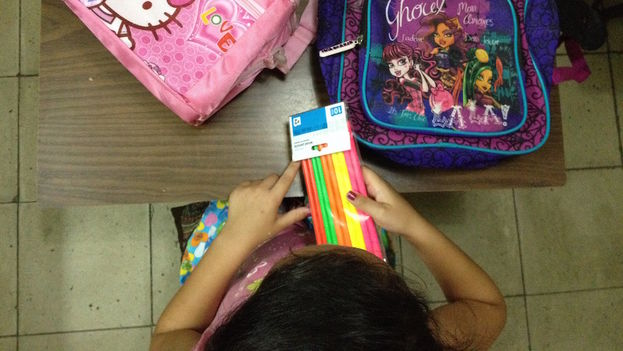
A girl getting her supplies ready for the new school year. (14ymedio)

14ymedio bigger14ymedio, Luz Escobar, Havana, 12 August 2015 — The long line snakes outside the bookstore under the scorching August sun. Most are women with children. “They’re selling the thick notebooks,” announces an elderly lady to someone asking who is last on line*. The race is on to buy school supplies, such as backpacks and lunchboxes. However, some have better starts than others.

Daniela visited the aquarium, went to the beach, and ran around in the park near her house during her summer vacation. But now, as the days of rest are running out, her mother has embarked on a marathon run from store to store trying to find everything from colored pencils to a water bottle. Daniela wants to start the first day of school with “nice and pretty things,” which will hardly be cheap.

With 6,827 elementary and 1,766 middle schools throughout the country, the authorities of the Cuban Ministry of Education are giving assurances that school supplies will be guaranteed for the more than 1,500,000 students starting the 2015-2016 school year. Still, students and parents complain about the poor quality of the supplies, and the limited quantities distributed. continue reading

“My daughter can’t use an eraser because it leaves a hole in the paper,” said a mother about the notebooks handed out in schools. The woman was waiting to shop outside of La Época department store in Central Havana. Illegal vendors in the vicinity of department stores sell notebooks with colorful covers, and ruled paper for one CUC.

In homes with school age children, the same scenario is being repeated over and over again as kids line up their precious pencils, protractors, and erasers on their beds or on the dinner table. Some families have already found backpacks, the source of many a headache given the high prices and flimsiness of those for sale in the government’s network of retail stores.

Daniela is lucky. She has an aunt living in Miami who bought her a backpack online. Her family received a phone call from the Plaza de Carlos III shopping center informing them there was a school supply purchase waiting for them there. The émigré relative also threw in a box of colored pencils. In Cuba, Daniela’s mother – an engineer who graduated a decade ago – would have had to work three days to pay for those pencils.

However, the online purchase hasn’t solved all the problems. Daniela’s family will spend a whole week searching for all the supplies she still needs. Her grandmother, who owns a car, will be going to “La Cuevita,”* a popular yet illegal market where small and medium size school uniforms are sold, although these same sizes are in short supply at government-run stores. Daniel’s father’s mission is to find her shoes, while her mother is in charge of finding a pencil sharpener and a compass for geometry class.
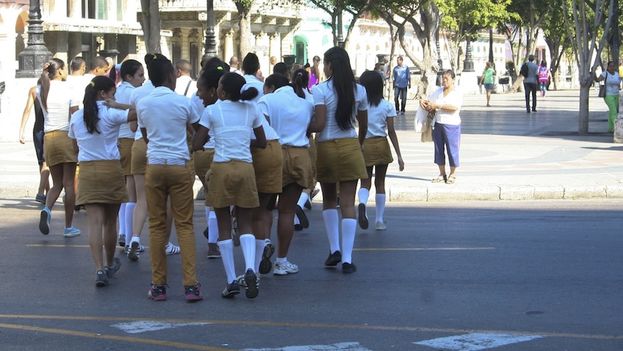
School uniforms (14ymedio)
School uniforms (Luz Escobar)


Since shortages have worsened in the last few weeks, Daniela’s family’s task will take a few days. “Every store is empty,” protested a grandmother of twins who will be starting first grade in September as she visited La Moderna Poesía bookstore. “An eraser here costs me at least 50 cents in CUC, but that’s my whole pension for one day,” she added.

Fashion also affects the predilection for specific school supplies. “My daughter wants a Monster High backpack,” explains a desperate mother who last Tuesday visited all the shops on Monte Street. The Monster High fashion doll and video franchise has become all the rage among Cuban children, putting their parents into a bind, pressured to do the impossible to get a hold of one of the brand’s items.

The same scenario – but with even more challenges – plays out in cities and small towns outside Havana Province. Long lines to buy school uniforms have become part of the urban landscape every month of August in the city of Pinar del Río. Still, unauthorized vendors manage to outwit the police by selling pencils, quality notebooks, and book covers made from recycled x-ray film.

The Ministry of Education turns a blind eye to all of this. A couple of weeks ago, Marisol Bravo Salvador, the Ministry’s director for the Vueltabajo Region of Pinar del Río Province affirmed that her district “has all the necessary resources, like notebooks, pencils, and teaching modules that guarantee a year for optimal learning.”

The race to get all necessary school supplies is in full swing, but surely many children will enjoy nothing new when the schools year begins. These kids will probably become the targets of the snooty stares of their classmates, who – right in front of their eyes – will be showing off their lunch boxes that keep soda cold until afternoon recess, as well as their strawberry-scented erasers.

When the first morning school bell rings in September, there will be children lining up for class with eye-catching backpacks sporting smiling Disney princesses, carrying notebooks purchased by émigré relatives. Others will recycle part of what they used last school year, or they will just wait for whatever the teacher gives out.

Translator’s Notes:
* Cubans join a line by asking, “who’s last,” and then they are free to cluster, wander around, leave and come back etc., without losing their place in line.
**Literally “The Little Cave.” In popular Cuban parlance the term is applied to discrete locales of unlawful activity, much like U.S. Prohibition-era speakeasies.

Translated by José Badué
US Expresses “Deep Concern” Over The Arrest Of Dissidents In Havana / 14ymedio

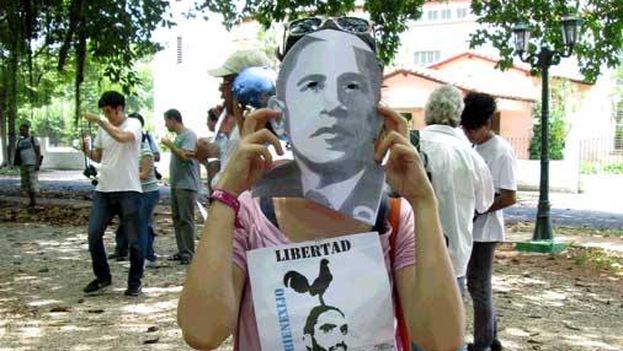
During the march of the Ladies in White on Sunday August 9, some demonstrators wore masks of Barack Obama. (Twitter /ForoDyL)

14ymedio biggerEFE, Washington 10 August 2015 — The US government on Monday expressed “deep concern” about the detention for some hours of about 90 dissidents in Cuba, including a group of members of the Ladies in White, and insisted that it will continue to work to ensure respect for the right to demonstrate in Cuba.

“We have seen the reports, and our staff at the embassy in Havana confirmed these arrests,” said John Kirby, spokesman for the State Department, in his daily briefing.

Kirby stressed the “deep concern” of the US government over these arrests. continue reading

“We are going to continue to pressure for the rights of peaceful assembly, associate and freedom of expression, and we are going to continue expressing our support for an improvement in the conditions of human rights and democratic reforms,” he added.

Those arrests come just days before the US Secretary of State John Kerry travels to Havana this Friday for the formalization of the raising the flag over the embassy in Cuba, opened last month, and within the process of normalization of diplomatic relations between the two countries which remained suspended for more than half a century.

The spokesman referred to the arrests Sunday, several hours after a demonstration in a Havana park, with some carrying photos of political prisoners and others wearing masks with images of the US president, Barack Obama.

The opponents Antonio González-Rodiles, his partner, Ailer Gonzalez and Angel Santiesteban told EFE that they were arrested and taken into a police car to a detention center after meeting with the Ladies in White, after the usual walk that this women’s movement undertakes on Sundays after Mass in a church in the neighborhood of Miramar.

The three said they were detained for a few hours and they knew of other dissidents in the same situation as in the case of Aliuska Gomez of the Ladies in White, who was already released.

Gonzalez Rodiles, who leads the independent project Estado de Sats, explained that they carried the photos to “signal that repression has intensified against opposition activists” as part of the campaign “We All March” which they have undertaken to advocate for the release of political prisoners.

According to the latest report released by the Cuban Commission for Human Rights and National Reconciliation (CCDHRN), during July there were at least 674 temporary political arrests on the island, the highest level since June 2014, and 21 cases of physical attacks during the arrests.

US Invites Cuban Opponents To An Event At The Official Residence, But Not To The Embassy / 14ymedio

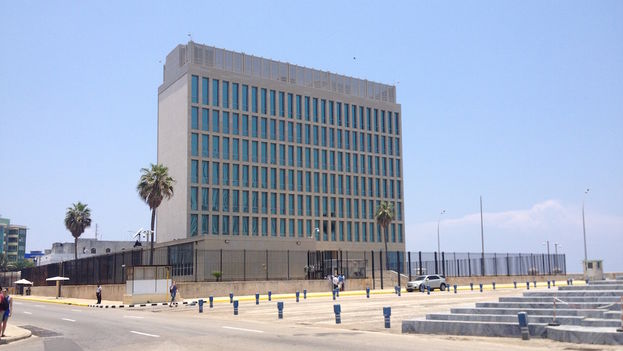
The raising of the flag is scheduled for Friday morning, August 14th. (14ymedio)

14ymedio bigger14ymedio, 12 August 2015 — The U.S. embassy in Havana will not be inviting the opposition to its official inauguration, which will take place this coming Friday, August 14th, in Havana, with the attendance of John Kerry. Nevertheless, another flag raising ceremony has been planned at the ambassador’s residence where there will be a meeting between the Secretary of State and a group of dissidents, as has been confirmed by 14ymedio. Among the activists who received an official invitation from Secretary of State John Kerry are Antonio González Rodiles, Martha Beatriz Roque, Elizardo Sánchez, Manuel Cuesta Morúa, Dagoberto Valdés and Héctor Maseda, among others.

The flag-raising ceremony and the reception at the residence of Jeffry DeLaurentis will begin at 4:15 PM and the guests are expected to arrive before 3:45 “for security reasons.”

Washington hopes this will resolve the dilemma created by the official visit of John Kerry to Havana, the first by a secretary of state in seventy years. continue reading

The news comes one day after Senator Marco Rubio (R-FL), wrote Mr. Kerry asking him to “meet with the courageous leaders who are fighting to bring freedom to Cuba and invite them to the ceremony you will be presiding over at the new American embassy.” The Cuban-American senator added: “They [the dissidents], among many others, and not the Castro family, are the legitimate representatives of the Cuban people.”

Republicans are pressuring the White House to express a gesture of encouragement towards the opposition. Yet the Obama administration finds itself in a predicament, since the Cuban government might interpret its Washington’s approach to the opposition as an offense at a moment when both countries are trying to normalize relations, since it considers dissidents to be “mercenaries.” On the other hand, excluding the opposition might result in criticism from those sectors that would accuse the U.S. of being lukewarm when it comes to defending human rights.

State Department spokesman John Kirby said: “The United States will continue to advocate for the rights to peaceful assembly, association and freedom of expression and religion, and we’re going to continue to voice our support for improved human rights conditions and democratic reforms in Cuba.” Apart from the flag-raising ceremonies, Kerry will meet with Cuban Foreign Minister Bruno Rodríguez, and they may also hold a joint press conference. Kerry also plans on taking a short stroll through the capital, according to the authorities.

Translated by José Badué
The Right To Public Debate / 14ymedio, Eliecer Avila

The video above is in English.

14ymedio bigger14ymedio, Eliecer Avila, Havana, 12 August 2015 – Recently the Cuban intellectual Rafael Hernández, editor of the journal Temas (Topics) and moderator of the debates that take place on the last Thursday of each month at the Fresa y Chocolate (Strawberry and Chocolate) center, gave an interview to the journalist Cristina Escobar for the program Interviews From Havana by the Telesur network.

The interview was conducted in English, and broadcast with subtitles in the early morning hours for Cuban viewers. In it Rafael Hernandez defends some theses that have been put forward for some time in the intellectual spaces tolerated by the government, and he proposed a “new look at the theoretical conceptualization of the socialism we need.”

When asked what to do with the fact that “the enemy press takes any criticism that comes out in the Cuban media to amplify it against Cuba”, the intellectual and responded with emphasis and determination: “We must tell the truth, period,” because he believes that “it is better to have a discussion on any topic in our camp, than to allow the enemy to take us to his.”
continue reading

Rafael Hernández makes innumerable references to the “enemy” without it being clear to me exactly what or who he means

In the interview Rafael Hernández makes innumerable references to the “enemy” without it being clear to me exactly what or who he means. I do not know if I myself, or my friends, many of my neighbors or my fellow students, who think differently from the Government of Cuba, are part of Rafael’s “enemy.” I hope not.

On the other hand, when he encourages us to “tell the truth, period,” it is also not clear to me to whom he is directing his message. Honestly, I do not believe that those who resist telling these truths are journalists. I know many of them personally, and by reference many more, and I am sure that they one hundred percent share this vision of the dignified and independent role that should be played by the press anywhere in the world. So who or what then prevents them from telling the unvarnished truths? The custom of not speaking them? Or is it that, in front of the cameras, everyone defends this “necessary sincerity” but in the spaces where it is truly decided what will be aired and what will not, no one is willing to assume the costs of telling the truth?

Are journalists the ones who decide what is published in Cuba? Is it perhaps the directors of the media? I think that as a example of what he himself demands, Rafael Hernandez could begin to say “the truth, period” recognizing that it is a tiny group of bureaucrats at the exclusive service of the Communist Party who decide every letter, voice or image that Cubans throughout the island see, hear or read.

I liked his defense in favor or a political and public debate in the national media. Like what more or less happens in the public space he leads. I clarify this saying “more or less,” because indeed it is true that normally no one is denied entry to these events, but it is also true that the panel does not usually represent the colors of the political spectrum of any nation in the world. Only in the audience can this diversity be seen from time to time. It is also the case that some dissidents speak. But they have only three minutes to do so and then the panel can dismantle everything they want, without the ongoing right to respond.

In the spaces where it is truly decided what will be aired and what will not, no one is willing to assume the costs of telling the truth

A debate, technically, is something else. In a debate, people who defend different points of view can count on a fair and reasonable time not just to defend their position but to question the proposals of their counterparts in a sequence that makes it possible to plumb the depths of each topic. For this, you have to have good intentions, and select exponents of similar intellectual levels, or at least those who enjoy public recognition in the sphere they defend.

Following this logic one could have a debate between Rafael Hernandez, on the one side, and Reinaldo Escobar n the other, about “journalism and truth in Cuba,” for example. Would the director of Temas accept this debate? Would he feature it in his magazine? I am sure that if he did it would break audience records and the results would be very useful.

I believe that when certain authorized intellectuals or thinkers talk about the necessary existence of public debate or of public spaces, they don’t always take into account that none of these things exist in Cuba.

Neither the Party nor the Government nor the intransigent Communists have anything against debate itself, what they can’t bear are the consequences. Because four good televised debates on crucial issues, no holds barred, in a framework of respect and civility, would collapse the entire house of cards.

I invite the director of Temas with regards to what he seriously proposes to be the promoter of the first public political debates in Cuba, similar to those held in other latitudes, involving communists, liberals, greens and other visions, all essential.

Cayo Granma’s Golden Dreams / 14ymedio, Rosa Lopez

The economy of Cayo Granma has been in decline for many years. The only way to secure a job is by crossing the channel separating it from Santiago de Cuba.

14ymedio bigger14ymedio, Rosa Lopez, Santiago de Cuba, 8 August 2015 — “If Cuba is the key to the Gulf of Mexico, than this is the key to Santiago de Cuba,” asserts Gaspar, who lives on Cayo Granma, and swears that he has not crossed the narrows separating him from the city in many years. Gaspar thought it “was the end” when hurricane Sandy devastated the area in October 2012. During those early morning hours when waves reached thirty feet, forty homes were destroyed and two hundred experienced major damages. Gale force winds took their heaviest toll on this tiny bit of land, and the storm’s scars are still visible.

A team of students from the Martha Abreu Central University of Las Villas has been rewarded for its rescue plan for Cayo Granma during the London-based i-Rec Conference 2015: International Perspectives on Disaster Recovery and Reconstruction. But thousands of miles from England, the residents of the most famous island in Santiago Bay are trying to rebuild their lives three years after what seemed like a meteor impact. continue reading

The team is led by Professor Andrés Olivera Ranero, and includes students Ana Lourdes Barrera Cano, Royer Leno Medina, Elisa Medina Toboso, and Niuris Martín Rosabel, all of who hail from the provinces of Cienfuegos and Villa Clara. With the objective of the revitalization of the community, they presented their four-step plan, and were able to beat out over fifteen other projects competing for the award given in London.

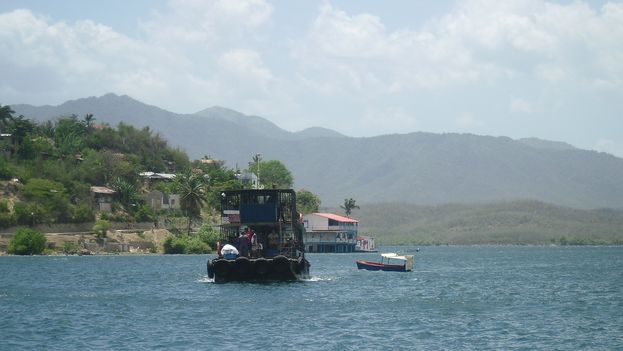
The longboat that arrives once a day at Cayo Granma is noisy and leaves behind an odor of burning oil. Immediately after disembarking one is struck by the natural beauty of the place, and by the precarious life of its inhabitants. Cayo Smith, as Cayo Granma was originally called, is still a humble fishermen’s village, with wooden shacks that gave it its architectural uniqueness, and that used to house families of up to twenty members. The holes the winds left in the roofs and in the walls have been concealed with zinc slabs and pieces of wood collected after the storm.

“There’s not too much to do here,” explains Agustina, who lived through those years when most of the owners of Cayo Granma’s best homes left for exile, and the government turned the dwellings over to very poor people. “It was like a dream come true, but then everything got run down.” This lady confirms what specialists and sociologists have proven through their research: Cayo Granma’s economy is at a standstill, alcoholism rates among the youth are alarming, and unemployment figures are high.

“There’s only one school here that goes up to the sixth grade, and a lot of the adolescents drop out because it’s too hard getting to the other side,” explains Agustina as she points to Santiago de Cuba. Some of the villagers have their own dangerous and fragile rowboats. When they use them, they do so very quietly since most of them are not authorized and therefore are subject to frequent confiscations. When talking abut the unreliable schedule of the only means of transportation connecting them to the city, Agustina complains: “There’re days we’re not sure if the government’s longboat is coming, or at what time.”

The architecture students have proposed a first phase that would guarantee a decent home with a roof for each family living on the key. Only after this is accomplished, the second phase of the project would start with the building of a manufacturing plant and a sawmill in order to create employment in an area with a high percentage of people without ties to the labor force.

The initiative’s third step would focus on urban and economic development. The models shown the judges who gave the award to the proposal show a lovely place, with flowers and abundant gardens, where residents build their own boats and semi-attached homes. “Picturesque, resilient, sustainable, and dignified habitat,” are some of the words used to describe the community that will ensue after the project is executed. The fourth stage would be the consolidation and preservation of what has been accomplished. However reality is far from this panacea.

With strong winds powerfully whipping the shoreline, 72-year old Carlos Cesario passes by with a bag hanging from his shoulder. “Very few homes have been repaired,” he states, while explaining how he shares a dilapidated house with fifteen relatives. This problem is common among the key’s residents, and they stare blankly out towards the horizon without the slightest hope that solutions will come through official channels.

“It’s an awful situation,” protests Moraima Fernández. “My roof caved in, my house fell apart, and I couldn’t find zinc slabs.” Mrs. Fernández points out that the local authorities’ poor handling of the situation has contributed to “after three years, everything still being more or less the same.”

When Cayo Granma’s residents were shown the winning models from the London competition, some could not contain their laughter, while others asked “And when is it supposed to happen?” The project’s timetable and date for the completion of the homes have yet to be determined. There is not even a budget yet to start on the first phase. “I’m sure that they’ll have to wait for some foreign organization to fall in love with the idea, ones that will want to finance it,” reflected Ana Laura, a young lady born on Cayo Granma. Nowadays “I only come here to visit my grandmother, because this place is like death,” she added.

Far from here, on a few restless architects’ drawing boards, rest the plans for Cayo Granma’s future, a faraway, utopian place that the island’s current residents do not even want to think about.

The projected future of Cayo Granma as it appears in one of the award-winning models presented in London.

Translated by José Badué

Resale of Water, A Lucrative Business / 14ymedio

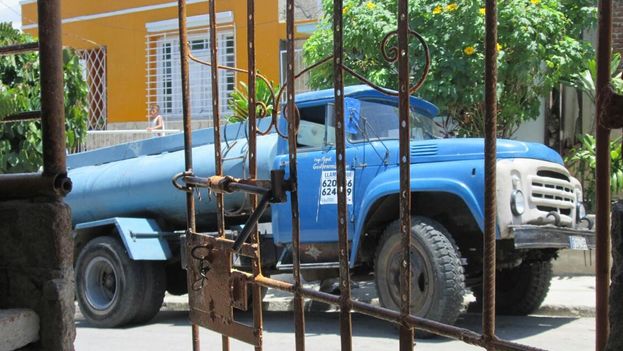
Tankers like this, in Santiago de Cuba, distribute water for the province. (Yosmani Mayeta)

14ymedio bigger14medio, Havana, 10 August 2015 – The drought in Guantanamo province has triggered an illegal market in water. Residents of the province are coming to pay between 300 and 500 Cuban pesos for the contents of a water truck, a lucrative business for drivers of the so-called “pipes,” which the authorities have denounced after a meeting in which they discussed the measures to be taken to confront the situation.

Ines Maria Chapman, a member of the Council of State and president of the National Institute of Hydraulic Resources (INRH), called the attitude of these drivers opportunistic, and called for people to fight back by denouncing those who “exploit” the situation caused by the drought for material benefits. continue reading

Chapman added that several communities in the region are receiving water only every 25 days.

For its part the local INRH delegate, Alfredo Correa, reported on the lack of rain and the alarming decline of water in the reservoir, which is now only 134 million cubic meters out of 347.5 possible, 39% of the storage capacity for the province.

The depletion of many sources of supply, such as rivers, dams, lakes, tanks and wells, has forced water rationing on more than 258,000 Guantanameros, 72% of the population of the province. Irrigation has been limited to a minimum in the depressed agriculture in the area, including on land for sugar cultivation managed by the State sugar company, Azcuba.

The most fortunate can receive water through supply networks on a cycle ranging from two to ten days.

The situation has forced to government to increase pumping from the Bano River, very low for years and with a high level of pollution. They have also had to construct new pumping stations, one of them about to be open on the Camarones canal, next to the central town of Argeo Martinez.

Opening wells in the mountains and the battle against leaks and illegalities are also among the measures promoted by the authorities of the province.

Cuban Activists Discuss the Diplomatic Normalization with the United States / 14ymedio

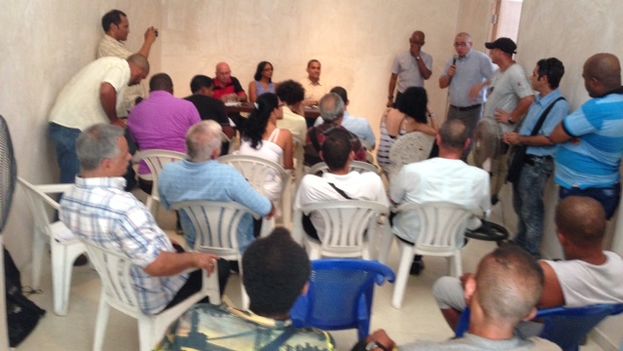
Cuban activists in the meeting on Monday at the headquarters of "Hannah Arendt Institute of Artivism."(14ymedio)
Cuban activists in the meeting on Monday at the headquarters of “Hannah Arendt Institute of Artivism.”(14ymedio)

14ymedio bigger14ymedio, Havana, 10 August 2015 – Under the title “Diplomatic Normalization and Democratic Normalization,” an even this Monday brought together some 25 Cuban activists of different points of view. The site of the meeting was the “Hannah Arendt Institute of Artivism” in Old Havana.

The panel in the morning meeting discussed diplomatic normalization with the United States and the political dialog that the Cuban government is holding with the European Union. Specifically, they dealt with “the effects on the generation strategies of Cuban civil society and the democratic opposition.”

The event was attended by dissidents and activists from several organizations, including Juan Antonio Madrazo, Pedro Campos, Laritza Diversent, Felix Navarro, Jorge Olivera, Tania Bruguera, Navid Fernandez, Eroisis Gonzalez, Boris Gonzalez and Lilianne Ruiz, among others.

The meeting took place a few days before the Secretary of State of the United States, John Kerry, will come to Havana to attend the reopening ceremony of the embassy of that country in Cuban territory. So far Kerry’s agenda on the island has not been made public, nor is it known whether it will include a meeting with activists and government opponents.

Cuba’s Problems Can’t Be Solved Without Its Exiles / 14ymedio, Eliécer Ávila

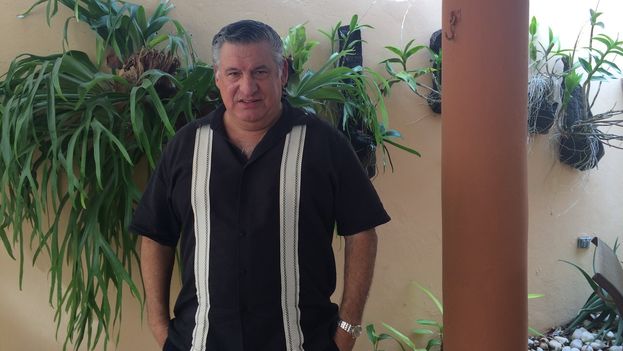
Lawyer Guillermo Toledo. (14ymedio)

14ymedio bigger14ymedio, Eliécer Ávila, Havana, 5 August 2015 — The Cuban National Conference, which will take place in Puerto Rico from August 12th until the 15th, is generating expectations and controversies. Since its dates coincide with the reopening ceremony of the American embassy in Havana and the visit to Cuba of Secretary of State John Kerry, it poses a challenge for leaders of Cuban civil society who are debating whether to be in San Juan during those days, or to witness the historical moment from within the island.

Guillermo Toledo, a lawyer by trade, and one of the event’s coordinators, explains the summit’s objectives and its significance.

Eliécer Ávila: How did the idea of a Cuban National Conference come about?

Guillermo Toledo: Around two years ago I submitted a proposal in writing to the leadership of United Cubans of Puerto Rico so they could analyze it and give me a response. A few months passed, and my proposal was still going nowhere. So I started insisting. I was then designated coordinator of the Cuban National Conference, the name we settled on after several meetings.

Ávila: Who worked to make it happen? continue reading

Guillermo Toledo: Together with the members of United Cubans of Puerto Rico, our Puerto Rican sisters and brothers have contributed their talents and hard work to this endeavor. Our Cuban sisters and brothers have also opened their wallets in order to make an event of this magnitude a reality. These are the same people who in a future free and democratic Cuba will help with their investments to further the material development of our people. Our profound gratitude to all of them.

Ávila: Have other gatherings like this taken place before?

Guillermo Toledo: Cuban Exiles have held some great events, but as far as I know there hasn’t ever been a meeting with the character and nature of the Cuban National Conference. I don’t know of any other event that brought together so many organizations and pro-democracy activists from inside and outside of Cuba, regardless of their beliefs.

Ávila: Who will be participating?

Guillermo Toledo: Our leadership has decided not to name names until we get closer to the event. The central figures of the democratic opposition from inside and outside Cuba will be there, although there are a lot of people we couldn’t invite for lack of funds. I don’t like political labels, but I can say that we’ve invited the democratic center, the democratic right, and the democratic left.

Ávila: Regardless of their position regarding the reestablishment of relations between Cuba and the United States?

Guillermo Toledo: It doesn’t matter if they’re in favor or against the policies towards Cuba of the President of the United States, Barack Obama. This can’t and shouldn’t be for us a new source of division. If we’re going to be a democratic people, we should respect everyone’s opinions. That’s our meeting’s golden rule.

Ávila: What are the event’s objectives?

Guillermo Toledo: Reaching a consensus on unity of action in diversity, through the appropriate mechanism to lead us to a free, prosperous, fair, and democratic Cuba. We’ll also be conducting workshops focused on identifying strategies, tactics, and peaceful methods that will help us reach our shared objective. We want to send a message of unity to the Cuban people and the international community.

Ávila: Why choose Puerto Rico as the location for this meeting?

Guillermo Toledo: Both peoples share a common historical bond. The Cuban Revolutionary Party founded by José Martí had a division dedicated to helping Puerto Rico gain its independence from Spain. It’s also about being in a neutral place, where the understandable passions of exiles residing in Miami aren’t vented so strongly. We also don’t want State Security, or “Castro’s Gestapo,” operating in Puerto Rico as it does in Miami, working as hard here to sow internal divisions as it does there.

Ávila: Will Cuban émigrés play a major role in Cuba’s shift towards democracy?

Guillermo Toledo: Cuba’s independence could never have come about without the support of émigrés and exiles. The War of 1895 [Cuba’s second and final war of independence] had its roots in the key role José Martí played outside of Cuba, although all the actual battles took place on the island. Both shores played a decisive role when Spanish despotic colonialism came to an end. Nowadays we’re trying to do away with a totalitarian dictatorship. Cuba’s problems can’t be solved without its exiles.

Ávila: Once it was known that the date for your gathering in Puerto Rico would coincide with the reopening of the United States embassy in Cuba, and given the historical importance of the latter, have you thought about moving the date?

Guillermo Toledo: United Cubans of Puerto Rico chose August 13th, 14th, and 15th of the current year, long before December 17, 2014, when the new United States policy towards Cuba was made public. Maybe we should ask the Americans if it’s just coincidence that they chose August 14th to hold the events at their embassy.

Our gathering can’t be cancelled or postponed because the international community is already aware of it, and the financial losses would be enormous. We also don’t believe there’s a valid reason to postpone it since our meeting is a thoroughly Cuban event where we’ll be discussing and reaching agreements regarding Cuba. The embassy is an American matter, as it should be.

Ávila: Do you have a dream that still hasn’t come true?

Guillermo Toledo: To return to Cuba in a dignified manner, and help create a new country where its people can enjoy freedom, and material and spiritual development.

Translated by José Badué

The Government We Need / 14ymedio, Regina Coyula

14ymedio bigger14ymedio, Regina Coyula, Havana. 2 August 2015 — In light of the government’s refusal to dialog with the nonviolent opposition, the latter should start a discussion within itself, an exercise unfamiliar to Cubans. Instead, we are accustomed to extremes ranging from the consistent unanimity of our parliamentary sessions, to the commotion of a “disqualifying”* act of repudiation.

Change – gradual or drastic – is the possibility of change in the roles of power and the government is not interested. But society needs all its actors, whether they are dissidents or government supporters. One must be blind not to realize that Cuba is on the road to change. So for starters, our government should uphold its own laws that it disobeys time and time again when they are not in keeping with its interests. This would be just a beginning. However, as we already know, the authorities are not interested in what would follow. The experiences of Eastern Europe are still fresh in their minds. continue reading

The Cuban government behaves ­– if not by decree or law, certainly in deed – as if it rules by divine right. It bases its authority on a form of anti-imperialism that on many occasions turns into anti-Americanism. Despite all the anti-imperialist warmongering and siege mentality indoctrination we have been subjected to for more than half a century, it was no match for the Cuban people’s jubilation upon the announcement of the process of normalization of relations between Cuba and the United States.

To speak of civil society in Cuba leads almost obligatorily to the dissidence, civic institutions that in other countries would be self-governing are subordinated to the state. According to this type of Socialism “we all support,” the only civic institutions are those recognized — and for the most part funded — by the government. Non-governmental organizations, especially those espousing independent political viewpoints, do not count.

Whether it is dissidents, government backers voicing criticisms, advocates for an independent civil society, or the “trusted opposition,” these groups highlight the existence of political pluralism in a country that is intended as a monolithic unit. Every individual is diverse and complex and if people don’t unite on issues far more simple than politics, it cannot be expected that a single political party could represent the interests of all its citizens over a timespan as long as five decades.

Cuba’s so-called “trusted opposition” is part of a larger ensemble that includes the genuine opposition. Clearly some of the more active and interesting members of this “trusted opposition” voice a type of radical nationalism more akin to the 19th century, not to this era in which national frontiers are blurred, among other reasons because of the emergence of globalization and a growing international consensus on protecting the environment, the eradication of poverty, and the marginalization of whole groups of people.

I do not support Cuba’s annexation to the United States, but if an annexationist** movement were to exist on the island, the level of support that it or any other political movement enjoys should be decided at the ballot box. Only the use of violence and discrimination in all its forms must be excluded from the national scene. Despite all the sloganeering to the contrary, Cuba is indeed moving towards a pluralistic future and it is not healthy if the government or the opposition flout the law.

By airing grievances before the authorities or the public, Cuban citizens are actually voicing their hopelessness in regards to what they expect from their government, which is the embodiment of the political system itself. Therefore it is absurd to think that Cubans will not switch ideologies, or “come out of the ideological closet” once we enjoy freedom and access to information. We will represent a wide spectrum – ranging from Christian democracy to the aforementioned annexationist movement – while never feeling any less patriotic than the most devoted member of the Communist Party.

It will be very difficult to ask for decency from an endogamous group that many years ago turned itself into the government and whose players defend their power at all costs. In their long manipulation of both information and nationalistic sentiments, we have inverted the concept of the presidency and the president. Therefore, instead of wasting time debating the limits of the “trusted opposition,” and consequently of the “other opposition” as well, we should begin to use the term “trusted government” to define what Cubans really need, a government we can trust based on the rule of law.

Translator’s Notes:
* The regime commonly uses the term “disqualified” towards its opponents, as a way of completely dismissing them and their opinions, a strong assertion that they do not even have the right to speak. For example, in this post Yoani Sanchez is told: “You have transgressed all the limits… This totally disqualifies you for dialog with Cuban authorities.”
** Historians estimate that during the last half of the 19th century, Cuba’s political class was divided into three equal parts: one third strived for more autonomy for the island while securing its place as an overseas province of Spain, another third fought for Cuba’s absolute independence, and the last third wanted to apply for U.S. statehood. The latter were known as “annexationists.” The current Cuban regime often dismisses dissidents with this term, which it considers pejorative.

Translated by JoséBadué

Deputy Health Minister Calls Situation In Holguin A “Health Emergency” / 14ymedio, Donate Fernando Ochoa

Auto announcing the measures against the threat of epidemics in Holguin. (14ymedio)

14ymedio bigger14ymedio, Fernando Donate Ochoa, Holguin, 7 August 2015 — The Deputy Minister of Public Health, Jose Angel Portal, described the epidemiological situation in the city of Holguin as a health emergency, according to a local television report. The statement was confirmed this Friday during a meeting to assess the epidemiological measures in the provincial capital to halt the spread of dengue fever in the area.

Deputy Minister Portal said that although the epidemiological situation of the country is one of the most favorable in recent years, Holguin is facing “a public health emergency in which there can be no room for carelessness and mistakes.” He emphasized that “people’s lives are at stake,” although he also said that currently, “it is more a perception of risk and we’re heading down the right path.”

For his part, the first secretary of the Communist Party in Holguin, Luis Antonio Torres Iribar, criticized the directors of the state agencies for allowing there to be foci of the Aedes aegypti mosquitos in their workplaces. The official criticized that situations like this go on despite the great offensive that takes place in all social and business sectors. continue reading

The provincial Government vice president, Marcia Aguero, called for more action by the state health inspectors with regards to fining offenders – people with mosquitoes breeding sites on their property. In this regard she noted that the number of penalties applied is minuscule relative to the violations committed.

Public health directors emphasized that the high prevalence of foci persists, including uncovered water tanks and closed houses that haven’t been inspected. They also reported an increase in cases of cholera in the area.

Also present at the meeting was Ines Maria Chapman, a member of the Council of State, who called attention to the water rationing because of the drought which is expected to get worse in the coming months, and which could further complicate the situation in Holguin.

Deputy Minister Portal stated that Cuba has extensive experience in the management of dengue fever, to which he will give his full attention, and added that in reversing the situation in the province they can count on sufficient health professionals and they are the best in the country.

Dr. Jorge Luis Quiñones Aguilar, head of the provincial department of Education and Health Promotion, said that cases of fever and cases of diarrhea are continuing to appear, with most of the latter testing positive for cholera.

Quiñones Aguilar said that given the large numbers of patients flocking to hospitals it has been decided to have a fourth hospital, located on the campus of Celia Sanchez Manduley University. He acknowledged that positive tests for dengue fever continue to increase with a figure now over 90%; that is of 100 cases of patients with fever, most of them are positive for dengue.

“We should not underestimate any kind of fever in our homes. If we know a neighbor who does not want to go to the hospital we must report it without fear and anonymously,” said Quiñones Aguilar.

He said that so far Holguin has not had a lamentable loss of life from this outbreak of dengue fever, but that there are patients in serious danger of dying.

In Cuba, We Have The Worst Of Both Worlds / 14ymedio, Jorge Hernandez Fonseca

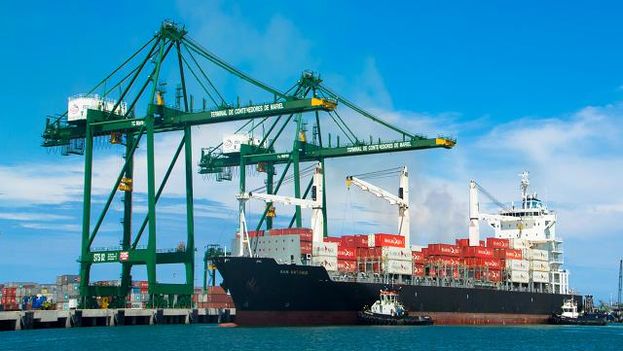
Container Terminal Development Special Zone of Mariel.

14ymedio bigger14ymedio, Jorge Hernandez Fonseca, 4 August 2015 – Cuba has lived under the rule of the Castro brothers for a long “socialist” period, the result of which has been an impoverished society. The solution now promoted by the authorities is “to befriend the imperialist enemy,” because, “without the restoration of capitalism it is impossible to construct socialism.” However, it is not the socialism that Raul Castro and his generals are going to implement on the island, but rather a hybrid of the worst of both worlds.

Capitalism requires individual freedom as a condition to better develop the entrepreneurial potential of society, to foster the development of the productive sources. Individual freedom implies, however, a certain dose of social insecurity – an undesirable feeling for many people – but that strengthens the entrepreneurial capacity of the other part of the same society. continue reading

Capitalist production organization is structured naturally so that the few entrepreneurs – owners of the businesses – give employment to a greater number of employees. Socialists denounce the “capitalist exploitation” by these entrepreneur-owners of the “unredeemed” masses.

Socialism, for its part, prioritizes “the social” at the cost of sacrificing individual freedom. It argues that “the social security is obtained at the sacrifice of individual freedom,” as a kind of payment to obtain the longed-for “social justice for the great dispossessed masses.

The productive socialist organization is very similar to the capitalist. In order to eradicate capitalism, it nationalizes the productive enterprises and in parallel limits individual freedom through a dictatorship in order to “give social justice in exchange for freedom.” As there are no owners, the earnings go to the all-powerful state which supposedly distributes them “equally” to offer the promised social justice. This scheme doesn’t work and decreases the earnings until the final collapse of the economy, an incentive for the return to the “old” capitalism.

The Castro regime has decided to implement a State capitalism that allows only foreign “capitalist exploitation,” but leaves the dictatorship intact

In the current circumstances, the Castro regime has decided to implement a State capitalism that allows only foreign “capitalist exploitation,” but leaves the dictatorship intact to curtail the individual freedoms of Cubans. In this case, we have the worst of both worlds: on the one hand, the lack of freedom implied by a socialist dictatorship, on the other hand, that lack of social justice implied by capitalism only for foreigners. This, for Cubans, means the continuation of the struggle against the dictatorship.

The Castro regime will disappear with the disappearance of the Castro brothers, with or without the presence of the United States on the national stage. It will be then when the Cuban people, inside and outside the island, will assert their rights, violated in this half-century of oppression and treachery.

___________________________________________________________________

Editorial Note: This text was previously published (in Spanish) here. It is reproduced with the permission of the author.

Isla De La Juventud Experiments With “Free” Sale Of Farm Supplies And Equipment / 14ymedio, Orlando Palma

Among the goods that fall into and illegal market include parts for agricultural machinery
Among the goods that fall into the illegal market are parts for agricultural machinery

14ymedio bigger14ymedio, Orlando Palma, Havana, 5 August 2015 – For an entire year the Ministry of the Agriculture has conducted an experiment on the Isla de la Juventud (Island of Youth) with the “free” sale of inputs, specialized services, and agricultural equipment. During this time, the authorities of the sector have measured and evaluated the pros and cons of a commercial policy based on supply and demand.

The principal beneficiaries of the program have been the more than 700 farmers in the territory who received land under the government’s usufruct leasing policy. Access to tools such as machetes and sharpening files has allowed them to keep down the bad weeds and the invasive marabou in the arable lands of the special municipality. However, a deficient and unstable distribution of certain products encourages the illegal sale of these products, to which the authorities have responded with new regulatory mechanisms.

There is an increase in the levels of production and encouraging results in products such as pork, beef, eggs, milk and grains continue reading

Ramon Mirabel, director of the Agricultural Logistics Company, told the official press that one year after implementation, “More than 54 millions pesos have come into state coffers as of the end of July,” and that the products in greatest demand are “animal feed and accessories like machetes, files, boots, packs, medicines and pesticides.”

Along with the profits obtained through sales and services rendered, there is an increase in the levels of production as well as encouraging results in products such as pork, beef, eggs, milk and grains, the latter of which is enough to satisfy the territorial demand.

The farmers in the area complain that the experiment doesn’t include the sale of irrigation systems, that there is a lack of veterinary medications, and that there is no reliable variety in feeds specific to the animal, and as a consequence chickens are given feed intended for pigs.

The experiment will have a second stage when the conclusions emerge, and its application for the rest of the country will be analyzed, gradually

Among the goods that “have fallen” into the illegal market networks are packs, PVC boots, files, and parts and pieces for farming equipment. Pig feed merits special mention, because its distribution was planned without considering that the Isla de la Juventud has many alternative pig breeders who, having no market where they can acquire food for their pigs, are making irresistible offers to those who were authorized to buy what they want under the experiment. One of the solutions applied was the elimination of the “alternative” pigsties.

The experiment will have a second stage when the conclusions emerge, and its application for the rest of the country will be analyzed, gradually. At the moment there is a study underway to determine the specific volumes of demand for each product on the Isla de la Juventud, which will allow a more precise plan to be developed, both with regards to the inputs required as well as the specialized technical services needed. The analysis will probably include a census of farm animals to determine the quantity and variety of feed needed in the territory.

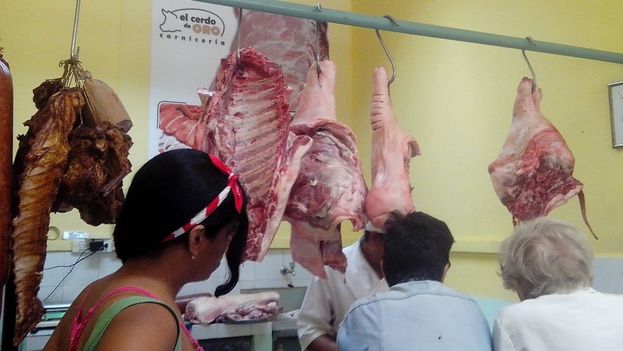
The Inflation is in the Pork Meat / 14ymedio, Jose Quintana de la Cruz

The carnage The golden pig in Havana. (14ymedio)
The butcher’s “The Golden Pig” in Havana. (14ymedio)

14ymedio bigger14ymedio, Jose A. Quintana de la Cruz, Pinar del Rio, 2 August 2015 – In evaluating the fulfillment of the economic plan for the first half of 2015, the Council of Ministers asserts that inflation is between 3% and 5%. Why such imprecision?

The technicians justify this vagueness by the dual currency, which blocks precision. However, a government that has a monopoly on foreign trade and the wholesale market, as well as control of small business, shouldn’t have this problem.

On the other hand, the professionals who work in the statistical institutions of the country are highly qualified and have international advice to overcome the obstacles that derive from the circulation in the country of both the convertible peso and the Cuban peso.

There are two ways of looking at the figure published by the Government: from the perspective of the economist and politician, or from the reality experienced by the people. continue reading

They know, for example, that any analysis of inflation taking as a base of calculation a year after the implementation of the dual currency will have greater complexity. However, if they choose a time previous to the implementation of the dual currency, then the inflation would be very high.

It is not wrong for the government to analyze the inflation of the last five years, because in that way in can see if it has controlled the price increases since 1959. Perhaps the 3% or the 5% that was recently announced refers to the last three- or five-year period. The choice of the base year could make the inflation higher or lower, so the analysts can manipulate this information for political or technical reasons.

There are two ways of looking at the figure published by the Government: from the perspective of the economist and politician, or from the reality experienced by the people.

The statistical logic of the technicians and the optimistic advice of the politicians see a positive sign in the low rate of inflation And it would be, if the data were true. But the people don’t apply abstract thinking in their analysis of inflation. They don’t even fully understand the concept. Living with the distress for dozens of years.

How could Cubans understand that inflation is low when a pound of pork that three decades ago sold for three Cuban pesos, is now worth more than 40 pesos? They would only understand if their salaries or their incomes, like the price of meat, had increased by the same 13 times.

“The Left will become More Pluralistic in Cuba” / 14ymedio, Miriam Celaya

Historian and activist Armando Chaguaceda en Miami. (14ymedio)

14ymedio bigger14ymedio, Miriam Celaya, Miami, 3 August 2015 — Historian and activist Armando Chaguaceda defines himself as a defender of “democratic socialism that does not sacrifice freedoms for goods or services.” In Cuba, he associates with the independent left and currently resides in Mexico. Last week, he traveled to Miami for a meeting of the Association for the Study of the Cuban Economy (ASCE, its acronym in English).

“Chagua” as his friends call him, spoke to 14ymedio about reforms in Cuba, the process of the negotiations with the US and the future of the ideology he has defended throughout his life.

Miriam Celaya (MC). Where is the left headed in Cuba?

Armando Chaguaceda. The left is often defined by privileging equality over freedom. However, this is a very schematic definition. For me, it is necessary to hold political equality and rights against all powers, including the market.

In Cuba, the left will become more pluralistic. There are several lefts currently on the Island: one that is more communist and totalitarian; another one is anarchist and does not recognize the State, which is good in a sense because it demystifies and questions it. Mine is the social democracy or democratic socialism, which does not sacrifice freedoms for goods or services. It is a more humane and inclusive socialism. continue reading

In Cuba the Revolution’s social pact broke down; social spending diminished in important areas — like health or education — which ultimately were never rights, since they were not recoverable.

The Cuban opposition has focused heavily on the issue of human rights, which are deficient, but unimportant to the people. The left’s agenda, however, defends social rights. At least one sector of the left is headed down that path, as is the case, for instance, of the Observatorio Crítico which defends the social conquests and rights of workers; or Pedro Campos, who proposes participatory and democratic socialism.

Personally, I was helped a great deal by anarchism in criticizing the State and in understanding another kind of militancy, because I come from communism. During my anarchism years I lived and felt the rescue of solidarity and affection “from the bottom up.” My fondest memories are from those years I spent as a Professor at the University of Havana.

MC. Do you consider the changes Raul Castro has made in Cuba more a “betrayal” rather than an improvement of the “socialist model”?

Chaguaceda. It is not a betrayal. It is an update, a reform. A new model is being built which has continuities and changes in respect to the previous one. Political control over society and the lack of social pluralism continue. At the same time, society is being changed to be less dependent on the State and more diverse, but also poorer and more unequal. Meanwhile, the market allocates goods and services in the economy to those who can pay.

“The Cuban opposition has focused heavily on the issue of human rights, which are deficient but unimportant to the people.”

MC. Can someone be liberal, right-wing, bourgeois or annexationist and still have good relations with Chaguaceda?

Chaguaceda. Yes. I have relatives and friends across the political spectrum, but we share values and feelings as human beings. It is important to understand and to defend that concept in a country that has been polarized and politicized for decades.

MC. To reform or to overthrow?

Chaguaceda. Do I advocate violence? In principle, I don’t. Violence is always imposed from the authorities when people are denied other avenues and freedoms, and that violence often claims the lives of the poorest and most powerless. Other times, when violence prevails as a revolutionary movement, it ends up exalting the previously subversive and establishing new dominance.

But, additionally, for ethical reasons, I cannot ask of others to do something I never did. In my years of political life in Cuba, in the official organizations, in the emerging activism and in my writings as a public intellectual, always I ventured to use “the correct place, time and means*” [chuckles], peacefully and appealing to the laws and the rights to promote the causes I believed in.

MC. How do you evaluate the process of negotiations between Cuba and the United States?

Chaguaceda. As something inevitable and understandable, given the failure of the isolationist agenda and from the legitimate interests of the US government towards its entrepreneurs and citizens. That does not mean that international support for democratization and respect for human rights in Cuba must be subordinated to geopolitical interests. I think it must be, above all, a citizen cause of activists, organizations, movements and, in the case of Cuba, it should have the participation of Latin American governments.

MC. How much has the Mexican experience enriched and changed you?

Chaguaceda.The Mexican experience has impacted me in various ways. First, I met a country, a culture and a people of immeasurable wealth, where I was able to develop an eight year career and academic training. But it has also helped me to understand rampant inequality and everyday violence. All legal structure and constitutional democracy is empty of meaning for the common people at the bottom.

In Mexico I have also gotten to know theoretical and practical movements in the fight for human rights which I did not catch in their proper level in my years in Cuba. And when I see cases of gross violations of human rights from the testimony of the victims, I realize that no violation is preferable to another, but – in the extreme — different conditions and guarantees to exercise your rights.

“When violence succeeds as a revolutionary movement, it ends up exalting the previously subversive and establishing new dominance.”

Physical murder may exist in some places, and, in others, civic murders. But from the experience of the repressed, any violation of rights, whatever the legitimating principle invoked to carry it out (the fight against terrorism or against “the mercenaries of the Empire**,” for example), is to be condemned.

MC. In your speech you did a report on the state of political science in Cuba. Could you summarize what you pose in it?

Chaguaceda. First, compared with other social sciences, development of political science lags significantly, both organizationally and in the theoretical-methodological, as well as in the dissemination in the results of research. Stalinist dogmas and abuses of guidelines persist, lacking empirical support. As a result, it becomes more like political philosophy than political sociology, and that brands the styles of all of us whose formative years were spent in Cuba.

However, previously excluded topics are surfacing in academic places and in alternative forums, the use of investigative techniques and the gathering and processing of data is becoming more rigorous, and legible work, without cryptic codes is being acknowledged by Latin America academia. We have challenges, such as reading and quoting “those inside” and “those outside”; overcoming the self-centered suspicion that lives in some of the former and the pedantic realism of those who, from abroad, believe there is no worthy work to be recognized and valued in those internal conditions.

Translator’s notes:
*A phrase used by the regime with regards to where when and how the Communist Party and the regime may be criticized.
**Also a phrase of the regime claiming that internal opposition members are being paid by the United States — “the empire” — to overthrow the Cuban government.

Translated by Norma Whiting

Police Warn Gorki Aguila He Will Not Leave Cuba If He Continues His Activism / 14ymedio

The musician Gorki Águila, leader of Porno para Ricardo. (EFE)

14ymedio, Havana, 5 August 2015 – After several hours of being detained by the police, the musician Gorki Águila was released at around four in the afternoon on Wednesday. During his arrest he was taken to the Fifth Station in the Havana municipality of Playa where an official warned him that he would not leave Cuba again if he continued attending the Sunday marches of the Ladies in White, according to what Gorki told 14ymedio in a telephone conversation.

The rocker and leader of the band Porno para Ricardo detailed that they warned him that his arrest would be brief, but if he continued to pursue his activism, “Those who invite you to visit other countries will have to come looking for you in boat.”

Hours earlier, his daughter Gabriele had denounced that, “Yesterday at noon they brought a police citation, which he received but he refused to sign it because he didn’t know the reason behind it.” The police agents were looking for the rocker for a couple of hours today at noon; a call to the phone number 18806 — through which one can ask for information about any citizen detained — which did not reveal his whereabouts nor the reason for his arrest.

The last time the musician Gorki Águila slept in a cell was at the end of May, when he was arrested outside Havana’s Museum of Fine Arts for carrying a sign with the image of the graffiti artist El Sexto, with the word “freedom.” This Wednesday history was about to repeat itself.