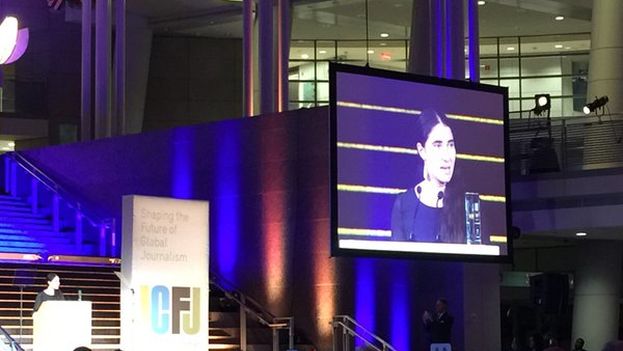
From Information to Action / 14ymedio, Yoani Sanchez

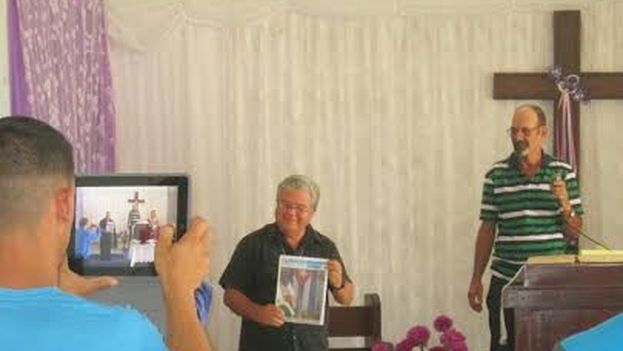
Yoani Sanchez accepts the Knight International Journalism Award 2015. (karinkarlekar)

Yoani Sanchez accepts the Knight International Journalism Award 2015. (karinkarlekar)

14ymedio biggerGeneration Y, Yoani Sanchez, 12 November 2015 — My grandmother only knew how to write the first letter of her name. She would sign documents with an almost childish looking capitalized “A.” In spite of being illiterate, Ana always advised me to study and learn as much as possible. Nevertheless, that laundress who never went to school taught me the best lesson of my life: that tenacity and hard work are needed to accomplish one’s dreams. She instilled in me the urgency of “action.” Action with a capital “A,” like the only letter of her name that she could write.

However, action can become a problem if it is not appropriately accompanied by information. An uninformed citizen is easy prey for the powerful, a guaranteed victim for manipulation and control. In fact, an individual without information cannot be considered a whole citizen, because her rights will constantly be violated and she will not know how to demand and reclaim them. continue reading

The most expansive authoritarian regimes in history have been characterized by a strict control of the media and a high disregard for freedom of information. For these systems, a journalist is an uncomfortable individual who must be tamed, silenced, or eliminated. These are societies where a journalist is recognized only when she repeats the official government rhetoric, applauds the authorities, and sings praises to the system.

I have lived forty years under a government that considers that information is treason. At first, when I learned to read and began to pay attention to the national media, with its optimistic headlines and data on the country’s economic over-achievement, I blindly believed what those newspapers were saying. That country that only existed in the ink of the Cuban Communist Party’s national newspaper was similar to the one my teachers taught me about in school, similar to the one from the Marxist manuals and the speeches of the Maximum Leader. But it did not resemble the reality.

From the frustration between my desires to know and the wall of silence that the official Cuban press imposes on so many issues, the person I am now was born.

My first reaction in the face of so much manipulation and censorship – like that of so many of my fellow citizens – was simply to stop reading that press which served those in power, that propaganda disguised as journalism. Like millions of Cubans, I sought information that was hidden, censored news articles, and I learned to hear the radio transmissions coming from outside even with the interference that the government would impose on them.

I felt like I would drown if I wasn’t informed. But, then another moment came. A moment when I switched to “action.” It wasn’t enough to know everything that was being hidden from me and to decipher the truth behind so many false statistics and such editorial grandiloquence. I wanted to be part of those who narrated the Cuban reality. Thus, I began my blog Generation Y in April of 2007, and with it I took the path of no return as a reporter and a journalist. A path filled with danger, gratification, and great responsibility.

During the past eight years, I have lived all of the extremes of the journalistic profession: the honors and the pains; the frustration of not being allowed to enter an official press conferences and the marvel of finding an ordinary Cuban who gives me the most valuable of testimonies. I have had moments where I have exalted this profession and moments in which I wished I had never written that first word. There is no journalist who does not carry the burden of her own demons.

Now, I lead a media outlet, 14ymedio, the first independent news platform inside of Cuba. I am no longer the teenager who turned her eyes away from the official press, looked for other alternative news sources, and later began her own blog as if she were someone opening a window into the entrails of a country. I now have new responsibilities. I lead a group of journalists, who every day must cross the lines of illegality to perform their jobs.

I am responsible for each and every one of the journalists who are a part of the newsroom of our news platform. The worst moments are when one of them takes longer than expected to return from covering a story and we have to call their family to say that they have been arrested or are being interrogated. Those are the days that I wish that I had not written that first word…or that I had not written that first word the moment I did, but much earlier.

I feel that if we had moved towards action, and if we had exercised our right to inform much earlier, Cuba would now be a country where a journalist would not be synonymous with a tamed professional or a furtive criminal. But at least we have begun to do it. We have moved from information into action, to help change a nation through news, reporting, and journalism. It is Action with a capital “A,” like the one my grandmother wrote on those papers though she never really understood what they were saying.

Note: Speech delivered by Yoani Sanchez on 10 November in New York, at the ceremony for the 2015 Knight International Journalism Awards. The director of 14ymedio was given the award last May by the International Center for Journalists for her “uncommon resolve in the fight against censorship.”

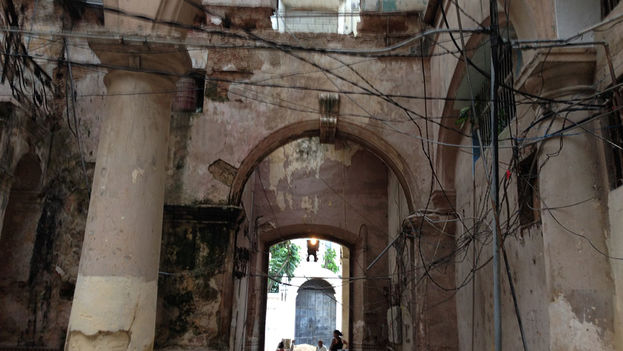
“We Want Decent Housing,” Say Residents Of Old Havana / 14ymedio, Armando Martinez

Residents in an Old Havana tenement demand "decent housing." (14ymedio)
Residents in an Old Havana tenement demand “decent housing.” (14ymedio)

14ymedio bigger14ymedio, Armando Martinez, Havana, 9 November 2015 — In Old Havana, the residents of a tenement on Compostela Street, between Luz and Acosta, across from the Belen Convent, no longer want to risk their lives under the roof of their dwelling. The façade is no longer a place where sports passions are written, now the residents have turned it into their Wailing Wall with an irrevocable demand: “We want decent housing.”

The reason they have taken their beds into the street is the deterioration of the building, which threatens to fall down on their heads. As of last Friday, the residents of the place made the decision to sleep in the entryway, which seems more secure, with their more precious treasures: a TV, a refrigerator, three mattresses and a table. continue reading

Since we’ve come out of there they are starting to listen to us,” says a woman of around 50, referring to the local authorities. With an unconvincing optimism, the woman says, “This Monday they will give us an answer, they’ve promised.” However, she adds with determination, “We do not want to go to a shelter and spend 15 or 20 years there waiting for the day they give us a decent house.”

The residents of the Compostela Street no longer want to continue to risk their lives under the roof of the dwelling. (14ymedio)

In November of last year the official press published the alarming number of families in need of homes: 33,889 (132,699 people). Many of them have lived for two decades in shelters for victims of uninhabitable housing. According to the census, 60% of the 3.9 million housing units on the island are in poor condition.

Yogurt, Scarce and Bad / 14ymedio, Orlando Palma

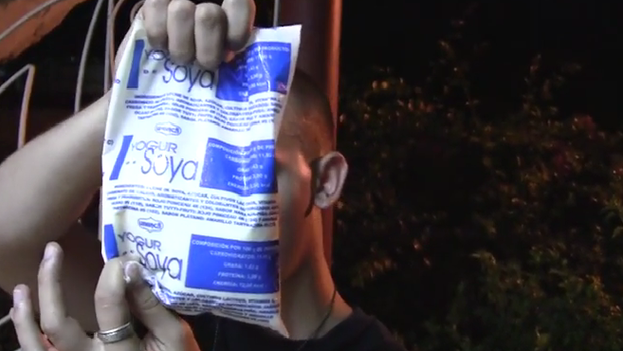
Consumers report the loss of product quality with soy yogurt due to failures in refrigeration and sanitary control. (Youtube)

14ymedio bigger14ymedio, Orlando Palma, 11 November 2015 – The shortage of soy yogurt in the regulated market has worsened in recent weeks, and this product intended for children between 7 and 13* years of age is also characterized by its low quality.

The shortage of soy yogurt has worsened in recent weeks in the regulated market where the product intended for children aged seven to thirteen years it is also characterized by its low quality.

Designated mostly for the “basic family food ration” and school meals, soy yogurt began to appear on the island in 2003, but manufacturers have never been able to fulfill their commitments for 275,500 tons annually. continue reading

In the last session of the National Assembly in July, industry officials blamed the instability of Party managers, technological obsolescence and the deterioration of refrigeration systems for the distribution problems.

On that occasion, the Minister of the Food Industry, Maria del Carmen Concepcion, reaffirmed the importance of soy yogurt and agreed on the urgent need to “find immediate solutions.” However, over the months the problem has worsened rather than improved.

The points of sale, distributed in each municipality, should be supplied three times a week, so that each child receives twelve bags in a month. Consumers complain that the quota is never met, but it is possible to find the same yogurt in the unregulated markets*.

“It shows up once or occasionally twice a week, but it is not safe,” an employee of a dairy in Central Havana explained this Tuesday, while a mother complained that “sometimes it doesn’t arrive for a whole week.”

Consumers also reported a loss of product quality due to failures in refrigeration and sanitary control.

In some areas the product has been replaced by a powdered mixture to prepare it, but with little acceptance among customers. “People do not want it because you need milk to mix it with. Made with just water the children don’t like it,” says an employee of a market in Havana’s Vibora neighborhood.

Modesto Perez, director of the dairy complex in the capital, explained the technical problems facing the industry on national television this week. “Maintaining stability and three operating boilers is complex. Whenever there is a situation with a boiler, production stops because steam is essential to the production.”

In the middle of this year the official press announced that nine million convertible pesos (CUC) would be earmarked to “gradually resolve the issue of technological obsolescence in the production and distribution of soy yogurt.” The results are not yet visible to the consumer.

Across the country the situation is repeated; the 15 companies that produce this food are all affected by breakdowns that prevent or hinder production. The most affected regions, including the capital, are Bayamo, Guantanamo and Santiago de Cuba.

*Translator’s note: Children under 7 receive a cow’s milk ration in Cuba; older children do not. See also: Children without milk, and Soy yogurt meant for children ends up feeding pigs.

The Crossing Of The Desert / 14ymedio, Manuel Pereira

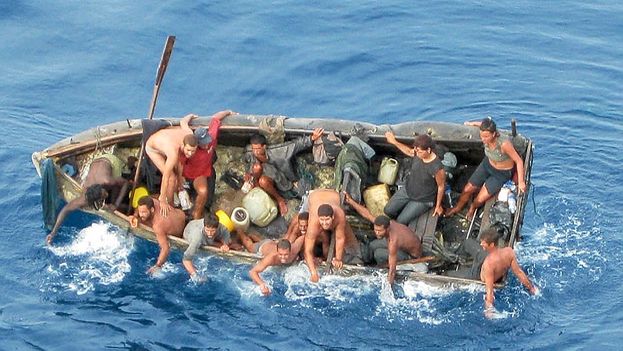
Cuban rafters
Cuban rafters

14ymedio bigger14ymedio, Manuel Pereira, Mexico City, 8 November 2015 — Since the second half of the twentieth century we Cubans have been the Jews of the Caribbean, and the Malecon is our Wailing Wall. Among other topics, the immigration issue figures in the meeting between Raul Castro and Pena Nieto in Merida, Yucatan. The two countries are united by historical ties: the poet José María Heredia lived and died here in Mexico, José Martí married here, passing through here were the politicians Mella, Fidel Castro, and Che Guevara. In 1951 Perez Prado launched “Ruidoso Rico Mambo” here, then came Benny More, Celia Cruz, “La Sonora Matancera,” the “Mulatas de Fuego” and, in the sixties, “The Tremendous Corte” triumphed on radio and television with Trespatines, Rudesindo and the Galician Rudesindo. All these humorous, musical and voluptuous cyclones are forever linked with Cuba.

But the Cuban exodus is a tragedy of biblical proportions. If the desert crossing of the Israelites lasted for 40 years, that of the Cuban people has lasted half a century, counting from the first mass exodus from the port of Camarioca (1965), followed by the port of Mariel stampede (1980), which was repeated during the “rafters crisis” (1994). continue reading

In 1995, when the US Coast Guard began to return Cuban rafters intercepted in the Straits of Florida, the island’s escaping slaves sought other routes toward the south. They started out from Camagüey, for Santa Cruz del Sur, toward the Cayman Islands and Honduras. Even between 2002 and 2004 many Cubans traveled as tourists to Russia, some asked for political asylum at the layover at the Barajas airport and for those arriving in Moscow it was harder. Some managed to get documents to travel to Mexico at astronomical prices, others ended up so far away they left with a free visa for Sao Tome and Principe in West Africa.

Mexico as a bridge to the United States became the most coveted goal. The sign of the most persistent “blood, sweat and tears” runs to Guatemala drawing a geography of pain that is clear proof of the failure of the Cuban utopia. As Voltaire said: “It has been tried in several countries not to allow a citizen to leave the nation in which he had the accident of being born; visibly the meaning of this law is: this country is so bad and so badly governed that we prohibit every individual from leaving, for fear that everyone would go.”

Those fugitives fleeing from the chronic shortages, repression, lack of individual human rights and a bleak future, soon crowd into Ecuador thanks to the close ideological relations between that country and the island. The Cuban government, as on other occasions, needs a valve to release the steam from the cauldron and, also, a future source of income from family remittances. And Quito has become the ideal place from which to reach Mexico in the long Cuban pilgrimage. From there, groups leave for Colombia, then Panama, Costa Rice, Nicaragua, Honduras, Guatemala and Mexico. The flow of Cubans who come from Ecuador to Tapachula, a migration station in Chiapas, varies between 40 and 50 a day. They are looking for safe conduct to cross Mexico as a bridge to the Promised Land.

The Cuban diaspora is the most extensive in world history since the Jews in the time of the Babylonian captivity. This dispersion of wandering Cubans has grown and accelerated since the “thaw” between Cuba and the United States, growing still more with the rumor of the imminent repeal of the Cuban Adjustment Act. It goes without saying that these tropical pilgrims face hurricanes, sharks, sunstroke, impenetrable jungles, tumultuous rivers, human trafficking, extortionist police and guerrillas and thieves…

This Cuban exodus evokes the riskiest travel fictions: The Odyssey by Homer; the myth of Jason and the Argonauts; Virgil’s Aeneid; Jonah and the Whale; The Lusiadas by Luis Vas de Camoes; Sinbad the Sailor; Defoe’s Robinson Crusoe; Gulliver’s Travels by Jonathan Swift; The Narrative of Arthur Gordon Pym by Edgar Allan Poe; Moby-Dick by Melville; The Sphinx of the Ice by Jules Verne; Stevenson’s Treasure Island; Joseph Conrad’s Heart of Darkness and other works that do not fit here.

The Cuban reality exceeds any of these stories no matter how fanciful and exaggerated their authors have been. In the film Memories of Underdevelopment, by Tomas Gutierrez Alea, the protagonist paraphrases Che Guevara when he says: “This great humanity has said enough and has started to get moving… and will not stop until it gets to Miami…”

Zaqueo Baez: ‘We Must Fight From Here, Within” / 14ymedio, Reinaldo Escobar

Zacchaeus Baez during a meeting of Cuban Civil Society Open Forum, weeks before his arrest. (14ymedio)
Zaqueo Báez during a meeting of Cuban Civil Society Open Forum, weeks before his arrest. (14ymedio)

14ymedio bigger14ymedio, Reinaldo Escobar, Havana, 10 November 2015 — This Monday afternoon the three activists who were arrested when they approached Pope Francis in the Plaza of the Revolution in Havana, last September 20, were released.Zaqueo Báez Guerrero and Ismael Bonet, members of the Patriot Union of Cuba (UNPACU), and the Lady in White Maria Josefa Acon Sardina, face trial for the alleged crimes of public disorder, disrespect and resistance.

In conversation with 14ymedio, Zaqueo Báez said that after nearly 50 days in prison he felt “weak and tired, but ready to continue fighting for democracy in Cuba.” When asked about how he will await his trial, he stressed that they were warned by the police that they could only “go from home to work and work to home.” continue reading

“What I most want to do, is to continue in opposition against the dictatorship,” said the activist. “So I will comply with these instructions, from my home to the street to engage opposition and so, if I am lucky and they don’t arrest me again I will return to my house,” he says.

Just two hours after being released from prison, Baez said their date to appear in court has not yet been announced. The regime opponent hopes that “they can not ask for the maximum sentence” because “none of the three of us have criminal records.”

To those who question his conduct before a head of state, the activist replies firmly that does not feel unhappy: “I think we could do a little more, like going out with a sign to ask freedom for political prisoners, for example.” However, he notes that “at an event of this nature we prefer to be moderate and peaceful activists for human rights so they don’t confuse us with aggressive people who want to harm the Pope.”

“We are not terrorists nor do we want to appear to be so,” Baez said a few hours after he was released and still feeling anxious from the days of imprisonment in the police station known as 100 y Aldabo in Havana. “I would have loved to get a microphone and demanded that the Castro brothers ask forgiveness from their people,” but he recognizes “that would be to think like a Hollywood movie.”

When asked about his future plans, he said he is preparing himself
“better and I want to make it clear that I have no intention of leaving Cuba as a political refugee.” A statement immediately qualified with, “Perhaps I will leave to take a course or something like that, but I believe we have to continue fighting here, within.”

Despite the rigors of prison, he believes that “we must exhaust all peaceful tools for change in Cuba.”

Three Activists Arrested During Visit of Pope Francis Are Released / 14ymedio

Activists arrested during Pope Francis’s Mass in the Plaza of the Revolution (frame of a video)

14ymedio bigger14ymedio, Havana, 9 November 2015 – This Monday afternoon the three activists arrested during Pope Francis’s visit were released. Zaqueo Baez Guerrero and Ismael Bonet, members of the Patriot Union of Cuba (UNPACU), and the Lady in White Maria Josefa Acon Sardina, were released pending trial as corroborated by 14ymedio in a telephone call from one of those released.

For nearly 50 days, the three dissidents had been held at the police station known as 100 y Aldabó in Havana, for approaching the bBishop of Rome on his arrival at the Plaza of the Revolution in the capital, on 20 September.

Within hours of the arrest, Baez managed to communicate with the leader of his organization, Jose Daniel Ferrer, who told the press: “Zaqueo told me that he managed to make it to where the Pope was and to tell him the truth and to shout ‘Freedom!’.”

During the first days of imprisonment, two of the regime opponents went on a hunger strike, but later they ceased to fast. UNPACU maintained a strong campaign for their release under the slogan “The three who reached the Pope,” which included marches in the east and other cities in the country.

The activists were charged with the offenses of assault, disrespect, public disorder and resisting arrest, according to what was detailed by family members who were able to visit them during their confinement.

Which Korea? / 14ymedio, Reinaldo Escobar

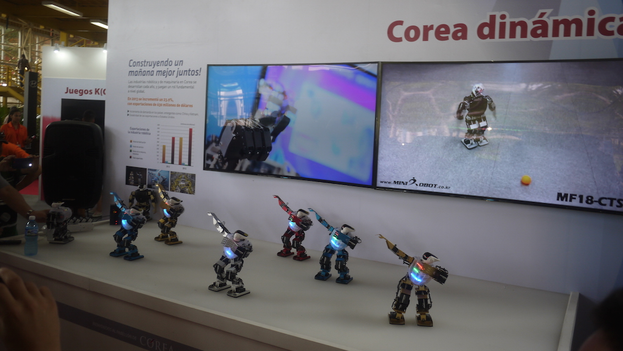
The dancing robots at the South Korean pavilion at the Havana International Fair
The dancing robots at the South Korean pavilion at the Havana International Fair (4ymedio)

14ymedio bigger14ymedio, Reinaldo Escobar, Havana, 7 November 2015 – So which Korea is it that has a pavilion here? A woman asked this of a uniformed guide at the International Fair of Havana. The man, friendly and solicitous, turns to the huge welcome sign at the entrance, looks at it as if he’s seeing it for the first time and answers, “Which Korea will it be madam? What you said I believe is written with a “K.”

The woman enters, followed by many others visiting the site, to look at the brand new Hyundi cars, or to admire the agricultural machinery, the Samsung technological products, the drinks, and to simply enjoy the display of small robots that dance and jump to the beat of the music. continue reading

The 9,500 square-foot pavilion is managed by the South Korea Agency for Trade Promotion and Investment (KOTRA). The Asian country has brought this time a delegation of 17 exporting companies of large firms such as Samsung Electronics and Hyundai Motors, as well as others such as Global Green and Seasco.

Many who throng in front of the exhibition of products and technology that fill the stand are very excited about the appearance in their lives of all this Korean manufacturing. “My aunt has a Samsung flat screen,” you can hear a boy who has come with his parents and cousins boasting to another. Others detail the latest Galaxy line of phones have come on the market and a woman dreams of a microwave oven from the distant peninsula.

On leaving the place, no one doubts that this display does not come from the Democratic Republic of Korea. They know because they have not seen a single picture of the Kim family, or a photo of any sculpture where someone raises a threatening fist or points towards an imaginary dazzling future. But also because business representatives moving through the halls do it with ease and freedom and do not ask anyone if they work for a State enterprise.

In this 33rd edition 33 of the International Fair, the most uptight are the Cubans, especially the officials because the gorgeous models pose happily for the cameras. The opening days were invitation-only and it was just on Friday that the doors were opened to the public. It is hard to believe that with the capital’s transportation problems so many people decided to go to the ExpoCuba fairgrounds.

Nearly a thousand companies from 20 countries exhibited their products here. Canada, Germany, Spain and Mexico are the pavilions attracting the most people but Korea’s has something special that nobody wants to miss. After asking several people why so many people visit this site, a young man gave me a surprising answer: “I came to see them, because Cubans are going to have to learn to be Koreans.”

Padre Conrado: “The Church has the responsibility of accompanying the people in new pathways” / 14ymedio, Luz Escobar

José Conrado Rodríguez receiving the Patmos Institute Award

14ymedio bigger14ymedio, Luz Escobar, Havana, 8 November 2015 –To a long list of awards and accolades received by the priest José Conrado Rodríguez Alegre, the Patmos Institute Prize has been added, awarded last week by the Baptist church. The pastor said that in his life he has made “a personal journey of great friendship with my Protestant brothers.” About this ecumenical attitude and the current situation of the Catholic Church in Cuba he offered this interview by telephone from the city of Trinidad.

Escobar. Some weeks after the visit of Pope Francis to Cuba, what do you think has been the most important legacy of his visit to the island?

Conrado. It was an extraordinary experience for all of us, Catholics and Cubans in general. Francis made a call for a more committed life, more faithful to justice and truth, but also invited us to live more committed to mercy. He has called us to see the faces of those who are suffering, who are waiting for a helping hand, one breath. He has demonstrated that attitude of closeness to the most needy, the poorest, the elderly, children. continue reading

Escobar. The Cuban church is bound to face some changes with the end of Jaime Ortega y Alamino’s tenure as Archbishop of Havana. How do you envision this new stage to come?

sacerdote-Jose-Conrado-Rodriguez-Alegre_CYMIMA20151108_0001_11Conrado. The current times demand from us a more intense presence at the side of the people, a greater commitment with the people and at the side of the people. I would say these are moments of a new sensitivity to respond to the call of our people, who have lived through very difficult times. Our people have had to face great difficulties over the years and the Church has the responsibility of accompanying the people along these new pathways. This requires a new inspiration, a renewed ability to seek paths of hope that will lead us to the responsibility of each person to achieve a better Cuba.

Escobar. You worked for a long time in the poor neighborhoods and towns of Santiago de Cuba, but now you are located in Trinidad, a more prosperous city thanks to tourism. What differences do you see between one community and the other?

Conrado. In Trinidad there is also great poverty, especially in the countryside. It is a region of contrasts. Some people are surviving with a little more resources, but there is also great need. As a consequence, people see things in a material way, and they turn a little more to resolving material problems and so often forget life’s spiritual dimension and a commitment to others.

Escobar. You just received the prize from the Patmos Institute which is a Baptist organization. Is it possible to reconcile religious differences for the good of Cuba?

Conrado. Yes, there is no doubt. When one adopts an attitude of true love. Love does not exclude, love includes. Love crosses borders and breaks down the walls that separate humans.

Escobar. How do you value this award?

Conrado. I am very pleased that people of another Christian denomination positively assess my behavior, but above all that they have done so thinking of Cuba.

Escobar. What do you think are the greatest challenges facing the Catholic Church in Cuba today?

Conrado. The challenge of fighting for justice, of solidarity with those who have violated your rights, or living overwhelmed and drowned by the weight of a very difficult life. Seeking ways in which people make their decisions but without forgetting others, without forgetting this dimension of openness to love that must always be present in the Christian.

Escobar. What kind of work are you doing from your parish?

Conrado. We help children by giving lunch at noon to those who live far from school. Many rural classrooms have had to close for economic reasons and then the children must attend school in the larger towns, but they live far away and returning home to eat could mean that they can not return for the afternoon session. It is a real problem.

We also visit the sick, we take care of them. Support for prisoners and families of prisoners is part of our work. We are there, in those situations where human beings are helpless, suffering injustice, without being heard. Pastoral work is accompanying, listening, paying attention, being there for people.

Nicolas Maduro’s Two Plans / 14ymedio, Carlos Alberto Montaner

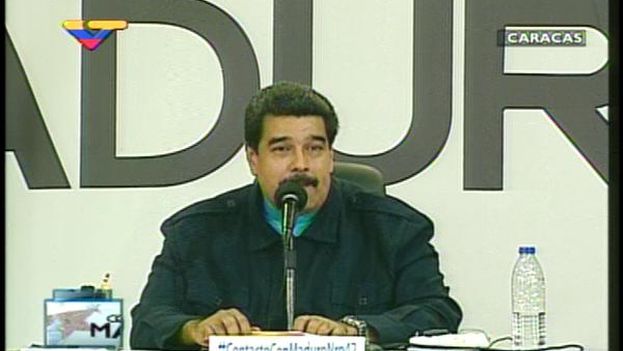
The Venezuelan president on his television program 'In Touch with Maduro'
The Venezuelan president on his television program ‘In Touch with Maduro’

14ymedio bigger14ymedio, Carlos Alberto Montaner, Miami, 7 November 2015 — Nicolas Maduro knows he will lose the election on December 6. The disaster is too intense. So say all the polls. Ninety percent of Venezuelans want a change. Eighty percent blame Maduro. Seventy percent are determined to vote against this thoroughly incompetent government.

Venezuelans are tired of lining up to buy milk, toilet paper, whatever. The inflation horrifies them. Everything is more expensive every day that passes. The salary of a month is consumed in a week. The corruption disgusts them. They know and intuit that the Chavista leadership is an association of crooks with no lack of narco-traffickers, all colluding to plunder the country. Lacking flour, violence is the daily arepa (bread). Caracas is one of the most dangerous cities in the world. And one of the filthiest. (This is also what Cubanization is: Wreckage and sewage running in the streets on the worn out pavement full of potholes.)

But Maduro blindly obeys an axiom of the Castros: “The Revolution will never surrender.” The Revolutiuon is actually a verbal construction that, in reality, means The Power. The Power is what is never handed over. The Revolution is a plastic thing that transforms itself so as not to lose power. The verbal construction has other rhetorical components: “the people, social justice, anti-imperialism, the oppressed poor, the greedy rich, multinational exploiters, the Yankee enemy.” There are hundreds of expressions that arm the story. continue reading

Until 1998, according to the Castros, power came from the barrel of a gun and the Revolution was declared. This was the dogma. This is what they had done. At the end of that year, Hugo Chavez won some elections and came to power by other means, but with the same ends. Fidel, reluctantly, accepted the change in method, but clarified that power is never relinquished.

He accepted that Chavism dismantled in slow-motion the scaffolding of the liberal democracy and liquidated the trifles of the three powers and the freedom of press and association, but made it very clear that the Revolution, that is, Power, was never negotiable. Alternation was a ridiculous republican practice of the soft bourgeoisie. That option did not fit into a genuine testicular and revolutionary model.

What will Maduro do in the face of the electoral defeat predicted by the polls and his decision never to relinquish power, imposed by Cuba but enthusiastically taken up by him and the Chavista leadership?

Maduro has a Plan A and a Plan B.

Plan A is to try to win the elections or to accept losing by a minimum amount. How will he perpetrate it? Jailing or prohibiting the participation of opposition leaders who could drag their supporters to the polls. This is the case, among others, for Leopoldo Lopez and Maria Corina Machado. Manipulating the voting machines. Generating false ballots. Drawing the districts to favor his voters. Abusing the media 100 to 1. Putting obstacles in front of the opposition vote in a thousand ways .

The intention of the government is to discourage the democrats so they do not vote. They calculate that with the total of all these tricks they can win, or lose by a small margin. And if they lose, they buy at any price a handful of dishonest deputies and continue with the power fiercely clenched between their legs.

And if Plan A fails? Plan B would be launched if the avalanche of votes is such that there is no way to hide a stunning defeat. That’s what happened to Jaruzelski in Poland in the summer of 1989. He used all the advantages of power to crush Solidarity in partial elections limited to the Senate, but Walesa and his democratic tribe obtained 95% of the vote and nearly all the seats. The communist regime collapsed before the evidence of widespread rejection.

Maduro has had the courtesy to announce his Plan B. If he loses he will use the prerogatives of the enabling law to demolish the few institutions of the Republic left standing. In that case, he will govern “revolutionarily” with “the people and the army” through a civilian-military junta. They call this infamy “deepening the Revolution.” Hand over power? Don’t even dream of it. He would create a satrapy pure and simple, collectivist and brutal, without bourgeois disguises.

What should Venezuelans do? What the Poles did. Come out to vote in massive numbers. Bury this filth under a mountain of votes, and fight ballot by ballot and polling place by polling place, without fear and without faltering.

Plan A is worse than Plan B. Plan A continues a dying farce that will inevitably lead to a slow and painful death. Plan B has the advantage of shamelessly undressing the totalitarian character of this dictatorship and puts an end to the doctored narrative of the revolution of the oppressed. End of story.

Many Venezuelans, Chavez supporters or not, military or civilian, will perhaps not remain impassive while Maduro and his masters in Havana distort the popular will and impose a permanent yoke. It will all play itself out on December 6. Perhaps life itself.

Musician Gorki Aguila Arrested Along With Two Foreign Journalists / 14ymedio

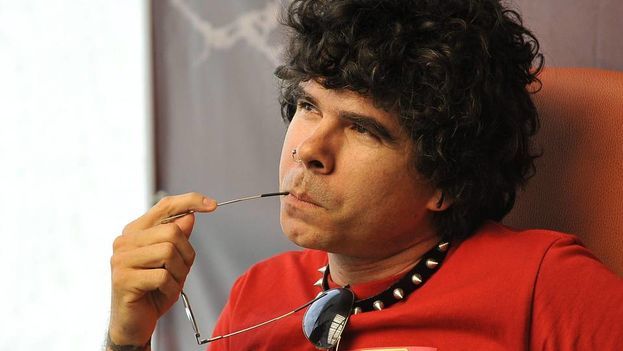
Musician Gorki Aguila (Photo EFE)

14ymedio bigger14ymedio, Havana, 7 November 2015 — The musician Gorki Águila was arrested this afternoon in Havana, as he was traveling in a car with two journalists from the television channel France24. The composer and singer managed to call this newspaper from the Fifth Police Station in the Playa municipality, where he was taken with the two reporters.

Águila, leader of the punk rock band Porno para Ricardo, does not know why he has been arrested and when talking with 14ymedio the police still had not informed him whether he would remain in a cell in the station, or be fined or prosecuted. Last August the musician was detained for several hours in the same station, where he was warned that if continue his activism “those who invite you to visit another country will have to come to looking for you in a boat.”

In May, a similar incident occurred when Águila was forcibly detained outside the Museum of Fine Arts in Havana for carrying a poster with the image of the graffiti artist El Sexto along with the word “Freedom.

El Sexto With Somos+ / 14ymedio, Reinaldo Escobar

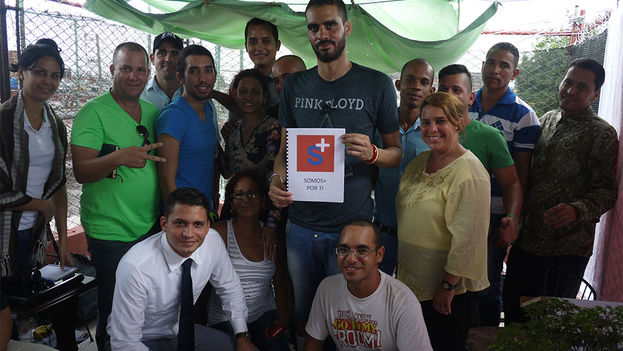
Danilo Maldonado, El Sexto, with members of Somos+ (We are more). (14ymedio)
Danilo Maldonado, El Sexto (the tall one in the center), with members of Somos+ (We are more). (14ymedio)

14ymedio, Reinaldo Escobar, Havana, 6 November 2015 — On Thursday a roof in Havana’s Cerro district was a suitable space for a group of young people to have a meeting with the graffiti artist Danilo Maldonado, El Sexto (The Sixth). Perhaps because neither the artist nor the members of the Somos+ Movement (We Are More) are given to extreme formalities, it is inappropriate to call what took place a tribute. But in fact, it was. continue reading

Danilo was given an anthology of messages of support from many parts of the world, sent during the almost ten months he spent in prison for attempting to stage a performance that angered the Cuban authorities and in particular the political police. The displays of affection came into his hands, the shouts of joy for his release, and the words of encouragement that filled the social networks during his imprisonment.

The coordinators of the young political movement, which is currently holding its third and expanded National Council, invited the artist to relate his experiences in prison. Numerous questions about his artistic action and about his days of confinement allowed El Sexto to demonstrate that he is something more than a “smearer of walls,” as his detractors from the official side call him, but rather someone with artistic sensibility and political will.

Asked about his hunger strike undertaken to secure his release, Maldonado drew with words the most recent of his artistic strokes, which today I want to share with you:

“As people we all occupy a physical space and I believe the most important thing is to make a scratch on this time line in the space we have occupied. I have always had the conviction that I was doing something right. I cold die, but I consoled myself knowing that if this happened I would be remembered, My jailers told they were going to let me die and I responded to them that my death would be different from theirs, because my family and friends would remember me.”

For Cuban Scientists Paradise Is Abroad / 14ymedio, Lilianne Ruiz

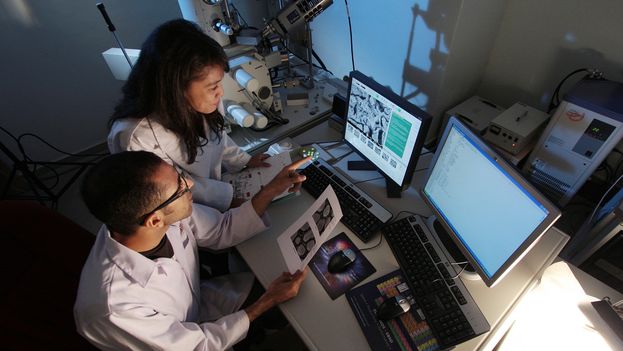
The subsidies that accompany scholarships abroad is also a motivation to apply for them. (CC)

14ymedio bigger14ymedio, Lilianne Ruiz, Havana, 6 November 2015 – He arrived in Berlin without a single euro in his pocket and with a pound of beans in his suitcase. Ariel Urquiola remembers his arrival in Germany to do post-doctoral work at Humboldt University’s Leibniz Institute. His departure from Cuba, like that of so many young specialists, was motivated by the desire to do serious science.

After graduating and earning a doctorate in cellular and molecular biology, Urquiola felt he had reached his peak inside the island. He was looking for a laboratory where he could examine zoological specimens but the lack of available technology didn’t allow him to study in his own country.

“Here I could work with at most one species, and in year have limited results,” he related during a visit to Cuba. “In contrast, in Germany, in just a month and a half I was able to process 503 samples,” that had arrived in Berlin from Cuba through institutional channels, he related with satisfaction. continue reading

His work consists of analyzing samples of the zoology of the Sierra de los Organos mogotes in Cuba’s Pinar del Rio province, research that he continued at the Leibniz Institute. The eyes of the young scientist shone when he explained that the results of his study might conclude that the population of the area by wild species “is much more ancient that is thought.” Like many other Cuban university graduates who have emigrated, he feels that abroad his work has potential.

In comparison to doctorates earned within the country, options abroad have a much more professional profile, according to the majority of those surveyed. A young Cuban biochemist who earned her PhD at the Catholic University of Chile points out “the quality and importance of scientific journals where research results are published.”

Cuban university students can choose from among more than 300 scholarships offered to PhDs by foreign governments. Many decide not to return to the island after having benefitted from one of them

Dr. Ileana Sorolla, director of the Center for International Migration Studies at the University of Havana, said in the journal Alma Mater: “Cuban employment centers need to readjust (…) to try to recover talent, so that returning to the country is an alternative. And not just because of an ethical, moral, political and ideological commitment, but also for business advantages.”

According to the official, looking at migration patterns of Cubans today, “some 23.9% are people with a university education,” and “around 86% of professionals who emigrate do it before they are 40.”

The subsidy that accompanies these scholarships abroad is also a motivation to apply for them. In the case of the German Academic Exchange Service, the researcher receives a monthly allowance of 1,000 euros to cover living costs, plus assistance for travel expenses, health insurance and a lump sum for study and research, among other secondary benefits.

Although the cost of living is much higher in these countries, conditions are incomparably better for these high-achieving university graduates, used to living in Cuba under the same roof as their parents and grandparents, unable to even afford dinner at a restaurant.

Just outside the Canadian embassy in Havana, several young people were waiting on Monday to start the consular procedures. A couple was reviewing all the documents they would present at an interview for the expeditious entry program to qualified professionals who want to settle in that northern country. Each year, 25,000 places are awarded worldwide.

Candidates must pass tests of English or French, deposit an amount of $ 5,000 in Canadian funds in a bank account in Canada, and confirm that their profession is included in the National Classification of Occupations. The applicant’s and spouse’s ages and levels of education are also considered for granting residence visas. This path is widely used by graduates of scientific specialties in Cuban universities.

The one in greatest demand is the program to settle in Quebec, which does not require a bank account in Canada, but applicants must give proof of sufficient funds to cover travel and subsistence. On the consulate website all the details are explained, but given the poor internet connectivity on the island, the information spreads by word of mouth.

Planning to settle in Quebec is Maikel Ruiz, holder of a degree in mathematics from the University of Havana, who considers that the financial benefits are not as important as the passion for scientific discovery. “When a professional is accustomed to living with an income below 40 convertible pesos a month, getting above the poverty threshold allows you to dedicate yourself completely to what interests you most.” It is not about “the mere fact of making money, eating or dressing better” he says.

Ruiz is the only graduate of his year who remains in Cuba, and currently teaches private math classes to high school students to pay for the legalization of his university degree*, an airplane ticket and the emigration paperwork that will bring him to “the land of snow and opportunities,” as he calls it. The visa alone costs 445 convertible pesos (CUC).

If someone wants to do probability mathematics at the theoretical level, they will consider going as a scholarship recipient to Paris or Toulouse,” explains Ruiz. “If they are interested in Geometry, they will think about the United States or Germany,” he points out, although he also believes that “to get this training in a dynamic system it’s better to go to Brazil or France, and those interested in number theory, they will do well in Hungary.” As he speaks it’s like watching him stick colored pins into an imaginary map, but none of them are stuck in Cuba.

For Cuban mathematicians, as for other scientists, the world out there seems an infinite universe of opportunities. “Mathematics needs to be engaged in with  new technologies,” reflects Ruiz, sure that as a specialist in his field he will have many work opportunities.

Dr. Urquiola is one of those few professionals who undertook the path of emigration and who now returns frequently. He carried out several projects in Pinar del Rio, including the development of an agroforestry farm in Viñales where he created a nursery to preserve Cuban timber species. “I am working hard with local authorities so that they will allow me to find ways of doing this work,” he says, with that air of tenacity that is achieved when one is “coming and going.”

*Translator’s note: Emigrating Cubans must pay fees that can run into the hundreds of dollars to the Cuban government to get certified copies of their degrees or professional experience. 

Is 21st Century Socialism Marxist? / 14ymedio, Jose Gabriel Barrenechea

Carlos Marx theorizes a society that surpasses capitalism, but without putting aside its unquestionable achievements.

14ymedio bigger14ymedio, Jose Gabriel Barrenechea, Santa Clara, 30 October 2015 – What do the socialism of Karl Marx and that of Nocolas Maduro have in common? Just like between the two men: nothing, or very little, perhaps the mutual membership in the human race and not much more. The difference between them, on the other hand, is comparable to that which existed between the dissatisfied Socrates and the satisfied pig of Platonic dialog.

In the Marxist vision, socialism will be the product of a very specific, contained social class – industrial workers – which Marx, in a not very happy semantic selection, called the proletariat. In turn, the distinction is made of a lumpen-proletariat, reactionary by nature, explicit in the clear vision of the people. He is in no way a believer in the supposed ethical or any other type of superiority of the most disadvantaged. In much of the analysis he left us about the events of his era, he clearly shows us a fear of this amorphous classless mass, not at all given to the values on which progress is based, which the demagogues and populists have interestingly joined together under the exotic word, “people.” continue reading

Marx believes in the superiority of industrial workers derived from their special position in the productive process of modern western society. Their concentration into great productive units, where complex forms of cooperation and socialization are created, from the level of the company to the planet, and where science and technology completely replace the natural landscape, allows them, unlike the lumpen and the farmer, to have the ability to construct a sophisticated society capable of overcoming the deficiencies of capitalism without, at the same time, renouncing its achievements. Having, in short, the progressive values necessary to arm a post-capitalist society, still based on the science and technology that overcame capitalism.

It is this supremacy based on constructive circumstances – not on a race or on a position in the income pyramid – that supports the industrial worker in building the society that Marx prefers to call socialist. And he is absolutely certain that this is something that those natural reactionary elements, opposed to progress – the lumpen and the peasant – could never achieve.

If we look at current Venezuelan society, we immediately notice the main difference between this socialism and the Marxist model: the support base of 21st century socialism is more than ever the lumpen, not the proletariat. In fact, it in “Madurism” (support of president Nicolas Maduro) it has gone so far that, to a large extent, its supporters are found today in the most openly criminal, in the underworld in the hills.

We ask ourselves: Why Maduro, or this gavel-wielding caveman, who, reluctantly from the presidency of the National Assembly, cannot manage to reduce the incredible Venezuelan crime rates? Quite simply because this criminal element is one of the most important bases of support for 21st century socialism.

More than a few thugs from the collectives dedicate their free time to smuggling, robbery and even assault, which should not surprise anyone: at the end of the day, if one inhabits the hills, one is subjected daily to the continuous and interminable nonsense that Nicolas Maduro launches on national television, which only ideological obsessives like Atilio Boron or Luis Britto could classify as political speeches, and so one couldn’t help but find it fair and morally justifiable to “redistribute” the wealth at the barrel of a gun, á la Robin Hood. Isn’t the Caracazo – the 1989 Caracas riots – one of the most memorable events of Chavez-Maduroism? During those disturbances it wasn’t just food that was looted, but home appliances and even luxury items.

I invite anyone who can bear it to listen to hours of Manichean phrases, barrio bluster, puerile lack of respect for the other, obvious contradictions, the worst chants, ridiculous gestures of fidelity and greetings to former comrades in the struggle discovered in the crowd, and you will soon discover this terrifying truth: Maduro’s rants are nothing more than incitements to hatred. Hatred of the rich by the poor, but also of the brilliant and creative by the mediocre, of the intelligent individual by the deficient intellect.

Madurism is by no means an experiment leading to a post-capitalist society. In essence, it is nothing but populism That is, today’s Venezuela is nothing more than a capitalist society in which all the progressive classes and sectors in the country have been stripped of power by a horde of lumpen-proletariat who are dedicated to consuming, or rather destroying, all the wealth previously created, without bringing anything new or making any kind of effort. Venezuela today is, therefore, something like a new Rome occupied by barbarians.

Hopefully the resulting Middle Ages will not be very long and soon Venezuela can rejoin the legitimate world seekers of a society that will truly surpass capitalism, and so prevent the return to pre-capitalist ways, a barbarism greatly feared by Marx in his later years.

Today I Woke Up To Bullets / 14ymedio, Nelson Jesus Lanz Fuentes

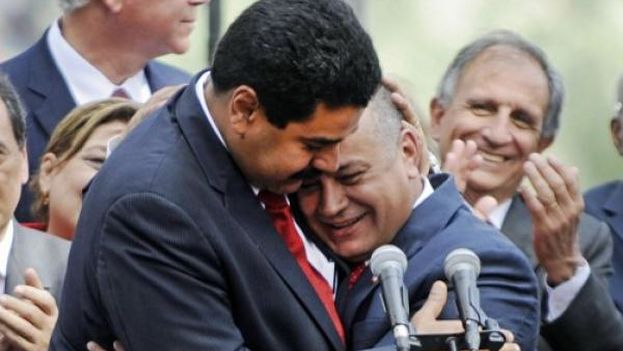
Nicolas Maduro and Diosdado Cabello

The author, a militant follower of Hugo Chavez, rebukes Venezuelan president Nicolas Maduro and Speaker of the National Assembly Diosdado Caballo, and the mafiosos who are destroying Venezuela.

14ymedio bigger14ymedio, Nelson Jesus Lanz Fuentes, 5 November 2015 – I have borrowed a title from a poem by Victor Valera Mora that appeared in one of his books, New Anthology, to define the moment in which I am living. Why do I say that I woke up to bullets? Because in these fateful days full of darkness and pain I want to become this, the bullet fired from the gun of history that we have to construct, those of us forced to see how in the last 55 years the always there official deceivers and liars have filled our beautiful Venezuela with hunger and misery.

I have to bear up and force myself to be patient, not to go out in the streets and turn myself into a real bullet to demonstrate the rage that I feel toward so many drones and crooks who have turned our country into a casino where everything has a price, is in play and for sale. A bullet loaded with contempt instead of lead, against Maduro and Diosdado and that whole string of mafiosos that accompany them in their work of destroying our country. A bullet with some huge desires to do away with, once and for all, the evil Venezuelans of the opposition gerontocracy solidly wedded to old precepts and immovable remnants, unable to evolve toward new scenarios. It is the so-called collaborationist opposition, the same one that spent time negotiating with the rojo-rojito (redder than red) traitors. continue reading

Today I woke up to bullets, perhaps tomorrow I will wake up with a smile on my face and hope on my lips, because today, today I woke up to bullets. Imaginary bullets that I want to shoot against those negotiators of the future of my children and grandchildren. Against those sectors where all the vices and old evils of capitalism, like strong-man rule, authoritarianism and despotism, are reflected.

Today I woke up to bullets because I cannot bear to see how the soldiers who should be defending out constitutional rights have allied, like in the old days, with the new and old bourgeoisie, that is, the most rancid of capitalism, to trample those rights. Corrupt soldiers, vicious gangsters sustaining this putrid government, living live like kings as they pimp out the country they say they are defending.

Today I woke up to bullets because I cannot bear to see how the noble and combative people of Venezuela, after two centuries of shedding their blood in the streets, fields and cities, fighting against all the evils caused by capitalism and its repressive agents, after a short awakening, were again sweet-talked with promises that none of those agents delivered on. They will vote again for the same people who killed their dreams and their desires to fight. The lie will prevail and the country will weep again and the blood will have been spilled in vain.

We, if we want, can truly give birth to a new country and a new man. The so-called Fourth and Fifth Republics were only, and are only, governments led by hookers and prostitutes in service to the most aberrant capitalism. We (the people), if we want to, can accomplish a Venezuela that is yours and mine. Throw out of the Miraflores Palace those who have always trampled the country that the Liberator left us. If we want, we can make the Venezuelan soil and those who mistreat it tremble. Only the people save the people and their colossal fury will make the corrupt of the Fourth and Fifth Republics tremble with fear.

Today I woke up to bullets, hopefully every day will dawn this way.


The Lilliput Rebellion / 14ymedio, Yoani Sanchez

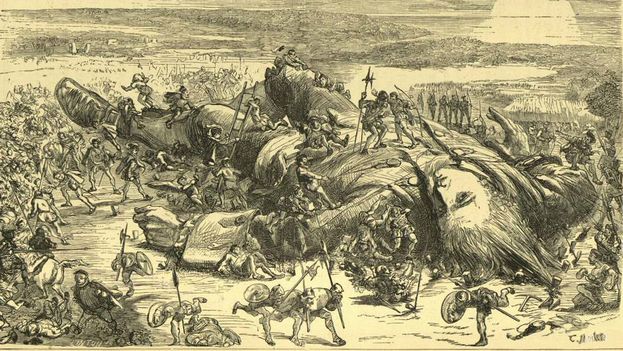
Gulliver being tied by the Lilliputians (CC)

14ymedio bigger14ymedio, Generation Y, Yoani Sanchez, 5 November 2015 – Calling for austerity while living in opulence has been common practice for Cuban leaders for more than half a century. Demands to “tighten one’s belt” are brandished about by officials with fat necks and ruddy faces, who for decades haven’t known what a refrigerator with more frost than food looks like. This contradiction undoubtedly annoys those who have to divide rationed bread with a family member, or cleverly cut up a bar of soap so it will last for several weeks.

The popular unease before the contrast between words and deeds could have led the journalist Alexander A. Ricardo to publish a metaphorical but accurate text in the opinion section of the Havana Tribune*. Under the title The Travels of Gulliver Junior, the opinion column refers to someone who “is seen in giant enjoyment of the shores of the Mediterranean, or as a dwarf adventurer without a problem in his life, in his visa.” continue reading

The allusion in the column was published some months ago when Antonio Castro, one of the sons of the former Cuban president, was discovered by a hidden camera while on vacation in Bodrum, Turkey. A place he arrived at from the Greek island of Mykonos on board a 150-foot yacht, and where he stayed with his companions in luxury suites.

It is hard not to relate the opulent life of Fidel Castro’s son and the calls for savings being launched today by his uncle from the dais, with the ironic phrase of the journalist: “Once he gets home he says nothing, He deceives his countrymen with stories about shipwrecks.” The similarities between the symbolic history and the real-life story have made the article go viral, and it is spreading via email within Cuba.

The coincidences grow when A. Ricardo writes, “he returned to weigh anchor, this time for the north, where the cold climate distanced him long ago,” which coincides with the onward journey of the ex-president’s son to New York, where he was also photographed, sheathed in sportswear and with a teddy bear in his hands.

“Thanks to his father Gulliver Junior travels quite often,” reads the text appearing in the newspaper of the Cuban capital. That is, because of the precarious economic situation imposed on millions of Cubans by his progenitor, now he can give himself luxuries that exceed what could be paid for with the retired father’s pension. But the Lilliputians are also getting tired. Could this journalist’s article be a sign of that indignation not at all diminutive?

*Translator’s note: A newspaper published by the Provincial Committee of the Cuban Communist Party