Machado Ventura: “The sugar harvest is very bad” in Cuba / 14ymedio

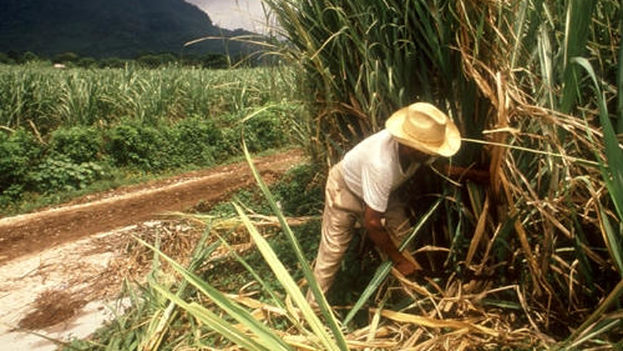
Cutting cane in Cuba. (Cuban Connection)

14ymedio bigger14ymedio 29 January 2016 — At least 43 of the 50 sugar mills taking part in the current sugar harvest are experiencing delays due to adverse weather conditions. This situation led Jose Ramon Machado Ventura, Second Secretary of the Cuban Communist Party Central Committee, to announce on television on Friday that “the sugar harvest is very bad.”

The official argued that first the country suffered “a severe drought that affected the estimates,” and in the current period of cane cutting, “the dampness and rain” have limited the process and paralyzed the milling in dozens of sugar mills. continue reading

“Although it can be cut, the industrial yield is low because the cane isn’t concentrated, it doesn’t have enough sugar,” said Machado Ventura, who is also vice president of the Council of State. The yield from the cane “is below what is normal for this time. Therefore, we have some affect on the harvest,” he emphasized.

The main problems with the harvest are concentrated in the western part of the country, according to the midday newscast. At least five sugar mills have had to stop their machines and another five have been unable to start the harvest because of the high levels of dampness in the fields.

“They are going to make the effort; if the weather improves they will be able to do it. They are not giving up, they can do it, they mustn’t start too soon, but we have to recognize that we are experiencing a harvest with many problems.”

Directors of the state sugar company Azcuba, which has a monopoly on sugar production on the island, had warned since November that the 2015-2016 harvest would be “special” due to the weather problems affecting the country. “We will be bringing in less cane than expected,” affirmed company specialist Dionis Perez Perez at that time.

The results of the 2014-2015 harvest have not been made fully public and the group only said that an increase of 18% over the previous harvest was achieved, although “the plan was some 4% lower than expected.” The experts put the figure at around 1.6 million metric tons of sugar (about 1.76 U.S. tons).

The Cuban Railroad Died / 14ymedio, Yoani Sanchez

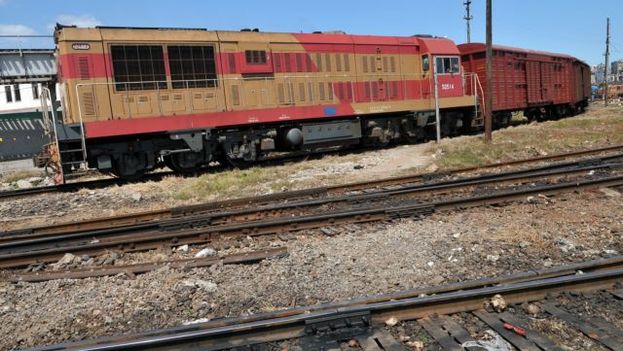
Railroad in Cuba. (EFE)

14ymedio bigger14ymedio, Yoani Sanchez, Generation Y, 29 January 2016 – My father is a train engineer. It has been decades since he drove a train, long years in which he hasn’t sounded the whistle of a locomotive while passing through a village with children running alongside the line. However, this still agile retiree originally from Matanzas still marks the 29th of January on the calendar and says “it is my day.” The day still smells of iron braking on iron, and has the rush of the platform, where some leave and others say goodbye. continue reading

The date honors the guild established in 1975, during the finishing of the first stretch of the central line. At the celebration Fidel Castro operated a Soviet locomotive, a moment that is still a source of amusement among elderly train engineers. “Everything was ready and he didn’t even get the credit of making that mass move,” says an old conductor in his eighties. The event, more about politics than railroads, was enough to let the imposed anniversary go.

The 19th of November should be the date for those who carry the iron serpent circulating in our blood. The day the first rail link in Cuba was completed, between Havana and Bejucal, in 1837, should get all the credit to earn itself a celebration that goes beyond the fanfare of the politicians and the headlines of the official press. In those nearly 17 miles (27.3 kilometers) of the initial line, a lineage began that refuses to die.

Now, when I stand in front of the lines at La Coubre terminal in Havana and observe the disaster that is rail transport in Cuba today, I ask myself if the era of the “sons of the railroad” will come to an end. Old cars, unsafe, accidents, delays, long lines to buy a ticket, luggage thefts, the stench of the toilets… and an iron fence that isolates the platform and those going aboard from those who are saying goodbye.

The Cuban railroad died. There is not much to celebrate on this day.

Cuban Police Detain Two UNPACU Activists UNPACU After Raiding Their Homes / 14ymedio

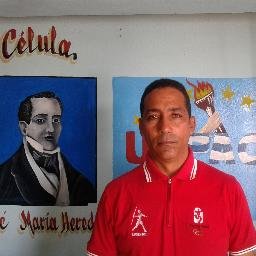
Carlos Oliva Rivery from UNPACU (Twitter)

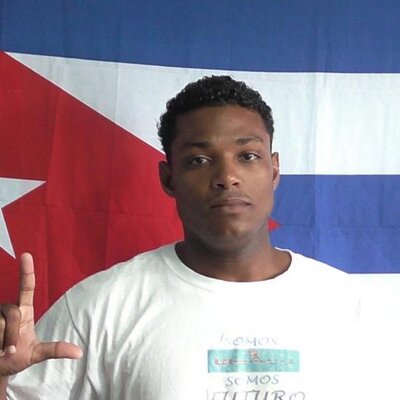
14ymedio, Havana, 29 January 2016 — The houses of Alexeis Martínez and Carlos Oliva Rivery, both members of the Patriotic Union of Cuba (UNPACU), were raided by police this morning, according to the opposition organization. The two houses, located in the Mariana de la Torre neighborhood in Santiago de Cuba, were searched just after six o’clock in the morning by uniformed personnel and the two activists were taken to the second unit of the PNR (People’s Revolutionary Police) in Santiago de Cuba.

Some witnesses commented to 14ymedio that participating in the operation were Special Troops of the Ministry of Interior along with the police. The 20 uniformed personnel presented a search warrant, but failed to summon two witnesses from the Committee for the Defense of the Revolution to be present during the search, as required by regulations, and instead took advantage of two “unknown passersby” to play that role.

Alexeis Martínez
Alexeis Martínez from UNPACU (Twitter)

According Alianne Pérez, the wife of Alexeis Martínez, at the conclusion of what she considered “an assault,” a computer, several disks and documents, two mobile phones, all the food in the house and two paintings hanging on the wall were seized.

In Oliva’s house, the dining room serves the organization’s members from other places who pass through the city to take courses, as well as other activists who work full time for UNPACU.

Between last 22 November and today, the organization has already reported 15 raids.

Residents Of Cuba’s ‘Oil-houses’ Will Be Relocated / 14ymedio

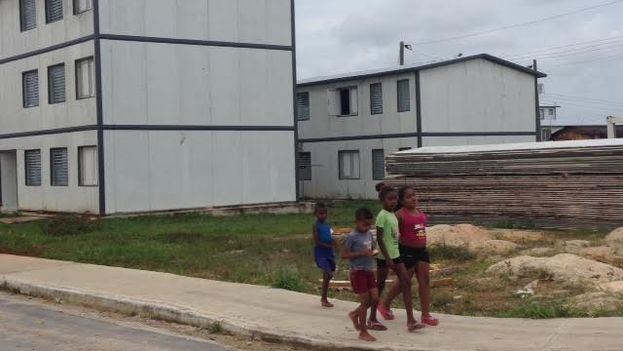
The neighborhood El Molino in Havana’s Cotorro district, made up of 19 so-called “petrocasas’ (oil-houses). (14ymedio)

14ymedio bigger14ymedio, 28 January 2016 — On Tuesday, the residents of El Molino neighborhood in Havana’s Cotorro district, were summoned in two groups to the municipal People’s Power to be informed that within a period of no more than 18 months they will be relocated into other housing, due to the calamitous state of the “petrocasas” (oil-houses) they were given less than a year ago.

A report titled “The Oil-houses are Falling Apart,” published by 14ymedio last week, revealed the deterioration and lack of finishes seen in the buildings and the infrastructure of this Havana settlement. The residents’ discontent had led to a situation that is “ready to explode,” confessed a resident of the area. continue reading

According to the testimonies of several local residents who participated in the meeting on Tuesday, the president of the Municipal Assembly, Teresa Beltran Santana, let them know that their complaints had reached those “very high up” and that according to studies, “the buildings had barely a year of life left in them.”

Zoraida Dopico, the mother of two children who lives in El Molino, is surprised by the solution they’ve been promised and adds, “Everyone knows that this was all constructed in a big rush and that it wouldn’t survive the first hurricane. When we complained that we were in danger, many said we were exaggerating,” says the woman.

Dopico confirms the long list of complaints and letters sent to official institutions. “We went to see Esteban Lazo, President of Parliament, and wrote letters to all levels … The problem even came out on the Internet!” said the lady, referring to the report published in this newspaper.

Carlos, whose testimony was collected in 14ymedio’s first report, recalls that shortly after the buildings were inaugurated, staff from the government TV program “Cuba Dice” (Cuba Says) came by. However, “they only told them about buildings with Chinese technology, which are concrete,” the elderly man remembers. The petrocasas are made from polyvinyl chloride panels.

With a certain sarcasm, the man predicted “surely at some moment they will show up here and they always find someone who seems content to have a microphone shoved in their face.”

Some were more cautious from the start and didn’t let their dreams run away with them in the petrocasas settlement, as is the case with a retired construction worker who commented, “It was clear to me, they didn’t even change the addresses on our ID Cards. Now with the move I’m not going to have to go to the end of the line because according to the paperwork I was never here,” he smiled.

For some, like Zoraida Dopico, the problem does not end with the transfer of the residents to another location. “The worst thing is that nobody cares who’s going to pay for all this. These components were brought from Spain, they paid salaries and spent millions doing it all so badly,” said the neighbor.

When asked if the government will find homes for so many people in less than a year and a half, she replied: “They do not want to see people here explode and if this problem isn’t solved quickly, what is going to develop here is going to be a revolution.”

Cuba faces a profound housing crisis with a deficit of more than 600,000 homes, and also a lack of maintenance of the buildings that are in a precarious state. According to official data, of 3.7 million properties in the country, almost 40 percent are in poor condition. However, only 27,000 homes were built in 2015.

Protest To Demand Food In Havana / 14ymedio


14ymedio biggerThe raid against street-cart vendors selling fruits and vegetables launched in Havana last week by the government is causing unease among large sectors of the population. Most affected by the restrictions are those who find in this commercial alternative a chance to buy food in their own neighborhoods and streets, far from agricultural markets.

For the elderly, people with disabilities or families with small children, the ability to buy fruits and vegetables “on their doorstep” has been very popular in recent years, despite high prices. In a clear strategy of “cutting off their nose to spite their face,” the authorities have decided to combat high food prices through maximum restrictions on intermediaries and street vendors.

The scene of a group of people protesting when police demand to see his papers and confiscate the merchandise from a street-cart vendor, as shown in this video that has come into our hands, says a lot about the unpopular measures of control the government has adopted against private vendors; and it also highlights the shortages of food products Cuban society is suffering today.

In the images posted on YouTube under the pseudonym SomosdeCuba (We are Cuban), the police harass street vendors selling fresh food. People start to gather and shout: “Abusers,” and then in a chorus yell “Food! Food! Food!” Finally the vendors start giving away their products rather than let the police confiscate them.

Price Controls Extended Across Havana / 14ymedio

 Youth Labor Army market on Tulipan Street in Havana. (14ymedio)
Youth Labor Army market on Tulipan Street in Havana. (14ymedio)

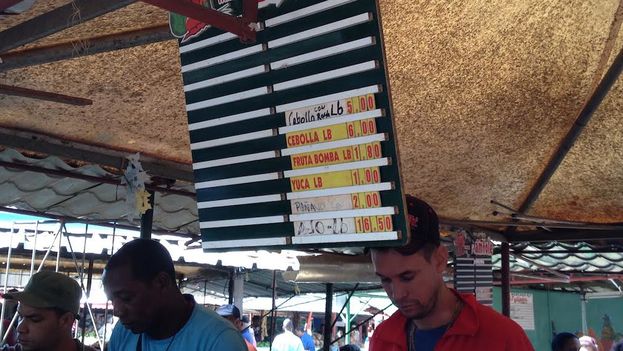
14ymedio bigger14ymedio, 25 January 2016 — What began as a novelty in mid-January has become common in the Cuban capital. The network of agricultural markets with controlled prices now extends to 66 markets and the authorities plan to extend the measure to the 105 people’s council markets in the city, as confirmed by the official press.

The second secretary of the Communist Party, Jose Ramon Machado Ventura, said after a meeting held on Saturday in Mayabeque, that fixing prices is being evaluated, “setting a maximum” on the price of numerous products, based on the cost of production and the total supply of the goods. continue reading

However, Machado Ventura acknowledged at the meeting that to finally solve the problem more and higher quality goods need to be produced, and he railed against the “illegal intermediaries” on whom the State is placing the blame for the sharp increase in prices since the middle of last year.

In Havana, the so-called State Agricultural Markets (MAE) were added to those covered by price controls; these markets had been under non-state forms of management but have now reverted to their former status. At these sites the government will maintain price controls on products such as bananas, taro, tomatoes, onions, potatoes, garlic, cabbage, squash, peppers, papaya, pineapple, okra, eggplant, chard and beans.

The implementation of the measure carries with it major restrictions on private transport that cater to the non-state markets, as well as and on street vendors who, with their wheeled carts, sell fruits and vegetables. These vendors have faced heavy police raids in recent weeks, leading them to abandon the streets of Havana where they had already become a part of the everyday landscape.

After the early enthusiasm over price controls in a limited number of markets such as the Youth Labor Army (EJT) located on Tulipan Street in the Nuevo Vedado neighborhood, customers are beginning to voice their complaints about the decline in quality of the products and the lack of stable supplies.

“Yesterday I came and bought cheap taro, but today I came and there is nothing but sweet potatoes,” complained a buyer at this Sunday’s busy market. This weekend the pallets displayed green tomatoes, squash and bananas. “But they are not ripe, you have to buy them green and wait for them to ripen in the house,” the customer protested.

Some neighbors looked thankfully on the lower prices. “I am retired and can not be paying 25 Cuban pesos for a pound of tomatoes,” says a buyer near the EJT market. “Many people are profiting from people’s needs,” added the retiree, who sees it as a good thing, because “they’ll see for themselves where the shoe pinches, and how are they going to steal now.”

The authorities have stated that only an efficient use of the land could cut prices on a permanent basis. In a recent interview with Eddy Soca Baldoquín, director general of the National Control Center of Land and Tractors, he stated that the amount of agricultural land in Cuba amounts to 15.4 million acres. State management is in charge of 30.5% of the land; cooperatives, 34.3%; and the rest is in the hands of small farmers.

Since Decree-Law No. 259 on the leasing of idle land in usufruct was approved in 2009, some 279,021 people have received land throughout the country and they currently remain in possession of about 3.5 million acres. But the measure has not had the expected impact on productivity and the prices of goods.

In a recent inspection in the province of Pinar del Rio chaired by Machado Ventura, 3,531 land leases were terminated: at least 1,126 for breach of contract; 766 for the abandonment of the land for more than six months; 703 for not using the land for the purpose for which it was granted; while the rest of the cancellations were due to deaths or voluntary abdications.

The Full Meal / 14ymedio, Reinaldo Escobar

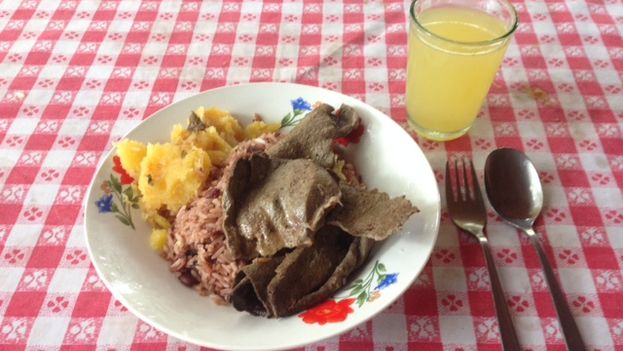
The “full meal” at the Ranchón restaurant in the Youth Labor Army market in Havana. (14ymedio)

14ymedio bigger14ymedio, Reinaldo Escobar, Havana, 29 January 2016 – “Give me the full meal,” a man tells the waiter who has stopped for a second at the table with the menu. No need to specify the menu item, the amounts or how you want it. The phrase “full meal” says it all: a plate with rice, some meat, a little vegetable and perhaps a salad. Service is fast, there are no details or sauces to choose from, just a little bit of everything before the infinite appetite of the diner.

The practice of eating away from home spread through many societies, where the family table was no longer featured when it came time to eat. The requirements of work and the speed of modern life have made people in many parts of the world choose to eat breakfast, lunch and dinner out. continue reading

In Cuba, those who go out to eat “on the street” know that they will need more money than they earn in a day’s work. There is no need to call out extreme examples of private or state restaurants where the average price for one person varies between 10 and 15 Cuban convertible pesos (about $11 to $17 U.S.), a figure that can double if the most expensive items on the menu are requested.

Among the most affordable options is food that is digested without even sitting down, which can be “bread with something” or a pizza costing ten Cuban pesos (about 40¢ US) that comes wrapped in paper and dripping with cheese. There are also the little cartons in Havana’s Chinatown where for 25 or 35 Cuban pesos you can “calm the dog,” meaning the stomach.

Other sites have managed to position themselves in a zone between the private and the state, like certain private restaurants attached to the agricultural markets. El Ranchón at the Youth Labor Army (EJT) market on Tulipan Street is a restaurant that enjoys a certain permissiveness and whose owner, as discussed in the neighborhood, is a member of the armed forces.

In places like this, of which there are very few in the city, they serve a plate with rice and beans, salad, mashed sweet potato and pork liver steak for 20 Cuban pesos. With the same sides, other options for the main course include roast pork, lamb fricassee or fried chicken, but the price never exceeds 40 Cuban pesos, even if fruit juice is included. There are no flowers or candles on the table and you have to cut the meat with a spoon, because there are no knives, but it’s good.

On the periphery of Ranchón are two government ministries, three banks, a high school and three military units, in addition to the thousands of customers who visit the busy market daily. A very old man with an enormous appetite asks for the leftovers every day. He hides so they don’t see him. He must be over 80 and he says that in his youth he could get “a full meal” for 25 centavos anywhere, “with beef: shredded, steak, or ground.”

Now that workplace cafeterias have almost disappeared, many people bring their full meal in a plastic bag and others who have chosen to eat just one meal a day, that they eagerly devour when they get home.

US-Cuba Relations: A Passing Idyll? / 14ymedio, Andres Oppenheimer

First meeting between Raul Castro and Barack Obama at the funeral of Nelson Mandela in South Africa
First meeting between Raul Castro and Barack Obama at the funeral of Nelson Mandela in South Africa.

14ymedio, Andres Oppenheimer, 28 January 2016 – There is a lot of excitement on all sides about president Barack Obama’s approach to Cuba, but allow me a word of caution: it is likely that the current idyll between Washington and Havana will cool somewhat after the November elections in the United States, regardless of who wins.

The reason is very simple: it takes two to tango (or cha-cha, in this case) and Cuba is doing little from its side to accompany the easing of U.S. trade relations against the island.

In addition, the next United States president will see the trade opening to Cuba as a legacy of Obama, and will likely not spend much political capital to continue unilaterally expanding a policy that will go down in history as the work of a previous president. continue reading

When Obama first announced the opening to Cuba on 17 December 2014, he said, rightfully, that the previous policy of the United States had failed, and that United States trade would help to create a new class of entrepreneurs and an independent civil society in Cuba.

But more than a year later, even the State Department officials who negotiatied the agreement are frustrated with Cuba.

Earlier this month, the official Cuban weekly Workers reported that the number of self-employed workers in Cuba has fallen to 496,000, from 504,000 six months ago, according to Cubaencuentro’s 12 January webpage.

The blog Letters From Cuba, by the Uruguayan journalist Fernando Ravsberg, said on 17 December that “internally, the paralysis is great.” He added that “during 2015 not one more cooperative was legalized, no new forms of self-employment were opened up, the wholesale markets were conspicuous by their absence and the long demanded unification of the currencies is still on the shelf.”

Politically, the military dictatorship in Cuba continues to ban political parties, freedom of assembly, and independent media.

During the past year, the number of arrests of peaceful dissidents rose to a record of 1,447 in November, according to the Cuban Commission on Human Rights and National Reconciliation.

Yoani Sánchez, the brave Cuban journalist publishes her digital daily 14ymedio from abroad because the regime does not allow her to publish it from Cuba, even online, wrote on January 6 that “Television, radio and newspapers are maintained under strict monopoly of the Communist Party.”

And she added, “Access to the microphone is granted only to those who agree with the government and applaud the actions of its leaders. They never interview someone with a difference of opinion.”

Despite all this, Obama announced a few days ago a third round of unilateral measures to ease the embargo on the island. The new measures will allow more American visitors to travel to Cuba and increase the number of authorized exports to the island.

The normalization of relations between the United States and Cuba has turned the island into a global object of curiosity. Tourism to Cuba increased to 3.5 million in 2015, up 17.4% over the previous year, according to official Cuban figures.

Cuban art, cuisine and music have become fashionable, and are the subject of countless newspaper articles. In contrast, few journalists report on the political prisoners or investigate the more than 3,130 killings attributed to the Castro regime since 1959, according to the records compiled by the research group CubaArchive.org.

My opinion: As I have said in earlier columns, the previous United States policy of isolating Cuba did not work and Obama’s new measures deserve a chance. However, so far they have not worked.

At this point, the normalization of relations has only helped Obama to cement his legacy as the president who resumed relations with Cuba, as Nixon did with China. So Obama pressed the accelerator with new measures of additional openings a few days ago, and will continue to do so.

But I do not think the next president of the United States – even if it is Hillary Clinton – will invest much political capital in cementing Obama’s legacy, unless Cuba gives concrete signs of an economic or political opening. The ball is in the Cuban court, and this idyll can cool off after November.

14ymedio Editorial Note: This analysis has been previously published in El Nuevo Herald. It is reproduced with the permission of the author.
The “Tight-fitting” Flag / 14ymedio

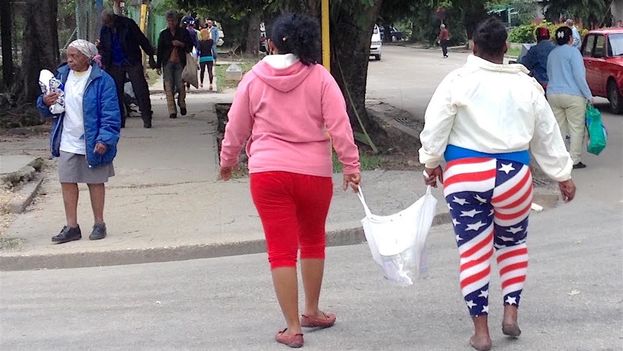
The stars and stripes, best when it is “snug” according to some. (14ymedio)

14ymedio bigger14ymedio, Havana, 27 January 2016 — After Cubans saw the handshake between Raul Castro and Barack Obama at last year’s Summit of the Americas in Panama, the number of American flags in the streets of the island soared exponentially. They are found inside taxis, on the caps that protect against the relentless tropical sun and adorning innumerable items of clothing.

There is some challenge in wearing this stars-and-stripes logo on the body. A gesture of defiance that officialdom just does not like.

Articles in the national press that acidly criticize the growing presence of Uncle Sam’s flag in Cuba have only served to fuel the desire to wear it. As if many would like to make up for those decades when showing the slightest sympathy for the country to the north meant being thrown out of work, kicked out of college or suffering even worse reprisals.

Nice and tight, in contact with the skin, today many Cubans wear it their own way to separate themselves from and contradict the government discourse.

A Decade Of Work On Press Freedom For Cuba / 14ymedio, Reinaldo Escobar

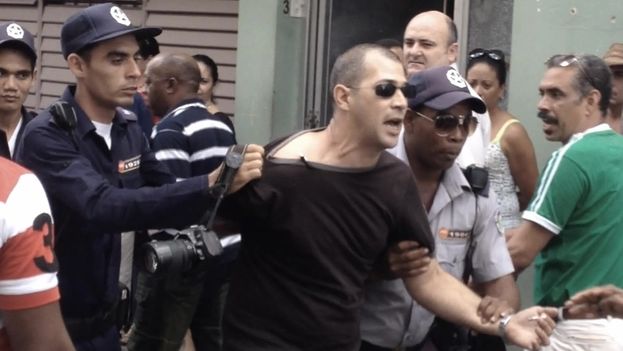
The official journalist Leandro Perez was arrested in Cuba while photographing an arrest. (Indomar Gomez / 14ymedio)

14ymedio bigger14ymedio, Reinaldo Escobar, Havana, 28 January 2016 — Journalism is a high-risk profession. Death threats and imprisonment are just around the corner for thousands of journalists throughout the world. In Cuba, as an illustrious writer said, in the last five decades “they haven’t killed journalists because they have killed journalism.” One organization defends the rights of the profession and tries to raise its voice for those who have been silenced at the microphones and in the national presses.

Ten years ago, a group of independent journalists founded the Association for Freedom of the Press (APLP) with the initial purpose of protecting the work of reporters and also to act as an independent news agency. Looking back, its members are taking stock of what it has accomplished and looking at the long road that lies ahead. continue reading

Jose Antonio Fornaris, APLP president, told 14ymedio that at present the organization is focused on “learning of and denouncing the problems of Cuban journalists in the exercise of their profession.” The most common difficulties range from arrests, the confiscation of working tools, and the little access to sources.

Freedom House, based in Washington, reported last year that Cuba remains, both regionally and globally, one of the countries with the greatest restrictions on the press. The organization denounced the fact that many Cuban journalists continue to be imprisoned and that official censorship is “widespread.” The island ranks last in Latin America with regards to press freedom.

The Cuban Constitution states that “citizens have freedom of speech and of the press in accordance with the objectives of socialist society,” but the editorial line of the national media is governed by the Department of Revolutionary Orientation (DOR), an arm of the Central Committee of the Communist Party of Cuba.

Many professionals, both in the independent sphere as well as those closest to the ruling party, have pushed in recent years for a press law. This legislation would regulate the activities of journalists and, in particular, force institutions to provide information of national interest in a public and transparent way.

Without this legal basis, the work of a reporter in Cuba will continue to move between self-censorship and danger, as APLP finds every day, when working to ensure that “in each province there are observers who are aware of the problems faced by information professionals.” Undoubtedly, these activists for press freedom have a great deal of work to do to collect every violation against the profession.

It is not enough, therefore, that a group of reporters, such as the APLP, are willing to raise their voices for others. “The ideal is for someone who has been harmed to approach us and report their case,” says Fornaris, a first step in order to then get “the corresponding verifications,” and “to provide assistance to the victim,” he adds.

Last October, during the 71st General Assembly of the Inter American Press Association (IAPA), a devastating report on Cuba was presented in which it is stated that human rights and freedom of the press are violated “absolutely and systematically” with the State “monopolizing” the media.

The small team that makes up this NGO tries to optimize its time. Miriam Herrera is responsible for the committee that attends to the journalists, while Migiuel Saludes, located in the United States, serves as the representative abroad; each one of the seven members of the board is responsible for an area of the NGO’s work.

In the APLP “we don’t have lifetime tenure,” says Fornaris. He says it with a pained smile in a country where there have not been democratic elections for seven decades. It is very important for the organization to break with this fatal flaw, and “this year we are renewing the mandates.” The president sees it clearly, “It would be unacceptable for us to call for democracy in Cuba and to have a dynasty in our ranks.”

His hope of a new morning of greater freedoms does not blind him to the present. “As long as the press doesn’t point the finger at who is responsible for its faults, nothing happens,” Fornaris concludes with determination. He does not believe that “under the rules of this system monopolized by a single party can one expect substantial change.”

However, what is not in doubt is that “the press must be free, otherwise it can’t be called the press.”

Springboard for Pigeons / 14ymedio

A landing strip for pigeons (14ymedio)
A springboard/landing strip/patio/sundeck for pigeons (14ymedio)

14ymedio bigger14ymedio, Havana, 26 January 2016 — A short walk through the streets of Havana is enough to confirm the passion that goes into the care of pigeons among young people and teenagers. The cages and feeders with grains of beans and peas, such as the one seen in the photo, are everywhere. Many residents of multifamily buildings complain that “the boys have filled the roof with pigeons” and medical authorities warn of diseases that can be transmitted by the intensive breeding of this bird.

The most common types of pigeons are pouters, messengers and Moroccans, with shades ranging from gray and blue to smoky and white. Stealing pigeons is also the order of the day, and one of these animals can become the currency of exchange in countless transactions. A well-cared-for and beautiful pigeon can cost up to three days’ pay.

Malaga Will Not Resume Cooperation With Cuba As Long It Continues to Violate Human Rights / 14ymedio

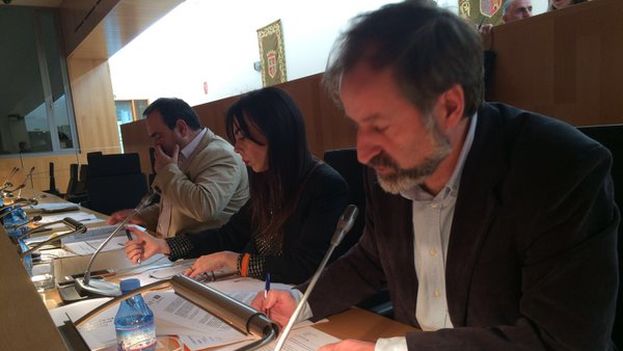
Gonzalo Sichar, spokesman in Malaga for the Citizens Party. (Twitter)

14ymedio bigger14ymedio, Havana, 24 January 2016 – The Citizens Party on the Malaga Provincial Council in Spain has called to prohibit any kind of cooperation between the provincial government and Cuba as long as Havana continues to not respect the most basic human rights, according to a report last Friday in the Spanish newspaper ABC. The proposal has received majority support from the People’s Party (PP) which holds the majority in the province.

A spokesman for the Citizens Party, Gonzalo Sichar, pointed out that the administration must comply with the so-called democratic clause included among the recommendations of the European Union to grant aid to developing countries. These rules exclude states that do not hold multiparty elections, said the politician. continue reading

The Citizens Party, of the liberal wing, also called for an end to cooperation with Equatorial Guinea, since Teodoro Obiang’s government has been listed as one of the most repressive in the world in the reports of different human rights observers.

In fact, following the arrival of the PP to power in 2011 in the province, the Malaga Provincial Council has spent more than four years without funding a single project with Cuba, unlike what happened in the previous administration, led by the Spanish Worker Socialist Party (PSOE) in coalition with United Left (the Communist party). The latter provided an annual training grant to the island of a million and a half euros.

According to the Spanish daily, the records of many of these projects with Cuba “remain cloudy and unresolved.”  The article also points out that there “were frequent trips to the island and the training sessions attended by politicians were blithely covered by the public purse.”

The Citizens Party proposal comes as the Council has voted for an increase of funds for development aid in 2016. According to the group’s spokesman, it wants to completely shield these programs so as to avoid the possibility of changes in politics or opinion leading to financing projects in countries with undemocratic regimes.

Jose Daniel Ferrer Arrested And Beaten In Santiago De Cuba / 14ymedio

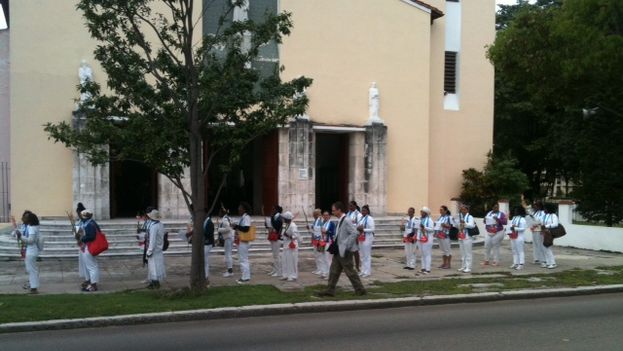
Ladies in White outside of the parish of Santa Rita in Havana. (Angel Moya)

14ymedio bigger14ymedio, Havana, 25 January 2016 — Cuban activists have again experienced a repressive Sunday with the arrest of more than a hundred opponents throughout the island. The leader of the Patriotic Union of Cuba (UNPACU), Jose Daniel Ferrer, was violently arrested in Santiago Cuba, according to sources in his organization.

About 130 members of the UNPACU and the Ladies in White movement were arrested in the eastern province while trying to reach the Shrine of Our Lady of Charity of Cobre. Police and special forces intercepted them at various points along the busy road to the church, said the national coordinator of the organization, Yriade Hernández Aguilera. continue reading

The testimony of Santiago activists said that the UNPACU leader’s arrest occurred at 7:40 am Pajuil, a place of the road to El Cobre where police often set uptheir checkpoint. Opponents say they were surrounded by more than 35 troops, which threw him down and after he was immobilized on the ground they kicked him.

Ferrer and the other members of the organization arrested in the morning were released shortly afterwards.

In Havana, 70 people, including activists and Ladies in White, made it to the parish of Santa Rita in the neighborhood of Miramar. Angel Moya, a former prisoner of the Black Spring, denounced the previous arrest of 12 women in the organization, to prevent them from reaching the site.

In its summary for last year, the independent Cuban Commission for Human Rights and National Reconciliation (CCDHRN) reported that “political repression increased steadily throughout 2015 from 178 cases in January to figures in the vicinity of 1000 arrests by year’s end.”

Zapya, The Network For The Disconnected / 14ymedio, Zunilda Mata

In Wifi zones, like this one on Havana’s La Rampa, the use of Zapya is proliferating. Users connect, download and share files through it. (14ymedio)

14ymedio bigger14ymedio, Zunilda Mata, Havana, 25 January 2016 – From their respective corners of the bench they point their phones at each other as if they were in the midst of a duel to the death. After a few seconds one of the young men shouts, “I got it!” and both smile at the effective transmission of a file with the Zapya app, an increasingly handy application for exchanging files in Cuba.

Zapya is the tool of the hour on Havana’s streets, especially among children and teens. Its users use it to exchange – easily and quickly – photos, videoclips or applications to install on their smart phones. Its creators have described it as a utility that allows transfer rates “hundreds of times faster than you get using Bluetooth.” continue reading

With a simple and intuitive interface, Zapya is available in Android and iOS versions. Its programmers boast of having exceeded 300 million users worldwide, thanks to a Chinese version that is gaining popularity among users in the Asiatic giant.

Its intuitive design makes Zapya an easy-to-use tool, with files received at an approximate speed of 10 MB per second.

For Epiphany, the traditional Christmas gift-giving day in Cuba, many children asked for “a tablet with Zapya,” which led other Cuban parents to have to deal with installing the application on their own devices. The tool has many followers in elementary schools, where the children amuse themselves exchanging songs and videos and where many teachers have started a full-out battle against the application.

“At my daughter’s school bringing phones is banned, because they spend the whole day playing games and sending little messages,” comments the mother of a nine-year-old in Havana’s Plaza district. When her daughter heads to class she goes to the park to “zapya,” explains the mother, using the word as a verb, which is spreading in popular speech.

The most attractive part of the application is the chat function, which allows the exchange of messages free, and without needing access to the internet. “This is driving the teachers crazy, because the students use it to mock the teachers, fall in love, and even send each other the answers to the tests,” says Mirtha, the mother of a teenager in high school.

In Wifi zones the use of Zapya is also proliferating. “I come, I start to download what interests me, and I’m going to send it to several friends,” says Ivan, 19, who was connected in Havana’s La Rampa area this weekend to download “videogame tricks.”

Zapya has gained ground thanks to its distribution in the so-called “weekly packet” that circulates throughout the country. Along with anti-virus updates, and other applications for smartphones, the tool has managed to reach a wide audience that uses it as a substitute for WhatsApp, because you don’t have to be connected to the web to use it.

At the end of 2015, State telecommunications industry authorities claimed that 150,000 Cubans connect to the Internet in public wifi areas every day, but the island is still among the countries with the lowest rates of connectivity in the world; only 5% of population is on-line (and only slightly over 1% are using broadband).

Among the many ways to overcome these obstacles, Zapya is today one of the most creative and popular applications. Ease of use, privacy and its ability to operate offline are keys to its success among Cubans.

The Land Belongs To The State … But The Work Does Not / 14ymedio, Reinaldo Escobar

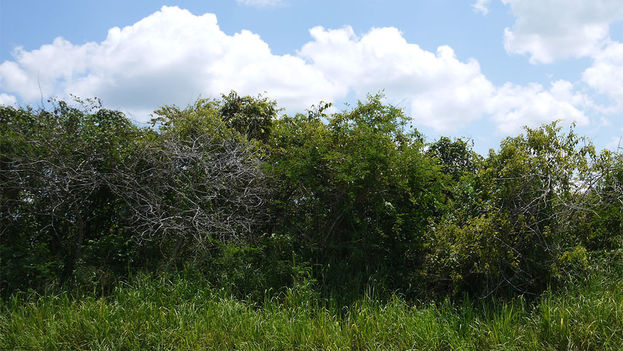
The invasive marabou plant takes over Cuba’s fertile land. (14ymedio)

14ymedio biggerMr. Jose Ramon Machado Ventura met with a group of farmers leasing land under the concept of usufruct in the province of Artemisa, showing first his political skills, and, seeing that his exhortations and appeals were insufficient, moving straight to threats. “The land belongs to the state,” he said, referring to those who do not satisfy the inflexible demands: “We can take it back without much discussion.”

Under decrees issues in 2009 and 2012, the country has 279,021 lessees who occupy just under 3.5 million acres, or 22% of the agricultural land in the country, according to official data that calculates the total to be about 15.4 million acres. continue reading

Much of this land that is leased to “natural persons,” was idle, and in the words of many, dead. Marabou and other weeds had taken it over, because the all-powerful state had not been able to make it produce.

Now, in the midst of a real price war, Communist Party leaders are trying to “incorporate into daily practice strict control over the use and possession of the land leased out under usufruct.” Machado Ventura repeats like a mantra that the solution to the problem of food shortages and high prices is in producing more, but he minimizes or understates the shortage of inputs required to achieve this production.

“They place demands on us as if we had everything we need: irrigation, fertilizer, pesticides and don’t even talk to me about machetes or the files to sharpen them,” said Agustin Lopez who only planted yucca and sweet potatoes because they are less demanding. And, he concludes, “We aren’t magicians, just peasants.”

When the controversial topic of prices arose at the Artemisa meeting, the second secretary of the Cuban Communist Party said that he would evaluate the alternative of fixing a maximum limit, that is, “setting an ‘up to’.” The obsession with identifying private traders as unscrupulous intermediaries is leading to the temptation to resuscitate Acopio, that ineffective state entity that only wants to buy from the farmer what it is sure it has the ability to sell, and that on numerous occasions has been responsible for losing tons of food through problems with transport or because of the inefficiencies of central planning and distribution.

Meanwhile, in the capital, the pushcart vendors who operate under the rules of supply and demand have disappeared, and 66 State Agricultural Markets have been set up where there is a list of 37 products, not always available, with fixed prices. The intention is to cover the city’s 195 “people’s councils.” An official note announcing this measure describes it as “the recovery of the status” of these places that had come to be managed outside state control.