
Fidel And Raul Castro “Are Very, Very Spanish” / 14ymedio

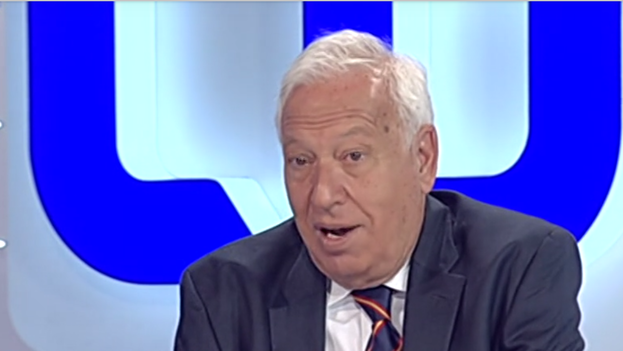
José Manuel García-Margallo during the interview in the Breakfasts program on Spanish Television (TVE). (Video Capture)

14ymedio bigger14ymedio, Madrid, 18 May 2016 — The Spanish Minister of Foreign Affairs and Cooperation, José Manuel García-Margallo, in an interview on Spanish Television on Wednesday, defended his meeting with Raul Castro in Cuba, recalling the ties that unite the two countries, among them the “Spanishness” of the Castros.

“In Cuba, apart from human relationships, Fidel and Raul’s father was a soldier who fought with our troops [on the Spanish side] in [Cuba’s war of] independence, and then turned. They are very very Spanish,” he said. continue reading

The minister appeared on TVE’s “Breakfasts,” a program on a state channel dedicated to political analysis, on his return from a trip to Cuba and Ecuador. Among the questions raised during the interview, García-Margallo was asked about his meeting with the Cuban president and the possible image of legitimizing the regime that this might have sent. The foreign minister asked that his meeting with Raul Castro be seen in context, recalling that Castro had also met recently with Pope Francis and the president of the United States, Barack Obama, as well as representatives from many European countries.

“We have initialed an important chapter in European Union-Cuba [relations] in which we are talking about human rights. In addition, we have normal contact with civil society. Therefore, incorporating this whole chapter of human rights in the agreement is a good sign and Spain cannot be, being who we are and what we have been in Cuba, the only country that is reticent and decides not to go,” defended the minister.

García-Margallo pointed out that Spain is the island’s third largest trading partner, behind only China and Venezuela, and companies in his country manage 90% of the 5-star hotels in Cuba, and 60% of all hotels. In addition, he said Spanish companies are negotiating tenders for the construction of four airports in Cuba, a country with many opportunities for infrastructure. “With Cuba we have such a special relationship that it would be very bad if Spain sat on the sidelines and we let everyone else on the right and the left get ahead of us,” he affirmed.

García-Margallo has framed Spain’s relationship with Cuba in different historical contexts, from the European Union Common Position (promoted in 1996 by former president José María Aznar) up to the new relations of the EU and the US with the island. In addition, he recalled that his position on human rights is clear and was defended by himself during speech on his previous visit to Havana. “The Cuban people, at this moment, primarily want progress and economic development, and we are going to help them in this change,” he concluded.

With regards to Venezuela, García-Margallo announced in this television interview the return to Caracas of the Spanish ambassador, Antonio Perez Hernandez. The minister gave instructions this same morning for the ambassador’s return to Venezuela; he left last April in protest at the “insults” of President Nicolas Maduro toward Spain’s prime minister, Mariano Rajoy. The Venezuelan president called the Spanish president “racist, corrupt trash and colonialist garbage.”

The chief of Spanish diplomacy explained that the reason for the return of the ambassador is the presence or 400,000 citizens with dual nationality who “need protection.” In addition, he said that former Prime Minister Jose Luis Rodriguez Zapatero is in the country and that Albert Rivera, leader of the Citizens Party, will travel there next Monday.

Venezuela is in an “absolutely impossible” situation, Garcia-Margallo said, adding that “we must deploy the foreign service.”
Jose Daniel Ferrer Gets a Passport / 14ymedio

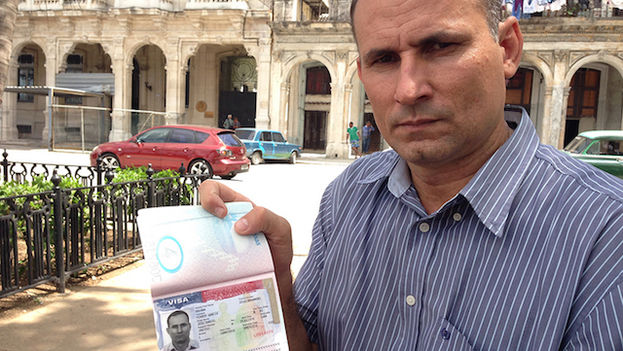
José Daniel Ferrer with his passport with a visa for the US. (14ymedio)

14ymedio bigger14ymedio, 18 May 2016 – Government opponent José Daniel Ferrer received his new passport on Tuesday, and will be able to travel outside the country for the first time. The former prisoner of the Black Spring has permission to leave the country only once, according to information from Cuban authorities. During his trip he plans to visit the United States and several European countries, according to what he told this newspaper.

The leader of the Patriotic Union of Cuba (UNPACU) will fly to Florida on Wednesday, where his plans to visit his mother and brother, Luis Enrique Ferrer, also a former political prisoner. “I want to see many good Cubans, especially those who in one way or another support the cause of the democratization of Cuba. I want to hug them,” he said.

Ferrer also plans to go to the Swiss city of Geneva, to appear before the United Nations Human Rights Council, and then he will visit Spain. “If I have the time I want to go to Poland, to the Gdansk shipyards, where the great demonstrations of the Solidarity Union took place,” he told 14ymedio.

Earlier this year, Ferrer received, along with other former political prisoners, the Homo Homini Prize awarded each year by the Czech NGO People in Need, for his contribution “in an outstanding way to the promotion of human rights, democracy and the non-violent resolution of political conflicts.” None of the award recipients were able to attend to the award ceremony because of travel restrictions imposed on them by the Cuban government.

Pedicabs, A Battle For The Streets / 14ymedio, Luz Escobar

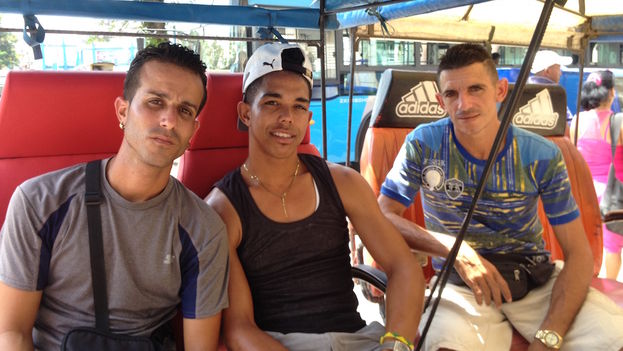
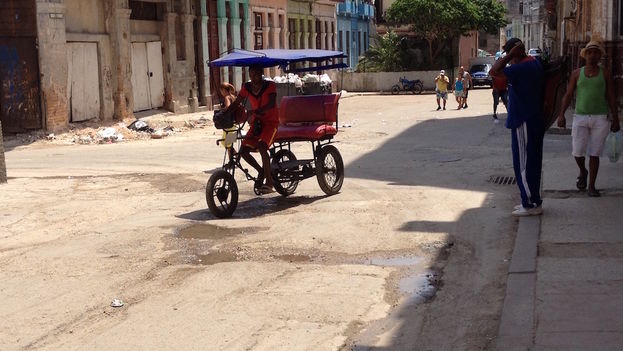
Pedicab in Havana. (14ymedio)

14ymedio bigger14ymedio, Luz Escobar, 16 May 2016 — A fine drizzle falls on the city and Felix, a pedicab driver for 22 years, takes advantage of the chance to take a break. Beside Havana’s Capitol building the man recalls a protest held last Monday by a group of his colleagues in the Plaza of the Revolution. They were demanding the right to use several streets that are now closed to their tricycles, along with less harassment from inspectors.

From a pocket in his fanny-pack he extracts a wad of papers and displays them with chagrin. They are the traffic fines that have been imposed on him so far this year, some thirty folded gray papers from the many he displays. Every one bears a stamp where we can read the word “paid.” continue reading

“Every day I have to keep all these receipts with me,” the man explains, and recalls that once he had to spend three nights in the police station because the data base of traffic fines hadn’t been updated with his information. “They work very badly, sometimes after paying, your name still shows up on the list of the defaulters,” comments Felix.

While he details the police harassment they receive, another pedicab driver arrives. The driver, Alejandro, joins the conversation and points out that even though they pay for a license to do their work, they don’t have “the right to travel on many of the important streets, like Galiano, Reina and Monte.”

Those three major arteries connect several districts and for decades have been the principal thoroughfares for this mode of transport, greatly used by Cubans for short distances. However, the pedicab drivers complain that the travel restrictions have been imposed on them under the justification of moving traffic at a higher speed on the avenues.

Yaseil Rodriguez, who has made his living pedaling for nearly a decade, says that the authorities have informed them that these vehicles move “very slowly.” A justification that does not convince him. “We aren’t allowed on these streets and the horse-drawn carts full of tourists managed by Eusebio Leal are?”

Pedicab drivers in Havana. From left to right, Yasiel Rodríguez, Noslen López y Hector Hernández. (14ymedio)

Rodriguez enumerates the streets where it is no longer possible to travel in a pedicab: “Monte, Monserrate, Zulueta, Prado, Egido, Industria, San Lázaro, la Avenida del Puerto y Cuba.” This latter “was a street in Old Havana where we were always able to travel without problems.”

The fines imposed for violating these restrictions range from 700 to 1,500 Cuban pesos. The police pay special attention to keeping the pedicabs outside the area around Fraternity Park. But the fines are not the most severe punishment; the worst is having the vehicle held at the police station until the driver pays or clarifies the situation.

Many pedicab drivers consider the application of the law “excessive.” This disagreement led to some forty of them traveling in a caravan to the Plaza of the Revolution on 10 May, with the intention to demand an end “to the abuse” against the drivers. So far they have received no response from the authorities.

For Nolsen Lopez, another young pedicab drivers, the pressure has become unbearable. “You have to travel looking on all sides as if you were transporting arms or drugs,” he said, explaining the stress he experiences during the workday. The man complains of the excessive cost to keep pedaling, because “you have to pay these fines, pay for the license, pay into social security, insurance, and if I get sick I have to use my savings because they don’t give you anything in these cases.”

Among the demands these self-employed workers are championing is also a reopening of the licenses to practice the occupation. The young man says that at the National Tax Administration Office (ONAT) it’s been ”four and a half years without their issuing permission to drive a pedicab.” For that reason they must work under the category of “helper,” a condition that limits their work even more.

“If the authorities do not respond on this issue, on Tuesday we will go to the Plaza again,” said Lopez, who did not take part in the first protest. “This time I’ll go because abuse has to end, if more of us go, it’s much better.”


Cuban Phone Company to Block “Blacklisted” Phones / 14ymedio

Cuba’s phone company says that its new measures are to prevent fraudulent use of lost or stolen phones. (DC)

14ymedio bigger14ymedio, Havana, 16 May 2016 – Cuba’s government-owned phone company, Empresa de Telecomunicaciones de Cuba (ETECSA), has announced that starting this Wednesday, May 18, new rules will come into effect for cellphones which will more strongly control their use.

According to the newspaper Juventud Rebelde (Rebel Youth), the measures will include an automatic blocking of a line if the SIM card inserted in the phone is on the “blacklist.” continue reading

According to that official newspaper, the new regulation is the result on an “increase in reports associated with criminal acts including theft and/or loss of cellphones, fraudulent changing of the IMEI (International Mobile Station Equipment) code which allows each mobile phone to be uniquely identified worldwide, which is done by unscrupulous citizens to facilitate the illegal use of these cellphones which are on the blacklist (blocked), and the desire to protect the population from the acts of these teams [of thieves].”

Owners of a line whose phone has been stolen or lost, according to the official note, can ask to have their device included on the “blacklist,” “upon presentation of documentation that validates the ownership or property.” ETECSA has made available through its website (www.etecsa.cu), it says, a site where you can find out if your phone is on the blacklist, by entering the IMEI, which can be obtained by dialing *#06#.

If the line is blocked, the owner has five days to “appear in ETECSA’s commercial offices and to clarify the causes of the event in order to unlock the line,” otherwise the service will be cancelled.

In addition, the new measures establish that users who have an IMEI that “is not valid (incorrect IMEI numbering)” must replace their device by this Wednesday. The newspaper warned that “those customers who are in this situation will be notified promptly by phone.”

Cellphone repair workshops managed by private individuals have become very popular in Cuba in recent years. One of their most provided services is unlocking devices that have been blocked by the phone company, or devices that have been stolen.

Cuban Government Announces New Set of Price Reductions / 14ymedio

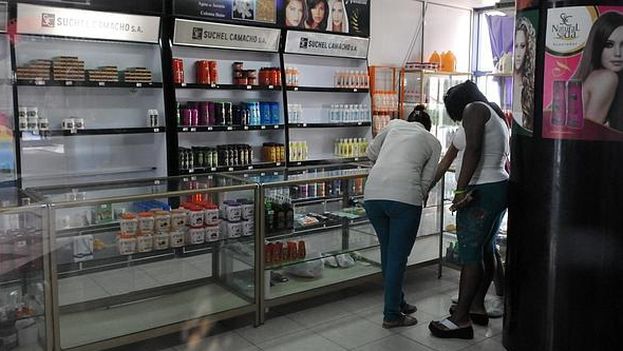
A store that sells in convertible pesos, Havana. (EFE)

14ymedio bigger14ymedio, 17 May 2016 – The Cuban government has published an “official note” announcing price reductions for products sold in Cuban convertible pesos (CUC) which will go into effect on Tuesday. The measure is aimed at “gradually increasing the purchasing power of the Cuban pesos (CUP),” explained the Ministry of Finances and Prices in the announcement read on primetime television news this Monday.

Among the products that will benefit from the reductions is powdered milk, the price of which was reduced by 9%, and liquid milk which was reduced by 20%. continue reading

“Powdered milk in half-kilo tri-laminate bags is reduced from 2.90 CUC to 2.65 CUC [the average monthly wage in Cuba is the equivalent of about 20-25 CUC]. The same product, in a half-kilo lithographed nylon bag is 2.55 CUC,” the note offered as an example.

The decision includes offering some items wholesale in several stores of the government-run chains TRD-Caribe and CIMEX, which already sell chicken in large boxes. Starting now, milk will also be added to this with “powdered milk in a 25 kilo sack for 119.85 CUC.”

The drop in prices will include “custards, jellies, grain rice, dried beans and canned goods (meat, seafood, fruit and vegetables) between 25% and 30%,” the note detailed.

In addition, children’s footwear will be reduced approximately 6%, a decision the government defines as part of “the societal strategies to address the effects of the current demographic dynamics.”

In late April, the government announced a reduction in the prices of various foods and other commodities sold in stores in convertible pesos (CUC) and national currency (CUP). The move came at a time of growing popular disconnect in the rising cost of living and shortages.

See also:


El Trigal Wholesale Market’s Last Day / 14ymedio, Luz Escobar

A cart driver at the El Trigal wholesale agricultural market in Havana (14ymedio)

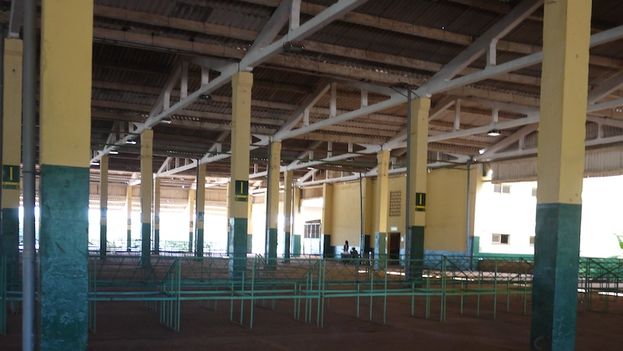
14ymedio bigger14ymedio, Luz Escobar, Havana, 14 May 2016 — The line of trucks extends along the embankment that provides access to the only wholesale agricultural market in Havana. But unlike other days, the farmers who have come with their merchandise neither unload it nor sell it. The place is surrounded by police and someone is passing out a flyer confirming the announcement on TV primetime news: El Trigal market has closed.

Many of those who congregated this Friday in front of the access to large space hadn’t heard the “bad news.” They came with their boxes and sacks loaded with farm products and found the employees as surprised as they were over the suspension of sales in the 292 spaces where, until a few hours ago, beans, onions, avocados and other fruits and vegetables were for sale. continue reading

The driver of a truck loaded with mangos almost begged the custodians of El Trigal to let him sell his merchandise. “I came from Santiago de Cuba and now the whole trip is wasted,” complained the man. “I’m a farmer,” he clarified, to avoid being labeled an “intermediary.” An inspector warned him that if he stayed in the vicinity he would be fined and his product would be confiscated.

After noon the place is a beehive of dissatisfaction and complaints. “Boris Fuentes, the wine writer for Cuba Dice was here,” said one of the carters, a man who until Thursday made a living carrying merchandise from the trucks to the stalls and pallets. The young man recalled when an official reporter wanted to record a program about the high prices of food in a market conceived to lower the cost of basic food supplies.

“People insulted him and asked him why he didn’t do a story about the high prices in the [officially-named] Hard Currency Collection Stores run by the State,” said a carter. A few yards away, Diosbel Castro Rodriguez, 24, can’t quite believe he has lost the job that supports his family. “As long as I work and can feed my family everything is fine. But I have two kids and now without work I can’t stop thinking about what I can do,” insinuates the man.

Rodriguez Castro repeated the claim of many others in El Trigal: “They can’t do this from one day to the next, they have to give us some time, so we can look for other work,” he laments.

Yerandy Diaz, a resident of Fortuna, believes that it was on purpose that the place was closed without any notice to users and facility workers so they “did not have time for anything, for protests or to go anywhere.” According to him, the president of the cooperative that managed the market, Carlos Sablon Sosa, was called to an emergency meeting late on Thursday afternoon.

A group of vendors waiting for El Trigal to be reopened because of people’s pressure

While Sablon Sosa was in the meeting a group of inspectors showed up and passed out a paper confirming the closure. “They came here with two police cars to intimidate people and make sure there wasn’t any hassle,” recalls Yerandy Diaz.

Working in the place were 66 carters who paid license fees to exercise their occupation, more than 30 vendors and a hundred people in the dining areas, and “over a thousand peasants who come here to sell every week,” said Diaz. All have been perplexed by the government’s decision to suspend sales.

“We have officially become unemployed, up in the air, they have not given us another alternative work,” Diaz complains facing the police as tempers begin to flare. The young man criticizes the lack of transparency because the TV news reported it was being closed “for illegalities but they didn’t detail them.”

The line of trucks continues to grow, spending hours in front of the door of El Trigal trying to convince the inspectors and the police that “at least give us one last chance to sell what we already brought here,” but authorities do not give in.

Yorenny Cobas, a resident of Fortuna, was carter at El Trigal and explains that he worked moving the product from one place to another. “We charge for the service at the time we provide it, depending on the load, it can be 10, 15 or 20 Cuban pesos; we pay for a license that costs 200 pesos a month, plus more than 87 pesos for social security and 60 pesos a day every time we work, for renting the cooperative’s truck.”

The carter, without much hope, questions an inspector. “Do you know how many families are now left with nothing?” He considers that what happened with El Trigal will bring out “more illegalities” because the farmers “will try to bring the merchandise and sell it.”

The evening falls and El Trigal remains closed, there is another police car and on the market access road a farmer tries, at a whisper, to sell his mangoes at a liquidation price.

Brazil And The Decline Of Latin American Left-Wing Populism / 14ymedio, Jorge Hernandez Fonseca

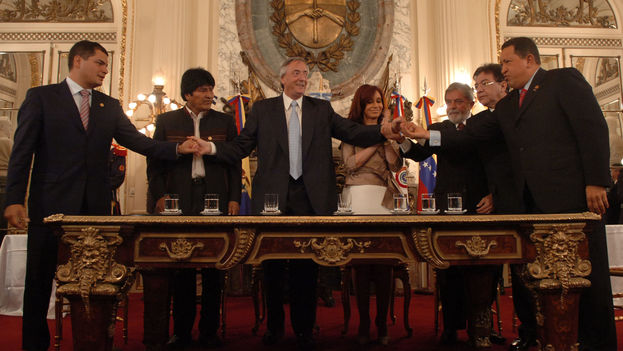
Rafael Correa, Evo Morales, Nestor Kirchner, Cristina Fernández, Lula Da Silva, Nicanor Duarte and Hugo Chavez signed the agreement for the foundation of Banco del Sur in 2009. (DC)

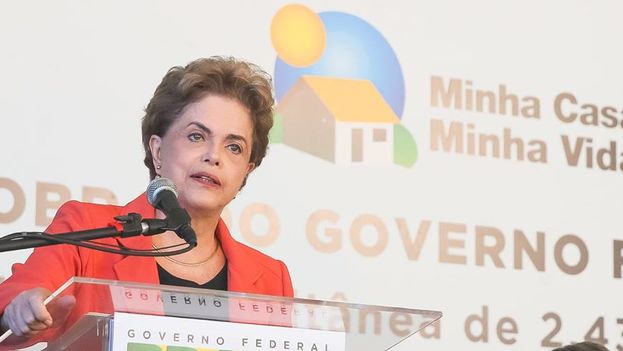
14ymedio bigger14ymedio, Jorge Hernandez Fonseca, 13 May 2016 – Like a good Brazilian novel, where the best scenes are reserved for the end, the Brazilian left is finally exiting the stage of that South American giant. This Thursday, having first served successive terms in the Chamber of Deputies and later the Federal Senate, Dilma Rousseff was officially informed that she had to step away from the presidency, to give her time to prepare her defense in front of the Senate.

Supposedly, Rouseff has 180 long days for this purpose, but the incriminating evidence, as well as the fragility of the defense (although she says otherwise) portend a process that will not use up the available time. The suspended president argues that other presidents did the same thing she did, but without being sanctioned. However, the fact that others committed crimes does not authorize her to commit them. Dilma Rousseff will not return to the presidency of Brazil, and nor will her mentor and leader Lula de Silva, because their party emerges ethically tarnished after numerable cases of corruption. continue reading

It has to be said that Da Silva’s and Rousseff’s Workers Party (PT) only came to power by allying themselves (over these long 14 years in power) to Brazil’s largest party, the Brazilian Democratic Movement Party (PMDB). The PMDB’s departure from the coalition determined, in good measure, Rousseff’s fate in both the House and the Senate. Rousseff’s party was never the majority party in Brazil, and after the “armed assault” staged to steal by the fistful from the state oil company Petrobras, it will not be for the foreseeable future.

Rousseff argues that her actions were not a crime, but more than three-quarters of the House and Senate believe otherwise. All in the context of the moral decadence of her party. The treasurer of Rousseff’s party is in jail, as is the head of the president’s last election campaign, both of them accused of corruption.

The fall of the main bastion of the South American left is nothing more than the continuation of the collapse of the Castro-Chavez project in Latin America, after the fall of Cristina Kirchner in Argentina, the victory of the opposition in the National Assembly elections in Venezuela, Evo Morales’s loss in a referendum to allow his reelection in Bolivia, and Rafael Correa’s agreeing not to run again for the presidency of Ecuador.

The South American subcontinent is beginning to emerge from the long night in which it was mired in left-wing populism promoted by Castro-Chavezism, and hopefully these democratic winds from the south, will reach Venezuelan soil first and Cuban soil afterwards, bringing the democracy that we Latin Americans desire and deserve.

El Trigal Wholesale Agricultural Market Closes Its Doors / 14ymedio

Empty stalls at El Trigal market. (14ymedio)

14ymedio bigger14ymedio, Havana, 13 May 2016 – Less than three years after it opened, the El Trigal agricultural market closed its doors this Friday after it was announced on primetime television news last night by the vice president of the provincial government, Luis Carlos Gongora Dominguez.

Located in Havana’s Boyeros municipality, the center had been heavily criticized by the official press itself in recent months, for its high prices and their possible causes. An article published on the Cubadebate site today enumerated the irregularities that occurred in the market, such as “violations, bad management, corruption, lack of control.” continue reading

Gongora Dominguez said that the sale of agricultural products would cease “temporarily” and the agricultural cooperative that manages the place would also be dissolved, because of “a group of irregularities” that were presented.

The vice president of the provincial government did not detail the causes that have led to the closure of El Trigal, and the television news just announced that in the coming days they will explain to people what happened through “Cuba Dice” (Cuba Says), an information segment that addresses issues such as shortages, the diversion of resources and bureaucratic excesses, from an official point of view.

With the closing of El Trigal many of the retail agricultural markets lost their source of supply in the Cuban capital, including local markets and pushcart vendors.

The El Trigal market, with 16,000 square meters and 292 stalls, was opened with great fanfare in December of 2013, and was created with the purpose, among others, of “eliminating obstacles to the marketing of agricultural products.” The cooperative that managed El Trigal was established with ten partners and the place was basically conceived to concentrate the production from Artemisa and Mayabeque provinces for distribution in Havana.

However, high prices and shortages in that market have been the reality in the just over two years of the life of El Trigal.

Rousseff’s Ouster Will Have a Negative Impact On The Cuban Economy / 14ymedio

Brazilian President Dilma Rousseff. (Facebook)

14ymedio/Agencies, Havana, 13 May 2016 — The suspension of the president of Brazil, Dilma Rousseff, is bad news for Cuba, which, despite detente with Washington, is feeling the effects of the recession affecting its allies in South America and Africa. Brazil will review its short-term policy toward the island, as revealed on Friday to Reuters, by a diplomat from that country who was stationed in Havana.

Over the past 13 years, the Government of Brazil provided Havana with at least 1.75 billion dollars in loans on favorable terms, resulting in criticism from the opposition, which is also angered by the “More Doctors” program, which sent some 11,400 Cuban doctors to work in Brazil. continue reading

These projects will be reexamined after the vote in the Brazilian Senate this Thursday and the ouster of president Rousseff for allegedly falsifying public accounts.

“There will be a short-term review of our policy toward Cuba because the money has run out. All this is not on hold,” said a Brazilian diplomat who asked to remain anonymous.

Some of the Brazilian loans were spent on the expansion of the Mariel Special Development zone, with repayment periods of 25 years at rates of between 4.4% and 6.9%, according to official data from Brazil. The detractors of this policy believe that the terms of the agreements have been extremely generous to a country like Cuba, with recognized solvency problems.

It is not expected that the interim government led by Michel Temer will end the collaboration with the with the Cuban doctors program working in Brazil since 2013, although it will not contract with new doctors. “This model of cooperation is debatable and he will not support, although I doubt they throw the Cuban doctors out of the country,” a diplomatic source told Reuters.

Last month, Rousseff extended the health services contract for three years, a measure that is currently pending in Congress.

Cuban medical personnel work in some of the remotest regions of Brazil, where they enjoy the support of local authorities. The holding of municipal elections in October is one of the factors that Congress should consider before opting for a drastic interruption of the program of cooperation.

Allies like Venezuela, Brazil and Angola have been used their enormous oil revenue during the boom years—now diminished by the very low price per barrel—to pay for medical and educational services from Cuba, making these a principal source of hard currency for the island..

The thaw reached by President Raul Castro with the United States has been a boost for tourism, but revenue from this sector accounts for only about a third of the seven billion earned in 2014 through the export of health and education services.

The Government of Cuba began to cut imports and request longer deadlines for payment to foreign suppliers last year, and is falling behind in its obligations this year, according to Western diplomats and businessmen. “Clearly, they have a liquidity problem. Some of our companies receive payments and others do not,” a European ambassador told Reuters on Monday.

The official forecast points to a slowdown in economic growth for 2016 compared to 4% increase recorded last year.

Hundreds of Cuban Migrants Are Stuck in Panama Without $805 to Travel to Mexico / 14ymedio, Mario Penton

Cuban migrants stranded in Panama are waiting to buy their tickets to Mexico. (Courtesy)

14ymedio bigger14ymedio, Mario Penton, Miami, 13 May 2016 — More than 300 Cuban migrants cannot pay their passage to Mexico or have only part of the money, a source in the Panamanian government who requested anonymity told 14ymedio on Friday. The migrants are in a temporary shelter prepared by the authorities in Gualaca (Chiriqui province), and so far it has not been decided what will happen with those who don’t manage to get together the $805 that Panama’s Copa Airlines is asking to take them to Ciudad Juarez.

Yuneisis Martell, a woman from Villa Clara stranded in Panama, says chagrined, “The majority have already left, those of us who are left are those who have nothing.” continue reading

“I don’t know what they are going to do with us, the problem is that many of us here lost money on the way, with the assaults, and what we had left went to paying for the stay and food in Pasa Canoas,” on the border with Costa Rica.

In recent days, more than 1,000 Cubans have flown to Ciudad Juarez, or are in the process of doing so, according to sources in the National Migration Service. Last Monday, the Panamanian government started the transfer of more than 3,800 Cubans who had been stranded in their country, as part of an agreement with Mexico.

Xiegdel Candanedo, representative of Caritas’ Social Pastoral in the Chiriqui province, told 14ymedio that this organization, belonging to the Catholic Church, will continue to support the Cubans. According Candanedo, the ministry has so far donated food, medicine and clothing, collaborating with the National Migration Service and the National Civil Protection Service.

Candanedo said his organization “is not in a position to spend thousands of dollars to help Cubans to reach the United States,” but said that at least four or five passages have been paid for by private donors through Caritas. “Today we have learned of the case of a family that has the resources to buy tickets for the parents, but needs to find the money for the passage of the child,” he said.

For Keila Ortega the hours in Gualaca don’t pass. Every time she sees a compañero leave the refuge, while she remains stuck there, she feels more desperate. “My friends have turned their backs on me and those who could help me right now are in a very difficult situation. They’ve already done enough.”

The women fears that in the end she’ll remain trapped in Panama. “There are those who say the Cuban-American members of Congress can’t help us. I would like anyone reading this to remember that they, too, came from Cuba in the same situation as we are in, and it might touch their hearts,” she said.

A Miami businessman is making efforts to collaborate with helping these migrants, although he declined to comment as long as his plans aren’t firm.

In the Dark / 14ymedio, Regina Coyula

Residents of #2 Bernaza Street, between Obispo and O'Reilly, were victims of an accident caused by the Electric Company at the site of repairs
Residents of #2 Bernaza Street, between Obispo and O’Reilly, were victims of an accident caused by the Electric Company at the site of repairs

14ymedio bigger14ymedio, Regina Coyula, Havana, 13 May 2016 — The municipality of Old Havana had its ancient underground water and electrical systems renovated last year. The streets were dug up to replace the pipes and wiring. Beyond the mess and the dust, these works have brought the residents two precious services, services without which it is unthinkable to live in a modern city. But the happiness has not been felt everywhere.

Residents of #2 Bernaza Street, between Obispo and O’Reilly, were victims of an accident caused by the Electric Company at the site of the repairs. An overload destroyed electrical appliances; a few stabilizers managed to protect a few. The jolt didn’t even spare many appliances protected by their owners’ surge protectors. continue reading

The building remained dark for several days and the residents organized to complain. The Electric Company blamed the Havana Water Company, which was able to prove its innocence, so the Electric Company was obliged to replace—“when there is availability”—the burned out appliances and to extend new wiring to the meters.

From the meters onward, that is to every apartment, is being litigated, so the majority of the residents, watching the days tick by without power, decided to resolve it themselves and to pay the Electric Company workers under the counter to connect their homes. With the wiring outside, almost all the residents have had makeshift electrical service for months now. But there are stubborn residents, or those who don’t have the 100 CUC (roughly $100 US) that it would cost to pay the electrical workers, and with faith in the power of justice, they have decided to take their case through institutional channels.

Those who have now lacked electricity for six months are finding the institutions unresponsive. The delegate to the People’s Power showed up on the day of the accident, but is surely engaged in the many other problems of her constituency. There was silence in response to letters to the Municipal and Provincial People’s Power. Silence in response to the section for complaint letters at the newspapers Juventud Rebel and Granma. Silence in response to a letter to the similar section at the Havana Channel. And silence in response to letters to the Electric Company. All this correspondence has been the victim of these residents’ “darkness syndrome,” and they haven’t received even an acknowledgement of receipt.

Only the Prosecutor took the time to rule that the residents are right and that the Electric Company is responsible, but this has not resulted in any change for those affected.

And in an event that is not without irony, the electric bills, which should show a “zero” for electrical usage, have arrived with an “approximate use” calculation, which after the accident caused by the Company last November is applied to the residents who have connected themselves to the electricity. Sparking new trips to the Basic Electricity Office in Old Havana to explain to them what they should obviously be very aware of.

One of the residents rests his hopes on managing to get an interview with the Minister of Basic Industry, which controls the Electric Company. His effort began through a friend who has a friend who is a friend of the minister, but after waiting three months for this improbable event, he went to the ministry in person and asked for an interview. He was assured that even though it is delayed, the minister deals with cases like his, so he feels optimistic that the blackout he is suffering will be resolved.

After learning about this event, we can make some inferences that go beyond who is responsible and what the deadlines for resolution are:

  • Most of the neighbors have no confidence in the institutions and decide to resolve the problem on their own
  • The pathetic complaint mechanisms available to citizens do not work
  • The capacity of some to resign themselves to such things is worthy of a study that could explain certain social behaviors, well beyond those related to a simple outage

Coppelia Puts Makeup on the Shortages / 14ymedio, Luz Escobar

Those who knew the centrally located ice cream parlor during its first decades of life complain that after the remodeling the presentation, variety and taste of the products on offer has not improved. (14ymedio)

14ymedio bigger14ymedio, Luz Escobar, Havana, 12 May 2016 – Havanans enjoyed a certain freshness twice this weekend. Not only did the thermometers drop a few degrees, but the emblematic Coppelia ice cream parlor, located in the heart of the capital, reopened its doors after being closed for repairs for several weeks. The work is part of the 50th anniversary celebration of this famous place, which is commemorated on the 4th of June.

The reopening of Coppelia has given rise to many reports in the official press. Last Friday, the place was visited by a select group of officials and later the public was allowed in. The customers could see that after a new coat of paint and the revitalized green areas, the quality of the ice cream sold in Cuban pesos continues to be low. continue reading

On Tuesday afternoon, a long line extended under the sun outside what is commonly called the “Cathedral of Ice Cream.” However, those who knew the centrally located place in its first decades of life complained that the remodel has not been accompanied by an improvement in the products, either in its presentation or in its flavor and variety.

heladeria-Coppelia-puertas-proceso-reparacion_CYMIMA20160511_0022_12

A man about 60 commented that the ice cream was “watered down,” he had tried the combination known as a “salad” which is five scoops and some cookies. The man couldn’t stop laughing when near his table a young man exclaimed he was amazed that Coppelia had returned with “a pile of flavors<’ because on the menu you could read that they are selling chocolate, curly chocolate, vanilla and strawberry.

Melancholy, the customer then evoked the original menu that distinguished the most famous Cuban ice cream parlor, when there were 26 flavors and 24 possible combinations. The difference is not in the quantity, but in the deterioration of the quality of the ice cream, that sometimes has bits of ice in it, little flavor and no pieces of natural fruit, like the strawberry, the orange pineapple and the mango they used to have.heladeria-Coppelia-puertas-proceso-reparacion_CYMIMA20160511_0015_12

To the annoyance of the customers, the place keeps some traces of the “workers diner” that it was during the Special Period. For example, you have to share the tables, there can’t be any vacant chairs, and it is not always pleasant to sit with strangers.

On the top floor, known as The Tower, and beautifully designed by the architect Mario Girona, they still limit sales to “two specialties per person” according to an employee. However, with a couple of bill slipped into the right hands, a customers can take home all the ice cream they want, always with the stealth of “not filling the cups in view of the bosses,” says the waitress.

One of the new features much appreciated after the closing is the white earthenware dishes in The Tower that replace the plastic ones, which, however, remain in the so-called “courts” down below. In the first week of the reopening, all the employees who serve the ice cream haven’t learned how to serve the ice cream in hollow scoops, a unique specialty of selling ice cream in Cuba, and that has characterized the celebrated ice cream parlor for years.

“Let’s see how it is three weeks from now,” said a distrustful mother who took her two little kids to have ice cream at 23rd and L, the most famous corner in the capital, this Tuesday. The woman sneered that “the cookies that are supposed to go with the ice cream are where they’re supposed to be, on the plate,” but “in a few days they’ll be back in the hands of the resellers outside the courts selling for extortionate prices.

A group of tourists naively asked customers why they were lined up a few yards from a completely empty area selling the most varieties of ice cream. A young college student, who was with a group of students from the philosophy school, explained to the foreigners the difference between consuming things in Cuban pesos versus Convertible pesos. “The one in chavitos (convertible pesos) is better, but there’s no one who can afford it,” said the young man.

The areas that are refurbished now are the The Court and The Tower, along with the imposing white staircase that leads to the upper level, the dome, the roof, and the typical wood and glass windows, also located on the upper level. The refurbishment program includes spaces such as the bar on the ground floor and the bathrooms, which will begin to be restored in the coming weeks.

However, for many customers the improvements should not remain in the physical appearance of Coppelia, but should be targeted to recovering the prestige it once enjoyed, now “watered down” like its ice cream, poor quality, unprofessional treatment by its employees and the absurd measures implemented in its services, including the closure of the beautiful passage to passersby. From now on, you can only enter after standing in the long line outside the Cathedral of Ice Cream that seems to have lost its way.

Caterpillar “Is Ready” To Join The Cuban Market / 14ymedio

Caterpillar machinery company

14ymedio bigger14ymedio, Havana, 12 May 2016 — US machinery maker Caterpillar is ready to enter the Cuban market once the embargo is lifted, confirmed Caterpillar director Doug Oberhelman on Wednesday, after a meeting in Havana with the island’s authorities.

The management of the company, headquartered in Illinois, told Reuters that it was “received warmly” by the representatives of the Cuban government during their two-day stay in the country. The executive traveled to Havana for the first time to participate in an event organized on the occasion of a half million dollar donation from the company for the conservation and preservation of documents and artifacts from the former home of American writer Ernest Hemingway in Cuba. continue reading

“We have talked about different projects,” he told reporters, “and I think the most interesting in the short term is at the Port of Mariel.”

To the question of when he expected the embargo to be lifted, Oberhelman said, “For me, the answer is not soon enough.”

This last February, Caterpillar named the Puerto Rican company Rimco as distributor of its products in Cuba in anticipation of the lifting of the trade embargo against the island.

In June, representatives of the group, along with employees of other major US companies like Cargill and Procter & Gamble, supported lobbying efforts in Congress by the organization Engage Cuba to lift restrictions on travel and trade with Cuba, supporting by Democratic and Republican advisors.

Cuba-Disneyland and Its Leftist Pimps / 14ymedio, Isaac Nahon Serfaty

Who gives a crap that repression continues against political dissidents?

14ymedio bigger14ymedio, Isaac Nahon Serfaty, 10 May 2016 — Cuba is now the Disneyland of the fashion show business. The list of celebrities who go to the island as almost archeological tourists is growing every day. The Mummy Stones, the Lagerfield effigy, and the inevitable voluptuous Kardashion have made their Havana pilgrimage. From Miami comes a cruise ship acclaimed by local enthusiasts. The gringos, like the expected Mr. Marshall from Garcia Berlanga’s film, wander along the Malecon and enjoy their mojitos. Fascinated, they discover a theme park populated by dilapidated American sedans, Old Havana with its architectural gems both restored and in ruins, and a people hungry for change. All this under the admiring acclaim of Western media fascinated by a supposed “opening” in the Pearl of the Caribbean.

It is worth the exercise of historic imagination to show the inconsistency of the liberal politicians and the enthusiastic journalists. Let’s consider, for example, that some legendary rockers, a fashion designer and an exemplar of the “beautiful people” had decided to visit Chile in the times of Pinochet to celebrate the economic opening implemented by the dictator at the hands of his neoliberal technocrats. continue reading

It is not difficult to imagine the reaction, fully justified, of leftist intellectuals and politicians: “What barbarity to endorse the bloody dictator!” “We must reject this propaganda maneuver of Yankee imperialism!” “Enough with the manipulation to conquer the fragile minds of our people, poor victims of industrial culture!” “Let’s boycott the music, clothes and porno photos of these agents of imperialism!” And so we could continue with variations on the same manifestations of indignation.

However, when this happens in the Cuba controlled by the monarchical Castro dictatorship, everything is all parties and laughter. Who gives a crap if the repression against political dissidents continues? Who cares if the regime’s propaganda machinery continues to vomit its hollow slogans while it limits freedom of expression? Who worries about the refugees escaping the island for the United States (via Costa Rica, for example), before Obama, or whoever succeeds him, eliminates the privilege of the Cuban Adjustment Act? Who denounces the military nomenklatura that controls the state enterprises, collecting bribes and preparing the terrain for an economic opening in the style of savage capitalism?

The hypocrisy of the leftist pimps has annulled their critical capacity. They is not capable of digesting that in their breast there is too much corruption (so says Lula); that with the excuse of the liberation of the people they proclaim a discourse of anti-Semitic hatred (as some in the British Labour Party say); with the alibi of the struggle against injustice and inequality they mount a new class of privileged cynics (so say the “bolichicos”—the young and politically connected Venezuelan entrepreneurs—of Chavism).

Carlos Rangel, a Venezuelan writer prematurely disappeared and despised by this left, in the seventies drew the portrait of that intellectual misery that idealizes the myth of the “good revolutionary.” Myths are not only symbolic resources. They are instruments to legitimize interests and businesses, like those now being cooked up in Cuba-Disneyland.

__________

Editor ‘s note: Isaac Nahon Serfaty is professor at the University of Ottawa (Canada). This text has been published in the Spanish newspaper El País and is reproduced here with the author’s consent.

A Laboratory Man: The Official Party ‘Cadre’ in Cuba / 14ymedio, Reinaldo Escobar

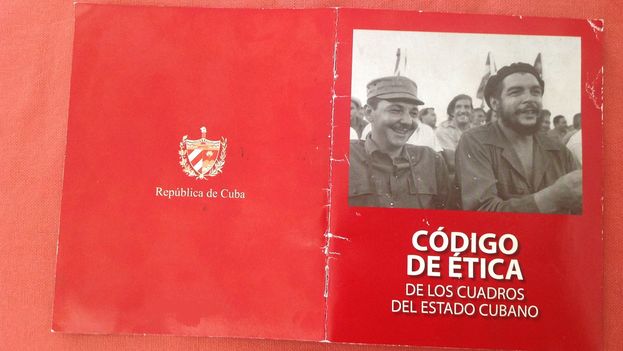
The Code of Ethics for Cuba’s Communist Party cadres. (14ymedio)

14ymedio bigger14ymedio, Reinaldo Escobar, Havana, 9 May 2016 – Marxist thinkers from the last century appeared to be convinced that the communist ethic could only work after the elimination of the different social classes or, and it’s the same thing, when the communist society triumphed in the economic plane. “How can stealing be ethically condemned when there is no property?” they asked with the same guileless eagerness medieval theologians brought to their debates about the carnality of the glorious bodies resuscitated after the final judgment. continue reading

In practice, politicians who have had to get their hands dirty in an attempt to implement different Marxist experiments have come to understand the length of this “transition stage” called socialism. They have confronted the contradiction of not being able to lay their principles in the already rejected “bourgeois morality” and, on the other hand, they have seen the impossibility of applying communist morality in anticipation, impractical without the support of the material base assumed in the scientific fulfillment of their inexorable laws.

In consequence, each “historically determined” model found its provisional ethics, negating the previous one but incompatible with those of the future. It was that ethic that enabled Joseph Stalin’s forced collectivization, Mao’s Great Step Forward, and Fidel Castro to decree the Revolutionary Offensive. From this moral relativism arose the Code of Ethics for the cadres of the Cuban State.

The original version of this little known document was promulgated on 17 July 1996, signed by the then all-powerful Carlos Lage Davila. It was called Agreement 3050 and was displayed as a “proposal presented by the Cadres’ Central Committee, concerning the need to define and systemize a code of standards that would rule the lives and conduct of the Cadres of the Cuban State.”

Among the purposes and forms of application summarized in seven points, is the need to alert and prevent cadres “facing tendencies that could arise in the face of economic transformations and aggressive enemy action.” Compliance with the principles codified would be obligatory for the heads of the state’s central administrative organs, national entities, and presidents of the provincial and municipal People’s Power Administrative Councils, among others, who will have to determine “within their respective systems, the positions to which the Code of Ethics will be applied.”

Once these functionaries know and accept the content of the new rules, they will have to express their willingness to comply with them “publically, in an official act at the acceptance of the position.” Not content with that, “in cases of promotions and transfers, in the process of preparation for the new position,” the cadre is obliged to update his or her knowledge of the document, as well as again publicly ratify the commitment to fully comply.

Through a table of commandments broken down into 27 points, the Code demands “high moral values, deep revolutionary sensitivity, and a clear sense of duty” along with other virtues that cadres must have, such as sincerity, honesty, modesty, austerity, simplicity and discretion.

At the same time, it condemns lying, deceit, demagoguery, fraud, apathy, indolence, pessimism, hypercriticism and defeatism. Among other harmful attitudes indicated are the spirit of justification, inaction in the face of difficulties and mistakes, lack of initiative, the features of ostentation and consumer habits. It warns that the performance of cadres should be stripped of voluntarism, vanity, improvisation, professional injustice and mediocrity as well as sectarianism, and contempt for the dignity of others. Cadres must combat boasting, self-sufficiency, conceit, intolerance and insensitivity.

Paradoxically, the inability to be consistent with such requirements has promoted a defect not mentioned in the text: simulation – that is, faking it – the only alternative to which has been, for many, desertion, an action not contemplated among the violations.

In the 20 years of the Code of Ethics’s existence, probably not a single one of the sins of listed here has ceased to be committed, nor has there flourished even one of the untarnished virtues advertised therein. Not only that, but sins have been abundant and virtues few at all levels of the government and political leadership of the country, and at all levels of administration.

In the wasteland of moral values there has been unleashed a plague of brazen cynicism, of sordid impudence that nobody knows how to stop. And not even mentioned is the advent of the New Jerusalem the communist utopia would suggest. There will be a final judgment where we all will have to be forgiven for something.