Cuba’s Phone Company Lowers Home Internet Prices After Customer Complaints

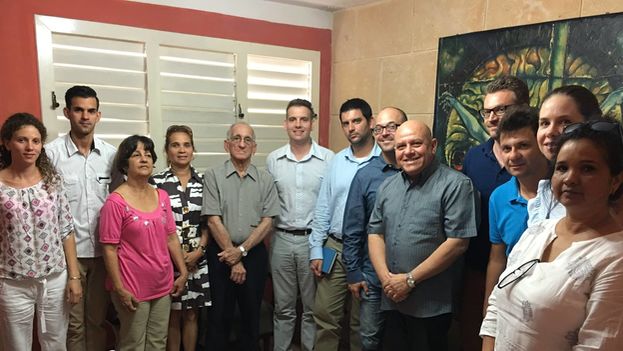
Users are looking for information about the rates of “Nauta Home” service at the phone company office on Obispo Street in Havana (14ymedio)

14ymedio bigger14ymedio, Havana, 5 April 2017 – After complaints from customers, the Telecommunications Company of Cuba (ETECSA) lowered internet browsing prices for its “Nauta Home” service. A few weeks after the pilot test, only 358 users have signed up for the service, 41% of whom who participated in the pilot project.

The pilot offered the service for free, bringing the internet to 858 homes in two People’s Councils areas of Old Havana, between 19 December 2016 and 28 February of this year. Initially the pilot was designed to include some 2,000 families. continue reading

At first, ETECSA marketed 30-hour internet packages for a price of between 15 and 105 Cuban convertible pesos (CUC) (roughly the same value in US dollars), at speeds ranging from 128 kilobytes to 2 Mb. However, as of 30 March, the minimum package has doubled the speed to 256 Kbps at the same price.

The 512 Kbps package now costs 30 CUC — more than the average monthly wage in Cuba — and the 1,024 Kbps costs 50 CUC, with 2,048 Kbps going for 70 CUC, a reduction of 40 percent; but the prices remain prohibitive for most Cubans.

The 512 Kbps package now costs 30 CUC — more than the average monthly wage in Cuba

The engineer Amarelys Rodríguez Sánchez, head of the Nauta Home Project, told the official press that during the test, issues such as contracting and service assistance were evaluated, as well as “the quality of the speeds.”

“The study has raised demand for wireless modems,” said the engineer, who added that customers also demanded that “rates be more affordable” and that there be a tool that allows them to “measure the speed at which they are surfing.”

The initial cost of a contract will now be 29 CUC: 19 for the purchase of the ADSL modem, and 10 CUC for the activation of user access.

Customers wishing to use more connection time will pay an additional 1.50 CUC for each extra hour.

Until now, web browsing from the homes had only been allowed for a select group of professionals

Until now, web browsing from home was only allowed for a select group of professionals such as doctors, journalists, intellectuals or academics, who needed government authorization to have the service.

Rodríguez justified the high rates because of “all the investments that must be deployed” by the company. “Fiber optic infrastructure solutions are very expensive, as is implementing a project that requires multiservice equipment.”

To continue expanding the service ETECSA needs to “make specific investments on fixed and mobile networks,” she said.

By the end of 2017, the company plans to have installed at least 38,000 internet connections in the island’s homes.

“State Security Doctors Constantly Mistreated Us”

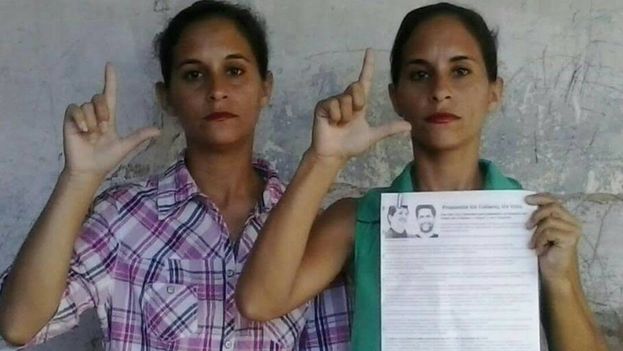
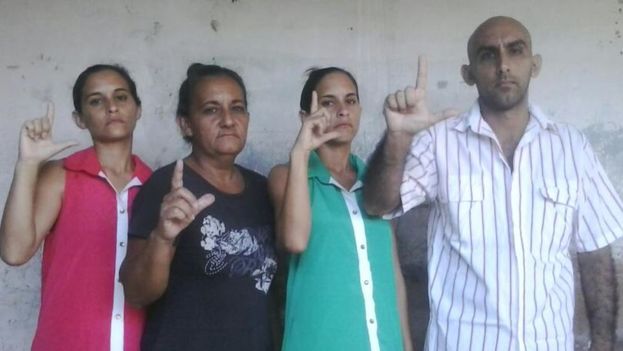
Anairis Miranda Leyva and her sister, Adairis, have just been released on parole after three weeks on a hunger strike. Adairis holds a report about Oswaldo Paya, founder of the Christian Liberation Movement (MLC) and Harold Cepero an activist in the movement, both of whom were killed in a suspicious car accident. (MLC)

14ymedio bigger14ymedio, Havana, 4 April 2017 — Maydolys Leyva can breath easy for the first time since last March 7. Her three children have abandoned their hunger strike after being released on parole. This Monday, their mother prepared a meal of mild creamed vegetables, root vegetables and meat for her daughter Anairis and son Fidel Batista, as they began to resume eating. Her other daughter, Adairis Miranda, is still in intermediate care.

From her bed at Vladimir Ilich Lenin Teaching Hospital in Holguín, where she is recovering, Anairis Miranda spoke via telephone with 14ymedio.

14ymedio. What led you to undertake the hunger strike?

Anairis. We spent 27 days without food and continued to demand the immediate release of our family because we never accepted the unjust sentence of a year of deprivation of liberty imposed on us. continue reading

We are also demanding the release of the political prisoners of the Cuban Reflection Movement to which we belong with pride and whose national leader is Librado Linares. We also demand the immediate release of the national leader of the Christian Liberation Movement, Eduardo Cardet. In response to these demands we obtained parole for health reasons.

14ymedio. Are you still under surveillance?

Anairis. Right now, here in the hospital, there is no presence of State Security. As of Sunday, when they delivered the parole documents to us, they took their repressors and left.

14ymedio. What were the most difficult moments during the strike?

Anairis. We suffered a lot of repression by State Security. They made threats against our mother’s life. The official in charge of confrontation in the province of Holguin, Fredy Agüero, threatened to take custody of my sister’s two children, who were being looked after by our mom. He said they would arrest her and kill her in prison.

“The official in charge of confrontation in the province of Holguin, Fredy Agüero, threatened to take custody of my sister’s two children, who were being looked after by our mom”

14ymedio. How is your sister right now?

Anairis. Adairis is now in intermediate therapy in the surgical clinic, she has a monitor and an IV. We all have very low blood pressure. We weigh 66 pounds and are continuing to lose weight. My brother has very unstable blood pressure, it goes up and down. My brother and I are suffering from ischemic heart disease as a sequel to the strike. I have some vaginal bleeding and diarrhea. I am still very ill, just like my siblings.

14ymedio. How has the treatment from the doctors been from a humane point of view?

Anairis. Some doctors have treated us well, those who are not from the Ministry of the Interior. The doctors of the State Security, who constantly mistreated us, have already left. They tried to misrepresent everything about our health and to overshadow everything. Now, since they left, we have noticed the change in the treatment of the hospital doctors and the people who have come to see us. Before they didn’t let anyone approach us.

14ymedio. How many days do the doctors expect you to remain  hospitalized?

Anairis. They tell us that we have to stay in the hospital about ten more days because we could suffer a heart attack or different complications can occur, although in the case of my sister it could be longer depending on the improvement in her immune system.

14ymedio. How did you receive evidence of solidarity?

Anairis. I would like to give my heartfelt thanks to the international public for their solidarity and to all the brother and sister activists of both the diaspora and the country. Of course, also the journalists who reported what happened.

Pro and Anti Castro Graffiti Face Off in the Canary Islands

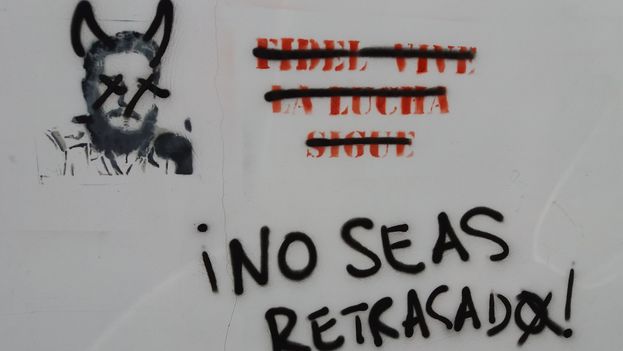
Photo caption: Red text: “Fidel Lives. The Struggle Continues.” Black Text: “Don’t be Retarded.”

14ymedio bigger14ymedio, Las Palmas de Gran Canaria, 5 April 2017 — A little more than four months after Fidel Castro’s death, the former Cuban leader continues to stir up controversy outside his country. In the city of Las Palmas de Gran Canaria in the Canary Islands, graffiti in support of the former president, spray painted using templates, has shown up on several walls.

However, one instance of the graffiti pained on the wall of abandoned tenement in the center of the island’s capital, gave rise to a duel among graffiti artists.

The portrait of Fidel Castro appears with two crosses over his eyes (which symbolize his death) and horns over his head, referring to the diabolical character of the former president. The phrase “Fidel lives. The Struggle Continues,” is completely crossed out by the second graffiti artist, who then paints “Don’t be retarded,” in reference to whomever stenciled the pro-Castro sign.

Within a short distance of this graffiti is the Cuban Consulate in the Canary Islands, where demonstrations for and against Havana’s government have taken place for years, with the participation of the Spanish Young Communists Union (UJCE).

On Tuesday, the other Young Communists Union (UJC) – the one in Cuba – celebrated its 55th anniversary, in the midst of a process of decline and a constant loss of membership.

Cuba Controls Electronic Eavesdropping Center in Venezuela, Says Former Chavez Official

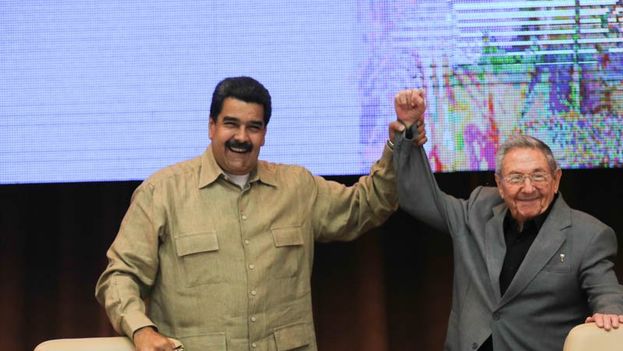
Raúl Castro and Nicolás Maduro on the 22nd anniversary of the Bolivarian Alliance of the Peoples of Our America. (@PrensaPresidencial)

14ymedio bigger14ymedio, Madrid, 5 April 2017 — Cuba controls everything that happens in Venezuela through an electronic eavesdropping center, according to statements made to the Spanish newspaper ABC by Gyoris Guzmán, who between 2013 and 2015 was the director general of Venezuela’s Office Against Organized Crime and Terrorism Financing.

Information obtained by Venezuela’s Center for Security and Protection of the Homeland (CESPPA) continues to be controlled by Cuban intelligence services according to this information. continue reading

The Venezuelan center was created by Nicolás Maduro in 2013 to unify confidential information previously dispersed between the Military Intelligence Directorate (DIM), the Bolivarian National Intelligence Service (SEBIN) and the police forces.

CESSPA employs a group of hackers and electronic experts that controls electronic eavesdropping in addition to the usual information mechanisms of the security bodies.

“All this information ends up in the hands of the Cuban intelligence services, the G2,” says the former Chavista official, who has asked for asylum in Spain

“All this information ends up in the hands of the Cuban intelligence services, the G2,” says the former Chavista official, who has applied for asylum in Spain, and was invited to give a lecture on CESPPA.

According to the Spanish newspaper, Guzman was surprised that it was not the head of SEBIN, Gustavo González López, who was in charge, “but rather a Cuban commander known as Colonel Camilo, who happens to be the representative of the G2 in Venezuela.”

Guzman also referred to the favorable treatment received by Cuban commanders in Venezuela and told ABC that, as head of the Office Against Organized Crime, he administered property seized from criminals and his superiors made him turn over a waterfront beach apartment in Tucacas to Colonel Camilo, who was also provided a truck that had been seized.

At 55, Cuba’s Young Communist Union Loses Relevance But Does Not Want To Retire

Cuba’s Union of Young Communists logo has the faces of Julio Antonio Mella, Che Guevara and Camilo Cienfuegos, all of whom died young. The slogan on the logo is “Study, Work, Rifle” (EFE)

14ymedio bigger14ymedio, Zunilda Mata, 4 April 2017 — There was a time when its red card was a source of pride and most teenagers dreamed of entering its ranks. But those days have been left behind for the Young Communists Union (UJC), an organization that turns 55 this Tuesday, with an aging image and a noticeable decrease in its membership.

Founded in 1962, the UJC was a copycat of the Soviet Komsomols, creating a youth front that served as a quarry for the Communist Party of Cuba (PCC). In the midst of the enthusiasm of those years there were massive “processes of growth,” with the signing up of numerous members, but today many evade or reject this opportunity. continue reading

“I never questioned whether or not to enter the UJC, it was what all my classmates did and I joined,” recalls Gladys Marrero, a retired nurse who worked with the organization for more than a decade. “In those years everything was different, people believed much more what was said in the meetings,” she says.

Marrero was sanctioned in her local committee in 1980 for not participating in acts of repudiation against those who emigrated during the Mariel Boatlift

Marrero was sanctioned in her local committee in 1980 for not participating in acts of repudiation* against those who emigrated during the Mariel Boatlift. “In the polyclinic where I worked a lab technician asked to step down to be able to leave [the country] and the UJC prepared a rally to ‘say goodbye’ to her,” she remembers. She didn’t want to participate in “those antics” and turned in her card.

Of the nearly three million young people living in Cuba, according to the most recent Population and Housing Census of 2012, only 300,752 are affiliated with the UJC, which operates through 33,000 base committees across the island. The figure is much lower than almost 600,000 members who were on the rolls in 2007, when the country was in the midst of the effervescence of the Battle of Ideas.

Yosvani, 25 years old and resident of Aguada de Pasajeros in Cienfuegos, was one of the young people who enrolled in the UJC during those years. “Several municipal leaders came to our high school and said they were going to undertake massive growth throughout the country, with more than 10,000 new militants,” he tells this newspaper.

Over time, the young man lost interest because “there were too many meetings” and “they summoned us for anything.” One day he pretended that he had a serious health problem and asked for his discharge. In his local committee alone “more than half of the militants left,” he says. Some alleged family complications, but Yosvani believes they actually did it out of “lack of interest.”

In Nuevo Laredo, Mexico, several young people waiting to enter the United States also once had the organization’s red membership card in their pockets. Richard, a fictitious name to avoid retaliation, has been stranded for two months at the US border after the cancellation of the wet foot/dry foot policy that allowed Cubans who stepped foot on American soil to stay. Although he calls himself a “revolutionary” he does not plan to mention his affiliation to US immigration officials should they “reverse Obama’s decision and let the Cubans in.”

The migrant served as general secretary of his local committee and believes that “the UJC helped many young people not to fall into delinquency and to direct their lives”

The migrant, who spoke with 14ymedio through videoconferencing, served as general secretary of his local committee and believes that “the UJC helped many young people not to fall into delinquency and to direct their lives.” However, he believes that the organization “fell into a rut” although “it still has a large presence in schools and workplaces, so it could take advantage of that structure.”

In the middle of last year a young Cuban migrant was declared “inadmissible” by the US authorities because she confessed to having belonged to the Young Communists Union between 2010 and 2013.

The absence of leadership has also hampered the activity of these komsomols. Of the UJC’s dozen first secretaries since its creation, more than half ended up being ousted while they leading the UJC or in later positions. The most famous cases were Luis Orlando Domínguez (1972-1982), Carlos Lage (1982-1986) and Roberto Robaina (1986-1993). The fear of ending up like them slows down many who would like to present themselves as more active and creative. Charisma is paid for dearly in these types of responsibilities.

“People do not want to take positions inside the UJC to avoid getting into trouble,” says Yosvani. “That’s a tremendous burning,” he quips. The young man criticizes the “lack of power of the militants who go along with many things in the meetings but they do not have ability to influence decision making.”

In 2015 and during meetings of the organization before the 10th Congress, the militants expressed their concern about the UJC’s stagnation

In 2015 and during meetings of the organization before the 10th Congress, the militants expressed their concern about the UJC’s stagnation. “It needs to be a living organism that has diversity, is truly transformed and represents young people,” said Han García, a student at the Victoria de Giron [Bay of Pigs Victory] Faculty of Medical Sciences.

In an attempt to revitalize the organization and during an extraordinary meeting of the UJC in the middle of last year, the psychologist Susely Morfa González was named first secretary of the organization, replacing Yuniasky Crespo Baquero. Shortly afterwards, her meteoric rise continued when she was chosen as a deputy to the National Assembly of People’s Power and made a member of the Council of State.

The young woman had turned in a combative performance at the Summit of the Americas in Panama in April 2015, starring in several acts of repudiation in which she labeled activists and exiles who participated in a parallel event with civil society as “lackeys, mercenaries, self-financed, underpaid by imperialism.”

On Tuesday, in an interview with the official press, Morfa stated as a purpose of the UJC “to add to it so that it is an organization for everyone, so that each young person feels ever closer to it.” The secretary general estimates that among young Cubans “the vast majority is revolutionary,” although she acknowledged that “some people are questioning whether the new generations are aware of their social role.”

The UJC has set out to capture young entrepreneurs at any cost but does not seem to have found much enthusiasm

But the functional paralysis and the diminution of its ranks are not the only concerns for the leaders of the UJC. The growth of the private sector has widened the phenomenon of young people who are outside the organization’s control and who work in a system governed by the laws of supply and demand.

Of the more than half a million self-employed workers on the island, 159,563 are young. The UJC has set out to capture young entrepreneurs at any cost but does not seem to have found much enthusiasm.

“What I like about my work is that there are no meetings, no union, and I do not have to donate part of my salary to the Territorial Troop Militias, much less go to UJC meetings,” says Roland, a worker in a restaurant in Chinatown, in Havana.

“Provincial and national leaders have come to talk to the young people here to raise awareness and make them militants, but people just aren’t up for that,” he reflects. “Now life is harder than when my parents were in the UJC, you have to earn money with a lot of effort and there is no time for so many meetings,” he finishes.

*Translator’s note: This video – “Gusano” (Worm) – is about a current day repudiation rally and the opening scenes show video from the Mariel Boatlift repudiation rallies.

Cuban Evangelicals Denounce Complacent Article By Associated Press

Religious Cubans are often repressed by the state.

14ymedio bigger14ymedio, Ricardo Fernandez, Pinar del Rio, 31 March 2017 – A report published by the Associated Press published last Monday, under the title “Far From the Dark Past, Evangelicals Growing in Cuba,” upset evangelical pastors with its open defense of the Cuban regime to the detriment of religious freedom.

The author, Andrea Rodríguez, cites one of the many examples of pastors imprisoned for their faith in the first decades of the Revolutionary Process, to compare it to the current situation and to refute the report from Christian Solidarity Worldwide. The London-based organization reported 2,380 violations of religious freedom in Cuba in 2016, among which were declaring 2,000 churches of the Assembly of God illegal, with 1,400 confiscations of properties. The report also denounced the persecution and imprisonment of parishioners, as well as the destruction of churches. continue reading

The reaction to the article, which has been circulating by e-mail between pastors and parishioners, lies in the fact that sources cited by the Associated Press journalist are close to the Cuban Government, so they have retained a number of “privileges” that should be inalienable rights for all Cubans.

Pastor Bernardo de Quesada of the Apostolic Movement believes that the report is “counterproductive” and “very loose with regards to the reality of religion in Cuba.”

The religious leader says, “Many of those who were interviewed did not speak truthfully and the journalist wrote it with marked apologies to the communist system.” He also claims that Rodríguez only included “a part” of his statements.

For Dagoberto Valdés, director of the Coexistence Study Center and a well-known Catholic layman, “it is common” to confuse freedom of belief, freedom of worship and religious freedom but “they are not the same”

“When I was interviewed, I didn’t express the ideas that were written,” he adds.

For Dagoberto Valdés, director of the Coexistence Study Center and a well-known lay Catholic, “it is common” to confuse freedom of belief, freedom of worship and religious freedom, but clarifies “they are not the same.”

“In the first decades of the Revolution we were persecuted for the simple fact of believing, professing a religion was a crime. Today we have gained that space, but we were not given it by the goodwill of government leaders,” says Valdés.

He acknowledges that a majority of people can regularly attend their religious ceremonies without being persecuted, but asserts that religious freedom is much more than that. “When Lieutenant Colonel Osvaldo (head of State Security’s Technical Department of Investigations in the province of Pinar del Río) threatened me in his office, he said that I was crossing the line between Christianity and the counterrevolution with the Coexistence Study Center.”

Kiri Kankhwende, a spokesman for Christian Solidarity Worldwide, accused the churches of not wanting to speak out because of government pressure.

The Office of Religious Affairs of the Communist Party is in charge of monitoring the religious. The organization holds periodic meetings with the main spiritual representatives of each municipality with the aim of avoiding possible disagreements.

“Once a dissident was attending my congregation and shortly afterwards a State Security agent came to threaten me with blocking my travel from the country if I was a member of the Church,” says a Pinar del Rio pastor on condition of anonymity.

“For those who do not travel, they pressure them with the illegality of their structures, because not even the legal churches have permission to build temples and we have to say that we are building houses even if inside we turn it into a hall to bring the church together,” he added.

Raúl Risco is a dissident lawyer who is not allowed to go to church to celebrate his faith

Raúl Risco is a dissident lawyer who is not allowed to go to church to celebrate his faith. “Many times I have been mistreated or expelled by pastors too fearful of losing government concessions,” in Pinar del Rio, where he resides, he says. Now, to avoid reprisals against him or the community, he practices his faith without attending the meetings of his congregation.

For Pastor Bernardo de Quesada the demolitions of Protestant temples have nothing to do with the supposed “illegality of the constructions” but with the impossibility of obtaining permits to build them. “Who will be more illegal, the church that is not legalized or the state that does not allow it?” asks the religious leader from Camagüey.

“We have experienced all kinds of repression, from threats to parishioners to their expulsion from their schools or jobs for attending our churches, to massive arrests and physical violence against those who were there on the day of the demolition of our temple,” says Dignora Marrero, who belongs to the same congregation. “That is our reality and not the one that the Government tries to present.”

A Fakir “Without Money But Without Rival”

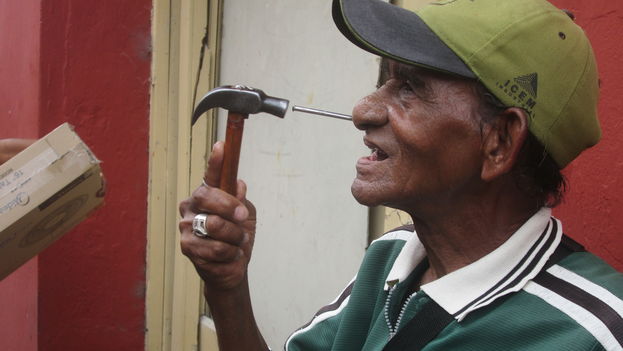
Juan Antonio Vargas Lefebre works in Enramadas Street, in Santiago de Cuba, and exhibits his circus skills in exchange for tips. (14ymedio)

14ymedio bigger14ymedio, Yosmany Mayeta Labrada, Santiago de Cuba, 3 April 2017 — Juan Antonio Vargas Lefebre inspires exclamations of surprise among Santiago de Cuba’s inhabitants and visitors. At 72 and living in the Chicharrones neighborhood, the well-known fakir sets up in the first hours of the day in Enramadas Street and exhibits his circus talents so that people will leave him some tips and many compliments.

Nails, bicycle spokes, pens and pencils, are some of the objects that Vargas puts in his right nostril. “The factory defect is on that side,” he says jokingly to those who inquire about his unusual physical ability. continue reading

“It rains, there’s thunder or lightening, every day comes with something new,” says a clerk at La California store, who given her proximity is a frequent spectator of the exploits of this well-known local fakir. “Sometimes he makes me nervous because the nails he puts in his nose are quite long,” she says.

Vargas Lefebre is undaunted and boasts that he has traveled “all over Cuba” and every year presents his street performance at the Rancho Boyero Fair in Havana

However, Vargas Lefebre is undaunted and boasts that he has traveled “all over Cuba” and every year presents his street performance at the Rancho Boyeros Fair in Havana. “I live on the tips they give me, but my dream is for someone to look at this old man and help me become a real circus performer,” he concludes.

Jose Antonio Vargas says he has “an iron constitution,” does not drink or smoke and says his best artistic numbers are “with sharp sabers,” but he can’t perform them on the street as the police expressly forbid it. “They are considered weapons, but I look for an out of the way place where I can do it,” he confesses.

He is considered the only “famous” fakir in all of Cuba and acknowledges that he is “without money, but without rival.” He also dances, sings and hums musical notes while pounding with a hammer on his nose as if it were a piece of wood. The passing tourists leave him with some coins, which are his main sustenance.

“Don’t try this at home,” he advises a child watching him while putting the handle of a mirror through his infinite nostril.

Three Siblings On Hunger Strike Released On Parole

Adairis Miranda, Maidolis Leyva Portelles, Anairis Miranda and Fidel Batista Leyva. (Courtesy)

14ymedio bigger14ymedio, Havana, 3 April 2017 — The three Holguin siblings who had been on hunger strike since last March 7 were released on Sunday on parole, according to what their mother, Maydolys Leyva, told this newspaper.

The activists Anairis Miranda, Adairis Miranda and Fidel Batista were sentenced were sentenced to one year in prison for the alleged crimes of “defamation of heroes and martyrs” and “public disorder” during the days of national mourning after the death of former President Fidel Castro last 25 November. continue reading

This Sunday, Leyva visited two of her children who had been admitted to the Vladimir Ilyich Lenin in the provincial capital city of Holguin, where she learned the news of their release. Shortly afterwards, she went to Clínica Quirúrgico Lucía Iñiguez hospital to visit her other daughter, Adairis Miranda, who had also been given parole papers, according to her mother.

At the moment Adairis and Fidel are receiving a treatment with sera as part of their recovery therapy after more than three weeks without eating. A doctor explained to Leyva that the treatment will last “between three and four days” before they can return home.

Anairis, who has a heart disease, is in “a more serious state of health, at risk for his life,” her mother explains to ’14ymedio’

Anairis, however, is in “a more serious state of health with her life at risk,” her mother explains to 14ymedio, so the doctors believe the recovery process will take longer. The young woman, her mother says, “has heart disease.”

Leyva conveyed words or thanks to other activists, the independent press, and the international community, “who have been aware of the lives of my children… and have not let them die.”

Parole is a condition frequently used by the government to release its political opponents. The former prisoners of the Black Spring who still live in Cuba are under that legal condition, so they can be returned to prison whenever the authorities decide. Also, they cannot travel outside the country.

Last Friday Amnesty International urged the Cuban government to provide medical care with guarantees to the siblings and cataloged them as “prisoners of conscience.”

Cuban Opponents Who Bet On The Ballot Box

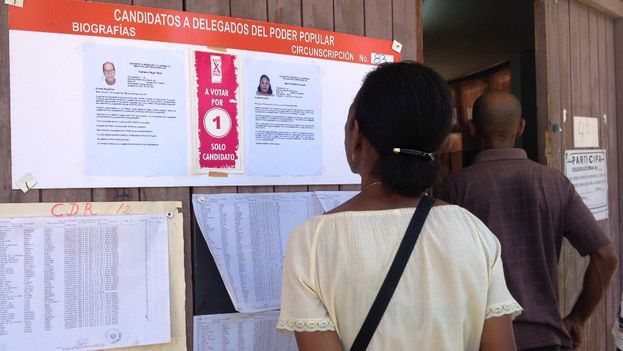
A woman looks at the biographies of the candidates before voting in the municipal elections of 2015. (14ymedio)

14ymedio bigger14ymedio, Reinaldo Escobar, Havana, 3 April 2017 – In any part of the world, the first option a politician has to participate in power is usually through elections, but in Cuba this path seems the most Utopian.

However, on the eve of the start of the electoral process that will culminate with the formation of the ninth legislature of Cuba’s National Assembly of People’s Power and Raul Castro’s departure as president of the country, different opposition groups are taking the opportunity to submit themselves to the verdict of the ballot boxes. continue reading

The hope of competing before the electorate as an alternative found encouragement after the February 2015 announcement that there would be a new electoral law. The idea that the new legislation would necessarily be more flexible stimulated that part of Cuba’s opposition sector whose plans do not include “overthrow the dictatorship.”

Candidates for Change: “We have been monitoring the Accountability Assemblies of the district delegates where violations occur”

In October 2008 a small group of opponents from the town of Punta Brava grouped under the name of the Liberal Party of the Republic of Cuba launched the initiative to “accept the challenge of participating in the elections for district delegates.” The political scientist Julio Aleaga participated in this project as an adviser and, offering himself as an example, stood for office in the capital neighborhood of Vedado. On that occasion he obtained a single vote, his own.

Now Aleaga is leading the Candidates for Change project. In conversation with 14ymedio he explains that since 2014, as part of a maturation process, they have created an executive secretariat that organizes all work.

“We have been monitoring the Accountability Assemblies of the district delegates where violations occur, such as not respecting the requirements for a quorum, or declaring that the Assembly has been held when in fact it has not and, at a higher level, the reports on the number of Accountability Assemblies held in the country that do not correspond to reality.”

In addition to that work, he states that wherever there is a representative of Candidates for Change, they have presented the problems of the community in the Assemblies with proposals to help solve them.

This project also promotes the idea of ​​encouraging Afro-descendants to engage  inpolitical processes as decision-makers, to become active in politics and jointly promotes women’s participation in political life.

However the absence of the announced new Electoral Law has reduced the expectations of those hoping to see a rift in the single-party political life of Cuba. With regards to this, Aleago says, “Apparently the government ‘has dropped the ball’ and we have decided to work with the tools we have to build change instead of waiting for that change to take place in order to have better tools.”

Cuesta Morúa says that Otro 18 has “unwavering requirement that they not receive money for the process of putting themselves forwards”

Another initiative that focuses on the electoral issue is Otro18 (Another 2018). Their work is made up of three parts: one is the search for and preparation of candidates for the upcoming elections; another is the constitution of what have been called Citizen Observers of Electoral Processes (OPE); and, finally, the paving the way for the citizenry to receive the message of this platform.

Manuel Cuesta Morúa, an experienced opponent from the social-democratic persepctive, explains that for the task of finding and preparing candidates they have a road map and attitude guide to establish like-minded approaches. “In this sense,” he emphasizes, “we focus on an unwavering requirement that they not receive money for the process of putting themselves forward.”

With regards to the observers, it is a network that watches over the process at every stage. “We demand as a requirement for being a Citizen Observer that the person not be a candidate and maintain absolute neutrality.”

As a founding member of the Democratic Action Roundtable (MUAD), Cuesta has invited the organizations that meet as a part of that collection of organizations to include in each of their activities an “Otro18 agenda,” so that, regardless of the fact that each organization has its own platforms and programs, they also engage in this initiative. “In the coming months,” Cuesta says, “the entities involved in MUAD will begin to provide candidates, observers for the network and, of course, activists to mobilize the electorate.”

“We would love to have about 300 people occupying the seat of the public service, but reality tells us that this is a dream too far.”

On the subject of the promised new Electoral Law, Manuel Cuesta takes for granted that it will no longer be the one that governs the upcoming electoral process. “A clear signal is that they have created an application for mobile phones where the electoral process is explained through Law 72, which should have been repealed to make way for a more flexible one.”

Perhaps the most obvious question you can ask a politician who believes in electoral processes is what are their hopes of winning votes. Julio Aleaga affirms that they have now counted a hundred people ready to present themselves as candidates in all of Cuba, with potential candidates concentrated in Santiago de Cuba, Havana, Sancti Spíritus and Cienfuegos.

“We would love to have about 300 people occupying the seat of the public service, but reality tells us that this is a dream too far. We are betting on the electoral exercise, the breakdown of social neglect with respect to elections. The real result won’t be measured in the number of candidates chosen, but in raising public awareness that elections can be an engine for change,” he says.

Manuel Cuesta, for his part, takes a look at his agenda and explains: “As of the beginning of April, we have 83 people who have shown their willingness to stand as candidates, mainly distributed in Havana, Santiago de Cuba and Pinar del Río.”

Cuesta recognizes that it is difficult to speak of numbers in the question of predicting presumed victories, but one can venture how the proportions might turn out.

It is taken for granted that these elections will be neither free, nor plural, nor fair, but at least they will try to make them competitive

“The first step is to overcome the difficulty of the area assemblies, where the vote is by a show of hands. Of all those who can show up, be it 70 or 700, only 15% would have the opportunity to pass this test and get to the ballot. Then the Electoral Commissions of the municipality will prepare a biography* for each of them, with somber tones, as they did in the previous process with two candidates, whom they clearly defined as counterrevolutionary elements. At the polls, maybe 4% would be elected as a delegate, and with that we would be more than satisfied.”

For any of these projects, the main thing seems to be to open the game of competitive elections at the municipal level. It is taken for granted that these elections will be neither free, nor plural, nor fair, but at least they will try to make them competitive. In fact, so far the Government has refused to compete, even among themselves.

Among those who support overthrowing the regime, there are those who accuse these initiatives of “playing the game of dictatorship.” The truth is, those in command in Cuba do not show any enthusiasm for anyone to play any kind of game and they are repressing with great intensity all those involved in Candidates for Change, Otro18 and other projects along the same line.

Before the end of this year we will know if the effort undertaken made any sense.

*Translator’s note: Under Cuba’s current electoral law, candidates are forbidden to campaign. The only presentation of their candidacy is a one-page (or less) ‘biography’ with their photo and a statement about who they are — strongly focused on a list of the mass organizations they belong to — with no information about political opinions. This biography is not prepared by the candidate, but by the Electoral Commission. As noted in the article, two opposition candidates who made it to small-area local ballots in the last elections, were described in their biographies as “counterrevolutionary” with a brief detailing of the ‘bad’ things they have done, for example being “funded by foreign groups.” Neither won.

Maduro Closes His Fist Around Venezuela

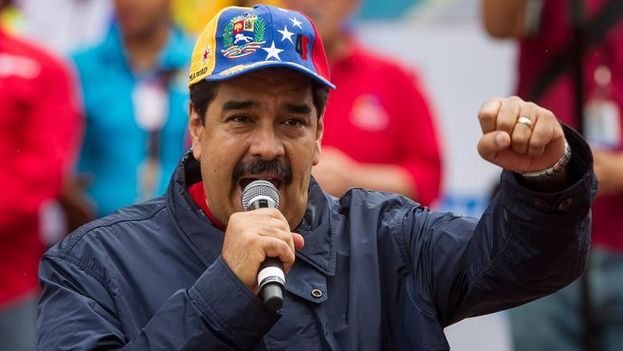
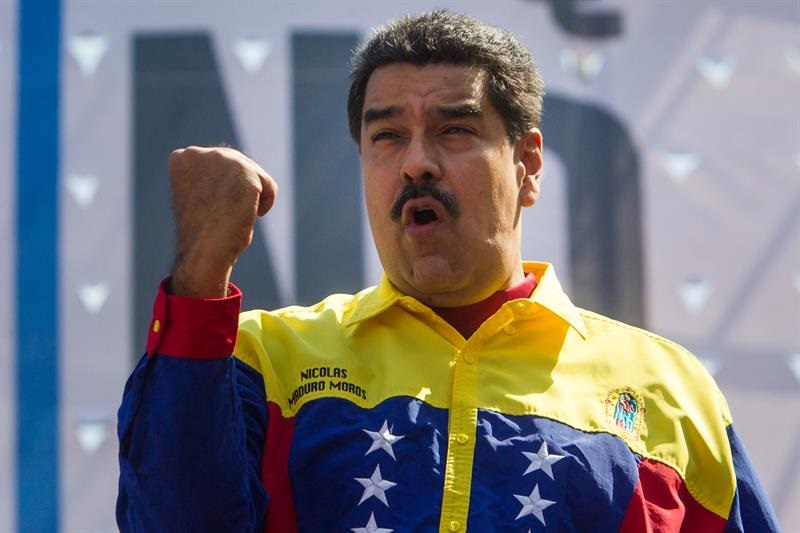
The president of Venezuela, Nicolás Maduro, in a civic act. (EFE File)

14ymedio bigger14ymedio, Yoani Sanchez, Havana, 2 April 2017 — Everything was to get to this point: the long harangues of Hugo Chávez, his populist promises and the perks distributed to the loyal. Nearly two decades of “Twenty-first Century Socialism” have successfully led to Venezuela’s abandonment of democracy. This week, with the cancellation and subsequent “restoration” of the powers of the National Assembly, the cage has been definitively closed.

Nicolás Maduro took a bold and desperate step. The all-powerful entity into which he converted the Supreme Court dealt the blow that the president had been planning since he lost control of Parliament in December 2015. The judges just did the dirty work and, three days later, they faced the ridicule of backing off from their decision. continue reading

The claims inside and outside of Venezuela prevented the leadership from accomplishing the self-coup. A move with which Maduro sought to end his stubborn opposition, to stand up to the possible application of the Democratic Charter of the Organization of American States, and to buy time for his battered and corrupt government.

A country shaken by the whims of a political elite as obstinate to preserve its own privileges, as it is to refuse to recognize that it has lost the support of the citizenry

Although Maduro backed down shortly afterwards, previous decrees make it so that the parliamentarians still can not implement their legislative decisions and the country has been living from January of 2016 under a state of exception, euphemistically denominated the economic emergency. The Venezuelans go through a calvary of hardship, violence and exodus.

Every week Maduro invents some campaign or confrontation that will help him, with the support of the leadership of his party, to stay in the presidential chair and exercise control over the country’s budget and oil wells.

The Chavistas have no ideology left. The movement they described as popular has become addicted to the attributes of power, unable to perceive the reality of the streets. It is not the Venezuelan people who interest them, but the life of luxuries that they have constructed in their palaces while proclaiming to the four winds the discourse of helping the poor and the needy.

However, more frightening than their insatiable material voracity is the institutional fragility in which they have left the nation. A country shaken by the whims of a political elite as obstinate to preserve its own privileges, as it is to refuse to recognize that it has lost the support of the citizenry.

Maduro has Venezuela in his fist and does not seem ready to let go.

Maduro Continues to Be a Danger for Everyone

Nicolas Maduro, President of Venezuela

14ymedio biggerCarlos Alberto Montaner, 2 April 2017 — Maduro changed course. The country’s Attorney General, Luisa Ortega Díaz, facilitated it on a silver platter. Surely it was prearranged. First, Nicolás Maduro eliminated any vestige of democracy in Venezuela. His hitmen in the Supreme Court of Justice took care of it by assuming all the duties of the National Assembly. It was to be their last maneuver. The dictatorship would continue, but now without pretending, and with an even tougher iron hand. The way was made clear to accuse the deputies of treason against the fatherland, or of anything else that came to mind.

They didn’t get away with it. National and international resistance became too strong. The congressman and the students took to the streets in protest. The latest step had been too impudent. Luis Almagro quickly set up the trenches at the OAS, while the PPK in Peru was practically breaking off relations, while Maduro’s allies –Leonel Fernández, Rodríguez Zapatero and Martín Torrijos– began to advise him that they could no longer join in this latest totalitarian twitch. continue reading

The operation to destroy the National Assembly began in earnest after the electoral defeat in December 2015. It was to be the Venezuelan version of the Nicaraguan piñata. It was then, during the few weeks that remained before the new Parliament was due to take charge, when, foot to the pedal, they undertook to reform the high echelon of the judicial branch, trampling on the Constitution and getting ready to govern by brute force as necessary.

And what does Raúl Castro think about all this? The bottom line is that the headquarters of 21st Century Socialism is in Havana. Nicolás Maduro is but a puppet (and a bad one at that) trained in the Marxist-Leninist workshops at the Cuban Communist Party’s School for Cadres, first suggested to Hugo Chávez by Fidel Castro.

To the Cuban intelligence services Maduro seemed to be a malleable and docile simpleton who speaks to the birds, and is much less corrupt and more tractable than say Adán Chávez, brother of the late Lieutenant Colonel. He was not perfect, but, from the available Venezuelans to choose from, he was the most useful to “the Cubans,” precisely on account of his weaknesses.

And what is going to happen now? Not much, unless the United States abandons its ridiculous attitude that “Venezuela is not a danger, but rather an inconvenience,” policy started during the Administration of George W. Bush and adopted by Barack Obama.

The government of Venezuela, although chaotic and disorganized, is a danger to the security of the United States due to its connections with Islamic terrorists and because of its military links to Iran and Hezbollah. It doesn’t have nuclear warheads but it possesses other means of severely harming its archenemy.

It is a danger because of its association with drug traffickers and for assigning some of its generals to be involved in this murderous trade. It is a danger because of its militant “anti-Yankeeism” always on the lookout for new conquests, and because it is one of the most corrupt nations on the face of the planet.

How does it help the Treasury Department in Washington to prosecute corruption by the heads of FIFA, the international soccer association, or a dozen bankers for laundering capital from the drug trade, as the DEA has denounced, if Venezuela is a narco-state working with impunity in all these activities while additionally openly helping the Colombian narco-guerrillas too?

Lastly, the government of Venezuela is endangering its own population, deliberately starved, while the country approaches a terrible humanitarian catastrophe with a lethal combination of terrible government and corruption. Hadn’t we come to the conclusion that we “have the duty to protect” the victims of these political horrors?

The United States is the only nation in the Americas with the strategic vision, resources, material wherewithal and sense of responsibility necessary to defend itself from its enemies and to formulate a “roadmap” as it is called today, intended to change a regime which greatly harms it and poisons all of Latin America too.

Perhaps it is not wise for the United States to eliminate its purchases of oil from Venezuela –the only cash source of income for the country– but it would be feasible to deposit the revenue from these transactions into an escrow account until the National Assembly certifies that Maduro’s behavior comports with constitutional norms. It would be an irresponsibility to feed an illegitimate government which usurps functions not within its purview.

It is not true that the Cold War completely ended. The USSR disappeared and with it the Communist regimes of Eastern Europe disappeared too, but the United States continues to have persistent enemies dedicated to fighting this country by any and all means. If Washington wishes to continue to be the head of the free world it cannot evade the Venezuelan issue. It has to step forward to lead the Continent. Nobody else can, or knows how, to undertake this task.

Note: English version from Montaner’s website

Anxiety Grows Over Cuba’s Gas Shortages

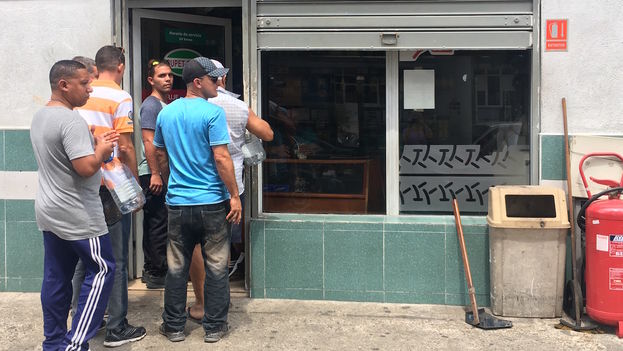
In Havana, drivers brought jars, bottles and all kinds of containers to store fuel. (14ymedio)

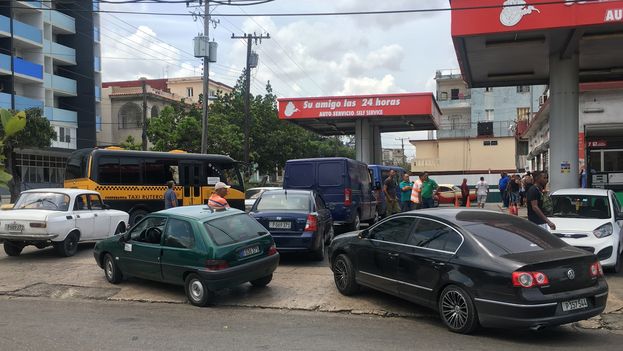
14ymedio bigger14ymedio, Zunilda Mata, Havana, 1 April 2017 — Rumors of a general rise in prices have sharpened shortages at gas stations this Saturday, with long lines of vehicles waiting their turn at service stations across the country.

The fuel sold at preferential prices for thousands of state employees has gone up 0.10 CUC in recent hours, but the Cuba-Petroleum Union (CUPET) maintains for the moment the prices for other customers: 1 CUC For diesel and regular gasoline, and 1.20 for premium, which has been missing for several days. continue reading

The most alarming rumors say that as of April 1 private users, except those who have rented a car from a state agency, will only be able to buy regular gas

With no official announcements, everything moves at the level of rumors and conjectures. The most alarming rumors say that as of April 1 private users, except those who have rented a car from a state agency, will only be able to buy regular gas, and in no case can they buy special high octane fuel.

“They told us there were regulations but we did not get any written information or anything,” a gas station worker at 24th and 23rd in Vedado told 14ymedio.

“There is no premium gasoline, not even for rental cars,” he says. The rental cars are mainly used by foreign tourists and Cuban emigrants who return to visit the country. “They must present the rental agreement in order to buy the product,” says the employee, but “right now they will have to buy regular gasoline because that is the only thing there is.”

In Havana, drivers come with jars and bottles and all kinds of containers to store fuel. “Hard times are coming,” said Ricardo, a private taxi driver who can’t get over his surprise. “When it finally seemed that this country was going to be on track, then look what happens,” he tells this newspaper while pointing out in the official press the news coming from Venezuela.

The driver spent six hours on Saturday in front of the Cupet service station at the corner of 25th and G in Havana waiting to refuel. His greatest fear is that there will be return to “those years of the Special Period when all of Cuba was paralyzed by lack of fuel.”

The alliance with Venezuela, promoted since Hugo Chavez came to power in 1999, finally relieved the energy shortage on the island. Caracas has been generous with the delivery of black gold to the island and in the best moments delivered up to 100,000 barrels of oil a day in exchange for medical services, sports coaches and a great deal of support from Cuba’s state security forces advising and operating in Venezuela.

But the times have changed and analysts agree that the oil quota has decreased by between 40% and 60%. This reduction negatively influenced Cuba’s economy last year, with the GDP declining by 0.9%. The recession awakens the worst ghosts of the economic crisis that followed the collapse of the Soviet Union in the early 1990s.

The national production of crude has also failed to take off. According to data from Cupet, the country extracts some 4 million tons of heavy oil, which is mainly used for electricity production

The national production of crude has also failed to take off. According to data from Cupet – the state-owned fuel company – the country extracts some 4 million tons of heavy oil, which is mainly used for electricity production. Cupet estimates that crude oil reserves of about 20 billion barrels exist in the Cuban Gulf of Mexico, although the US Geological Survey suggests a lower figures.

The government expects that, by the year 2030, 24% of the country’s energy will come from renewable sources, but first it needs new infrastructure and the investment of foreign companies in the sector.

This Saturday, long lines of vehicles are waiting their turn in the service stations all over the country. (14ymedio)

Hours before midnight on Friday the anguish grew among the drivers. The service stations cut off sales to adjust the machines and to program the new prices for the so-called “magnetic card affiliates,” a group of state workers who receive the fuel at preferential prices among whom are doctors and military.

The informal fuel market is supplied with the thousands of liters that are diverted each day from those with “magnetic cards” and are resold to other drivers. Authorities are trying to stop this flow and since March 31, it is forbidden for “affiliates” to carry a container for gasoline.

But the least of the problems is the rise of the privileged tariffs or the deficit of premium gas, more expensive and therefore exclusive to a few. What keeps the population on edge is that many gas stations are totally empty, with no product for sale. “This is more and more like the past,” Ricardo said minutes before getting his turn at that pump.


After Decades of Abandonment, Work Begins on José Martí Sports Park

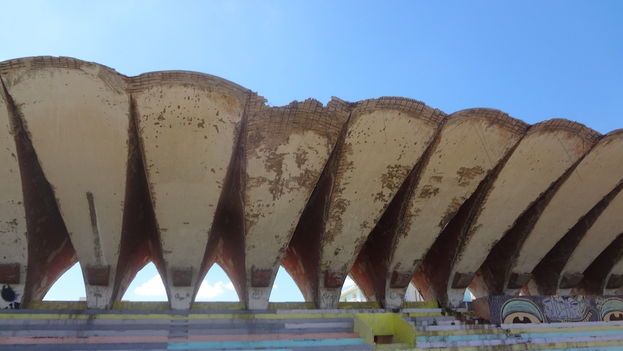
The Jose Marti sports center had part of its perimeter fence collapse, its pools were empty or with standing water and on the point of collapse. (14ymedio)

14ymedio bigger14ymedio, Marcelo Hernandez, Havana, 24 March 2017 — The José Martí Sports Park, on the Havana Malecon, is benefitting from major repairs, albeit with several years of delay. The iconic installation, which for decades has fascinated photographers with its peculiar mixture of ruins and beauty, is filled these days with construction workers.

The sports area was converted into a dormitory for homeless people, a zone of sexual tolerance and an area of ​​danger in the face of the threat of collapse. Its decadent esplanade, subjected to salt air and apathy that shredded the exterior wall, continued to be visited by runners who wanted to lose a few pounds, kids ‘in training’ and people walking their dogs. continue reading

Opened in the 1940s, the park was remodeled in 1960 by the Cuban architect Octavio Buigas and at that time had a gym, swimming pool, stadium, parking, children’s play area, a basketball and volleyball court which had tiered seating for more than 1,000 spectators.

The stadium, from where one could enjoy sports competitions and the spectacle of the sea at the same time, had stands for 3,150 spectators, and provided a light shelter in the form of a vault that became a landmark identified with the Cuban capital city.

On the occasion of the 1991 Pan-American Games, partial repairs were made to be able to hold the handball matches there, but at the end of the competitions, no attention was paid to the place. There was a project to “stop the deterioration” that never got beyond minor masonry work.

The damage became so deep and widespread that in 2000 the authorities decided to close the facility, because it was considered a danger to life

The damage became so deep and widespread that in 2000 the authorities decided to close the facility. A technical report from the Directorate of Hygiene and Epidemiology of Public Health, in collaboration with the Directorate of Construction and Real Estate Repair, decreed that the installation constituted a danger to life.

The most serious problems included the accumulation of water in the roof of the stands, the collapse of the diving platforms and the vandalism of the windows. Those who slipped through any hole to perform exercises were dealt with by the custodians. Without success.

At the end of last year, two racquetball courts, the karate practice ground and the handball, volleyball and outdoor basketball courts were repaired, but no progress was made in the more complex areas.

This time the repairs aim to go further and demolish the emblematic roofs of the stadium, a task assigned to Specialized Construction Services (SECONS) under the direction of Constructora Caribe. The athletic locker rooms, bathrooms and cafeteria located underneath will be completely renovated.

Those responsible for the work have told the official media that one of the first actions will be the rebuild the perimeter fence. Instead of the reinforced concrete there will be reinforced polymers that are resistant to corrosion and that offer less resistance to the inevitable waves from the sea.

Only when the area is protected will the track and field area begin to be remodeled. The swimming and diving pools will have to wait until next year.

European Diplomats Visit The Center For Coexistence Studies In Pinar Del Río

Members of the Center for Studies Coexistence with European diplomats during the visit this Thursday. (Facebook)

14ymedio bigger14ymedio, Havana, 31 March 2017 — A delegation from the European Union in Cuba visited the Coexistence Study Center (CEC) in the city of Pinar del Río on Thursday. The group was headed by EU political attaché in Havana, Carlos Perez Padilla, and also included representatives from the embassies of Germany, Austria, the Czech Republic, Greece and Sweden, according to a text published on the CEC’s Facebook account.

Diplomats spoke with the Center’s team about the “vision, mission and lines of work” of the independent center. They also received details on the “Itinerary of Thoughts and Proposals for the Future of Cuba” and the program of “ethical and civic education for citizenship,” which the center promotes. continue reading

The current situation of the digital magazine Convivencia (Coexistence) and the microprojects that for years have been carried out by the team were also part of the conversation that took place “in a climate of cordiality and frank communication,” CEC said in Facebook.

The meeting took place in the midst of an intense escalation of pressure against the CEC, whose members have been victims in the last months of numerous interrogations by the State Security and officials from the department of Immigration and Aliens.

Economist Karina Gálvez, one of the founders of the think tank, is being prosecuted for alleged “tax evasion” and her house was sealed by the prosecutors handling her case.

Last November, the police prevented the holding of a meeting on Culture And Education In The Future Of Cuba: Vision And Proposal in Pinar del Rio.

The Center organizes training courses for citizens and civil society and operates independently of the State, the Church and any political grouping. The magazine of the same name emerged in 2008 and is published bimonthly.

New Airline Will Link Havana And Barcelona

The Spanish airline Plus Ultra will operate regular flights between Havana and Barcelona from July 1st. (Networks)

14ymedio bigger14ymedio, 27 March 2017 – The Spanish airline Plus Ultra will operate regular flights between Havana and Barcelona from July 1, according to reports in Spanish media.

The flights will operate once a week and will be the first to directly link both cities. As a launch promotion, round-trip tickets will cost 449 euros.

Sources at the company said that this is an important connection, giving the ongoing changes in relations between the European Union and Cuba. continue reading

In 2016, more than 70,000 passengers traveled between the two cities, via connections through other cities. More than 7,000 Cubans live in Catalonia, according to official statistics.

Plus Ultra will be the sixth airline to operate between Cuba and Spain, joining to Wamos, Iberia, Air Europa, Evelop and Cubana.

During 2015, exports from Catalonia to Cuba grew by 50%, reaching 294 million euros.

According to the National Office of Statistics and Information, Spain is the eighth largest source of tourists to Cuba and the fifth largest European source.

In November 2016 a business group from Catalonia visited the island to strengthen the commercial relationship between both countries. Some 40 companies joined the commercial mission led by the Catalan government’s Agency for Enterprise Competitiveness and the Port of Barcelona.