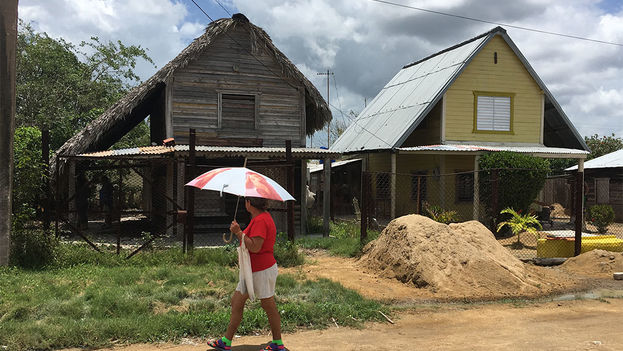
“You will write a letter addressed to Fidel Castro thanking him for free education,” the center’s educator told the students. (14ymedio)
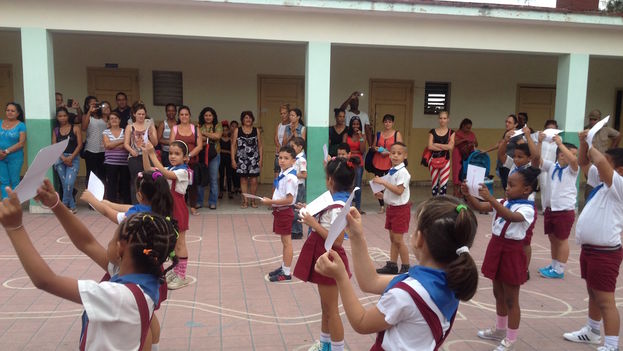
14ymedio, Generation Y, Yoani Sanchez, Havana, 29 June 2017 — “Today we are going to practice writing a letter,” announced the fourth grade teacher at a school in the Plaza of the Revolution district in mid-June. Immediately, Lucia, age 9, thought about writing a letter to her grandmother telling her about her latest acrobatics on skates, but the recipient had already been decided. “You are going to write a letter addressed to Fidel Castro thanking him for a free education,” declared the educator.
The girl froze. It never would have occurred to her to address a letter to a dead person, nor to anyone who wasn’t a friend or a member of her family. She scribbled the date on the top of the page and then stopped, with the pencil suspended in the air, not knowing what to do. “Lucia, you have to thank him for building schools and teaching Cuban children to read,” ordered the teacher. continue reading
The student remained paralyzed. “Come on, it is very likely that on the test they will ask you to write a letter to the Comandante and you have to practice.” The pencil didn’t move a fraction of an inch. “Look, I’m going to dictate some sentences to you and then you can continue on your own,” the teacher said, her tone increasingly irritable. “Fidel, without you I would have no shoes and no books and I would be illiterate,” she dictated. But the girl didn’t make a single mark.
When she got home the sheet of paper still had only the day and the month in one corner. So it was her mother’s turn to insist, “Think that you are writing another person and then later put ‘His’ name on it,” she proposed as a trick to get around the problem. Lucia imagined she was telling her grandmother about the games in the park, and thanking her for her affections and then signed it, squeezing in her name next to a drawing of a flower.
Last week the final exam included the request to write a letter. But this time it was addressed to the teacher and had to respond to the question, “What do you do to help your mom with the housework?” The girl stopped for several minutes with the pencil suspended over the paper without knowing what to do. No one came to dictate the sentences.
* This story is not literature, but absolute reality. The student’s name has been changed to avoid retaliation.
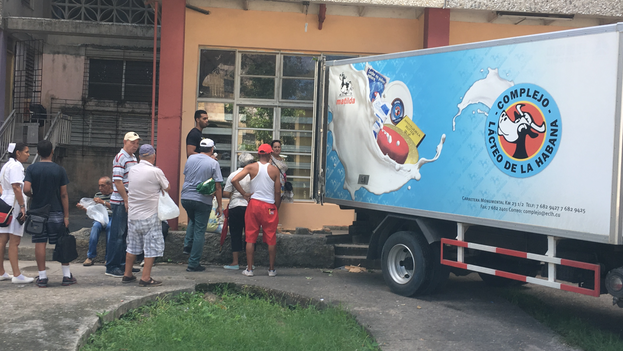
After the announcement, hundreds of customers crowded outside the dairy outlets. (14ymedio)
14ymedio, Havana, 28 June 2017 — This week the official media have fueled expectations among consumers in Havana with an announcement of “the return of soy yogurt,” a product of the rationed market that has not been distributed in the capital for nearly a year.
After the announcement, hundreds of customers crowded around outside the dairy outlets, but a national television report clarified that the distribution will be “gradual” until it reaches the 85,000 children in the city who are authorized to receive a share of this product. continue reading
During the last year, children between the ages of seven and fourteen have been receiving a powdered mix to make a dairy substitute shake, but it has been strongly criticized for its poor quality.
A national television report clarified that the distribution will be “gradual” until the it reaches the 85,000 children in the city
The interruption of the sale of soy yogurt was due to the technological deterioration experienced by Havana’s Milk Complex, especially the steam boiler, which has been in operation for more than 40 years.
The malfunctions forced production to stop for eight months in order to undertake a repair that included the importing of new boilers, and maintenance work on the cold storage facilities and the production rooms. In addition, the distribution service will now be made from a renovated truck lot.
However, many parents are wary about whether the renovations will last, and fear that the soy yogurt will disappear “gradually.”
From the former glamorous Fin de Siglo, all that remains is a building with serious structural problems, empty and stinky. (14ymedio)
14ymedio, Reinaldo Escobar, 28 June 2017 – The shit, not the metaphorical kind but the kind that stinks, makes it nearly impossible to read the name Fin de Siglo, End of Century, imbedded in the granite floor. In five decades, one of the most emblematic Havana stores has transitioned from glamor to abandonment, passing also through experiments in socialist distribution and the self-employment sector.
Founded in the long ago 1897 and located on the central corner formed by San Rafael Boulevard and Aguila Street, Fin de Siglo was among the most important commercial establishments in Cuba, along with La Época and El Encanto. In its place today, however, there remains only a building with serious structural problems, vacant and stinky.
During what Fidel Castro labeled with euphemistically the Special Period in Time of Peace – a time of great economic hardship after the collapse of the Soviet Union and the end of its financial support for Cuba – Fin de Siglo sold only to distinguished workers awarded “vanguard” status, and to newly married couples. A nice 1992 documentary, made by the Belgian Madelin Waterlet and the Pole Simon Saleski and named after the store, relates the surrealist moment. continue reading
During the so-called Special Period in Time of Peace the business sold only to the distinguished workers awarded “vanguard” status and to newly married couples
That form of the socialist marketing could not be sustained for long and with the gentle winds of economic reforms the ground floor of the building was set up for private sector retailers to sell sandals, household utensils, objects for religious rituals and clothing.
Many tourists also came to acquire an ashtray with the face of Che Guevara or canvases from which shone the skin of beautiful mulatas. But a month ago the sellers were reassigned among the soulless state stores.
The authorities justify the relocations with the deterioration of the building. However, private individuals who paid rent for space in the building insist that their contracts with the state Empresa de Comercio stipulated that 30% of lease proceeds would go to repairs, which were never made.
At the end of 2012, the sellers were informed that restoration work would begin on the building, but after a few weeks and the placement of wooden beams to prop up the top floor, the works did not continue.
In order not to lose their clientele, the vendors proposed that the local government allow them to become a non-agricultural cooperative (CNA), a form of economic management which, as of January this year, had 397 examples throughout the country dedicated to food, personal and technical services.
However, the initiative did not prosper and for several weeks now the retailers have been relocated in nearby stores such as Cancha, Florida and Sublime, smaller and more poorly located.
“I have lost a lot of money in this move and also this place does not have the minimum necessary conditions,” says a clothing saleswoman with a counter in the Cancha store who preferred anonymity. However, she acknowledges that “Fin de Siglo also had problems because of the heat, the lack of windows and the constant obstructions in the sewer pipes.”
The merchant believes that if they had let the tenants invest the conditions of the ground floor would have been improved, since each year the premises collected about 3 million Cuban pesos (roughly $120k US) in rent receipts. “Why didn’t they use part of that for reconstruction?” she protests.
The merchant believes that if they had let the tenants invest the conditions of the ground floor would have been improved, since each year the premises collected about 3 million Cuban pesos in rent
Some vendors have placed handmade posters in the windows of Fin de Siglo alerting customers to their new locations. There is no obvious construction work taking place in the building but all the outlets and the bulbs from the ceiling lights are missing.
Carlos Alberto, a young jeweler wants an explanation. “When someone finds out what they are going to do there, let them come and tell me.” The artisan doubts the official version and maintains that the building will be “remodeled to become a store selling in convertible pesos” – that is to the well-to-do and tourists – a speculation which the authorities of the municipality of Central Havana do not want to comment on.
At the Sublime establishment, a CD vendor predicts a worse future for the emblematic store. “It’s going to be just like the Duplex cinema, a block away, which one day was closed because it had a problem in the bathroom and today is a ruin,” he says.
Regina Coyula was not able to board her flight this Monday, like six other activists, to go to Cancun to a Forum on Democracy in Cuba. (Courtesy)
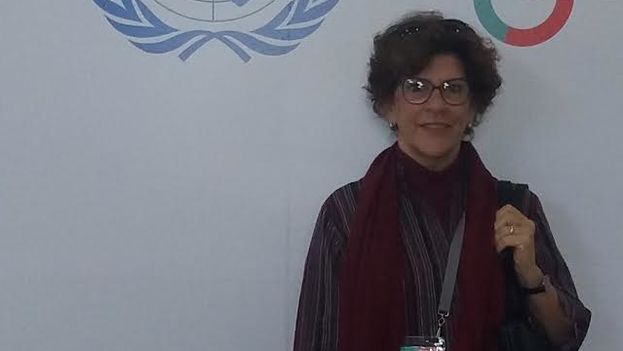
14ymedio, Havana, 27 June 2017 – Cuban authorities blocked at least seven activists from traveling to Cancun, Mexico this Monday, to participate in the 4th Forum on Roads to a Democratic Cuba, a meeting of the United Democratic Action Roundtable (MUAD) organized by the Konrad Adenauer Foundation (KAS), according to blogger Regina Coyula speaking to 14ymedio.
“When I arrived at the immigration window in Terminal 3 of Jose Marti International Airport, they told me to step back and wait a minute” said the activist. Then she was approached by an immigration official who, after asking for her documents, informed her that there was “a ban on travel abroad” in effect against her.
Coyula demanded explanations for the reasons she was prevented from leaving, but the agent would only say that she “had nothing to do with this” and told her if she wanted more information to visit the Office of Attention to the Population near the Plaza of the Revolution. continue reading
The other activists who were not allowed to board the plane are Rafael León Rodríguez, general coordinator of the Cuban Democratic Project; Hildebrando Chaviano, director of the Center for Analysis of Public Policies of Freedom and Development; Wilfredo Vallín and Amado Calixto Gammalame, members of the Legal Association of Cuba; Erick Álvarez, promoter of the CubaDecide initiative; and Alexei Gámez, activist of the Somos+ (We Are More) Movement.
The practice of preventing dissidents from leaving the country has become a repressive method of State Security in increasing use in recent months.
The practice of preventing dissidents from leaving the country has become a repressive method of State Security in increasing use in recent months.
In early 2013 a Migration Reform measure came into effect which eliminated the “exit permit” required for travel abroad. In the first ten months after the approval of the new measures, Cubans made more than 250,000 trips abroad. The opposition also benefited from this relaxation of controls.
However, any time it likes the Government may invoke certain subsections of article 25 of the new immigration regulations that prohibit departure “for reasons of public interest or national security.”
Travel bans are put into practice in a number of ways, including preventing opponents from leaving their home, intercepting the vehicles taking them to the airport, or notifying them at the immigration window at the airport that they are forbidden to leave, as happened on Monday.
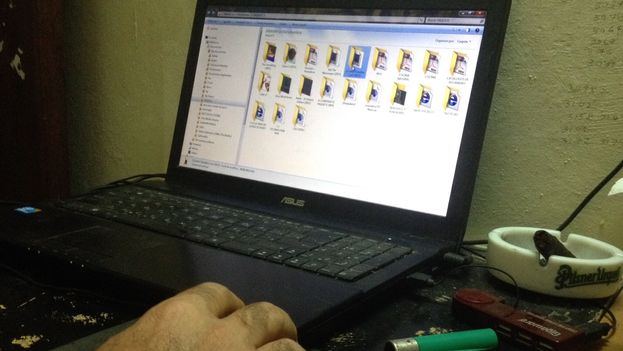
A Cuban accessing the Weekly Packet’ from his laptop at home. (14ymedio)
14ymedio, Generation Y, Yoani Sanchez, 27 June 2017 — Official propaganda has been euphoric since Donald Trump spoke at the Manuel Artime Theater in Miami. The government discourse rages with an intensity that hasn’t been seen since the campaign for ‘The Cuban Five’, the spies serving sentences in the United States. Faced with this saturation of slogans, many opt to take refuge in the ‘Weekly Packet.’
The Cuban Government seems to be advised by its worst enemies in terms of content dissemination, in view of the excess of ideology and ephemeris of the national media. The result is the galloping loss of viewers who opt for the informal networks of distribution of audiovisuals, series and films.
Each line of the incendiary political tirades published in the written press equals more than one los reader, tired of so much rhetoric. It is easy to detect through the comments on the street how the ‘rating’ of the media controlled by the Communist Party is collapsing these days, especially among the youngest. continue reading
It is easy to detect through the comments on the street how the ‘rating’ of the media controlled by the Communist Party is collapsing these days, especially among the youngest
In the past, television viewers tired of so much empty talk had to watch anyway, in the absence of other options, but now Cubans live in the age of USB memory and external hard drives.
Now, while the national media rant against the United States president’s new policy toward Cuba, the informal market is awash in entertainment material that has nothing to do with politics.
A bad quality copy of The Mummy starring Tom Cruise, or Wonder Woman featuring Patty Jenkins, along with the eighth installment of Fast and Furious, grab the attention of the fans of the Weekly Packet, and offer nothing but a headache for the government propagandists who don’t know how to attract that lost audience.
It is significant that science fiction, fantasy and car racing triumph where politics loses ground. Cubans escape reality through fiction, they evade propaganda by choosing programming far removed from ideology.
Among the areas most affected by the avalanche of visitors are the Viñales valley, the city of Trinidad, the resort of Varadero and the Cuban capital. (JVY)
14ymedio, Zunilda Mata, Viñales, 27 June 2018 — At the entrance to Calle Obispo a guide explains to her customers the restoration works in the historical center of Havana. A few yards away, the line to exchange currency is full of foreigners and in the corner bar one hears English, French and German. Tourism is shaping the face of several areas of Cuba and becoming a problem for their residents.
“In this neighborhood you can’t even walk,” complains Idania Contreras, a resident of Obrapía Street in Old Havana and a law graduate. “At first people were happy because the area improved economically, but little by little the tourists have been taking over all the spaces and this is less and less like a neighborhood where people live.” continue reading
“A pineapple never costs less than 20 Cuban pesos because the private restaurants in the area can pay that amount, because they sell the tourists a piña colada for three times that price“
As a consequence of the increase in tourism, prices have also risen. “Now buying fruits in the markets is a headache because they are hoarded by the people who rent to tourists,” adds Contreras. “A pineapple never costs less than 20 Cuban pesos because the private restaurants in the area can pay that amount, because they sell the tourists a piña colada for three times that price,” she explains. In her view, those mainly affected are the citizens themselves who can’t afford these prices.
Contreras, who worked for a few months in a real estate management office, says housing prices are also up in the area. “The price per square meter has exploded around the Plaza de la Catedral, the Plaza de San Francisco and the streets where it is most profitable streets.” She also says that these areas are beginning to look like the center of Barcelona or Venice, where fewer and fewer families are living.
However, she acknowledges that “the problem has not yet reached the point of other cities in the world that receive many more tourists,” but she is concerned because there are no “public policies to alleviate the problems we are already experiencing.”
Contreras’s biggest fear is that there is only talk of the positive side of tourism, while some streets in the area are already showing symptoms of congestion and tourism activity aggravates the problems of waste treatment and water supply.
Several regions of the island face the challenge of absorbing an increasing number of travelers despite the precariousness of their infrastructure. Among the areas most affected by the avalanche of visitors are the Viñales valley, the city of Trinidad, the Varadero resort area and the Cuban capital.
“At night the discos are full of ‘yumas’ with young girls and it is a really pitiful show for our children”
“It is very difficult for a Cuban to rent a room because homeowners prefer to rent only tourists,” warns Gustavo, a handicraft seller near the Casa de la Trova in the city of Trinidad, which was declared a World Heritage Site by UNESCO in 1988 and is now an obligatory stop on many of the package tours.
“This whole area is focused on foreigners,” he says. The salesman, born on the outskirts of Trinidad, believes that there are many people who benefit from tourism, but on the way he has lost the city he knew as a child. “Now it has been commodified and everything has a price, even people,” he laments.
In all the tourist hubs, along with an increase in private businesses there is also an increase in prostitution. “At night the discos are full of yumas, foreigners, with young girls and it is a really pitiful show for our children,” notes Gustavo.
“[Tourism] is more positive than negative because 30 years ago this city had old and beautiful houses, but nothing more,” says the seller despite his reservations about this economic sector.
Carlos and his two children live on the road to Viñales. Coming from a family of farmers, they now sell fruit at a stand by the side of the road. “Most of our customers are foreigners coming and going from the Valley,” says the farmer. He hasn’t gone into town for two years because, he says, “you can’t take a step with so many tourists.”
“Before this was predominantly a farming area with strong traditions, but now everything is being lost”
The winding road that leads to Viñales also suffers with the increase of vehicles. “It’s a rare week that there is not an accident in this section,” recounts Carlos while pointing to one of the curves near his house. The number of travelers interested in the area seems to have grown, but the seller points out that the streets and roads remain the same and that no expansion has been undertaken.
Carlos’s closest neighbors have a thriving business that offers horseback rides to travelers. They gain much more from these “ecotours” than they could sowing beans or tobacco, another change that is due to the avalanche of visitors. “Before this was predominantly a farming area with strong traditions, but now everything is being lost,” he says.
A few yard away, a tobacco drying shed stands with its gabled roof and its walls made of logs. In the interior, a peasant shows a dozen tourists how the leaves re dried. “This shed has been set up for groups who want to see how the process is done, it’s pure showcase,” says Carlos. “In this town everything is already like this.”
Independent journalists Sol García Basulto and Henry Constantín Ferreiro. (14ymedio)
14ymedio, Mario Penton, Miami, 26 June 2017 — Independent communicators in Cuba are victims of an escalating repression, according to a complaint filed Monday by the Cuban Observatory of Human Rights (OCDH), based in Madrid. The alarm sounded by the organization coincides with an increase in complaints from journalists on the island as a result of the government persecutions and obstacles they suffer when exercising their profession.
“Last June 20 Henry Constantín and Sol Garcia, journalists for La Hora de Cuba and contributors to 14ymedio, were not able to participate in an event in Miami because each of them has been indicted for the alleged crime of “‘usurpation of legal capacity’ [that is practicing a profession without a license to do so] and so under Cuban law they are not permitted to travel outside the country,” OCDH reported.
According to the non-governmental organization, the Cuban government had maintained a kind of “moratorium” with regards to repression against independent journalists, but the strategy seems to have changed in recent weeks with actions such as those carried out against Henry Constantin, Sol Garcia Basulto and Manuel Alejandro Leon Velázquez. continue reading
Human rights lawyer and activist Laritza Diversent explained that there are more than 300 items within the Penal Code to crack down on dissent and journalism on the island
The OCDH also denounced the arrest of journalist Manuel Alejandro León Velázquez, a contributor to Radio Martí and Diario de Cuba . Leon returned from a trip to Spain and has been accused of “usurpation of legal capacity, association to commit a crime and dissemination of false news,” according to the organization.
The accusations against the three communicators are based on Article 149 of the Cuban Penal Code, which punishes those who carry out “acts of a profession for the exercise of which one is not properly qualified.” If they are tried for this offense they could face a sentence of up to one year of deprivation of liberty.
In Cuba, all the media belong to the State, according to the Constitution of 1976. However, the absence of a Media Law has allowed the independent press to flourish with sites such as El Estornudo, El Toque, Cubanet, CiberCuba, Diario de Cuba, Periodismo de Barrio, On Cuba, among others.
In Cuba, all the media belong to the State, according to the Constitution of 1976. However, the absence of a Media Law has allowed the independent press to flourish
“State Security is looking for different strategies to prosecute all types of dissidents or critics in Cuba,” explained Diversent, president of the legal group Cubalex, who went into exile after a police and State Security operation against her.
“Both illegal economic activity and the usurpation of legal capacity are nothing more than resources to punish any type of activism within the Island. Legal insecurity is very high because both the criminal law and the criminal procedure law have been designed as tools of repression,” said Diversent.
Independent journalist Maykel Gonzalez Vivero, who was arrested last October in Guantanamo and suffered the confiscation of his tools of the trade while covering the recovery in Baracoa after the passage of Hurricane Matthew, confirmed the difficulties of practicing the profession on the island.
“We do not have a law that supports us and protects the exercise of journalism, we are at the mercy of the arbitrariness of the authorities”
“We do not have a law that supports us and protects the exercise of journalism, we are at the mercy of the arbitrariness of the authorities,” he said. On that occasion, a team of correspondents from Periodismo de Barrio suffered the same fate as Gonzalez Vivero.
Last year the IAPA emphasized, however, the timid rebellion of some official journalists against the information policy directed from the Communist Party. Among the examples cited by the IAPA was a letter signed by young journalists published by the Villa Clara newspaper Vanguardia, in which they claimed their right to collaborate with other media.
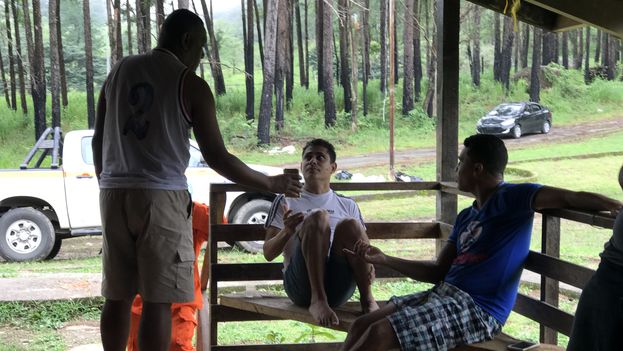
14ymedio, Mario Penton, David (Panama), 23 June 2017 — The green seems to fill everything in Chiriquí, in the western Panamanian province where the government hosts 126 undocumented Cubans in a camp in the region of Gualaca. The stillness of the morning in the middle of the huge pines that grow in the foothills of the mountains is only interrupted by the bites of insects, a true torture at dawn and dusk.
“This place is beautiful, but everything gets tiring, being in limbo is exhausting,” says Yosvani López, a 30-year-old Cuban who arrived in Gualaca in April after spending three months in the hostel set up by Caritas for Cuban migrants in Panama City.
“Sometimes we sit down and talk about what we would do if we could get out of here and get to another country. Some relatives tell us that they are preparing a camp in Canada to welcome us, others tell us that they have everything prepared to deport us. Illusions and fears,” he laments. continue reading
The camp that houses the Cubans was built by the Swiss brigades which, in the 1970’s, built the La Fortuna dam. It is 104 acres, occupied mostly by forests and a stream. One hour from the nearest city, the humidity is such that mushrooms and plants establish themselves even in the fibrocement roof tiles.
A day in the migrant camp for Cubans stranded in Gualaca, Panama (our apologies for not having this video subtitled).
Along with the wooden buildings, deteriorated by the passage of time, there are still satellite antennas, electric heaters and, according to the migrants, from time to time they find foreign currencies buried in the vacant land.
López was born in Caibarién, a city on the north coast of Cuba. Although he had the opportunity to emigrate using a speed boat to cross the Florida Straits, he preferred the jungle route to avoid the seven years moratorium on being able to return to Cuba that the government imposes on those who leave Cuba illegally.
“I wanted to go back before 7 years was up. I have my mother and my sisters in Cuba,” he explains.
He worked as a chef specializing in seafood at the Meliá hotel in the cays north of Villa Clara, earning the equivalent of $25 US a month. With the money from the sale of his mother’s house he traveled via Guyana and in Panama he was taken by surprise by the end of the wet foot/dry foot policy that allowed Cubans who reached American soil to stay.
“Here we pass the hours between chats with our relatives in Cuba and the United States, and searching the news for clues that will tell us what is going to happen to us,” he says.
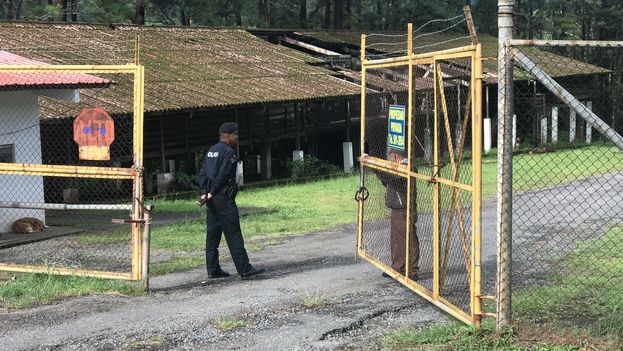
The migrants in Gualaca not only do not have permission to work, but they can only leave the camp one day a week to go to Western Union, with prior notice and accompanied by presidential police officers, who are guarding the site.
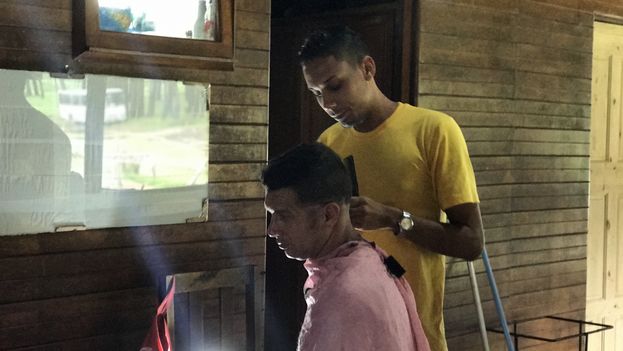
Some, however, have improvised coffee sales and even a barbershop. The locals also set up a small shop to supply the undocumented immigrants with the personal care products and treats, which they pay for with remittances sent by relatives from the United States.
Some migrants have taken the opportunity to develop their talents, such as this young man who set up a barber shop in the Gualaca camp. (14ymedio)
The authorities gave themselves 90 days to decide what they would do with the 126 Cubans who accepted the proposal to go to Gualaca. Two months later, the patience of the migrants is beginning to wear thin. At least six escapes have been reported since they were moved there. The last one, on Monday, was led by four Cubans, two of whom have already returned to the camp while two crossed the border into Costa Rica.
Since dawn, Alejandro Larrinaga, 13, and his parents have been waiting for some news about their fate. Surrounded by adults, Alejandro has only one other child to play in the hostel, Christian Estrada, 11. Neither has attended school for a year and a half, when they left Havana.
Alejandro spent more than 50 days in the jungle and, as a result of severe dehydration, he suffered epilepsy and convulsed several times. “It was difficult to go through it. It’s not easy to explain: it is one thing to tell it and another to live it,” he says with an intonation that makes him seem much more adult.
“We had to see dead people, lots of skulls. I was afraid of losing my mom and dad,” he recalls. But, although tears appear in the eyes of his mother while he recalls those moments, now he says he feels safe in Gualaca and spends his days playing chess.
“I want to be a chess master, which is more than a champion. Someday I will achieve it,” he says.
His mother, Addis Torres, does not want to return to the Island where she has nothing left because she sold their few belongings to be able to reunite with Alejandro’s grandfather, who lives in the United States. Although they have a process of family reunification pending at the US Embassy in Havana, the family does not want to hear about returning to Cuba.
They eat three times a day and even have a health program financed by the Panamanian government, but for Torres “that’s not life.”
“Detained, without a future, afraid to return to Cuba. We need someone to feel sorry for us and, in the worst case, to let us stay here,” she says.
Liuber Pérez Expósito is a guajiro from Velasco, a town in Holguín where he grew garlic and corn. After the legalization of self-employment by the Cuban government, Pérez began to engage in trade and intended to improve things by going to the US.
The presidential police and Panama Immigration officers guard the entrance of the camp Los Planes, Gualaca. (14ymedio)
In Gualaca he feels “desperate” to return to his homeland, but he has faith that, at least, he will get the help promised by the Panamanian Deputy Minister of Security, and leave a door open to engage in trade.
“I am here against what my family’s thinking. There (in Cuba) I have my wife, my nine-year-old son and my parents, they want me to come back and pressure me but I am waiting for the opportunity to at least recover some of the 5,000 dollars I spent,” he says.
His mother-in-law, an ophthalmologist who worked in Venezuela, lent him part of the money for the trip. Indebted, without money and without hope, he only thinks of the moment he can return.
“During the day we have nothing to do. Sometimes we play a little dominoes, we walk or we go to the stream, but we have 24 hours to think about how difficult this situation is and the failure we are experiencing,” he says.
Liuber communicates with his family through Imo, a popular videochat application for smartphones. “They recently installed Wi-Fi in Velasco and they call me whenever they can,” he adds.
“Hopefully, this nightmare we are living will end soon. Whatever happens, just let it end,” he says bitterly.
Many houses are empty and uninhabited because their owners have moved to other towns in search of greater economic development. (14ymedio)
14ymedio, Reinaldo Escobar, Florida, Cuba, 26 June 2017 — “The sea water cleans everything,” Agustin reflects as he calls out his merchandise. This 74-year-old forensic assistant now works renting inflatable boats for the fishermen of Playa Florida, in Camagüey, a coastal strip where tourists rarely come and the economic crisis is strongly felt.
“I came here to escape the odor of death, and I did,” jokes the worker, one of the few residents in the unpopulated streets on Friday. On every side many of the few houses that do not seem vacant exhibit a “for sale” sign. “All of Playa Florida is for sale but no one wants to buy it,” a resident jokes. continue reading
Lacking the natural beauty of the north coast, with no functioning industries and no important crops, the area is experiencing times of hardship that have worsened in recent years. On the entrance road, a rusted out anchor gives visitors a preview of the lethargy they will find here.
Only 24 miles separate the fishermen’s village from the municipal center, but it takes between four and six hours to cover the route due to the poor state of the road and the lack of public transport. On both sides of the road, the invasive marabou weed rises defiantly.
“Without tourists there is no money,” says Bururu, an informal realtor.
Lack communication characterizes the village. Nowhere among its crowded streets has a public telephone been installed and cell phones only manage to pick up a signal near the medical clinic, due to the poor coverage of the area.
The lack of mobility also sinks the area’s small businesses. The private restaurant Comida Criollo barely survives after being opened five years. Alfredo, the paladar’s chef, says that “from time to time a foreign tourist arrives.” People who “explore every corner with a map in hand,” but they are fewer and fewer.
Of the 4 million visitors who arrived in Cuba last year, only a few dozen came to this coast without white sands or crystal clear water, where to take a dip the bather must wear shoes to avoid the mud, stones and mangrove roots.
“Without tourists there is no money,” Bururu, an informal realtor, tells 14ymedio. The high number of homes for sale has caused a collapse of prices in the area. “A two-room house with a covered porch, cistern and garden can cost less than 1,000 CUC (roughly $1,000 US),” he says.
“People do not want to stay because there is nothing to do here”
“They put a jacuzzi in the bathroom and all the furniture inside is from the mall,” says Bururú while pointing to a newly painted building. The dealer takes his time to describe the characteristics of each house, hoping to make at least one sale.
“People do not want to stay because there is nothing to do here,” he explains to the 14ymedio. The man blames the stampede on the fact that “there are no recreational options and also nowhere to work”. “[The fishing] is not as good as in other places, so it gives you something to eat but not enough to make a living,” he emphasizes.
Near the coastline, a fisherman removes the scales from a sea bass he caught that morning. “I promised it to a family that wants to celebrate the birthday of their youngest son,” he tells a woman who inquires about the price of fish.
“The fishing is very affected since they built the embankment,” says the fisherman. “This area used to get a lot of oysters, but that has decreased a lot,” he adds.
The coast has also been affected by rising sea levels, to the extent that rumors of relocating the village have increased in recent years
The narrow and rugged access road divides the wetland in two and it has lost a part of the mangroves in its southern area. “Experts came here to research it and said that cutting the flow of water had increased the salinity and that is killing the mangroves.”
In 2009 the United Nations Small Grants Program provided more than $40,000 in funding for ecosystem recovery, but eight years later the damage has hardly been reversed. “The sea water has entered the river Mala Fama inland,” says the fisherman.
The coast has also been affected by rising sea levels, to the extent that rumors of relocating the village have increased in recent years. Wooden palisades are trying to slow down the push of the waves during hurricanes, but they seem like ridiculous chopsticks in the face of the immensity of the Caribbean.
The picture of deterioration is completed by the Argentina Campsite. where for months there has been neither electricity nor water. Julia, the guard who watches the entrance of the abandoned place, is categorical. “Here in Florida Beach, the only thing that is abundant is gnats and mosquitoes.”
In Cuba users connect through a Wi-Fi network in parks or at strategic points in their different cities. (EFE)
14ymedio, Yoani Sanchez, Havana, 25 June 2017 – More than five years ago social networks were roiled by the Arab Spring, while the screens of their mobile phones lit up the faces of the young protesters. In those years Twitter was seen as a road to freedom, but shortly afterwards the repressors also learned how to publish in 140 characters.
With a certain initial suspicion, and later with much opportunism, the populists have found in the internet a space to spread their promises and capture adherents. They use the incredible loudspeaker of the virtual world to set the snares of their demagoguery, with which they trap thousands of internet users.
The tools that once gave voice to the citizens have been transformed into a channel for the authoritarians to enthrone their discourses. They assimilated that, in these post-truth times, a tweet repeated ad nauseam is more effective than billboards along the side of the road or paying for advertising space. continue reading
Totalitarian regimes have gone on the offensive on the web. It took them some time to realize that they could use the same networks as their opponents, but now they launch the information police against their critics. And they do it with the same methodical precision with which for years they have surveilled dissidents and controlled the civil society of their nations.
Totalitarian regimes assimilated that, in these post-truth times, a tweet repeated ad nauseam is more effective than billboards along the side of the road
From the hacking of digital sites to the creation of false user profiles, the anti-democratic governments are trying everything to help them impose frameworks of opinion favorable to their management. They count on the irresponsible naivety with which content is often shared in cyberspace as a factor that works in their favor.
One of these radical about faces has been made by Turkish President Recep Tayyip Erdogan. During the 2013 protests, when he was prime minister, he wanted to enact several laws to restrict the use of Facebook and Twitter. He described the network of the little blue bird as “a permanent source of problems” and “a threat to society.”
However, during last year’s coup attempt in Turkey, Erdogan relied on these tools to summon people to the squares and to report on his personal situation. Since then he has dedicated himself to expanding his power through tweets, reaffirming in the virtual world the dictatorial drift of his regime.
Turkish President Recep Tayyip Erdogan has dedicated himself to expanding his power through tweets, reaffirming in the virtual world the dictatorial drift of his regime.
Last March, Twitter administrators had to admit that several of their accounts, some linked to institutions, organizations and personalities around the world, had been hacked with messages of support for Erdogan. The sultan urged his cyberhosts to make it clear that, even on the internet, he is not playing games.
In Latin America several cases reinforce the process of appropriation that authoritarianism has been making with the new technologies. Nicolás Maduro has opened on Twitter one of the many fronts of a battle through which he intends to stay in power and to quell the popular riots that erupted since the beginning of April.
Venezuelans not only must deal with economic instability and the violence of the police forces, but for many the internet has become a hostile territory where the chavistas shout and threaten with total impunity. They distort events, turn victimizers into victims and impose their own labels as they launch the blows.
The Miraflores Palace responds to images of protesters killed by the Bolivarian National Guard with hoaxes about an alleged international conspiracy to destroy chavismo. The social networks have taken up against the general prosecutor, Luisa Ortega Díaz, where Maduro’s supporters have branded her, at the very least, as a crazy person.
Nicolás Maduro has opened on Twitter one of the many fronts of a battle through which he intends to stay in power and to quell the popular riots that erupted since the beginning of April.
With so many attempts to manipulate trends and adulterate states of opinion on the web, Venezuelan officialdom has ended up getting caught with its fingers in the door. Recently, more than 180 Twitter accounts, which repeated government slogans like ventriloquists, were cancelled. The penalty could be extended to the accounts of other minions linked to government institutions and media.
Venezuelan Communications Minister Ernesto Villegas defined this suspension of accounts as an “ethnic cleansing” operation and Maduro threatened microblogging network administrators with a phrase fraught with outdated triumphalism: “If they close 1,000 accounts, we are going open 1,000 more.”
With his well-known verbal incontinence, Hugo Chavez’s successor was revealing the internet strategy that his regime has followed in recent years. That of planting users who confuse, lie and, above all, misrepresent what is happening in the country. A strategy taught to them by a close ally.
With his well-known verbal incontinence, Hugo Chavez’s successor revealed the regime’s internet strategy… confuse, lie and, above all, misrepresent what is happening in the country.
In Cuba, the soldiers of cyberspace have long experience in shooting down the reputations of digital opponents, blocking critical sites and unleashing the trolls to flood the comment areas of any posting that is especially annoying to them. But the main weapon is to limit internet access to their most reliable followers, and to maintain prohibitive prices for the majority.
“We have to tame the wild colt of new technologies,” said Ramiro Valdés, one of the Revolution’s historical commanders, when the first independent blogs and Twitter accounts managed by opponents began to surface.
Since then there has been a lot of water under the bridge and the Castro regime has launched an effort to conquer those spaces with the same intensity that it brings to its rants in international organizations. Its objective is to recover the space that it lost when it was suspicious of adopting new technologies. Its goal: to silence dissident voices with its hullabaloo.
The Castro regime’s goal: to silence dissident voices with its hullabaloo.
Even in the most long-standing democracies, technologies are being hijacked to inflict deadly blows on institutions.
In the White House, a man puts his country and the world at the edge of the abyss with every tweet he writes. Every night that Donald Trump goes to bed without publishing on that social network, millions of human beings breathe a sigh of relief. He has found in 140 characters a parallel way of governing, one with no limitations.
These are not the times of that liberating network that linked dissidents and served as the infrastructure for citizen rebellion. We are living in times when populism and authoritarianism have understood that new technologies can be converted into an instrument of control.
_______________
Editorial Note: This text has been previously published by the Spanish newspaper El País in its edition of Saturday, 24 June 2017.
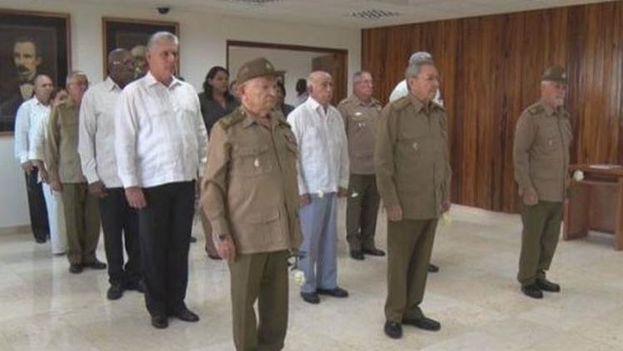
Members of the Revolutionary Armed Forces are present in all of Cuba’s power structures. (Prensa Latina)
14ymedio, Reinaldo Escobar, Havana, 20 June 2017 — The recent decision by the president of the United States to limit commercial relations with Cuban companies controlled by the military highlights a rarely explored corner of the national reality.
Anyone who knows the Island minimally knows that there is nothing like what can be called a “division of powers” here. It was demonstrated recently when the deputies to the National Assembly of People’s Power unanimously raised their hands to “back” some program documents from the Communist Party, documents that the deputies had no legal capacity to approve but politically could not disapprove.
In other countries, it is to be expected that Congress will oppose what the Executive has proposed or that the Judiciary will rule unconstitutional what a Parliament has approved. In most nations, when some measure, new policy, or any law is applied, analysts wonder how the unions will react or what the students are going to do. In Cuba it is not like that. Those who rule give the orders and the rest obey or go to jail. continue reading
The ostensible presence of individuals from the military sector in power structures, especially in economic management, may lead one to think that the army enriches itself this way and that having so many resources in its hands makes it easier for it to repress the people. This reasoning thus forms part of the belief that there is some kind of division of powers and that introduces a huge error in the analysis.
The presence of colonels and generals (retired or active) in charge of tourism companies such as Gaviota, or powerful consortiums such as Gaesa, Cimex and TRD among others, may not mean the militarization of the economy as much as it means the conversion, the metamorphosis, of soldiers into managers.
Devoid of or “healed” of an authentic “working-class spirit,” they handle with the iron fists of ruthless foremen – loyal to the boss – any dispute with the workers. Their habits of discipline lead them to do what they are ordered to do without asking if it is viable or absurd. They do not demand anything for themselves and anything that improves their standard of living or working conditions (modern cars, comfortable homes, trips abroad, food and beverage baskets…) will be considered as a favor from the boss, a privilege which can be paid for only with loyalty.
Although difficult to believe, they are not backed by their cannons or their tanks, their influence is not determined by the numbers of their troops or the firepower of the armaments they control, but by the confidence that Raúl Castro has in them. It is as simple as that.
When we review the extensive documentation issued by the different spheres of the outlawed political opposition, or by the officially unrecognized civil society, we can barely observe any protest against the dominance that the military has gained over the economy in the last decade.
Civil society’s priorities are different. The liberation of political prisoners, the cessation of repression, freedom of expression and association, the right to choose leaders in plural elections… In the area of economics, what is being questioned are the difficulties faced by private entrepreneurs in starting a business, limitations on access to the international market, excessive taxes, and the plunder to which the self-employed are subjected to by the inspectors.
The most perceptible concern in this sense is that placing these soldiers in key points of the economy is engineering the future economic empowerment of the ruling clans in a virtual piñata, which implies self-annihilation of the system by the heirs of power.
If it were not so dramatic it would be laughable to imagine the infinite solutions that the Cuban rulers have to circumvent “the new measures” announced by the president of the United States. All they have to do is change the name of the current monopolies and place civilian leaders in charge of supposed “second level cooperatives,” already foreseen in Guideline 15 from the 7th Congress of the Communist Party of Cuba.
This magic trick or, to use a Cubanism, “shuffling of the dominoes” would force the mammoth American bureaucracy to make a new inventory of entities with which trading is forbidden. “As the stick comes and goes,” they reorganize their forces while remaining at the helm of the country and watching Donald Trump’s term expire.
To perform this trick it will not be necessary to gather the Party together in a congress, nor to consult the constitutionalist lawyers, they would not even have to inform the Parliament. To make matters worse, in the streets there will be no protest against the chameleon gesture of the military exchanging their uniforms and their weapons for guayaberas or business cocktails.
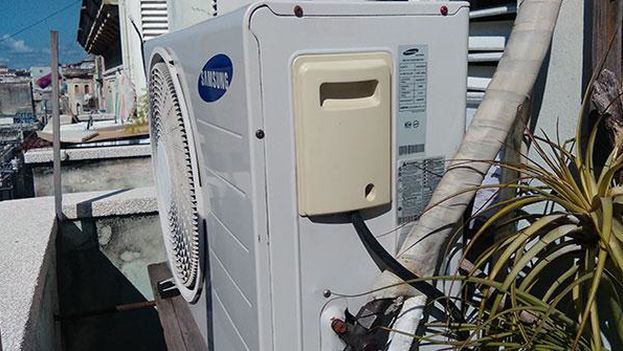
In recent years the supply of air conditioners in the informal market has increased considerably. (J. Cáceres)
14ymedio, Zunilda Mata, Havana, 20 June 2017 — The passenger complains of the heat while frantically moving the fan. “In a few days I will install an air conditioning,” justifies the taxi driver and adds that he will charge “higher fares.” In summer everyone dreams of air-conditioning their rooms or vehicles, but whether or not one suffers the heat depends on the pocketbook.
In 2013, after eight years of prohibition, the government authorized travelers to import air conditioners, electric stoves, refrigerators and microwave ovens. It was the starting shot for an avalanche that invades the airports, the port terminals and the shipping agencies to Cuba.
“Six ‘splits’ (air conditioners) came on that flight,” said an employee of Terminal 3 at José Martí International Airport in Havana. The plane from Cancun, a route greatly appreciated by the mules, also brought a dozen flat-screen TVs, eight minibars and two desktop computers. continue reading
Among the boxes that are piled around the luggage belt are the units that will be placed inside rooms and others that will be placed on a roof or an outer wall, a cruel irony, because in the main airport of the country travelers complain about the heat and drip fat beads of sweat while waiting for their suitcases.
“It is difficult to know the number of AC units entering each day,” says the employee. “It is rare that a flight arrives from Panama, Mexico or any other nearby country that comes without at least two devices.” In the lines to pay for overweight luggage and the import of domestic appliances one sees the new arrivals loaded with bundles.
Permanent residents in Cuba, national or foreign, can import two air conditioners of up to one-ton capacity on each trip. On the first occasion only – over the space of a year — they pay tariffs in Cuban pesos at a price ranging from 150 to 200 CUP (roughly $6 to $8 US). For additional imports they pay that amount in convertible pesos (CUC – roughly $150 to $200 US).
The business is booming. Even paying in CUC the traveler can resell a one-ton air conditioner on the black market for about 650 CUC, for a device that originally cost less than 350 dollars. The brands that enter most frequently are Midea, LG, Carrier, Royal, Daewoo and Prestiger. Prices have fallen by up to 30% since the imports were authorized and given the volume of supply that trend will continue.
State stores try to compete with the “under the counter” sales but have higher prices, fewer models and shortages that make the supply unstable.
The air conditioners have slowly been incorporated into the landscape of cities and towns. If before the economic relaxations they were installed discreetly, now with a more open economy the tendency is to exhibit them.
“The people living there have cash,” says Igor, a pedicab driver who waits for his clients in the vicinity of the Plaza de Carlos III. While pedaling and showing some parts of the city, the cyclist glances at these signs of families with money. “Wherever there is an air conditioner they are affluent,” he muses. Not only does acquiring one of these devices mark membership in a social group, the most difficult thing is to pay for its operation.
Much of the electricity supply remains subsidized. “The average monthly consumption in the residential sector in 2013 was approximately 180 KWh per customer,” said Marino Murillo. For that amount a consumer pays 36.60 CUP, “while the cost to the state is 220 CUP,” said Cuba’s vice president.
Keeping a one-ton air conditioner on all night can trigger electricity consumption above 400 CUP monthly, the entire salary of a professional. However, many families decide to do so, overwhelmed by the heat or because they want to rent rooms to foreigners.
“Air conditioning and hot water cannot be lacking in this business,” says Rocío, who operates a colonial hostel in Trinidad with his mother. With three rooms for rent, each with AC, minibar and television, the entrepreneurs pay a four-digit electricity bill. They consider that, even so, it “brings in business” in an area with a high occupation rate throughout the year.
In November 2010, a new progressive electricity rate began to be imposed, which imposes a penalty of up to 300% on households that consume more than 300 KWh per month, a situation that has triggered electricity fraud.
An engineer from the Electricity Company in Havana told 14ymedio about the new ways in which citizens seek to steal electricity. Before there were “visible” cables that were easy to detect or they tampered with the meters in a way that technicians noticed right away, but now they conspire with the workers who repair the streets and get the cables installed underground.
In 2013 the Cuban government authorized travelers to import air conditioners, electric stoves, refrigerators and microwaves. (J. Cáceres)
The specialist says that there are “people whose homes abut state entities and they steal electricity from a company, a warehouse, a carpentry workshop or even a polyclinic.” He says that almost always “it is a cases of people who have some highly customer-based business, like an electric oven to make pizzas, a body shop, a private restaurant or a lot of air conditioners.”
The engineer recalls a family in which “even the youngest children had AC in their room and left it on all day.” A neighbor reported the situation when he learned that they paid a very low electricity rate. The complaint brought the inspectors and they discovered that the meter was tampered with. In addition to the fine “they had to pay retroactively all that they owed.”
To counter fraud, analog meters were replaced by digital ones and in some areas of the country they are being changed again for new ones with infrared technology. But the tricks are inexhaustible.
“The upstairs neighbor lives alone and is retired, and he passes the cable with electricity to me and in return I also pay for his consumption,” says a prosperous entrepreneur who runs a coffee shop on Zanja Street. “So I share the consumption and it’s not as expensive” because it prevents all the kilowatts going on a single account with the consequent progressive surcharge.
The customer has three air conditioners installed throughout the house. “Without this you can not live here, because this house hardly has windows to the outside and the kitchen of the business generates a lot of heat,” he explains. He bought the devices in the informal market and is waiting for them “to lower prices a little” to buy a room.
“It is not the same to be Cuban with a fan as it is to be a Cuban with AC,” he reflects. “The first one is irritated but the second is less stressed because he has air conditioning.”
Independent guides show what the state-run companies leave out.
14ymedio, Marcelo Hernandez, Havana, 21 June 2017 — Economic hardships turn many Cuban engineers to work as bartenders, doctors become taxi drivers and innumerable professionals become alternative guides for tourists. Among the latter, there are the experienced or the just-getting-started, but all of them earn more money than they would working in the state sector.
“When they change a picture I know instantly,” says Natacha, a Havana city guide who says she has visited “the Museum of Fine Arts more than 300 times” with her clients. She graduated from the Teaching Institute but she left the classrooms after five years of teaching in junior high.
“I had to think about what to do with my life and I realized that I spoke Spanish very clearly, I knew the history of Cuba and I was good at dealing with people.” A friend advised her to start offering tours to foreigners who came to the country. continue reading
At first, Natacha stood in a corner of Old Havana and whispered her services to travelers. Now, after the relaxations regarding self-employment, she has been able to legalize part of her activities and form a team. “We have a network that includes rental houses, dance teachers, masseuses and chauffeurs,” she says.
With the increase in tourism, which last year exceeded 4 million visitors, the guide has “a surplus of work,” but now fears that after the announcements of US President Donald Trump that “the business will decline.”
Natacha accompanies her clients “to places where a state guide will never take them…The program is flexible according to their tastes: from exclusive areas to poor neighborhoods, trips in collective taxis, a train ride and a santería party.”
She speaks English and French fluently and recently began studying Italian and Japanese. “Japanese tourism is still small but they pay very well and are very respectful people,” says Natacha. Most of her clients end up recommending her services to a friend who wants to travel to Cuba. “This is a chain of trust that has allowed me to have up to 200 customers a year.”
The prices of a walk with the former teacher vary. “They can go from 20 to 100 CUC (roughly $20 to $100 US) depending on the place, the time and the complexity of the subject.” For years she included visits outside of Havana but now she has left these to her younger colleagues because her mother is very old and she doesn’t want to leave the city.
“This work is hard because it takes a lot of personal involvement, learning something new every day and answering many questions,” she explains. “I spend hours walking, most of the time under the sun, but I would not give up my independence by going back to teaching.” She says that being a tourist guide has allowed her to “put a plate of food on the table every day… a good plate of food.”
A growing alternative is digital sites that advertise independent guides and offer a wide variety of services or entertainment packages. Recently a team of 30-something Cuban residents in Miami launched Tour Republic, a website to sell recreational activities on the Island.
The site connects the traveler with urban guides with a marketplace – similar to Airbnb – but instead of offering lodging it markets tours of varied intensity and duration, from a ride in a classic car through Havana, to an escape through the unique natural landscape of the valley of Viñales.
Máximo, a 30-year-old Italian newcomer to Havana, was hesitant Tuesday about whether to buy a three-day package worth $58 including visits to the Ernest Hemingway Museum, the University of Havana, the old colonial fortresses of the capital, and even an encounter with the sculpture of John Lennon located in a Vedado park.
With Tour Republic the customer pays the online service and must be at the site where the itinerary begins at the agreed-upon time. In the case of the tour that interests Maximo, the guide is at the bottom of the steps of the Capitol and departs every morning at ten.
The tourist says he prefers an independent guide because “the program is more flexible and can be adjusted more” to what he wants. In a small notebook he has noted some interesting places that escape the typical tourist route: the town of San Antonio, the Superior Art Institute and the Alamar neighborhood.
“In this arena there are people very prepared and with excellent training,” says Carlos, an alternative guide who leaves the statue of José Martí in Central Park every morning for a tour he has baptized Habana Real. “I take them through the streets where tourists do not normally pass, I have them try a drink of rum in a bar where the Cubans really go,” he says.
The young man, with a degree in geography, has been “wearing out shoe leather in the city for seven years.” At first “I did not know much about history, architecture or famous people, but little by little I have become an itinerant encyclopedia of Cuba,” he says.
The GuruWalk platform has also risen to the crest of the wave of tourist interest in Cuba. The Spanish company runs an international website for free walking tours and has chosen Havana as their preferred site to begin operations.
Communications director, Pablo Perez-Manglano, told 14ymedio that “the platform is completely democratic, anyone can join and create a tour.” Site administrators check the offers one by one, but the reviews are left to users after each visit.
“We are an open and free platform, we do not charge the guide or the visitor anything, and therefore, we hope that each person understands and takes responsibility to comply, or not, with the legality in their respective cities of the world,” he clarifies.
The site already has seven free tours in Havana, one in Santiago and another in Santa Clara. “In addition, we had about 200 registered users in the last month, which is a lot for such a new platform,” says Pérez-Manglano.
Unlike Tour Republic there is nothing to pay online and the money is delivered directly to the guide.
The perspectives that the web offers for entrepreneurs like Natacha sound promising. GuruWalk does not deny “entry to someone for not having an official guide qualification.” Rather, it seeks “people who are passionate about culture and history, who also enjoy teaching and transmitting that knowledge.”
One of the strategies of the company is to make itself known among “the owners of private houses” because it is to them that more often the foreigners ask: “What should we see in the city?”
Pérez-Manglano underlines that the cornerstone of GuruWalk is the “collaborative economy.” Instead of “certificates, rules, rules, or permits,” they are interested in trust, which “is built little by little.”
The winter solstice (above) and the summer (below) seen from the newsroom. (14ymedio)
14ymedio, Generation Y, Yoani Sanchez, Havana, 21 June 2017 — It has been six months since a photo taken from 14ymedio’s newsroom, last 21 December, captured the moment when a reddish sun was about to sink into the longest night of the year. This Wednesday the image reflects the other extreme and the reporters of this newspaper look out over the day with the most light: the summer solstice.
From the municipality Diez de Octubre to Old Havana the restless star has traversed the landscape of our balcony. A brief route before the eyes, but incredibly transcendent for nature and life. Spring has ended in the northern hemisphere and the 93 days that summer “officially” lasts have begun, although the thermometers have us believing that we are already in the hottest season. continue reading
On this terrace it is impossible to ignore the resounding news that today, at noon, the sun will be at its highest point of the year and will illuminate us for the longest number of hours. In the southern hemisphere winter will begin and it will be the longest night. Meanwhile, in the street, life remains oblivious to how the stars place themselves above us.
The rainy season has also begun, although El Indio seems reluctant to cede prominence to the downpours and insists on mistreating with its rays the already affected Cuban landscape, which is suffering the most grueling drought in a century.
It is true that there will be scarcely any difference between today and tomorrow, that our spring is as close to the summer as one can imagine, and that the sun strikes equally in June as in August, but an avalanche of events has occurred in the six months since that other solstice. In December we were in a total diplomatic thaw with the United States and today we grind our teeth amid the political glaciation, led by President Donald Trump.
In half a year we have also had to say goodbye many times to the friends who have left, the official press has been filled with obituaries, and in our newsroom the gray hairs are sprouting and the impetus to report grows. I only wish that on this day, the longest of the year, the light will accompany us in both its real and metaphorical sense, and give us clarity to know what news is and what it is not; what sinks us and what saves us.
Hundreds of people gathered in the vicinity of the Manuel Artime Theater to show their disagreement with the change in policy toward Cuba. (14ymedio)
14ymedio, Reinaldo Escobar, Havana, 19 June 2017 – Over the weekend the official media have repeated ad nauseam the declaration of the government in response to Donald Trump’s speech about his policy toward Cuba. The declaration’s rhetoric recalls the years before the diplomatic thaw, when political propaganda revolved around confrontation with our neighbor to the north.
Beyond these words, many on the island are breathing a sigh of relief because the main steps taken by Barack Obama will not be reversed. The remittances on which so many families depend will not be cut, nor will the American Embassy in Havana be closed.
On the streets of Cuba, life continues its slow march, far from what was said at the Artime Theater in Miami and published by the Plaza of the Revolution. continue reading
Julia Borroto put a bottle of water in the freezer on Saturday to be ready for the line he expects to find waiting for him Monday outside the United States Embassy. This 73-year-old from Camagüey, who arrived in the capital just after Trump’s speech, remembers that Trump had said “he was going to put an end to the visas and travel, but I see that it isn’t so.”
The retiree also had another concern: the reactivation of the wet foot/dry foot policy eliminated by Obama last January. “I have two children who were plotting to go to sea. I just sent them a message to forget about it.”
The hopes of many frustrated rafters were counting on the magnate to restore the migratory privileges that Cubans enjoyed for more than two decades, but Trump defrauded them. Hundreds of migrants from the island who have been trapped in Central America on their way to the US were also waiting for that gesture that did not arrive.
Among the self-employed, concern is palpable. Homeowners who rent to tourists and private restaurant owners regret that the new policy will lead to a decline in American tourists on the island. The so-called yumas are highly desired in the private sector, especially for their generous tips.
Mary, who runs a lodging business in Old Havana, is worried. “Since the Americans began to come, I hardly have a day with empty rooms.” She had made plans on the basis of greater flexibilities and hoped “to open up more to tourism.”
On national television there is a flood of “indignant responses from the people” including no shortage of allusions to sovereignty, dignity and “the unwavering will to continue on the path despite difficulties.” The Castro regime is seizing the opportunity to reactivate the dormant propaganda machinery that had been missing its main protagonist: the enemy.
However, away from the official microphones people are indifferent or discontented with what happened. A pedicab driver swears not to know what they are talking about when he is asked about Friday’s announcements, and a retiree limits himself to commenting, “Those people who applaud Trump in Miami no longer remember when they were here standing in line for bread.”
Of the thirteen activists who met with Barack Obama during his trip to Havana, at least five expressed opinions to this newspaper about the importance of the new policy towards Cuba.
José Daniel Ferrer, leader of the Patriotic Union of Cuba (UNPACU), was at that table in March 2016 and was also mentioned on this occasion by Donald Trump during his speech. The activist had planned to be in Miami for the occasion, but at the airport in Holguin was denied exit and was subsequently arrested.
“It is the speech that had to be given and the person who could have avoided it is Raul Castro,” the former political prisoner asserts categorically. Ferrer believes that Obama did the right thing whenhe began a new era in relations between the two countries but “the Castro regime’s response was to bite the hand that was extended to it.”
In the opinion of the opposition leader, in the last 20 months repression has multiplied and “it was obvious that a different medicine had to be administered” because “a dictatorship like this should not be rewarded, it should be punished and more so when it was given the opportunity to improve its behavior and did not do so.”
Berta Soler, leader of the Ladies in White, was also prevented from flying to Miami to attend the event. For her, the words of the American president were clear and “if the Cuban regime accepts the conditions that Donald Trump has imposed on it, Cuba will begin to change.”
Soler believes that the Cuban government’s response is aimed at confusing the people, who “do not know exactly what is going on.” She says that Trump wants to maintain business with Cuba “but not with the military, but directly with the people,” something that the official press has not explained.
Opponent Manuel Cuesta Morúa, who manages the platform #Otro18 (Another 2018), is blunt and points out that “returning to failed policies is the best way to guarantee failure.” The measures announced by Trump, in his opinion, do not help the changes, and they once again give the Cuban government “the excuse to show its repressive nature.”
The dissident believes that the new policy tries to return the debate on democracy on the island to the scenario of conflict between Cuba and the United States, “just when it was beginning to refocus the national scenario on communication between the Cuban State and its citizens, which is where it needs to be.”
The director of the magazine Convivencia, Dagoberto Valdés, believes that there is a remarkable difference between the discourse itself “which seems a return to the past with the use of a language of confrontation, and the so-called concrete measures that have been taken.”
For Valdés there is no major reversal of Obama’s policy. “The trips of the Cuban Americans, the embassy, the remittances are maintained… and the possibility of a negotiating table remains open when the Cuban Government makes reforms related to human rights.”
Journalist Miriam Celaya predicted that the speech would not be “what the most radical in Miami and the so-called hard line of the Cuban opposition expected. What is coming is a process and it does not mean that from tomorrow no more Americans will come to the Island and that negotiations of all kinds are finished,” she says.
In her usual poignant style, she adds that “regardless of all the fanfare and the bells and whistles, regardless of how abundant the smiles, and no matter how much people laughed at Trump’s jokes, it doesn’t seem that the changes are going to be as promising as those who are proclaiming that it’s all over for the government.”
Celaya sheds light on the fact that the official statement of the Cuban government “manifests its intention to maintain dialogue and relations within the framework of respect.” This is a great difference with other times when a speech like that “would have provoked a ‘march of the fighting people’ and a military mobilization.”
Instead, officialdom has opted for declarations and revolutionary slogans in the national media. But in the streets, that rhetoric is just silent. “People are tired of all this history,” says a fisherman on the Havana Malecon. “There is no one who can fix it, but no one who can sink it.”
 14ymedio, Generation Y, Yoani Sanchez, Havana, 29 June 2017 — “Today we are going to practice writing a letter,” announced the fourth grade teacher at a school in the Plaza of the Revolution district in mid-June. Immediately, Lucia, age 9, thought about writing a letter to her grandmother telling her about her latest acrobatics on skates, but the recipient had already been decided. “You are going to write a letter addressed to Fidel Castro thanking him for a free education,” declared the educator.