The court orders Lithuania to pay 15,000 euros in compensation to the migrants from the island for moral damages
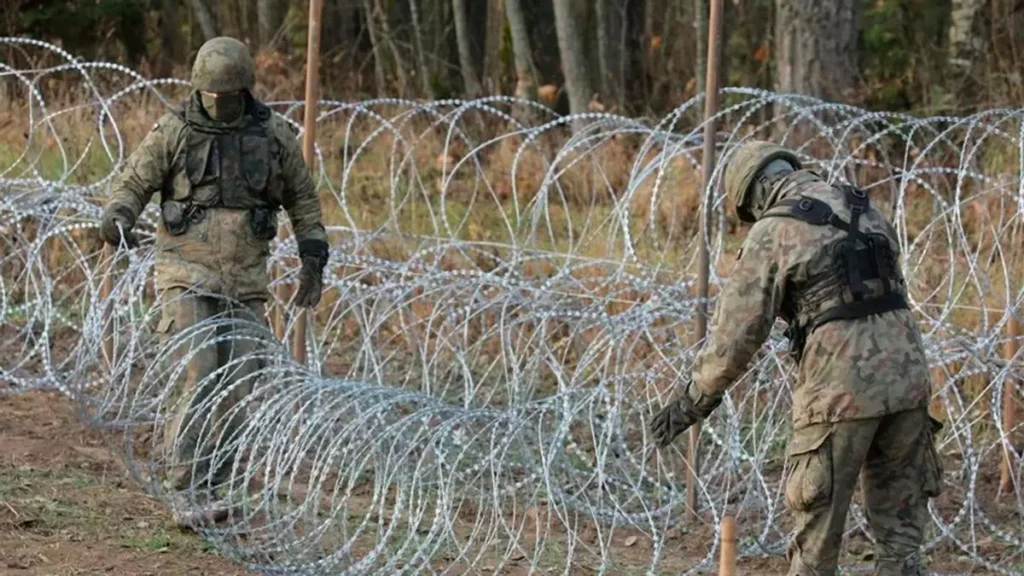
 14ymedio, Havana, November 25, 2026 / The European Court of Human Rights (ECHR), based in Strasbourg (France), has handed down three final judgments that allow migrants to be pushed back at borders when a neighboring state instrumentalizes migratory flows to destabilize another country. The rulings, relating to events that took place between 2021 and 2022 on the borders of Poland, Latvia and Lithuania with Belarus, include the case of four Cubans who left the island after the protests of July 11, 2021 (11J).
The ECHR ruling does not affect the current immigration status of Sonia Hernández, Carlos Cruz, Yarisledy Rodríguez and another woman who asked to keep her identity confidential, since they have asylum and permanent residence in Lithuania.
The lawsuit filed by the organization Pro Iura on behalf of the Cubans was partially dismissed, although financial compensation of 15,000 euros – compared with the 50,000 claimed – was approved for moral damages relating to the violation of Article 5 of the European Convention on Human Rights. By 11 votes to six, the judges concluded that Lithuania did not violate Article 3 of the European Convention on Human Rights by pushing them back to Belarus on six occasions.
In addition, the ECHR determined that the Cuban plaintiffs did not belong to a category of manifest vulnerability due to age, health or disability that would have required their pushback at the border to be halted. However, it did acknowledge that they were detained arbitrarily and unlawfully, without being adequately informed of the reasons for their deprivation of liberty or being guaranteed effective judicial review.
The court determined that the Cubans did not belong to a category of vulnerability due to age, health or disability that would have required their pushback to be halted
In an interview given last April to the French newspaper Le Monde, the Cubans said that during their journey they were trapped in a forest, exposed to the cold, hunger and abuse by the border guards of both countries.
According to their testimony, between March and April 2022 they tried several times to cross from Belarus into Lithuania and apply for international protection, but were turned away and sent back. On some occasions, they said, they were forced back at gunpoint, without being allowed access to an effective asylum procedure.
“I was so exhausted that I started hitting myself. They (the guards) laughed,” one of the Cuban women told the French newspaper last April.
On April 13, 2022, they finally managed to enter Lithuanian territory. They were detained and later granted asylum. Yarisledy Rodríguez, who was 21 at the time, currently lives in Vilnius, where she works for a catering company, according to the same newspaper.
The case is part of the migration crisis triggered by Belarus in 2021, when thousands of people, including migrants from Afghanistan, Iraq and Cuba, tried to reach European Union territory across its borders. The ECHR found it proven that the Minsk regime encouraged, facilitated or forced these movements with the aim of destabilizing its neighboring countries.
The case is part of the migration crisis triggered by Belarus in 2021, when thousands of people, including migrants from Afghanistan, Iraq and Cuba
The European Union described the strategy at the time as a form of “hybrid warfare,” in retaliation for the sanctions imposed on Belarusian President Alexander Lukashenko after the crackdown on the opposition protests of 2020.
The court’s interpretation has drawn criticism from human rights organizations. Amnesty International, which intervened as a third party in two of the three proceedings, described the rulings as “a devastating blow” to the legal protection of migrants and refugees at Europe’s borders.
Mandi Mudarikwa, the organization’s Head of Strategic Litigation, warned that the judgments shift onto the migrants themselves the burden of proving evident vulnerabilities or imminent risks, despite the absolute nature of the prohibition of torture. She also stressed that the instrumentalization of migration or emergency situations do not exempt states from their international obligations.
Translated by GH.
______________________
COLLABORATE WITH OUR WORK: The 14ymedio team is committed to practicing serious journalism that reflects Cuba’s reality in all its depth. Thank you for joining us on this long journey. We invite you to continue supporting us by becoming a member of 14ymedio now. Together we can continue transforming journalism in Cuba.