Díaz-Canel speaks of “progress,” but in some areas of Lawton, residents have gone up to seven weeks without water service.
 14ymedio, Madrid, November 20, 2026 – While Cubans endure an alarming water-supply crisis that forces them to collect rainwater, river water, water from leaks, or water from makeshift wells, and the business of selling gallons and water trucks flourishes through informal or private channels, sector authorities said Thursday that the official number of people affected in the capital has fallen to 255,000, compared with more than half a million just a few weeks ago.
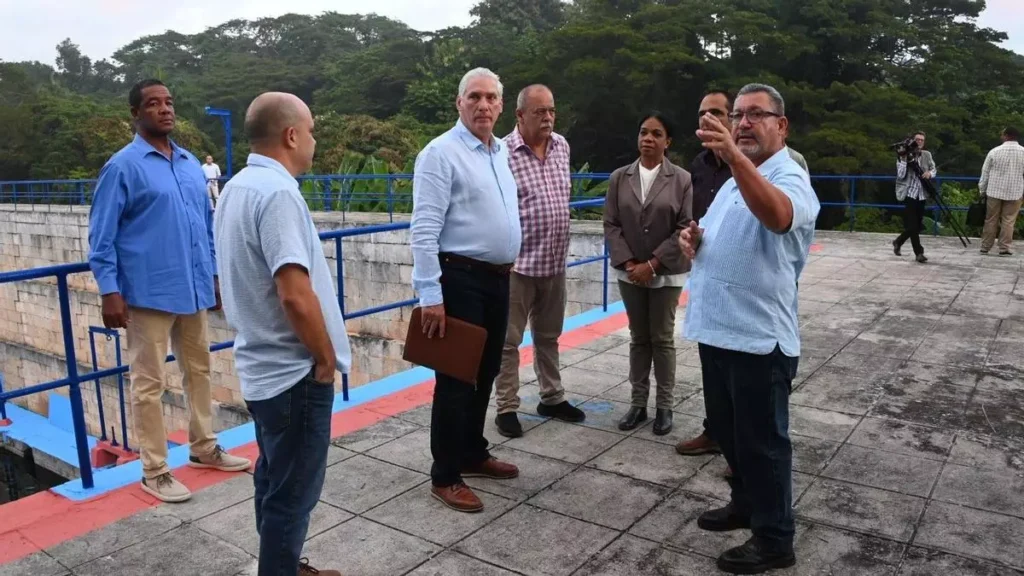
“Over these last ten days, I believe we have made progress on several fronts, but we must keep going,” Miguel Díaz-Canel said in his concluding remarks during a supervisory visit to the Taza de Vento, which is part of the Albear Aqueduct, in Boyeros, to “oversee progress” on the so-called Comprehensive Water Supply Assurance Program in Havana.
According to the state press, Díaz-Canel “inquired” about the hardest-hit areas, including municipalities in the capital “that have experienced particularly difficult situations,” such as Cotorro and Arroyo Naranjo, as well as the municipality of Manzanillo in Granma Province, where, officials claim, “the water-supply situation has been improving.”
Through this program, which Díaz-Canel says he has monitored weekly since September, the Government intends to ease the crisis in the capital and, more broadly, throughout the rest of the Island. As evidence of this progress, the first vice president of the National Institute of Hydraulic Resources, Toledo Tápanes, said that the number of people affected in the capital has fallen by almost half, from the 577,000 recorded when the program began, and expressed his belief “that it will continue to decline over the next 15 days.”
Toledo Tápanes said that the number of people affected in the capital has fallen by almost half, from the 577,000 recorded when the program began
Just two weeks ago, the figure the Government publicly acknowledged was approximately 536,000 people affected in Havana and more than 2.6 million nationwide, according to a statement by Antonio Rodríguez, president of the National Institute of Hydraulic Resources, alongside Díaz-Canel on the pro-government program Criterio Compartido [Shared Views]. At the time, the official explained that 66% of the disruptions were associated with electricity and 25% with pumping equipment.
On Thursday, during the visit to the Aqueduct, Tápanes said the reduction in the number of people affected had occurred thanks to “a process in which the electrical situation has been somewhat stabilized through the protection of water sources.”
The Albear Aqueduct – named after engineer Francisco de Albear, who designed it in the 19th century – transports water by gravity from the Vento springs to the Palatino reservoirs through an underground channel approximately ten kilometers long. According to Tápanes, who spoke on Thursday, work is now underway on general tasks involving the “complete rehabilitation of the system so that it can regain its original characteristics.”
The official explained some of this supposed progress: “The Vento well was restored here; there is a well here that pumps water directly; the pumping stations have been restored; La Taza has been restored to its original condition; and the tunnel is currently being rehabilitated.”
During the most difficult periods, questions go unanswered and, many times, water-supply schedules are announced that are subsequently not met
He also said that important pumping equipment is being replaced, that work is underway to install an additional unit at the El Gato water source, and that another is being prepared for Cuenca Sur. In addition, two new units are being prepared at the Aguada del Cura water source, all as part of the same Comprehensive Water Supply Assurance Program in Havana.
The same pro-government press published testimonies on Friday from residents of Diez de Octubre, where the lack of water particularly affects elderly people and the sick. A report by Cubadebate on Lawton describes communities that have gone months, and in one case seven consecutive weeks, without receiving a single drop of water. Because of the lack of supply, some families have had to seek water from nearby wells, which they cannot drink because of unsanitary conditions.
The report also acknowledges that private water trucks can cost as much as 50,000 pesos and recognizes the lack of institutional transparency: according to a local delegate, during the most difficult periods, questions go unanswered and, many times, water-supply schedules are announced that are subsequently not met, without any subsequent explanation. The delegate also describes how residents have emerged who resell water to people in higher-lying areas, along with private vehicles that distribute water in tanks in exchange for money.
This economy of thirst has been documented by 14ymedio in recent months. In Luyanó, a five-liter jug sells for 2,000 pesos, or 400 pesos per liter, while water vendors have accumulated waiting lists. The small and medium-sized enterprise A Granel, which was already selling imported U.S. fuel, has entered the water-delivery business, offering water trucks for $100 with immediate availability. Meanwhile, at the offices of Aguas de La Habana, people have to stand in line and offer money to an employee to obtain the same service.
The supply crisis stems from structural problems that Díaz-Canel recently acknowledged when he described it as “real, serious, and complex,” saying it could not be resolved with a speech or a single measure. Antonio Rodríguez, president of the National Institute of Hydraulic Resources, acknowledged that more than 40% of the water pumped is lost through deteriorated networks and pipelines, and that the main energy investments will not be completed until August 2027. In the meantime, the Cuban president continues to insist that the primary cause is the U.S. embargo.
Translated by Regina Anavy
______________________
COLLABORATE WITH OUR WORK: The 14ymedio team is committed to practicing serious journalism that reflects Cuba’s reality in all its depth. Thank you for joining us on this long journey. We invite you to continue supporting us by becoming a member of 14ymedio now. Together we can continue transforming journalism in Cuba.